From Surf Wiki (app.surf) — the open knowledge base
32nd century BC
One hundred years, from 3200 BC to 3101 BC
One hundred years, from 3200 BC to 3101 BC
The 32nd century BC was a century lasting from the year 3200 BC to 3101 BC.
Events
- c. 3190–3170 BC?: Reign of King Double Falcon of Lower Egypt. There is a strong possibility that he appears on the Palermo stone, although half his name is chipped away.
- c. 3195–3165 BC?: King Iry-Hor reigns from Abydos over most of Egypt.
- c. 3165–3141 BC: Reign of King Ka in Ancient Egypt.
- c. 3138 BC: Ljubljana Marshes Wheel is a wooden wheel that was found in the Ljubljana Marsh in Slovenia. Radiocarbon dating showed that it is approximately 5,150 years old, which makes it the oldest wooden wheel yet discovered.
- c. 3141–3121 BC: Reign of Scorpion II in Upper Egypt..
- c. 3121 BC?: Beginning of the reign of Narmer, first pharaoh to unify Ancient Egypt and founder of the 1st Dynasty.
- c. 3100 BC: The earliest phase of Stonehenge construction begins.
- c. 3100 BC?: Malta: Construction of the Ħaġar Qim megalithic temples, featuring both solar and lunar alignments. "Tarxien period" of megalithic temple construction reaches its apex.
- c. 3100 BC?: Sumerian cuneiform writing system
- c. 3100 BC?: Beginning of the Early Dynastic Period of Egypt, Horus was the main god worshiped in Upper Egypt, Neith was the main god worshiped in Lower Egypt.
- c. 3100 BC?: Crete: Rise of Minoan civilization.
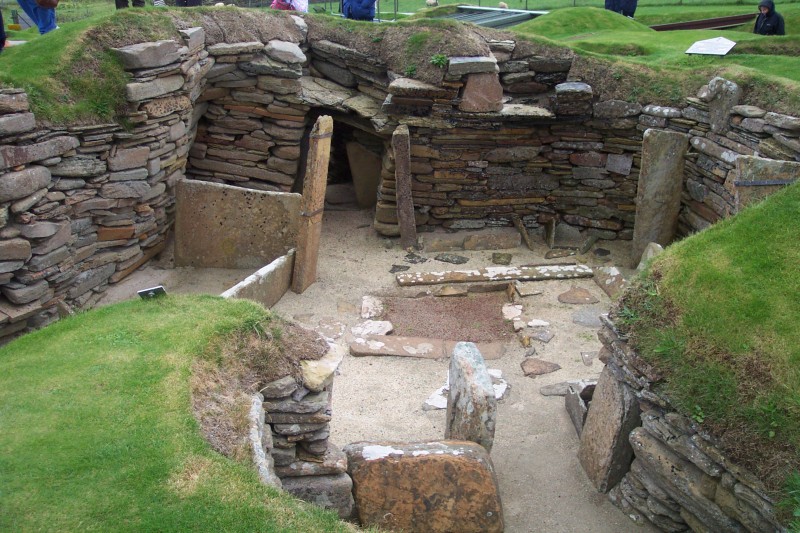
- c. 3100 BC?: Neolithic settlement built at Skara Brae in the Orkney Islands, Scotland (pictured).
- c. 3100 BC?: Earliest buildings at the Ness of Brodgar in the Orkney Islands constructed.
- c. 3100 BC?: Neolithic people in Ireland build the 250,000-ton (230,000-tonne) Newgrange solar-oriented passage tomb.
- c. 3105 BC?: Ötzi is shot and killed.
Calendar epochs
-
3114 BC: According to the most widely accepted correlations between the Western calendar and the calendar systems of pre-Columbian Mesoamerica, the mythical starting point of the Mesoamerican Long Count calendar cycle occurs in this year. The Long Count calendar, used and refined most notably by the Maya civilization but also attested in some other (earlier) Mesoamerican cultures, consisted of a series of interlocked cycles or periods of day-counts, which mapped out a linear sequence of days from a notional starting point. The system originated sometime in the Mid- to Late Preclassic period of Mesoamerican chronology, during the latter half of the 1st millennium BC. The starting point of the most commonly used highest-order cycle—the b'ak'tun-cycle consisting of thirteen b'ak'tuns of 144,000 days each—was projected back to an earlier, mythical date. This date is equivalent to 11 August 3114 BC in the proleptic Gregorian calendar (or 6 September in the proleptic Julian calendar), using the correlation known as the "Goodman-Martínez-Thompson (GMT) correlation". The GMT-correlation is worked out with the Long Count starting date equivalent to the Julian Day Number (JDN) equal to 584283, and is accepted by most Mayanist scholars as providing the best fit with the ethnohistorical data. Two succeeding dates, the 12th and 13 August (Gregorian) have also been supported, with the 13th (JDN = 584285, the "astronomical" or "Lounsbury" correlation) attracting significant support as according better with astronomical observational data. Although it is still contended which of these three dates forms the actual starting base of the Long Count, the correlation to one of this triad of dates is definitively accepted by almost all contemporary Mayanists. All other earlier or later correlation proposals are now discounted. The end of the thirteenth baktun was either on December 21 or 23 of 2012 (supposed end of the world).
-
3102 BC: According to Puranic sources, Krishna's death marked the start of Kali Yuga, which is dated to 17/18 February 3102 BCE. Lasting for 432,000 years (1,200 divine years), Kali Yuga began years ago and has years left as of CE. Kali Yuga will end in the year 428,899 CE.
Notes
Citations
References
References
- P. Tallet, D. Laisnay: ''Iry-Hor et Narmer au Sud-Sinaï (Ouadi 'Ameyra), un complément à la chronologie des expéditios minière égyptiene'', in: BIFAO 112 (2012), 381–395, [https://www.academia.edu/3844520/Iry-Hor_et_Narmer_au_Sud-Sinai_ouadi_Ameyra available online]
- Gasser, Aleksander. (March 2003). "World's Oldest Wheel Found in Slovenia". Government Communication Office of the Republic of Slovenia.
- "Writing".
- (2013). "The Incredible Age of the Find". [[South Tyrol Museum of Archaeology]].
- See Finley (2002), Houston (1989, pp. 49–51), Miller and Taube (1993, pp. 50–52), Schele and Freidel (1990, pp. 430 ''et seq.''), Voss (2006, p.138), Wagner (2006, pp. 281–283). Note that Houston 1989 mistakenly writes "3113 BC" (when "-3113" is meant), and Miller and Taube 1993's mention of "2 August" is a (presumed) erratum.
- Miller and Taube (1993, p. 50), Schele and Freidel (1990)
- Most commonly used in the Classic period [[Maya script. Maya inscriptions]]; some other [[Maya calendar]] inscriptions of this period note even longer cycles, while later Postclassic-era inscriptions in Maya cities of northern [[Yucatán Peninsula. Yucatán]] generally used an abbreviated form known as the Short Count. See Miller and Taube (1993, p. 50); Voss (2006, p. 138).
- See survey by Finley (2002).
- After a modified proposal championed by [[Floyd Lounsbury]]; sources that have used this 584285 correlation include Houston (1989, p. 51), and in particular Schele and Freidel (1990, pp. 430 ''et seq.''). See also commentary by Finley (2002), who although making an assessment that the "[584285 correlation] is now more popular with Mayanists", expresses a personal preference for the 584283 correlation.
- (1950). "Bhagavata Purana". [[Motilal Banarsidass.
- (1895). "The Vishnu Purana". S.P.C.K. Press.
- (1958). "The Brahmanda Purana". [[Motilal Banarsidass]].
- (1988). "The Vayu Purana". [[Motilal Banarsidass]].
- (1955). "Brahma Purana". [[Motilal Banarsidass]].
- (2003). "The Blackwell Companion to Hinduism". [[Blackwell Publishing]].
- (2011). "Atlantis and the Cycles of Time: Prophecies, Traditions, and Occult Revelations". [[Inner Traditions]].
- Merriam-Webster. (1999). "Merriam-Webster's Encyclopedia of World Religions". [[Merriam-Webster.
- (2010). "Units of Measurement: Past, Present and Future. International System of Units". [[Springer Publishing.
This article was imported from Wikipedia and is available under the Creative Commons Attribution-ShareAlike 4.0 License. Content has been adapted to SurfDoc format. Original contributors can be found on the article history page.
Ask Mako anything about 32nd century BC — get instant answers, deeper analysis, and related topics.
Research with MakoFree with your Surf account
Create a free account to save articles, ask Mako questions, and organize your research.
Sign up freeThis content may have been generated or modified by AI. CloudSurf Software LLC is not responsible for the accuracy, completeness, or reliability of AI-generated content. Always verify important information from primary sources.
Report