From Surf Wiki (app.surf) — the open knowledge base
Jack Nicholson
American actor and filmmaker (born 1937)
American actor and filmmaker (born 1937)
| Field | Value | ||
|---|---|---|---|
| name | Jack Nicholson | ||
| image | Jack Nicholson 2001.jpg | ||
| caption | Nicholson in 2001 | ||
| birthname | John Joseph Nicholson | ||
| birth_date | |||
| birth_place | Neptune City, New Jersey, U.S. | ||
| occupation | {{flatlist | ||
| years active | 1955–2010 | ||
| spouse | |||
| partner | {{plainlist | class=nowrap | |
| children | 6, including Lorraine and Ray | ||
| works | Filmography | ||
| awards | Full list | ||
| signature | Jack Nicholson Signature.png |
- Actor
- filmmaker
- Anjelica Huston (1973–1990)
- Rebecca Broussard (1989–1994)
- Lara Flynn Boyle (1999–2004)
John Joseph Nicholson (born April 22, 1937) is an American actor and filmmaker. Nicholson is widely regarded as one of the greatest actors of the 20th century, often playing charismatic rebels fighting against the social structure. Over his five-decade-long career, he received numerous accolades, including three Academy Awards, three British Academy Film Awards, six Golden Globe Awards, and a Grammy Award.
Nicholson won Academy Awards for Best Actor for playing Randle McMurphy in One Flew Over the Cuckoo's Nest (1975) and an author with OCD in As Good as It Gets (1997), as well as for Best Supporting Actor for playing an aging playboy in Terms of Endearment (1983). He received further Oscar nominations for Easy Rider (1969), Five Easy Pieces (1970), The Last Detail (1973), Chinatown (1974), Reds (1981), Prizzi's Honor (1985), Ironweed (1987), A Few Good Men (1992), and About Schmidt (2002).
Nicholson made his film debut in Roger Corman's The Cry Baby Killer (1958). His other notable roles were in Psych-Out (1968), Carnal Knowledge (1971), The King of Marvin Gardens (1972), The Passenger (1975), The Missouri Breaks (1976), The Shining (1980), Broadcast News (1987), Batman (1989), Hoffa (1992), Mars Attacks! (1996), Anger Management, Something's Gotta Give (both 2003), The Departed (2006), and The Bucket List (2007). He also had a cameo in Corman's cult classic The Little Shop of Horrors (1960), which has been heavily promoted on home video releases. As a director, Nicholson has helmed three films: Drive, He Said (1971), Goin' South (1978), and The Two Jakes (1990). Nicholson has also written several films, including The Monkees' vehicle Head (1968). He took a break from acting after starring in How Do You Know (2010).
Nicholson is one of three male actors to win three Academy Awards and one of only two actors to be nominated for an Academy Award for acting in films made in every decade from the 1960s to the 2000s (the other is Michael Caine). His 12 Academy Award nominations make him the most nominated male actor in the Academy's history. He was honored with the AFI Life Achievement Award in 1994, the Cecil B. DeMille Award in 1999 and the Kennedy Center Honor in 2001.
Early life and education
John Joseph Nicholson was born on April 22, 1937, in Neptune City, New Jersey, the son of a showgirl, June Frances Nicholson (stage name June Nilson; 1918–1963). Nicholson's mother was of Irish, English, German, and Welsh descent. Nicholson has identified as Irish, comparing himself to the playwright Eugene O'Neill, whom he played in the film Reds (1981): "I'm not saying I'm as dark as he was ... but I am a writer, I am Irish, I have had problems with my family." His mother married Italian-American showman Donald Furcillo (stage name Donald Rose; 1909–1997) in 1936, before realizing that he was already married. Biographer Patrick McGilligan stated in his book Jack's Life that Latvian-born Eddie King (originally Edgar A. Kirschfeld), June's manager, may have been Nicholson's biological father, rather than Furcillo. Other sources suggest June Nicholson was unsure of the father's identity.
As June was only 17 and unmarried, her parents agreed to raise Nicholson as their own child without revealing his true parentage, with June acting as his sister. In 1974, Time magazine researchers learned, and informed Nicholson, that his "sister", June, was actually his mother, and his other "sister", Lorraine, was really his aunt. By this time, both his mother and grandmother had died (in 1963 and 1970, respectively). On finding out, Nicholson said it was "a pretty dramatic event, but it wasn't what I'd call traumatizing ... I was pretty well psychologically formed".
Nicholson grew up in Neptune City, New Jersey.Before starting high school, his family moved to an apartment in Spring Lake, New Jersey. "Nick", as he was known to his high school friends, attended nearby Manasquan High School, where he was voted "Class Clown" by the Class of 1954. He was in detention every day for a whole school year. A theatre and a drama award at the school are named in his honor. In 2004, Nicholson attended his 50-year high school reunion accompanied by his aunt Lorraine.
Military service
In 1957, Nicholson joined the California Air National Guard, a move he sometimes characterized as an effort to "dodge the draft"; the Korean War era's Military Selective Service Act was still in force, and draftees were required to perform up to two years of active duty. After completing the Air Force's basic training at Lackland Air Force Base, Nicholson performed weekend drills and two-week annual training as a firefighter assigned to the unit based at the Van Nuys Airport. During the Berlin Crisis of 1961, Nicholson was called up for several months of extended active duty, and he was discharged at the end of his enlistment in 1962.
Career
1958–1969: Early roles and breakthrough
Nicholson first came to California in 1950, when he was 13, to visit his sister. He took a job as an office worker for animation directors William Hanna and Joseph Barbera at the MGM cartoon studio. They offered him an entry-level job as an animator, but he declined, citing his desire to become an actor. While accepting the Cecil B. DeMille Award at the 56th Golden Globe Awards, he recalled that his first day as a working actor (on Tales of Wells Fargo) was May 5, 1955, which he considered lucky, as 5 was the jersey number of his boyhood idol, Joe DiMaggio. He trained to be an actor with a group called the Players Ring Theater, after which he found small parts performing on the stage and in TV soap operas. He made his film debut in a low-budget teen drama The Cry Baby Killer (1958), playing the title role. For the next decade, Nicholson frequently collaborated with the film's producer, Roger Corman. Corman directed Nicholson on several occasions, such as in The Little Shop of Horrors as undertaker (and masochistic dental patient) Wilbur Force; in The Raven; The Terror, where he plays a French officer seduced by an evil ghost; and The St. Valentine's Day Massacre. Nicholson frequently worked with director Monte Hellman on low-budget westerns; two of them—Ride in the Whirlwind and The Shooting—initially failed to interest U.S. film distributors but gained cult success on the French art-house circuit and were later sold to television. Nicholson also appeared in two episodes of The Andy Griffith Show, and starred as a rebellious dirt-track race driver in the 1960 film The Wild Ride.
With his acting career foundering, Nicholson seemed resigned to a career behind the camera as a writer/director. His first real taste of writing success was the screenplay for the 1967 counterculture film The Trip (directed by Corman), starring Peter Fonda and Dennis Hopper. After first reading the script, Fonda told Nicholson he was impressed by the writing and felt it could become a great film. But Fonda was disappointed with how the film turned out and blamed the editing for turning it into a "predictable" film and said so publicly. "I was livid", he recalls. Nicholson also co-wrote, with Bob Rafelson, the movie Head, which starred The Monkees, and arranged the movie's soundtrack.
Nicholson's first big acting break came when a role opened up in Fonda and Hopper's Easy Rider (1969). He played alcoholic lawyer George Hanson, for which he received his first Oscar nomination. The film cost only $400,000 to make, and became a blockbuster, grossing $60 million. Biographer John Parker writes that Nicholson's interpretation of his role placed him in the company of earlier antihero actors, such as James Cagney and Humphrey Bogart, while promoting him into an "overnight number-one hero of the counter-culture movement". The part was a lucky break for Nicholson. The role had been written for Rip Torn, who withdrew from the project after an argument with Hopper. Nicholson later acknowledged the importance of being cast in Easy Rider: "All I could see in the early films, before Easy Rider, was this desperate young actor trying to vault out of the screen and create a movie career." Stanley Kubrick, who was impressed by his performance in Easy Rider, cast Nicholson as Napoleon in a film about his life, and although production on the film commenced, the project fizzled out, partly due to a change in ownership at MGM.
1970–1989: Stardom and acclaim
In 1970, Nicholson starred in Five Easy Pieces alongside Karen Black in what became his persona-defining role. Nicholson and Black were nominated for Academy Awards for their performances. Nicholson played Bobby Dupea, an oil rig worker, and Black played his waitress girlfriend. Black noted that Nicholson's character in the film was very subdued and very different from Nicholson's real personality. She said that the now-infamous restaurant scene was partly improvised by Nicholson, and was out of character for Bobby, who would not have cared enough to argue with a waitress. "I think that Jack really has very little in common with Bobby. I think Bobby has given up looking for love. But Jack hasn't, he's very interested in love, in finding out things. Jack is a very curious, alive human being. Always ready for a new idea." Nicholson himself said as much, telling an interviewer, "I like listening to everybody. This to me is the elixir of life."
Black later admitted that she had a crush on Nicholson from the time they met, although they dated only briefly. "He was very beautiful. He just looked right at you ... I liked him a lot ... He really sort of wanted to date me but I didn't think of him that way because I was going with Peter Kastner ... Then I went to do Easy Rider, but didn't see him because we didn't have any scenes together ... At the premiere, I saw him out in the lobby afterward and I started crying ... He didn't understand that, but what it was was that I really loved him a lot, and I didn't know it until I saw him again, because it all welled up."
Within a month after its release that September, Five Easy Pieces became a blockbuster, making Nicholson a leading man and the "new American anti-hero", according to McDougal. Critics began speculating as to whether he might become another Marlon Brando or James Dean. His career and income skyrocketed. He said, "I have [become] much sought after. Your name becomes a brand image like a product. You become Campbell's soup, with thirty-one different varieties of roles you can play."He told his new agent, Sandy Bresler, to find him unusual roles so he could stretch his acting skill: "I like to play people that haven't existed yet, a 'cusp character, he said, "I have that creative yearning. Much in the way Chagall flies figures into the air: once it becomes part of the conventional wisdom, it doesn't seem particularly adventurous or weird or wild."
Also in 1970, Nicholson appeared in the film adaptation of On a Clear Day You Can See Forever, although most of his performance was left on the cutting room floor. His agent turned down a starring role in Deliverance when the film's producer and director, John Boorman, refused to pay what Nicholson's agent wanted.In 1971, Nicholson starred in Carnal Knowledge, a comedy-drama directed by Mike Nichols and co-starring Art Garfunkel, Ann-Margret, and Candice Bergen. He was nominated for a Golden Globe Award for Best Actor. Nichols felt few actors could handle the role, saying, "There is James Cagney, Spencer Tracy, Humphrey Bogart, and Henry Fonda. After that, who is there but Jack Nicholson?" During the filming, Nicholson struck up what became a lifelong friendship with Garfunkel. When he visited Los Angeles, Garfunkel stayed at Nicholson's home in a room Nicholson jokingly called "the Arthur Garfunkel Suite".
Other Nicholson roles included Hal Ashby's The Last Detail (1973), with Randy Quaid, for which Nicholson won Best Actor at the Cannes Film Festival and was nominated for his third Oscar and a Golden Globe. Television journalist David Gilmour writes that one of his favorite Nicholson scenes from all his films was the often censored one in this film, when Nicholson slaps his gun on the bar yelling he was the Shore Patrol. Critic Roger Ebert called it a very good movie, but credited Nicholson's acting as the main reason: "He creates a character so complete and so complex that we stop thinking about the movie and just watch to see what he'll do next." In 1974, Nicholson starred in Roman Polanski's noir thriller Chinatown, and was again nominated for the Academy Award for Best Actor for his role as Jake Gittes, a private detective. The film co-starred Faye Dunaway and John Huston, and included a cameo role with Polanski. Ebert called Nicholson's portrayal sharp-edged, menacing, and aggressive, a character who knew "how to go over the top", as he did in One Flew Over the Cuckoo's Nest. That edge kept Chinatown from becoming a typical genre crime film. Ebert also notes the importance of the role for Nicholson's career, seeing it as a major transition from the exploitation films of the previous decade. "As Jake Gittes, he stepped into Bogart's shoes", says Ebert. "As a man attractive to audiences because he suggests both comfort and danger ... From Gittes forward, Nicholson created the persona of a man who had seen it all and was still capable of being wickedly amused."
Nicholson had been friends with Polanski long before the murder of Polanski's wife, Sharon Tate, by the Manson Family, and supported him in the days following her death. After Tate's death, Nicholson began sleeping with a hammer under his pillow and took breaks from work to attend Manson's trial.
In 1977, three years after Chinatown, Polanski was arrested at Nicholson's home for the sexual assault of 13-year-old Samantha Geimer, who was modeling for Polanski during a magazine photo shoot around the pool. At the time, Nicholson was out of town making a film, but his steady girlfriend, actress Anjelica Huston, had dropped by unannounced to pick up some items. She heard Polanski in the other room say, "We'll be right out." Polanski then came out with Geimer and introduced her to Huston, and they chatted about Nicholson's two large dogs, which were sitting nearby. Huston recalled Geimer was wearing platform heels and appeared quite tall. After a few minutes of talking, Polanski had packed up his camera gear and Huston saw them drive off in his car. Huston told police the next day, after Polanski was arrested, that she "had witnessed nothing untoward" and never saw them together in the other room.
Geimer learned afterward that Huston herself was not supposed to be at Nicholson's house that day, since they had recently broken up, but stopped over to pick up some belongings. Geimer described Nicholson's house as "definitely" a guy's house, with lots of wood and shelves crowded with photos and mementos.
One of Nicholson's successes came in 1975, with his role as Randle P. McMurphy in One Flew Over the Cuckoo's Nest. The movie was an adaptation of Ken Kesey's novel of the same name, and was directed by Miloš Forman and co-produced by Michael Douglas. Nicholson plays an anti-authoritarian patient at a mental hospital where he becomes an inspiring leader for the other patients. Playing one of the patients was Danny DeVito in an early role. Nicholson learned afterward that DeVito grew up in the same area of New Jersey, and they knew many of the same people. The film received nine nominations at the Academy Awards, and won five, including Nicholson's first for Best Actor. The role seemed perfect for Nicholson, with biographer Ken Burke noting that his "smartass demeanor balances his genuine concern for the treatment of his fellow patients with his independent spirit too free to exist in a repressive social structure". Forman allowed Nicholson to improvise throughout the film, including most of the group therapy sequences. Reviewer Marie Brenner notes that his bravura performance "transcends the screen" and continually inspires the other actors by lightening their mental illnesses with his comic dialogue.
Also in 1975, Nicholson starred in Michelangelo Antonioni's The Passenger (1975), which co-starred Maria Schneider. Nicholson plays a journalist, David Locke, who during an assignment in North Africa decides to quit journalism and disappear by taking on a new hidden identity. Unfortunately, the dead person whose identity he takes on turns out to have been a weapons smuggler on the run. Antonioni's unusual plot included convincing dialogue and fine acting, states film critic Seymour Chatman. It was shot in Algeria, Spain, Germany, and England. The film received good reviews and revived Antonioni's reputation as a great director. He said he wanted the film to have more of a "spy feeling [and] be more political". Nicholson began shooting the film from an unfinished script, notes Judith Crist, yet upon its completion he thought so highly of the film that he bought the world rights and recorded a reminiscence of working with Antonioni.
Critic and screenwriter Penelope Gilliatt provides an overview of Nicholson's role, "The Passenger is an unidealized portrait of a drained man whose one remaining stimulus is to push his luck. Again and again, in the movie, we watch him court danger. It interests him to walk the edge of risk. He does it with passivity as if he were taking part in an expressionless game of double-dare with life. Jack Nicholson's performance is a wonder of insight. How to animate a personality that is barely there.
.jpg)
Nicholson continued to take more unusual roles. He took a small role in The Last Tycoon opposite Robert De Niro. He took a less sympathetic role in Arthur Penn's western The Missouri Breaks (1976), specifically to work with Marlon Brando. Nicholson was especially inspired by Brando's acting ability, recalling that in his youth, as an assistant manager at a theater, he watched On the Waterfront about 40 times. He once stated, "Marlon Brando influenced me strongly. Today, it's hard for people who weren't there to realize the impact that Brando had on an audience. ... He's always been the patron saint of actors". "I'm part of the first generation that idolized Marlon Brando", he said.
Nicholson has observed that while both De Niro and Brando were noted for their skill as method actors, he himself has seldom been described as one, a fact he sees as an accomplishment: "I'm still fooling them", he told Sean Penn. "I consider it an accomplishment because there's probably no one who understands Method acting better academically than I do—or actually uses it more in his work. But it's funny, nobody really sees that. It's perception versus reality, I guess."
Although he garnered no Academy Award for Stanley Kubrick's adaptation of Stephen King's The Shining (1980), his role in the film as writer Jack Torrance remains one of his more significant. He was Kubrick's first choice to play the role, although the book's author, Stephen King, wanted more of an "everyman". Kubrick won the argument and called Nicholson's acting "on a par with the greatest stars of the past, like Spencer Tracy and Jimmy Cagney". In preparation for the role, Nicholson drew upon his own experiences as a writer and slept short hours to help remain in an agitated state during the shoot. His co-star Shelley Duvall recalled that she and Nicholson spent many hours discussing their characters, with Nicholson maintaining that his character be cold to her from the start. On the set, Nicholson always appeared in character and if Kubrick felt confident that Nicholson knew his lines well enough, he encouraged him to improvise beyond the script. For example, Nicholson improvised his now-famous "Here's Johnny!" line, along with a scene in which he unleashes his anger on his wife when she interrupts his work. There were also extensive takes of scenes, due to Kubrick's perfectionism. Nicholson shot a scene with the ghostly bartender 36 times. He said, "Stanley's demanding. He'll do a scene fifty times, and you have to be good to do that."

In 1982, Nicholson starred as an immigration enforcement agent in The Border, directed by Tony Richardson. It co-starred Warren Oates, who played a corrupt border official. Richardson wanted Nicholson to play his role less expressively than he had in his earlier roles. "Less is more", he told him, and wanted him to wear reflecting sunglasses to portray what patrolmen wore. Richardson recalled that Nicholson worked hard on the set:
Nicholson won his second Oscar, an Academy Award for Best Supporting Actor, for his role of retired astronaut Garrett Breedlove in Terms of Endearment (1983), directed by James L. Brooks. It starred Shirley MacLaine and Debra Winger. McGilligan claims it was one of Nicholson's most complex and unforgettable characters. He and MacLaine played many of their scenes in different ways, constantly testing and making adjustments. Their scenes together gave the film its "buoyant edge", states McGilligan, and describes Nicholson's acting as "Jack floating like a butterfly".
Nicholson continued to work prolifically in the 1980s, starring in such films as: The Postman Always Rings Twice (1981); Reds (1981), where Nicholson portrays the writer Eugene O'Neill with a quiet intensity; Prizzi's Honor (1985); Heartburn (1986); The Witches of Eastwick (1987); Broadcast News (1987); and Ironweed (1987). Three Oscar nominations also followed (Reds, Prizzi's Honor, and Ironweed). John Huston, who directed Prizzi's Honor, said of Nicholson's acting, "He just illuminates the book. He impressed me in one scene after another; the movie is composed largely of first takes with him." In the 1989 Batman movie, Nicholson played the psychotic villain, the Joker. The film was an international smash hit, and a lucrative deal earned him a percentage of the box office gross estimated at $60 million to $90 million. Nicholson said that he was "particularly proud" of his performance as the Joker: "I considered it a piece of pop art", he said.
1990–1999: Established actor
For his role as hot-headed Col. Nathan R. Jessup in A Few Good Men (1992), a movie about a murder in a U.S. Marine Corps unit, Nicholson received yet another Academy Award nomination for Best Supporting Actor. One review describes his performance as "spellbinding", adding that he portrayed "the essence of the quintessential military mindset". Critic David Thomson notes that Nicholson's character "blazed and roared". The film's director, Rob Reiner, recalls how Nicholson's level of acting experience affected the other actors during rehearsals: "I had the luck of having Jack Nicholson there. He knows what he's doing, and he comes to play, every time out, full-out performance! And what it says to a lot of the other actors is, 'Oooooh, I better get on my game here because this guy's coming to play! So I can't hold back; I've got to come up to him.' He sets the tone."
In 1996, Nicholson collaborated once more with Batman director Tim Burton on Mars Attacks!, pulling double duty as two contrasting characters, President James Dale and Las Vegas property developer Art Land. Not all of Nicholson's performances have been well received. He was nominated for Razzie Awards as worst actor for Man Trouble (1992) and Hoffa (1992). But his performance in Hoffa also earned him a Golden Globe nomination. David Thomson states that the film was terribly neglected, since Nicholson portrayed one of his best screen characters, someone who is "snarly, dumb, smart, noble, rascally—all the parts of 'Jack'". Roger Ebert also praised his performance writing, "Nicholson is an actor who can reflect almost anything in his face. One reason his performance is so good as Hoffa is that he reveals almost nothing."

Nicholson won his next Academy Award for Best Actor in the romantic comedy As Good as It Gets (1997), his third film directed by James L. Brooks. He played Melvin Udall, a "wickedly funny", mean-spirited novelist with obsessive-compulsive disorder. "I'm a studio Method actor", he said. "So I was prone to give some kind of clinical presentation of the disorder." His Oscar was matched by the Academy Award for Best Actress for Helen Hunt, who played a Manhattan single mother drawn into a love/hate friendship with Udall, a frequent diner in the restaurant where she works as a waitress. The film was a box-office success, grossing $314 million, making it Nicholson's second-best-grossing film, after Batman. The win was Nicholson's third Academy Award, tying him with six other actors, Walter Brennan, Ingrid Bergman, Meryl Streep, Daniel Day-Lewis, and Frances McDormand who all have three acting Oscars.
Nicholson admits he initially disliked playing a middle-aged man alongside a much younger Hunt, seeing it as a movie cliché. "But Helen disarmed that at the first meeting", he says, "and I stopped thinking about it." They got along well during the filming, with Hunt saying that he "treated me like a queen", and they connected immediately: "It wasn't even what we said", she said. "It was just some frequency we both could tune into that was very, very compatible." Critic Jack Mathews of Newsday said Nicholson was "in rare form", adding, "it's one of those performances that make you aware how much fun the actor is having". Author and screenwriter Andrew Horton describes their on-screen relationship as being like "fire and ice, oil and water—seemingly complete opposites".
2000–present: Later roles and extended break
In 2001, Nicholson was the first actor to receive the Stanislavsky Award at the 23rd Moscow International Film Festival for "conquering the heights of acting and faithfulness". That same year Nicholson starred in The Pledge, a mystery drama where he portrays retired police detective Jerry Black, who vows to find a murderer of a young girl. Nicholson was praised for his performance; Bob Graham of the San Francisco Chronicle called it "deeply felt" compared to some of Nicholson's other films. Nicholson was one of several celebrities who participated in a telethon shortly after the September 11th attacks. Nicholson acted in Alexander Payne's comedy-drama About Schmidt (2002), playing a retired Nebraska actuary who questions his own life after his wife dies. His quietly restrained performance earned him nominations for an Academy Award, BAFTA Award, Golden Globe Award and Screen Actors Guild Award for Best Actor. In Anger Management (2003), he played an aggressive therapist assigned to help an overly pacifist man (portrayed by Adam Sandler).
In 2003, Nicholson also starred in the Nancy Meyers directed romantic comedy Something's Gotta Give playing an aging playboy who falls for the mother (Diane Keaton) of his young girlfriend. For his performance he was nominated for the Golden Globe Award for Best Actor – Motion Picture Musical or Comedy. In late 2006, Nicholson marked his return to the dark side in Martin Scorsese's Oscar-winning film The Departed, a remake of Andrew Lau's Infernal Affairs, playing Frank Costello, a nefarious Boston Irish Mob boss based on Whitey Bulger, who was still on the run at the time. The role earned Nicholson worldwide critical praise, along with various awards and nominations, including a Golden Globe Award for Best Supporting Actor - Motion Picture nomination. In 2007, Nicholson co-starred with Morgan Freeman in Rob Reiner's The Bucket List, in which Nicholson and Freeman portrayed dying men who fulfill their list of goals. In researching the role, Nicholson visited a Los Angeles hospital to see how cancer patients coped with their illnesses.
Nicholson's next film role saw him reunite with James L. Brooks, director of Terms of Endearment, Broadcast News and As Good as It Gets, for a supporting role for the 2010 film How Do You Know starring Paul Rudd, Reese Witherspoon, and Owen Wilson. The film was a financial and critical failure. In a September 2013 Vanity Fair article, Nicholson said that he did not consider himself retired, but that he was now less driven to "be out there anymore". How Do You Know remains Nicholson's last film role, and brings his filmography to 80 films. In 2013, Nicholson co-presented the Academy Award for Best Picture with First Lady Michelle Obama, the eighth time he presented the Academy Award for Best Picture (1972, 1977, 1978, 1990, 1993, 2006, 2007, and 2013).
On February 15, 2015, Nicholson made a special appearance as a presenter on SNL 40, the 40th anniversary special of Saturday Night Live. After the death of boxer Muhammad Ali on June 3, 2016, Nicholson appeared on HBO's The Fight Game with Jim Lampley for an exclusive interview about his friendship with Ali. He was reported to be starring in an English-language remake of Toni Erdmann in 2017 opposite Kristen Wiig, his first feature film role since How Do You Know, but the project was later abandoned. In October 2019, with the release of The Shining sequel Doctor Sleep, director Mike Flanagan revealed he approached Nicholson for a cameo appearance, but Nicholson declined with best wishes. Flanagan also disclosed that Nicholson had previously been approached to appear in Steven Spielberg's science-fiction film Ready Player One (2018).
On February 16, 2025, Nicholson made a rare appearance on SNL 50, the 50th anniversary special of Saturday Night Live. He introduced Adam Sandler, who performed a tribute song to the show.
Influence
Actors who have cited Nicholson as an influence include Leonardo DiCaprio, and Alden Ehrenreich.
Acting credits and accolades
Main article: Jack Nicholson filmography, List of awards and nominations received by Jack Nicholson
During his career Nicholson has appeared in 80 films. Among some of Nicholson's films are:
- Easy Rider (1969)
- Five Easy Pieces (1970)
- Carnal Knowledge (1971)
- The Last Detail (1973)
- Chinatown (1974)
- The Passenger (1975)
- One Flew Over the Cuckoo's Nest (1975)
- The Shining (1980)
- Reds (1981)
- Terms of Endearment (1983)
- Prizzi's Honor (1985)
- Heartburn (1986)
- Ironweed (1987)
- Batman (1989)
- A Few Good Men (1992)
- As Good as It Gets (1997)
- About Schmidt (2002)
- The Departed (2006)
With 12 Academy Award nominations (eight for Best Actor and four for Best Supporting Actor), Nicholson is the most nominated male actor in Academy Awards history. Only Nicholson (1960s–2000s), Michael Caine (1960s–2000s), Meryl Streep (1970s–2010s), Paul Newman (1950s–1960s, 1980s–2000s), Katharine Hepburn (1930s–1960s, 1980s), Frances McDormand (1980s–2020s), Denzel Washington (1980s–2020s), and Laurence Olivier (1930s–1970s) have been nominated for an acting (lead or supporting) Academy Award in five decades. With three Oscar wins, he also ties with Walter Brennan, Daniel Day-Lewis, Ingrid Bergman, Frances McDormand and Meryl Streep for the second-most Oscar wins in acting categories. Only Katharine Hepburn, with four Oscars, won more.
Nicholson is an active and voting member of the Academy. In 1990, Nicholson was honored in France by Jack Lang, the Minister of Culture, with a Commander of Arts and Letters. In May 2008, the California Governor Arnold Schwarzenegger and First Lady Maria Shriver announced that Nicholson would be inducted into the California Hall of Fame, located at The California Museum in Sacramento. The induction ceremony took place on December 15, 2008, where he was inducted alongside 11 other Californians. In 2010, Nicholson was inducted into the New Jersey Hall of Fame. In 2011, Nicholson received an honorary Doctor of Fine Arts degree from Brown University at its 243rd commencement. At the ceremony, Ruth Simmons, Brown University's president, called him "the most skilled actor of our lifetime".
In 2018, the Australian fishing spider Ornodolomedes nicholsoni was named in his honor for "brilliantly portraying diverse personalities".
Personal life
- with Sandra Knight
- Jennifer Nicholson (born 1963)
- with Susan Anspach
- Caleb Goddard (born 1970)
- with Winnie Hollman
- Honey Hollman (born 1982)
- with Rebecca Broussard
- Lorraine Nicholson (born 1990)
- Ray Nicholson (born 1992)
- with Jennine Gourin
- Tessa Gourin (born 1994)
Relationships and children
In his private life, Nicholson is notorious for his inability to "settle down"; he has fathered six children by five women but married only once. Nicholson's marriage was to The Terror co-star Sandra Knight from 1962 to 1968, though they separated in 1966. The couple had one daughter, born in 1963.
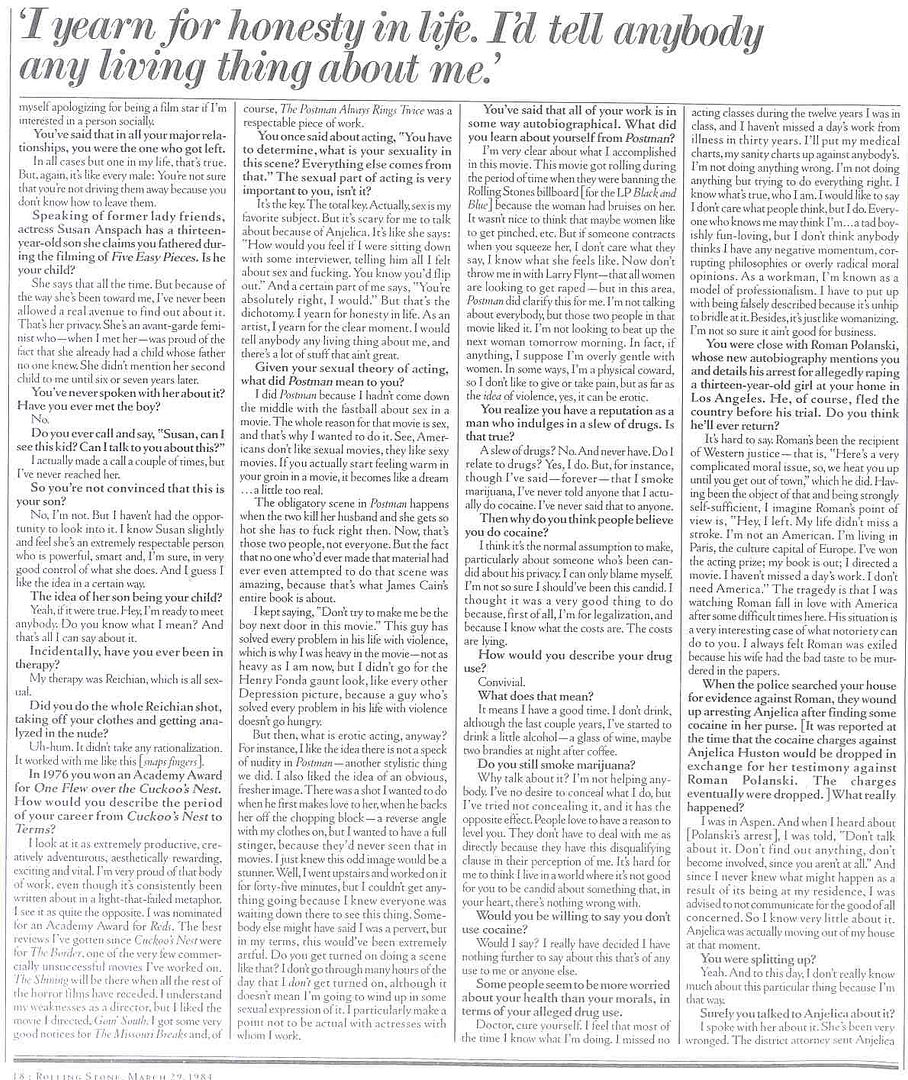
Five Easy Pieces co-star Susan Anspach contended that her son, Caleb (b. September 26, 1970), whose legal father was Mark Goddard, was actually Nicholson's biological son. In 1984, Nicholson said he was not convinced of this, but in 1996, Caleb said that Nicholson had recognized Caleb as his son in private. By 1998, Nicholson publicly acknowledged him as his son and said that they got along "beautifully now".
In 1971 and 1972, Nicholson was in a relationship with singer Michelle Phillips, the ex-wife of his best friend Dennis Hopper, during which time she suffered a miscarriage. Nicholson's longest relationship was with actress Anjelica Huston, from 1973 until 1990. Their on-again, off-again romance included several periods of overlap with other women, notably former Bond girl Jill St. John and Danish model Winnie Hollman, with whom Nicholson had a daughter, Honey Hollman (born January 26, 1982). In 1999, it was discovered that Honey's biological father is producer Lou Adler. Despite this, Honey later stated she has a “normal father-daughter relationship” with Nicholson.
The relationship with Huston ended amid actress Rebecca Broussard's first pregnancy by Nicholson. He and Broussard had two children, Lorraine (b. April 16, 1990) and Raymond (b. February 20, 1992). The pair split up in 1994. That same year, Nicholson reportedly had a daughter, born in 1994, with waitress Jeannine Gourin. Nicholson has never publicly acknowledged the female in question as his child.
Beginning in the late 1990s, Nicholson was involved with actress Lara Flynn Boyle. The two initially broke up in 2000, later reuniting before splitting permanently in 2004, after which Nicholson was linked to English supermodel Kate Moss. In 2006, Nicholson dated actress Paz de la Huerta.
Nicholson has said that children "give your life a resonance that it can't have without them ... As a father, I'm there all the time. I give unconditional love". He has also lamented that he "didn't see enough of my eldest daughter because I was trying to make a career".
Legal issues
In a criminal complaint filed on February 8, 1994, Robert Blank stated that Nicholson, then 56, approached Blank's Mercedes-Benz while he was stopped at a red light in North Hollywood. After accusing Blank of cutting him off in traffic, Nicholson used a golf club to bash the roof and windshield of Blank's car. A witness confirmed Blank's account of the incident and misdemeanor charges of assault and vandalism were filed against Nicholson. Charges were dropped after Nicholson apologized to Blank, and the two reached an undisclosed settlement, which included a reported $500,000 check from Nicholson.
In 1996, a lawsuit was brought against Nicholson alleging that he promised a woman named Catherine Sheehan $1,000 for sex and then assaulted her when she asked for the money. Sheehan received a settlement of about $40,000, but filed another lawsuit against him, arguing that the settlement was insufficient to cover the injuries inflicted upon her, including brain trauma, which she said were "actually killing her." The case was dismissed.
Celebrity friendships
Nicholson lived next door to Marlon Brando for a number of years on Mulholland Drive in Beverly Hills, California. Warren Beatty also lived nearby, earning the road the nickname "Bad Boy Drive". After Brando's death in 2004, Nicholson purchased his bungalow for $6.1 million, with the purpose of having it demolished. Nicholson said he did so out of respect for Brando's legacy, as it had become too expensive to renovate the "derelict" building, which was plagued by mold.
Nicholson's friendship with author-journalist Hunter S. Thompson is described in Thompson's autobiography Kingdom of Fear (2003). After Thompson died in 2005, Nicholson and fellow actors Johnny Depp, John Cusack, and Sean Penn attended his private memorial service in Colorado. Nicholson was also a close friend of Robert Evans, the producer of Chinatown, and after Evans lost Woodland, his home, as the result of a 1980s drug bust, Nicholson and other friends of Evans bought Woodland to give it back to him. Nicholson is also friends with fellow New Jerseyans Danny DeVito and Joe Pesci.
Hobbies
Nicholson is a fan of the New York Yankees and Los Angeles Lakers. He became a Lakers season ticket holder in 1970, and held courtside seats next to the opponent's benches both at The Forum and Staples Center. He was described as a "fixture" at the games, though his regular attendance had stopped by 2021, as he withdrew from public appearances. Nicholson occasionally argued with game officials and opposing players, and even walked onto the court. He was almost ejected from a Lakers playoff game in May 2003 after yelling at a referee. After the death of former Lakers star Kobe Bryant in a helicopter crash in January 2020, Nicholson gave a rare phone interview to Los Angeles station KCBS-TV expressing his grief. He attended a 2023 playoff game, which media outlets noted was his first appearance at a Lakers game in nearly two years.
Nicholson is a collector of 20th-century and contemporary paintings, including those of Henri Matisse, Tamara de Lempicka, Andy Warhol and Jack Vettriano. In 1995, artist Edward Ruscha said that Nicholson has "one of the best collections out here".
Political views
In 1998, Nicholson met Fidel Castro and referred to him as a "genius". Nicholson has called himself a "lifelong Irish Democrat". He supported George McGovern in the 1972 presidential election, Michael Dukakis in 1988, and Hillary Clinton in 2008.
Nicholson supports solar energy, decriminalizing drugs, monopoly laws, and raising teachers' pay. Although personally against abortion, he is pro-choice. He has said, "I'm pro-choice but against abortion because I'm an illegitimate child myself, and it would be hypocritical to take any other position. I'd be dead. I wouldn't exist." He has also said that he has "nothing but total admiration, gratitude, and respect for the strength of the women who made the decision they made in my individual case".
Religious beliefs
Nicholson was raised Roman Catholic and has expressed admiration for the religion, calling it "the only official dogma training I've had. I liked it. It's a smart religion." It has been asserted that some of Nicholson's 1970s movie roles were influenced by Catholicism. In a 1992 Vanity Fair interview, Nicholson said, "I don't believe in God now. I can still work up an envy for someone who has faith. I can see how that could be a deeply soothing experience."
Explanatory notes
References
General and cited bibliography
References
- Fear, David. (April 22, 2021). "Jack Nicholson: 25 Essential Movies".
- Garner, Glenn. (2025-12-13). "James L. Brooks Is “Sure We’ll Be Seeing” Jack Nicholson Return To Acting".
- Ross, Graeme. (April 20, 2017). "Jack Nicholson's twelve greatest performances". [[The Independent]].
- Chilton, Charlotte. (May 8, 2020). "Jack Nicholson's Life in Photos". [[Esquire (magazine).
- "Jack Nicholson Biography Film Actor (1937–)". Biography.com.
- Davies, Hunter. (February 23, 1993). "INTERVIEW / Great film, Jack, now let's talk about you: Jack Nicholson". The Independent.
- Marx, Arthur. (Summer 1995). "On His Own Terms". [[Cigar Aficionado]].
- Douglas, Edward. (2004). "Jack: The Great Seducer – The Life and Many Loves of Jack Nicholson". [[HarperCollins]].
- Dennis McDougal, ''Five Easy Decades: How Jack Nicholson Became the Biggest Movie Star in Modern Times'' (Hoboken, NJ: John Wiley & Sons, 2008), p. 229
- McDougal, Dennis. (October 2007). "Five Easy Decades: How Jack Nicholson Became the Biggest Movie Star in Modern Times". Wiley.
- Berliner, Eve. [http://www.evesmag.com/jackmarriage.htm Marriage certificate of June Nilson and Donald Furcillo] {{webarchive. link. (October 11, 2008. ''Young Jack Nicholson: Auspicious Beginnings''. Evesmag.com. 2001.)
- McDougal, Dennis. (October 2007). "Five Easy Decades: How Jack Nicholson Became the Biggest Movie Star in Modern Times". Wiley.
- [http://www.biography.com/people/jack-nicholson-9423081 Jack Nicholson Biography] {{webarchive. link. (March 27, 2014, ''Biography.com'')
- Collins, Nancy. [https://web.archive.org/web/20081021095326/http://www.jacknicholson.org/1984RollingStone.html ''The Great Seducer: Jack Nicholson'']. ''Rolling Stone'', March 29, 1984,
- Nicholson, Jack. [http://njmonthly.com/articles/lifestyle/people/no-getting-away-from-nj.html "No Getting Away From NJ: Hollywood legend Jack Nicholson attempts to elucidate the definitive quality of New Jersey"] {{webarchive. link. (March 24, 2012, ''[[New Jersey Monthly]]'', November 15, 2010. Retrieved July 14, 2011. "I grew up on the Shore ... in Neptune, Neptune City, Manasquan, and Spring Lake. Graduated from Manasquan [High School]. No offense to Atlantic City, but, where we grew up, we called it 'The Shore'.")
- Cumming, Calum. (2014). ["Jack Nicholson"]({{Google books). Author House.
- [https://www.bing.com/videos/search?q=lifetime+achievement+award+at+the+1999+golden+globes&view=detail&mid=EFD5B0206462231450B9EFD5B0206462231450B9&FORM=VIRE "Jack Nicholson Receives Cecil B Demille Award - Golden Globes 1999"] via [[Dick Clark Productions]]; retrieved February 24, 2020
- Katz, Ephraim. ''The Film Encyclopedia'', HarperCollins (2012) pp. 1079–1080
- Linderman, Lawrence. "Playboy Interview with Peter Fonda", ''Playboy'' magazine, September 1970
- [[John Parker (author). Parker, John]]. ''Michael Douglas: Acting on Instinct'', Hachette Book Group (2011) e-book
- Hill, Lee. ''A Grand Guy: The Life and Art of Terry Southern''. Bloomsbury, 2001.
- (February 27, 2008). "Easy rider: The Jack Nicholson interview". Irish Independent.
- link. (October 14, 2017 , fair use video clip)
- Crane, Robert. ''Jack Nicholson: The Early Years'', Univ. Press of Kentucky (2012)
- D'Agostino, Ryan. ''Esquire the Meaning of Life: Wisdom, Humor, and Damn Good Advice from 64 Extraordinary Lives'', Sterling Publishing (2009) pp. 97–99
- Gilmour, David. ''The Film Club: A Memoir'', Hachette Book Group (2008) e-book
- [https://www.youtube.com/watch?v=OnY88imrH78 Shore Patrol scene in ''The Last Detail''], fair use clip
- Ebert, Roger. ''Roger Ebert's Four Star Reviews—1967–2007'', Andrews McMeel Publishing (2007) p. 405
- Ebert, Roger. ''The Great Movies, Volume 1'', Broadway Books (2002) p. 106
- Ebert, Roger. ''27 Movies from the Dark Side: Ebert's Essentials'', Andrews McMeel Publishing (2012) e-book
- Dunne, Dominick. (April 2001). "Murder Most Unforgettable".
- McGilligan, Patrick. (1996). ["Jack's Life: A Biography of Jack Nicholson"]({{Google books). W. W. Norton & Company.
- Huston, Anjelica. ''Watch Me'', Simon & Schuster (2014) e-book
- Geimer, Samantha. ''The Girl: A Life in the Shadow of Roman Polanski'', Simon & Schuster (2013) p. 79
- (1994). "Danny DeVito speaks at the 22nd AFI Life Achievement Award: A Tribute To Jack Nicholson".
- (October 4, 2014). "The 48th Academy Awards {{!}} 1976".
- (2001). "The Guide to United States Popular Culture". Bowling Green State University Popular Press.
- link. (March 10, 2016 , fair use clip)
- Brenner, Marie. ''Texas Monthly'', January 1976, p. 32
- Chatman, Seymour; Duncan, Paul. ''Michelangelo Antonioni: The Investigation'', [[Taschen]] (2004) p. 134
- Crist, Judith. "The Plot Slickens", ''New York Magazine'', April 14, 1975, p. 76
- Eliot, Marc. ''Nicholson: A Biography'', Random House (2013) Title page
- Wild, David. "Rolling Stone Interview with Jack Nicholson", ''Rolling Stone'', May 3, 2007, p. 110
- Nicholson, Jack. (August 19, 2004). "Remembering Marlon".
- LoBrutto, Vincent. ''Stanley Kubrick: A Biography'', Da Capo Press (1997) p. 420
- (January 30, 2021). "What Jack Nicholson Was Really Like Filming The Shining".
- Webster, Patrick. (2010). "Love and Death in Kubrick: A Critical Study of the Films". McFarland.
- Ciment, Michel. ''Kubrick: The Definitive Edition'', Faber and Faber, Inc. (1980; 1999)
- link. (December 9, 2015 , fair use clip)
- "The 54th Academy Awards: 1982". [[Academy of Motion Picture Arts and Sciences]].
- (October 4, 2014). "The 58th Academy Awards: 1986". [[Academy of Motion Picture Arts and Sciences]].
- "The 60th Academy Awards: 1988". [[Academy of Motion Picture Arts and Sciences]].
- Grobel, Lawrence. "Playboy Interview with John Huston", ''Playboy'' magazine, September 1985
- Matt Carey. (November 8, 2013). "You don't know Jack (Nicholson)". CNN.
- (October 4, 2014). "The 65th Academy Awards: 1993". [[Academy of Motion Picture Arts and Sciences]].
- link. (August 21, 2015 , fair use clip)
- Bleiler, David, Ed. ''TLA Video & DVD Guide'', St. Martin's Griffin (2003) p. 206
- Kagan, Jeremy. ''Directors Close Up'', Scarecrow Press (2006) p. 148
- "Razzie nominations 1992".
- "Golden Globe actor reference".
- "Hoffa movie review".
- Schruers, Fred. (March 19, 1998). "Rolling Stone Interview with Jack Nicholson".
- Bona, Damien. ''Inside Oscar 2'', Random House (2002) e-book
- Horton, Andrew. (2000). "Laughing Out Loud: Writing the Comedy-centered Screenplay". [[University of California Press]].
- "23rd Moscow International Film Festival (2001)". MIFF.
- Graham, Bob. (January 19, 2001). "Nicholson Takes 'Pledge' / Penn directs all-star cast in murder mystery".
- Boucher, Geoff. (September 22, 2001). "Celebrities Take to the Stage, Phones in Global Telethon". Los Angeles Times.
- (September 23, 2001). "Huge audience for all-star telethon". BBC.
- link. (January 12, 2020 , fair use clip)
- Thomson, David. ''The New Biographical Dictionary of Film'', Alfred A. Knopf (2002) pp. 634–635
- Miller, Julie. (September 16, 2013). "Jack Nicholson–Retirement Clarification: The Actor Is Retiring from Hitting on Women, Not Acting".
- Thorpe, Vanessa. (January 24, 2010). "Hope for Haiti: Hollywood stars answer the calls in Haiti telethon". The Guardian.
- (January 22, 2010). "Hope For Haiti: On the Phones". CBS News.
- "The Funniest Moment From Michelle Obama's Surprise Oscar Appearance".
- link. (March 12, 2016 , ''Saturday Night Live'')
- Pugmire, Lance. (June 15, 2016). "HBO's Jim Lampley captures essence of Muhammad Ali in 'The Fight Game' closing". [[Los Angeles Times]].
- (February 7, 2017). "Jack Nicholson, Kristen Wiig to Star in "Toni Erdmann" Remake (EXCLUSIVE)". Penske Business Media, LLC.
- Barfield, Charles. (August 15, 2018). "Jack Nicholson Drops Out Of 'Toni Erdmann' As American Remake Sees Behind-The-Scenes Changes".
- Breznican, Anthony. (November 21, 2019). "Shades of The Shining: Hunting for Easter Eggs in Doctor Sleep".
- White, Nicholas. (October 30, 2019). "How 'Doctor Sleep' Filmmakers Pulled Off That 'Shining' Cameo". [[Variety (magazine).
- (February 16, 2025). "Jack Nicholson Makes 'SNL50' Appearance To Introduce Adam Sandler Singing "50 Years" Ballad".
- (February 13, 2010). "Leonardo DiCaprio On His Hollywood Heroes & Five Favorite Movies".
- "Jack Nicholson's Influence On 'Solo' Star Alden Ehrenreich".
- Bailey, Jeremy. (November 7, 2023). "Jack Nicholson Still Refusing Movie Offers 13 Years After Last Role, Would Rather 'Sit Under a Tree and Read a Book'". [[TheWrap]].
- (September 11, 1990). "France Lauds Nicholson for Unforgettable Roles". Los Angeles Times.
- (December 3, 2008). "Nicholson And Fonda Join California Hall of Fame".
- "The California Museum's California Hall of Fame Fact Sheet".
- (December 16, 2008). "Jack Nicholson and Jane Fonda are inducted into the California Hall of Fame". The Telegraph.
- Alloway, Kristen. (May 3, 2010). "Jack Nicholson, Susan Sarandon are among 15 inducted into N.J. Hall of Fame".
- [http://blogdailyherald.com/2011/06/03/some-wisdom-from-jack-and-binder/#more-15300 "Some Wisdom from Jack... and Binder!"] {{Webarchive. link. (February 24, 2021 BlogDailyHerald. June 3, 2011.)
- (January 19, 2019). "The Living Legends Of Sex".
- Macke, Johnni. (February 20, 2023). "Jack Nicholson's Family Guide: His 6 Children, Grandchildren and the 1 Woman He Married". Us Weekly.
- Humphrey, Zara. (September 30, 2019). "Jack Nicholson: The Hollywood Heartbreaker". Ninjajournalist.com.
- Abramovitch, Seth. (December 17, 2019). "Meet Duke Nicholson, Jack's Grandson and In-Demand Actor". The Hollywood Reporter.
- Bergan, Ronald. (April 11, 2018). "Susan Anspach obituary".
- Gates, Anita. (April 5, 2018). "Susan Anspach, 75, Dies; Daring Actress in Maverick Films". [[The New York Times]].
- (March 29, 1984). "Jack Nicholson Interview".
- Gliatto, Tom. (July 1, 1996). "The House That Jack Owns".
- Abcarian, Robin. (May 29, 1996). "Never a Borrower or a Lender Be—Especially in Hollywood". [[Los Angeles Times]].
- (March 19, 1998). "Jack Nicholson: The Badass Hollywood Star".
- Weller, Sheila. (November 20, 2007). "California Dreamgirl".
- Gritten, David. (April 26, 1982). "Michelle Phillips Is a Mama Again, and Grainger Hines Is a Papa, but Don't Bill Them as Mr. and Mrs.". People.
- "Jill St John".
- (January 13, 2015). "The women Jack Nicholson loved and lost: In pictures". [[The Daily Telegraph.
- (September 14, 2024). "Sandheden om Winnie Hollmanns datter: Afsløret af DNA-test".
- (January 9, 2006). "Jack Nicholsons danske datter Honey taler ud".
- Boardman, Madeline. (December 16, 2014). "Jack Nicholson, Daughter Lorraine Nicholson Make Rare Public Appearance Together".
- McDougal, Dennis. (2008). "Five Easy Decades: How Jack Nicholson Became the Biggest Movie Star in Modern Times". [[John Wiley & Sons]].
- Cooper, Michelle. (September 29, 2010). "September 29". Vogue.
- (February 13, 2012). "Paz De La Huerta's 10 Most Scandalous Moments".
- Johnson, Zach. (November 6, 2012). "Jack Nicholson: I'm "Uncomfortable" With "Sex Legend" Rumors".
- Johnson, Chip. (March 1, 1994). "Nicholson Accused of Attack With Golf Club". Los Angeles Times.
- Mrozek, Thom. (May 3, 1994). "Nicholson Settles Case : Courts: Assault and vandalism charges against actor are dropped. Victim of golf club attack tells judge he was compensated".
- (August 23, 2009). "The Religious Affiliation of Jack Nicholson". Adherents.com.
- Guardian Staff. (May 15, 2000). "Jack Nicholson sued for assault". The Guardian.
- "Catherine Sheehan vs. Jack Nicholson".
- Harlow, John. (August 6, 2006). "Jack Nicholson to demolish his friend Brando's house". The Sunday Times.
- "The Five Most Gonzo Stories About Hunter S. Thompson".
- Bane, Vickie. (March 9, 2005). "Jack Nicholson Draws Hunter S. Thompson". People.
- "The Kid Stays in the Picture". reelingreviews.com.
- (July 6, 2010). "Jack Nicholson gets inducted into the New Jersey Hall of Fame".
- Southern, Keiran. (January 12, 2023). "Jack Nicholson's friends fear he has become recluse like Marlon Brando". [[The Times]].
- [https://news.bbc.co.uk/1/hi/entertainment/3018487.stm "Nicholson gets court rage"] . BBC News. May 11, 2003.
- "Jack Nicholson yells at referee".
- (January 27, 2020). "Longtime Lakers fan Jack Nicholson mourns Kobe Bryant: 'It kills you'".
- Tapp, Tom. (April 28, 2023). "Jack Is Back! Jack Nicholson Attends A Laker Game for First Time Since 2021, Is Greeted By LeBron James & Larry David, Gets JumboTron Tribute". [[Deadline Hollywood]].
- (September 23, 1994). "New Angle on a Symbol of Art Deco: Painting: Tamara de Lempicka's portraits of the '20s and '30s leisure class are finding revived interest.". Los Angeles Times.
- Braid, Mary. (July 23, 1999). "Jack Nicholson loves him. The public adores him. His erotic art has made him millions and his posters outsell Van Gogh and Star Wars. So why is Jack Vettriano so bitter?". The Independent.
- [[Bob Colacello]]. (April 1995). "The Art of the Deal".
- Archerd, Army. (July 16, 1998). "Nicholson, Castrow powwow in Cuba".
- Snow, Shauna. (July 17, 1998). "Arts and entertainment reports from The Times, national and international news services and the nation's press". Los Angeles Times.
- (December 20, 2007). "Jack Nicholson goes public with his politics". Today.com.
- (December 20, 2007). "Jack Nicholson goes public with his politics".
- Johnson, Ted. (March 5, 2008). "Nicholson Defends Hillary".
- (December 20, 2007). "Jack Nicholson goes public with his politics".
- (August 15, 1990). "NAMES IN THE NEWS: Nicholson Split on Abortion". Los Angeles Times.
- (October 9, 2015). "The religion of Jack Nicholson, actor".
- Smith, Warren Allen. (2002). "Celebrities in Hell". Barricade Books.
This article was imported from Wikipedia and is available under the Creative Commons Attribution-ShareAlike 4.0 License. Content has been adapted to SurfDoc format. Original contributors can be found on the article history page.
Ask Mako anything about Jack Nicholson — get instant answers, deeper analysis, and related topics.
Research with MakoFree with your Surf account
Create a free account to save articles, ask Mako questions, and organize your research.
Sign up freeThis content may have been generated or modified by AI. CloudSurf Software LLC is not responsible for the accuracy, completeness, or reliability of AI-generated content. Always verify important information from primary sources.
Report