From Surf Wiki (app.surf) — the open knowledge base
Green Bay Packers
National Football League franchise in Wisconsin
National Football League franchise in Wisconsin
| Field | Value | |||||||||||
|---|---|---|---|---|---|---|---|---|---|---|---|---|
| name | Green Bay Packers | |||||||||||
| current | 2026 Green Bay Packers season | |||||||||||
| logo | Green Bay Packers logo.svg | |||||||||||
| wordmark | Green Bay Packers wordmark.svg | |||||||||||
| established | ||||||||||||
| first_season | [1919](1919-green-bay-packers-season) | |||||||||||
| stadium | Lambeau Field | |||||||||||
| Green Bay, Wisconsin | ||||||||||||
| headquartered | Lambeau Field | |||||||||||
| Green Bay, Wisconsin | ||||||||||||
| uniform | Green Bay Packers Uniforms - (2025).png | |||||||||||
| colors | Dark green, gold, white | |||||||||||
| website | ||||||||||||
| coach | Matt LaFleur | |||||||||||
| owner | Green Bay Packers, Inc. (537,460 stockholdersgoverned by a Board of Directors) | |||||||||||
| chairman | Ed Policy | |||||||||||
| ceo | Ed Policy | |||||||||||
| president | Ed Policy | |||||||||||
| general manager | Brian Gutekunst | |||||||||||
| hist_yr | 1919 | |||||||||||
| song | "Go! You Packers Go!" | |||||||||||
| * Indian Packers (1919–1920)<ref>{{cite book | chapter | Birth of a Team, and a Legend | chapter-url=https://www.nfl.com/static/content/public/static/pdf/media-guides/GB-Media-Guide.pdf#page=539 | title=2018 Green Bay Packers Media Guide | url=https://www.nfl.com/static/content/public/static/pdf/media-guides/GB-Media-Guide.pdf | publisher=NFL Enterprises | date=September 12, 2018 | access-date=May 8, 2019 | archive-date=August 18, 2019 | archive-url=https://web.archive.org/web/20190818155831/http://www.nfl.com/static/content/public/static/pdf/media-guides/GB-Media-Guide.pdf#page=539 | url-status=dead}} | |
| * Acme Packers (1921)<ref>{{Cite news | last | Christl | first=Cliff | author-link=Cliff Christl | date=March 23, 2017 | title=The Acme Packers were short-lived | url=https://www.packers.com/news/the-acme-packers-were-short-lived-18677091 | url-status=live | archive-url=https://web.archive.org/web/20180801221116/https://www.packers.com/news/the-acme-packers-were-short-lived-18677091 | archive-date=August 1, 2018 | access-date=July 18, 2021 | work=Packers.com}} |
| * Big Bay Blues (1920s)<ref name | "names30" / | |||||||||||
| * Bays (1918–1940s)<ref name | "names30" | |||||||||||
| NFL_start_yr | 1921 | |||||||||||
| no_league_champs | 13† | |||||||||||
| no_sb_champs | 4 | |||||||||||
| no_conf_champs | 9 | |||||||||||
| no_div_champs | 21 | |||||||||||
| sb_champs | [1966](1966-green-bay-packers-season) (I), [1967](1967-green-bay-packers-season) (II), [1996](1996-green-bay-packers-season) (XXXI), [2010](2010-green-bay-packers-season) (XLV) | |||||||||||
| no_playoff_appearances | 38 |
Green Bay, Wisconsin Green Bay, Wisconsin
- Indian Packers (1919–1920)
- Acme Packers (1921)
- Blues (1922)
- Big Bay Blues (1920s)
- Bays (1918–1940s)
- The Pack (current)
- The Green and Gold (current) Independent (1919–1920)
- Western Division (1933–1949)
- National Conference (1950–1952)
- Western Conference (1953–1969)
- Central Division (1967–1969)
- National Football Conference (1970–present)
- Central Division (1970–2001)
- North Division (2002–present)
- NFL championships (pre-1970 AFL–NFL merger) (11) 1929, 1930, 1931, 1936, 1939, 1944, 1961, 1962, 1965, 1966, 1967 † – Does not include 1966 and 1967 NFL championships won during the same season that the Super Bowl was contested
- NFL Western: 1960, 1961, 1962, 1965, 1966, 1967
- NFC: 1996, 1997, 2010
- NFL West: 1936, 1938, 1939, 1944
- NFL Central: 1967
- NFC Central: 1972, 1995, 1996, 1997
- NFC North: 2002, 2003, 2004, 2007, 2011, 2012, 2013, 2014, 2016, 2019, 2020, 2021
- NFL: 1936, 1938, 1939, 1941, 1944, 1960, 1961, 1962, 1965, 1966, 1967, 1972, 1982, 1993, 1994, 1995, 1996, 1997, 1998, 2001, 2002, 2003, 2004, 2007, 2009, 2010, 2011, 2012, 2013, 2014, 2015, 2016, 2019, 2020, 2021, 2023, 2024, 2025
- see Playoff opponents
- Hagemeister Park (1919–)
- Bellevue Park ()
- City Stadium ()
- Borchert Field ()
- Wisconsin State Fair Park ()
- Marquette Stadium ()
- Milwaukee County Stadium ()
- Lambeau Field (–present)
- Green Bay Packers, Inc. (1923–present) The Green Bay Packers are a professional American football team based in Green Bay, Wisconsin. The Packers compete in the National Football League (NFL) as a member of the National Football Conference (NFC) North division. They are the third-oldest franchise in the NFL, established in 1919, and are the only non-profit, community-owned major league professional sports team based in the United States. Since 1957, home games have been played at Lambeau Field. They hold the record for the most wins in NFL history.
The Packers are the last of the "small-town teams" that were common in the NFL during the league's early days of the 1920s and 1930s. Founded in 1919 by Earl "Curly" Lambeau and George Whitney Calhoun, the franchise traces its lineage to other semi-professional teams in Green Bay dating back to 1896. Between 1919 and 1920, the Packers competed against other semi-pro clubs from around Wisconsin and the Midwest, before joining the American Professional Football Association (APFA), the forerunner of today's NFL, in 1921. In 1933, the Packers began playing part of their home slate in Milwaukee until changes at Lambeau Field in 1995 made it more lucrative to stay in Green Bay full-time; Milwaukee is still considered a home media market for the team. Although Green Bay is the smallest major league professional sports market in North America, Forbes ranked the Packers as the world's 27th-most-valuable sports franchise in 2019, with a value of $2.63 billion.
The Packers have won 13 league championships, the most in NFL history, with nine pre-Super Bowl NFL titles and four Super Bowl victories. The Packers, under coach Vince Lombardi, won the first two Super Bowls in 1966 and 1967; they were the only NFL team to defeat the American Football League (AFL) before the AFL–NFL merger. After Lombardi retired, the Super Bowl trophy was named for him, but the team struggled through the 1970s and 1980s. The team's performance shifted after acquiring Brett Favre in 1992 and his eventual successor Aaron Rodgers in 2005, beginning a new ongoing era which has been characterized by consistent regular-season success, with 25 playoff appearances and two Super Bowl wins in 1996 and 2010, under head coaches Mike Holmgren and Mike McCarthy, respectively. In addition to the most wins, the Packers hold the second-highest win–loss record (.571) in NFL history, including both regular season and playoff games. The Packers are longstanding adversaries of the Chicago Bears, Minnesota Vikings, and Detroit Lions, who today form the NFL's NFC North division (formerly known as the NFC Central Division). They have played more than 100 games against each of those teams, and have a winning overall record against all of them, a distinction only shared with the Kansas City Chiefs, Dallas Cowboys, and Miami Dolphins. The Bears–Packers rivalry is one of the oldest rivalries in U.S. professional sports history, dating to 1921.
History
Main article: History of the Green Bay Packers
Curly Lambeau years (1919–1949)
The Green Bay Packers were founded on August 11, 1919, by former high-school football rivals Earl "Curly" Lambeau and George Whitney Calhoun. Lambeau solicited funds for uniforms from his employer, the Indian Packing Company, a meat packing company. He was given $500 ($ today) for uniforms and equipment, on the condition that the team be named after its sponsor. The Green Bay Packers have played in their original city longer than any other team in the NFL.
On August 27, 1921, the Packers were granted a franchise in the American Professional Football Association, a new national pro football league that had been formed the previous year. The APFA changed its name to the National Football League a year later. Financial troubles plagued the team, and the franchise was forfeited within the year before Lambeau found new financial backers and regained the franchise the next year. These backers, known as "The Hungry Five", formed the Green Bay Football Corporation.
NFL champions (1929, 1930, 1931)
After a near-miss in 1927, Lambeau's squad claimed the Packers' first NFL title in 1929 with an undefeated 12–0–1 campaign, behind a stifling defense which registered eight shutouts. Green Bay would repeat as league champions in 1930 and 1931, bettering teams from New York, Chicago and throughout the league, with all-time greats and future Hall of Famers Mike Michalske, Johnny (Blood) McNally, Cal Hubbard and Green Bay native Arnie Herber. Among the many impressive accomplishments of these years was the Packers' streak of 29 consecutive home games without defeat, an NFL record which still stands.
NFL champions (1936, 1939, 1944)
The arrival of the end Don Hutson from Alabama in 1935 gave Lambeau and the Packers the most feared and dynamic offensive weapon in the game. Credited with inventing pass patterns, Hutson would lead the league in receptions in eight seasons and spur the Packers to NFL championships in 1936, 1939 and 1944. An Iron Man, Hutson played both ways, leading the league in interceptions as a safety in 1940. Hutson claimed 18 NFL records when he retired in 1945, many of which still stand. In 1951, his number 14 was the first to be retired by the Packers, and he was inducted as a charter member of the Pro Football Hall of Fame in 1963.
After Hutson's retirement, Lambeau could not stop the Packers' slide. He purchased a large lodge near Green Bay for team members and families to live in. Rockwood Lodge was the home of the 1946–49 Packers. The 1947 and 1948 seasons produced a record of 12–10–1, and 1949 was even worse at 3–9. The lodge burned down on January 24, 1950, and insurance money paid for many of the Packers' debts.
Curly Lambeau departed after the 1949 season. Gene Ronzani and Lisle Blackbourn could not coach the Packers back to their former magic, even as a new stadium was unveiled in 1957. The losing would descend to the disastrous 1958 campaign under coach Ray "Scooter" McLean, whose lone 1–10–1 year at the helm is the worst in Packers history.
Vince Lombardi years (1959–1967)
Former New York Giants assistant Vince Lombardi was hired as Packers head coach and general manager on February 2, 1959. Few suspected the hiring represented the beginning of a remarkable, immediate turnaround. Under Lombardi, the Packers would become the team of the 1960s, winning five championships over seven years, including victories in the first two Super Bowls. During the Lombardi era, the stars of the Packers' offense included Bart Starr, Jim Taylor, Carroll Dale, Paul Hornung (as halfback and placekicker), Forrest Gregg, and Jerry Kramer. The defense included Willie Davis, Henry Jordan, Willie Wood, Ray Nitschke, Dave Robinson, and Herb Adderley.[[File:Nitschke packers.jpg|thumb|left|[[Ray Nitschke]] – his No. 66 jersey is one of six numbers [[List of Green Bay Packers retired numbers|retired by the Packers]]]] The Packers' first regular-season game under Lombardi was on September 27, 1959, a 9–6 victory over the Chicago Bears in Green Bay. After winning their first three, the Packers lost the next five before finishing strong by sweeping their final four. The 7–5 record represented the Packers' first winning season since 1947, enough to earn rookie head coach Lombardi the NFL Coach of the Year.
The next year, the Packers, led by Paul Hornung's 176 points, won the NFL West title and played in the NFL Championship against the Philadelphia Eagles at Philadelphia. In a see-saw game, the Packers trailed by only four points when All-Pro Eagle linebacker Chuck Bednarik tackled Jim Taylor just nine yards short of the goal line as time expired.
NFL champions (1961, 1962, 1965)
The Packers returned to the NFL Championship game the following season and faced the New York Giants in the first league title game to be played in Green Bay. The Packers scored 24-second-quarter points, including a championship-record 19 by Paul Hornung, on special "loan" from the Army (one touchdown, four extra points, and three field goals), powering the Packers to a 37–0 rout of the Giants, their first NFL Championship since 1944. It was in 1961 that Green Bay became known as "Titletown".
The Packers stormed back in the 1962 season, jumping out to a 10–0 start on their way to a 13–1 season. This consistent level of success would lead to Lombardi's Packers becoming one of the most prominent teams of their era, and to be featured as the face of the NFL on the cover of Time on December 21, 1962, as part of the magazine's cover story on "The Sport of the '60s". Shortly after Time article, the Packers faced the Giants in a much more brutal championship game than the previous year, but the Packers prevailed on the kicking of Jerry Kramer and the determined running of Jim Taylor. The Packers defeated the Giants in New York, 16–7. The 1963 team went 11–2–1 but finished second in the NFL West. The 1964 went 8–5–1 and finished second in the NFL West.
The Packers returned to the championship game in 1965 following a two-year absence when they defeated the Colts in a playoff for the Western Conference title. That game would be remembered for Don Chandler's controversial tying field goal in which the ball allegedly went wide right, but the officials signaled "good". The 13–10 overtime win earned the Packers a trip to the NFL Championship game, where Hornung and Taylor ran through the defending champion Cleveland Browns, helping the Packers win, 23–12, to earn their third NFL Championship under Lombardi and ninth overall. Goalpost uprights would be made taller the next year.
Super Bowl I champions (1966)
The 1966 season saw the Packers led to the first-ever Super Bowl by MVP quarterback Bart Starr. The team went 12–2, and as time wound down in the NFL Championship against the Dallas Cowboys, the Packers clung to a 34–27 lead. Dallas had the ball on the Packers' two-yard line, threatening to tie the game, but on fourth down, the Packers' Tom Brown intercepted Don Meredith's pass in the end zone to seal the win. The team crowned its season by rolling over the AFL champion Kansas City Chiefs 35–10 in Super Bowl I.
Super Bowl II champions (1967)
The 1967 season was the last for Lombardi as the Packers' head coach. The NFL Championship game, a rematch of the 1966 contest against Dallas, became indelibly known as the "Ice Bowl" as a result of the brutally cold conditions at Lambeau Field. Still the coldest NFL game ever played, it remains one of the most famous football games at any level in the history of the sport. With 16 seconds left, Bart Starr's touchdown on a quarterback sneak brought the Packers a 21–17 victory and their still unequaled third straight NFL Championship. They then won Super Bowl II with a 33–14 victory over the Oakland Raiders. Lombardi stepped down as head coach after the game, and Phil Bengtson was named his successor. Lombardi remained as general manager for one season but left in 1969 to become head coach and minority owner of the Washington Redskins.
After Lombardi died of cancer on September 3, 1970, the NFL renamed the Super Bowl trophy the Vince Lombardi Trophy in recognition of his accomplishments with the Packers. The city of Green Bay renamed Highland Avenue in his honor in 1968, placing Lambeau Field at 1265 Lombardi Avenue ever since.[[File:1986 Jeno's Pizza - 16 - Eddie Lee Ivery.jpg|thumb|right|The Packers, pictured against Cardinals in the [[1982–83 NFL playoffs|1982–83 playoffs]], only qualified for the postseason twice during the team's post-Lombardi "dark ages" (1969–91).]]
For about a quarter-century after Lombardi's departure, the Packers had relatively little on-field success. In the 24 seasons from 1968 to 1991, they had only five seasons with a winning record, one being the shortened 1982 strike season. They appeared in the playoffs twice, with a 1–2 record. The period saw five different head coaches—Phil Bengtson, Dan Devine, Bart Starr, Forrest Gregg, and Lindy Infante—two of whom, Starr and Gregg, were Lombardi's era stars, while Bengtson was a former Packer coach. Each led the Packers to a worse record than his predecessor. Poor personnel decisions were rife, notoriously the 1974 trade by acting general manager Dan Devine which sent five 1975 or 1976 draft picks (two first-rounders, two-second-rounders and a third) to the Los Angeles Rams for aging quarterback John Hadl, who would spend only 1 seasons in Green Bay. Another came in the 1989 NFL draft, when offensive lineman Tony Mandarich was taken with the second overall pick ahead of future Hall of Fame inductees Barry Sanders, Derrick Thomas, and Deion Sanders. Though rated highly by nearly every professional scout at the time, Mandarich's performance failed to meet expectations, earning him ESPN's ranking as the third "biggest sports flop" in the last 25 years.[[File:David Martin82 Brett Favre4-Edit2.jpg|alt=Packers great Brett Favre, a three-time All-Pro, three-time NFL MVP, and Super Bowl XXXI champion in his 16 years in Green Bay|thumb|left|Packers great [[Brett Favre]] played for 16 years in Green Bay. He had his No. 4 jersey retired by the Packers in 2015.]]
The Packers' performance in the 1970s, 1980s, and early 1990s led to a shakeup, with Ron Wolf hired as general manager and given full control of the team's football operations to start the 1991 season.
Mike Holmgren years (1992–1998)
In 1992, Wolf hired San Francisco 49ers offensive coordinator Mike Holmgren as the Packers' new head coach.
Soon afterward, Wolf acquired quarterback Brett Favre from the Atlanta Falcons for a first-round pick. Favre got the Packers their first win of the 1992 season, stepping in for injured quarterback Don Majkowski and leading a comeback over the Cincinnati Bengals. He started the following week, a win against the Pittsburgh Steelers, and never missed another start for Green Bay through the end of the 2007 season. He would go on to break the record for consecutive starts by an NFL quarterback, starting 297 consecutive games including stints with the New York Jets and Minnesota Vikings with the streak finally coming to an end late in the 2010 season.
The Packers had a 9–7 record in 1992 and began to turn heads around the league when they signed perhaps the most prized free agent in NFL history in Reggie White on the defense in 1993. White believed that Wolf, Holmgren, and Favre had the team heading in the right direction with a "total commitment to winning". With White on board, the Packers made it to the second round of the playoffs during both the 1993 and 1994 seasons but lost their 2nd-round matches to their playoff rival, the Dallas Cowboys, playing in Dallas on both occasions. In 1995, the Packers won the NFC Central Division championship for the first time since 1972. After a home playoff 37–20 win against Favre's former team, the Atlanta Falcons, the Packers defeated the defending Super Bowl champion San Francisco 49ers 27–17 in San Francisco on the road to advance to the NFC Championship Game, where they lost again to the Dallas Cowboys 38–27.
Super Bowl XXXI champions (1996)
In 1996, the Packers' turnaround was complete. The team posted a league-best 13–3 record in the regular season, dominating the competition and securing home-field advantage throughout the playoffs. They were ranked no. 1 in offense with Brett Favre leading the way, no. 1 in defense with Reggie White as the leader of the defense, and no. 1 in special teams with former Heisman Trophy winner Desmond Howard returning punts and kickoffs for touchdowns. After relatively easy wins against the San Francisco 49ers in a muddy 35–14 beatdown and Carolina Panthers 30–13, the Packers advanced to the Super Bowl for the first time in 29 years. In Super Bowl XXXI, Green Bay defeated the New England Patriots 35–21 to win their 12th championship. Desmond Howard was named MVP of the game for his kickoff return for a touchdown that ended the Patriots' bid for a comeback. Then-Packers president Bob Harlan credited Wolf, Holmgren, Favre, and White for ultimately changing the fortunes of the organization and turning the Green Bay Packers into a model NFL franchise. A 2007 panel of football experts at ESPN ranked the 1996 Packers the 6th-greatest team ever to play in the Super Bowl.
The following season the Packers recorded another 13–3 record and won their second consecutive NFC championship. After defeating the Tampa Bay Buccaneers 21–7 and San Francisco 49ers 23–10 in the playoffs, the Packers returned to the Super Bowl as an 11 point favorite. The team ended up losing in an upset to John Elway and the Denver Broncos in Super Bowl XXXII, by the score of 31–24.[[File:19981213 24 Mike Holmgren, Lambeau Field,.jpg|thumb|Holmgren, one of three Packer coaches to win a Super Bowl, pictured in 1998]] In 1998, the Packers went 11–5 and met the San Francisco 49ers in the first round of the NFC playoffs. It was the fourth consecutive year these teams had met in the playoffs and the sixth overall contest since the 1995 season. The Packers had won all previous games, and the media speculated that another 49ers loss would result in the dismissal of San Francisco head coach Steve Mariucci. Unlike the previous playoff matches, this game was hotly contested, with the teams frequently exchanging leads. With 4:19 left in the 4th quarter, Brett Favre and the Packers embarked on an 89-yard drive, which concluded with a Favre touchdown pass to receiver Antonio Freeman. This play appeared to give Green Bay the victory. But San Francisco quarterback Steve Young led the 49ers on an improbable touchdown drive, which culminated when Terrell Owens caught Young's pass between several defenders to give the 49ers a lead with three seconds remaining. Afterward, the game was mired in controversy. Many argued that during the 49ers game-winning drive, Niners receiver Jerry Rice fumbled the ball but officials stated he was down by contact. Television replays confirmed the fumble, but referees were unable to review the play; the next season the NFL reinstituted an instant replay system. In the end, this game turned out to be the end of an era in Green Bay. Days later Mike Holmgren left the Packers to become vice president, general manager, and head coach of the Seattle Seahawks. Much of Holmgren's coaching staff went with him, and Reggie White also retired after the season (but later played one season for the Carolina Panthers in 2000).
In 1999, the team struggled to find an identity after the departure of so many of the individuals responsible for their Super Bowl run. Ray Rhodes was hired in 1999 as the team's new head coach. Rhodes had served around the league as a highly regarded defensive coordinator and more recently experienced moderate success as head coach of the Philadelphia Eagles from 1995 to 1998. Ron Wolf believed that Rhodes' experience and player-friendly demeanor would fit nicely in Green Bay's veteran locker room, but Rhodes was fired after one 8–8 season. Wolf visited team practice late in the 1999 season and believed that players had become too comfortable with Rhodes' style, and said the atmosphere resembled a country club.
In 2000, Wolf replaced Rhodes with Mike Sherman. Sherman had never been a head coach at any level of football and was relatively unknown in NFL circles. He had only coached in professional football for three years starting as the Packers' tight ends coach in 1997 and 1998. In 1999, he followed Mike Holmgren to Seattle and became the Seahawks' offensive coordinator, although Sherman did not call the plays during games. Despite Sherman's apparent anonymity, Wolf was blown away in the interview process by the coach's organizational skills and attention to detail. Sherman's inaugural season started slowly, but the Packers won their final four games to achieve a 9–7 record. Brett Favre praised the atmosphere Sherman had cultivated in Green Bay's locker room and fans were optimistic about the team's future. In the offseason, however, Wolf suddenly announced his own resignation as general manager to take effect after the April 2001 draft. Packers' president Bob Harlan was surprised by Wolf's decision and felt unsure of how to replace him. Harlan preferred the structure Green Bay had employed since 1991; a general manager who ran football operations and hired a subservient head coach. But with the momentum and locker room chemistry that was built during the 2000 season, Harlan was reluctant to bring in a new individual with a potentially different philosophy. Wolf recommended that Harlan give the job to Sherman. Though Harlan was wary of the structure in principle, he agreed with Wolf that it was the best solution. In 2001, Sherman assumed the duties of both general manager and head coach.
From 2001 to 2004, Sherman coached the Packers to respectable regular-season success, led by the spectacular play of Brett Favre, Ahman Green, and a formidable offensive line. But Sherman's teams faltered in the playoffs. Before 2003, the Packers had never lost a home playoff game since the NFL instituted a post-season in 1933 (they were 13–0, with 11 of the wins at Lambeau and two more in Milwaukee.). That ended on January 4, 2003, when the Atlanta Falcons defeated the Packers 27–7 in an NFC Wild Card game. The Packers would also lose at home in the playoffs to the Minnesota Vikings two years later.
By the end of the 2004 season, the Packers' team depth appeared to be diminishing. Sherman also seemed overworked and reportedly had trouble communicating with players on the practice field with whom he was also negotiating contracts. Harlan felt the dual roles were too much for one man to handle and removed Sherman from the general manager position in early 2005 while retaining him as a head coach. Harlan hired the Seattle Seahawks' vice president of operations Ted Thompson as the new executive vice president, general manager, and director of football operations. The relationship between Thompson and Sherman appeared strained, as Thompson immediately began rebuilding Green Bay's roster. Following a dismal 4–12 season, Thompson fired Sherman.
Mike McCarthy years (2006–2018)
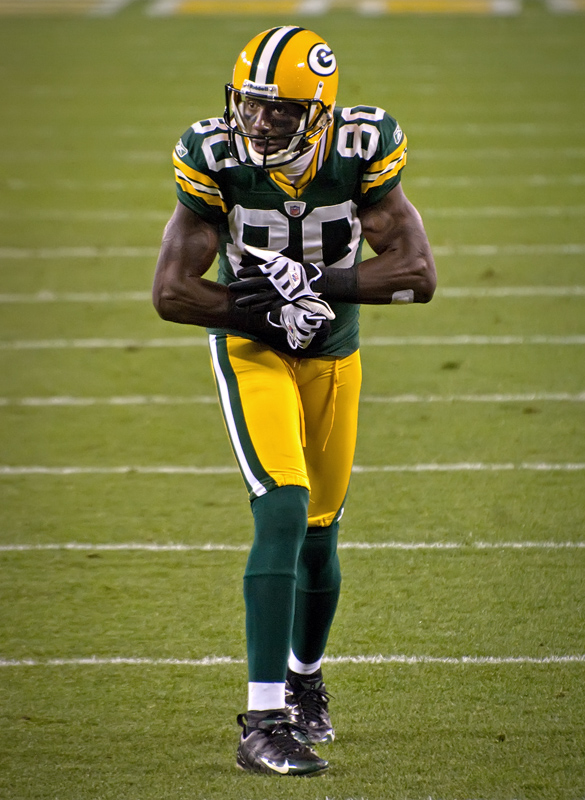
In 2006, Thompson hired Mike McCarthy, former offensive coordinator for the San Francisco 49ers and New Orleans Saints, as head coach. McCarthy had served as quarterbacks coach for the Packers in 1999. In McCarthy's debut year coaching the Packers, the team began with a 4–8 record. Then, Brett Favre sustained injuries, as did backup quarterback, Aaron Rodgers. Despite the injuries, McCarthy coached the team to four consecutive wins, finishing with an 8–8 record.
After missing the playoffs in 2006, Favre announced he would return for the 2007 season, it would be one of his best. The Packers finished 13–3, earning a first-round bye in the playoffs. The Packers' passing offense finished second in the NFC, behind the Dallas Cowboys, and third in the league. Running back Ryan Grant, became the featured back in Green Bay. In the divisional playoff round, in a snowstorm, the Packers beat the Seattle Seahawks 42–20. Grant rushed for 201 yards and three touchdowns, while Favre tossed an additional three touchdown passes to receiver Donald Driver (as well as a snowball, in celebration). On January 20, 2008, Green Bay appeared in their first NFC Championship Game in 10 years facing the New York Giants. The game was lost 23–20 on a field goal by Lawrence Tynes. This would be Favre's final game as a Packer. McCarthy coached the NFC team during the 2008 Pro Bowl in Hawaii.
In December 2007, Ted Thompson was signed to a 5-year contract extension with the Packers. On February 5, 2008, McCarthy signed a 5-year contract extension. On March 4, Favre announced his retirement. Within five months, however, he filed for reinstatement. On August 6, it was announced that Favre was traded to the New York Jets for a conditional draft pick in 2009.
The Packers began their 2008 season with their 2005 first-round draft pick, quarterback Aaron Rodgers, under center, as the first QB other than Favre to start for the Packers in 16 years. Rodgers played well in his first year, throwing for over 4,000 yards and 28 touchdowns. However, injuries plagued the Packers' defense, as they lost 7 close games by 4 points or fewer, finishing with a 6–10 record. 8 assistant coaches were dismissed, including Bob Sanders, the team's defensive coordinator, who was replaced by Dom Capers.
In March 2009, the organization assured fans that Favre's jersey number would be retired, but not during the 2009 season. In April 2009, the Packers selected nose tackle B. J. Raji of Boston College as the team's first pick in the draft. The team then traded three draft picks for another first-round pick, selecting linebacker Clay Matthews III. During the 2009 NFL season, two matchups between the franchise and Favre were highly anticipated after Favre's arrival with division-rival Vikings in August. The first encounter took place in Week 4, a Monday Night Football game that broke TV audience records. This scheduling was made possible when Baseball Commissioner and Packer board of directors member Bud Selig forced baseball's Minnesota Twins to play 2 games within 12 hours. The Vikings won 30–23; Favre threw 3 TDs, no interceptions, and had a passer rating of 135. The teams met again in Week 8, Favre leading the Vikings to a second win, 38–26, in Green Bay. Rodgers was heavily pressured in both games, being sacked 14 times total, but still played well, throwing five touchdowns. The next week, the Packers were upset by the winless Tampa Bay Buccaneers. Green Bay won 7 of their last 8 games, including their 16th regular-season finale from 17 seasons, and earning an NFC wild-card playoff bid with an 11–5 regular-season record. Rodgers became the first quarterback in NFL history to throw for at least 4,000 yards in each of his first two seasons as a starter. Cornerback Charles Woodson won NFL Defensive Player of the Year honors, his 9 interceptions were more than the 8 collected by all Packer opponents. The season ended with an overtime loss in a wild card round shootout at the Arizona Cardinals, 51–45. It was the second time McCarthy led the Packers to the postseason. While they were not as successful as their 90s counterparts in the postseason, the 2000s were by no means a dark time for the Packers. The team finished the decade with the 5th highest winning percentage.
Super Bowl XLV champions (2010)
Main article: 2010 Green Bay Packers season
The team lost Johnny Jolly to a season long suspension after he violated NFL drug policy. Their running corps suffered a blow when RB Ryan Grant sustained a season-ending ankle injury in Week 1. By the end of the season, the team had 16 people on injured reserve, including 7 starters. Key injuries did not stop McCarthy's team from finishing the regular season with a 10–6 record. In week 7, the team faced the Minnesota Vikings, then led by former Packers quarterback Brett Favre. Green Bay beat Favre's new team 28–24 when Favre's final pass to Randy Moss in the end zone flew incomplete. In week 17, the Packers clinched their playoff berth with a 10–3 victory over the Chicago Bears at Lambeau Field, aided in large part by Nick Collins' interception of Jay Cutler's throw that allowed Green Bay to run out the clock.
The Packers 10–6 record allowed them to clinch the No. 6 seed in the NFC playoffs. They first faced Philadelphia, winning 21–16. In the Divisional round, they defeated No. 1 seed Atlanta 48–21. They then played the Chicago Bears at Soldier Field in the NFC Championship Game—only the second playoff meeting between the two storied rivals. Packers won 21–14 to move on to Super Bowl XLV, having secured a 3–0 record in the postseason.
On the evening before the Super Bowl, McCarthy had each player fitted for a championship ring. Aware of the motivational tactic, team president Mark Murphy instructed his organization to begin designing the ring. The following day on February 6, 2011, they defeated the AFC champion Pittsburgh Steelers 31–25, becoming the first No. 6 seed from the NFC to win a Super Bowl. It was the first time the Packers had won the Lombardi Trophy since 1996. Aaron Rodgers was named Super Bowl MVP.
During Super Bowl XLV, McCarthy's team initially enjoyed a comfortable 21–3 lead over the Steelers. Then, Charles Woodson had to leave the game with a broken collarbone and the Steelers' Hines Ward found the endzone to make the score 21–10 by halftime. During the third quarter, Pittsburgh scored 7 more points. In the fourth quarter, Green Bay's Clay Matthews tackled Pittsburgh's Rashard Mendenhall, and Desmond Bishop recovered the ball for a key turnover.
,_Charles_Woodson_(21).jpg)
In 2011, the Packers won their first 13 games, eventually finishing the season 15–1, a franchise record for wins in a season and tied for the second-most regular-season wins in NFL history, behind only the 2007 Patriots who went 16–0. Aaron Rodgers was named the NFL's MVP, his first such award. McCarthy's offensive strategies aided Rodgers in throwing for 4,643 yards and 45 touchdowns. These strategies propelled the Packers to lead the NFL in scoring that year. Despite receiving homefield advantage, Green Bay lost their first postseason game to eventual Super Bowl XLVI champion New York Giants, 37–20.
Finishing the 2012 season with an 11–5 record and their second straight division title, the Packers beat the Minnesota Vikings in the NFC wild-card round 24–10, but lost in the playoffs to the eventual NFC Champion San Francisco 49ers by 45–31. The Packers offense finished the season fifth in points. Rodgers passed for 4,295 yards. The Packers topped the first-ever AP Pro32 rankings, a new pro football version of the AP Top 25 college football and basketball polls.
In 2013, the Packers started 5–2, leading up to a Week 9 match up against the Bears. It was in that game that the Packers lost Rodgers to a broken collarbone; Rodgers missed the next six games, during which the club would go 2–3–1 under three different quarterbacks. Despite having a 7–7–1 record, the Packers were still in a position to win the NFC North division, if they were able to win their final game. With Rodgers returning, the Packers managed to beat the Bears in a Week 9 rematch, 33–28. Finishing at 8–7–1, the Packers won their division and were awarded a home playoff game. It was the fifth consecutive time that McCarthy led his team to a playoff appearance. However, the Packers would lose to the 49ers 20–23 in the playoffs.
The Packers recorded their 700th victory, against the Bears, in Week 4 of 2014. The team went undefeated at home for the first time since the 2011 season; they led the league in scoring, with 486 points. 2014 marked the first time since 2009 that the team had a 4,000-yard passer, two 1,000-yard receivers, and a 1,000-yard rusher. McCarthy led an offense that finished sixth in the league in total offense. After winning against the Tampa Bay Buccaneers in Week 16, McCarthy (99 wins) passed Hall of Famer Vince Lombardi (98) on the all-time wins list for the Packers. Overall, the team went 12–4, clinching a fourth consecutive NFC North division title, making the playoffs for the sixth straight season, tying a franchise record. The Packers beat the Cowboys in the divisional round, advancing to the NFC Championship to face the Seattle Seahawks. After leading throughout most of regulation, the Packers lost 28–22 in an overtime rally by Seattle. Rodgers was named the league's Most Valuable Player for the second time.
During Week 2 of the 2015 preseason against the Pittsburgh Steelers, wide receiver Jordy Nelson caught an eight-yard pass from Aaron Rodgers but fell to the turf, Nelson had torn his ACL. He would remain inactive for the rest of 2015. Even without Nelson, the Packers managed to get off to a 6–0 start, but then lost four of their next five games, falling to 7–4. On December 3, against the Detroit Lions, the Packers quickly fell to a 20–0 deficit going into halftime. Green Bay started to make a comeback in the second half thanks to a touchdown by Davante Adams and a 27-yard touchdown run by Rodgers to narrow the game to 23–21. The Packers then got the ball back with 23 seconds left. While attempting a "lateral" play, Rodgers was sacked with no time remaining but then a flag was thrown for a facemask penalty on Detroit. The Packers now had one more un-timed play, which Rodgers threw a 61-yard Hail Mary touchdown to tight end Richard Rodgers. It was the longest Hail Mary touchdown pass thrown in NFL history.
Up until week 14, McCarthy delegated playcalling duties to associate head coach Tom Clements. However, the team's struggling offense made McCarthy decide to take back play-calling duties. During that first game that McCarthy resumed play calling, the Packers ran the ball for 230 yards in 44 carries. Green Bay then finished the season 10–6 and 2nd in the NFC North behind the Minnesota Vikings. The Packers beat the Washington Redskins in the NFC wild-card game to advance to the divisional round with the Arizona Cardinals. A similar play to tie the game against the Cardinals happened between Aaron Rodgers and Jeff Janis. Janis caught a 41-yard touchdown which sent the game into overtime. However, the Packers fell to Arizona 26–20, ending their season.
After a 4–6 start to the 2017 season, the Packers went on a six-game winning streak to finish the regular season with a 10–6 record. The team clinched the NFC North for the fifth time in six years. They routed the New York Giants, 38–13, in the wild-card round of the playoffs and upset the top-seeded Dallas Cowboys, 34–31, in the divisional round, but their season ended when they were beaten by the Atlanta Falcons in the NFC Championship Game, 44–21.
The Packers began the 2017 regular season with a 4–2 record. On October 15, during a week 6 game, Rodgers was driven to the ground by Minnesota Vikings linebacker Anthony Barr. Rodgers suffered a broken collarbone, and the Packers placed him on injured reserve, with the stipulation that he could return, especially if the injury healed quickly and the Packers were still in playoff contention. Rodgers did return for a week 15 game against the Carolina Panthers on December 17, but the Packers were eliminated from the playoff hunt after a 31–24 loss. The team placed Rodgers back on injured reserve, which prompted several teams to complain the Packers had violated rules about reactivating injured players. During Rodgers' absence, backup quarterback Brett Hundley stepped into the starting role for the first time in his professional career, but struggled to replicate Rodgers' success, despite a Pro Bowl-caliber season by receiver Davante Adams. In a 23–0 loss to the Baltimore Ravens in week 11, the Packers suffered their first shutout at Lambeau Field in 11 years. The Packers finished the season at 7–9, missing the playoffs for the first time since 2008. Off the field, the Packers organization opened the Titletown District adjacent to Lambeau Field. This shopping, entertainment, and restaurant district includes a public plaza, park, and commercial businesses.
In 2018, the Packers again failed to qualify for the playoffs, finishing third in the NFC North with a record of 6–9–1. Following a Week 13 loss to the Cardinals, McCarthy was released as head coach, replaced by Offensive Coordinator Joe Philbin on an interim basis. McCarthy left having tallied a 125–77–2 (.618) regular season record, as well as a postseason record of 10–8 (.556). His total record with the Packers was 135–85–2. McCarthy had brought the team to nine playoff berths and a Super Bowl win. Following the season, Matt LaFleur, the Offensive Coordinator of the Tennessee Titans the prior season, was hired as the Packers' new coach.
Matt LaFleur years (since 2019)
.jpg)
Under first-year head coach Matt LaFleur, Aaron Rodgers and the Packers opened the season by defeating the Chicago Bears in the season's opening game, the first time since 2003 that the league-wide kickoff game did not feature the defending Super Bowl champions, with the Packers and Bears being selected for their historic rivalry in the NFL's 100th season. The Packers returned to the playoffs for the first time since 2016, finishing with a record of 13–3 and securing a first-round bye as the NFC's second seed. They defeated the Seattle Seahawks 28–23 in the NFC Divisional round to advance to the NFC Championship game, where they were defeated 37–20 by the San Francisco 49ers.
In 2020, the Green Bay Packers won the NFC North Division for the second consecutive year. They also earned a first-round bye, with the top seed in the NFC. They defeated the Los Angeles Rams 32–18 in the Divisional Round, but fell to the underdog Tampa Bay Buccaneers in the NFC championship- their fourth straight loss in the game in five appearances under Rodgers. Rodgers won his third MVP award during the season.
The next year, they clinched the top seed in the NFC again, with a 13–4 record, before losing 13–10 to the 49ers in the Divisional round. The special teams unit was consistently the worst in the NFL during the season, though their defense was noted as an improvement from previous seasons. The special teams was especially costly in the postseason game as a field goal attempt and punt were both blocked, the latter of which the 49ers returned for a touchdown. The defense did not allow any touchdowns in that game, as the only other points the 49ers scored were off two field goals. Matt LaFleur became the first coach to have three straight 13-win seasons, however, none of them ended with a trip to the Super Bowl. For his performance in the season, Aaron Rodgers won his fourth MVP award- the second most for any quarterback, only behind Peyton Manning who has five.
In the 2022 season, the Green Bay Packers struggled and were eliminated from advancing to the NFL's wild-card playoffs when they lost their last regular-season game 20–16 to the Detroit Lions. This was the first time the team missed the playoffs during Matt LaFleur's coaching stint. The team finished with an 8–9 record.
The 2023 season was the first without longtime quarterback Aaron Rodgers, who was traded to the New York Jets during the offseason. Jordan Love, who was drafted to the Green Bay Packers in 2020, took over as starting quarterback. The team finished with an 9–8 record which secured 2nd place in the NFC North division, and the 7th seed in the NFC. The Packers defeated the 2nd seed Dallas Cowboys 48–32 in their Wild-Card matchup, becoming the first 7th seed team to win a playoff game. The Packers would go on to lose to the 1st seed San Francisco 49ers 24–21 in the Divisional round. Following the loss, the team announced that defensive coordinator Joe Barry would not return next season.
In 2024 the Packers finished the season with a record of 11–6. This was thanks in part due to some new additions to the team, including running back Josh Jacobs and safety Xavier McKinney, who were both named to the Pro Bowl that year. New backup quarterback Malik Willis, who was acquired in a trade with the Tennessee Titans during the preseason, filled in and won multiple games for an injured Jordan Love. Some other additions to the team came in the coaching department, including new defensive coordinator Jeff Hafley, and former New York Jets head coach Robert Saleh, who joined the team as an offensive assistant shortly after being fired by the Jets following a 2–3 start. Despite their record however, the Packers only managed to finish in 3rd place in the NFC North. Both the Detroit Lions and the Minnesota Vikings finished above them at 1st and 2nd with records of 15–2 and 14–3 respectively. Their record was still good enough to earn the 7th seed in the NFC for the second year in a row. In their Wild-Card matchup, the Packers were defeated by the 2nd seeded Philadelphia Eagles with a final score of 22–10.
.jpg)
During the offseason, the city of Green Bay hosted the 2025 NFL Draft, marking their first time hosting the annual event. On July 13th 2025, Packers President Mark Murphy turned 70 years old, which is the organizations mandatory retirement age, thus ending his 17+ year tenure as President of the team. Ed Policy, who has been with the team since 2012, was selected to succeed Murphy as President, Chairman, and CEO in a unanimous decision from the board of directors. The story of the offseason came just after the preseason ended, when the Packers traded for star Dallas Cowboys pass rusher Micah Parsons in exchange for two first round picks and defensive tackle Kenny Clark. Despite a promising start to the season, the Packers were marred by injuries to several notable players, including tight end Tucker Kraft and the aforementioned Parsons, both of whom were in the middle of standout seasons before going down to season ending ACL tears. Other players that missed multiple games due to injury include QB Jordan Love, WR Jayden Reed, DT Devonte Wyatt, RB Josh Jacobs, C Elgton Jenkins, and OT Zach Tom. The Packers finished the season with a 4-game losing streak and a record of 9–7–1, earning the NFC's 7th seed in the playoffs for the third straight year. They would go on to lose to the 2nd seed Chicago Bears in the Wild-Card matchup, with a final score of 27–31, despite leading by 18 points at halftime.
Community ownership
Main article: Green Bay Packers, Inc.

The Packers are the only community-owned franchise in North America's four traditional major leagues. Rather than being the property of an individual, partnership, or corporate entity, they are held by stockholders, more than 537,000 in total as of 2022. No one is allowed to hold more than 200,000 shares. It is this broad-based community support and non-profit structure which has kept the team in Green Bay for nearly a century even though it is the smallest market in North American professional sports.
The city of Green Bay had a population of only 107,395 as of the 2020 census, and 600,000 in its television market, significantly less than the average NFL figures. The team, however, has long had an extended fan base throughout Wisconsin and parts of the Midwest, thanks in part to playing one pre-season and three regular-season home games each year in Milwaukee through 1995. It was only when baseball-only Miller Park preempted football there that the Packers' home slate became played entirely in Green Bay.
As of 2021, there have been six stock sales to fund Packer operations over the team's history, beginning with $5,000 being raised through 1,000 shares offered at $5 apiece in 1923. The latest was in November 2021, where they sold almost 200,000 shares.
The original "Articles of Incorporation for the Green Bay Football Corporation", enacted in 1923, specified that should the franchise be sold, any post-expenses money would have gone to the Sullivan-Wallen Post of the American Legion to build "a proper soldier's memorial". This stipulation was included to ensure there could never be any financial inducement for shareholders to move the club from Green Bay. At the November 1997 annual meeting, shareholders voted to change the beneficiary from the Sullivan-Wallen Post to the Green Bay Packers Foundation, which makes donations to many charities and institutions throughout Wisconsin.
Even though it is referred to as "common stock" in corporate offering documents, a share of Packers stock does not share the same rights traditionally associated with common or preferred stock. It does not include an equity interest, does not pay dividends, cannot be traded, has no securities-law protection, and brings no season ticket purchase privileges. All shareholders receive are voting rights, an invitation to the corporation's annual meeting, and an opportunity to buy exclusive shareholder-only merchandise. Shares of stock cannot be resold, except back to the team for a fraction of the original price. While new shares can be given as gifts, transfers are technically allowed only between immediate family members once ownership has been established.
Green Bay is the only team with this form of ownership structure in the NFL, which does not comply with current league rules stipulating a maximum of 32 owners per team, with one holding a minimum 30% stake. The Packers' corporation was grandfathered when the NFL's current ownership policy was established in the 1980s. As a publicly held nonprofit, the Packers are also the only American major-league sports franchise to release its financial balance sheet every year.
Board of directors
Green Bay Packers, Inc., is governed by a seven-member executive committee elected from a 45-member board of directors. It consists of a president, vice president, treasurer, secretary, and three members-at-large; only the president is compensated. Responsibilities include directing corporate management, approving major capital expenditures, establishing broad policy, and monitoring management performance.
The team's elected president normally represents the Packers in NFL owner's meetings. During his time as coach, Vince Lombardi generally represented the team at league meetings in his role as general manager, except at owners-only meetings, where president Dominic Olejniczak appeared.
Green Bay Packers Foundation
Main article: Green Bay Packers Foundation
The team created the Green Bay Packers Foundation in December 1986. It assists in a wide variety of activities and programs benefiting education, civic affairs, health services, human services and youth-related programs.
At the team's 1997 annual stockholders meeting the foundation was designated in place of a Sullivan-Wallen Post soldiers memorial as the recipient of any residual assets upon the team's sale or dissolution.
Fan base

The Packers have an exceptionally loyal fan base. Regardless of team performance, every game played in Green Bay—preseason, regular season, and playoffs—has been sold out since 1960. Despite the Packers having by far the smallest local TV market, the team consistently ranks as one of the most popular in the NFL. They also have one of the longest season ticket waiting lists in professional sports: 140,000 names long, more than there are seats at Lambeau Field. The average wait is said to be over 30 years, but with only 90 or so tickets turned over annually it would be 955 years before the newest name on the list got theirs. As a result, season tickets are willed to next of kin, and newborns are placed optimistically on the waiting list.

Packers fans are often referred to as cheeseheads, a nickname for Wisconsin residents reflecting the state's bountiful cheese production first leveled as an insult at a 1987 game between the Chicago White Sox and Milwaukee Brewers. Instead, it came to be a statewide source of pride, and particularly since 1994 has been embraced by Packers fans. Bright orange triangular cheesehead hats are a fixture wherever the team plays.
During training camp in the summer months, held outside the Don Hutson Center, young Packers fans can bring their bikes and have their favorite players ride them from the locker room to practice at Ray Nitschke Field. This old tradition began around the time of Lambeau Field's construction in 1957. Gary Knafelc, a Packers end at the time, said, "I think it was just that kids wanted us to ride their bikes. I can remember kids saying, 'Hey, ride my bike.
The team holds an annual scrimmage called Family Night, typically an intra-squad affair, at Lambeau Field. During 2004 and 2005 sellout crowds of over 60,000 fans showed up, with an all-time mark of 62,492 set in 2005 when the Buffalo Bills appeared.
In August 2008, ESPN.com ranked Packers fans as second-best in the NFL. The team initially finished tied with the Pittsburgh Steelers (who finished ahead of the Packers) as having the best fans, but the tie was broken by ESPN's own John Clayton, a Pittsburgh native.
Branding
Nickname
Needing to outfit his new squad, team founder Curly Lambeau solicited funds from his employer, the Indian Packing Company. He was given $500 for uniforms and equipment in return for the team being named for its sponsor. An early newspaper article referred to the fledglings as "the Indians", but by the time they played their first game "Packers" had taken hold.
Indian Packing was purchased in 1920 by the Acme Packing Company. Acme continued to support the team, which played its first NFL season with "ACME PACKERS" emblazoned on its jerseys.
Team colors
Lambeau, a Notre Dame alumnus, borrowed its Irish's navy blue and gold team colors, much as George Halas borrowed his Illinois alma mater's for the Chicago Bears. As a result, the early Packers were often referred to as the "Bays" or the "Blues" (and even occasionally as "the Big Bay Blues").
By 1950, Green Bay replaced navy blue with kelly green but kept what was by then a lighter shade of athletic gold. Navy blue was kept as a secondary color, seen primarily on sideline capes, but was quietly dropped on all official materials shortly after that. In 1958, this kelly green was replaced by a darker hunter green; it and athletic gold have served as the team colors since. The team's current uniform combination of forest green or white jerseys and metallic gold pants was adopted soon after Vince Lombardi arrived in 1959. However, to celebrate the NFL's 75th anniversary in 1994, the Packers joined in a league-wide donning of "throwback" jerseys, back to navy blue and gold. The team would go throwback again for two Thanksgiving Day games against the Detroit Lions, in blue and gold 1930s-era uniforms in 2001, and 1960s green and gold (only slightly different from the current ones) in 2003.
Logo
In 1951, the team finally stopped wearing leather helmets, adopting the metallic gold plastic headgear it has used ever since. The oval "G" logo was added in 1961 when Lombardi asked Packers equipment manager Gerald "Dad" Braisher to design a logo. Braisher tasked his assistant, St. Norbert College art student John Gordon. Satisfied with a football-shaped letter "G", the pair presented it to Lombardi, who then approved the addition. Tiki Barber falsely reported it to stand for "greatness" without a reliable source to back up his claims. Other reputable media outlets then published similar stories using Barber's false claim as a source. The Packers' Assistant Director of PR and Corporate Communications had the following to say: "There's nothing in our history that suggests there's any truth to this. The Packers Hall of Fame archivist said the same thing." The team used several different logos before 1961, but the "G" is the only logo that has ever appeared on the helmet. The Packers hold the trademark on the "G" logo, and have granted limited permission to other organizations to utilize a similar logo, such as the University of Georgia and Grambling State University, in addition to the city of Green Bay itself as part of its civic logo. Adopted in 1964, the Georgia "G", though different in design and color, was similar to the Packers' "G". Then-Georgia head coach Vince Dooley thought it best to clear the use of Georgia's new emblem with the Packers.
Uniform variation
While several NFL teams choose to wear white jerseys at home early in the season due to white's ability to reflect the late summer sun rays, the Packers have done so only twice, during the opening two games of the 1989 season. In 2016, the Packers debuted their Color Rush uniform, wearing white pants and socks with a white uniform. This set has been worn five times, four of them at home and two against the Chicago Bears. In 2024, the all-white Color Rush uniform would be paired with a new alternate white helmet, which is essentially the primary helmet minus the gold elements. Although alternate gold jerseys with green numbers are sold on a retail basis, the team currently has no plans to introduce such a jersey to be used in actual games.
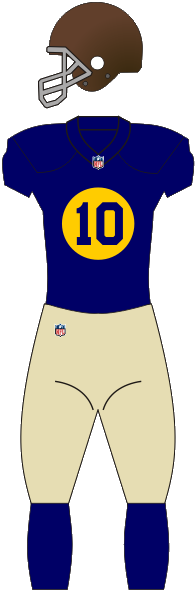
During the 2010 season, the Packers paid tribute to their historical roots with a throwback jersey modeled after that worn by the club in 1929, during its first championship season. The jersey was navy blue with a gold circle and navy numbers, again making the Packers "the Blues". These were then changed in 2015 to the navy blue throwback worn from 1937 to 1949, featuring gold shoulders and numbers. In 2021, the Packers changed their throwback thirds to an all-green design, resembling the uniforms worn from 1950 to 1953. Originally, the Packers wore brown helmets with the throwbacks, but in 2013, they started wearing their gold helmets without any decals due to the then-implementation of the NFL's one-shell rule; this rule has been abolished in 2022. As a result, they changed their throwbacks in both 2015 and 2021 to properly recreate those original uniforms, which had gold helmets with them. In 2025, the Packers unveiled a 1923 throwback navy blue uniform with dark gold numbers, tan pants and navy socks, featuring a special alternate helmet that was meticulously hand-painted to simulate the leather helmets of the era. The helmets would be equipped with navy blue facemasks.
The Packers' uniform manufacturer is Berlin-based Ripon Athletic, who has manufactured the team's uniforms since the 1960s. Upon the NFL's switch of uniform suppliers in 2012 to Nike from Reebok, the Packers refused any changes to their uniform in any way outside of the required supplier's logo and new league uniform logos, declining all of Nike's "Elite 51" enhancements, including retaining the traditional striped collar of the jersey rather than Nike's new collar design. However, in 2025, the Packers' new 1923 throwback uniform became the first to adopt Nike's "Vapor FUSE" template.
Rivalries
Divisional
Chicago Bears
Main article: Bears–Packers rivalry
The Packers and Chicago Bears have been rivals since their team's inception in 1920, becoming one of the oldest and most storied rivalries in the league's history. The Packers currently lead the series 107–95–6, and the teams have met thrice in the postseason. The Bears won the 1941 meeting, 33–14, and eventually defeated the New York Giants in the 1941 NFL Championship Game, and the Packers won the 2011 meeting, 21–14, en route to a Super Bowl XLV win over the Pittsburgh Steelers. The Bears defeated the Packers in the 2026 meeting, 31-27, on the way to an NFC Divisional Game loss to the Los Angeles Rams. The teams' first meeting was a victory for the Bears (known as the Staleys at the time) in 1921 in a shutout, 20–0. The Packers claimed their first win over the Bears in 1925, 14–10. The 1924 matchup (which ended in a 3–0 win for Chicago) was notable for featuring the first-ever ejection of players in a game in NFL history, as Frank Hanny of the Bears and Walter Voss of the Packers were ejected for punching each other. The rivalry also featured one of the last successful fair catch kicks in 1968, when Bears kicker Mac Percival kicked the game-winning field goal. As of the 2024 season, the Packers lead the all-time series 108–96–6.
Minnesota Vikings
Main article: Packers–Vikings rivalry
The rivalry between the Packers and Minnesota Vikings began in 1961, similar to their other divisional rivalries. It is also considered to be one of the most intense rivalries in the NFL, due to the intensity of most of the matchups over the years, As is the case with many of their respective state's college teams sharing a rivalry; (Minnesota and Wisconsin) have a rivalry in multiple sports, seen between the Big Ten rivals, the University of Wisconsin and University of Minnesota. Events such as Randy Moss mooning the Green Bay crowd in the first playoff game between these two teams (won by the Vikings), and former Packer great Brett Favre's move to the Vikings have created more resentment between these teams. The Packers lead the all-time series 66–60–3, despite the two teams splitting their two playoff contests.
Detroit Lions
Main article: Lions–Packers rivalry
The Packers' rivalry with the Detroit Lions has been another one of the oldest regular matchups in the NFL. They first met in 1930 when the Lions were known as the Portsmouth Spartans and based in Portsmouth, Ohio. The team eventually moved to Detroit for the 1934 season. The Lions and Packers have been division rivals since 1933 and have always met at least twice a season since 1932, without any canceled games between both rivals. The Packers lead the series 106–78–7 as of the end of the 2024 season, the first time in NFL history that a team has recorded 100 wins over an opponent.
Conference
Dallas Cowboys
Main article: Cowboys–Packers rivalry
The rivalry between the Packers and Dallas Cowboys has resulted in several notable games in league history, including the "Ice Bowl" and other games impacting the playoff race. The rivalry heated up during the 2010s, with several of their games impacting the NFC playoff race during that decade. During the Brett Favre era in Green Bay, the Cowboys dominated the rivalry, going 9–2 (including 9–0 in Dallas) against the Packers when Favre was the quarterback. However, in the Aaron Rodgers era from 2008 to 2022, the Packers have dominated the rivalry, as Rodgers had an 8–2 record against the Cowboys with Green Bay, including a perfect 3–0 record in Dallas. The Packers lead the all-time series 22–17. The Packers lead 5–4 in the playoffs, with the last playoff match taking place in January 2024 at AT&T Stadium in the Wild Card round with a 48–32 Packers win.
San Francisco 49ers
Main article: 49ers–Packers rivalry
The rivalry between the Packers and the San Francisco 49ers ignited during the 1990s, with the two teams facing each other in four consecutive playoff games. The Packers won four of five playoff games against the 49ers with Brett Favre as its quarterback, with four of those games pitting Favre against the 49ers' Hall of Fame quarterback Steve Young. Since 2012, the 49ers have defeated the Aaron Rodgers-led Packers four times in the playoffs. The Packers currently lead the series 39–34–1, but the 49ers have won the last four postseason meetings to take a 6–4 lead.
Seattle Seahawks
Main article: Packers–Seahawks rivalry
Following Seattle's relocation to the NFC in 2002, the Packers have faced the Seattle Seahawks multiple times in the playoffs, developing an intense rivalry as well. Some notable moments include the clubs' first playoff meeting in in which Seahawks quarterback Matt Hasselbeck threw a game-losing pick-six in overtime after guaranteeing a game-winning drive, the Fail Mary, and Russell Wilson overcoming four interceptions and a 16–0 Packers lead to lead Seattle to a 28–22 overtime win to advance to Super Bowl XLIX. As of the 2023 season, the Packers lead the all-time series 16–9.
New York Giants
Main article: Giants–Packers rivalry
The series between the Packers and New York Giants has been one of the oldest regular matchups in the league as the two teams first met in 1928. The two teams have played since 1970 in the National Football Conference, and they play each other in the regular season either every three years or depending on its NFC division placement, and in the postseason, The Packers lead the all-time series 34–28–2 and postseason series 5–3.
Tampa Bay Buccaneers
Main article: Buccaneers–Packers rivalry
The Tampa Bay Buccaneers and Packers were division rivals from 1977 to 2002 when both were in the NFC Central division. The teams have played several notable games, including a Snow Bowl game in 1985, a playoff game in 1998 and the NFC Championship Game in 2021. As of the 2024 season, the Packers lead the series 34–24–1.
Stadium history

After their early seasons at Bellevue Park and Hagemeister Park, the Packers played home games in City Stadium from 1925 to 1956. The team won its first six NFL championships there.
By the 1950s, the wooden 25,000-seat arena was considered outmoded. The NFL threatened to move the franchise to Milwaukee full-time unless it got a better stadium. The city responded by building a new 32,150 seat City Stadium for the team, the first built exclusively for an NFL team, which opened in time for the 1957 season. It was renamed Lambeau Field in 1965 to honor Curly Lambeau, who had died earlier in the year.
Expanded seven times before the end of the 1990s, Lambeau Field capacity reached 60,890. In 2003, it was extensively renovated to expand seating, modernize stadium facilities, and add an atrium area. Even with a current seating capacity of 72,928, ticket demand far outpaces supply, as all Packers games have been sold out since 1960. About 86,000 names are on the waiting list for season tickets.
The Packers played part of their home slate in Milwaukee starting in 1933, including two to three home games each year in Milwaukee's County Stadium from 1953 to 1994. Indeed, County Stadium had been built partly to entice the Packers to move to Milwaukee full-time. The Packers worked to capture their growing fan base in Milwaukee and the larger crowds. By the 1960s, the threat of an American Football League franchise in Milwaukee prompted the Packers to stay, including scheduling a Western Conference Championship game in 1967.
County Stadium was built primarily as a baseball stadium and made only the bare minimum adjustments to accommodate football. At its height, it only seated 56,000 people, just barely above the NFL minimum; many of those seats were badly obstructed. The field was just barely large enough to fit a football field. Both teams shared the same sideline (separated by a piece of tape) and the end zones extended onto the warning track. By 1994, improvements and seating expansions at Lambeau, along with the Brewers preparing to campaign for their new stadium prompted the Packers to play their full slate in Green Bay for the first time in 62 years. Former season ticketholders for the Milwaukee package continue to receive preference for one pre-season and the second and fifth regular-season games at Lambeau Field each season, along with playoff games through a lottery under the "Gold Package" plan.
The Packers have three practice facilities across the street from Lambeau Field in Ashwaubenon, Wisconsin: the Don Hutson Center, an indoor facility; Ray Nitschke Field, an outdoor field with artificial FieldTurf; and Clarke Hinkle Field, an outdoor field with natural grass.
The Packers Pro Shop has been the official retail store of the Packers since 1989. The primary retail store is located at Lambeau Field, having been expanded numerous times since it opened. The Pro Shop reported sales of over $7 million in 2015.
Statistics and records
Main article: List of Green Bay Packers team records
Season-by-season results
This is a partial list of the Packers' last five completed seasons. For the full season-by-season franchise results, see List of Green Bay Packers seasons.
Note: The finish, wins, losses, and ties columns list regular season results and exclude any postseason play.
| **Super Bowl champions** | **Conference champions** | **Division champions** | **Wild Card berth** |
|---|
As of January 2026
| Green Bay Packers}};" | Season | Green Bay Packers}};" | Team | Green Bay Packers}};" | League | Green Bay Packers}};" | Conference | Green Bay Packers}};" | Division | Green Bay Packers}};" | Regular season | Green Bay Packers}};" | Postseason results | Green Bay Packers}};" | Awards | Green Bay Packers}};" | Finish | Green Bay Packers}};" | Wins | Green Bay Packers}};" | Losses | Green Bay Packers}};" | Ties | [2021](2021-green-bay-packers-season) | [2022](2022-green-bay-packers-season) | [2023](2023-green-bay-packers-season) | [2024](2024-green-bay-packers-season) | [2025](2025-green-bay-packers-season) | ||||||||||
|---|---|---|---|---|---|---|---|---|---|---|---|---|---|---|---|---|---|---|---|---|---|---|---|---|---|---|---|---|---|---|---|---|---|---|---|---|---|---|
| NFL | NFC | North | 1st | 13 | 4 | 0 | Lost [Divisional Playoffs](2021-22-nfl-playoffs) ([49ers](2021-san-francisco-49ers-season)) 13–10 | — | ||||||||||||||||||||||||||||||
| NFL | NFC | North | 3rd | 8 | 9 | 0 | — | — | ||||||||||||||||||||||||||||||
| NFL | NFC | North | 2nd | 9 | 8 | 0 | **Won** [Wild-Card Playoffs](2023-24-nfl-playoffs) (at [Cowboys](2023-dallas-cowboys-season)) 48–32 | |||||||||||||||||||||||||||||||
| Lost [Divisional Playoffs](2023-24-nfl-playoffs) (at [49ers](2023-san-francisco-49ers-season)) 21–24 | — | |||||||||||||||||||||||||||||||||||||
| NFL | NFC | North | 3rd | 11 | 6 | 0 | Lost [Wild-Card Playoffs](2024-25-nfl-playoffs) (at [Eagles](2024-philadelphia-eagles-season)) 10–22 | — | ||||||||||||||||||||||||||||||
| NFL | NFC | North | 2nd | 9 | 7 | 1 | Lost [Wild-Card Playoffs](2025-26-nfl-playoffs) (at [Bears](2025-chicago-bears-season)) |
Records
Main article: List of Green Bay Packers team records
| Green Bay Packers}};" | All-Time Packers leaders | Green Bay Packers}};" | Leader | style=";" | Player | style=";" | Record Number | style=";" | Years on Packers | |||
|---|---|---|---|---|---|---|---|---|---|---|---|---|
| Passing | Brett Favre | |||||||||||
| Rushing | Ahman Green | |||||||||||
| Receiving | Donald Driver | |||||||||||
| Coaching wins | Curly Lambeau |
Playoff record
| Year | Game | Opponent | Result |
|---|---|---|---|
| 1936 | NFL Championship | Boston Braves | **W** 21–6 |
| 1938 | New York Giants | **L** 17–23 | |
| 1939 | New York Giants | **W** 27–0 | |
| 1941 | Western Division Championship | Chicago Bears | **L** 14–33 |
| 1944 | NFL Championship | New York Giants | **W** 14–7 |
| 1960 | Philadelphia Eagles | **L** 13–17 | |
| 1961 | New York Giants | **W** 37–0 | |
| 1962 | New York Giants | **W** 16–7 | |
| 1965 | Western Conference Championship | Baltimore Colts | **W** 13–10 (OT) |
| NFL Championship | Cleveland Browns | **W** 23–12 | |
| 1966 | Dallas Cowboys | **W** 34–27 | |
| Super Bowl I | Kansas City Chiefs | **W** 35–10 | |
| 1967 | Conference Championship | Los Angeles Rams | **W** 28–7 |
| NFL Championship | Dallas Cowboys | **W** 21–17 | |
| Super Bowl II | Oakland Raiders | **W** 33–14 | |
| 1972 | Divisional Round | Washington Redskins | **L** 3–16 |
| 1982 | First Round | St. Louis Cardinals | **W** 41–16 |
| Second Round | Dallas Cowboys | **L** 26–37 | |
| 1993 | Wild Card | Detroit Lions | **W** 28–24 |
| Divisional Round | Dallas Cowboys | **L** 17–27 | |
| 1994 | Wild Card | Detroit Lions | **W** 16–12 |
| Divisional Round | Dallas Cowboys | **L** 9–35 | |
| 1995 | Wild Card | Atlanta Falcons | **W** 37–20 |
| Divisional Round | San Francisco 49ers | **W** 27–17 | |
| NFC Championship | Dallas Cowboys | **L** 27–38 | |
| 1996 | Divisional Round | San Francisco 49ers | **W** 35–14 |
| NFC Championship | Carolina Panthers | **W** 30–13 | |
| Super Bowl XXXI | New England Patriots | **W** 35–21 | |
| 1997 | Divisional Round | Tampa Bay Buccaneers | **W** 21–7 |
| NFC Championship | San Francisco 49ers | **W** 23–10 | |
| Super Bowl XXXII | Denver Broncos | **L** 24–31 | |
| 1998 | Wild Card | San Francisco 49ers | **L** 27–30 |
| 2001 | NFC Wild Card | San Francisco 49ers | **W** 15–25 |
| Divisional Round | St. Louis Rams | **L** 17–45 | |
| 2002 | NFC Wild Card | Atlanta Falcons | **L** 7–27 |
| 2003 | NFC Wild Card | Seattle Seahawks | **W** 33–27 (OT) |
| Divisional Round | Philadelphia Eagles | **L** 17–20 (OT) | |
| 2004 | NFC Wild Card | Minnesota Vikings | **L** 17–31 |
| 2007 | Divisional Round | Seattle Seahawks | **W** 42–20 |
| NFC Championship | New York Giants | **L** 20–23 (OT) | |
| 2009 | NFC Wild Card | Arizona Cardinals | **L** 45–51 (OT) |
| 2010 | NFC Wild Card | Philadelphia Eagles | **W** 21–16 |
| Divisional Round | Atlanta Falcons | **W** 48–21 | |
| NFC Championship | Chicago Bears | **W** 21–14 | |
| Super Bowl XLV | Pittsburgh Steelers | **W** 31–25 | |
| 2011 | Divisional Round | New York Giants | **L** 20–37 |
| 2012 | NFC Wild Card | Minnesota Vikings | **W** 24–10 |
| Divisional Round | San Francisco 49ers | **L** 31–45 | |
| 2013 | NFC Wild Card | San Francisco 49ers | **L** 20–23 |
| 2014 | Divisional Round | Dallas Cowboys | **W** 26–21 |
| NFC Championship | Seattle Seahawks | **L** 22–28 (OT) | |
| 2015 | NFC Wild Card | Washington Redskins | **W** 35–18 |
| Divisional Round | Arizona Cardinals | **L** 20–26 (OT) | |
| 2016 | NFC Wild Card | New York Giants | **W** 38–13 |
| Divisional Round | Dallas Cowboys | **W** 34–31 | |
| NFC Championship | Atlanta Falcons | **L** 21–44 | |
| 2019 | Divisional Round | Seattle Seahawks | **W** 28–23 |
| NFC Championship | San Francisco 49ers | **L** 20–37 | |
| 2020 | Divisional Round | Los Angeles Rams | **W** 32–18 |
| NFC Championship | Tampa Bay Buccaneers | **L** 26–31 | |
| 2021 | Divisional Round | San Francisco 49ers | **L** 10–13 |
| 2023 | NFC Wild Card | Dallas Cowboys | **W** 48–32 |
| Divisional Round | San Francisco 49ers | **L** 21–24 | |
| 2024 | NFC Wild Card | Philadelphia Eagles | **L** 10–22 |
| 2025 | NFC Wild Card | Chicago Bears | **L** 27-31 |
| **Overall Playoff Record: 37–28** |
Championships
The Packers have been league champions a record 13 times, topping their nearest rival, the Chicago Bears, by four. The first three were decided by league standing, the next six by the NFL Title Game, and the last four by Super Bowl victories. The Packers are also the only team to win three consecutive NFL titles, having accomplished this twice—from 1929 to 1931 under Lambeau, and from 1965 to 1967 under Lombardi.
Super Bowl championships
Starting in 1966, the NFL began holding the Super Bowl. The Packers have won four Super Bowls.
| Green Bay Packers | border=2}}" | Year | Green Bay Packers | border=2}}" | Coach | Green Bay Packers | border=2}}" | Super Bowl | Green Bay Packers | border=2}}" | Location | Green Bay Packers | border=2}}" | Opponent | Green Bay Packers | border=2}}" | Score | Green Bay Packers | border=2}}" | Record |
|---|---|---|---|---|---|---|---|---|---|---|---|---|---|---|---|---|---|---|---|---|
| 1966 | Vince Lombardi | I | Los Angeles Memorial Coliseum (Los Angeles) | Kansas City Chiefs | 35–10 | 12–2 | ||||||||||||||
| 1967 | II | Orange Bowl (Miami) | Oakland Raiders | 33–14 | 9–4–1 | |||||||||||||||
| 1996 | Mike Holmgren | XXXI | Louisiana Superdome (New Orleans) | New England Patriots | 35–21 | 13–3 | ||||||||||||||
| 2010 | Mike McCarthy | XLV | Cowboys Stadium (Arlington, Texas) | Pittsburgh Steelers | 31–25 | 10–6 | ||||||||||||||
| **Total Super Bowls won: 4** |
NFL championships (pre Super Bowl era)
From 1933 to 1969, the NFL held a championship game to decide their champion. The Packers won 8 NFL Championship Games. From 1966 to 1969, the NFL Championship Game was followed by the Super Bowl.
| Green Bay Packers | border=2}}" | Year | Green Bay Packers | border=2}}" | Coach | Green Bay Packers | border=2}}" | Location | Green Bay Packers | border=2}}" | Opponent | Green Bay Packers | border=2}}" | Score | Green Bay Packers | border=2}}" | Record |
|---|---|---|---|---|---|---|---|---|---|---|---|---|---|---|---|---|---|
| 1936 | Curly Lambeau | Polo Grounds (New York) | Boston Redskins | 21–6 | 10–1–1 | ||||||||||||
| 1939 | Dairy Bowl (West Allis, Wisconsin) | New York Giants | 27–0 | 9–2 | |||||||||||||
| 1944 | Polo Grounds (New York) | New York Giants | 14–7 | 8–2 | |||||||||||||
| 1961 | Vince Lombardi | New City Stadium (Green Bay) | New York Giants | 37–0 | 11–3 | ||||||||||||
| 1962 | Yankee Stadium (New York) | New York Giants | 16–7 | 13–1 | |||||||||||||
| 1965 | Lambeau Field (Green Bay) | Cleveland Browns | 23–12 | 10–3–1 | |||||||||||||
| 1966 | Cotton Bowl (Dallas) | Dallas Cowboys | 34–27 | 12–2 | |||||||||||||
| 1967 | Lambeau Field (Green Bay) | Dallas Cowboys | 21–17 | 9–4–1 | |||||||||||||
| **Total NFL championships won: 8** |
NFC championships
The Packers have won three NFC Championship Games, with twice as many losses. NFC Championships did not exist before the AFL–NFL merger in 1970.
| Green Bay Packers | border=2}}" | Year | Green Bay Packers | border=2}}" | Coach | Green Bay Packers | border=2}}" | Location | Green Bay Packers | border=2}}" | Opponent | Green Bay Packers | border=2}}" | Score | Green Bay Packers | border=2}}" | Record |
|---|---|---|---|---|---|---|---|---|---|---|---|---|---|---|---|---|---|
| 1996 | Mike Holmgren | Lambeau Field (Green Bay) | [Carolina Panthers](1996-carolina-panthers-season) | 30–13 | 13–3 | ||||||||||||
| 1997 | [3Com Park](3com-park) (San Francisco) | [San Francisco 49ers](1997-san-francisco-49ers-season) | 23–10 | 13–3 | |||||||||||||
| 2010 | Mike McCarthy | Soldier Field (Chicago) | [Chicago Bears](2010-chicago-bears-season) | 21–14 | 10–6 | ||||||||||||
| **Total NFC Championships won: 3** |
NFL championship by standings
From 1920 to 1932, the NFL championship was awarded based on standings, with no championship game taking place. The Packers won three such championships.
| Green Bay Packers | border=2}}" | Year | Green Bay Packers | border=2}}" | Coach | Green Bay Packers | border=2}}" | Record |
|---|---|---|---|---|---|---|---|---|
| 1929 | Curly Lambeau | 12–0–1 | ||||||
| 1930 | 10–3–1 | |||||||
| 1931 | 12–2 | |||||||
| **Total NFL championships by best record: 3** |
Division Championships
The Packers have won 21 divisional championships.
| Green Bay Packers | border=2}}" | Year | Green Bay Packers | border=2}}" | Coach | Green Bay Packers | border=2}}" | Division | Green Bay Packers | border=2}}" | Record |
|---|---|---|---|---|---|---|---|---|---|---|---|
| 1936 | Curly Lambeau | NFL West | 10–1–1 | ||||||||
| 1938 | 8–3 | ||||||||||
| 1939 | 9–2 | ||||||||||
| 1944 | 8–2 | ||||||||||
| 1967 | Vince Lombardi | NFL Central | 9–4–1 | ||||||||
| 1972 | Dan Devine | NFC Central | 10–4 | ||||||||
| 1995 | Mike Holmgren | 11–5 | |||||||||
| 1996 | 13–3 | ||||||||||
| 1997 | 13–3 | ||||||||||
| 2002 | Mike Sherman | NFC North | 12–4 | ||||||||
| 2003 | 12–4 | ||||||||||
| 2004 | 10–6 | ||||||||||
| 2007 | Mike McCarthy | 13–3 | |||||||||
| 2011 | 15–1 | ||||||||||
| 2012 | 11–5 | ||||||||||
| 2013 | 8–7–1 | ||||||||||
| 2014 | 12–4 | ||||||||||
| 2016 | 10–6 | ||||||||||
| 2019 | Matt LaFleur | 13–3 | |||||||||
| 2020 | 13–3 | ||||||||||
| 2021 | 13–4 | ||||||||||
| **Total NFC Divisional Championships won: 21** |
Notable players
Main article: Lists of Green Bay Packers players
Current roster
Pro Football Hall of Fame members
Main article: List of Green Bay Packers in the Pro Football Hall of Fame
The Packers have the second most members in the Pro Football Hall of Fame with 30, 25 of which were inducted as Packers. They trail only the Chicago Bears with 37 Hall of Famers, 30 of which were inducted as Bears.
| Green Bay Packers | border=2}};" | Green Bay Packers Pro Football Hall of Famers | Green Bay Packers}};color:#203731;" | Players | No. | Name | Positions | Seasons | Inducted | No. | Name | Positions | Seasons | Inducted | Green Bay Packers}};color:#203731;" | Coaches and Executives | Name | Positions | Seasons | Inducted |
|---|---|---|---|---|---|---|---|---|---|---|---|---|---|---|---|---|---|---|---|---|
| 26 | **Herb Adderley** | CB | 1961–1969 | 1980 | 64 | **Jerry Kramer** | G | 1958–1968 | 2018 | |||||||||||
| 36 | **LeRoy Butler** | S | 1990–2001 | 2022 | 20 | **Earl (Curly) Lambeau** | HB | |||||||||||||
| Coach | 1919–1929 | |||||||||||||||||||
| 1930–1949 | 1963 | |||||||||||||||||||
| 3 | **Tony Canadeo** | HB | 1941–1944 | |||||||||||||||||
| 1946–1952 | 1974 | 80 | **James Lofton** | WR | 1978–1986 | 2003 | ||||||||||||||
| 87 | **Willie Davis** | DE | 1960–1969 | 1981 | 24 | **Johnny "Blood" McNally** | HB | 1929–1933 | ||||||||||||
| 1935–1936 | 1963 | |||||||||||||||||||
| 44 | **Bobby Dillon** | S | 1952–1959 | 2020 | 2 | **Mike Michalske** | OG | 1929–1935 | ||||||||||||
| 1937 | 1964 | |||||||||||||||||||
| 4 | **Brett Favre** | QB | 1992–2007 | 2016 | 66 | **Ray Nitschke** | LB | 1958–1972 | 1978 | |||||||||||
| 75 | **Forrest Gregg** | OT | 1956 | |||||||||||||||||
| 1958–1970 | 1977 | 51 | **Jim Ringo** | C | 1953–1963 | 1981 | ||||||||||||||
| 56 | Ted Hendricks | LB | 1974 | 1990 | 89 | **Dave Robinson** | LB | 1963–1972 | 2013 | |||||||||||
| 38 | **Arnie Herber** | QB | 1930–1940 | 1966 | 84 | **Sterling Sharpe** | WR | 1988–1994 | 2025 | |||||||||||
| 30 | **Clarke Hinkle** | FB | 1932–1941 | 1964 | 15 | **Bart Starr** | QB | 1956–1971 | 1977 | |||||||||||
| 5 | **Paul Hornung** | HB | 1956–1962 | |||||||||||||||||
| 1964–1966 | 1986 | 31 | **Jim Taylor** | FB | 1958–1966 | 1976 | ||||||||||||||
| 36 | **Cal Hubbard** | OT | 1929–1933 | |||||||||||||||||
| 1935 | 1963 | 92 | **Reggie White** | DE | 1993–1998 | 2006 | ||||||||||||||
| 14 | **Don Hutson** | E | 1935–1945 | 1963 | 24 | **Willie Wood** | S | 1960–1971 | 1989 | |||||||||||
| 74 | **Henry Jordan** | DT | 1959–1969 | 1995 | 21 | **Charles Woodson** | CB | 2006–2012 | 2021 | |||||||||||
| **Vince Lombardi** | Coach | 1959–1967 | 1971 | |||||||||||||||||
| **Ron Wolf** | General manager | 1991–2001 | 2015 |
Wisconsin Athletic Hall of Fame
Main article: Wisconsin Athletic Hall of Fame
Many Packers players and coaches are also enshrined in the Wisconsin Athletic Hall of Fame. In 2018 Ron Wolf, the most recent Packers contributor to be honored, was inducted.
Retired numbers
Main article: List of Green Bay Packers retired numbers
In nearly nine decades of Packers football, the Packers have formally retired six numbers. All six Packers are members of the Pro Football Hall of Fame and their numbers and names are displayed on the green facade of Lambeau Field's north endzone as well as in the Lambeau Field Atrium.
| Green Bay Packers}}; padding:0.3em;" | **Tony Canadeo** | |
|---|---|---|
| HB, 1941–1944, 1946–1952 | ||
| Retired 1952 | Green Bay Packers}}; padding:0.3em;" | **Brett Favre** |
| QB, 1992–2007 | ||
| Retired 2015 | Green Bay Packers}}; padding:0.3em;" | **Don Hutson** |
| WR, 1935–1945 | ||
| Retired 1951 | Green Bay Packers}}; padding:0.3em;" | **Bart Starr** |
| QB, 1956–71 | ||
| Retired 1973 | Green Bay Packers}}; padding:0.3em;" | **Ray Nitschke** |
| LB, 1958–1972 | ||
| Retired 1983 | Green Bay Packers}}; padding:0.3em;" | **Reggie White** |
| DE, 1993–1998 | ||
| Retired 2005 |
Green Bay Packers Hall of Fame
Main article: Green Bay Packers Hall of Fame
The Green Bay Packers Hall of Fame was the first hall of fame built to honor a single professional American football team. John P. Holloway, a Brown County administrator and arena director, and William L. Brault, a Green Bay restaurateur and Packers fan, co-founded the Packer Hall of Fame museum in 1966.
As of 2019, the Packers Hall of Fame has inducted 162 people, 24 of whom have been inducted into the Pro Football Hall of Fame.
Notable coaches
Current staff
Head coaches
Main article: List of Green Bay Packers head coaches
| Name | Tenure | Record | Titles | W | L | T |
|---|---|---|---|---|---|---|
| Earl (Curly) Lambeau | 1919–1949 | 231 | 108 | 21 | 6 | |
| Gene Ronzani | 1950–1953 | 14 | 31 | 1 | ||
| Hugh Devore* | 1953 | 0 | 2 | 0 | ||
| Ray (Scooter) McLean* | ||||||
| Lisle Blackbourn | 1954–1957 | 17 | 31 | 0 | ||
| Ray (Scooter) McLean | 1958 | 1 | 10 | 1 | ||
| Vince Lombardi | 1959–1967 | 98 | 30 | 4 | 5 | |
| Phil Bengtson | 1968–1970 | 20 | 21 | 1 | ||
| Dan Devine | 1971–1974 | 25 | 28 | 4 | ||
| Bart Starr | 1975–1983 | 53 | 77 | 3 | ||
| Forrest Gregg | 1984–1987 | 25 | 37 | 1 | ||
| Lindy Infante | 1988–1991 | 24 | 40 | 0 | ||
| Mike Holmgren | 1992–1998 | 73 | 36 | 0 | 1 | |
| Ray Rhodes | 1999 | 8 | 8 | 0 | ||
| Mike Sherman | 2000–2005 | 56 | 39 | 0 | ||
| Mike McCarthy | 2006–2018 | 125 | 77 | 2 | 1 | |
| Joe Philbin* | 2018 | 2 | 2 | 0 | ||
| Matt LaFleur | 2019–present | 79 | 46 | 1 |
*Interim head coaches
Media
The Packers are unique in having their market area cover two media markets, both Green Bay and Milwaukee. NFL blackout restrictions for the team apply within both areas. However, Packers games have not been blacked out locally since 1972 (the last year home game local telecasts were prohibited regardless of sellout status) due to strong home attendance and popularity. As mentioned above, every Packers home game—preseason, regular season and playoffs—has been sold out since 1960.
Radio
The flagship station of the Packers Radio Network is iHeartMedia's WRIT-FM (95.7) in Milwaukee. Formerly, Good Karma Brands's WTMJ in Milwaukee, served as the flagship station, and had broadcast the team's games since 1929, producing the games until the end of the 2018 season, when the team brought their broadcast operations in-house, thus the personnel is directly employed by the team. WTMJ's relationship with the team was the longest-lived between a radio station and an NFL team, and the only rights deal in American professional sports where a station outside of the team's main metro area is the radio flagship, as WTMJ's signal is city-grade across eastern Wisconsin. Games air in Green Bay on WTAQ (1360/97.5) and WIXX-FM (101.1), and WYDR (94.3) in Appleton and the Fox Cities.
Wayne Larrivee is the play-by-play announcer and Larry McCarren is the color analyst. Larrivee joined the team after many years as the Chicago Bears' announcer. Jim Irwin and Max McGee were the longtime radio announcers before Larrivee and McCarren. When victory is assured for the Packers, either a game-winning touchdown, interception or a crucial 4th down defensive stop, Larrivee's trademark declaration of "And there is your dagger!" signifies the event.
On October 27, 2021, the Packers announced that it would end its longtime association with WTMJ at the end of the season, with WRNW becoming the team's Milwaukee radio affiliate in 2022. WRIT-FM became the team's Milwaukee affiliate starting with the team's away game with Arizona on October 19, 2025, after WRNW switched to an adult contemporary format after layoffs which affected most of the sports talk station's hosts and personnel.
Television
The TV rights for pre-season games not nationally broadcast are held by E. W. Scripps Company-owned television stations WGBA-TV (channel 26) in Green Bay and WTMJ-TV (channel 4) in Milwaukee; the game broadcasts are distributed to 19 further TV stations in Wisconsin, Michigan, North Dakota, South Dakota, Iowa, Nebraska, Illinois, Missouri, and Alaska, as well as Spanish-language WYTU-LD "Telemundo Wisconsin" in Milwaukee (also broadcast on its sister station WMEI in Green Bay, usually an English-language MeTV station). The deal marked a change in affiliate in Green Bay from WFRV-TV; in the wake of the 2012 deal, McCarren resigned his duties as sports director of WFRV to move to WTMJ/WGBA as a Packers analyst, becoming WGBA's official sports director on April 1, 2013. McCarren left WGBA in 2015 and became a team employee. Spectrum News 1 also rebroadcasts team programming, including the team's two programs aired across the preseason network on weeknights before prime time; Packers Live and The Matt LeFleur Show, respectively.
The team's intra-squad Lambeau scrimmage at the beginning of the season, marketed as Packers Family Night, was produced for over a decade by WLUK-TV in Green Bay and broadcast by the state's Fox affiliates through the 2016 season. In 2017, Scripps and the Packers Television Network began to originate the Packers Family Night broadcast.
Preseason television games are announced by Kevin Harlan, son of former Packers president Bob Harlan, and color commentator Rich Gannon. Regular-season and postseason games not aired on a broadcast network are simulcast on broadcast stations in the Green Bay and Milwaukee markets.
In popular culture
On the television sitcom That '70s Show, in season 7 episode 14, Donna Pinciotti gives the gang and Red Forman, a long-time Packers fan, six free tickets to Lambeau Field for a Bears–Packers game. Eric (who has no interest in football himself, including not knowing Packers lore) wears a Walter Payton jersey to the game, with Packers fans teasing and booing him for doing so. In the season 8 finale, Red declines to move to Florida after Steven Hyde acquires a season ticket package for him.
In 2015, five members of the Packers (David Bakhtiari, Don Barclay, T. J. Lang, Clay Matthews, and Josh Sitton) made an appearance as an a cappella group in the musical comedy Pitch Perfect 2. Aaron Rodgers' brother Jordan also appeared. That same year, Rodgers himself appeared in an episode of the sketch comedy television series Key & Peele, along with Ha Ha Clinton-Dix.
In the television series Danny Phantom, the main antagonist, Vlad Masters/Vlad Plasmius, is a Packers "Fanatic". His prized possession is a football autographed by Ray Nitschke, and his dream is to own the team.
In the 1998 film There's Something about Mary, Mary, played by actress Cameron Diaz, consistently talks about her boyfriend "Brett". It is revealed towards the end of the film that "Brett" is then-Packers' quarterback Brett Favre.
References
; Notes
; Citations
References
- "Packers Timeline".
- (July 28, 2023). "2023 Green Bay Packers Media Guide". NFL Enterprises, LLC.
- (July 20, 2022). "2022 Official National Football League Record and Fact Book". NFL Enterprises, LLC.
- "Executive Committee & Board Of Directors".
- "Shareholders".
- (September 12, 2018). "2018 Green Bay Packers Media Guide". NFL Enterprises.
- Christl, Cliff. (March 23, 2017). "The Acme Packers were short-lived". Packers.com.
- Names, Larry D.. (1987). "The History of the Green Bay Packers: The Lambeau Years". Angel Press of WI.
- (January 14, 2017). "History of Champions: Packers are No. 1 in NFL". [[Green Bay Press-Gazette]].
- "Packers Championship Seasons".
- (September 25, 2013). "2013 Official National Football League Record and Fact Book". NFL Enterprises, LLC.
- "Green Bay Packers Team History". NFL Enterprises, LLC.
- (January 25, 2011). "Those Non-Profit Packers".
- Gordon, Grant. (December 4, 2022). "Packers earn NFL-record 787th victory in franchise history, moving past rival Bears for first time". NFL Enterprises, LLC.
- "Most NFL Wins Since 1920".
- Bain, Katie. (July 31, 2017). "The Green Bay Packers Are the NFL's Great Rural Anomaly".
- Zanghi, Peter. (October 2, 2014). "The Packers' roots run deep in Milwaukee".
- Prigge, Matthew J.. (January 2, 2018). "How the Packers Kept Milwaukee a One-Team Town".
- "No screen pass: Packers-Vikings not on TV in some areas". Milwaukee Journal Sentinel.
- Graney, Ed. (October 20, 2019). "Mystique of Lambeau Field welcomes Raiders to Green Bay".
- Badenhausen, Kurt. (July 22, 2019). "The World's 50 Most Valuable Sports Teams 2019".
- "Green Bay Packers Coaches".
- (January 14, 2024). "Green Bay Packers Playoff History".
- "List of all the Pro Football Franchises".
- "Super Bowls & Championships". Green Bay Packers.
- "Green Bay Packers Team Encyclopedia".
- (1987). "The History of the Green Bay Packers: The Lambeau Years". Angel Press of WI.
- Christl, Cliff. (March 23, 2017). "The Acme Packers were short-lived".
- Hendricks, Martin. (June 3, 2009). "A name 90 years in the making".
- Christl, Cliff. (May 26, 2016). "The truth and myth about 'The Hungry Five'".
- M’Glynn, Stoney. "Dec. 8, 1929: Packers earn first league title".
- (January 14, 2017). "History of Champions: Packers are No. 1 in NFL".
- Jones, Brian. (June 22, 2017). "Packers explain why three championship trophies missing in HOF".
- "Team Records: Games Won". National Football League.
- Stephenson, Creg. (July 1, 2016). "Don Hutson, the Babe Ruth of wide receivers and Alabama's greatest football player".
- Kruse, Zach. (July 10, 2024). "Uniform numbers retired by the Green Bay Packers". USA Today.
- Lea, Bud. (July 16, 1997). "Last of the Legends: Don Hutson one of a kind".
- Fleming, David. (September 27, 2013). "Blaze of Glory". [[ESPN]].
- "Gene Ronzani Record, Statistics, and Category Ranks".
- "Lisle Blackbourn Record, Statistics, and Category Ranks".
- Maraniss, David. (September 14, 1999). "In throes of winter, a team in disarray is reborn". [[Milwaukee Journal Sentinel]].
- Johnson, Chuck. (January 28, 1959). "Jan. 28, 1959: Packers Hire Vince Lombardi".
- "1959 Green Bay Packers Rosters, Stats, Schedule, Team Draftees".
- "AP Coach of the Year Winners".
- "1960 Green Bay Packers Rosters, Stats, Schedule, Team Draftees".
- "1960 NFL Scoring Summary".
- Lea, Bud. (December 26, 1960). "Dec. 26, 1960: Eagles Win NFL Title".
- Pennington, Bill. (January 16, 2008). "Out of the Icebox, the N.F.L. Caught Fire". [[The New York Times]].
- "1961 Green Bay Packers Rosters, Stats, Schedule, Team Draftees".
- Wallace, William N.. (January 21, 2008). "In Previous Title Game, Giants No Match for Lombardi's Packers".
- "1962 Green Bay Packers Rosters, Stats, Schedule, Team Draftees".
- (December 21, 1962). "Green Bay Coach Vince Lombardi".
- Dederer, John. (January 30, 2014). "Freezing With the Giants in '62".
- "1963 Green Bay Packers Rosters, Stats, Schedule, Team Draftees".
- "1964 Green Bay Packers Rosters, Stats, Schedule, Team Draftees".
- "Divisional Round – Baltimore Colts at Green Bay Packers – December 26th, 1965".
- Stellino, Vito. (August 13, 2011). "NFL Confidential: Vince Lombardi's legendary Green Bay Packers had a few close calls".
- Schudel, Jeff. (December 24, 2021). "56 years ago, Browns lost 1965 NFL championship to Packers in Lambeau quagmire".
- Bink, Addy. (February 11, 2024). "Why the NFL goal posts aren't where they used to be".
- "AP NFL Most Valuable Player Winners".
- "1966 Green Bay Packers Rosters, Stats, Schedule, Team Draftees".
- Maule, Tex. (January 9, 1967). "GREEN BAY ROLLS HIGH".
- Hand, Jack. (January 31, 2022). "AP WAS THERE: Packers bombard Chiefs, 35–10, in Super Bowl".
- "Vince Lombardi Record, Statistics, and Category Ranks".
- (December 28, 2017). "AP Was There: 1967 Cowboys–Packers Ice Bowl game". USA Today.
- "The 100 Greatest Moments in Sports History {{!}} The Ice Bowl".
- Maule, Tex. (January 8, 1968). "Bart Starr and the Packers beat Dallas in the Ice Bowl".
- Maule, Tex. (January 22, 1968). "Super Bowl II: Packers beat Raiders on an off day".
- (February 2, 1968). "Lombardi Quits as Packers' Coach, but Stays With Club; BENGTSON GIVEN GREEN BAY POST Lombardi Will Retain Job as General Manager of Champion Eleven".
- Maraniss, David. (January 7, 2016). "When Vince Lombardi left Green Bay for Washington, one town wept. The other cheered.". Washington Post.
- Wallace, William N.. (September 4, 1970). "Vince Lombardi, Football Coach, Dies".
- Gardner, Steve. (February 11, 2024). "Lombardi Trophy: History, facts about Super Bowl champion prize".
- (January 19, 2024). "The Lean Years (1968–1991) Archives".
- D'Amato, Gary. (January 2, 2015). "The Sorry Years".
- [http://www2.jsonline.com:80/packer/insider/history/oldschool/ Old School Packers] {{webarchive. link. (February 18, 2006 from the [[Milwaukee Journal Sentinel]] website. Retrieved February 5, 2007)
- "1989 NFL Draft".
- Low, Chris. (July 20, 2004). "ESPN25: The 25 Biggest Sports Flops of 1979–2004".
- Demovsky, Rob. (February 1, 2015). "Former Packers GM Ron Wolf selected to Pro Football Hall of Fame".
- McGinn, Bob. (January 11, 1992). "Jan. 11, 1992: Ron Wolf gets the man he wants, at a price".
- (February 11, 1992). "How Brett Favre landed in Green Bay – from those who made it happen".
- Yasinskas, Pat. (March 4, 2008). "Yasinskas: Majkowski recalls birth of Favre's legacy".
- Trister, Noah. (December 13, 2010). "Brett Favre finally sits: Streak ends at 297 consecutive starts".
- Radcliffe, JR. (April 9, 2018). "Reggie White: 25 years later, Packers free-agent signing resonates".
- "1993 Green Bay Packers Rosters, Stats, Schedule, Team Draftees".
- "1994 Green Bay Packers Rosters, Stats, Schedule, Team Draftees".
- "NFC Championship – Green Bay Packers at Dallas Cowboys – January 14th, 1996".
- "1995 Green Bay Packers Rosters, Stats, Schedule, Team Draftees".
- "1996 Green Bay Packers Rosters, Stats, Schedule, Team Draftees".
- "1996 NFL Standings & Team Stats".
- Manoloff, Dennis. (January 26, 2017). "20 years ago, Desmond Howard was magnificent for Green Bay Packers in Super Bowl XXXI".
- "1997 Green Bay Packers Rosters, Stats, Schedule, Team Draftees".
- (January 25, 1998). "Super Bowl XXXII: Elway, AFC Finally Have Super Moment". Washington Post.
- "ESPN.com: Instant replay comes back to haunt Holmgren". ESPN.
- (January 11, 1999). "Rhodes Is Packers New Coach".
- (January 3, 2000). "Hit The Rhodes! Pack Fire Ray".
- (January 17, 2000). "Packers Hire Coach Sherman".
- (January 2, 2006). "Packers' Sherman loses job after first losing season".
- Pasquarelli, Len. (January 12, 2006). "Big cheese: Packers hire 49ers' McCarthy".
- "2006 Green Bay Packers Statistics & Players".
- (November 20, 2006). "Packers' Rodgers out for season; Favre likely to play". ESPN.
- (February 2, 2007). "Favre To Return In 2007".
- "McCarthy stays true to Packers' plan, sits atop NFC with best start among active coaches".
- (January 13, 2008). "Playful Favre accurate even with snowball".
- (January 7, 2017). "9 years ago, the Giants froze out Brett Favre in his last game as a Packer".
- (January 7, 2008). "Green Bay GM signs contract extension".
- (February 5, 2008). "NFL Report: Packers' McCarthy signs five-year deal".
- (March 4, 2008). "Favre announces his retirement from Packers".
- (August 6, 2008). "Packers trade Favre to Jets". Fox Sports on MSN.
- "2008 Green Bay Packers Rosters, Stats, Schedule, Team Draftees".
- Mortensen, Chris. (January 19, 2009). "Capers joins Packers as defensive coordinator".
- "Brett Favre: Game Logs at". National Football League.
- "2009 Green Bay Packers Rosters, Stats, Schedule, Team Draftees, Injury Reports".
- Baum, Bob. (January 10, 2010). "Cardinals top Packers in OT, 51–45".
- "2009 Season Review Dope Sheet".
- Kyle Staff. (January 16, 2010). "Green Bay Packers 2000s All-Decade Team".
- (September 9, 2009). "Decade of Dominance {{!}} Pro Football Hall of Fame Official Site".
- (July 16, 2010). "NFL bans Packers' Jolly for 2010, maybe more".
- (September 14, 2010). "Packers place RB Grant on season-ending IR".
- Smith, Michael David. (January 25, 2011). "Packers lost close games like no other team, ever".
- Kruse, Zach. (May 24, 2011). "Green Bay Packers: The 10 Biggest Moments of the Packers' 2010 Super Bowl Season".
- (October 24, 2010). "Vikings vs. Packers – Game Summary". ESPN.
- "2010 Green Bay Packers Statistics & Players".
- Seifert, Kevin. (February 7, 2011). "McCarthy had Pack fitted for rings Saturday".
- Silverstein, Tom. (February 6, 2011). "McCarthy had players fitted for Super Bowl rings Saturday night".
- McGinn, Bob. (February 7, 2011). "Green Bay holds on to win fourth Super Bowl title".
- (February 7, 2011). "Super Bowl XLV, Packers Beat Steelers, 31–25". The New York Times.
- Farmer, Sam. (February 7, 2011). "Ending is cheddar-perfect for Packers in Super Bowl XLV victory over Steelers". [[Los Angeles Times]].
- (February 6, 2011). "Steelers vs. Packers – Game Summary". ESPN.
- "Rodgers, Packers top Steelers 31–25 to win Super Bowl XLV".
- Hutchins, Andy. (February 4, 2012). "Aaron Rodgers Named 2011 NFL MVP By AP At NFL Honors Ceremony".
- "NFL 100". National Football League.
- (January 15, 2012). "Packers done in by mistakes, Giants in 37–20 loss".
- "2012 Green Bay Packers Schedule & Game Results".
- "2012 Green Bay Packers football Roster on StatsCrew.com".
- Wilner, Barry. (July 31, 2012). "Packers top first-ever AP Pro32 rankings". [[The Washington Times]].
- Farmer, Sam. (November 5, 2013). "Aaron Rodgers confirms he has broken collarbone".
- "A look back at the Packers' 2013 season".
- (January 5, 2014). "49ers Edge Packers 23–20 In Frigid Wild-Card Game".
- Ketchman, Vic. (September 28, 2014). "Win over Bears feels like season saver". Green Bay Packers.
- "Infographic: Packers 2014 season review".
- Merrill, Elizabeth. (January 15, 2015). "Hot Read: Mike McCarthy ideal for Green Bay".
- Reischel, Rob. (January 9, 2020). "A Look Back At The 2014 NFC Championship Game".
- Brinson, Will. (February 1, 2015). "Aaron Rodgers bests J.J.Watt for 2014 NFL MVP Award".
- Wesseling, Chris. (August 23, 2015). "Jordy Nelson out for 2015 season with knee injury". National Football League.
- "Green Bay Packers 2015 Regular Season Schedule". National Football League.
- Rosenthal, Gregg. (December 3, 2015). "Packers stun Lions on Aaron Rodgers' Hail Mary TD". National Football League.
- "Ranking Aaron Rodgers' three Hail Mary completions". National Football League.
- (December 13, 2015). "McCarthy reclaims play calling for Packers offense". ESPN.
- Farmer, Sam. (January 17, 2016). "Cardinals survive a successful Hail Mary to beat Packers in overtime".
- "Packers' season-ending Dope Sheet".
- Stapleton, Art. (January 9, 2017). "Giants' season ends in a blink in 38–13 loss to Packers".
- (January 16, 2017). "Green Bay Packers defeat Dallas Cowboys in final seconds 34–31".
- (January 22, 2017). "Atlanta Falcons rout Green Bay Packers 44–21, next stop: Super Bowl".
- "2017 NFL Regular Season Standings – Nation Football League". ESPN.
- Boren, Cindy. (October 15, 2017). "Aaron Rodgers could be out for the season, a sobering possibility for the Packers". The Washington Post.
- (November 4, 2017). "Packers: Aaron Rodgers to return this season if collarbone heals and 'it would make sense'".
- (December 24, 2017). "Aaron Rodgers's Return to Injured Reserve May Have Violated League Rules".
- (January 16, 2018). "Packers WR Davante Adams named to 2018 Pro Bowl".
- "Green Bay Packers shut out for first time in more than a decade".
- Murray, Patty. (November 30, 2017). "Packers Open New Part of Titletown District". Wisconsin Public Radio.
- (December 17, 2018). "Packers miss playoffs for second straight year".
- "Green Bay Packers 2018 Game Log".
- Demovsky, Rob. (December 5, 2018). "Joe Philbin focused on interim coaching job, not permanent one".
- Shook, Nick. (December 2, 2018). "Packers fire coach Mike McCarthy after 13 seasons". National Football League.
- Felt, Hunter. (December 3, 2018). "Why the Green Bay Packers fired Mike McCarthy". The Guardian.
- "Mike McCarthy Record, Statistics, and Category Ranks".
- (February 4, 2019). "Tracing LaFluer's path from D.C. assistant to Packers head coach".
- Gordon, Grant. (March 25, 2019). "Packers-Bears rivalry kicks off 2019 NFL season". National Football League.
- Pierangeli, Greg. (December 31, 2019). "13–3? Yes, the Packers are 13–3!".
- Spofford, Mike. (January 19, 2020). "Packers fall to 49ers in NFC title game, 37–20".
- (December 14, 2020). "Green Bay Packers clinch NFC North with win over Detroit Lions as No. 1 seed remains in play". ESPN.
- (January 17, 2021). "Rodgers, Packers beat Rams 32–18 to reach NFC title game".
- Patra, Kevin. (January 24, 2021). "Tom Brady, Buccaneers stave off Packers for NFC Championship Game win, trip to Super Bowl LV". National Football League.
- Curtis, Jake. (February 7, 2021). "Aaron Rodgers Wins His Third NFL MVP Award and Announces He's Engaged".
- Renner, Michael. (November 16, 2021). "The Green Bay Packers finally have a dominant defense, and it makes them NFC favorites {{!}} NFL News, Rankings and Statistics".
- Johnson, Leslie. (February 19, 2022). "Packers: Special teams, O-line more to blame than Rodgers in 49ers loss".
- Huber, Bill. (January 2, 2022). "Because of Rodgers' Mastery, Packers Eye Lucky 13".
- Schneidman, Matt. (February 10, 2022). "Packers' Aaron Rodgers wins NFL MVP for fourth time".
- Birkett, Dave. (January 9, 2023). "Detroit Lions upset Packers, 20–16, knock them from playoffs".
- Wood, Ryan. (January 9, 2023). "Packers come up short of playoffs in 20–16 season-finale loss to Lions".
- (April 26, 2023). "Packers trade QB Aaron Rodgers to New York Jets".
- (April 24, 2020). "2020 NFL Draft: Packers select Utah State QB Jordan Love in first round, No. 26 overall".
- (February 8, 2024). "Packers' 2023 season-ending Dope Sheet".
- (January 15, 2024). "Packers knock off Cowboys in wild-card round, 48–32".
- (January 21, 2024). "Packers fall to 49ers, 24–21, in NFC Divisional playoff".
- (January 24, 2024). "Packers announce coaching staff change".
- Hodkiewicz, Wes. (January 2, 2025). "Three Green Bay Packers chosen for 2025 Pro Bowl Games".
- Gordon, Grant. (August 26, 2024). "Titans trading QB Malik Willis to Packers in exchange for seventh round pick".
- Hodkiewicz, Wes. (September 27, 2024). "One month later, Malik Willis trade has paid major dividends for Packers".
- (January 31, 2024). "Packers name Jeff Hafley defensive coordinator".
- Spofford, Mike. (October 23, 2024). "Former Jets coach Robert Saleh assisting Packers on offense".
- Patra, Kevin. (October 8, 2024). "Jets fire Robert Saleh after 2–3 start; DC Jeff Ulbrich named interim head coach".
- "Packers Standings".
- (January 12, 2025). "Packers fall in NFC Wild Card playoff to Eagles, 22–10".
- Hodkiewicz, Wes. (August 29, 2025). "Micah Parsons heard Packers fans loud and clear".
- (April 10, 2025). "2025 NFL Draft presented by Bud Light kicks off April 24 in Green Bay".
- Hodkiewicz, Wes. (July 25, 2025). "Mark Murphy sees bright future for Packers under Ed Policy".
- Shook, Nick. (June 24, 2024). "Ed Policy named Packers' next chairman, president and CEO, to take over for Mark Murphy in 2025".
- (August 28, 2025). "Packers agree to terms on trade with Cowboys, acquire DL Micah Parsons".
- Gordon, Grant. (November 3, 2025). "Packers TE Tucker Kraft to miss remainder of season with torn ACL".
- (December 15, 2025). "MRI confirms Packers star Micah Parsons suffered torn ACL vs. Broncos".
- (January 4, 2026). "Packers fall to Vikings, 16-3".
- (January 10, 2026). "Packers lose to Bears in NFC Wild Card playoffs, 31-27".
- "Executive Committee And Board of Directors". Green Bay Packers.
- (January 31, 2011). "The right way? The Green Bay Way". ESPN.
- Saunders, Laura. (January 13, 2012). "Are the Green Bay Packers the Worst Stock in America?". [[The Wall Street Journal]].
- "2010 Census". [[US Census Bureau]].
- Allen, Mara. (November 20, 2021). "8 Fun Facts About the Packers' Stock Sale".
- (February 25, 2022). "Green Bay Packers stock sale ends Friday".
- (January 22, 2015). "Shareholder History & Financial History". Green Bay Packers.
- "Home". SportsBusiness Journal.
- Anon., [https://www.packers.com/community/packers-foundation "Green Bay Packers Foundation"] {{Webarchive. link. (August 8, 2018 , [[Green Bay Packers, Inc.]], 2018.)
- "Fans keep their eyes on the ball in Green Bay (Dallas Morning News)".
- [[Harris Insights & Analytics. link. (February 6, 2010 , [http://www.harrisinteractive.com/harris_poll/index.asp?PID=604 No. 1 in 2005] {{Webarchive). link. (January 4, 2010 , [http://www.harrisinteractive.com/harris_poll/index.asp?PID=523 No. 1 in 2004] {{Webarchive). link. (December 29, 2008 , [http://www.harrisinteractive.com/harris_poll/index.asp?PID=418 No. 1 in 2002] {{Webarchive). link. (December 29, 2008)
- Ryman, Richard. (May 20, 2022). "Some Packers fans have waited almost 50 years for season tickets. That wait is now over.". USA TODAY.
- (January 19, 2011). "Packers season tickets worth the wait – 955 years for some on the list". [[Milwaukee Journal Sentinel]].
- [[:File:Waitlist Postcard.jpg]]
- (October 9, 2007). "SI.com – Be the 74,659th in Line!". CNN.
- "David Morris and Daniel Kraker. "[https://ilsr.org/rooting-home-team-why-packers-wont-leave-and-why-browns-did/]{{Webarchive. link. (August 10, 2017 Rooting the Home Team: Why the Packers Won't Leave{{sndand Why the Browns Did". ''The American Prospect'', no. 40 (September–October 1998), pp. 38–43.)
- "The Big Cheese: Cheesehead inventor profits from insults".
- "Letters to Lee Remmel, August 25, 2004".
- "Packers Training Camp – Family Night".
- Mosley, Matt. (August 29, 2008). "NFL's best fans? We gotta hand it to Steelers (barely)". ESPN.
- (March 12, 2010). "Packers' alternate jersey a real throwback". Host.madison.com.
- (September 28, 2018). "Infographic: 100 Seasons of Packers uniforms". Green Bay Packers, Inc..
- Christl, Cliff. (August 18, 2015). "St. Norbert art student designed the G". Green Bay Packers, Inc..
- Christl, Cliff. (September 24, 2015). "The G Stands for Green Bay". Green Bay Packers, Inc..
- (2011). "Green Bay: A City and Its Team". Hurly Investments.
- (February 2, 2011). "What Does the 'G' in the Packers Logo Stand for?". Blippitt.com.
- Poe, Barry. (February 3, 2011). "Cheap Seats: The "G" on Packers helmets doesn't stand for what you think". Sioux City Journal.
- (February 14, 2011). "G still stands for gullible". Packersuniforms.blogspot.com.
- [http://www.packers.com/fan_zone/fan_clubs/ Packers Fan Clubs] {{Webarchive. link. (March 29, 2010 from Packers.com. Retrieved February 5, 2007.)
- (August 25, 2010). "Green Bay Packers Logo – Design and History". Dinesh.com.
- (May 25, 2005). "Oval G is a Green Bay Packers trademark". ESPN.
- "Georgia Traditions".
- Jones, Brian. (September 28, 2017). "Packers to wear color rush uniforms vs. Bears".
- (August 1, 2024). "Packers unveil white alternate helmets, invite fans to join 'Winter Warning' Oct. 20".
- "There's No Service Like Wire Service, Vol. 6".
- Hillman, Lou. (February 22, 2010). "Packers in blue jerseys?".
- (July 28, 2015). "Packers unveil alternate throwback jerseys".
- (October 13, 2021). "Packers introduce history-inspired alternate uniform".
- (July 24, 2025). "Packers introduce 1923-inspired classic uniform, leather-look helmet". Green Bay Packers, Inc..
- Patra, Kevin. (July 24, 2025). "Packers turn back to 1923 for classic alternate uniform in 2025". NFL Enterprises, LLC.
- Perez, Geno. (October 28, 2025). "Family-owned business continues to make jerseys for Packers and other NFL teams". Spectrum News 1.
- (October 12, 2010). "New deal establishes Nike as league's official uniform provider".
- Siefert, Kevin. (April 4, 2012). "New unis: Packers reject all changes". [[ESPN]].
- Rosenthal, Phil. (October 21, 2016). "Cubs clobber Bears in Thursday's TV ratings". [[Chicago Tribune]].
- Cahill, Michael. (January 17, 2011). "Packers vs. Bears NFC Championship Game: 15 Fun Facts About This NFL Rivalry".
- Mayer, Larry. (March 9, 2012). "Bears shocked Pack with late free kick".
- "All Matchups, Green Bay Packers vs. Chicago Bears".
- "All Matchups, Green Bay Packers vs. Minnesota Vikings".
- "All Matchups, Green Bay Packers vs. Detroit Lions".
- Hurley, Scott. (January 10, 2024). "Memorable moments and dramatic games have defined Packers-Cowboys playoff history".
- "All Matchups, Green Bay Packers vs. Dallas Cowboys".
- Holloway, Patrick. (January 19, 2020). "The 49ers, the Packers, and everything you need to know about the rivalry". [[SB Nation]].
- Wirth, Taylor. (January 22, 2022). "49ers make NFL history with fourth playoff win vs. Rodgers".
- "All Matchups, Green Bay Packers vs. San Francisco 49ers".
- Hanzus, Dan. (January 4, 2017). "Remembering Matt Hasselbeck's coin-flip guarantee". National Football League.
- (January 18, 2015). "Seahawks rally to stun Packers in OT, clinch return trip to Super Bowl".
- "All Matchups, Green Bay Packers vs. Seattle Seahawks".
- "All Matchups, Green Bay Packers vs. New York Giants".
- Strauss, Chris. (November 20, 2014). "In 1985, the Packers and Bucs played a 'Snow Bowl' for the ages". USA Today.
- "All Matchups, Green Bay Packers vs. Tampa Bay Buccaneers".
- "City Stadium".
- Leland, Mark. (October 30, 2017). "Fox 11 Investigates: Close calls on the Packers calling Green Bay home". WLUK.
- Wood, Ryan. (September 29, 2017). "How Lambeau Field saved the Packers in Green Bay". Packers News.
- (September 9, 2016). "Green Bay Packers Have Deep Roots in Milwaukee". Fox Sports.
- Mackay, Neil. (September 30, 1957). "Sept. 29, 1957: Birth of Lambeau Field". JSOnline.com.
- "Green & Gold Package Scheduling". Packers.com.
- Ryman, Richard. (July 18, 2024). "Green Bay Packers training camp; what to know, schedule, practices".
- Ryman, Richard. (July 10, 2014). "Packers Pro Shop redesigns website". Green Bay Press-Gazette.
- Ryman, Richard. (July 10, 2014). "Green Bay Packers' revenue continues to grow". Green Bay Press-Gazette.
- "Green Bay Packers Team Records, Leaders, and League Ranks".
- "Green Bay Packers Career Passing Leaders".
- "Green Bay Packers Career Rushing Leaders".
- "Green Bay Packers Career Receiving Leaders".
- Boston, Freddie. (June 28, 2024). "3 of the most unbreakable records in Green Bay Packers history".
- "Super Bowl History".
- Reineking, Jim. (January 30, 2024). "Super Bowl winners: All-time scores, results for NFL title game".
- Molski, Max. (January 22, 2024). "NFC Championship Game history following 49ers' comeback victory over Lions".
- Mitchell, Houston. (January 31, 1997). "After Green Bay won the Super Bowl...".
- "Hall of Famers by Franchise". [[Pro Football Hall of Fame]].
- "History of the Hall".
- D'Amato, Gary. (June 6, 2018). "For helping shape the state sports landscape, Marques Johnson, Herbert V. Kohler Jr., Ron Wolf will be honored". Milwaukee Journal Sentinel.
- (August 11, 2019). "Infographic: Packers' retired numbers". NFL Enterprises, LLC.
- Holloway, Dionne. (July 20, 1967). "Hall of Fame?". Green Bay Press Gazette.
- (April 18, 2025). "Green Bay Packers Hall of Famers". Green Bay Packers Hall of Fame Inc..
- "Green Bay Packers Coaches".
- (February 5, 2011). "Steelers, Packers no strangers to sellout streaks, waiting lists".
- "Packers Radio Station Listing". Packers.com.
- "Packers Radio Network". Packers.com.
- Kirchen, Rich. (October 27, 2021). "Green Bay Packers switch Milwaukee radio home from WTMJ-AM to iHeartMedia sports station". [[Milwaukee Business Journal]].
- (October 13, 2025). "iHeart Milwaukee Makes Adult Decision". RAMP Media.
- (October 14, 2025). "Packers Radio Network Milwaukee affiliate station shifts to 95.7 BIG FM". Green Bay Packers, National Football League.
- Wolfley, Bob. (March 2, 2012). "Packers and Journal Broadcast Group announce partnership deal". [[Milwaukee Journal Sentinel]].
- "Packers TV Network".
- Gerds, Warren. (March 28, 2012). "McCarren will leave WFRV; no plans announced". Green Bay Press-Gazette.
- Kirchen, Rich. (March 18, 2013). "McCarren will return to anchoring sports on Green Bay TV". Milwaukee Business Journal.
- (April 9, 2015). "Larry McCarren joins Packers Media Group as sports analyst". Green Bay Packers.
- "Green Bay Packers TV Broadcast Partners". Packers.com.
- Kirchen, Rich. (April 20, 2017). "Green Bay Packers extend partnership with WTMJ-TV in Milwaukee". [[American City Business Journals.
- "That '70s Show Episode Synopses".
- Rich, Katey. (May 21, 2015). "How the Green Bay Packers Cameo in Pitch Perfect 2 Happened".
- (January 28, 2015). "Key & Peele, Aaron Rodgers spoof player introductions".
- Rooney, Ed. (September 2, 2020). "Green Bay Packers in Popular Culture".
- Dornbush, Jonathon. (November 6, 2014). "Brett Favre was 3rd choice for a 'There's Something About Mary' cameo".
This article was imported from Wikipedia and is available under the Creative Commons Attribution-ShareAlike 4.0 License. Content has been adapted to SurfDoc format. Original contributors can be found on the article history page.
Ask Mako anything about Green Bay Packers — get instant answers, deeper analysis, and related topics.
Research with MakoFree with your Surf account
Create a free account to save articles, ask Mako questions, and organize your research.
Sign up freeThis content may have been generated or modified by AI. CloudSurf Software LLC is not responsible for the accuracy, completeness, or reliability of AI-generated content. Always verify important information from primary sources.
Report