From Surf Wiki (app.surf) — the open knowledge base
Flag of Ivory Coast
none
.svg)
none
| Field | Value |
|---|---|
| Name | Republic of Côte d'Ivoire |
| Image | Flag of Côte d'Ivoire.svg |
| Use | 111111 |
| Symbol | |
| Proportion | 2:3 |
| Adoption | |
| Design | A vertical tricolour of orange, white, and green |
The national flag of Ivory Coast (or Côte d'Ivoire) is a vertical tricolour of orange, white, and green, with a 2:3 width-to-length ratio. It was adopted on 3 December 1959 with the passing of law no. 59-240 by the Ivorian Legislative Assembly, and is defined in Article 48 of the country's 2016 constitution. It is similar to the flag of Ireland, which is the same tricolour but reversed and with wider proportions.
The symbolism of the flag's colours and layout has been variously interpreted as representing aspects of the country's growth and geography. The president's office uses the meaning assigned by then state minister in a speech he gave after the flag was adopted. Delafosse stated that orange represents Ivorians' land, struggle, and blood; white represents peace and order; and green represents hope and a better future.
Adoption
The results of the 1958 French constitutional referendum led to the French Fourth Republic being replaced with the Fifth Republic and the French Union with the French Community, under which most colonies became "autonomous states", including Ivory Coast on 4 December 1958. The new status allowed the adoption of a distinct flag for the first time, in place of the French flag. The orange, white, and green tricolour was adopted by law no. 59-240, passed by the Ivorian Legislative Assembly on 3 December 1959, just before the first anniversary of the country's autonomy. The French commissioner had suggested a red, white, and blue tricolour with stars, but Ivorians wanted a greater departure from the flag of their former colonial ruler. Conversely, the vexillologist Whitney Smith claimed that, in contrast to neighbouring post-colonial states, Ivory Coast rejected the pan-African colours of green, yellow, and red for its national flag because of its close ties to France.
Prime Minister Félix Houphouët-Boigny declared full independence from France on 7 August 1960, and the Legislative Assembly sat as a constituent assembly to draft a constitution. Legislator Augustin Loubao proposed changing the orange band to red, to symbolise Ivorians' willingness to shed their blood to defend the new republic. Other legislators opposed the proposed change, and the existing flag was retained in Article 1 of the constitution adopted on 3 November 1960. It was retained as Article 29 of the 2000 constitution and Article 48 of the 2016 constitution.
Design

The design of the flag is defined in Article 48 of the Constitution of Ivory Coast (2016) as a "tricolour flag of orange, white, and green in vertical bands and of equal dimensions". The width-to-length ratio of the flag is 2:3. The London Organising Committee of the Olympic and Paralympic Games (LOCOG) used Pantone codes PMS 151 for orange and PMS 347 for green in their manual for the 2012 Summer Olympics.
| Orange | White | Green | CMYK | Hexadecimal | Pantone | RGB |
|---|---|---|---|---|---|---|
| 0/70/100/0 | 0/0/0/0 | 77/20/95/4 | ||||
| #FF8200 | #FFFFFF | #009A44 | ||||
| 151 | N/A | 347 | ||||
| 255/130/0 | 255/255/255 | 0/154/68 |
Symbolism
After the flag was officially adopted on 3 December 1959, Minister of State presented the flag to the Legislative Assembly and gave the following explanation of its significance:
| L'Emblème National doit être le vivant Symbole de la Patrie. L'Orange rappelant la couleur de notre terre riche et généreuse, c'est le sens de notre lutte, le sang d'un peuple jeune dans sa lutte pour notre émancipation; le Blanc, la paix, mais la paix du droit; le Vert, l'espérance, certes pour d'autres, mais pour nous, la certitude d'un devenir meilleur. | The national [flag] must be the living symbol of the fatherland: orange recalling the colour of our rich and generous land, it is the meaning of our struggle, the blood of a young people in its struggle for our emancipation; white, peace, but the peace of law; green, hope, certainly for others, but for us, the certainty of a better future.
The office of the president of Ivory Coast repeats this anecdote and describes it as having "thus defined the meaning of [the flag]". Smith similarly wrote in the Encyclopædia Britannica that the "symbolism of the colours was said to be dynamic national growth (orange), peace developing out of the purity and unity of all citizens (white), and hope for the future (green)". However, when presenting the colours of the flag to the 1960 constitutional assembly, commissioner Mamadou Coulibaly gave a different explanation:
| La bande Orange exprime l'éclat de l'épanouissement national, en même temps qu'elle fait penser aux Savanes du Nord. La bande Blanche magnifie la paix dans la pureté et l'union des cœurs et est le gage de notre succès et la bande Verte, expression de notre espérance dans l'avenir rappelle la luxuriante forêt vierge de Côte d'Ivoire, première grande source de la prospérité nationale. | The orange band expresses the brilliance of national blossoming, while also serving as a reminder of the northern savannas. The white band glorifies peace in the purity and union of hearts, and is the pledge of our success; and the green band, expression of our hope for the future, recalls the luxuriant virgin forest of Ivory Coast, the first great source of national prosperity.
Smith describes the added meaning of the savannas and forests as unofficial. The vertical alignment of the bands also symbolises Ivorian youth working towards a better future for their country, under the national motto "Unity, Discipline and Work" (L'Union, la Discipline et le Travail).
Similarity to the flag of Ireland
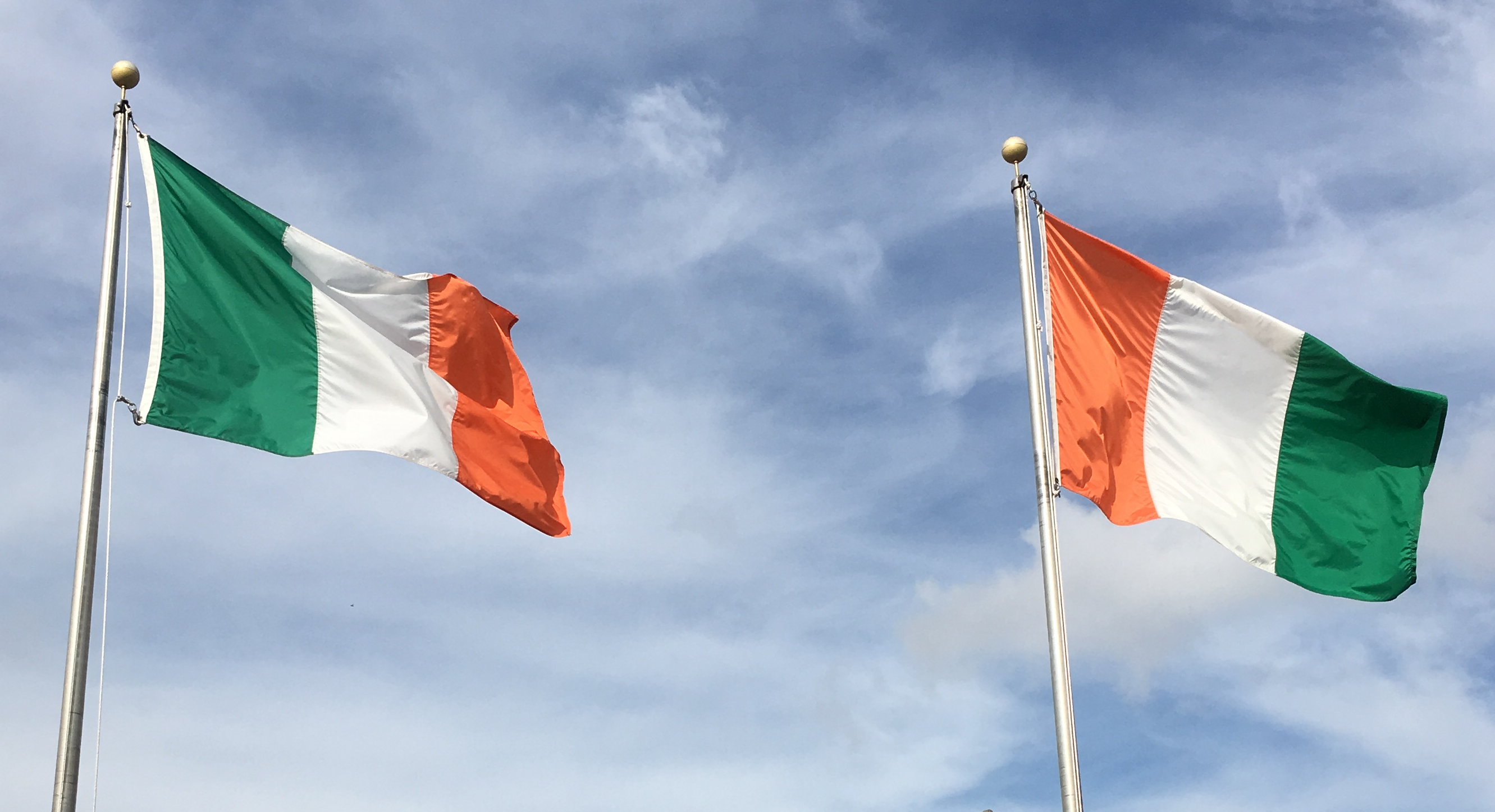
The flag of Ivory Coast is similar to the flag of Ireland, which is the exact same tricolour but reversed (the green being on the hoist side) and with a width-to-length ratio of 1:2 rather than 2:3. Due to the similarity of the two flags, Ulster loyalists in Northern Ireland have sometimes desecrated the Ivorian flag, mistaking it for the Irish flag. For example, during Ulster celebrations of the Twelfth in 2013, large Ivorian flags were burned in a bonfire in Belfast instead of Irish ones. In 2014, a Belfast shop hanging the Ivorian flag as part of a FIFA World Cup display labelled it accordingly to avoid confusion with the Irish flag. Conversely, when Ivorian sprinter Murielle Ahouré-Demps celebrated winning gold at the 2018 World Indoor 60-meter dash, for lack of an Ivorian flag to wave, she borrowed an Irish flag from a spectator and reversed it.
Notes
References
References
- David, Philippe. (2009). "La Côte d'Ivoire". Karthala.
- "Symboles". Office of the President of the Republic of Côte d'Ivoire.
- Smith, Whitney. (2 February 2001). "Flag of Côte d'Ivoire". [[Encyclopædia Britannica, Inc.]].
- (3 November 1960). "Côte d'Ivoire – Constitution du 3 novembre 1960". [[University of Perpignan]].
- (3 November 1960). "Constitution de Côte d'Ivoire du 3 novembre 1960".
- (23 July 2000). "Constitution ivoirienne du 23 juillet 2000".
- (23 July 2000). "Constitution de Côte d'Ivoire du 23 juillet 2000".
- Koffi, Sandra Manuella. (5 August 2025). "Indépendance, 65 ans : Comprendre les symboles de la Côte d'Ivoire". Pulse Côte d'Ivoire.
- "Loi n° 2016-886 du 8 novembre 2016 portant Constitution de la République de Côte d'Ivoire". Government of Ivory Coast.
- (8 November 2016). "Constitution de Côte d'Ivoire du 8 novembre 2016". [[Wikisource]].
- (2016). "Côte d'Ivoire 2016 Constitution".
- (2012). "Flags and Anthems Manual: London 2012". [[London Organising Committee of the Olympic and Paralympic Games]].
- "Ivory Coast Flag Color Codes".
- (2018). "5 Symboles de la République". Ministry of Public Service (Ivory Coast).
- (6 August 2014). "An 54 de la Côte d'Ivoire : chronique du drapeau tricolore ivoirien". Abidjan.net.
- Devlin, Emma. (7 October 2024). "Irish flag vs Ivory Coast flag: The difference". IrishCentral.com.
- (2019). "Department of the Taoiseach – The National Flag – Guidelines".
- Smith, Whitney. (9 February 2001). "Flag of Ireland". [[Encyclopædia Britannica, Inc.]].
- (12 July 2013). "What have the Ivory Coast ever done to deserve this?".
- Roberts, Patrick. (12 July 2013). "Loyalists ask us to respect their flag as they burn everyone else's?".
- McLysaght, Emer. (13 June 2014). "Belfast shop insists it's displaying Ivory Coast flag, NOT Ireland flag".
- (5 March 2018). "Quick-thinking Irish fans come to the rescue of victorious Ivory Coast star at World Indoor Athletics Championships". [[Irish Independent]].
This article was imported from Wikipedia and is available under the Creative Commons Attribution-ShareAlike 4.0 License. Content has been adapted to SurfDoc format. Original contributors can be found on the article history page.
Ask Mako anything about Flag of Ivory Coast — get instant answers, deeper analysis, and related topics.
Research with MakoFree with your Surf account
Create a free account to save articles, ask Mako questions, and organize your research.
Sign up freeThis content may have been generated or modified by AI. CloudSurf Software LLC is not responsible for the accuracy, completeness, or reliability of AI-generated content. Always verify important information from primary sources.
Report