From Surf Wiki (app.surf) — the open knowledge base
Falcon Heavy
Partially reusable super-heavy-lift launch vehicle by SpaceX
Partially reusable super-heavy-lift launch vehicle by SpaceX
| Field | Value | ||||||||
|---|---|---|---|---|---|---|---|---|---|
| name | Falcon Heavy | ||||||||
| logo | Falcon Heavy logo.svg | ||||||||
| logo_upright | 0.3 | ||||||||
| image | NASA's SpaceX Europa Clipper Launch (KSC-20241014-PH-AJN01 0022) (cropped).jpg | ||||||||
| caption | Europa Clipper launch on Falcon Heavy to Europa | ||||||||
| function | Super heavy-lift launch vehicle | ||||||||
| manufacturer | SpaceX | ||||||||
| country-origin | United States | ||||||||
| cpl | {{plainlist | ||||||||
| * Reusable: (2022)<ref name | spacex-capabilities | ||||||||
| * Expendable: (2017)<ref name | cnbc-20180212 | ||||||||
| height | 229.6 ft | ||||||||
| diameter | 3.7 m (each booster) | ||||||||
| width | 12.2 m | ||||||||
| mass | 1420000 kg | ||||||||
| stages | 2.5 | ||||||||
| capacities | {{Infobox rocket/payload | ||||||||
| location | LEO | ||||||||
| inclination | 28.5° | ||||||||
| mass | {{Unbulleted list | ||||||||
| when fully expended<ref name | "sxfh"/ | ||||||||
| with boosters recovered{{Citation needed | date | December 2024}} | |||||||
| < with boosters and core recovered{{Citation needed | date | December 2024}} | |||||||
| location | GTO | ||||||||
| inclination | 27.0° | ||||||||
| kilos | 26700 kg | ||||||||
| location | Mars | ||||||||
| kilos | 16800 kg | ||||||||
| derived_from | Falcon 9 | ||||||||
| payloads | {{flatlist | ||||||||
| comparable | {{flatlist | ||||||||
| status | Active | ||||||||
| sites | {{plainlist | ||||||||
| launches | 11 | ||||||||
| success | 11 | ||||||||
| landings | |||||||||
| first | February 6, 2018 (test flight) | ||||||||
| last | October 14, 2024 (Europa Clipper, *most recent*) | ||||||||
| stagedata | {{Infobox rocket/stage | ||||||||
| type | booster | ||||||||
| number | 2 | ||||||||
| engines | 9 × Merlin 1D per booster | ||||||||
| thrust | {{plainlist | ||||||||
| total | {{plainlist | ||||||||
| SI | {{plainlist | ||||||||
| * : <ref>{{cite web | title | Falcon 9 | work=SpaceX | url=http://www.spacex.com/falcon9 | access-date=September 29, 2013 | archive-url=https://web.archive.org/web/20130501002858/http://www.spacex.com/falcon9 | archive-date=May 1, 2013 | date=November 16, 2012 | author1=Spacexcmsadmin }} |
| * : <ref name | msF9Study}} | ||||||||
| burntime | 154.3 seconds | ||||||||
| fuel | LOX / RP-1 | ||||||||
| type | stage | ||||||||
| stageno | First | ||||||||
| engines | 9 × Merlin 1D | ||||||||
| thrust | {{plainlist | ||||||||
| SI | {{plainlist | ||||||||
| burntime | 187 seconds | ||||||||
| fuel | LOX / RP-1 | ||||||||
| type | stage | ||||||||
| stageno | Second | ||||||||
| engines | 1 × Merlin 1D Vacuum | ||||||||
| thrust | 934 kN | ||||||||
| SI | 348 isp | ||||||||
| burntime | 397 seconds | ||||||||
| fuel | LOX / RP-1 | ||||||||
| payload-location | Inside fairing at top of second stage | family=Falcon 9 Vehicle Family |
| country-origin = United States
- Reusable: (2022)
- Expendable: (2017)
|63800 kg when fully expended |57000 kg with boosters recovered |
-
Arabsat-6A
-
Boeing X-37B
-
EchoStar XXIV
-
Europa Clipper
-
GOES-19
-
Psyche
-
Dragonfly (Titan space probe)
-
Delta IV Heavy
-
New Glenn
-
NGLV
-
Vulcan Centaur
-
Kennedy, LC-39A
-
Vandenberg, SLC-6 (future)
-
SL: 7600 kN each
-
vac: 8200 kN each
-
SL: 15200 kN
-
vac: 16400 kN
-
SL: 282 isp
-
vac: 311 isp}}
-
SL: 7600 kN
-
vac: 8200 kN
-
SL: 282 isp
-
vac: 311 isp |payload-location=Inside fairing at top of second stage|family=Falcon 9 Vehicle Family}}
Falcon Heavy is a super heavy-lift launch vehicle with partial reusability that can carry cargo into Earth orbit and beyond. It is designed, manufactured and launched by American aerospace company SpaceX.
The rocket consists of a center core on which two Falcon 9 boosters are attached, and a second stage on top of the center core. Falcon Heavy has the second highest payload capacity of any currently operational launch vehicle behind NASA's Space Launch System (SLS), and the fourth-highest capacity of any rocket to reach orbit, trailing behind the SLS, Energia and the Saturn V.
SpaceX conducted Falcon Heavy's maiden launch on February 6, 2018, at 20:45 UTC. The second Falcon Heavy launch occurred on April 11, 2019, and all three booster rockets successfully returned to Earth. The third Falcon Heavy launch successfully occurred on June 25, 2019. Since then, Falcon Heavy has been certified for the National Security Space Launch (NSSL) program.
Falcon Heavy was designed to be able to carry humans into space beyond low Earth orbit (LEO), although , SpaceX does not intend to transport people on Falcon Heavy, nor pursue the human-rating certification process to transport NASA astronauts. Both Falcon Heavy and Falcon 9 are expected to eventually be superseded by the Starship super-heavy lift launch vehicle, currently being developed.
History
Concepts for a Falcon Heavy launch vehicle using three Falcon 1 core boosters, with an approximate payload-to-LEO capacity of two tons, were initially discussed as early as 2003. The concept for three core booster stages of the company's then as-yet-unflown Falcon 9 was referred to in 2005 as the Falcon 9 Heavy.
SpaceX unveiled the plan for the Falcon Heavy to the public at a Washington, D.C., news conference in April 2011, with an initial test flight expected in 2013.
A number of factors delayed the planned maiden flight to 2018, including two anomalies with Falcon 9 launch vehicles, which required all engineering resources to be dedicated to failure analysis, halting flight operations for many months. The integration and structural challenges of combining three Falcon 9 cores were more difficult than expected.
In July 2017, Elon Musk said, "It actually ended up being way harder to do Falcon Heavy than we thought. ... We were pretty naive about that".
The initial test flight for the first Falcon Heavy lifted off on February 6, 2018, at 20:45 UTC, carrying its dummy payload, Elon Musk's personal Tesla Roadster, beyond Mars orbit.
Conception and funding
Musk first mentioned Falcon Heavy in a September 2005 news update, referring to a customer request from 18 months prior. Various solutions using the planned Falcon 5 (which was never flown) had been explored, but the only cost-effective, reliable iteration was one that used a 9-engine first stage—the Falcon 9. The Falcon Heavy was developed using private capital with Musk stating that the cost was more than US$500 million. No government financing was provided for its development.
Design and development
The Falcon Heavy design is based on Falcon 9's fuselage and engines. By 2008, SpaceX had been aiming for the first launch of Falcon 9 in 2009, while "Falcon 9 Heavy would be in a couple of years". Speaking at the 2008 Mars Society Conference, Musk also indicated that he expected a hydrogen-fueled upper stage would follow two to three years later (which would have been around 2013).
By April 2011, the capabilities and performance of the Falcon 9 vehicle were better understood, SpaceX having completed two successful demonstration missions to low Earth orbit (LEO), one of which included reignition of the second-stage engine. At a press conference at the National Press Club in Washington, D.C., on April 5, 2011, Musk stated that Falcon Heavy would "carry more payload to orbit or escape velocity than any vehicle in history, apart from the Saturn V Moon rocket ... and Soviet Energia rocket".
In 2015, SpaceX announced a number of changes to the Falcon Heavy rocket, worked in parallel to the upgrade of the Falcon 9 v1.1 launch vehicle. In December 2016, SpaceX released a photo showing the Falcon Heavy interstage at the company headquarters in Hawthorne, California.
Testing
By May 2013, a new, partly underground test stand was being built at the SpaceX Rocket Development and Test Facility in McGregor, Texas, specifically to test the triple cores and twenty-seven rocket engines of the Falcon Heavy. By May 2017, SpaceX conducted the first static fire test of flight-design Falcon Heavy center core at the McGregor facility.
In July 2017, Musk discussed publicly the challenges of testing a complex launch vehicle like the three-core Falcon Heavy, indicating that a large extent of the new design "is really impossible to test on the ground" and could not be effectively tested independent of actual flight tests.
By September 2017, all three first stage cores had completed their static fire tests on the ground test stand. The first Falcon Heavy static fire test was conducted on January 24, 2018.
Maiden flight
Main article: Falcon Heavy test flight
In April 2011, Musk was planning for a first launch of Falcon Heavy from Vandenberg Air Force Base, California on the United States west coast in 2013. SpaceX refurbished Launch Complex 4E at Vandenberg AFB to accommodate Falcon 9 and Heavy. The first launch from the Cape Canaveral, Florida east coast launch complex was planned for late 2013 or 2014.
Due partly to the failure of SpaceX CRS-7 in June 2015, SpaceX rescheduled the maiden Falcon Heavy flight in September 2015 to occur no earlier than April 2016. The flight was to be launched from the refurbished Kennedy Space Center Launch Complex 39A. The flight was postponed again to late 2016, early 2017, summer 2017, late 2017 and finally to February 2018.
At a July 2017 meeting of the International Space Station Research and Development meeting in Washington, D.C., Musk downplayed expectations for the success of the maiden flight:
There's a real good chance the vehicle won't make it to orbit ... I hope it makes it far enough away from the pad that it does not cause pad damage. I would consider even that a win, to be honest.
In December 2017, Musk tweeted that the dummy payload on the maiden Falcon Heavy launch would be his personal Tesla Roadster playing David Bowie's "Space Oddity" (though the song actually used for the launch was "Life on Mars"), and that it would be launched into an orbit around the Sun that will reach the orbit of Mars. He released pictures in the following days.{{cite news|last1=Knapp|first1=Alex |title=Elon Musk Shows Off Photos of a Tesla Roadster Getting Prepped to Go to Mars
On December 28, 2017, the Falcon Heavy was moved to the launch pad in preparation of a static fire test of all 27 engines, which was expected on January 19, 2018. However, due to the U.S. government partial shutdown that began on January 20, 2018, the testing and launch were further delayed. The static fire test was conducted on January 24, 2018. Musk confirmed via Twitter that the test "was good" and later announced the rocket would be launched on February 6, 2018.
.jpg)
On February 6, 2018, after a delay of over two hours due to high winds, Falcon Heavy lifted off at 20:45 UTC. However, only one of the three engines on the center booster that were intended to restart ignited during descent, causing the booster to be destroyed upon impacting the ocean at a speed of over 480 km/h.
Initially, Elon Musk tweeted that the Roadster had overshot its planned heliocentric orbit, and would reach the asteroid belt. Later, observations by telescopes showed that the Roadster would only slightly exceed the orbit of Mars at aphelion.
Later flights
Main article: List of Falcon 9 and Falcon Heavy launches
A year after the successful demo flight, SpaceX had signed five commercial contracts worth US$500–750 million, meaning that it had managed to cover the development cost of the rocket. The second flight, and first commercial one, occurred on April 11, 2019, launching Arabsat-6A, with all three boosters landing successfully for the first time.
The third flight occurred on June 25, 2019, launching the STP-2 (U.S. Department of Defense Space Test Program) payload. The payload was composed of 25 small spacecraft. Operational Geostationary transfer orbit (GTO) missions for Intelsat and Inmarsat, which were planned for late 2017, were moved to the Falcon 9 Full Thrust rocket version as it had become powerful enough to lift those heavy payloads in its expendable configuration. In June 2022, the U.S. Space Force certified Falcon Heavy for launching its top secret satellites, with the first such launch being USSF-44 which happened at November 1, 2022; and the second of which being USSF-67, which was launched 11 weeks after USSF-44. ViaSat selected the Falcon Heavy in late 2018 for the launch of its ViaSat-3 satellite which was scheduled to launch in the 2020–2022 timeframe; however it would not launch until May 1, 2023. On October 13, 2023, Falcon Heavy embarked on its 8th flight carrying NASA's Psyche probe to the asteroid 16 Psyche. This mission only had the side boosters return to Earth with the center core expended, a decision made to create more tolerable margins for the mission.
Following the announcement of NASA's Artemis program of returning humans to the Moon, the Falcon Heavy rocket has been mentioned several times as an alternative to the expensive Space Launch System (SLS) program, but NASA decided to exclusively use SLS to launch the Orion capsule. However, Falcon Heavy will support commercial missions for the Artemis program, since it will be used to transport the Dragon XL spacecraft to the Lunar Gateway. It was also selected to launch the first two elements of the Lunar Gateway, the Power and Propulsion Element (PPE), and the Habitation and Logistics Outpost (HALO), on a single launch no earlier than 2025, and to launch Astrobotic Technology's Griffin lander as part of the Artemis Program's Commercial Lunar Payload Services (CLPS) initiative. On October 14, 2024, Falcon Heavy transported NASA's Europa Clipper into space to explore Jupiter's moon Europa.
Design
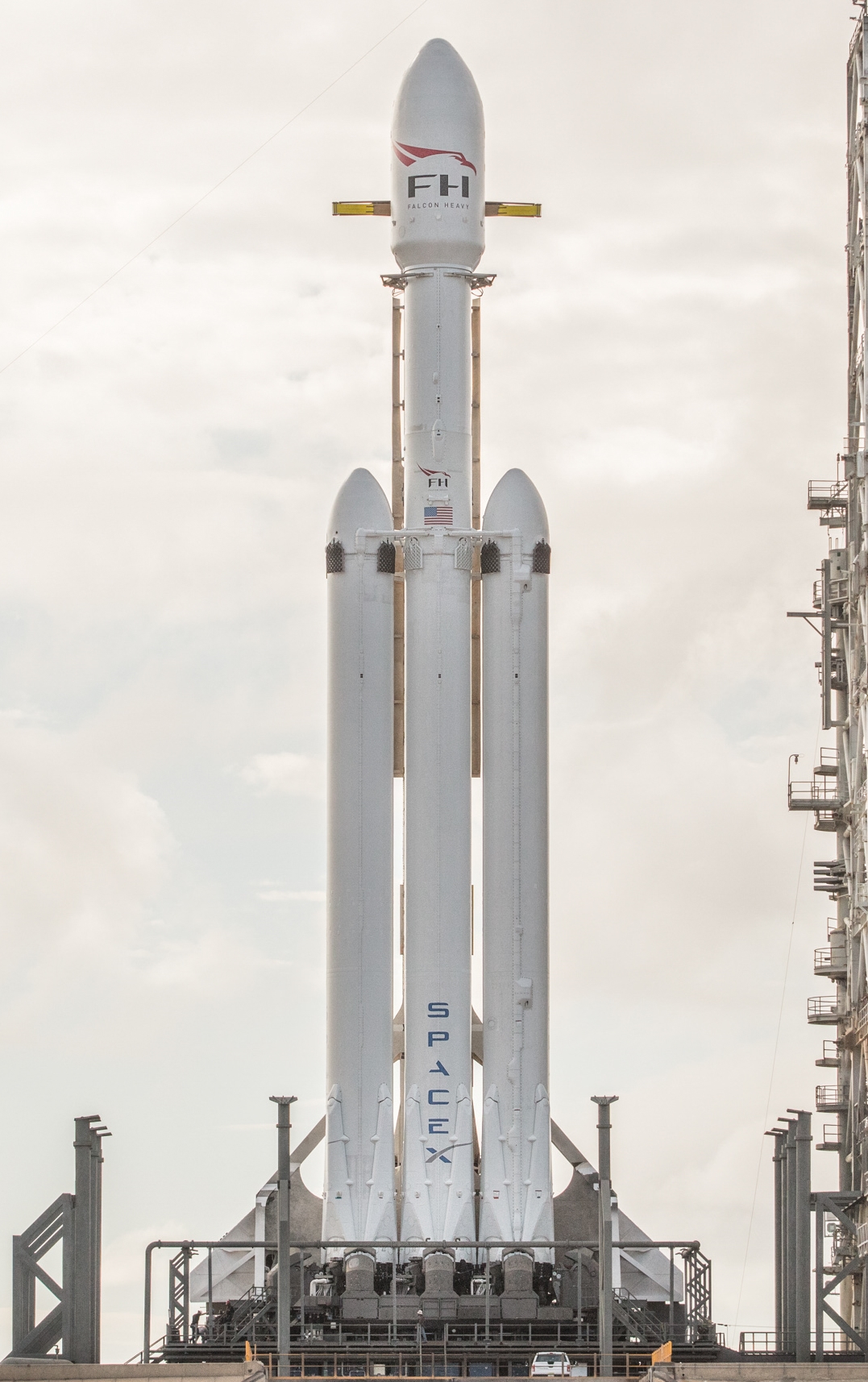
Falcon Heavy consists of a structurally strengthened Falcon 9 as the "core" component, with two additional Falcon 9 first stages with aerodynamic nose-cones mounted outboard serving as strap-on boosters, conceptually similar to the Delta IV Heavy launcher and proposals for the Atlas V Heavy and Russian Angara A5V. This triple first stage carries a standard Falcon 9 second stage, which in turn carries the payload in a fairing. Falcon Heavy has the second highest lift capability of any operational rocket, with a payload of 63800 kg to low Earth orbit, 26700 kg to Geostationary Transfer Orbit, and 16800 kg to trans-Mars injection. The rocket was designed to meet or exceed all current requirements of human rating. The structural safety margins are 40% above flight loads, higher than the 25% margins of other rockets. Falcon Heavy was designed from the outset to carry humans into space and it would restore the possibility of flying crewed missions to the Moon or Mars.

The first stage is powered by three Falcon 9 derived cores, each equipped with nine Merlin 1D engines. The Falcon Heavy has a total sea-level thrust at liftoff of 2327 t-f, from the 27 Merlin 1D engines, while thrust rises to 2517 t-f as the craft climbs out of the atmosphere. The upper stage is powered by a single Merlin 1D engine modified for vacuum operation, with a thrust of 95.2 t-f, an expansion ratio of 117:1 and a nominal burn time of 397 seconds. At launch, the center core throttles to full power for a few seconds for additional thrust, then throttles down. This allows a longer burn time. After the side boosters separate, the center core throttles back up to maximum thrust. For added reliability of restart, the engine has dual redundant pyrophoric igniters (Triethylaluminium-Triethylborane) (TEA-TEB). The interstage, which connects the upper and lower stage for Falcon 9, is a carbon fiber aluminum core composite structure. Stage separation occurs via reusable separation collets and a pneumatic pusher system. The Falcon 9 tank walls and domes are made from Aluminum–lithium alloy. SpaceX uses an all-friction stir welded tank. The second stage tank of Falcon 9 is simply a shorter version of the first stage tank and uses most of the same tooling, material, and manufacturing techniques. This approach reduces manufacturing costs during vehicle production.
All three cores of the Falcon Heavy arrange the engines in a structural form SpaceX calls Octaweb, aimed at streamlining the manufacturing process, and each core includes four extensible landing legs. To control the descent of the boosters and center core through the atmosphere, SpaceX uses four retractable grid fins at the top of each of the three Falcon 9 boosters, which extend after separation. Immediately after the side boosters separate, three engines in each continue to burn for a few seconds in order to control the booster's trajectory safely away from the rocket. The grid fins then deploy as the boosters turn back to Earth, followed by the extending of the landing legs. The side boosters land softly on the ground in fully/partially reusable launch configuration. The center core continues to fire until stage separation. In fully reusable launches, its grid fins and legs deploy and the center core touches down on a drone ship. If boosters are to be expended, then the landing legs and grid fins are omitted from the vehicle. The landing legs are made of carbon fiber with an aluminum honeycomb structure. The four legs stow along the sides of each core during liftoff and extend outward and down just before landing.
Rocket specifications
| Characteristic | First stage core unit | |||||||||||||||||||||||||
|---|---|---|---|---|---|---|---|---|---|---|---|---|---|---|---|---|---|---|---|---|---|---|---|---|---|---|
| (1 × center, 2 × booster) | Second stage | Payload fairing | Height | Diameter | Dry mass | Fueled mass | Structure type | Structure material | Engines | Engine type | Propellant | Liquid oxygen tank capacity | Kerosene tank capacity | Engine nozzle | Engine designer/manufacturer | Thrust, stage total | Propellant feed system | Throttle capability | Restart capability | Tank pressurization | Ascent attitude control: | |||||
| pitch, yaw | Ascent attitude control: | |||||||||||||||||||||||||
| roll | Coast/descent attitude control | Shutdown process | Stage separation system | |||||||||||||||||||||||
| 42.6 m | 12.6 m | 13.2 m | ||||||||||||||||||||||||
| 3.7 m | 3.7 m | 5.2 m | ||||||||||||||||||||||||
| 22.2 t | 4 t | 1.7 t | ||||||||||||||||||||||||
| 433.1 t | 111.5 t | |||||||||||||||||||||||||
| LOX tank: monocoque | ||||||||||||||||||||||||||
| Fuel tank: skin and stringer | LOX tank: monocoque | |||||||||||||||||||||||||
| Fuel tank: skin and stringer | Monocoque halves | |||||||||||||||||||||||||
| Aluminum–lithium skin; aluminum domes | Aluminum–lithium skin; aluminum domes | Carbon fiber | ||||||||||||||||||||||||
| 9 × Merlin 1D | 1 × Merlin 1D Vacuum | rowspan=14 | ||||||||||||||||||||||||
| Liquid, gas generator | Liquid, gas generator | |||||||||||||||||||||||||
| Subcooled liquid oxygen, kerosene (RP-1) | Liquid oxygen, kerosene (RP-1) | |||||||||||||||||||||||||
| 287.4 t | 75.2 t | |||||||||||||||||||||||||
| 123.5 t | 32.3 t | |||||||||||||||||||||||||
| Gimbaled, 16:1 expansion | Gimbaled, 165:1 expansion | |||||||||||||||||||||||||
| SpaceX | SpaceX | |||||||||||||||||||||||||
| 2327 t-f, sea level | 95.2 t-f, vacuum | |||||||||||||||||||||||||
| Turbopump | Turbopump | |||||||||||||||||||||||||
| Yes: 42.7–83.2 t-f, sea level | Yes: 37–95 t-f, vacuum | |||||||||||||||||||||||||
| Yes, in 3 engines for boostback, reentry, and landing | Yes, dual redundant TEA-TEB | |||||||||||||||||||||||||
| pyrophoric igniters | ||||||||||||||||||||||||||
| Heated helium | Heated helium | |||||||||||||||||||||||||
| Gimbaled engines | Gimbaled engine and | |||||||||||||||||||||||||
| nitrogen gas thrusters | ||||||||||||||||||||||||||
| Gimbaled engines | Nitrogen gas thrusters | |||||||||||||||||||||||||
| Nitrogen gas thrusters and grid fins | Nitrogen gas thrusters | Nitrogen gas thrusters | ||||||||||||||||||||||||
| Commanded | Commanded | |||||||||||||||||||||||||
| Pneumatic | Pneumatic |
The Falcon Heavy uses a 4.5 m interstage attached to the first stage core. The overall length of the vehicle at launch is 70 m, and the total fueled mass is 1420 t. Without recovery of any stage, the Falcon Heavy can theoretically inject a 63.8 t payload into a low Earth orbit, or 16.8 t to Venus or Mars.
The Falcon Heavy includes first-stage recovery systems, to allow SpaceX to return the first stage boosters to the launch site as well as recover the first stage core following landing at an Autonomous Spaceport Drone Ship barge after completion of primary mission requirements. These systems include four deployable landing legs, which are locked against each first-stage tank core during ascent and deploy just prior to touchdown. Excess propellant reserved for Falcon Heavy first-stage recovery operations will be diverted for use on the primary mission objective, if required, ensuring sufficient performance margins for successful missions. The nominal payload capacity to a geostationary transfer orbit (GTO) is 8 t with recovery of all three first-stage cores (the price per launch is US$97 million), versus 26.7 t in fully expendable mode. The Falcon Heavy can also inject a 16 t payload into GTO if only the two side boosters are recovered.
Capabilities
The partially reusable Falcon Heavy falls into the heavy-lift range of launch systems, capable of lifting 20 - into low Earth orbit (LEO), under the classification system used by a NASA human spaceflight review panel. A fully expendable Falcon Heavy is in the super heavy-lift category with a maximum payload of 64 t to LEO.
The initial concept (Falcon 9-S9 2005) envisioned payloads of 24.75 t to LEO, but by April 2011 this was projected to be up to 53 t with geostationary transfer orbit (GTO) payloads up to 12 t. 16 t to translunar trajectory, and 14 t on a trans-Martian orbit to Mars.
By late 2013, SpaceX raised the projected GTO payload for Falcon Heavy to 21.2 t.

In April 2017, the projected LEO payload for Falcon Heavy was raised from 54.4 to. The maximum payload is achieved when the rocket flies a fully expendable launch profile, not recovering any of the three first-stage boosters. Returning all three boosters to the launch site rather than landing them on drone ships would yield about 30 t of payload to LEO.
| Destination | Falcon Heavy | Falcon 9 | August 2013 | ||
|---|---|---|---|---|---|
| to April 2016 | May 2016 | ||||
| to March 2017 | Since | ||||
| April 2017 | |||||
| LEO (28.5°) expendable | 53 t | 54.4 t | 63.8 t | 22.8 t | |
| GTO (27.0°) expendable | 21.2 t | 22.2 t | 26.7 t | 8.3 t | |
| GTO (27.0°) reusable | 6.4 t | 6.4 t | 8 t | 5.5 t | |
| Mars | 13.2 t | 13.6 t | 16.8 t | 4 t | |
| Pluto | – | 2.9 t | 3.5 t | – |
Reusability
Main article: SpaceX reusable launch system development program
.jpg)
From 2013 to 2016, SpaceX conducted parallel development of a reusable rocket architecture for Falcon 9, that applies to parts of Falcon Heavy as well. Early on, SpaceX had expressed hopes that all rocket stages would eventually be reusable. SpaceX has since demonstrated routine land and sea recovery of the Falcon 9 first stage, and has successfully recovered multiple payload fairings. In the case of Falcon Heavy, the two outer cores separate from the rocket earlier in the flight, and are thus moving at a lower velocity than in a Falcon 9 launch profile. For the first flight of Falcon Heavy, SpaceX had considered attempting to recover the second stage, but did not execute this plan.
Falcon Heavy payload performance to geosynchronous transfer orbit (GTO) is reduced by the reusable technology, but at a much lower price. When recovering all three booster cores, GTO payload is 8 t.
Propellant crossfeed
Falcon Heavy was originally designed with a "propellant crossfeed" capability, whereby the center core engines would be supplied with fuel and oxidizer from the two side cores until their separation. This approach had previously been proposed by Vladimir Chelomei for the UR-700 launch system. Operating all engines at full thrust from launch, with fuel supplied mainly from the side boosters, would deplete the side boosters sooner, allowing their earlier separation to reduce the mass being accelerated. This would leave most of the center core propellant available after booster separation.
Musk stated in 2016 that crossfeed would not be implemented. Instead, the center booster throttles down shortly after liftoff to conserve fuel, and resumes full thrust after the side boosters have separated.
Launch prices
At an appearance in May 2004 before the United States Senate Committee on Commerce, Science, and Transportation, Musk testified, "Long term plans call for development of a heavy lift product and even a super-heavy, if there is customer demand. We expect that each size increase would result in a meaningful decrease in cost per pound to orbit. ... Ultimately, I believe US$500 per pound or less is very achievable". This 1100 $/kg goal stated by Musk in 2011 is 35% of the cost of the lowest-cost-per-pound LEO-capable launch system in a 2001 study: the Zenit, a medium-lift launch vehicle that could carry 14 t into LEO for US$35–50 million. In 2011, SpaceX stated that the cost of reaching low Earth orbit could be as low as 2200 $/kg if an annual rate of four launches can be sustained, and as of 2011 planned to eventually launch as many as 10 Falcon Heavies and 10 Falcon 9s annually.
The published prices for Falcon Heavy launches have changed as development progressed, with announced prices for the various versions of Falcon Heavy priced at US$80–125 million in 2011, US$83–128 million in 2012, US$77–135 million in 2013, US$85 million for up to 6.4 t to GTO in 2014, US$90 million for up to 8 t to GTO in 2016.
From 2017 to early 2022, the price has been stated at US$150 million for 63.8 t to LEO or 26.7 t to GTO (fully expendable). This equates to a price of US$2,350 per kg to LEO and US$5,620 per kg to GTO. In 2022, the published price for a reusable launch was $97 million. In 2022 NASA contracted with SpaceX to launch the Nancy Grace Roman Space Telescope on a Falcon Heavy for approximately $255 million, including launch service and other mission related costs.
The nearest competing U.S. rocket was United Launch Alliance's Delta IV Heavy with a LEO payload capacity of 28.4 t costs US$12,340 per kg to LEO and US$24,630 per kg to GTO. The Delta IV Heavy was retired in 2024.
Competitors from 2024 onwards may include Blue Origin's New Glenn (45 t to LEO), Relativity Space's Terran R (34 t to LEO), and United Launch Alliance (ULA) Vulcan Centaur (27 t to LEO). From late 2025 onwards, the SpaceX Starship (100+ t to LEO) may also be included.
Launches and payloads
Due to improvements to the performance of Falcon 9, some of the heavier satellites flown to GTO, such as Intelsat 35e and Inmarsat-5 F4, were launched before the debut of Falcon Heavy. SpaceX anticipated the first commercial Falcon Heavy launch would be three to six months after a successful maiden flight, but due to delays, the first commercial payload, Arabsat-6A was successfully launched on April 11, 2019, a year and two months after the first flight. SpaceX hoped to have 10 launches every year from 2021 on, but there were no launches in 2020 or 2021.
| Flight No. | Launch date (UTC) | Launch site | Payload | Payload mass | Orbit | Customer | Price | Outcome | 1 | 2 | 3 | 4 | 5 | 6 | 7 | 8 | 9 | 10 | 11 | |||||||||
|---|---|---|---|---|---|---|---|---|---|---|---|---|---|---|---|---|---|---|---|---|---|---|---|---|---|---|---|---|
| February 6, 2018 | ||||||||||||||||||||||||||||
| 20:45 | Kennedy, LC-39A | Elon Musk's Tesla Roadster | ~1250 kg | Heliocentric | SpaceX | |||||||||||||||||||||||
| First demonstration flight launched a Tesla Roadster to a trans-Mars injection heliocentric orbit. Both side boosters returned to the launch site and made simultaneous landings; the center core failed to fully relight on landing and crashed into the water adjacent to the droneship, resulting in damage to the vessel's thrusters. | ||||||||||||||||||||||||||||
| April 11, 2019 | ||||||||||||||||||||||||||||
| 22:35 | Kennedy, LC-39A | Arabsat-6A | 6465 kg | GTO | Arabsat | |||||||||||||||||||||||
| Heavy communications satellite purchased by the Arab League. All three boosters landed successfully but the center core subsequently fell over and was lost during transport due to heavy seas. The two side-boosters were reused on the STP-2 launch. | ||||||||||||||||||||||||||||
| June 25, 2019 | ||||||||||||||||||||||||||||
| 06:30 | Kennedy, LC-39A | USAF STP-2 | 3700 kg | LEO / MEO | United States Department of Defense | US$160.9 million | ||||||||||||||||||||||
| The mission supported the U.S. Air Force National Security Space Launch (formerly EELV) certification process for the Falcon Heavy. GPIM, OTB (hosting the Deep Space Atomic Clock,) six COSMIC-2 (FORMOSAT-7), Oculus-ASR, Prox-1, and ISAT. Successfully reused the boosters from the second Falcon Heavy flight. Center core failed to land on the droneship and was lost. | ||||||||||||||||||||||||||||
| November 1, 2022 | ||||||||||||||||||||||||||||
| 13:41 | Kennedy, LC-39A | USSF-44 | ~3750 kg | GEO | U.S. Space Force, Millennium Space Systems and Lockheed Martin Space | ~US$130 million | ||||||||||||||||||||||
| First classified flight of Falcon Heavy. The contract was awarded to SpaceX for a price of under 30% of that of a typical Delta IV Heavy launch (US$440 million). Payload included two separate satellites and at least three additional rideshare payloads (including *TETRA-1)* and weighed roughly 3.7 t at launch. They were launched in a direct geosynchronous orbit, necessitating for the first time a planned partially expendable launch, that is, to deliberately expend the center core which was configured without grid fins and landing gear needed for a landing, while the two side-boosters landed at Cape Canaveral Space Force Station. It was originally scheduled for Q1 2022, but it was delayed due to payload issues to November 1, 2022. Second stage featured a mission extension kit with a gray band painted on the RP-1 kerosene fuel tank, which absorbs sunlight and keeps the propellant from freezing. | ||||||||||||||||||||||||||||
| January 15, 2023 | ||||||||||||||||||||||||||||
| 22:56 | Kennedy, LC-39A | USSF-67 | ~3750 kg | GEO | U.S. Space Force | US$317 million | ||||||||||||||||||||||
| (includes new infrastructure) | ||||||||||||||||||||||||||||
| Second classified flight of Falcon Heavy, using a new center core in an expendable configuration (no grid fins or landing gear), while the two boosters were reused side-boosters that landed at Cape Canaveral Space Force Station. The second stage had a gray band for thermal purposes as the mission requirements were similar to the USSF-44 mission. | ||||||||||||||||||||||||||||
| May 1, 2023 | ||||||||||||||||||||||||||||
| 00:26 | Kennedy, LC-39A | ViaSat-3 Americas | ||||||||||||||||||||||||||
| 6400 kg | GEO | ViaSat | Undisclosed}} | rowspan="3" | ||||||||||||||||||||||||
| Aurora 4A (Arcturus) | 300 kg | Astranis / Pacific Dataport | ||||||||||||||||||||||||||
| GS-1 | 22 kg | Gravity Space | ||||||||||||||||||||||||||
| Falcon Heavy was originally slated to launch the Viasat-2 satellite, but due to delays an Ariane 5 launch vehicle was used. Viasat maintained the launch option and delivered its next Ka-band satellite aboard the Falcon Heavy – this one intended to provide service to the Americas region. Astranis' microGEO satellite Arcturus was manifested in late September 2021. Following a series of MVac engine burns and long periods of coasting, the upper stage of Falcon Heavy deployed the satellite into a near-geosynchronous orbit at approximately T+4:32:27. The upper stage went on to successfully deploy the additional payloads, G-Space 1 and Arcturus. Featured a thermal gray band second stage, due to performance requirements for a direct GEO injection, both the center core and side boosters were expended (thus configured without landing legs or grid fins). This was also the first fully expendable mission for Falcon Heavy since its introduction with the fairings being recovered with heavy burn marks. | ||||||||||||||||||||||||||||
| July 29, 2023 | ||||||||||||||||||||||||||||
| 03:04 | Kennedy, LC-39A | Jupiter-3 (EchoStar-24) | ~9200 kg | GTO | EchoStar | |||||||||||||||||||||||
| Heaviest commercial geostationary satellite weighing 9200 kg at launch. The second stage had a gray band for the same reason as on the USSF-44 flight, but this time it was configured for medium coast phase. Core expended, two boosters recovered to land. Payload fairing recovery attempted. | ||||||||||||||||||||||||||||
| date=October 28, 2022 | title=NASA Continues Psyche Asteroid Mission | url=https://www.jpl.nasa.gov/news/nasa-continues-psyche-asteroid-mission | url-status=live | archive-url=https://web.archive.org/web/20221108030113/https://www.jpl.nasa.gov/news/nasa-continues-psyche-asteroid-mission | archive-date=November 8, 2022 | access-date=October 28, 2022 | work=JPL | publisher=NASA}} | Kennedy, LC-39A | *Psyche* | ~2608 kg | Heliocentric | NASA (Discovery) | sentence=yes}} | ||||||||||||||
| Falcon Heavy launched the 2.6 t Psyche orbiter mission into a heliocentric orbit. From there, the *Psyche* spacecraft will visit the [Psyche](16-psyche) asteroid in the main asteroid belt. Core expended, two boosters recovered to land. No gray band on second stage as the flight plan did not include long coast phases. | ||||||||||||||||||||||||||||
| December 29, 2023 | ||||||||||||||||||||||||||||
| 01:07 | Kennedy, LC-39A | USSF-52 (Boeing X-37B OTV-7) | ~6350 kg + OTV payload | HEO | Department of the Air Force Rapid Capabilities Office/U.S. Space Force | US$149 million | ||||||||||||||||||||||
| Third classified flight of Falcon Heavy, awarded in June 2018. This mission was the fourth flight of the second X-37B vehicle and the seventh overall flight in the X-37B program, as well as the first X-37B flight to a highly elliptical high Earth orbit. It was intended to include NASA's *Seeds-2* experiment investigating the effects of space-based radiation on plant seeds during a long-duration spaceflight. The center core expended and the two boosters were recovered to land. | ||||||||||||||||||||||||||||
| June 25, 2024 | ||||||||||||||||||||||||||||
| 21:26 | Kennedy, LC-39A | GOES-19 | 5000 kg | GTO | NOAA | US$152.5 million | ||||||||||||||||||||||
| In September 2021, NASA awarded SpaceX a launch services contract for the geostationary GOES-19 weather satellite (known as GOES-U during launch). All three Falcon 9 boosters were new. Both side boosters landed at Cape Canaveral Landing Zones and the center core was expended. The second stage had a gray band for thermal purposes due to the mission requirements of a long coast phase between second stage ignitions. | ||||||||||||||||||||||||||||
| October 14, 2024 | ||||||||||||||||||||||||||||
| 16:06 | Kennedy, LC-39A | *Europa Clipper* | 6065 kg | Heliocentric | NASA | US$178 million | ||||||||||||||||||||||
| Europa Clipper is to conduct a detailed survey of Europa and use a sophisticated suite of science instruments to investigate whether the icy moon has conditions suitable for life. Key mission objectives are to produce high-resolution images of Europa's surface, determine its composition, look for signs of recent or ongoing geological activity, measure the thickness of the moon's icy shell, search for subsurface lakes, and determine the depth and salinity of Europa's ocean. The mission makes flybys of Mars and Earth before arriving at Jupiter in April 2030. The Falcon Heavy for this mission was fully expendable as both the side boosters and core were expended (and configured without landing legs and grid fins). This was the second fully expendable Falcon Heavy mission after Viasat-3 in May 2023. |
Future launches{{Sticky header}}
| Date | Payload | Customer | Price | ||||||
|---|---|---|---|---|---|---|---|---|---|
| July 2026 | Griffin Mission One | Astrobotic / NASA (Commercial Lunar Payloads Services) | |||||||
| Astrobotic's Griffin Mission One is a lunar lander contracted by NASA as part of the Commercial Lunar Payloads Services program. The lander, the company's second after Peregrine Mission One, is expected to land in a region of interest in the Moon's south polar region with scientific payloads attached. | |||||||||
| September 2026 | Nancy Grace Roman Space Telescope | NASA (Launch Services Program) | US$255 million | ||||||
| Infrared space telescope to be stationed at Sun-Earth L2. | |||||||||
| Q4 2026 | Griffin Mission Two | Astrobotic | |||||||
| Third Astrobotic lunar lander mission. | |||||||||
| 2026 | USSF-70 | USSF | |||||||
| Classified mission for the United States Space Force. | |||||||||
| 2026 | USSF-75 | USSF | |||||||
| Classified mission for the United States Space Force. | |||||||||
| number=1910231013726224818 | user=GewoonLukas_ | title=None of these are scheduled for launch this year. They will all launch no earlier then 2027. | first=Lukas | last=C.H. | date=April 10, 2025 | access-date=April 10, 2025}} | NROL-97 | NRO | |
| Classified mission for the National Reconnaissance Office. First NRO launch from a Falcon Heavy. | |||||||||
| 2027 | USSF-174 | USSF | |||||||
| Classified mission for the United States Space Force. | |||||||||
| 2027 | USSF-186 | USSF | |||||||
| Classified mission for the United States Space Force. | |||||||||
| July 5–25, 2028 | Dragonfly | NASA (New Frontiers Program) | US$256.6 million | ||||||
| Rotorcraft mission to Saturn's moon Titan. Awarded on November 25, 2024. The launch will cost NASA $256.6 million. First Falcon mission to carry an RTG. | |||||||||
| 2028 | NROL-86 | USSF | |||||||
| Classified mission for the National Reconnaissance Office. | |||||||||
| 2028 | USSF-63 | USSF | |||||||
| Classified mission for the United States Space Force. | |||||||||
| 2028 | USSF-155 | USSF | |||||||
| Classified mission for the United States Space Force. | |||||||||
| 2028 | USSF-206 (WGS-12) | USSF | |||||||
| Wideband Global SATCOM satellite. | |||||||||
| NET 2027 | PPE | ||||||||
| HALO | NASA (Artemis) | US$331.8 million | |||||||
| First elements for the Lunar Gateway mini-station as part of the Artemis program, awarded in February 2021. Maxar had already made $27.5 million in payments to SpaceX for the contract to launch the Power and Propulsion Element (PPE), but later, NASA decided to launch both PPE and Habitation and Logistics Outpost (HALO) together. | |||||||||
| NET 2028 | GLS-1 (Dragon XL) | NASA (Gateway Logistics Services) | |||||||
| NET 2030 | GLS-2 (Dragon XL) | NASA (Gateway Logistics Services) | |||||||
| NET 2031 | GLS-3 (Dragon XL) | NASA (Gateway Logistics Services) | |||||||
| NET 2032 | GLS-4 (Dragon XL) | NASA (Gateway Logistics Services) | |||||||
| In March 2020, NASA announced its first contract for the Gateway Logistics Services that guarantees at least two launches on a new Dragon XL resupply spacecraft on top of a Falcon Heavy. The spacecraft will carry cargo to Lunar orbit on a six- to twelve-month-long mission. Four launches are to ressuply Artemis IV, Artemis V, Artemis VI, and Artemis VII missions respectively. | |||||||||
| TBA | TBA | Intelsat | |||||||
| This was the first commercial agreement of a Falcon Heavy, and was signed in May 2012. In 2018, the contract option was still maintained but no definitive payload had been chosen. |
First commercial contracts
In May 2012, SpaceX announced that Intelsat had signed the first commercial contract for a Falcon Heavy flight. It was not confirmed at the time when the first Intelsat launch would occur, but the agreement had SpaceX delivering satellites to geosynchronous transfer orbit (GTO). In August 2016, it emerged that this Intelsat contract had been reassigned to a Falcon 9 Full Thrust mission to deliver Intelsat 35e into orbit in the third quarter of 2017. Performance improvements of the Falcon 9 vehicle family since the 2012 announcement, advertising 8.3 t to GTO for its expendable flight profile, enabled the launch of this 6 t satellite without upgrading to a Falcon Heavy variant.
In 2014, Inmarsat booked three launches with Falcon Heavy, but due to delays, switched a payload to Ariane 5 for 2017. Similarly to the Intelsat 35e case, another satellite from this contract, Inmarsat 5-F4, was switched to a Falcon 9 Full Thrust due to the increased liftoff capacity. The remaining contract covered the launch of Inmarsat-6 F1 in 2020 on a Falcon 9.
Department of Defense contracts
In December 2012, SpaceX announced its first Falcon Heavy launch contract with the United States Department of Defense (DoD). The United States Air Force Space and Missile Systems Center awarded SpaceX two Evolved Expendable Launch Vehicle (EELV)-class missions, including the Space Test Program 2 (STP-2) mission for Falcon Heavy, originally scheduled to be launched in March 2017, to be placed at a near circular orbit at an altitude of 700 km, with an inclination of 70.0°.
In April 2015, SpaceX sent the U.S. Air Force an updated letter of intent outlining a certification process for its Falcon Heavy rocket to launch national security satellites. The process included three successful flights of the Falcon Heavy including two consecutive successful flights, and the letter stated that Falcon Heavy can be ready to fly national security payloads by 2017. But in July 2017, SpaceX announced that the first test flight would take place in December 2017, pushing the second launch (Space Test Program 2) to June 2018. In May 2018, on the occasion of the first launch of the Falcon 9 Block 5 variant, a further delay to October 2018 was announced, and the launch was eventually pushed to June 25, 2019.
SpaceX was awarded 40% of the launches in Phase 2 of the National Security Space Launch (NSSL) contracts, which includes several launches, a vertical integration facility, and development of a larger fairing, from 2024 to 2027.
Space Test Program 2 (STP-2) mission
The payload for the STP-2 mission of the Department of Defense included 25 small spacecraft from the U.S. military, NASA, and research institutions:
The Green Propellant Infusion Mission (GPIM) was a payload; it is a project partly developed by the U.S. Air Force to demonstrate a less-toxic propellant.
Another secondary payload is the miniaturized Deep Space Atomic Clock that is expected to facilitate autonomous navigation. The U.S. Air Force Research Laboratory's Demonstration and Science Experiments (DSX) has a mass of 500 kg and will measure the effects of very low frequency radio waves on space radiation. The British 'Orbital Test Bed' payload is hosting several commercial and military experiments.
Other small satellites included Prox 1, built by Georgia Tech students to test a 3D-printed thruster and a miniaturized gyroscope, LightSail by The Planetary Society, Oculus-ASR nanosatellite from Michigan Tech, and CubeSats from the U.S. Air Force Academy, the Naval Postgraduate School, the United States Naval Research Laboratory, the University of Texas at Austin, California Polytechnic State University, and a CubeSat assembled by students at Merritt Island High School in Florida.
The Block 5-second stage allowed multiple reignitions to place its many payloads in multiple orbits. The launch was planned to include a 5 t ballast mass, but the ballast mass was later omitted from the 3.7 t total mass for the payload stack.
NASA contracts
Solar System transport missions
In 2011, NASA Ames Research Center proposed a Mars mission called Red Dragon that would use a Falcon Heavy as the launch vehicle and trans-Martian injection vehicle, and a variant of the Dragon capsule to enter the Martian atmosphere. The proposed science objectives were to detect biosignatures and to drill approximately 1 m underground, in an effort to sample reservoirs of water ice known to exist under the surface. The mission cost was projected to be less than US$425 million, not including the launch cost. SpaceX 2015 estimation was 2000–4000 kg to the surface of Mars, with a soft retropropulsive landing following a limited atmospheric deceleration using a parachute and heat shield. Beyond the Red Dragon concept, SpaceX was seeing potential for Falcon Heavy and Dragon 2 to carry science payloads across much of the Solar System, particularly to Jupiter's moon Europa.
Lunar missions
Falcon Heavy is the launch vehicle for the initial modules of the Lunar Gateway: Power and Propulsion Element (PPE) and Habitation and Logistics Outpost (HALO). To decrease complexity, NASA announced in February 2021 that it will launch the first two elements on a single Falcon Heavy launch vehicle, targeting a launch date no earlier than 2025.
In March 2020, Falcon Heavy won the first award to a resupply mission to the Lunar Gateway, placing a new Dragon XL spacecraft on a translunar injection orbit.
''Psyche'', ''Europa Clipper'', and ''Dragonfly''
NASA chose Falcon Heavy as the launch vehicle for its Psyche mission to a metallic asteroid; it launched on October 13, 2023. The contract was worth US$117 million.
Europa Clipper was initially targeted to be launched on an SLS rocket. However, due to extensive delays, in 2021 NASA awarded the launch contract to SpaceX for a fully expendable Falcon Heavy. It launched on October 14, 2024.
Dragonfly, a rotorcraft mission to Saturn's moon Titan, is scheduled to launch on a Falcon Heavy in July 2028.
Gallery
File:Falcon Heavy Demo Mission (39337245145).jpg|Falcon Heavy test flight launch File:Arabsat-6A Mission (40628442293).jpg|Arabsat-6A launch File:STP-2 Mission (48129211778).jpg|STP-2 launch File:USSF-44, Falcon Heavy, 11-01-2022 (52469536962).jpg|USSF-44 launch File:SLD 45 Supports Successful USSF 67 Mission (7600949).jpeg|USSF-67 launch File:Falcon Heavy VIASAT 3 1 Launch (7775402).jpg|ViaSat-3 F1 launch File:Psyche Launch (NHQ202310130021).jpg|Psyche launch File:X-37B mission (2003366658).jpg|OTV-7 launch File:NASA's SpaceX GOES-U Liftoff (KSC-20240625-PH-KMO02 0003).jpg|GOES-U launch File:NASA's SpaceX Europa Clipper Launch (KSC-20241014-PH-AJN01 0022) (cropped).jpg|Europa Clipper launch
Notes
References
References
- (2022). "Capabilities & Services". SpaceX.
- Sheetz, Michael. (February 12, 2018). "Elon Musk says the new SpaceX Falcon Heavy rocket crushes its competition on cost". CNBC.
- "Falcon Heavy". SpaceX.
- (November 16, 2012). "Falcon 9". SpaceX.
- "The Mars Society Inspiration Mars International Student Design Competition".
- (February 6, 2018). "Elon Musk's huge Falcon Heavy rocket set for launch". BBC News.
- SpaceX. (August 10, 2018). "Arabsat-6A Mission".
- (September 21, 2019). "Air Force certified Falcon Heavy for national security launch but more work needed to meet required orbits". SpaceNews.
- "Elon Musk Says SpaceX's New Falcon Heavy Rocket Unlikely to Carry Astronauts". The Wall Street Journal.
- Foust, Jeff. (September 29, 2017). "Musk unveils revised version of giant interplanetary launch system". SpaceNews.
- (August 25, 2003). "An Interview with Elon Musk". HobbySpace.
- (August 14, 2003). "The Falcon Launch Vehicle – An Attempt at Making Access to Space More Affordable, Reliable and Pleasant". Utah State University.
- Gaskill, Braddock. (October 10, 2005). "SpaceX reveals Falcon 1 Halloween date". NASASpaceFlight.com.
- Clark, Stephen. (April 5, 2011). "SpaceX enters the realm of heavy-lift rocketry". Spaceflight Now.
- Wall, Mike. (July 20, 2017). "SpaceX's Big New Rocket May Crash on 1st Flight, Elon Musk Says". Space.com.
- Musk, Elon. (July 19, 2017). "Elon Musk, ISS R&D Conference".
- Harwood, William. (February 6, 2018). "SpaceX Falcon Heavy launch puts on spectacular show in maiden flight". CBS News.
- (December 20, 2005). "June 2005 through September 2005 Update". SpaceX.
- Boozer, R. D.. (March 10, 2014). "Rocket reusability: a driver of economic growth". The Space Review.
- (August 16, 2008). "Transcript – Elon Musk on the future of SpaceX".
- (August 15, 2011). "F9/Dragon: Preparing for ISS". SpaceX.
- (March 20, 2015). "SpaceX Aims To Debut New Version of Falcon 9 this Summer". SpaceNews.
- SpaceX. (December 28, 2016). "Falcon Heavy interstage being prepped at the rocket factory. When FH flies next year, it will be the most powerful operational rocket in the world by a factor of two". Instagram.
- "Falcon Heavy Test Stand".
- (May 9, 2017). "SpaceX proves Falcon Heavy is indeed a real rocket with a test firing". Ars Technica.
- (May 9, 2017). "First static fire test of a Falcon Heavy center core completed at our McGregor, TX rocket development facility last week.".
- (September 1, 2017). "Falcon Heavy's 3 first stage cores have all completed testing at our rocket development facility in McGregor, Texas".
- (April 5, 2011). "SpaceX announces launch date for the world's most powerful rocket". SpaceX.
- (September 2, 2015). "First Falcon Heavy Launch Scheduled for Spring". SpaceNews.
- "Launch Schedule". Spaceflight Now.
- Foust, Jeff. (February 4, 2016). "SpaceX seeks to accelerate Falcon 9 production and launch rates this year". SpaceNews.
- Bergin, Chris. (August 9, 2016). "Pad hardware changes preview new era for Space Coast". NASASpaceFlight.com.
- (February 17, 2017). "SpaceX is pushing back the target launch date for its first Mars mission". The Verge.
- Clark, Stephen. (October 14, 2017). "Launch Schedule". Spaceflight Now.
- "Debut of SpaceX's Falcon Heavy rocket now planned early next year". Spaceflight Now.
- (December 2, 2017). "Elon Musk: On the Roadster to Mars". Syfy Wire.
- (December 2, 2017). "Musk says Tesla car will fly on first Falcon Heavy launch". SpaceNews.com.
- Kelly, Emre. (January 17, 2018). "SpaceX Falcon Heavy status updates: Now targeting Friday for test fire at KSC". Florida Today.
- Grush, Loren. (January 22, 2018). "Shutdown means SpaceX can't test its Falcon Heavy rocket, creating further delays". The Verge.
- "SpaceX performs crucial test fire of Falcon Heavy, potentially paving way for launch". The Verge.
- Kapatos, Dennis. (January 24, 2018). "01/24/2018 – Historic Falcon 9 Heavy Test Fire!".
- (January 27, 2018). "Aiming for first flight of Falcon Heavy on February 6 from Apollo launchpad 39A at Cape Kennedy. Easy viewing from the public causeway.".
- (February 6, 2018). "Continue to monitor the upper level wind shear. New T-0 is 3:45 p.m. EST, 20:45 UTC.".
- "SpaceX Landed the Falcon Heavy's Two Boosters, But Its Core Clipped Its Drone Ship at 300 MPH". Gizmodo.
- "The middle booster of SpaceX's Falcon Heavy rocket failed to land on its drone ship". The Verge.
- "Elon Musk's Tesla overshot Mars' orbit, but it won't reach the asteroid belt as claimed". The Verge.
- (February 8, 2019). "A year after the colossal SpaceX rocket's debut, Falcon Heavy has 'high value' uses – despite skepticism".
- "SpaceX Falcon Heavy launch with Arabsat reset for Tuesday". UPI.
- Wattles, Jackie. (November 1, 2022). "SpaceX's Falcon Heavy rocket returns to flight after three years".
- (January 15, 2023). "SpaceX's Falcon Heavy rocket launches classified mission for US Space Force".
- (October 25, 2018). "Viasat, SpaceX Enter Contract for a Future ViaSat-3 Satellite Launch".
- (May 1, 2023). "ViaSat-3 Americas Successfully Launched".
- "NASA head rules out SpaceX rockets for 2024 moon mission". CNET.
- Grush, Loren. (July 18, 2019). "NASA's daunting to-do list for sending people back to the Moon". The Verge.
- (October 10, 2019). "As NASA tries to land on the Moon, it has plenty of rockets to choose from".
- Dunbar, Brian. (December 18, 2023). "Gateway".
- "NASA and SpaceX Set for Europa Clipper Launch on October 14".
- (May 8, 2010). "Falcon 9 Overview". SpaceX.
- (2020). "Falcon Heavy Overview". SpaceX.
- (April 5, 2011). "SpaceX Announces Launch Date for the World's Most Powerful Rocket". SpaceRef.com.
- (April 12, 2013). "Octaweb". SpaceX.
- (April 12, 2013). "Landing Legs". SpaceX.
- (January 27, 2015). "Falcon Heavy Rocket Launch and Booster Recovery Featured in Cool New SpaceX Animation". Universe Today.
- Nield, George C.. (April 2014). "Draft Environmental Impact Statement: SpaceX Texas Launch Site". Federal Aviation Administration, Office of Commercial Space Transportation.
- Simberg, Rand. (February 8, 2012). "Elon Musk on SpaceX's Reusable Rocket Plans". Popular Mechanics.
- (June 2019). "Fiche Technique: Falcon Heavy".
- "SpaceX Falcon Heavy : USSF-67 : KSC LC-39A : 15 January 2023 (22:56 UTC)".
- (October 2009). "Seeking a Human Spaceflight Program Worthy of a Great Nation". NASA.
- "SpaceX Brochure".
- "SpaceX Press Conference". SpaceX.
- (October 31, 2011). "Feasibility of a Dragon-derived Mars lander for scientific and human-precursor investigations". 8m.net.
- (2013). "Capabilities & Services". SpaceX.
- (February 12, 2018). "Side boosters landing on droneships & center expended is only ~10% performance penalty vs fully expended. Cost is only slightly higher than an expended F9, so around US$95 million.".
- Musk, Elon. (September 29, 2017). "Becoming a Multiplanet Species". SpaceX.
- Bergin, Chris. (January 12, 2009). "Musk ambition: SpaceX aim for fully reusable Falcon 9". NASASpaceFlight.com.
- "Fairing Recovery Attempts". SpaceXFleet.
- Clark, Stephen. (March 31, 2017). "SpaceX flies rocket for second time in historic test of cost-cutting technology". Spaceflight Now.
- (March 31, 2017). "Considering trying to bring upper stage back on Falcon Heavy demo flight for full reusability. Odds of success low, but maybe worth a shot.".
- Strickland, John K. Jr.. (September 2011). "The SpaceX Falcon Heavy Booster". National Space Society.
- (April 5, 2011). "SpaceX Announces Launch Date for the World's Most Powerful Rocket". SpaceX.
- (May 1, 2016). ""Does FH expendable performance include crossfeed?" "No cross feed. It would help performance, but is not needed for these numbers".".
- Testimony of Elon Musk. (May 5, 2004). "Space Shuttle and the Future of Space Launch Vehicles". SpaceRef.
- Sietzen, Frank Jr.. (March 18, 2001). "Spacelift Washington: International Space Transportation Association Faltering; The myth of US$10,000 per pound". SpaceRef.
- Clark, Stephen. (April 5, 2011). "SpaceX enters the realm of heavy-lift rocketry". Spaceflight Now.
- (2022). "Space Exploration Technologies Corporation – Falcon Heavy". SpaceX.
- (November 28, 2012). "Capabilities and Services".
- (May 3, 2016). "Capabilities and Services". SpaceX.
- "SpaceX". SpaceX.
- (2022). "Capabilities & Services". SpaceX.
- Dodson, Gerelle. (July 18, 2022). "NASA Awards Launch Services Contract for Roman Space Telescope".
- "Delta IV". United Launch Alliance.
- (June 27, 2017). "SpaceX set to launch massive satellite on July 2nd: 3 flights in 9 days".
- (November 3, 2016). "Inmarsat, juggling two launches, says SpaceX to return to flight in December". SpaceNews.
- Foust, Jeff. (February 5, 2018). "SpaceX set for Falcon Heavy debut". SpaceNews.
- Berger, Eric. (January 29, 2019). "After government re-opened, SpaceX sought two Falcon Heavy permits". Ars Technica.
- (2020). "Draft Environmental Assessment for SpaceX Falcon Launches at Kennedy Space Center and Cape Canaveral Air Force Station". Federal Aviation Administration.
- (March 1, 2018). "Tesla Roadster (AKA: Starman, 2018-017A)". NASA.
- Chang, Kenneth. (February 6, 2018). "Falcon Heavy, in a Roar of Thunder, Carries SpaceX's Ambition Into Orbit". The New York Times.
- Musk, Elon. (December 1, 2017). "Payload will be my midnight cherry Tesla Roadster playing Space Oddity. Destination is Mars orbit. Will be in deep space for a billion years or so if it doesn't blow up on ascent.".
- (December 22, 2017). "A Red Car for the Red Planet http://instagram.com/p/BdA94kVgQhU".
- FOX. (April 11, 2019). "Launch of SpaceX Falcon Heavy rocket pushed to Thursday".
- "Arabsat 6A". Gunter's Space Page.
- (April 11, 2019). "Arabsat CEO: Falcon Heavy gives our satellite extra life". SpaceNews.
- (April 11, 2019). "SpaceX's Falcon Heavy successful in commercial debut". Spaceflight Now.
- Foust, Jeff. (December 19, 2018). "NASA looking to launch delayed space science missions in early 2019". SpaceNews.
- (April 11, 2019). "SpaceX Falcon Heavy launches Arabsat-6A". NASASpaceFlight.com.
- (April 15, 2019). "SpaceX: Falcon Heavy core booster lost to rough seas en route to Port Canaveral". Florida Today.
- (April 11, 2019). "SpaceX to Launch Falcon Heavy Rocket #Nasa @Kennedy Space Center, 5:35pm". YouTube.
- "Rocket Launch Viewing at Cape Canaveral: Where & How to Watch, View and See Atlas 5, Delta 4 & Falcon 9 Launches".
- "Preview: Succeed or fail, SpaceX's Falcon Heavy test sure to be a...". The Planetary Society.
- "Lightsail". Planetary Society.
- (2014). "About Green Propellant Infusion Mission (GPIM)". NASA.
- (2014). "Green Propellant Infusion Mission (GPIM)". Ball Aerospace.
- (March 2013). "The Green Propellant Infusion Mission (GPIM)". Ball Aerospace & Technologies Corp..
- {{Source-attribution. [https://www.nasa.gov/mission_pages/tdm/clock/overview.html Deep Space Atomic Clock (DSAC) Overview] {{Webarchive. link. (April 12, 2019 NASA Accessed on December 10, 2018)
- [http://www.ga.com/general-atomics-completes-ready-for-launch-testing-of-orbital-test-bed-satellite General Atomics Completes Ready-For-Launch Testing of Orbital Test Bed Satellite] {{Webarchive. link. (December 14, 2018 General Atomics Electromagnetic Systems, press release on April 3, 2018)
- (December 5, 2012). "SpaceX Awarded Two EELV-Class Missions From The United States Air Force". SpaceX.
- "FORMOSAT 7 / COSMIC-2". Gunter's Space Page.
- "Oculus-ASR". Gunter's Space Page.
- "Falcon overloaded with knowledge – Falcon Heavy rocket under the Space Test Program 2 scheduled in October 2016". Spaceflights News.
- (March 6, 2019). "Falcon Heavy and Starlink headline SpaceX's upcoming manifest". NASASpaceFlight.com.
- (June 25, 2019). "SpaceX, Falcon Heavy center core narrowly miss". Inverse.
- (December 12, 2022). "USSF-44: Space Force successfully completes first mission on Falcon Heavy rocket".
- (February 19, 2019). "Air Force awards US$739 million launch service contracts". Air Force Space Command.
- (February 20, 2019). "SpaceX Wins Potential US$297 million Contract for USAF, NRO Satellite Launch Services".
- (April 25, 2020). "US Space Force TETRA-1 Satellite Prepared for Launch After 15-month Integration – Parabolic Arc". Parabolic Arc.
- Ralph, Eric. (September 9, 2020). "SpaceX's next Falcon Heavy launch slips into 2021". Teslarati.
- "USSF-44 centre core lacks landing gear and grid fins".
- Clark. "After a three-year wait, SpaceX's Falcon Heavy could launch again later this month".
- Clark, Stephen. (May 23, 2022). "Launch of NASA's Psyche asteroid mission delayed to late September". Spaceflight Now.
- Ralph, Eric. (October 11, 2022). "SpaceX's first Falcon Heavy launch in three years eyes late-October liftoff".
- Clark. "After a three-year wait, SpaceX's Falcon Heavy could launch again later this month".
- Erwin, Sandra. (November 9, 2020). "SpaceX explains why the U.S. Space Force is paying $316 million for a single launch".
- Clark, Stephen. "Falcon Heavy rocket on the launch pad for one of SpaceX's most complex missions – Spaceflight Now".
- (October 31, 2021). "Falcon Heavy could launch three U.S. Space Force missions in 2022".
- (April 30, 2023). "ViaSat-3 Americas launches on expendable Falcon Heavy". [[NASASpaceFlight.com]].
- (October 25, 2018). "Viasat, SpaceX Enter Contract for a Future ViaSat-3 Satellite Launch". ViaSat.
- Henry, Caleb. (October 25, 2018). "Viasat books Falcon Heavy for ViaSat-3 launch". SpaceNews.
- Rainbow, Jason. (September 23, 2021). "Next commercial Falcon Heavy mission to launch debut Astranis satellite". [[SpaceNews]].
- (June 7, 2021). "Application for Fixed Satellite Service by Astranis Bermuda Ltd. – Attachment Narrative". [[Federal Communications Commission.
- (June 1, 2018). "Arabsat Falcon Heavy mission slated for December–January timeframe". SpaceNews.
- Clark, Stephen. "Viasat confirms SpaceX's Falcon Heavy will launch next-gen broadband satellite". Spaceflight Now.
- (October 25, 2018). "Viasat, SpaceX Enter Contract for a Future ViaSat-3 Satellite Launch". Viasat.
- Baylor, Michael. "Falcon Heavy – EchoStar 24 (Jupiter 3)".
- Krebs, Gunter. (May 6, 2022). "Jupiter 3 / EchoStar 24". Gunter's Space Page.
- (October 28, 2022). "NASA Continues Psyche Asteroid Mission". [[NASA]].
- (February 28, 2020). "NASA Awards Launch Services Contract for the Psyche Mission". NASA.
- Davenport, Justin. (December 29, 2023). "Falcon Heavy launches USSF-52 spaceplane". NASASpaceFlight.
- (November 8, 2023). "Department of the Air Force scheduled to launch seventh X-37B mission".
- (June 21, 2018). "Air Force Awards AFSPC-52 Launch Services Contract to SpaceX". Air Force Space Command.
- (August 20, 2021). "Contracts For Aug. 20, 2021".
- McDowell, Jonathan. (February 9, 2024). "Congrats to Tomi Simola for locating the secret X-37B spaceplane. OTV 7 is in a 323 x 38838 km x 59.1 deg orbit. Could be testing out a new HEO IR sensor for future early warning satellites – just a wild speculation on my part here.".
- (November 8, 2023). "U.S. Air Force X-37B spaceplane to launch on a SpaceX Falcon Heavy rocket". SpaceNews.
- (November 8, 2023). "In a surprise move, the military's spaceplane will launch on Falcon Heavy". Ars Technica.
- (November 9, 2023). "SpaceX will launch the Space Force's mysterious X-37B space plane on a Falcon Heavy rocket Dec. 10".
- (June 25, 2024). "Powerful GOES-U weather satellite launches to orbit atop SpaceX Falcon Heavy rocket (video)".
- Margetta, Robert. (September 10, 2021). "NASA Awards Launch Services Contract for GOES-U Mission".
- (October 14, 2024). "Liftoff of NASA's Europa Clipper!".
- (July 23, 2021). "NASA Awards Launch Services Contract for the Europa Clipper Mission". [[NASA]].
- "The Flagship: Europa Clipper Inches Forward, Shackled to the Earth".
- (February 11, 2021). "NASA to use commercial launch vehicle for Europa Clipper".
- "Roman Space Telescope on track for September launch".
- (February 18, 2016). "NASA Introduces New, Wider Set of Eyes on the Universe".
- (July 19, 2022). "NASA Awards Launch Services Contract for Roman Space Telescope". [[NASA]].
- (April 25, 2023). "Astrobotic, which is launching its debut lander on Vulcan, said today it is purchasing a Falcon Heavy for its third lander mission to the Moon. This mission will launch an Astrobotic lander to the Moon's South Pole in 2026.".
- C.H., Lukas. (April 10, 2025). "None of these are scheduled for launch this year. They will all launch no earlier then 2027.".
- Space Systems Command. (April 7, 2025). "Space Systems Command Releases National Security Space Launch Phase 3 Lane 2 FY25 Mission Assignments".
- Donaldson, Abbey. (November 25, 2024). "NASA Awards Launch Services Contract for Dragonfly Mission".
- Hitchens, Theresa. (2025-10-03). "Space Force taps SpaceX, ULA for first set of critical launches beyond FY27".
- Hitchens, Theresa. (2025-10-03). "Space Force taps SpaceX, ULA for first set of critical launches beyond FY27".
- Hitchens, Theresa. (2025-10-03). "Space Force taps SpaceX, ULA for first set of critical launches beyond FY27".
- Hitchens, Theresa. (2025-10-03). "Space Force taps SpaceX, ULA for first set of critical launches beyond FY27".
- "NASA Assessments of Major Projects April 2020". US Government Accountability Office.
- Clark, Stephen. "NASA plans to launch first two Gateway elements on same rocket". Spaceflight Now.
- (February 9, 2021). "NASA Awards Contract to Launch Initial Elements for Lunar Outpost". NASA.
- (November 12, 2020). "Space News".
- Sheetz, Michael. (March 27, 2020). "SpaceX's most powerful rocket will send NASA cargo to the moon's orbit to supply astronauts". CNBC.
- Foust, Jeff. (March 13, 2023). "NASA planning to spend up to $1 billion on space station deorbit module". [[SpaceNews]].
- Foust, Jeff. (February 24, 2023). "NASA plans to start work this year on first Gateway logistics mission". [[SpaceNews]].
- Clark, Stephen. "NASA picks SpaceX to deliver cargo to Gateway station in lunar orbit – Spaceflight Now".
- Henry, Caleb. (June 1, 2018). "Arabsat Falcon Heavy mission slated for December–January timeframe". SpaceNews.
- Doherty, Caitlin. (June 4, 2018). "First EVER commercial launch via Elon Musk's SpaceX could happen before end of this year".
- (May 30, 2012). "SpaceX Announces First Commercial Contract For Launch In 2013". Red Orbit.
- (May 29, 2012). "Intelsat Signs First Commercial Falcon Heavy Launch Agreement With SpaceX". SpaceX.
- Clark, Stephen. (August 30, 2016). "SES agrees to launch satellite on "flight-proven" Falcon 9 rocket". Spaceflight Now.
- (November 16, 2012). "Falcon 9". SpaceX.
- (July 2, 2014). "Inmarsat Books Falcon Heavy for up to Three Launches". SpaceNews.
- Foust, Jeff. (December 8, 2016). "Inmarsat shifts satellite from SpaceX to Arianespace". SpaceNews.
- de Selding, Peter B.. (November 3, 2016). "Inmarsat, juggling two launches, says SpaceX to return to flight in December". SpaceNews.
- Krebs, Gunter. "Inmarsat-6 F1, 2". Gunter's Space Page.
- David, Leonard. (April 13, 2016). "Spacecraft Powered by 'Green' Propellant to Launch in 2017". Space.com.
- Foust, Jeff. (August 9, 2016). "SpaceX offers large rockets for small satellites". SpaceNews.
- (2014). "DSAC (Deep Space Atomic Clock)". Earth Observation Resources.
- (April 15, 2015). "SpaceX Sends Air Force an Outline for Falcon Heavy Certification". SpaceNews.
- (May 11, 2018). "LightSail 2 launch slips to Fall". The Planetary Society.
- (August 7, 2020). "Space Force awards National Security Space Launch Phase 2 launch service contracts to ULA, SpaceX". United States Air Force.
- Clark, Stephen. (March 3, 2018). "Rideshare mission for U.S. military confirmed as second Falcon Heavy launch – Spaceflight Now". Spaceflight Now.
- (July 2013). "Green Propellant Infusion Mission Project". NASA.
- (April 27, 2015). "Deep Space Atomic Clock". NASA.
- Ralph, Eric. (June 10, 2018). "SpaceX Falcon Heavy with Block 5 rockets targets November launch debut".
- (June 19, 2019). "A SpaceX surprise: Falcon Heavy booster landing to smash distance record".
- Wall, Mike. (July 31, 2011). ""Red Dragon" Mission Mulled as Cheap Search for Mars Life". Space.com.
- (May 11, 2015). "Falcon Heavy enabler for Dragon solar system explorer". NASASpaceFlight.com.
- (July 19, 2017). "Elon Musk suggests SpaceX is scrapping its plans to land Dragon capsules on Mars". The Verge.
- Clark, Stephen. "NASA chooses Maxar to build keystone module for lunar Gateway station". Spaceflight Now.
- (May 6, 2020). "NASA plans to launch first two Gateway elements on same rocket".
- (2020). "Assessments of Major Projects". GAO.
- (March 27, 2020). "SpaceX wins NASA commercial cargo contract for lunar Gateway". SpaceNews.
- (October 13, 2023). "Psyche Spacecraft Separates From Falcon Heavy Second Stage".
- Foust, Jeff. (February 28, 2020). "Falcon Heavy to launch NASA Psyche asteroid mission".
- Shieber, Jonathan. (February 29, 2020). "SpaceX wins the $117 million launch contract to explore Psyche's heavy metal asteroid". TechCrunch.
- Moon, Mariella. (February 29, 2020). "NASA's Psyche asteroid mission will use a SpaceX Falcon Heavy rocket". Engadget.
- Potter, Sean. (July 23, 2021). "NASA Awards Launch Services Contract for Europa Clipper Mission".
- (October 14, 2024). "NASA, SpaceX launch historic Europa Clipper mission to Jupiter".
- "NASA Awards Launch Services Contract for Dragonfly Mission".
This article was imported from Wikipedia and is available under the Creative Commons Attribution-ShareAlike 4.0 License. Content has been adapted to SurfDoc format. Original contributors can be found on the article history page.
Ask Mako anything about Falcon Heavy — get instant answers, deeper analysis, and related topics.
Research with MakoFree with your Surf account
Create a free account to save articles, ask Mako questions, and organize your research.
Sign up freeThis content may have been generated or modified by AI. CloudSurf Software LLC is not responsible for the accuracy, completeness, or reliability of AI-generated content. Always verify important information from primary sources.
Report