From Surf Wiki (app.surf) — the open knowledge base
EFL Championship
English association football league

English association football league
| Field | Value |
|---|---|
| name | EFL Championship |
| image | EFL Championship Logo.svg |
| pixels | 165px |
| organiser | English Football League (EFL) |
| country | England |
| other countries | Wales |
| founded | |
| teams | 24 |
| promotion | Premier League |
| relegation | EFL League One |
| levels | 2 |
| domest_cup | |
| league_cup | |
| confed_cup | |
| champions | Leeds United |
| 2nd title and 5th second-tier title | |
| season | [2024–25](2024-25-efl-championship) |
| most_champs | |
| tv | List of broadcasters |
| website | |
| current | [2025–26 EFL Championship](2025-26-efl-championship) |
2nd title and 5th second-tier title
The English Football League Championship, known simply as the Championship and for sponsorship purposes as the Sky Bet Championship, is a professional association football league in England and Wales. Contested by 24 clubs, it is the highest division of the English Football League (EFL) and second-highest overall in the English football league system, sitting below the Premier League.
In its present form, the Championship traces its legacy to the original Football League Second Division, which became the First Division in 1992 when the top flight of English football was reorganised as the Premier League. The current competition was intended for the 2004–05 season as the Football League Championship as a rebrand of the First Division. The winning club of this division each season receives the EFL Championship trophy, which was the previous trophy awarded to the winners of the English top-flight prior to the launch of the Premier League. As with other divisions of professional English football, Welsh clubs can be part of this division, thus making it a cross-border league.
Each season, the two top-finishing teams in the Championship are automatically promoted to the Premier League. The teams that finish the season in third to sixth place enter a play-off tournament, with the winner also gaining promotion to the Premier League. The three lowest-finishing teams in the Championship are relegated to League One.
The Championship is the wealthiest non-top-flight football division in the world, the ninth-richest division in Europe, and the 12th best-attended division in world football (with the second highest per-match attendance of any secondary league – after the German 2. Bundesliga). Its average match attendance for the 2022–23 season was 18,787.
Cardiff City have spent more seasons in this division than any other team, and Bristol City, Preston North End and Queens Park Rangers currently hold the longest tenure in this division, having last been absent in the 2014–15 season. Barnsley became the first club to attain 1,000 wins in second-tier English league football with a 2–1 home victory over Coventry City on 3 January 2011. They also became the first club to play 3,000 games in second-level English league football following another 2–1 home victory, this time against Brighton & Hove Albion on 12 March 2013 The current champions of the league are Leeds United.
History
Sunderland won the league in the first season since rebranding, with Wigan Athletic finishing second to win promotion to the top flight of English football for the first time in their history. They had only been elected to the Football League in 1978 playing in the fourth tier as recently as 1994 before their promotion. West Ham United won the first Championship play-off final that season, following a 1–0 victory over Preston North End at the Millennium Stadium in Cardiff. The 2004–05 season saw the division announce a total attendance (including postseason) of 9.8 million, the fourth-highest total attendance for a European football division, behind the Premier League (12.88 million), Spain's La Liga (11.57 million) and Germany's Bundesliga (10.92 million). Additionally, Millwall, competing in the inaugural Championship season, qualified for the UEFA Cup, only to lose in the first round. In the 2005–06 season, Reading broke the Football League points record for a season, finishing with 106 points, exceeding the record of 105 set by Sunderland in 1998–99.
Sunderland won their second Championship title in the 2006–07 season, after being relegated from the top division the previous season. On 4 May 2007, Leeds United became the first side since the re-branding of the division to enter administration; they were deducted 10 points and were relegated as a result. On 28 May 2007, Derby County won the first Championship play-off final at the new Wembley Stadium, beating West Bromwich Albion 1–0. West Brom would go on to win the Championship in the following season.
Burnley, who finished fifth in 2009, defeated Sheffield United to earn their first season in the newly branded Premier League, last being in the Football League First Division in 1976.
On 30 September 2009, Coca-Cola announced they would end their sponsorship deal with the Football League, which began in 2004, at the end of the 2009–10 season. On 16 March 2010, npower were announced as the new title sponsors of the Football League, and from the start of the 2010–11 Football League season until the end of the 2012–13 season, the Football League Championship was known as the Npower Championship. Crystal Palace became the second Championship club to enter administration in 2010.
After winning the 2011 League Cup final, Birmingham City became the first Championship club to compete in the group stage of the UEFA Cup/Europa League, finishing third in the group, only one point behind Portuguese club Braga. Birmingham City eventually finished fourth in the Championship that season, and would lose to fifth-place Blackpool in the play-off. Wigan Athletic became the second club to participate in the Europa League group stage after winning the 2013 FA Cup, only to accumulate one win and lose their last three group matches.
On 18 July 2013, UK bookmaker Sky Bet announced that they had signed a five-year agreement to sponsor the league.
On 24 May 2014, the Championship play-off final between Derby County and Queens Park Rangers saw the highest crowd for any Championship fixture – 87,348 witnessed a Bobby Zamora stoppage time winner for QPR to win promotion for the London club.
For the 2016–17 season, the Football League was rebranded as the English Football League. The league had a cumulative attendance of more than 11 million – excluding play-off matches – with more than two million watching Newcastle United and Aston Villa home fixtures alone, both of whom had been relegated from the Premier League in the previous season. This was included in the highest crowds for the second to fourth tier in England since the 1958–59 season. Newcastle won the title in 2016–17, while Aston Villa finished 13th, eventually returning to the Premier League in 2019.
On 13 March 2020, Championship play was halted due to the COVID-19 pandemic, with a suspension lasting until 4 April. It was then extended to the end of April, with the league eventually restarting on 20 June. Leeds United were confirmed as champions on 17 July 2020, being promoted to the Premier League for the first time in 16 years.
Brentford, having been in League Two in 2009 and gaining promotion to the Championship five years later, were promoted following a play-off victory against Swansea City on 29 May 2021, after losing the play-off to Fulham the previous year. On 29 May 2022, Nottingham Forest, having been in the Championship for 14 consecutive seasons, ended their 23-year absence from the top flight by beating Huddersfield Town in the play-off final, after being last in the league as late as round 8 of the 2021–22 season.
The EFL Championship took a unique four-week break in November and December 2022 to allow for players to join their national teams at the 2022 FIFA World Cup held in Qatar.
League structure
Current members
Charlton Athletic
Millwall
Queens Park Rangers
| Team | Location | Stadium | Capacity |
|---|---|---|---|
| Birmingham City | Birmingham (Bordesley) | St Andrew's | 29,409 |
| Blackburn Rovers | Blackburn | Ewood Park | 31,367 |
| Bristol City | Bristol | Ashton Gate | 26,462 |
| Charlton Athletic | London (Charlton) | The Valley | 27,111 |
| Coventry City | Coventry | Coventry Building Society Arena | 32,609 |
| Derby County | Derby | Pride Park | 32,926 |
| Hull City | Kingston upon Hull | MKM Stadium | 25,586 |
| Ipswich Town | Ipswich | Portman Road | 30,056 |
| Leicester City | Leicester | King Power Stadium | 32,259 |
| Middlesbrough | Middlesbrough | Riverside Stadium | 34,742 |
| Millwall | London (Bermondsey) | The Den | 20,146 |
| Norwich City | Norwich | Carrow Road | 27,359 |
| Oxford United | Oxford | Kassam Stadium | 12,500 |
| Portsmouth | Portsmouth | Fratton Park | 20,899 |
| Preston North End | Preston | Deepdale | 23,408 |
| Queens Park Rangers | London | ||
| (Shepherd's Bush) | Loftus Road | 18,439 | |
| Sheffield United | Sheffield | ||
| (Highfield) | Bramall Lane | 32,050 | |
| Sheffield Wednesday | Sheffield | ||
| (Hillsborough) | Hillsborough Stadium | 39,732 | |
| Southampton | Southampton | St Mary's Stadium | 32,384 |
| Stoke City | Stoke-on-Trent | bet365 Stadium | 30,089 |
| Swansea City | Swansea | Swansea.com Stadium | 21,088 |
| Watford | Watford | Vicarage Road | 22,200 |
| West Bromwich Albion | West Bromwich | The Hawthorns | 26,850 |
| Wrexham | Wrexham | Racecourse Ground | 10,771 |
Seasons in English second tier
There are 106 teams that have taken part in 122 English second tier seasons (including the Football League Second Division, the Football League First Division, and the EFL Championship) that were played from the 1892–93 season until the 2025–26 season. The teams in bold compete in the EFL Championship currently, while the teams in italics have never competed in the EFL Championship. The year in parentheses represents the most recent year of participation at this level.
- 78 seasons: Barnsley (2022)
- 65 seasons: Hull City (2026)
- 64 seasons: Leicester City (2026)
- 61 seasons: Birmingham City (2026)
- 58 seasons: Nottingham Forest (2022), Bristol City (2026)
- 56 seasons: Fulham (2022), Derby County (2026)
- 53 seasons: Middlesbrough (2026), Preston North End (2026)
- 52 seasons: Grimsby Town (2003), Blackpool (2023), Cardiff City (2025)
- 50 seasons: Wolverhampton Wanderers (2018)
- 49 seasons: Blackburn Rovers (2026), Millwall (2026), Stoke City (2026)
- 48 seasons: Burnley (2025), Sheffield United (2026)
- 47 seasons: Charlton Athletic (2026)
- 46 seasons: Sheffield Wednesday (2026)
- 45 seasons: Swansea City (2026)
- 44 seasons: West Bromwich Albion (2026)
- 43 seasons: Huddersfield Town (2024), Norwich City (2026)
- 42 seasons: Leeds United (2025), Plymouth Argyle (2025), Portsmouth (2026)
- 41 seasons: Leyton Orient (1982), Port Vale (2000), Southampton (2026)
- 39 seasons: Bury (1999), Luton Town (2025), Ipswich Town (2026)
- 37 seasons: Notts County (1995), Crystal Palace (2013), Queens Park Rangers (2026)
- 36 seasons: Oldham Athletic (1997)
- 35 seasons: Coventry City (2026)
- 34 seasons: Lincoln City (1961), Bolton Wanderers (2019), Watford (2026)
- 33 seasons: Sunderland (2025)
- 32 seasons: West Ham United (2012)
- 30 seasons: Rotherham United (2024)
- 29 seasons: Bradford City (2004), Reading (2023)
- 28 seasons: Newcastle United (2017)
- 26 seasons: Stockport County (2002)
- 25 seasons: Manchester City (2002)
- 24 seasons: Brighton & Hove Albion (2017)
- 22 seasons: Bradford (Park Avenue) (1950), Manchester United (1975)
- 20 seasons: Chesterfield (1951), Oxford United (2026)
- 19 seasons: Chelsea (1989), Bristol Rovers (1993), Doncaster Rovers (2014)
- 18 seasons: Swindon Town (2000)
- 17 seasons: Brentford (2021)
- 16 seasons: Gainsborough Trinity (1912), Glossop North End (1915), Tottenham Hotspur (1978)
- 15 seasons: Carlisle United (1986), Walsall (2004)
- 13 seasons: Arsenal (1915), Aston Villa (2019)
- 12 seasons: Crewe Alexandra (2006)
- 11 seasons: Liverpool (1962), Tranmere Rovers (2001)
- 10 seasons: Leeds City (1915), Shrewsbury Town (1989)
- 9 seasons: Burton Swifts (1901), Gateshead (1928), Scunthorpe United (2011)
- 8 seasons: Cambridge United (1993), Wigan Athletic (2023)
- 7 seasons: Southend United (2007), Bournemouth (2022)
- 6 seasons: Darwen (1899), Burton United (1907), Wimbledon (2004), Peterborough United (2022)
- 5 seasons: Loughborough (1900), Gillingham (2005), Wrexham (2026)
- 4 seasons: Rotherham County (1923), Everton (1954)
- 3 seasons: Rotherham Town (1896), Burton Wanderers (1897), New Brighton Tower (1901), Northampton Town (1967)
- 2 seasons: Northwich Victoria (1894), Darlington (1927), York City (1976), Colchester United (2008), Burton Albion (2018)
- 1 season: Bootle (1893), Middlesbrough Ironopolis (1894), Nelson (1924), Newport County (1947), Hereford United (1977), Mansfield Town (1978), Yeovil Town (2014), Milton Keynes Dons (2016), Wycombe Wanderers (2021)
Seasons in EFL Championship
There are 58 teams that have taken part in 22 English second tier seasons that were played from the 2004–05 season until the 2025–26 season. The teams in bold compete in the EFL Championship currently. The year in parentheses represents the most recent year of participation at this level.
- 19 seasons: Cardiff City (2025), Derby County (2026), Queens Park Rangers (2026)
- 18 seasons: Preston North End (2026)
- 17 seasons: Bristol City (2026), Ipswich Town (2026), Sheffield Wednesday (2026)
- 16 seasons: Reading (2023), Birmingham City (2026), Middlesbrough (2026), Millwall (2026)
- 15 seasons: Nottingham Forest (2022), Leeds United (2025), Hull City (2026), Watford (2026)
- 14 seasons: Coventry City (2026), Norwich City (2026)
- 13 seasons: Barnsley (2022), Blackburn Rovers (2026)
- 12 seasons: Burnley (2025), Sheffield United (2026), Stoke City (2026)
- 11 seasons: Leicester City (2026), Swansea City (2026)
- 10 seasons: Wolverhampton Wanderers (2018), Huddersfield Town (2024), West Bromwich Albion (2026)
- 9 seasons: Blackpool (2023)
- 8 seasons: Crystal Palace (2013), Brighton & Hove Albion (2017), Rotherham United (2024), Plymouth Argyle (2025), Charlton Athletic (2026)
- 7 seasons: Brentford (2021), Wigan Athletic (2023), Luton Town (2025), Southampton (2026)
- 6 seasons: Bolton Wanderers (2019), Fulham (2022), Sunderland (2025)
- 5 seasons: Doncaster Rovers (2014)
- 4 seasons: Bournemouth (2022), Peterborough United (2022), Portsmouth (2026)
- 3 seasons: Scunthorpe United (2011), Aston Villa (2019)
- 2 seasons: Crewe Alexandra (2006), Colchester United (2008), West Ham United (2012), Newcastle United (2017), Burton Albion (2018), Oxford United (2026)
- 1 season: Gillingham (2005), Southend United (2007), Yeovil Town (2014), Milton Keynes Dons (2016), Wycombe Wanderers (2021), Wrexham (2026)
Results
League champions, runners-up and play-off finalists
| Season | Champions | Runners-up | Play-off winners | Score | Play-off runners-up | |
|---|---|---|---|---|---|---|
| [2004–05](2004-05-football-league-championship) | Sunderland 94 | Wigan Athletic 87 | West Ham United 73 (6th) | 1–0 | Preston North End 75 (5th) | |
| [2005–06](2005-06-football-league-championship) | Reading 106 | Sheffield United 90 | Watford 81 (3rd) | 3–0 | Leeds United 78 (5th) | |
| [2006–07](2006-07-football-league-championship) | Sunderland 88 | Birmingham City 86 | Derby County 84 (3rd) | 1–0 | West Bromwich Albion 76 (4th) | |
| [2007–08](2007-08-football-league-championship) | West Bromwich Albion 81 | Stoke City 79 | Hull City 75 (3rd) | 1–0 | Bristol City 74 (4th) | |
| [2008–09](2008-09-football-league-championship) | Wolverhampton Wanderers 90 | Birmingham City 83 | Burnley 76 (5th) | 1–0 | Sheffield United 80 (3rd) | |
| [2009–10](2009-10-football-league-championship) | Newcastle United 102 | West Bromwich Albion 91 | Blackpool 70 (6th) | 3–2 | Cardiff City 76 (4th) | |
| [2010–11](2010-11-football-league-championship) | Queens Park Rangers 88 | Norwich City1 84 | Swansea City 80 (3rd) | 4–2 | Reading 77 (5th) | |
| [2011–12](2011-12-football-league-championship) | Reading 89 | Southampton 88 | West Ham United 86 (3rd) | 2–1 | Blackpool 75 (5th) | |
| [2012–13](2012-13-football-league-championship) | Cardiff City 87 | Hull City 79 | Crystal Palace 72 (5th) | 1–0 | Watford 77 (3rd) | |
| [2013–14](2013-14-football-league-championship) | Leicester City 102 | Burnley 93 | Queens Park Rangers 80 (4th) | 1–0 | Derby County 85 (3rd) | |
| [2014–15](2014-15-football-league-championship) | Bournemouth 90 | Watford 89 | Norwich City 86 (3rd) | 2–0 | Middlesbrough 85 (4th) | |
| [2015–16](2015-16-football-league-championship) | Burnley 93 | Middlesbrough 89 | Hull City 83 (4th) | 1–0 | Sheffield Wednesday 74 (6th) | |
| [2016–17](2016-17-efl-championship) | Newcastle United 94 | Brighton & Hove Albion 93 | Huddersfield Town 81 (5th) | 0–0 (4–3 pen.) | Reading 85 (3rd) | |
| [2017–18](2017-18-efl-championship) | Wolverhampton Wanderers 99 | Cardiff City 90 | Fulham 88 (3rd) | 1–0 | Aston Villa 83 (4th) | |
| [2018–19](2018-19-efl-championship) | Norwich City 94 | Sheffield United 89 | Aston Villa 76 (5th) | 2–1 | Derby County 74 (6th) | |
| [2019–20](2019-20-efl-championship) | Leeds United 93 | West Bromwich Albion 83 | Fulham 81 (4th) | 2–1 | Brentford 81 (3rd) | |
| [2020–21](2020-21-efl-championship) | Norwich City 97 | Watford 91 | Brentford 87 (3rd) | 2–0 | Swansea City 80 (4th) | |
| [2021–22](2021-22-efl-championship) | Fulham 90 | Bournemouth 88 | Nottingham Forest 80 (4th) | 1–0 | Huddersfield Town 82 (3rd) | |
| [2022–23](2022-23-efl-championship) | Burnley 101 | Sheffield United 91 | Luton Town 80 (3rd) | 1–1 (6–5 pen.) | Coventry City 70 (5th) | |
| [2023–24](2023-24-efl-championship) | Leicester City 97 | Ipswich Town 96 | Southampton 87 (4th) | 1–0 | Leeds United 90 (3rd) | |
| [2024–25](2024-25-efl-championship) | Leeds United 100 | Burnley2 100 | Sunderland 76 (4th) | 2–1 | Sheffield United 90 (3rd) |
1 When Norwich City gained promotion to the Premier League they were the first team to be relegated to, relegated from, promoted to and promoted from the Championship.
2 When Burnley were promoted with 100 points they set a record for the most points for a second-placed team; beating the previous record of 96 points by Ipswich Town.
For past winners at this level before 2004, see List of winners of English Football League Championship and predecessors
Relegated teams (from Championship to League One)
| Season | Clubs (Points) | |
|---|---|---|
| [2004–05](2004-05-football-league-championship) | Gillingham (50), Nottingham Forest (44), Rotherham United (29) | |
| [2005–06](2005-06-football-league-championship) | Crewe Alexandra (42), Millwall (40), Brighton & Hove Albion (38) | |
| [2006–07](2006-07-football-league-championship) | Southend United (42), Luton Town (40), Leeds United (36) | |
| [2007–08](2007-08-football-league-championship) | Leicester City (52), Scunthorpe United (46), Colchester United (38) | |
| [2008–09](2008-09-football-league-championship) | Norwich City (46), Southampton (45), Charlton Athletic (39) | |
| [2009–10](2009-10-football-league-championship) | Sheffield Wednesday (47), Plymouth Argyle (41), Peterborough United (34) | |
| [2010–11](2010-11-football-league-championship) | Preston North End (42), Sheffield United (42), Scunthorpe United (42) | |
| [2011–12](2011-12-football-league-championship) | Portsmouth (40), Coventry City (40), Doncaster Rovers (36) | |
| [2012–13](2012-13-football-league-championship) | Peterborough United (54), Wolverhampton Wanderers (51), Bristol City (41) | |
| [2013–14](2013-14-football-league-championship) | Doncaster Rovers (44), Barnsley (39), Yeovil Town (37) | |
| [2014–15](2014-15-football-league-championship) | Millwall (41), Wigan Athletic (39), Blackpool (26) | |
| [2015–16](2015-16-football-league-championship) | Charlton Athletic (40), Milton Keynes Dons (39), Bolton Wanderers (30) | |
| [2016–17](2016-17-efl-championship) | Blackburn Rovers (51), Wigan Athletic (42), Rotherham United (23) | |
| [2017–18](2017-18-efl-championship) | Barnsley (41), Burton Albion (41), Sunderland (37) | |
| [2018–19](2018-19-efl-championship) | Rotherham United (40), Bolton Wanderers (32), Ipswich Town (31) | |
| [2019–20](2019-20-efl-championship) | Charlton Athletic (48), Wigan Athletic (47), Hull City (45) | |
| [2020–21](2020-21-efl-championship) | Wycombe Wanderers (43), Rotherham United (42), Sheffield Wednesday (41) | |
| [2021–22](2021-22-efl-championship) | Peterborough United (37), Derby County (34), Barnsley (30) | |
| [2022–23](2022-23-efl-championship) | Reading (44), Blackpool (44), Wigan Athletic (42) | |
| [2023–24](2023-24-efl-championship) | Birmingham City (50), Huddersfield Town (45), Rotherham United (27) | |
| [2024–25](2024-25-efl-championship) | Luton Town (49), Plymouth Argyle (46), Cardiff City (44) |
Relegated teams (from Premier League to Championship)
| Season | Clubs (Points) | ||
|---|---|---|---|
| [2004–05](2004-05-fa-premier-league) | Crystal Palace (33), Norwich City (33), Southampton (32) | ||
| [2005–06](2005-06-fa-premier-league) | Birmingham City (34), West Bromwich Albion (30), Sunderland (15) | ||
| [2006–07](2006-07-fa-premier-league) | Sheffield United (38), Charlton Athletic (34), Watford (29) | ||
| [2007–08](2007-08-premier-league) | Reading (36), Birmingham City (35), Derby County (11) | ||
| [2008–09](2008-09-premier-league) | Newcastle United (34), Middlesbrough (32), West Bromwich Albion (32) | ||
| [2009–10](2009-10-premier-league) | Burnley (30), Hull City (30), Portsmouth (19) | ||
| [2010–11](2010-11-premier-league) | Birmingham City (39), Blackpool (39), West Ham United (33) | ||
| [2011–12](2011-12-premier-league) | Bolton Wanderers (36), Blackburn Rovers (31), Wolverhampton Wanderers (25) | ||
| [2012–13](2012-13-premier-league) | Wigan Athletic (36), Reading (28), Queens Park Rangers (25) | ||
| [2013–14](2013-14-premier-league) | Norwich City (33), Fulham (32), Cardiff City (30) | ||
| [2014–15](2014-15-premier-league) | Hull City (35), Burnley (33), Queens Park Rangers (30) | ||
| [2015–16](2015-16-premier-league) | Newcastle United (37), Norwich City (34), Aston Villa (17) | ||
| [2016–17](2016-17-premier-league) | Hull City (34), Middlesbrough (28), Sunderland (24) | ||
| [2017–18](2017-18-premier-league) | Swansea City (33), Stoke City (33), West Bromwich Albion (31) | ||
| [2018–19](2018-19-premier-league) | Cardiff City (34), Fulham (26), Huddersfield Town (16) | ||
| [2019–20](2019-20-premier-league) | Bournemouth (34), Watford (34), Norwich City (21) | ||
| [2020–21](2020-21-premier-league) | Fulham (28), West Bromwich Albion (26), Sheffield United (23) | ||
| [2021–22](2021-22-premier-league) | Burnley (35), Watford (23), Norwich City (22) | ||
| [2022–23](2022-23-premier-league) | Leicester City (34), Leeds United (31), Southampton (25) | ||
| [2023–24](2023-24-premier-league) | Luton Town (26), Burnley (24), Sheffield United (16) | ||
| [2024–25](2024-25-premier-league) | Leicester City (25), Ipswich Town (22), Southampton (12) |
Promoted teams (from League One to Championship)
| Season | Clubs (Points) | |
|---|---|---|
| [2004–05](2004-05-football-league-one) | Luton Town (98), Hull City (86), Sheffield Wednesday (Play-off winners) (72) | |
| [2005–06](2005-06-football-league-one) | Southend United (82), Colchester United (79), Barnsley (Play-off winners) (72) | |
| [2006–07](2006-07-football-league-one) | Scunthorpe United (91), Bristol City (85), Blackpool (Play-off winners) (83) | |
| [2007–08](2007-08-football-league-one) | Swansea City (91), Nottingham Forest (82), Doncaster Rovers (Play-off winners) (80) | |
| [2008–09](2008-09-football-league-one) | Leicester City (96), Peterborough United (89), Scunthorpe United (Play-off winners) (76) | |
| [2009–10](2009-10-football-league-one) | Norwich City (95), Leeds United (86), Millwall (Play-off winners) (85) | |
| [2010–11](2010-11-football-league-one) | Brighton & Hove Albion (95), Southampton (92), Peterborough United (Play-off winners) (79) | |
| [2011–12](2011-12-football-league-one) | Charlton Athletic (101), Sheffield Wednesday (93), Huddersfield Town (Play-off winners) (81) | |
| [2012–13](2012-13-football-league-one) | Doncaster Rovers (84), Bournemouth (83), Yeovil Town (Play-off winners) (77) | |
| [2013–14](2013-14-football-league-one) | Wolverhampton Wanderers (103), Brentford (94), Rotherham United (Play-off winners) (86) | |
| [2014–15](2014-15-football-league-one) | Bristol City (99), Milton Keynes Dons (91), Preston North End (Play-off winners) (89) | |
| [2015–16](2015-16-football-league-one) | Wigan Athletic (87), Burton Albion (85), Barnsley (Play-off winners) (74) | |
| [2016–17](2016-17-efl-league-one) | Sheffield United (100), Bolton Wanderers (87), Millwall (Play-off winners) (73) | |
| [2017–18](2017-18-efl-league-one) | Wigan Athletic (98), Blackburn Rovers (96), Rotherham United (Play-off winners) (79) | |
| [2018–19](2018-19-efl-league-one) | Luton Town (94), Barnsley (91), Charlton Athletic (Play-off winners) (88) | |
| [2019–20](2019-20-efl-league-one) | Coventry City (88.71), Rotherham United (77.94), Wycombe Wanderers (Play-off winners) (76.35) | |
| [2020–21](2020-21-efl-league-one) | Hull City (89), Peterborough United (87), Blackpool (Play-off winners) (80) | |
| [2021–22](2021-22-efl-league-one) | Wigan Athletic (92), Rotherham United (90), Sunderland (Play-off winners) (84) | |
| [2022–23](2022-23-efl-league-one) | Plymouth Argyle (101), Ipswich Town (98), Sheffield Wednesday (Play-off winners) (96) | |
| [2023–24](2023-24-efl-league-one) | Portsmouth (97), Derby County (92), Oxford United (Play-off winners) (77) | |
| [2024–25](2024-25-efl-league-one) | Birmingham City (111), Wrexham (92), Charlton Athletic (Play-off winners) (84) |
Top scorers
| Season | Top scorer(s) | Club(s) | Goals |
|---|---|---|---|
| [2004–05](2004-05-football-league-championship) | ENG Nathan Ellington | Wigan Athletic | 24 |
| [2005–06](2005-06-football-league-championship) | JAM Marlon King | Watford | 21 |
| [2006–07](2006-07-football-league-championship) | ENG Jamie Cureton | Colchester United | 23 |
| [2007–08](2007-08-football-league-championship) | ENG Sylvan Ebanks-Blake | Plymouth Argyle | |
| Wolverhampton Wanderers | 23 | ||
| [2008–09](2008-09-football-league-championship) | ENG Sylvan Ebanks-Blake | Wolverhampton Wanderers | 25 |
| [2009–10](2009-10-football-league-championship) | ENG Peter Whittingham | Cardiff City | 20 |
| ENG Nicky Maynard | Bristol City | ||
| [2010–11](2010-11-football-league-championship) | ENG Danny Graham | Watford | 24 |
| [2011–12](2011-12-football-league-championship) | ENG Rickie Lambert | Southampton | 27 |
| [2012–13](2012-13-football-league-championship) | ENG Glenn Murray | Crystal Palace | 30 |
| [2013–14](2013-14-football-league-championship) | SCO Ross McCormack | Leeds United | 28 |
| [2014–15](2014-15-football-league-championship) | IRL Daryl Murphy | Ipswich Town | 27 |
| [2015–16](2015-16-football-league-championship) | ENG Andre Gray | Brentford | |
| Burnley | 25 | ||
| [2016–17](2016-17-efl-championship) | NZL Chris Wood | Leeds United | 27 |
| [2017–18](2017-18-efl-championship) | CZE Matěj Vydra | Derby County | 21 |
| [2018–19](2018-19-efl-championship) | FIN Teemu Pukki | Norwich City | 29 |
| [2019–20](2019-20-efl-championship) | SRB Aleksandar Mitrović | Fulham | 26 |
| [2020–21](2020-21-efl-championship) | ENG Ivan Toney | Brentford | 31 |
| [2021–22](2021-22-efl-championship) | SRB Aleksandar Mitrović | Fulham | 43 |
| [2022–23](2022-23-efl-championship) | ENG Chuba Akpom | Middlesbrough | 28 |
| [2023–24](2023-24-efl-championship) | IRL Sammie Szmodics | Blackburn Rovers | 27 |
| [2024–25](2024-25-efl-championship) | SUR Joël Piroe | Leeds United | 19 |
Attendances
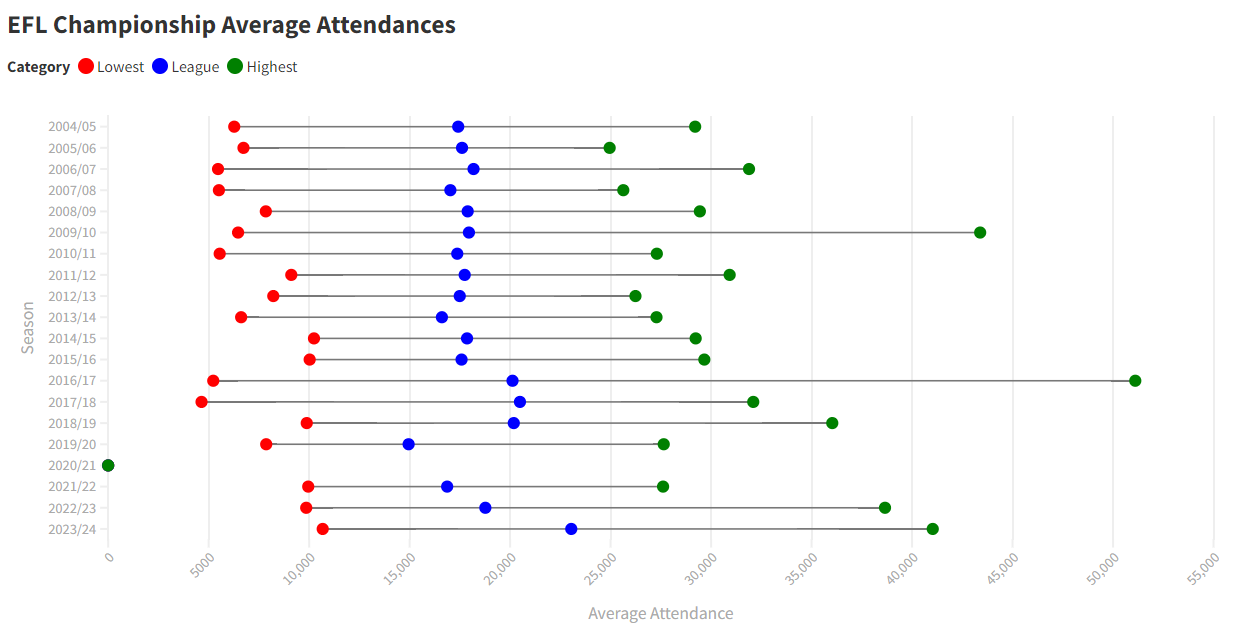
The EFL Championship is the second most-watched second-tier domestic sports league in the World, behind the German 2. Bundesliga (29,081), with an average of 23,048 spectators per game in the 2023–24 season. The Championship is the fifth most watched league in Europe.
The highest average league attendance was in 2023–24 season, when 12.7 million fans attended Championship matches, at an average of 23,048 per game. The lowest average league attendance came in the 2013–14 season, when 9.1 million spectators watched at an average of 16,605 per game. The highest seasonal average for a club was 51,106 for Newcastle United in the 2016–17 season.
| Season | League average attendance | Highest average | Club | Attendance | ||||||
|---|---|---|---|---|---|---|---|---|---|---|
| [2004–05](2004-05-football-league-championship) | 17,417 | Leeds United | 29,207 | |||||||
| [2005–06](2005-06-football-league-championship) | 17,607 | Norwich City | 24,952 | |||||||
| [2006–07](2006-07-football-league-championship) | 18,179 | Sunderland | 31,887 | |||||||
| [2007–08](2007-08-football-league-championship) | 17,027 | Sheffield United | 25,631 | |||||||
| [2008–09](2008-09-football-league-championship) | 17,888 | Derby County | 29,440 | |||||||
| [2009–10](2009-10-football-league-championship) | 17,949 | Newcastle United | 43,388 | |||||||
| [2010–11](2010-11-football-league-championship) | 17,369 | Leeds United | 27,299 | |||||||
| [2011–12](2011-12-football-league-championship) | 17,739 | West Ham United | 30,923 | |||||||
| [2012–13](2012-13-football-league-championship) | 17,493 | Brighton & Hove Albion | 26,236 | |||||||
| [2013–14](2013-14-football-league-championship) | 16,605 | Brighton & Hove Albion | 27,283 | |||||||
| [2014–15](2014-15-football-league-championship) | 17,857 | Derby County | 29,232 | |||||||
| [2015–16](2015-16-football-league-championship) | 17,583 | Derby County | 29,663 | |||||||
| [2016–17](2016-17-efl-championship) | 20,119 | Newcastle United | 51,106 | |||||||
| [2017–18](2017-18-efl-championship) | 20,489 | Aston Villa | title=Championship 2017/2018 – Attendance | url=https://www.worldfootball.net/competition/co20/se23961/attendance/ | url-status=live | archive-url=https://web.archive.org/web/20160512143019/http://www.soccerstats.com/attendance.asp?league=england2 | archive-date=12 May 2016 | access-date=2022-06-01 | website=worldfootball.net}} | |
| [2018–19](2018-19-efl-championship) | 20,269 | Aston Villa | 36,029 | |||||||
| [2019–20](2019-20-efl-championship) | title=English League Championship Performance Stats 2019-20 | url=https://www.espn.co.uk/football/stats/_/league/ENG.2/view/performance/season/2019 | access-date=2022-06-01 | publisher=ESPN | archive-date=1 June 2022 | archive-url=https://web.archive.org/web/20220601093729/https://www.espn.co.uk/football/stats/_/league/ENG.2/view/performance/season/2019 | url-status=live }} | Leeds United | 27,643 | |
| [2020–21](2020-21-efl-championship) | No attendances due to COVID-19 pandemic | |||||||||
| [2021–22](2021-22-efl-championship) | 16,776 | Sheffield United | 27,611 | |||||||
| [2022–23](2022-23-efl-championship) | 18,787 | Sunderland | 38,653 | |||||||
| [2023–24](2023-24-efl-championship) | 23,048 | Sunderland | 41,158 | |||||||
| [2024–25](2024-25-efl-championship) | 22,057 | Sunderland | 40,425 |
Historic performance
Since the restructuring into the Championship in 2004, 57 teams have spent at least one season in the division, including 13 of the 20 teams in the 2025–26 Premier League. Cardiff City have spent the longest in the league with 19 seasons. The 15-season spell for Ipswich Town between 2004 and 2019 is the longest consecutive spell of any team in the division. The teams with the current longest tenure are Bristol City, Preston North End and Queens Park Rangers, who will each have their eleventh consecutive season as a Championship team in the 2025–26 season. Norwich City has had six separate spells in the Championship; the most of any team. There have been 13 different winners of the EFL Championship, with eight teams (Burnley, Leeds United, Leicester City, Newcastle United, Norwich City, Reading, Sunderland and Wolverhampton Wanderers) having won it twice.
Burnley and Norwich City have been promoted out of the Championship on four occasions, with five teams (Fulham, Hull City, Sheffield United, Watford, West Brom) having been promoted on three occasions. Rotherham United have been relegated from the Championship the most times on five occasions, with Wigan Athletic having been relegated the second-most times on four occasions and two teams (Barnsley and Charlton Athletic) having been relegated on three occasions. 14 teams have been both promoted out of and relegated from the Championship.
Key
- Teams with this background and symbol in the "Club" column will be competing in the 2025–26 EFL Championship
- Team will be competing in the 2025–26 Premier League
- The club competed in the EFL Championship during that season (the number is the club's final league position)
| Club | Total Seasons | Number of Spells | Longest Spell (Seasons) | Highest Position | Lowest Position | Season | stp=1 | 2004–05}} | stp=1 | 2005–06}} | stp=1 | 2006–07}} | stp=1 | 2007–08}} | stp=1 | 2008–09}} | stp=1 | 2009–10}} | stp=1 | 2010–11}} | stp=1 | 2011–12}} | stp=1 | 2012–13}} | stp=1 | 2013–14}} | stp=1 | 2014–15}} | stp=1 | 2015–16}} | stp=1 | 2016–17}} | stp=1 | 2017–18}} | stp=1 | 2018–19}} | stp=1 | 2019–20}} | stp=1 | 2020–21}} | stp=1 | 2021–22}} | stp=1 | 2022–23}} | stp=1 | 2023–24}} | stp=1 | 2024–25}} | stp=1 | 2025–26}} |
|---|---|---|---|---|---|---|---|---|---|---|---|---|---|---|---|---|---|---|---|---|---|---|---|---|---|---|---|---|---|---|---|---|---|---|---|---|---|---|---|---|---|---|---|---|---|---|---|---|---|---|
| AFC Bournemouth | 4 | 2 | 2 | 1 | 10 | 10 | 1 | 6 | 2 | |||||||||||||||||||||||||||||||||||||||||
| Aston Villa | 3 | 1 | 3 | 4 | 13 | 13 | 4 | 5 | ||||||||||||||||||||||||||||||||||||||||||
| Barnsley | 13 | 3 | 8 | 5 | 24 | 20 | 18 | 20 | 18 | 17 | 21 | 21 | 23 | 14 | 22 | 21 | 5 | 24 | ||||||||||||||||||||||||||||||||
| Birmingham City | 16 | 4 | 13 | 2 | 22 | 2 | 2 | 4 | 12 | 21 | 10 | 10 | 19 | 19 | 17 | 20 | 18 | 20 | 17 | 22 | ||||||||||||||||||||||||||||||
| Blackburn Rovers | 13 | 2 | 8 | 7 | 22 | 17 | 8 | 9 | 15 | 22 | 15 | 11 | 15 | 8 | 7 | 19 | 7 | |||||||||||||||||||||||||||||||||
| Blackpool | 9 | 3 | 4 | 5 | 24 | 19 | 16 | 6 | 5 | 15 | 20 | 24 | 16 | 23 | ||||||||||||||||||||||||||||||||||||
| Bolton Wanderers | 6 | 2 | 4 | 7 | 24 | 7 | 14 | 18 | 24 | 21 | 23 | |||||||||||||||||||||||||||||||||||||||
| Brentford | 7 | 1 | 7 | 3 | 11 | 5 | 9 | 10 | 9 | 11 | 3 | 3 | ||||||||||||||||||||||||||||||||||||||
| Brighton & Hove Albion | 8 | 2 | 6 | 2 | 24 | 20 | 24 | 10 | 4 | 6 | 20 | 3 | 2 | |||||||||||||||||||||||||||||||||||||
| Bristol City | 17 | 2 | 11 | 4 | 24 | 4 | 10 | 10 | 15 | 20 | 24 | 18 | 17 | 11 | 8 | 12 | 19 | 17 | 14 | 11 | 6 | |||||||||||||||||||||||||||||
| Burnley | 12 | 5 | 5 | 1 | 17 | 13 | 17 | 15 | 13 | 5 | 8 | 13 | 11 | 2 | 1 | 1 | 2 | |||||||||||||||||||||||||||||||||
| Burton Albion | 2 | 1 | 2 | 20 | 23 | 20 | 23 | |||||||||||||||||||||||||||||||||||||||||||
| Cardiff City | 19 | 3 | 9 | 1 | 24 | 16 | 11 | 13 | 12 | 7 | 4 | 4 | 6 | 1 | 11 | 8 | 12 | 2 | 5 | 8 | 18 | 21 | 12 | 24 | ||||||||||||||||||||||||||
| Charlton Athletic | 8 | 4 | 4 | 9 | 24 | 11 | 24 | 9 | 18 | 12 | 22 | 22 | ||||||||||||||||||||||||||||||||||||||
| Colchester United | 2 | 1 | 2 | 10 | 24 | 10 | 24 | |||||||||||||||||||||||||||||||||||||||||||
| Coventry City | 14 | 2 | 8 | 5 | 23 | 19 | 8 | 17 | 21 | 17 | 19 | 18 | 23 | 16 | 12 | 5 | 9 | 5 | ||||||||||||||||||||||||||||||||
| Crewe Alexandra | 2 | 1 | 2 | 21 | 22 | 21 | 22 | |||||||||||||||||||||||||||||||||||||||||||
| Crystal Palace | 8 | 1 | 8 | 5 | 21 | 6 | 12 | 5 | 15 | 21 | 20 | 17 | 5 | |||||||||||||||||||||||||||||||||||||
| Derby County | 19 | 3 | 14 | 3 | 23 | 4 | 20 | 3 | 18 | 14 | 19 | 12 | 10 | 3 | 8 | 5 | 9 | 6 | 6 | 10 | 21 | 23 | 19 | |||||||||||||||||||||||||||
| Doncaster Rovers | 5 | 2 | 4 | 12 | 24 | 14 | 12 | 21 | 24 | 22 | ||||||||||||||||||||||||||||||||||||||||
| Fulham | 6 | 3 | 4 | 1 | 20 | 17 | 20 | 6 | 3 | 4 | 1 | |||||||||||||||||||||||||||||||||||||||
| Gillingham | 1 | 1 | 1 | 22 | 22 | 22 | ||||||||||||||||||||||||||||||||||||||||||||
| Huddersfield Town | 10 | 2 | 5 | 3 | 23 | 19 | 17 | 16 | 19 | 5 | 18 | 20 | 3 | 18 | 23 | |||||||||||||||||||||||||||||||||||
| Hull City | 15 | 5 | 5 | 2 | 24 | 18 | 21 | 3 | 11 | 8 | 2 | 4 | 18 | 13 | 24 | 19 | 15 | 7 | 21 | |||||||||||||||||||||||||||||||
| Ipswich Town | 17 | 3 | 15 | 2 | 24 | 3 | 15 | 14 | 8 | 9 | 15 | 13 | 15 | 14 | 9 | 6 | 7 | 16 | 12 | 24 | 2 | |||||||||||||||||||||||||||||
| Leeds United | 15 | 3 | 10 | 1 | 24 | 14 | 5 | 24 | 7 | 14 | 13 | 15 | 15 | 13 | 7 | 13 | 3 | 1 | 3 | 1 | ||||||||||||||||||||||||||||||
| Leicester City | 11 | 4 | 5 | 1 | 22 | 15 | 16 | 19 | 22 | 5 | 10 | 9 | 6 | 1 | 1 | |||||||||||||||||||||||||||||||||||
| Luton Town | 7 | 3 | 4 | 3 | 23 | 10 | 23 | 19 | 12 | 6 | 3 | 22 | ||||||||||||||||||||||||||||||||||||||
| Middlesbrough | 16 | 2 | 9 | 2 | 17 | 11 | 12 | 7 | 16 | 12 | 4 | 2 | 5 | 7 | 17 | 10 | 7 | 4 | 8 | 10 | ||||||||||||||||||||||||||||||
| Millwall | 16 | 3 | 9 | 8 | 23 | 10 | 23 | 9 | 16 | 20 | 19 | 22 | 8 | 21 | 8 | 11 | 9 | 8 | 13 | 8 | ||||||||||||||||||||||||||||||
| Milton Keynes Dons | 1 | 1 | 1 | 23 | 23 | 23 | ||||||||||||||||||||||||||||||||||||||||||||
| Newcastle United | 2 | 2 | 1 | 1 | 1 | 1 | 1 | |||||||||||||||||||||||||||||||||||||||||||
| Norwich City | 14 | 6 | 4 | 1 | 22 | 9 | 16 | 17 | 22 | 2 | 3 | 8 | 14 | 1 | 1 | 13 | 6 | 13 | ||||||||||||||||||||||||||||||||
| Nottingham Forest | 15 | 2 | 14 | 3 | 23 | 23 | 19 | 3 | 6 | 19 | 8 | 11 | 14 | 16 | 21 | 17 | 9 | 7 | 17 | 4 | ||||||||||||||||||||||||||||||
| Oxford United | 2 | 1 | 2 | 17 | 17 | 17 | ||||||||||||||||||||||||||||||||||||||||||||
| Peterborough United | 4 | 3 | 2 | 18 | 24 | 24 | 18 | 22 | 22 | |||||||||||||||||||||||||||||||||||||||||
| Plymouth Argyle | 8 | 2 | 6 | 10 | 23 | 17 | 14 | 11 | 10 | 21 | 23 | 21 | 23 | |||||||||||||||||||||||||||||||||||||
| Portsmouth | 4 | 2 | 2 | 16 | 22 | 16 | 22 | 16 | ||||||||||||||||||||||||||||||||||||||||||
| Preston North End | 18 | 2 | 11 | 4 | 22 | 5 | 4 | 7 | 15 | 6 | 17 | 22 | 11 | 11 | 7 | 14 | 9 | 13 | 13 | 12 | 10 | 20 | ||||||||||||||||||||||||||||
| Queens Park Rangers | 19 | 3 | 11 | 1 | 21 | 11 | 21 | 18 | 14 | 11 | 13 | 1 | 4 | 12 | 18 | 16 | 19 | 13 | 9 | 11 | 20 | 18 | 15 | |||||||||||||||||||||||||||
| Reading | 16 | 3 | 10 | 1 | 22 | 7 | 1 | 4 | 9 | 5 | 1 | 7 | 19 | 17 | 3 | 20 | 20 | 14 | 7 | 21 | 22 | |||||||||||||||||||||||||||||
| Rotherham United | 8 | 5 | 3 | 19 | 24 | 24 | 21 | 21 | 24 | 22 | 23 | 19 | 24 | |||||||||||||||||||||||||||||||||||||
| Scunthorpe United | 3 | 2 | 2 | 20 | 24 | 23 | 20 | 24 | ||||||||||||||||||||||||||||||||||||||||||
| Sheffield United | 12 | 5 | 4 | 2 | 23 | 8 | 2 | 9 | 3 | 8 | 23 | 10 | 2 | 5 | 2 | 3 | ||||||||||||||||||||||||||||||||||
| Sheffield Wednesday | 17 | 3 | 9 | 4 | 24 | 19 | 9 | 16 | 12 | 22 | 18 | 16 | 13 | 6 | 4 | 15 | 12 | 16 | 24 | 20 | 12 | |||||||||||||||||||||||||||||
| Southampton | 7 | 4 | 4 | 2 | 23 | 12 | 6 | 20 | 23 | 2 | 4 | |||||||||||||||||||||||||||||||||||||||
| Southend United | 1 | 1 | 1 | 22 | 22 | 22 | ||||||||||||||||||||||||||||||||||||||||||||
| Stoke City | 12 | 2 | 8 | 2 | 18 | 12 | 13 | 8 | 2 | 16 | 15 | 14 | 14 | 16 | 17 | 18 | ||||||||||||||||||||||||||||||||||
| Sunderland | 6 | 4 | 3 | 1 | 24 | 1 | 1 | 24 | 6 | 16 | 4 | |||||||||||||||||||||||||||||||||||||||
| Swansea City | 11 | 2 | 8 | 3 | 15 | 8 | 7 | 3 | 10 | 6 | 4 | 15 | 10 | 14 | 11 | |||||||||||||||||||||||||||||||||||
| Watford | 15 | 4 | 8 | 2 | 18 | 18 | 3 | 6 | 13 | 16 | 14 | 11 | 3 | 13 | 2 | 2 | 11 | 15 | 14 | |||||||||||||||||||||||||||||||
| West Bromwich Albion | 10 | 4 | 5 | 1 | 10 | 4 | 1 | 2 | 4 | 2 | 10 | 9 | 5 | 9 | ||||||||||||||||||||||||||||||||||||
| West Ham United | 2 | 2 | 1 | 3 | 6 | 6 | 3 | |||||||||||||||||||||||||||||||||||||||||||
| Wigan Athletic | 7 | 5 | 2 | 2 | 24 | 2 | 5 | 23 | 23 | 18 | 23 | 24 | ||||||||||||||||||||||||||||||||||||||
| Wolverhampton Wanderers | 10 | 3 | 5 | 1 | 23 | 9 | 7 | 5 | 7 | 1 | 23 | 7 | 14 | 15 | 1 | |||||||||||||||||||||||||||||||||||
| Wrexham | 1 | 1 | 1 | |||||||||||||||||||||||||||||||||||||||||||||||
| Wycombe Wanderers | 1 | 1 | 1 | 22 | 22 | 22 | ||||||||||||||||||||||||||||||||||||||||||||
| Yeovil Town | 1 | 1 | 1 | 24 | 24 | 24 |
References
References
- (18 July 2013). "Sky Bet to sponsor The Football League".
- "Cumulative revenue of Europe's 'big five' leagues grew by 5% in 2012/13 to €9.8 billion". Deloitte Touche Tohmatsu Limited.
- A referenced list of all leagues ranking above the Championship is available at the [[Major League Soccer attendance#MLS attendance vs. other soccer leagues worldwide. Major League Soccer attendance]] page.
- "Championship 2022/2023 – Attendance".
- (12 March 2013). "Barnsley 2–1 Brighton". [[BBC Sport]].
- (6 August 2005). "Countdown underway to new season". [[BBC Sport]].
- Lansley, Peter. (29 July 2005). "Championship glories in outstripping Serie A". The Times.
- [https://archive.today/20051102201410/http://www.thefa.com/TheFA/NewsFromTheFA/Postings/2005/08/Features_ChampionshipSuccess.htm First class second division] TheFA.com
- "League Points". Football League 125.
- (4 May 2007). "Leeds Utd call in administrators". BBC News.
- (4 May 2007). "Relegated Leeds in administration". BBC Sport.
- (28 May 2007). "Derby 1–0 West Brom". BBC Sport.
- (25 May 2009). "Burnley 1–0 Sheff Utd". [[BBC Sport]].
- [https://www.theguardian.com/football/2009/sep/30/coca-cola-football-league-sponsorship Coca-Cola end Football League sponsorship deal] {{Webarchive. link. (6 January 2014 ''The Guardian'', 30 September 2009)
- [http://news.bbc.co.uk/1/hi/business/8570749.stm Football League names npower as new sponsor ] {{Webarchive. link. (15 November 2019 BBC Sport, 16 March 2010)
- (28 January 2010). "Crystal Palace in Administration".
- "Season 2013/14". UEFA.
- (18 July 2013). "Sky Bet Sponsor Football League". Sky Sports.
- (24 May 2014). "Derby County 0–1 Queens Park Rangers". BBC Sport.
- (11 May 2017). "EFL: More than 18m fans watched matches in 2016–17". BBC Sport.
- (14 May 2019). "Championship play-off final: Aston Villa 2-1 Derby County". BBC Sport.
- (17 July 2020). "¡Vamos Leeds Carajo! Bielsa's boys back in the big time". Goal.
- (29 May 2021). "Championship play-off final: Brentford promoted to Premier League after winning 'football's richest game'". [[Sky News]].
- (29 May 2022). "Huddersfield 0–1 Nottingham Forest". BBC Sport.
- (May 2023). ["World Cup: Championship to be paused during Qatar 2022 showpiece"](https://uk-sport-web.prod.oceanusorigin.com/football/news/11095/12469493/world-cup-championship-to-be-paused-during-qatar-2022-showpiece-next-but-league-one-and-two-will-continue }}{{Dead link).
- "Championship". Sporting Life.
- The teams listed for this season were ranked using points per game following the curtailment of the season due to the [[COVID-19 pandemic in the United Kingdom]].
- (9 June 2023). "Highest League attendances for 70 years as nearly 22 million attend EFL competitions".
- (2024-05-05). "Championship 2023/2024 – Attendance".
- "Championship 2013/2014 – Attendance".
- (11 May 2017). "EFL records highest attendance records in 60 years '" thanks to Newcastle".
- (16 May 2023). "EFL Championship 2004/2005 – Attendance".
- "Championship 2005/2006 – Attendance".
- "Championship 2006/2007 – Attendance".
- "Championship 2007/2008 – Attendance".
- "Championship 2008/2009 – Attendance".
- "Championship 2009/2010 – Attendance".
- "Championship 2010/2011 – Attendance".
- "Championship 2011/2012 – Attendance".
- "Championship 2012/2013 – Attendance".
- "Championship 2014/2015 – Attendance".
- "Championship 2015/2016 – Attendance".
- "Championship 2016/2017 – Attendance".
- "Championship 2017/2018 – Attendance".
- "Championship 2018/2019 – Attendance".
- "English League Championship Performance Stats 2019-20". ESPN.
- "Championship 2019/2020 – Attendance".
- "Championship 2021/2022 – Attendance".
- "Championship 2022/2023 – Attendance".
- (5 May 2024). "Championship 2023/2024 – Attendance".
- (3 May 2025). "Championship 2024/2025 – Attendance".
This article was imported from Wikipedia and is available under the Creative Commons Attribution-ShareAlike 4.0 License. Content has been adapted to SurfDoc format. Original contributors can be found on the article history page.
Ask Mako anything about EFL Championship — get instant answers, deeper analysis, and related topics.
Research with MakoFree with your Surf account
Create a free account to save articles, ask Mako questions, and organize your research.
Sign up freeThis content may have been generated or modified by AI. CloudSurf Software LLC is not responsible for the accuracy, completeness, or reliability of AI-generated content. Always verify important information from primary sources.
Report