From Surf Wiki (app.surf) — the open knowledge base
Classical Kuiper belt object
Kuiper belt object, not controlled by an orbital resonance with Neptune
Kuiper belt object, not controlled by an orbital resonance with Neptune
A classical Kuiper belt object, also called a cubewano ( "QB1-o"), is a low-eccentricity Kuiper belt object (KBO) that orbits beyond Neptune and is not controlled by an orbital resonance with Neptune. Cubewanos have orbits with semi-major axes in the 40–50 AU range and, unlike Pluto, do not cross Neptune's orbit. That is, they have low-eccentricity and sometimes low-inclination orbits like the classical planets.
The name "cubewano" derives from the first trans-Neptunian object (TNO) found after Pluto and Charon: 15760 Albion, which until January 2018 had only the provisional designation (15760) . Similar objects found later were often called "QB1-os", or "cubewanos", after this object, though the term "classical" is much more frequently used in the scientific literature.
Objects identified as cubewanos include:
- 15760 Albion (aka and gave rise to the term "Cubewano")
- Makemake, a dwarf planet
- Quaoar and 20000 Varuna, each considered the largest TNO at the time of discovery
- 19521 Chaos, 58534 Logos, 53311 Deucalion, 66652 Borasisi, 88611 Teharonhiawako
- , , 55565 Aya, 55637 Uni
- 486958 Arrokoth
Haumea was provisionally listed as a cubewano by the Minor Planet Center in 2006, but was later found to be in a resonant orbit.
Orbits: 'hot' and 'cold' populations
There are two basic dynamical classes of classical Kuiper-belt bodies: those with relatively unperturbed ('cold') orbits, and those with markedly perturbed ('hot') orbits.
Most cubewanos are found between the 2:3 orbital resonance with Neptune (populated by plutinos) and the 1:2 resonance. 50000 Quaoar, for example, has a near-circular orbit close to the ecliptic. Plutinos, on the other hand, have more eccentric orbits bringing some of them closer to the Sun than Neptune.
The majority of classical objects, the so-called cold population, have low inclinations (
The Deep Ecliptic Survey reports the distributions of the two populations; one with the inclination centered at 4.6° (named Core) and another with inclinations extending beyond 30° (Halo). ()
Distribution
The vast majority of KBOs (more than two-thirds) have inclinations of less than 5° and eccentricities of less than 0.1 . Their semi-major axes show a preference for the middle of the main belt; arguably, smaller objects close to the limiting resonances have been either captured into resonance or have their orbits modified by Neptune.
The 'hot' and 'cold' populations are strikingly different: more than 30% of all cubewanos are in low inclination, near-circular orbits. The parameters of the plutinos' orbits are more evenly distributed, with a local maximum in moderate eccentricities in 0.15–0.2 range, and low inclinations 5–10°. See also the comparison with scattered disk objects.
Cubewanos form a clear 'belt' outside Neptune's orbit, whereas the plutinos approach, or even cross Neptune's orbit. When orbital inclinations are compared, 'hot' cubewanos can be easily distinguished by their higher inclinations, as the plutinos typically keep orbits
Cold and hot populations: physical characteristics
In addition to the distinct orbital characteristics, the two populations display different physical characteristics.
The difference in colour between the red cold population, such as 486958 Arrokoth, and more heterogeneous hot population was observed as early as in 2002. Recent studies, based on a larger data set, indicate the cut-off inclination of 12° (instead of 5°) between the cold and hot populations and confirm the distinction between the homogenous red cold population and the bluish hot population.
Another difference between the low-inclination (cold) and high-inclination (hot) classical objects is the observed number of binary objects. Binaries are quite common on low-inclination orbits and are typically similar-brightness systems. Binaries are less common on high-inclination orbits and their components typically differ in brightness. This correlation, together with the differences in colour, support further the suggestion that the currently observed classical objects belong to at least two different overlapping populations, with different physical properties and orbital history.
Toward a formal definition
There is no official definition of 'cubewano' or 'classical KBO'. However, the terms are normally used to refer to objects free from significant perturbation from Neptune, thereby excluding KBOs in orbital resonance with Neptune (resonant trans-Neptunian objects). The Minor Planet Center (MPC) and the Deep Ecliptic Survey (DES) do not list cubewanos (classical objects) using the same criteria. Many TNOs classified as cubewanos by the MPC, such as dwarf planet Makemake, are classified as ScatNear (possibly scattered by Neptune) by the DES. may be an inner cubewano near the plutinos. Furthermore, there is evidence that the Kuiper belt has an 'edge', in that an apparent lack of low-inclination objects beyond 47–49 AU was suspected as early as 1998 and shown with more data in 2001. Consequently, the traditional usage of the terms is based on the orbit's semi-major axis, and includes objects situated between the 2:3 and 1:2 resonances, that is between 39.4 and 47.8 AU (with exclusion of these resonances and the minor ones in-between).
These definitions lack precision: in particular the boundary between the classical objects and the scattered disk remains blurred. , there are 870 objects with perihelion (q) 40 AU and aphelion (Q)
DES classification
Introduced by the report from the Deep Ecliptic Survey by J. L. Elliott et al. in 2005 uses formal criteria based on the mean orbital parameters. Put informally, the definition includes the objects that have never crossed the orbit of Neptune. According to this definition, an object qualifies as a classical KBO if:
- it is not resonant
- its average Tisserand's parameter with respect to Neptune exceeds 3
- its average eccentricity is less than 0.2.
SSBN07 classification
An alternative classification, introduced by B. Gladman, B. Marsden and C. van Laerhoven in 2007, uses a 10-million-year orbit integration instead of the Tisserand's parameter. Classical objects are defined as not resonant and not being currently scattered by Neptune.
Formally, this definition includes as classical all objects with their current orbits that
- are non-resonant (see the definition of the method)
- have a semi-major axis greater than that of Neptune (30.1 AU; i.e. excluding centaurs) but less than 2000 AU (to exclude inner-Oort-cloud objects)
- are not being scattered by Neptune
- have their eccentricity e (to exclude detached objects) Unlike other schemes, this definition includes the objects with major semi-axis less than 39.4 AU (2:3 resonance)—termed inner classical belt, or more than 48.7 (1:2 resonance) – termed outer classical belt, and reserves the term main classical belt for the orbits between these two resonances.
Families
The first known collisional family in the classical Kuiper belt—a group of objects thought to be remnants from the breakup of a single body—is the Haumea family. It includes Haumea, its moons, and seven smaller bodies. The objects not only follow similar orbits but also share similar physical characteristics. Unlike many other KBO their surface contains large amounts of water ice (H2O) and no or very little tholins. The surface composition is inferred from their neutral (as opposed to red) colour and deep absorption at 1.5 and 2. μm in infrared spectrum. Several other collisional families might reside in the classical Kuiper belt.
Exploration
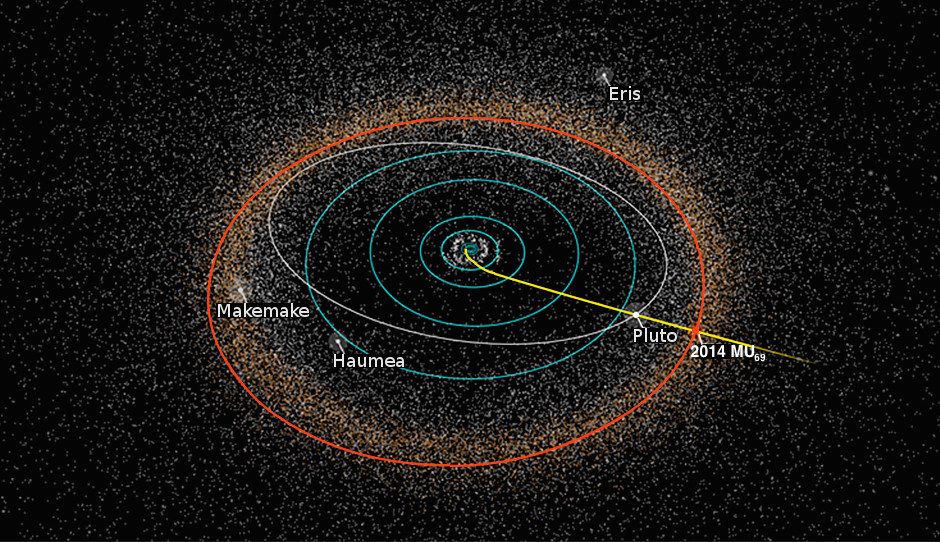
As of January 2019, only one classical Kuiper belt object has been observed up close by spacecraft. Both Voyager spacecraft have passed through the region before the discovery of the Kuiper belt. New Horizons was the first mission to visit a classical KBO. After its successful exploration of the Pluto system in 2015, the NASA spacecraft has visited the small KBO 486958 Arrokoth at a distance of 3500 km on 1 January 2019.
List
Main article: List of trans-Neptunian objects#List
Here is a very generic list of classical Kuiper belt objects. , there are about 870 objects with q 40 AU and {{nowrap|Q
Footnotes
References
References
- "Distant Minor Planets".
- Jewitt, David. "Classical Kuiper Belt Objects". UCLA.
- (2006-12-12). "MPEC 2006-X45: Distant Minor Planets". IAU Minor Planet Center & Tamkin Foundation Computer Network.
- (2006). "Solar System Update : Topical and Timely Reviews in Solar System Sciences". [[Springer (publisher).
- (2003). "The formation of the Kuiper belt by the outward transport of bodies during Neptune's migration". [[Nature (journal).
- (July 2002). "A Collisional Family in the Classical Kuiper Belt". [[The Astrophysical Journal]].
- (11 February 2018). "Dynamically correlated minor bodies in the outer Solar system". [[Monthly Notices of the Royal Astronomical Society]].
- Stern, Alan. (28 February 2018). "The PI's Perspective: Why Didn't Voyager Explore the Kuiper Belt?".
- Lakdawalla, Emily. (24 January 2018). "New Horizons prepares for encounter with 2014 MU69". Planetary Society.
- "{{nowrap". Harvard-Smithsonian Center for Astrophysics.
This article was imported from Wikipedia and is available under the Creative Commons Attribution-ShareAlike 4.0 License. Content has been adapted to SurfDoc format. Original contributors can be found on the article history page.
Ask Mako anything about Classical Kuiper belt object — get instant answers, deeper analysis, and related topics.
Research with MakoFree with your Surf account
Create a free account to save articles, ask Mako questions, and organize your research.
Sign up freeThis content may have been generated or modified by AI. CloudSurf Software LLC is not responsible for the accuracy, completeness, or reliability of AI-generated content. Always verify important information from primary sources.
Report