From Surf Wiki (app.surf) — the open knowledge base
Citizenship of the United States
none

none
United States citizenship in general
Citizenship of the United States is a legal status that entails citizens with specific rights, duties, protections, and benefits in the United States. It serves as a foundation of fundamental rights derived from and protected by the Constitution and laws of the United States, such as freedom of expression, due process, the rights to vote, live and work in the United States, and to receive federal assistance.
There are two primary sources of citizenship: birthright citizenship, in which persons born within the territorial limits of the United States (except American Samoa) are presumed to be a citizen, or—providing certain other requirements are met—born abroad to a United States citizen parent, and naturalization, a process in which an eligible legal immigrant applies for citizenship and is accepted. The first of these two pathways to citizenship is specified in the Citizenship Clause of the Fourteenth Amendment of the Constitution which reads:
The second is provided for in U.S. law. In Article One of the Constitution, the power to establish a "uniform rule of naturalization" is granted explicitly to Congress.
United States law permits multiple citizenship. Citizens of other countries who are naturalized as United States citizens may retain their previous citizenship, although they must renounce allegiance to the other country. A United States citizen retains United States citizenship when becoming the citizen of another country, should that country's laws allow it. United States citizenship can be renounced by Americans via a formal procedure at a United States embassy.
National citizenship signifies membership in the country as a whole; state citizenship, in contrast, signifies a relation between a person and a particular state and has application generally limited to domestic matters. State citizenship may affect (1) tax decisions, (2) eligibility for some state-provided benefits such as higher education, and (3) eligibility for state political posts such as United States senator. At the time of the American Civil War, state citizenship was a source of significant contention between the Union and the seceding Southern states.
Rights, duties, and benefits
Rights
- Freedom to reside and work. United States citizens have the right to reside and work in the United States. Certain non-citizens, such as lawful permanent residents, have similar rights; however, non-citizens, unlike citizens, may have the right taken away. For example, they may be deported if convicted of a serious crime.
- Freedom to enter and leave the United States. United States citizens have the right to enter and leave the United States freely. Certain non-citizens, such as permanent residents, have similar rights. Unlike permanent residents, United States citizens do not have an obligation to maintain residence in the United States – they can leave for any length of time and return freely at any time.
- Voting for federal office in all fifty states and the District of Columbia is restricted to citizens only. States are not required to extend the franchise to all citizens: for example, several states bar citizen felons from voting, even after they have completed any custodial sentence. The United States Constitution bars states from restricting citizens from voting on grounds of race, color, previous condition of servitude, sex, failure to pay any tax, or age (for citizens who are at least eighteen years old). Historically, many states and local jurisdictions have allowed non-citizens to vote; however, today this is limited to local elections in very few places. Citizens are not compelled to vote.
- Freedom to stand for public office. The United States Constitution requires that all members of the United States House of Representatives have been citizens for seven years, and that all senators have been citizens for nine years, before taking office. Most states have similar requirements: for example California requires that legislators have been citizens for three years, and the Governor has been a citizen for five years, upon taking office. The United States Constitution requires that one be "a natural born Citizen" and a United States resident for fourteen years in order to be president of the United States or vice president of the United States. The Constitution also stipulates that otherwise eligible citizens must meet certain age requirements for these offices.
- Right to apply for federal employment. Many federal government jobs require applicants to have United States citizenship. United States citizens can apply for federal employment within a government agency or department.
Duties

- Jury duty is only imposed upon citizens. Jury duty may be considered the "sole differential obligation" between non-citizens and citizens; the federal and state courts "uniformly exclude non-citizens from jury pools today, and with the exception of a few states in the past, this has always been the case".
- Military participation is not currently required in the United States, but a policy of conscription of men has been in place at various times (both in war and in peace) in American history, most recently during the Vietnam War. Currently, the United States Armed Forces are a professional all-volunteer force, although both male United States citizens and male non-citizen permanent residents are required to register with the Selective Service System and may be called up in the event of a future draft. Johns Hopkins University political scientist Benjamin Ginsberg writes, "The professional military has limited the need for citizen soldiers".
- Taxes. In the United States today, everyone except those whose income is derived from tax-exempt revenue (Subchapter N, Section 861 of the U.S. Tax Code) is required to file a federal income tax return. U.S. citizens are subject to federal income tax on worldwide income regardless of their country of residence.
Benefits
- Consular protection outside the United States. While traveling abroad, if a person is arrested or detained by foreign authorities, the person can request to speak to somebody from the United States Embassy or Consulate. Consular officials can provide resources for Americans incarcerated abroad, such as a list of local attorneys who speak English. The United States government may even intervene on the person's behalf. Non-citizen United States nationals also have this benefit.
- Increased ability to sponsor relatives living abroad. Several types of immigrant visas require that the person requesting the visa be directly related to a United States citizen. Having United States citizenship facilitates the granting of IR and F visas to family members.
- Transmission of United States citizenship to children born abroad. Generally, children born to two United States citizen parents abroad are automatically United States citizens at birth. When the parents are one United States citizen and one non-United States citizen, certain conditions about the United States citizen's parent's length of time spent in the United States need to be met. Non-citizen United States nationals also have an analogous benefit (transmission of non-citizen United States nationality to children born abroad).
- Protection from deportation. Naturalized United States citizens are no longer considered aliens and cannot be placed into deportation proceedings.
- Other benefits. The USCIS sometimes honors the achievements of naturalized United States citizens. The Outstanding American by Choice Award was created by the USCIS to recognize the outstanding achievements of naturalized United States citizens, and past recipients include author Elie Wiesel who won the Nobel Peace Prize; Indra K. Nooyi who was CEO of PepsiCo; John Shalikashvili who was Chairman of the Joint Chiefs of Staff; and others. Further, citizenship status can affect which country an athlete can compete as a member of in competitions such as the Olympics.
Civic participation
Civic participation is not required in the United States. There is no requirement to attend town meetings, belong to a political party, or vote in elections. However, a benefit of naturalization is the ability to "participate fully in the civic life of the country". Moreover, to be a citizen means to be vitally important to politics and not ignored. There is disagreement about whether popular lack of involvement in politics is helpful or harmful.
Vanderbilt professor Dana D. Nelson suggests that most Americans merely vote for president every four years, and sees this pattern as undemocratic. In her book Bad for Democracy, Nelson argues that declining citizen participation in politics is unhealthy for long term prospects for democracy.
However, writers such as Robert D. Kaplan in The Atlantic see benefits to non-involvement; he wrote "the very indifference of most people allows for a calm and healthy political climate". Kaplan elaborated: "Apathy, after all, often means that the political situation is healthy enough to be ignored. The last thing America needs is more voters—particularly badly educated and alienated ones—with a passion for politics".
Dual citizenship
A person who is considered a citizen by more than one nation has dual citizenship. It is possible for a United States citizen to have dual citizenship; this can be achieved in various ways, such as by birth in the United States to a parent who is a citizen of a foreign country (the foreign nationality may also be transmitted by a grandparent), by birth in another country to a parent(s) who is/are a United States citizen/s, or by having parents who are citizens of different countries. Anyone who becomes a naturalized United States citizen is required to renounce any prior "allegiance" to other countries during the naturalization ceremony.
The State Department states that "A United States citizen may naturalize in a foreign state without any risk to his or her United States citizenship."
The earliest recorded instances of dual citizenship began before the French Revolution when the British captured American ships and forced them back to Europe. The British Crown considered subjects from the United States as British by birth and forced them to fight in the Napoleonic Wars.
Under certain circumstances there are relevant distinctions between dual citizens who hold a "substantial contact" with a country, for example by holding a passport or by residing in the country for a certain period of time, and those who do not. For example, under the Heroes Earnings Assistance and Relief Tax (HEART) Act of 2008, United States citizens in general are subject to an expatriation tax if they give up United States citizenship, but there are exceptions (specifically ) for those who are either under age upon giving up United States citizenship and have lived in the United States for less than ten years in their lives, or who are dual citizens by birth residing in their other country of citizenship at the time of giving up United States citizenship and have lived in the United States for less than ten out of the past fifteen years. Similarly, the United States considers holders of a foreign passport to have a substantial contact with the country that issued the passport, which may preclude security clearance.
United States citizens are required by federal law to identify themselves with a United States passport, not with any other foreign passport, when entering or leaving the United States. The Supreme Court case of Afroyim v. Rusk, declared that a United States citizen did not lose his citizenship by voting in an election in a foreign country, or by acquiring foreign citizenship, if they did not intend to lose United States citizenship. United States citizens who have dual citizenship do not lose their United States citizenship unless they renounce it officially.
History of citizenship in the United States
Citizenship began in colonial times as an active relation between men working cooperatively to solve municipal problems and participating actively in democratic decision-making, such as in New England town hall meetings. Men met regularly to discuss local affairs and make decisions. These town meetings were described as the "earliest form of American democracy" which was vital since citizen participation in public affairs helped keep democracy "sturdy", according to Alexis de Tocqueville in 1835. A variety of forces changed this relation during the nation's history. Citizenship became less defined by participation in politics and more defined as a legal relation with accompanying rights and privileges. While the realm of civic participation in the public sphere has shrunk, the citizenship franchise has been expanded to include not just propertied white adult men but black men and adult women.
The Supreme Court affirmed in United States v. Wong Kim Ark, , that per the Fourteenth Amendment's Citizenship Clause an ethnic Chinese person born in the United States becomes a citizen. This is distinct from naturalized citizenship; in 1922 the Court held in Ozawa v. United States, , that a Japanese person, born in Japan but resident in the United States for twenty years, could not be naturalized under the law of the time and in 1923 in United States v. Bhagat Singh Thind, , that an Indian person could not be naturalized. In the Ozawa decision it was noted that "In all of the naturalization acts from 1790 to 1906 the privilege of naturalization was confined to white persons (with the addition in 1870 of those of African nativity and descent)", 1906 being the most recent legislation in question at the time.
The Equal Nationality Act of 1934 allowed a foreign-born child of a US citizen mother and an alien father, who had entered US territory before age 18 and lived in the United States for five years, to apply for United States citizenship for the first time. It also made the naturalization process quicker for American women's alien husbands. This law equalized expatriation, immigration, naturalization, and repatriation rules between women and men. However, it was not applied retroactively, and was modified by later laws, such as the Nationality Act of 1940.
Birthright citizenship
Main article: Birthright citizenship in the United States
United States citizenship is usually acquired by birth when a child is born within the national territory of the United States. For the purposes of birthright citizenship and nationality, U.S. congress defines by the Immigration and Naturalization Act (INA) of 1952 (8 USC 1402) that the national territory of the United States consists of the 50 U.S. states, the District of Columbia, Guam, Puerto Rico, the Northern Mariana Islands, the United States Virgin Islands, and the Palmyra Atoll. Citizenship and nationality, however, was not specified in the original Constitution. In 1868, the Fourteenth Amendment specifically defined persons who were either born or naturalized in the United States and subject to its jurisdiction as citizens. All babies born in the United States—except those born to enemy aliens in wartime or the children of foreign diplomats—enjoy United States citizenship under the Supreme Court's long-standing interpretation of the Fourteenth Amendment regardless of the citizenship or immigration status of their parents. The amendment states: "All persons born or naturalized in the United States, and subject to the jurisdiction thereof, are citizens of the United States and of the State wherein they reside." There remains dispute as to who is "subject to the jurisdiction" of the United States at birth.
By act of Congress, every person born in Puerto Rico, the United States Virgin Islands, Guam, and the Northern Mariana Islands is a United States citizen by birth. Also, every person born in the former Panama Canal Zone whose father or mother (or both) are or were a U.S. citizen is a United States citizen by birth.
Regardless of where they are born, children of United States citizens are United States citizens in most cases. Children born outside the United States with at least one United States citizen parent usually have birthright citizenship by parentage.
A child of unknown parentage found in the United States while under the age of five is considered a US citizen unless and until it is proven, before that child reaches the age of twenty-one, that the child had not been born in the US.
While persons born in the United States are considered to be citizens and can obtain US passports, children under the age of eighteen are legally considered to be minors and cannot vote, stand for, or hold public office. Upon the person's eighteenth birthday, they are considered to be full citizens, although no official ceremony takes place and no correspondence between the government and the new citizen occurs to acknowledge the relation. Citizenship is assumed to exist, and the relation is assumed to remain viable until death or until it is renounced or dissolved by some other legal process. Secondary schools ideally teach the basics of citizenship and create "informed and responsible citizens" who are "skilled in the arts of effective deliberation and action."
Americans who live in foreign countries and become members of other governments have, in some instances, been stripped of citizenship, although there have been court cases where decisions regarding citizenship have been reversed.
{{anchor|naturalized}}Naturalized citizenship
Article I, Section 8 of the U.S. constitution gives Congress the power "To establish an uniform Rule of Naturalization". Acts of Congress provide for acquisition of citizenship by persons not born in the U.S.
Agency in charge
The agency in charge of admitting new citizens is the United States Citizenship and Immigration Services, commonly abbreviated as USCIS. It is a bureau of the Department of Homeland Security. It offers web-based services. The agency depends on application fees for revenue; in 2009, with a struggling economy, applications were down sharply, and consequently there was much less revenue to upgrade and streamline services. There was speculation that if the administration of president Barack Obama passed immigration reform measures, then the agency could face a "welcome but overwhelming surge of Americans-in-waiting" and longer processing times for citizenship applications. The USCIS has made efforts to digitize records.{{cite news|author=PRNewswire|title=CSC Receives US$27 Million Task Order From United States Citizenship and Immigration ...
Pathways to citizenship
_commanding_officer.jpg)
People applying to become United States citizens must satisfy certain requirements. For example, applicants must generally have been permanent residents for five years (three if married to a United States citizen), be of "good moral character" (meaning no felony convictions), be of "sound mind" in the judgment of immigration officials, have a knowledge of the Constitution, and be able to speak and understand English unless they are elderly or disabled. Applicants must also pass a citizenship test. In 2006, the government replaced the former trivia test with a ten-question oral test designed to "shun simple historical facts about America that can be recounted in a few words, for more explanation about the principles of American democracy, such as freedom". One reviewer described the new citizenship test as "thoughtful". While some have criticized the new version of the test, officials counter that the new test is a "teachable moment" without making it conceptually more difficult, since the list of possible questions and answers, as before, will be publicly available. Six correct answers constitute a passing grade. The new test probes for signs that immigrants "understand and share American values".
- One way to become a permanent resident is to apply to the US government Diversity Visa (DV) lottery. This program permits foreigners to apply for a drawing to become a permanent resident.
- Military participation can also allow immigrant residents to become citizens. The military has had a tradition of "filling out its ranks" with aliens living in the United States. The financial and social benefits of citizenship can motivate persons to participate in potentially hazardous activities such as military service. For example, a 2009 article in The New York Times said that the United States Military was recruiting "skilled immigrants who are living in this country with temporary visas" by promising an opportunity to become citizens "in as little as six months" in exchange for service in Afghanistan and Iraq where United States forces are "stretched thin". One estimate was that in 2009 the US military had 29,000 foreign-born people currently serving who were not American citizens. By June 2003, twelve non-citizens had died while on active duty in the United States armed forces during the Iraqi war.
- Grandparent rule. Section 322 of the Immigration and Nationality Act of 1952 (INA), added in 1994, enabled children of a United States citizen who did not become citizens at birth, to use the physical presence period in the United States of a grandparent who was a citizen to qualify for United States citizenship. Under the Child Citizenship Act of 2000, Section 322 was amended to extend also to children who generally reside outside the United States with a United States citizen parent, whether biological or adopted. The child must be in the legal and physical custody of the United States citizen parent, the child and parent must be lawfully present in the United States for the interview, and the child must take the oath of allegiance before the age of 18 years (for those 14 years or older). The application (Form N-600K) may only be submitted by the United States citizen parent, or by the grandparent or legal guardian within 5 years of the parent's death. In 2006, there were 4,000 applications of citizenship using the physical presence of grandparents. Israel comprises 90% of those taking advantage of the clause.
Strong demand
According to a senior fellow at the Migration Policy Institute, "citizenship is a very, very valuable commodity". In the mid-1990s to 2009, the levels rose to about 500,000 per year with considerable variation. In 1996, more than one million people became citizens through naturalization.{{cite news|author=William Booth|title=The United States Citizenship Test: Learning, And Earning, Their Stripes|quote=A record number of immigrants, more than 1 million, will become United States citizens this year.
Naturalization fees were US$60 in 1989; US$90 in 1991; US$95 in 1994; US$225 in 1999; US$260 in 2002; US$320 in 2003; US$330 in 2005. In 2007 application fees were increased from US$330 to US$595 and an additional US$80 computerized fingerprinting fee was added. Doris Meissner, a senior fellow at the Migration Policy Institute and former Immigration and Naturalization Service Commissioner, doubted that fee increases deter citizenship-seekers.
Citizenship ceremonies
The citizenship process has been described as a ritual that is meaningful for many immigrants. According to federal law, citizenship applicants who are also changing their names must appear before a federal judge.
Honorary citizenship
The title of "Honorary Citizen of the United States" has been granted eight times by an act of Congress or by a proclamation issued by the president pursuant to authorization granted by Congress. The eight individuals are Sir Winston Churchill, Raoul Wallenberg, William Penn, Hannah Callowhill Penn, Mother Teresa, the Marquis de Lafayette, Casimir Pulaski, and Bernardo de Gálvez y Madrid, Viscount of Galveston and Count of Gálvez.
Sometimes, the government awarded non-citizen immigrants who died fighting for American forces with the posthumous title of United States citizen, but this is not considered honorary citizenship. In June 2003, Congress approved legislation to help families of fallen non-citizen soldiers.
Corporate citizenship
Since corporations are considered persons in the eyes of the law, some carry US citizenship. US citizenship's main advantage for a corporation is the protection and support of the United States government in legal or bureaucratic disputes. For example, the airline Virgin America asked the United States Department of Transportation to be treated as an American air carrier when jockeying with foreign governments for access to air routes and overseas airports.
For the purposes of diversity jurisdiction in the United States civil procedure, corporate citizenship is determined by the principal place of business of the corporation. There is some degree of disagreement among legal authorities as to how exactly this may be determined.
Distinction between citizenship and nationality
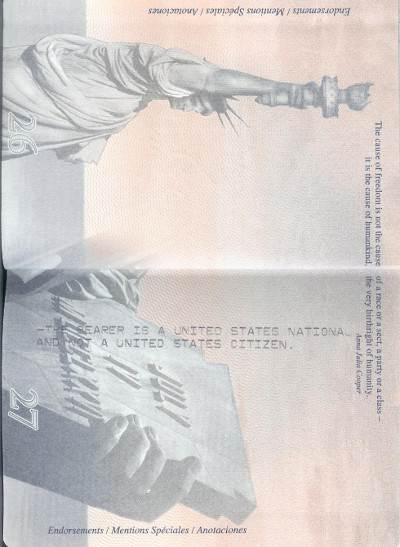
The Immigration and Nationality Act of 1952 made a distinction between "citizenship" and "nationality" of the United States: all United States citizens are also United States nationals, but not all U.S. nationals are also U.S. citizens. Hence, it is possible for a person to be a national of the United States but not a U.S. citizen.
Historic and current grants of non-citizen nationality
The federal government of the United States takes the position that unincorporated territories of the United States are not "in the United States" for purposes of the Citizenship Clause of the Fourteenth Amendment to the U.S. Constitution, which grants U.S. citizenship at birth to people born in the United States. Hence, people born in an unincorporated territory of the United States are U.S. citizens at birth only if Congress has passed a citizenship statute for that territory; otherwise, they become non-citizen U.S. nationals at birth instead, as per .
Currently, American Samoa is the only unincorporated territory of the United States where newborn infants become non-citizen U.S. nationals at birth. Although international law and Supreme Court dicta would regard persons born in a United States Minor Outlying Island as non-citizen nationals of the United States, the nationality status of such persons is not specifically mentioned by US law (and none of these islands are inhabited, so the question does not routinely arise).
The U.S. government position regarding American Samoa began to be challenged in court in the 2010s. A 2016 ruling by the D.C. Circuit Court upheld the government's position that American Samoa is not "in the United States" for purposes of the Fourteenth Amendment and thus American Samoans are nationals but not citizens at birth, A 2021 ruling by the 10th Circuit Court of Appeals similarly upheld the government's position and reversed a lower court ruling that said American Samoan plaintiffs were United States citizens at birth.
Unlike people born in American Samoa, people born in Puerto Rico, Guam, the United States Virgin Islands and the Northern Mariana Islands (on or after November 4, 1986) have United States citizenship at birth, as Congress has granted this status by law. People born in the Northern Mariana Islands before November 4, 1986, automatically gained U.S. citizenship on that date, but they could choose to give up U.S. citizenship and become non-citizen U.S. nationals within 6 months after the later of November 4, 1986, and the date they turned 18 years old.
Legal distinctions between United States citizens and non-citizen nationals
United States citizenship grants more privileges and rights than non-citizen United States nationality. For example, while non-citizen U.S. nationals can reside and work in the United States without restrictions, both they and foreign nationals and citizens are not allowed to vote in federal or state elections, although there is no constitutional prohibition against their doing so. By statute law, most non-citizen U.S. nationals pass their U.S. nationality to children born outside the United States, similarly to U.S. citizens.
Non-citizen U.S. nationals can apply for naturalization if they want to become U.S. citizens. In order to be naturalized, non-citizen U.S. nationals must meet similar requirements to foreign nationals, meaning non-citizen nationals must pay a US$640 fee (), pass a good moral character assessment, be fingerprinted and pass an English and civics examination. However, unlike foreign nationals, non-citizen U.S. nationals do not need to hold permanent residency of the U.S. when they apply for citizenship, and they can count their legal residence and physical presence in unincorporated U.S. territories the same as presence in the U.S. proper toward the naturalization requirements.
The United States passport issued to non-citizen nationals of the United States contains the endorsement code 9 which states: "The bearer is a United States national and not a United States citizen" on the annotations page.
Controversies
The issue of citizenship naturalization is a highly contentious matter in United States politics, particularly regarding illegal immigrants. Candidates in the 2008 presidential election, such as Rudy Giuliani, tried to "carve out a middle ground" on the issue of illegal immigration, but rivals such as John McCain advocated legislation requiring illegal immigrants to first leave the country before being eligible to apply as citizens. Some measures to require proof of citizenship upon registering to vote have met with controversy.{{cite news|author=Ian Urbina|title=Voter ID Battle Shifts to Proof of Citizenship|quote=The battle over voting rights will expand this week as lawmakers in Missouri are expected to support a proposed constitutional amendment to enable election officials to require proof of citizenship from anyone registering to vote.|newspaper=The New York Times|date=May 12, 2008
Controversy can arise when citizenship affects political issues. Whether to include questions about current citizenship status in the United States Census questions has been debated in the Senate. Including non-citizens in Census counts also shifts political power to states that have large numbers of non-citizens due to the fact that reapportionment of congressional seats is based on Census data, and including non-citizens in the census is mandated by the United States Constitution.
There have been controversies based on speculation about which way newly naturalized citizens are likely to vote. Since immigrants from many countries have been presumed to vote Democratic if naturalized, there have been efforts by Democratic administrations to streamline citizenship applications before elections to increase turnout; Republicans, in contrast, have exerted pressure to slow down the process. In 1997, there were efforts to strip the citizenship of 5,000 newly approved immigrants who, it was thought, had been "wrongly naturalized"; a legal effort to do this presented enormous challenges. Foreign-born naturalized citizens tend to vote at the same rates as natives. For example, in the state of New Jersey in the 2008 election, the foreign born represented 20.1% of the state's population of 8,754,560; of these, 636,000 were eighteen or older and hence eligible to vote; of eligible voters, 396,000 actually voted, which was about 62%.
There has been controversy about the agency in charge of citizenship. The USCIS has been criticized as being a "notoriously surly, inattentive bureaucracy" with long backlogs in which "would-be citizens spent years waiting for paperwork".{{cite news|author=Editorial staff|title=A Commitment to Citizenship|quote=Reports this week that the United States citizenship agency was yet again struggling with a budget shortfall, and considering raising fees on the hopeful immigrants who are its main source of revenue, could have led any American to wonder what kind of beacon to the world we are anymore.|newspaper=The New York Times|date=September 25, 2009|url=https://www.nytimes.com/2009/09/26/opinion/26sat3.html?_r=1|access-date=November 19, 2009
Generally, eligibility for citizenship is denied for the millions of people living in the United States illegally, although from time to time, there have been amnesties. In 2006, there were mass protests numbering hundreds of thousands of people throughout the United States demanding United States citizenship for illegal immigrants. Many carried banners which read "We Have A Dream Too". One estimate is that there were 12 million illegal immigrants in the United States in 2006. Many American high school students have citizenship issues.{{cite news|author=Eddy Ramírez|title=Should Colleges Enroll Illegal Immigrants?
Relinquishment of citizenship
Main article: Relinquishment of United States nationality
United States citizens can relinquish their citizenship, which involves abandoning the right to reside in the United States and all the other rights and responsibilities of citizenship. "Relinquishment" is the legal term covering all seven different potentially-expatriating acts (ways of giving up citizenship) under . "Renunciation" refers to two of those acts: swearing an oath of renunciation before a United States diplomatic or consular officer abroad, or before an official designated by the attorney general within the United States during a state of war. Out of an estimated three to six million United States citizens residing abroad, between five and six thousand relinquished citizenship each year in 2015 and 2016. United States nationality law treats people who perform potentially-expatriating acts with intent to give up United States citizenship as ceasing to be United States citizens from the moment of the act, but United States tax law since 2004 treats such individuals as though they remain United States citizens until they notify the State Department and apply for a Certificate of Loss of Nationality (CLN).
Renunciation requires an oath to be sworn before a State Department officer and thus involves in-person attendance at an embassy or consulate, but applicants for CLNs on the basis of other potentially-expatriating acts must attend an in-person interview as well. During the interview, a State Department official assesses whether the person acted voluntarily, intended to abandon all rights of United States citizenship, and understands the consequences of their actions. The State Department strongly recommends that Americans intending to relinquish citizenship have another citizenship, but will permit Americans to make themselves stateless if they understand the consequences. There is a US$2,350 administrative fee for the process. In addition, an expatriation tax is imposed on some individuals relinquishing citizenship, but payment of the tax is not a legal prerequisite for relinquishing citizenship; rather, the tax and its associated forms are due on the normal tax due date of the year following relinquishment of citizenship. State Department officials do not seek to obtain any tax information from the interviewee, and instruct the interviewee to contact the IRS directly with any questions about taxes.
Revocation of citizenship
Main article: Denaturalization
Citizenship can be revoked under certain circumstances. For instance, if held that a naturalized person has concealed material evidence, willfully misrepresented themselves, or engaged in subversive activities, then they may have their naturalization revoked.
A citizen does not lose United States citizenship when they perform such acts like seeking office in a foreign state. However, the higher office and more important role a citizen holds in a foreign government, the more limited the exercise of consular rights of United States citizenship will be: "Serving as a foreign head of state/government or foreign minister may affect the level of immunity from United States jurisdiction that a dual national may be afforded. All such cases should be referred to the Office of the Assistant Legal Adviser for Consular Affairs".
From September 22, 1922, to the passage of Nationality Act of 1940, a woman holding United States citizenship could lose it simply by marriage to an alien or certain aliens ineligible for citizenship.
Explanatory footnotes
References
References
- (April 1, 2011). "Get a passport". Travel.state.gov.
- "Hooven & Allison Co. v. Evatt, 324 U.S. 652 (1945)".
- (1990). "United States".
- "Top 10 Reasons to become a United States citizen". American Immigration Center.
- Heineman (book reviewer), Robert. (July 2004). "''Downsizing Democracy: How America Sidelined Its Citizens and Privatized Its Public'' (book) by Matthew A. Crenson and Benjamin Ginsberg". [[Independent Institute]].
- "United States Citizenship". [[United States Department of Homeland Security.
- Note: A person is presumed to be a full citizen in the sense of having a duty to pay some types of taxes and serve on juries, upon reaching the age of majority. At present the age of majority is 18 years.
- {{uscsub. 8. 1101. a. 23 ("The term '[[naturalization]]' means the conferring of nationality of a state upon a person after birth, ''by any means whatsoever''".) (emphasis added).
- {{usc. 8. 1481
- "Legal Considerations". Travel.state.gov.
- United States Citizenship and Immigration Services: [http://www.uscis.gov/us-citizenship/citizenship-through-naturalization Citizenship Through Naturalization]: [http://www.uscis.gov/sites/default/files/files/article/M-476.pdf A Guide to Naturalization] {{Webarchive. link. (November 2, 2013 , page 28 of 58 in PDF, page 25 in hard copy {{PD-notice)
- Services, USCIS-United States Citizenship and Immigration. (September 1, 2014). "English: The Citizen's Almanac – Pub. M-76 (rev. 09/2014) – United States Citizenship and Immigration Services – Fundamental Documents, Symbols, and Anthems of the United States".
- Peter J. Spiro. (December 31, 2007). "Beyond Citizenship : American Identity After Globalization: American Identity After Globalization". Oxford University Press.
- Martin A. Vaughan. (May 28, 2008). "New Law Makes Escape Tougher For Tax Exiles". The Wall Street Journal.
- {{USCSub. 8. 1401. c and (d).
- Julia Preston. (July 5, 2007). "Surge Seen in Applications for Citizenship". [[The New York Times]].
- PRNewswire. (April 27, 2009). "'Outstanding American by Choice Award' Announced by the United States Citizenship". Reuters.
- Jere Longman. (March 3, 2000). "Olympics; Marathon Runner's United States Citizenship Is on the Line". The New York Times.
- (November 20, 2009). "Citizenship and Civic Engagement". mpI Migration Policy Institute.
- Rouder, Susan. (1977). "American Politics: Playing the Game". Houghton Mifflin Company.
- Robert D. Kaplan. (December 1, 1997). "Was Democracy Just a Moment?".
- Robert D. Kaplan. (December 1, 1997). "Was Democracy Just a Moment?".
- "Title 8 of Code of Federal Regulations (8 CFR) \ 8 CFR Part 1337- Oath of allegiance \ § 1337.1 Oath of allegiance.". U.S. Code of Federal Regulations.
- "Dual Nationality".
- (January 2017). "At Home in Two Countries: The Past and Future of Dual Citizenship". European Journal of American Studies.
- (December 19, 2011). "Cut United States tax ties". [[Rogers Media]].
- "US State Department Services Dual Nationality".
- (March 20, 2003). "United States Mexicans Gain Dual Citizenship". The New York Times.
- Jonathan Alter. (March 3, 2010). "Who Cares About Iowa?".
- Jean Bethke Elshtain. (October 29, 1996). "Democracy at Century's End (speech)". Brigham Young University.
- Paula Span. (November 20, 2005). "Jersey; An Exercise In Community". The New York Times.
- Naomi Wolf. (November 25, 2007). "Hey, Young Americans, Here's a Text for You". The Washington Post.
- Naomi Wolf. (September 27, 2007). "Books: The End of America". The Washington Post.
- Note: after the Fourteenth Amendment during the [[American Civil War]], blacks became technically enfranchised as ''citizens'' although [[Racial segregation. segregation]] and [[discrimination]] did not begin to break down until the twentieth century
- Note: women [[Nineteenth Amendment to the United States Constitution. achieved the right to vote]] in 1919 after a constitutional amendment.
- (2006). "Defining "American": Birthright Citizenship and the Original Understanding of the 14th Amendment". [[The Green Bag (1997).
- (2018-10-30). "Trump wants to end birthright citizenship. A judge he appointed says he can't.". Washington Post.
- Sally Kitch. (August 6, 2009). "The Specter of Sex: Gendered Foundations of Racial Formation in the United States". SUNY Press.
- (1935). "New Frontiers of Democracy: The Story of America in Transition". American Education Press, Incorporated.
- Richard Marback. (February 16, 2015). "Generations: Rethinking Age and Citizenship". Wayne State University Press.
- See 8 U.S.C. § 1101(a)(36) and 8 U.S.C. § 1101(a)(38) Providing the term "State" and "United States" definitions on the [[United States Code. United States Federal Code]], Immigration and Nationality Act. {{USC. 8. 1101a
- {{usc. 8. 1401, {{usc. 8. 1401a, {{usc. 8. 1401b, {{usc. 8. 1402, {{usc. 8. 1403, {{usc. 8. 1404, {{usc. 8. 1405, {{usc. 8. 1406, {{usc. 8. 1407, {{usc. 8. 1408, {{usc. 8. 1409
- (April 2003). "3222 Citizenship by Birth". State of South Dakota.
- Jones, Martha S.. (October 31, 2018). "The Real Origins of Birthright Citizenship".
- (October 31, 2018). "As Trump strikes at birthright citizenship, Americans – and Indians – look up 14th Amendment".
- (July 22, 2007). "Romney Eyeing End to Birthright Citizenship". ABC News.
- "The Constitution of the United States: Amendments 11–27".
- See [[Birthright citizenship in the United States#Political controversies]].
- 8 U.S.C. secs. 1402 (Puerto Rico), 1406 (Virgin Islands), and 1407 (Guam); 48 U.S.C. sec. 1801, US-NMI Covenant sec. 303 (Northern Mariana Islands).
- 8 U.S.C. sec. 1403.
- "8 U.S. Code § 1401 – Nationals and citizens of United States at birth".
- Susan Jo Keller. (October 27, 1996). "Bringing Up Citizens". The New York Times.
- (February 21, 1987). "Metro Dateline; American Citizenship Restored to Kahane Published". The New York Times.
- "Article 1 - The Legislative Branch : Section 8 - Powers of Congress".
- "Citizenship and Nationality". United States Department Of State.
- (November 20, 2009). "USCIS Processing Time Information". United States government — United States Citizenship and Immigration Services.
- Andrew Taylor. (November 5, 2009). "Senate blocks census US-citizenship question". [[NJ.com]].
- Bill Nichols. (May 16, 2006). "Study guide for United States citizenship test omits freedom of press". USA Today.
- Ben Arnoldy. (November 17, 2006). "United States to unveil new citizenship test". Christian Science Monitor.
- "DV Lottery".
- (April 2, 1951). "National Affairs: Passport to Citizenship".
- Tom Regan. (December 26, 2006). "United States military may recruit foreigners to serve". Christian Science Monitor.
- Julia Preston. (February 14, 2009). "United States Military Will Offer Path to Citizenship". The New York Times.
- [[Michael Barone (pundit). (May 2012}} The option was not open to illegal immigrants. One analyst noted that "many immigrants, not yet citizens, have volunteered to serve in the United States military forces ... Some have been killed and others wounded ... Perhaps this can be seen as a cynical attempt to qualify more easily for United States citizenship ... But I think that service in the United States military has to be taken as a pretty serious commitment to the United States".{{cite magazine). "Dual citizenship".
- Miriam Jordan. (October 16, 2007). "Citizenship via Grandparents". The Wall Street Journal.
- "Chapter 5 – Child Residing Outside of the United States (INA 322)". UCSIS.
- (July 13, 2017). "Instructions for Application for Citizenship and Issuance of Certificate Under Section 322 (Form N-600K Instructions)". UCSIS.
- (November 20, 2009). "Number of Immigrants Who Became United States Citizens: Fiscal Year 1920 to 2008". mpI Migration Policy Institute.
- (November 20, 2009). "Citizenship Fee Increases In Context Figure 1. Naturalization Applications Processed and Pending at USCIS, FY 1985 to 2005.". mpI Migration Policy Institute.
- Jerry Markon. (June 12, 2008). "Judge Offers Lesson In United States Citizenship". The Washington Post.
- Tatiana Morales. (July 4, 2003). "Citizenship For Immigrant Soldiers". CBS News.
- Harry R. Weber. (September 4, 2009). "Virgin America to DOT: Dismiss citizenship challenge". USA Today.
- {{uscsub. 8. 1101. a. 22 ("The term '[[national of the United States]]' means (A) a citizen of the United States, or (B) a person who, though not a citizen of the United States, owes [[wikt:permanent#English. permanent]] [[allegiance]] to the United States."); ''[[Miller v. Albright]]'', [https://web.archive.org/web/20180821223249/https://casetext.com/case/miller-v-albright-3#p424 523 U.S. 420], 423-24 (1998) ("Persons not born in the United States acquire United States citizenship or by birth only as provided by [[Immigration and Nationality Act. Acts of Congress]]".); ''Jaen v. Sessions'', F.3d, [http://www.ca2.uscourts.gov/decisions/isysquery/cf2ba23b-3ccb-41e7-a2f6-0d81ded289f6/4/doc/17-1512_opn.pdf No. 17-1512] {{Webarchive. link. (December 12, 2019 ([[United States Court of Appeals for the Second Circuit). 2d Cir.]] Aug. 13, 2018) (case involving a United States citizen in [[removal proceedings]]); ''Anderson v. Holder'', [https://casetext.com/case/anderson-v-holder-12#p1092 673 F.3d 1089] {{Webarchive. link. (September 30, 2018 , 1092 ([[United States Court of Appeals for the Ninth Circuit). 9th Cir.]] 2012) (same); ''Ricketts v. Attorney General of the United States'', F.3d, [http://www2.ca3.uscourts.gov/opinarch/163182p.pdf No. 16-3182], p.5 note 3 ([[United States Court of Appeals for the Third Circuit. 3d Cir.]] July 30, 2018) ("[[Citizenship]] and [[nationality]] are not synonymous. While all citizens are nationals, not all nationals are citizens".); ''Mohammadi v. Islamic Republic of Iran'', [https://casetext.com/case/mohammadi-v-islamic-republic-of-iran-1#p15 782 F.3d 9] {{Webarchive. link. (December 9, 2018 , 15 ([[United States Court of Appeals for the District of Columbia Circuit). D.C. Cir.]] 2015) ("The sole such statutory provision that presently confers United States nationality upon non-citizens is {{usc. 8. 1408."); see also {{usc. 8. 1436 ("Nationals but not citizens; residence within outlying possessions").
- [https://fam.state.gov/FAM/08FAM/08FAM030201.html#M302_1_4 ''8 FAM 302.1 Historical Background to Acquisition by Birth in United States Territories and Possessions''] United States Department of State. 8 FAM 302.1–4 Status of Inhabitants of Territories Not Mentioned in the Immigration and Nationality Act (INA). Retrieved Jun 9, 2020.
- ''[[Tuaua v. United States]]'', [https://casetext.com/case/tuaua-v-united-states-1#p302 788 F.3d 300] {{Webarchive. link. (September 28, 2018 , 301-02 ([[United States Court of Appeals for the District of Columbia Circuit). D.C. Cir.]] 2015) ("The judgment of the [[United States District Court for the District of Columbia. district court]] is affirmed; the [[Citizenship Clause]] does not extend birthright citizenship to those born in [[American Samoa]].").
- ''Fitisemanu v. United States'', [https://law.justia.com/cases/federal/appellate-courts/ca10/20-4017/20-4017-2021-06-15.html No. 20-4017], ([[United States Court of Appeals for the Tenth Circuit. 10th Cir.]] 2021) ("Such consideration properly falls under the purview of Congress, a point on which we fully agree with the concurrence. These circumstances advise against the extension of birthright citizenship to American Samoa. We reverse.").
- Pampuro, Amanda. (June 16, 2021). "American Samoans Are Not Born Into US Citizenship". Courthouse News Service.
- "Covenant".
- [https://fam.state.gov/FAM/08FAM/08FAM030803.html#M308_3_1 ''8 FAM 308.3 Non-Citizen U.S. Nationality in The Commonwealth of the Northern Mariana Islands''.] United States Department of State. 8 FAM 308.3-1 CNMI Applicants Claiming National Status. Retrieved June 9, 2020. {{PD-notice
- [http://www.cnn.com/2014/02/11/opinion/cevallos-citizenship-american-samoa/index.html ''Should American Samoans be citizens?''] Danny Cevallos. CNN. February 11, 2014. Retrieved March 7, 2015.
- [https://fam.state.gov/FAM/08FAM/08FAM030809.html 8 FAM 308.9 Acquisition by Birth Abroad to Non-Citizen United States National Parent(s)]. Foreign Affairs Manual. United States Department of State. {{PD-notice
- (August 29, 2011). "Title 8: Aliens and Nationality - PART 325: NATIONALS BUT NOT CITIZENS OF THE UNITED STATES; RESIDENCE WITHIN OUTLYING POSSESSIONS".
- [https://fam.state.gov/fam/08fam/08fam050502.html#M505_2_2 ''8 FAM 505.2 Passport Endorsements''] 8 FAM 505.2-2 List of Current endorsements. United States Department of State. Retrieved July 18, 2018. {{PD-notice
- (March 23, 2007). "Giuliani Sidesteps Whether Illegals Should Get Citizenship Without First Leaving United States". ABC News.
- Ed O'Keefe. (November 19, 2009). "Eye Opener: Citizenship and the Census". The Washington Post.
- [https://www.latimes.com/archives/la-xpm-2010-may-29-la-oe-adv-kenney-census-20100529-story.html Census Nonsense], ''[[Los Angeles Times]]'', May 29, 2010; see also, Steve Camarota, [http://cis.org/ImmigrationEffectCongressionalApportionment Remaking the Political Landscape: The Impact of Illegal and Legal Immigration on Congressional Apportionment] Center for Immigration Studies, October 2003.
- Eric Schmitt. (May 24, 1997). "United States Is Seeking To Strip 5,000 Of Citizenship". The New York Times.
- Julia Preston. (March 15, 2008). "Goal Set for Reducing Backlog on Citizenship Applications". The New York Times.
- (November 20, 2009). "Role of Foreign-born Voters in Election". mpI Migration Policy Institute.
- Julia Preston. (April 12, 2008). "Perfectly Legal Immigrants, Until They Applied for Citizenship". The New York Times.
- Laura Parker. (April 11, 2006). "Immigrants, backers demand citizenship". USA Today.
- (June 2014}} A 1982 [[Supreme Court of the United States). "Trump Challenges Birthright Citizenship". The [[Annenberg Public Policy Center]].
- (2018-10-30). "Trump again raises much-debated but rarely tested question of birthright citizenship". [[The Washington Post]].
- Tom Barry. (November 1, 2009). "A Death in Texas — Profits, poverty, and immigration converge". Boston Review.
- (September 19, 2014). "[[Foreign Affairs Manual]]". Department of State.
- (December 19, 2014). "Foreign Affairs Manual". Department of State.
- Lee, Young Ran. (2017). "Considering 'Citizenship Taxation': In Defense of FATCA". Florida Tax Review.
- Berg, Roy. (November 30, 2014). "FATCA in Canada: The 'Cure' for a United States Place of Birth".
- Spiro, Peter. (2017). "Citizenship Overreach". Michigan Journal of International Law.
- (2012). "The Exit Tax: A Move in the Right Direction". William & Mary Business Law Review.
- (November 12, 2015). "Foreign Affairs Manual". Department of State.
- "[USC02] 8 USC 1451: Revocation of naturalization". United States Code.
- (March 12, 2019). "Advice About Possible Loss of U.S. Nationality and Seeking Public Office in a Foreign State".
- "54 Stat. 1137 1936-1941".
- "[USC02] 8 USC 1435: Former citizens regaining citizenship". United States Code.
This article was imported from Wikipedia and is available under the Creative Commons Attribution-ShareAlike 4.0 License. Content has been adapted to SurfDoc format. Original contributors can be found on the article history page.
Ask Mako anything about Citizenship of the United States — get instant answers, deeper analysis, and related topics.
Research with MakoFree with your Surf account
Create a free account to save articles, ask Mako questions, and organize your research.
Sign up freeThis content may have been generated or modified by AI. CloudSurf Software LLC is not responsible for the accuracy, completeness, or reliability of AI-generated content. Always verify important information from primary sources.
Report