From Surf Wiki (app.surf) — the open knowledge base
Brentford F.C.
Association football club in England
Association football club in England
| Field | Value |
|---|---|
| clubname | Brentford |
| image | Brentford FC crest.svg |
| upright | 0.85 |
| fullname | Brentford Football Club |
| nickname | The Bees |
| short name | Brentford |
| founded | |
| ground | Brentford Community Stadium |
| capacity | 17,250 |
| owner | Matthew Benham |
| chairman | Cliff Crown |
| manager | Keith Andrews |
| mgrtitle | Head coach |
| league | |
| season | |
| position | |
| current | 2025–26 Brentford F.C. season |
| pattern_la1 | _brentford2526h |
| pattern_b1 | _brentford2526h |
| pattern_ra1 | _brentford2526h |
| pattern_sh1 | _brentford2526h |
| pattern_so1 | _brentford2526hl |
| leftarm1 | FFFFFF |
| body1 | FFFFFF |
| rightarm1 | FFFFFF |
| shorts1 | 000000 |
| socks1 | 000000 |
| pattern_la2 | _brentford2526a |
| pattern_b2 | _brentford2526a |
| pattern_ra2 | _brentford2526a |
| pattern_sh2 | _brentford2526a |
| pattern_so2 | _brentford2526al |
| leftarm2 | 4e3423 |
| body2 | 4e3423 |
| rightarm2 | 4e3423 |
| shorts2 | 4e3423 |
| socks2 | 4e3423 |
| pattern_la3 | _brentford2526t |
| pattern_b3 | _brentford2526t |
| pattern_ra3 | _brentford2526t |
| pattern_sh3 | _brentford2526t |
| pattern_so3 | _brentford2526tl |
| leftarm3 | a1c4e2 |
| body3 | a1c4e2 |
| rightarm3 | a1c4e2 |
| shorts3 | a1c4e2 |
| socks3 | a1c4e2 |
| website |
the men's team
Brentford Football Club is a professional association football club based in Brentford, West London, England. The team competes in the Premier League, the top tier of English football. Nicknamed "The Bees", the club was founded in 1889 and played home matches at Griffin Park from 1904 before moving to the Brentford Community Stadium in 2020.
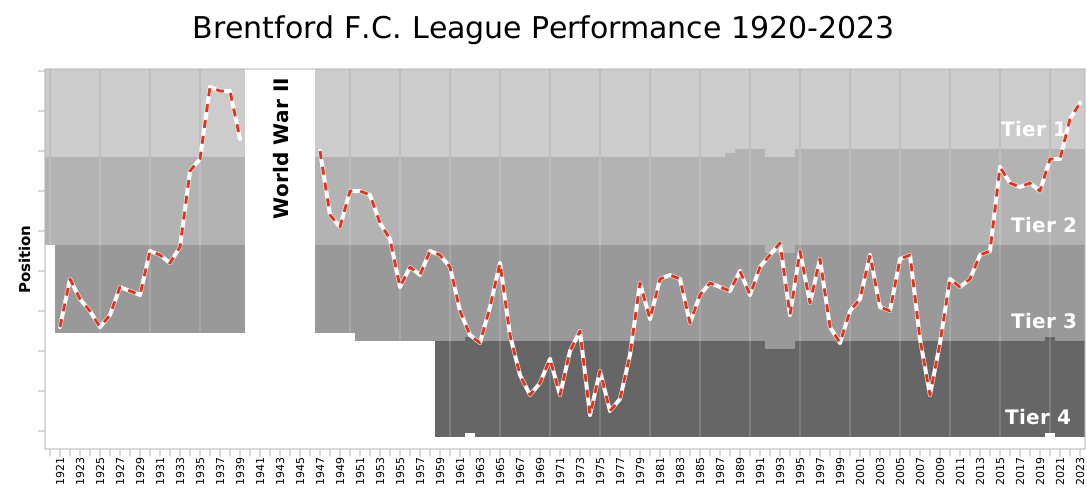
Brentford initially played amateur football before they entered the London League in 1896 and finished as runners-up of the Second Division and then the First Division to win election into the Southern League in 1898. They won the Southern League Second Division in 1900–01 and were elected into the Football League in 1920. Brentford won the Third Division South title in 1932–33 and the Second Division title in 1934–35. The club enjoyed a successful spell in the top flight of English football, reaching a peak of fifth in the First Division, in 1935–36, their highest ever league finish, before three relegations left them in the Fourth Division by 1962. They were crowned Fourth Division champions in 1962–63, but were relegated in 1966 and again in 1973 after gaining promotion in 1971–72. Brentford spent 14 seasons in the Third Division after gaining promotion in 1977–78 and went on to win the Third Division title in 1991–92, though were relegated again in 1993.
Brentford were relegated into the fourth tier in 1998 and won promotion as champions in the 1998–99 campaign. The club were relegated in 2007 and won promotion as champions of League Two in 2008–09 and then were promoted out of League One in 2013–14. They had unsuccessful Championship play-off campaigns in 2015 and 2020. Brentford have a poor record in finals, finishing as runners-up in three Associate Members' Cup/Football League Trophy finals (1985, 2001 and 2011) and losing four play-off finals (the 1997 Second Division final, 2002 Second Division final, 2013 League One final and 2020 Championship final). However, Brentford won the 2021 Championship final to be promoted to the highest level for the first time since the 1946–47 season. Their main rivals are fellow West London-based clubs Fulham and Queens Park Rangers. They are affiliated with the women's club Brentford Women.
History
Main article: History of Brentford F.C.
1889–1920: Formation and early years
In 1889, the town of Brentford, Middlesex was home to the Brentford Rowing Club and Boston Park Cricket Club. Attempts to form football and rugby clubs in the town fell by the wayside until a new recreation ground was opened on 17 October 1889. Seven days earlier, a meeting had taken place at the Oxford & Cambridge pub near Kew Bridge, during which it had been endeavoured between the rowing and cricket club members to decide how best to use the recreation ground. On 16 October 1889, the rowing club members again met at the Oxford & Cambridge pub and it was voted that the new club would play association football, be named "Brentford Football Club".
On 26 October 1889, the club staged its first practice match and on 23 November the club's first competitive match was played versus Kew, which resulted in a 1–1 draw. The 1892–93 season saw Brentford enter a league for the first time — the West London Alliance. The 1894–95 season was when Brentford first got their nickname, The Bees. A group of people from Borough Road College had come to a match to support their friend Joseph Gettins who was playing for Brentford at the time. They shouted their school chant, 'Buck up Bs!' but it was misheard by the media as 'Buck up bees!', and the name stuck.
Brentford continued to largely play cup and friendly matches until 1896, when the club was elected into the Second Division of the London League. The Bees finished second to secure promotion to the First Division. Brentford's London League exploits and its establishment as one of the top amateur clubs in London led to the club's election into the Second Division (London section) of the Southern League for the 1898–99 season. The club became a professional outfit in the 1899–1900 season and won a place in the top-flight in July 1901 after Gravesend United dropped out of the Southern League.
Brentford moved to Griffin Park, its first permanent home, in time for the beginning of the 1904–05 season. The Bees reached the FA Cup first round proper for the first time in 1905–06, advancing to the third round before succumbing to Liverpool at Anfield. Despite an initial upturn in form, 9 defeats in the final 11 matches of 1912–13 led to Brentford's relegation after an 11-season stay in the First Division.
In July 1915, the Southern League cancelled its competition for the duration of the First World War. Brentford competed in the London Combination during the War. The squad was decimated by the call-up of players for service or war work. Brentford won the London Combination title in 1918–19, four points ahead of nearest challengers Arsenal. Brentford turned down the opportunity to apply for election to the Football League for the 1919–20 season and instead applied for election to the First Division of the Southern League, which was awarded, finishing 15th.
1920–1954: Establishment in the Football League and glory years
In May 1920, Brentford and 20 other Southern League First Division clubs were elected into the Football League as founder members of the Third Division for the 1920–21 season. 11 new players were signed and the Bees' first-ever Football League match took place on 28 August 1920 at Exeter City's St James Park, which resulted in a 3–0 defeat. Despite 18 goals from Harry King, a lack of goals from elsewhere in the side led Brentford to a 21st-place finish, but the club were re-elected into the league without going to a poll.
It was all change at Griffin Park during the 1926 off-season, with former Gillingham boss Harry Curtis being installed as manager. Just 9 members of the previous season's squad were retained, but despite mid-table finishes over the following three seasons, Curtis slowly rebuilt the squad. The 1929–30 Third Division South season provided the foundation for the Bees' future success, however, the club missed out on promotion to Plymouth Argyle. The Bees romped to the 1932–33 Third Division South title, with Jack Holliday scoring a club-record 39 goals.
After topping the table for the third time in the 1934–35 season on 2 March 1935, the Bees would not again relinquish top spot, cruising to the title and promotion to the First Division for the first time in the club's history. Brentford also completed a unique double by winning the London Challenge Cup. After having risen from the third-tier to the first in the space of just three seasons, manager Harry Curtis elected to keep his squad intact for the 1935–36 First Division season. An extension to the New Road terrace increased Griffin Park's capacity to 4,000, which would generate extra income. After 15 matches, Brentford looked certain to be relegated, however, the club completed a remarkable turnaround, with the Bees losing just two of the final 23 matches and finishing in the club's all-time-highest position of 5th. Brentford again performed above expectations during the 1936–37 and 1937–38 seasons, finishing 6th in each campaign and reaching the FA Cup sixth round for the first time in the latter. The club reached its zenith between October 1937 and February 1938, holding onto top spot in the First Division for 17 consecutive matches.
The 1938–39 season was the beginning of the end of Brentford's peak; narrowly avoiding relegation. The 1939–40 season lasted just three matches before World War Two brought about the suspension of competitive football. Brentford competed in the Football League South and the London War League during the war years, with much of the team supplemented by guests and young amateurs, though the core of the pre-war team continued to play in the majority of the club's matches. On 30 May 1942, the Bees earned a 2–0 victory over Portsmouth in the London War Cup final at Wembley Stadium.
Brentford's 1946–47 squad, for the first competitive season after the Second World War, was propped up by the ageing core of the 1939–40 pre-war squad which would lead to the Bees' relegation from the First Division. After narrowly avoiding a second successive relegation in 1947–48, manager Harry Curtis announced that the 1948–49 season would be his last in the job after nearly 23 years. The season ended with a poor 18th-place finish, though notably the FA Cup sixth round fixture at home to Leicester City set a new club-record attendance of 38,678. In 1953–54 Brentford's relegation to the Third Division South was confirmed on the final day of the season after a 3–1 defeat to Leicester City at Griffin Park.
1954–1986: Decline and financial difficulties
Relegation to the Third Division South at the end of the 1953–54 season meant that 1954–55 would be Brentford's first in the bottom-tier for 21 years. After three consecutive top-six finishes, the rot set in during the 1960–61 season, with the poor form on the field mirrored by the news from the boardroom of debts of £50,000 ().
After the sale of several key players, the Bees finished second-from-bottom of the 1961–62 Third Division and were relegated, starting several yo-yo years between the Third and Fourth divisions. Despite winning just seven of the final 14 matches of the season, Brentford finished 1962–63 as Fourth Division champions. However, in 1965–66, Billy Gray couldn't prevent relegation to the Fourth Division. In December 1966, it was revealed by chairman Dunnett at Brentford's AGM that the club had lost £20,000 during the previous financial year and that he would be selling his stake in the club. Earlier that month, there had been an approach from neighbours QPR, suggesting that the two clubs share Griffin Park. On 19 January 1967, the news broke that Dunnett and his QPR counterpart Jim Gregory had reached an agreement that Brentford's rivals would move into Griffin Park, Rangers' ground Loftus Road would be redeveloped as housing and Brentford, as a club, would cease to exist.
After a tense month of fan protests, negotiations and donations amounting to £8,500 (), a six-man syndicate headed by former Plymouth Argyle chairman Ron Blindell took over Dunnett's shares on 23 February 1967 and guaranteed a 12-month bridging loan of £104,000. The following day, Blindell, as chairman, took control of the club. It transpired that QPR chairman Jim Gregory had resurrected his interest in Griffin Park and offered £250,000 for the use of the ground, a fee that would wipe out Brentford's £135,000 debt instantly, if the club moved to Hillingdon. The name "Brentford Borough FC" had already been chosen for the new Hillingdon-based club, but once again Brentford was saved at the eleventh hour, with former director Walter Wheatley granting the club a £69,000 interest-free loan, repayable in 12 months.
Under Frank Blunstone, Brentford secured promotion back to the Third Division with two matches of the season remaining. However, the Bees were relegated on the final day of the 1972–73 season. After a period of consolidation, Bill Dodgin Jr. led Brentford to a 4th-place finish and promotion to the Third Division in the 1977–78 season. Brentford reached its first major competitive cup final in the 1984–85 season, but lost 3–1 against Wigan Athletic in the 1985 Football League Trophy final at Wembley Stadium. In the 1988–89 season, the Bees' reached the sixth round of the FA Cup, which ended after a 4–0 defeat to Liverpool at Anfield.
1986–2014
In 1991–92, six wins from the six final matches saw Brentford recover to win the Third Division championship on the final day and secure second-tier football for the first time since the 1953–54 season. However, Brentford returned immediately to the third tier. In 1996–97, Brentford missed out on promotion, losing the play-off final against Crewe Alexandra. In the 1997–98 season, Brentford were relegated to the Third Division on the final day of the season.
In June 1998, former Crystal Palace chairman Ron Noades assumed ownership of Brentford and made wholesale changes throughout the club, installing himself as chairman-manager. The Bees won the 1998–99 Third Division championship on the final day, after beating Cambridge United 1–0 in a "winner takes all" match at the Abbey Stadium. Brentford reached the 2001 Football League Trophy final, but were defeated 2–1 by Port Vale. At the end of the 2001–02 season, Brentford narrowly missed out on automatic promotion on the final day to Reading. The Bees could only manage a draw in a must win match, before later losing the 2002 play-off final, to Stoke City, 2–0.
In the wake of the ITV Digital collapse, the financial restraints placed on the club by Noades left new manager Wally Downes with an inexperienced squad and administration was narrowly avoided in August 2002. Noades quit the club and handed control to supporters' trust Bees United. Brentford narrowly avoided relegation at the end of the 2003–04 season. In both 2004–05 and 2005–06, Brentford reached the FA Cup fifth round and the play-off semi-finals. In 2006, Matthew Benham made his first interaction with Brentford, donating £500,000. He was anonymous and was known as the 'Mysterious Investor'. Despite a good start to the 2006–07 season, Brentford's relegation was confirmed on 9 April 2007, eventually finishing bottom of the league. Despite the relegation, the club's finances had been improved after Matthew Benham paid nearly £3 million to take over some of the club's debts in January 2007.
In July 2009, Benham and Bees United made a deal under the codename 'Gecko' in which he agreed to give £1m every year for 5 years, in return for increasing his equity to 35% and have an option to become the owner of Brentford by 2014. Under Andy Scott, the Bees won the League Two title after victory in the penultimate match of the 2009–10 season. 2010–11 became memorable for Brentford's cup exploits, going on a run to the fourth round of the League Cup and reaching the 2011 Football League Trophy final, which was lost 1–0 to Carlisle United. In June 2012, Benham fully bought the club from Bees United. However, Bees United still keep a place on the club board. Brentford came within a penalty kick of automatic promotion to the Championship on the final day of the 2012–13 season, losing 1–0 to promotion rivals Doncaster Rovers at Griffin Park, who only needed a draw to secure automatic promotion. The Bees would eventually lose to Yeovil Town in the play-off final. Despite a poor start to the season, Mark Warburton led the Bees to automatic promotion to the Championship on April 18th 2014 confirmed by a home tie vs Preston North End F.C..
2014–present: Rise to the Premier League
In their first season in the second tier since 1993, Brentford finished 5th but lost to Middlesbrough in the play-off semi-finals. Under Dean Smith, Brentford became an established Championship side. Smith's successor, Thomas Frank, took Brentford to the 2020 Championship play-off final after finishing third in the league, but lost 2–1 to West London rivals Fulham. During the 2020 off-season, the club moved out of Griffin Park (its home ground for 116 years) and into the Brentford Community Stadium, a 17,250-capacity all-seater stadium. Brentford finally broke their play-off curse having previously lost 9 out of 9 play-off campaigns which was then a national record and went one better in the play-offs that year, securing promotion to the Premier League with a 2–0 victory over Swansea City in the 2021 Championship play-off final.
Brentford played in the top division of English football for the first time in 74 years. Frank guided his side to 13th, 9th, 16th and 10th-placed finishes in Brentford's first four Premier League campaigns, before eventually leaving the club in June 2025 to manage Tottenham Hotspur. Keith Andrews was eventually announced as his successor later that month.
Current and past grounds
- Clifden Road (1889–1891)
- Benn's Field (1891–1895)
- Shotter's Field (1895–1898)
- Cross Roads (1898–1900)
- York Road (1900–1904)
- Griffin Park (1904–2020)
- Gtech Community Stadium (2020–present)
Players
First team
Out on loan
Brentford B
Main article: Brentford F.C. Reserves and Academy
Out on loan
Coaching staff
Brentford's predominant home colours are a red and white striped shirt, black shorts and red or black socks. These have been the club's predominant home colours since the 1925–26 season, bar one season – 1960–61 – when yellow (gold) and blue were used, unsuccessfully. The colours on entering the Football League, in 1920–21, were white shirts, navy shorts and navy socks. Away kits have varied over the years, with the current colours being a light pink shirt and socks, with purple shorts, a first for the club. It includes a button-down detail with a ribbed collar. The Brentford badge features in purple and the sleeves have a printed stripe cuff.
Brentford have had several badges on their shirts since it was formed in 1889. The first one, in 1893, was a white shield, with 'BFC' in blue and a wavy line in blue, which is thought to represent the river and the rowing club, who founded the football club. The next known badge, the Middlesex County Arms, was on shirts donated by a club supporter in 1909. The Brentford and Chiswick arms, as a badge, was used just for the one season, in 1938–39. The next badge was in 1971–72 when a shield, formed into quadrants, which had a hive and bees in one, 3 seaxes in another and the other two with red and white stripes. In 1972, the club organised a competition to design a new crest, which was won by Mr B.G. Spencer's design, a circle with a bee and stripes and the founding date of 1888. This was introduced in 1973 and used until May 1975, when it was brought to the club's attention, via Graham Haynes, that the club was formed in 1889 and not in 1888. Therefore, a new badge, reputedly designed by Dan Tana – the club's chairman at the time – was introduced for the 1975–76 season and continued until 1994 when the current badge was introduced. In 2011 Russell Grant claimed to have designed the badge in a BBC interview; however, it was in fact designed in 1993 for two season tickets by supporter Andrew Henning, following a request from Keith Loring, the then chief executive. In 2017, the club redesigned its crest to a more modern, uncluttered, design with the flexibility for use in two tone colour print. The design is a double roundel with the club name and year founded in white on a red background and a large central bee.
Kit suppliers and shirt sponsors
| Period | Kit supplier | Shirt sponsor (front) | Shirt sponsor (sleeve) | Shirt sponsor (back) | Shorts sponsor |
|---|---|---|---|---|---|
| 1975–1976 | Umbro | None | None | None | None |
| 1977–1980 | Bukta | ||||
| 1980–1981 | Adidas | ||||
| 1981–1984 | Osca | DHL | |||
| 1984–1986 | KLM | ||||
| 1986–1988 | Spall | ||||
| 1988–1990 | Hobott | ||||
| 1990–1992 | Chad | ||||
| 1992–1995 | Hummel | ||||
| 1995–1996 | Core | Ericsson | |||
| 1996–1998 | Cobra | ||||
| 1998–2000 | Super League | GMB | |||
| 2000–2002 | Patrick | ||||
| 2002–2003 | TFG | ||||
| 2003–2004 | St. George PLC | ||||
| 2004–2005 | UK Packaging | UK Packaging | |||
| 2005–2006 | Lonsdale | ||||
| 2006–2007 | Samvo Group | ||||
| 2007–2008 | Puma | ||||
| 2008–2009 | Hertings (Home) & MKT Computers (Away) | Intermode Shipping (Home) & Cardiac Risk in the Young (Away) | MKT Computers (Home) | ||
| 2009–2010 | SPIT Tools (Home) & Cardiac Risk in the Young (Away) | Reliable Networks | |||
| 2010–2011 | Hertings (Home) & Bathwise (Away) | Reliable Networks | Thames Valley University | ||
| 2011–2012 | None | None | |||
| 2012–2013 | SkyEx.co.uk | Reliable Networks | |||
| 2013–2014 | Adidas | Reliable Networks (Home) | |||
| 2014–2015 | Matchbook.com | Matchbook.com | |||
| 2015–2016 | Matchbook.com | None | |||
| 2016–2017 | 888sport | ||||
| 2017–2019 | LeoVegas | ||||
| 2019–2020 | Umbro | EcoWorld London | |||
| 2020–2021 | Utilita | Hollywoodbets | Hollywoodbets | ||
| 2021–2023 | Hollywoodbets | SafetyCulture | None | ||
| 2023–2025 | PensionBee | ||||
| 2025–present | Joma | Cazoo |
Rivalries
Main article: West London derby
Brentford's main rivals are Fulham, Chelsea and Queens Park Rangers. The club has a long-standing rivalry with Fulham. In the past this fixture has been marred by crowd violence. Brentford's rivalry with Queens Park Rangers intensified in 1967, when Rangers failed in an attempted takeover of the Bees, a move which, had it succeeded, would have seen Rangers move into Griffin Park and Brentford quit the Football League. As with the Fulham and Chelsea rivalries, this fixture sees passions run high amongst both sets of supporters with local pride at stake.
International links
In February 2013, it was announced that Brentford had entered into partnership with Icelandic 1. deild karla club UMF Selfoss, which would enable Brentford to send youth and development squad players to Iceland to gain experience. The partnership also sees the two clubs exchanging coaching philosophies and allows Brentford to utilise UMF Selfoss' scouting network. In May 2013, the Brentford staff forged links with Ugandan lower league club Gulu United as part of the "United for United" project, aimed at forming the region's first youth training camp and identifying talented players. Brentford owner Matthew Benham became majority shareholder in Danish club FC Midtjylland in 2014 and the staff of both clubs share ideas. In 2023, Benham sold FC Midtjylland to Danish billionaire Anders Holch Povlsen, therefore, they are now no longer sister clubs. In April 2025, it was announced that the holding company for Brentford FC, Best Intentions Analytics, was acquiring 100% ownership of the Spanish side, Asociación Deportiva Mérida (Mérida AD). Similar to previous international affiliations, this move allowed for easier access to spanish markets and scouting networks.
Affiliated clubs
- London Tigers
- UMF Selfoss
- Gulu United
- Mérida AD
In popular culture
- The club is mentioned often on the BBC comedy People Just Do Nothing. DJ Beats often wears a Brentford jacket, and Angel's room is full of Brentford memorabilia.
- Actor and comedian Bradley Walsh was a professional at the club in the late 1970s, but never made the first team squad.
- Dan Tana, Hollywood actor and restaurateur, served on the club's board and was chairman.
- Model Stephen James played for the club's youth team prior to his release in 2008.
- Entertainer Vic Oliver served as the club's vice-president in the early 1950s and was later president of the Brentford Supporters' Club.
- Politician Jack Dunnett served as club chairman between 1961 and 1967.
- Former Yes keyboardist and solo artist Rick Wakeman became a director of the club for a year in 1979.
- Radiohead guitarist Ed O'Brien has been a supporter and season ticket holder.
- Status Quo bass player John "Rhino" Edwards is a supporter; he wrote and recorded a song for Brentford player Lloyd Owusu.
- In season two of Ted Lasso, Brentford is mentioned as AFC Richmond's biggest rival.
Honours
Main article: List of Brentford F.C. records and statistics#Club honours and best performances, List of Brentford F.C. seasons
:Source:
League
- Second Division / Championship (level 2)
- Third Division South / Third Division / League One (level 3)
- Fourth Division / League Two (level 4)
- United League
- Champions: 1907–08
- London League
- Champions: 1908–09
- Southern League Second Division
- Champions: 1900–01
- London League Second Division
- Champions: 1896–97
- West London Alliance
- Champions: 1892–93No system of promotion in place.
Cup
- Football League Trophy
- London Senior Cup
- Winners: 1897–98*, 2021–22
- London Challenge Cup
- Middlesex Junior Cup
- Winners: 1893–94
- West Middlesex Cup
- Winners: 1894–95
- Middlesex Senior Cup
- Winners: 1897–98
- Southern Professional Charity Cup
- Winners: 1908–09
- Ealing Hospital Cup
- Winners: 1910–11
- London Charity Fund
- Winners: 1928
Wartime honours
Best performances
- Highest league finish: 5th in First Division (level 1), 1935–36
- Best FA Cup performance: Sixth round/quarter-finals, 1937–38, 1945–46, 1948–49, 1988–89
- Best League Cup performance: Semi-finals, 2020–21
- Best League Trophy performance: Runners-up, 1984–85, 2000–01, 2010–11
- Best Empire Exhibition Trophy performance: First round, 1938
- Best Southern Professional Floodlit Cup performance: Semi-finals, 1955–56, 1956–57
- Best First Alliance Cup performance: First round, 1988
Notes
References
Works cited
References
- "The stadium". Brentford Football Club New Stadium.
- Brett, Ciaran. "Match report from Brentford FC's first ever fixture".
- (2021-07-27). "Brentford".
- Cooper, Vince. "THE BEES. THE HISTORY OF BRENTFORD – Part One {{!}} Read The League".
- Chapman, Mark. "Remembering The Guvnor: Harry Curtis".
- "Brentford League Table 1929–1930".
- "Brentford results for the 1934–1935 season".
- "Brentford results for the 1935–1936 season".
- "Brentford results for the 1937–1938 season".
- "Brentford Complete History".
- "Brentford results for the 1962–1963 season".
- Street, Tim. (19 January 2017). "When Brentford were almost taken over by QPR – 50 years on". getwestlondon.
- Brett, Ciaran. "Brentford supporters wanted for 50th anniversary documentary of failed Queens Park Rangers takeover".
- "Brentford results for the 1988–1989 season".
- {{Fchd
- "Brentford results for the 1992–1993 season".
- (22 April 2001). "Vale vault Brentford to lift Vans trophy". BBC.
- Street, Tim. (2 October 2014). "Rewind: Brentford heartache as Reading snatch promotion".
- (11 May 2002). "Stoke seal promotion". BBC.
- (15 March 2004). "Downes gets sack from troubled Brentford".
- (19 August 2002). "Administration shelved – thanks to £400,000 Powell".
- "Ron Steps Down".
- (8 May 2004). "Brentford 1–0 Bournemouth".
- (28 January 2006). "Brentford 2–1 Sunderland". BBC.
- Waterman, Greville. (2022). "Just a bus stop in Hounslow". Hawksmoor Publishing.
- (10 April 2007). "Bees Seek New Management Team".
- (22 January 2007). "Brentford fan takes on club debts". BBC.
- (26 April 2009). "aHighlight".
- "Brentford results for the 2010–2011 season".
- "Brentford 0–1 Doncaster". BBC Sport.
- (19 May 2013). "Brentford 1–2 Yeovil: Bees lose League One play-off final". Evening Standard.
- Wickham, Chris. "Mark Warburton Appointed Manager".
- Matt Newsum. (15 May 2015). "Middlesbrough 3–0 Brentford". BBC Sport.
- "Brentford results for the 2014–2015 season".
- (10 October 2018). "Dean Smith: Aston Villa appoint new head coach with John Terry as assistant". BBC Sport.
- (4 August 2020). "Championship play-off final: Brentford 1–2 Fulham (AET)". BBC Sport.
- "Brentford FC move in to new home".
- "How Far is it Between Griffin Park, London and Brentford Community Stadium".
- Gareth Vincent. (29 May 2021). "Brentford 2–0 Swansea City". BBC Sport.
- Smith, Emma. (12 June 2025). "Frank replaces Postecoglou as Tottenham head coach".
- Johnston, Neil. (27 June 2025). "Andrews' journey from set-piece expert to Brentford boss".
- "The last night at Griffin Park".
- "Brentford 1 Wycombe Wanderers 1 (Brentford win 4–2 on penalties)".
- "Men's". Brentford F.C..
- (2025-08-17). "Brentford Football Club Official Instagram".
- "B Team Squad". Brentford F.C..
- "Coaching Staff".
- "Brentford B and Academy squads, coaching staff and pre-season updates {{!}} Brentford FC".
- "Martin Drury departs Brentford {{!}} Brentford FC".
- (2025-09-09). "Brentford appoint Jack Lester as assistant first-team coach {{!}} Brentford FC".
- "Brentford FC Company Details".
- Daly, Ken. "Ken Daly's alternative look at the history of Middlesbrough and Brentford who play in a Sky Bet Championship play off at Griffin Park on Friday 8 May 2015".
- "Brentford – Historical Football Kits".
- (12 November 2011). "Which Strictly star designed Brentford's badge?". BBC News.
- (10 November 2016). "Introducing our new club crest". Brentford FC.
- "Brentford and Umbro agree extension of partnership".
- "Football League Division Three".
- "The 80’s Stripes: The good, the bad and the unusual".
- "The Bees Red and White story 3".
- "Brentford Football Shirt Detail History".
- "Brentford FC extended Adidas deal".
- "Brentford and Umbro agree extension of partnership".
- "Brentford announce Joma as new official kit partner {{!}} Brentford FC".
- "Brentford home kit for 2025/26".
- "The results of the largest ever survey into club rivalries".
- (April 2011). "Football Ground Guide". Football Ground Guide.
- "Fulham F.C. – The 1995/1996 Season".
- "I'm Backing Brentford part two: how the proposed 1967 takeover started".
- (6 October 2006). "Brentford FC vs. QPR".
- Wickham, Chris. "Bees agree Icelandic partnership".
- Wickham, Chris. "Join Brentford in supporting Gulu United".
- Wickham, Chris. "Brentford club staff visit FC Midtjylland".
- Sim, Josh. (17 August 2023). "Brentford owner Matthew Benham sells FC Midtjylland to Danish billionaire". Sports Pro.
- "Best Intentions Analytics purchases Spanish club Mérida".
- "London Tigers play on Griffin Park pitch".
- "Best Intentions Analytics purchases Spanish club Mérida".
- (16 August 2006). "Ex bees Rover returns".
- (12 April 2012). "A match made in Hollywood interview".
- (26 October 2017). "Stephen James {{!}} The Man Behind The Body Art Model".
- Newton, Becca. (October 19, 2021). "Ted Lasso Season 2 Report Card: Most Valuable Player, Most Disappointing Storyline, & More!".
- "London League 1896–1910".
- Argus. (16 November 1928). "A Changed Brentford". The Brentford & Chiswick Times.
- (15 February 2003). "England 1918/19".
This article was imported from Wikipedia and is available under the Creative Commons Attribution-ShareAlike 4.0 License. Content has been adapted to SurfDoc format. Original contributors can be found on the article history page.
Ask Mako anything about Brentford F.C. — get instant answers, deeper analysis, and related topics.
Research with MakoFree with your Surf account
Create a free account to save articles, ask Mako questions, and organize your research.
Sign up freeThis content may have been generated or modified by AI. CloudSurf Software LLC is not responsible for the accuracy, completeness, or reliability of AI-generated content. Always verify important information from primary sources.
Report