From Surf Wiki (app.surf) — the open knowledge base
Branching order of bacterial phyla (Woese, 1987)
Main article: Bacterial phyla
There are several models of the Branching order of bacterial phyla, one of these was proposed in 1987 paper by Carl Woese.{{Cite journal
The branching order proposed by Carl Woese was based on molecular phylogeny, which was considered revolutionary as all preceding models were based on discussions of morphology. (v. Monera). Several models have been proposed since and no consensus is reached at present as to the branching order of the major bacterial lineages.
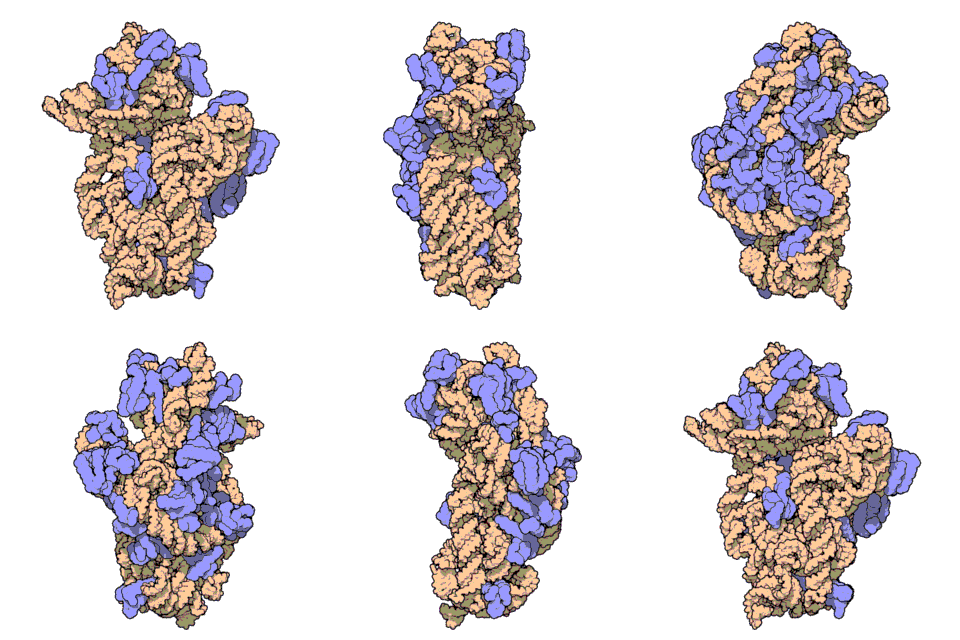
The gene used was the 16S ribosomal DNA.
Tree
The names have been changed to reflect more current nomenclature used by molecular phylogenists.
Note on names
Despite the impact of the paper on bacterial classification, it was not a proposal for change of taxonomy. Consequently, many clades were given official names. Only subsequently, this occurred: for example, the "purple bacteria and relatives" were renamed Proteobacteria.{{cite journal
Discussion
In 1987, Carl Woese, regarded as the forerunner of the molecular phylogeny revolution, divided Eubacteria into 11 divisions based on 16S ribosomal RNA (SSU) sequences, listed below. Many new phyla have been proposed since then.
- Purple Bacteria and their relatives (later renamed Proteobacteria)
- alpha subdivision (purple non-sulfur bacteria, rhizobacteria, Agrobacterium, Rickettsiae, Nitrobacter)
- beta subdivision (Rhodocyclus, (some) Thiobacillus, Alcaligenes, Spirillum, Nitrosovibrio)
- gamma subdivision (enterics, fluorescent pseudomonads, purple sulfur bacteria, Legionella, (some) Beggiatoa)
- delta subdivision (Sulfur and sulfate reducers (Desulfovibrio), Myxobacteria, Bdellovibrio)
- Gram-positive Eubacteria
- High-G+C species (later renamed Actinobacteria) (Actinomyces, Streptomyces, Arthrobacter, Micrococcus, Bifidobacterium)
- Low-G+C species (later renamed Firmicutes) (Clostridium, Peptococcus, Bacillus, Mycoplasma)
- Photosynthetic species (Heliobacteria)
- Species with Gram-negative walls (Megasphaera, Sporomusa)
- Cyanobacteria and chloroplasts (Aphanocapsa, Oscillatoria, Nostoc, Synechococcus, Gloeobacter, Prochloron)
- Spirochetes and relatives
- Spirochetes (Spirochaeta, Treponema, Borrelia)
- Leptospiras (Leptospira, Leptonema)
- Green sulfur bacteria (Chlorobium, Chloroherpeton)
- Bacteroides, Flavobacteria and relatives (later renamed Bacteroidetes
- Bacteroides (Bacteroides, Fusobacterium)
- Flavobacterium group (Flavobacterium, Cytophaga, Saprospira, Flexibacter)
- Planctomyces and relatives (later renamed Planctomycetes)
- Planctomyces group (Planctomyces, Pasteuria [sic])
- Thermophiles (Isocystis pallida)
- Chlamydiae (Chlamydia psittaci, Chlamydia trachomatis)
- Radioresistant micrococci and relatives (now commonly referred to as Deinococcus–Thermus or Thermi)
- Deinococcus group (Deinococcus radiodurans)
- Thermophiles (Thermus aquaticus)
- Green non-sulfur bacteria and relatives (later renamed Chloroflexi)
- Chloroflexus group (Chloroflexus, Herpetosiphon)
- Thermomicrobium group (Thermomicrobium roseum)
- Thermotogae (Thermotoga maritima)
Last universal common ancestor
Main article: Last universal common ancestor
The root of the tree, i.e. the node of the last universal common ancestor, is placed between the domain Bacteria (or kingdom Eubacteria as it was then known) and the clade formed by the domains Archaea (formerly kingdom Archaebacteria) and Eukaryotes. This is consistent with all subsequent studies, bar the study by Thomas Cavalier-Smith in 2002 and 2004, which was not based on molecular phylogeny.{{Cite journal | doi-access = free
Eukaryotes are a mosaic of different lineages:
- The genome in the nucleus descends from the first organelle-less eukaryote, the "urkaryote" a sister species to the ancestral archeon
- The mitochondria are organelles that descended from the proto-mitochondrion, a species of Rickettsiales (Alphaproteobacteria) (v. Reclinomonas and retortamonads).
- The chloroplasts are organelles of cyanobacterial origin. Consequently, in Woese (1987) the group is referred to as urkaryote.
The clade composed of Archaea and the nuclear genome of eukaryotes is called Neomura by T. Cavalier-Smith
Footnotes
References
References
- (1994). "The winds of (evolutionary) change: breathing new life into microbiology". Journal of Bacteriology.
- (2009). "Mapping the Tree of Life: Progress and Prospects". Microbiology and Molecular Biology Reviews.
- Schluenzen F. (2000). "Structure of functionally activated small ribosomal subunit at 3.3 angstroms resolution". Cell.
- Holland L. (22 May 1990). "Carl Woese in forefront of bacterial evolution revolution". The Scientist.
- Stackebrandt. (1988). "Proteobacteria classis nov., a name for the phylogenetic taxon that includes the "purple bacteria and their relatives"". Int. J. Syst. Bacteriol..
- (2001). "Investigation of Candidate Division TM7, a Recently Recognized Major Lineage of the Domain Bacteria with No Known Pure-Culture Representatives". Applied and Environmental Microbiology.
- (2010). "''Thermogemmatispora onikobensis'' gen. nov., sp. nov. and ''Thermogemmatispora foliorum'' sp. nov., isolated from fallen leaves on geothermal soils, and description of Thermogemmatisporaceae fam. nov. and Thermogemmatisporales ord. nov. within the class Ktedonobacteria". International Journal of Systematic and Evolutionary Microbiology.
- (2011). "Cell envelope architecture in the Chloroflexi: A shifting frontline in a phylogenetic turf war". Environmental Microbiology.
- (1997). "Proposal for a New Hierarchic Classification System, Actinobacteria classis nov". International Journal of Systematic Bacteriology.
- J.P. Euzéby. "List of Prokaryotic names with Standing in Nomenclature: classification of Deinococcus–Thermus".
- Bergey's Manual of Systematic Bacteriology 1st Ed.
- (2002). "The neomuran origin of Archaebacteria, the negibacterial root of the universal tree and bacterial megaclassification". International Journal of Systematic and Evolutionary Microbiology.
- (1997). "List of Prokaryotic names with Standing in Nomenclature—Class Hadobacteria". [[LPSN]].
- (18 May 2001). "The Archaea and the Deeply Branching and Phototrophic Bacteria". Springer.
This article was imported from Wikipedia and is available under the Creative Commons Attribution-ShareAlike 4.0 License. Content has been adapted to SurfDoc format. Original contributors can be found on the article history page.
Ask Mako anything about Branching order of bacterial phyla (Woese, 1987) — get instant answers, deeper analysis, and related topics.
Research with MakoFree with your Surf account
Create a free account to save articles, ask Mako questions, and organize your research.
Sign up freeThis content may have been generated or modified by AI. CloudSurf Software LLC is not responsible for the accuracy, completeness, or reliability of AI-generated content. Always verify important information from primary sources.
Report