From Surf Wiki (app.surf) — the open knowledge base
Army National Guard
Organized militia force and a federal military reserve force of the United States Army
Organized militia force and a federal military reserve force of the United States Army
| Field | Value | |
|---|---|---|
| unit_name | Army National Guard | |
| image | Seal of the Army National Guard.png | |
| caption | Seal of the Army National Guard | |
| dates | As state-funded militia under various names: 1636–1903 | |
| As federal reserve forces called the Army National Guard: 1903–present | ||
| type | Reserve force | |
| Militia | ||
| country | United States | |
| branch | United States Army | |
| role | Provide the Army with combat-ready reserve Army (Title 10) as well as protecting and supporting their respective states (Title 32) | |
| size | 325,066 personnel (authorized end strength for Fiscal Year 2023) | |
| command_structure | [[File:Seal of the United States National Guard.svg | 23px]] National Guard |
| [[File:NGB-seal-high.png | 23px]] National Guard Bureau | |
| Reserve components of the United States Armed Forces | ||
| garrison | Army National Guard Readiness Center, Arlington Hall | |
| Arlington County, Virginia | ||
| nickname | "Army Guard", "The Guard" | |
| march | Always Ready, Always There | |
| equipment | List of equipment of the United States Army | |
| anniversaries | 13 December 1636 (founding) | |
| website | ||
| commander1 | LTG Jonathan Stubbs | |
| commander1_label | Director | |
| commander2 | MG Joseph R. Baldwin | |
| commander2_label | Deputy Director | |
| commander3 | CW5 Brian Searcy | |
| commander3_label | Command Chief Warrant Officer | |
| commander4 | CSM James B. Kendrick | |
| commander4_label | Command Sergeant Major |
As federal reserve forces called the Army National Guard: 1903–present Militia Reserve components of the United States Armed Forces Arlington County, Virginia
The Army National Guard (ARNG) is an organized militia force and a federal military reserve force of the United States Army. It is simultaneously part of two different organizations: the Militia of the United States (consisting of the ARNG of each state, most territories, and Washington D.C.), as well as the federal ARNG, as part of the National Guard as a whole (which includes the Air National Guard). It is divided into subordinate units stationed in each state or insular area, responsible to their respective governors or other head-of-government.
The Guard's origins are usually traced to the city of Salem, Massachusetts, in 1636. That year a regiment of militia drilled for the first time to defend a multi-community area within what is now the United States.
Activation
The ARNG operates under Title 10 of the United States Code when under federal control, and Title 32 of the United States Code and applicable state laws when under state control. It may be called up for active duty by the state or territorial governors to help respond to domestic emergencies and disasters, such as those caused by hurricanes, floods, and earthquakes, as well as civil disorder. The District of Columbia Army National Guard is a federal militia, controlled by the president of the United States with authority delegated to the secretary of defense, and through him to the secretary of the Army.
Members or units of the ARNG may be ordered, temporarily or indefinitely, into United States service. If mobilized for federal service, the member or unit becomes part of the U.S. ARNG, which is a reserve component of the U.S. Army. Individuals volunteering for active federal service may do so subject to the consent of their governors. Largely on the basis of a 1990 U.S. Supreme Court decision, governors generally cannot veto involuntary activations of individuals or units for federal service, either for training or national emergency.
The president may also call up members and units of the ARNG, in its status as the militia of the several states, to repel invasion, suppress rebellion, or enforce federal laws. The Army National Guard is one of two organizations administered by the National Guard Bureau, the other being the Air National Guard. The director of the ARNG is the head of the organization, and reports to the chief of the National Guard Bureau. Because the ARNG is both the militia of the several states and a federal reserve component of the Army, neither the chief of the National Guard Bureau nor the director of the ARNG "commands" it. This operational command authority is performed in each state or territory by the state adjutant general, and in the District of Columbia by the commanding general of the D.C. National Guard when a unit is in its militia status. While under federal activation, the operational command authority is transferred to the commanders of the unified combatant commands, who command all U.S. forces within their area of responsibility. The chief of the National Guard Bureau and the director of the ARNG serve as the channel of communications between the Department of the Army and the ARNG in each state and territory, and administer federal programs, policies, and resources for the National Guard.
The ARNG's portion of the president's proposed federal budget for the 2018 fiscal year is approximately $16.2 billion to support an end strength of 343,000, including appropriations for personnel pay and allowance, facilities maintenance, construction, equipment maintenance and other activities.
History
Main article: History of the United States Army National Guard
Main article: Militia (United States)
The Army National Guard is constantly reorganizing. Many storied formations with valiant battle histories have obscure descendants in the mid-2020s. Some have been renamed or inactivated. Some have had subordinate units reallocated to other commands. A partial list of inactivated major formations includes:
- [[File:Yankee Division.svg|31x31px]] 26th Infantry Division, inactivated 1 September 1993.
- [[File:27th Infantry Division SSI.svg|25x25px]] 27th Infantry Division, reorganized as 27th Armored Division, 1 February 1955. (See below.)
- [[File:27th Armored Division Empire.jpg|25x25px]] 27th Armored Division, inactivated 1 February 1968.
- [[File:30th US Armored Division SSI.svg|25x25px]] 30th Armored Division, inactivated 1 December 1973. (See below.)
- [[File:30th Infantry Division SSI.svg|30x30px]] 30th Infantry Division, inactivated 4 January 1974.
- [[File:31st ID SSI.svg|25x25px]] 31st Infantry Division, inactivated 14 January 1968. Units allocated to 30th Armored Division.
- [[File:32nd infantry division shoulder patch.svg|40x40px]] 32nd Infantry Division, inactivated 1 December 1967.
- [[File:33rd Infantry Division SSI.svg|25x25px]] 33rd Infantry Division, inactivated 1 February 1968.
- [[File:37th Infantry Division CSIB.svg|25x25px]] 37th Infantry Division, inactivated 15 February 1968.
- [[File:US 39th Infantry Division.svg|29x29px]] 39th Infantry Division, inactivated 1 December 1967.
- [[File:40th US Armored Division SSI.svg|25x25px]] 40th Armored Division, inactivated 29 January 1968.
- [[File:41st Infantry Division SSI.svg|25x25px]] 41st Infantry Division, inactivated 1 January 1968.
- [[File:43rd Infantry Division CSIB.svg|25x25px]] 43rd Infantry Division, inactivated 16 December 1967.
- [[File:US Army 44th Infantry Division SSI.png|25x25px]] 44th Infantry Division, inactivated 10 October 1954.
- [[File:45th Infantry insignia (thunderbird).svg|25x25px]] 45th Infantry Division, inactivated 1 February 1968.
- [[File:46th Infantry Division CSIB.svg|32x32px]] 46th Infantry Division, inactivated 1 February 1968.
- [[File:47th Division Shoulder Patch.svg|25x25px]] 47th Infantry Division, inactivated 10 February 1991.
- [[File:48th US Armored Division SSI.svg|25x25px]] 48th Armored Division, inactivated 29 January 1968.
- [[File:49th US Armored Division SSI.svg|25x25px]] 49th Armored Division, inactivated 1 May 2004; reflagged as the 36th Infantry Division.
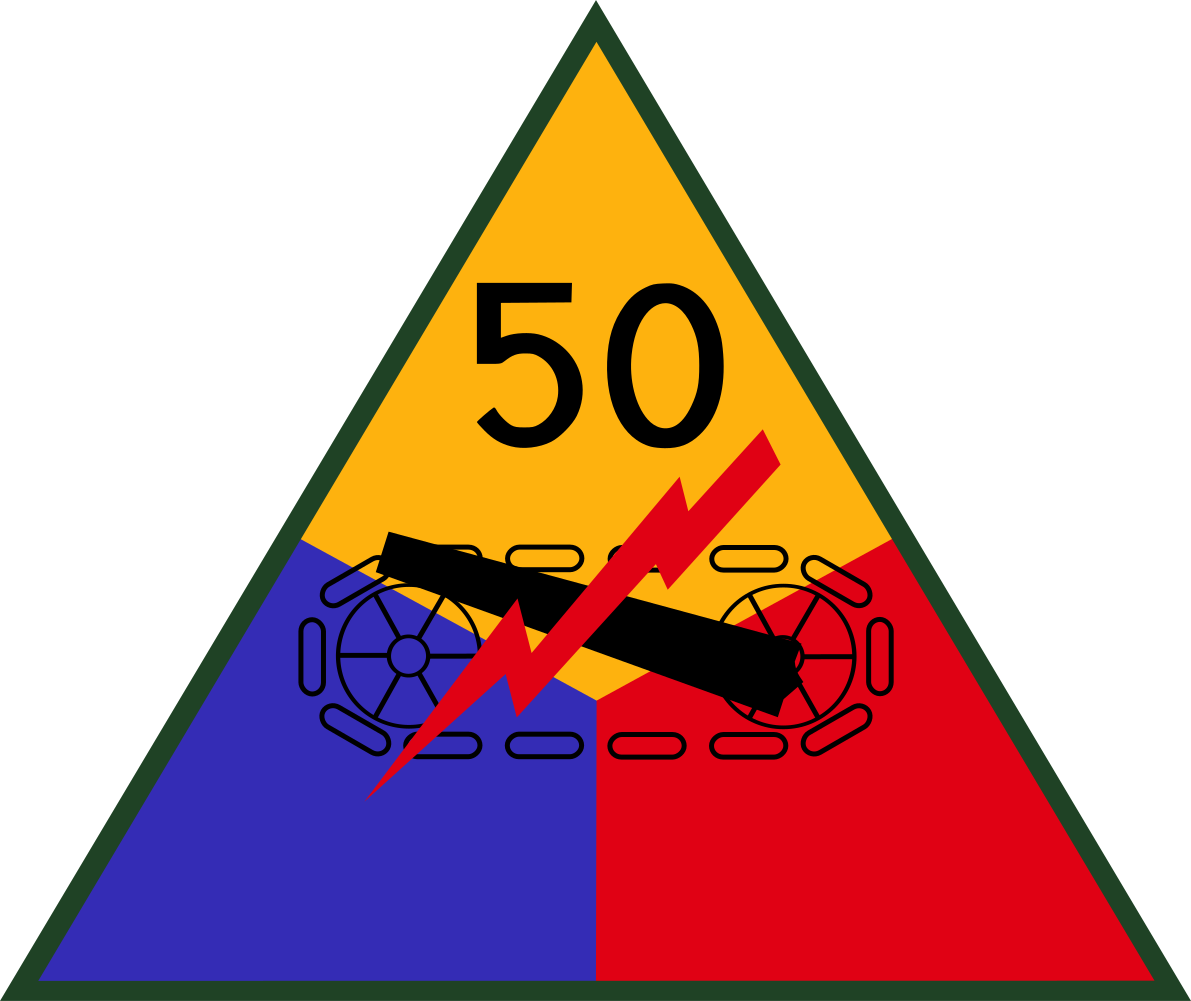
- [[File:50th US Armored Division SSI.svg|25x25px]] 50th Armored Division, inactivated 1 September 1993.

Units and formations
Deployable Army units are organized as Table of organization and equipment (TOE) organizations or modified table of organization and equipment (MTOE) organizations. Non-deployable units, such as a state's joint force headquarters or regional training institutes are administered as Table of distribution and allowance (TDA) units.
Commands
- [[File:46MPCmdSSI.jpg|31x31px]] 46th Military Police Command (MI ARNG)
- [[File:135 Sus Cmd SSI.jpg|33x33px]] 135th Sustainment Command (Expeditionary) (AL ARNG)
- [[File:167 Sus Cmd SSI.png|37x37px]]167th Sustainment Command (Theater) (AL ARNG)
- 184th Sustainment Command (Expeditionary) (MS ARNG)
- [[File:263ADABdeSSI.gif|37x37px]] 263rd Army Air and Missile Defense Command (SC ARNG)
Divisions
In addition to many deployable units which are non-divisional, the Army National Guard's deployable units include eight infantry divisions. These divisions, their subordinate brigades or brigades with which the divisions have a training oversight relationship, and the states represented by the largest units include:
Army Aviation Magazine wrote on 31 March 2021 that "The ARNG is pressing forward with the Division Alignment for Training (DIV AFT) effort. The DIV AFT intent is to enhance leader development and training readiness through codified relationships across echelons and states to develop combat capable division formations for large scale combat operations. The Director, ARNG. recently convened a DIV AFT Initial Planning Conference to clarify unit alignments for all eight ARNG Division Headquarters and synchronize activities that will facilitate unity of effort between Division Headquarters and aligned for training States."
-
[[File:28th Infantry Division SSI.svg|35px]] 28th Infantry Division (PA ARNG)
- 2nd Infantry Brigade Combat Team (PA ARNG)
- 56th Stryker Brigade Combat Team (PA ARNG)
- 256th Infantry Brigade Combat Team (LA ARNG)
- 28th Combat Aviation Brigade (PA ARNG)
- 28th Infantry Division Sustainment Brigade (OH ARNG)
-
[[File:29th Infantry Division SSI.svg|40px]] 29th Infantry Division (VA ARNG)
- 48th Infantry Brigade Combat Team (GA NG)
- 53rd Infantry Brigade Combat Team (FL ARNG)
- 116th Infantry Brigade Combat Team (VA ARNG)
- 29th Combat Aviation Brigade (MD ARNG)
- 29th Infantry Division Sustainment Brigade (NC ARNG)
-
[[File:34th 'Red Bull' Infantry Division SSI.svg|40px]] 34th Infantry Division (MN ARNG)
- 1st Armored Brigade Combat Team (MN ARNG)
- 2nd Infantry Brigade Combat Team (IA ARNG)
- 30th Armored Brigade Combat Team (NC ARNG)
- 116th Cavalry Brigade Combat Team (ID ARNG)
- 34th Combat Aviation Brigade (MN ARNG)
- 34th Infantry Division Sustainment Brigade (IL ARNG)
-
[[File:35th Infantry Division SSI.svg|40px]] 35th Infantry Division (KS ARNG)
- 39th Infantry Brigade Combat Team (AR ARNG)
- 45th Infantry Brigade Combat Team (OK ARNG)
- 72nd Infantry Brigade Combat Team (TX ARNG)
- 35th Combat Aviation Brigade (MO ARNG)
- 35th Infantry Division Sustainment Brigade (TN ARNG)
-
[[File:36th Infantry Division CSIB.svg|35px]] 36th Infantry Division (TX ARNG)
- 56th Infantry Brigade Combat Team (TX ARNG)
- 81st Stryker Brigade Combat Team (WA ARNG)
- 155th Armored Brigade Combat Team (MS ARNG)
- 278th Armored Cavalry Regiment (TN ARNG)
- 36th Combat Aviation Brigade (TX ARNG)
- 36th Infantry Division Sustainment Brigade (TX ARNG)
-
[[File:38th Infantry Division SSI.svg|35px]] 38th Infantry Division (IN ARNG)
- 32nd Infantry Brigade Combat Team (WI ARNG)
- 33rd Infantry Brigade Combat Team (IL ARNG)
- 37th Infantry Brigade Combat Team (OH ARNG)
- 76th Infantry Brigade Combat Team (IN ARNG)
- 38th Combat Aviation Brigade (IN ARNG)
- 38th Infantry Division Sustainment Brigade (IN ARNG)
-
[[File:40th Infantry Division CSIB.svg|40px]] 40th Infantry Division (CA ARNG)
- 29th Infantry Brigade Combat Team (HI ARNG)
- 41st Infantry Brigade Combat Team (OR ARNG)
- 79th Infantry Brigade Combat Team (CA ARNG)
- 40th Combat Aviation Brigade (CA ARNG)
- 40th Infantry Division Sustainment Brigade (CA ARNG)
-
[[File:42nd Infantry Division SSI.svg|40px]] 42nd Infantry Division (NY ARNG)
- 27th Infantry Brigade Combat Team (NY ARNG)
- 44th Infantry Brigade Combat Team (NJ ARNG)
- 86th Infantry Brigade Combat Team (VT ARNG)
- 42nd Combat Aviation Brigade (NY ARNG)
- 42nd Infantry Division Sustainment Brigade (NY ARNG)
Multifunctional Support Brigades
The Army National Guard fields 37 multifunctional support brigades.
Maneuver Enhancement Brigades
- [[File:Yankee Division.svg|31x31px]] 26th Maneuver Enhancement Brigade (MA ARNG)
- [[File:US Army 55th Maneuver Enhancement Brigade.png|25x25px]] 55th Maneuver Enhancement Brigade (PA ARNG)
- [[File:67th Infantry Brigade SSI.svg|37x37px]] 67th Maneuver Enhancement Brigade (NE ARNG)
- [[File:US Army 110th Maneuver Enhancement Brigade SSI.png|33x33px]] 110th Maneuver Enhancement Brigade (MO ARNG)
- [[File:130MEBSSI.svg|37x37px]] 130th Maneuver Enhancement Brigade (NC ARNG)
- [[File:136th MEB.png|36x36px]] 136th Maneuver Enhancement Brigade (TX ARNG)
- [[File:141st Maneuver Enhancement Brigade.png|30x30px]] 141st Maneuver Enhancement Brigade (ND ARNG)
- [[File:149th Armored Brigade CSIB.gif|30x30px]] 149th Maneuver Enhancement Brigade (KY ARNG)
- [[File:57th Field Artillery Brigade SSI.svg|38x38px]] 157th Maneuver Enhancement Brigade (WI ARNG)
- [[File:158 MEB SSI.png|25x25px]] 158th Maneuver Enhancement Brigade (AZ ARNG)
- [[File:196th Maneuver Enhancement Brigade.png|38x38px]] 196th Maneuver Enhancement Brigade (SD ARNG)
- [[File:204th Maneuver Enhancement Brigade.png|33x33px]] 204th Maneuver Enhancement Brigade (UT ARNG)
- [[File:218th Infantry Brigade SSI.svg|38x38px]] 218th Maneuver Enhancement Brigade (SC ARNG)
- 226th Maneuver Enhancement Brigade (AL ARNG)
- [[File:404ChemBdeSSI.jpg|37x37px]] 404th Maneuver Enhancement Brigade (IL ARNG)
- [[File:648th MEB.jpg|31x31px]] 648th Maneuver Enhancement Brigade (GA ARNG)
Field Artillery Brigades
- [[File:USA - 45 FAB.png|37x37px]] 45th Field Artillery Brigade (OK ARNG)
- [[File:65 FIRES BDE-SSI Full Color.png|32x32px]] 65th Field Artillery Brigade (UT ARNG)
- [[File:115FABdeSSI.png|25x25px]] 115th Field Artillery Brigade (WY ARNG)
- [[File:130FABdeSSI.svg|38x38px]] 130th Field Artillery Brigade (KS ARNG)
- [[File:138FABdeSSI.svg|38x38px]] 138th Field Artillery Brigade (KY ARNG)
- [[File:142FABdeSSI.gif|25x25px]] 142nd Field Artillery Brigade (AR ARNG)
- [[File:USA - 169 FAB.png|34x34px]] 169th Field Artillery Brigade (CO ARNG)
- [[File:197th FA Brigade patch.png|37x37px]] 197th Field Artillery Brigade (NH ARNG)
Sustainment Brigades
- [[File:17 Sust Bde SSI.png|42x42px]] 17th Sustainment Brigade (NV ARNG)
- [[File:111ADABdeSSI.svg|35px]] 111th Sustainment Brigade (NM ARNG)
Military Intelligence Brigades
- [[File:58th Infantry Brigade SSI.svg|33x33px]] 58th Military Intelligence Brigade (Expeditionary) (MD ARNG)
- [[File:71st BfSB SSI.jpg|30x30px]] 71st Military Intelligence Brigade (Expeditionary) (TX ARNG)
- [[File:300MIBdeSSI.gif|38x38px]] 300th Military Intelligence Brigade (Linguist) (UT ARNG) (TDA organization)
Functional Support Brigades and Groups
Engineer Brigades
- [[File:16th Engineer Brigade.png|25x25px]] 16th Engineer Brigade (OH ARNG)
- [[File:USA - 35 Eng Bde.svg|25x25px]] 35th Engineer Brigade (MO ARNG)
- [[File:111EngrBdeSSI.jpg|36x36px]] 111th Engineer Brigade (WV ARNG)
- [[File:US Army 117 Engineer Brigade SSI.png|25x25px]]117th Engineer Brigade (SC ARNG)
- [[File:168EngineerBdeSSI.svg|36x36px]] 168th Engineer Brigade (MS ARNG)
- [[File:US Army 176th Engineer Brigade SSI.png|32x32px]]176th Engineer Brigade (TX ARNG)
- [[File:194EngrBdeSSI.svg|38x38px]] 194th Engineer Brigade (TN ARNG)
- [[File:219th Battlefield Surveillance Brigade CSIB.svg|28x28px]] 219th Engineer Brigade (IN ARNG)
- [[File:225EngineerBdeSSI.jpg|36x36px]] 225th Engineer Brigade (LA ARNG)
Air Defense Artillery Brigades
- [[File:164th Air Defense Artillery Brigade.svg|38x38px]] 164th Air Defense Artillery Brigade (FL ARNG)
- [[File:Insignia USA Army Brigade 174 ADA Bde SSI.svg|38x38px]] 174th Air Defense Artillery Brigade (OH ARNG)
- [[File:US Army 678th Air Defense Artillery Brigade.png|37x37px]] 678th Air Defense Artillery Brigade (SC ARNG)
Theater Tactical Signal Brigades
- [[File:228SigBdeSSI.png|40x40px]]228th Theater Tactical Signal Brigade (SC ARNG)
- [[File:261SigBdeSSI.svg|25x25px]] 261st Theater Tactical Signal Brigade (DE ARNG)
[[Military Police Corps (United States)|Military Police]] Brigades
- [[File:US Army 35th Military Police Brigade SSI.png|37x37px]]35th Military Police Brigade (MO ARNG)
- [[File:43MPBdeSSI.png|30x30px]] 43rd Military Police Brigade (RI ARNG)
- [[File:49MpBdeSSI.svg|38x38px]] 49th Military Police Brigade (CA ARNG)
- [[File:Combat service identification badge of the 92nd Maneuver Enhancement Brigade.svg|37x37px]]92nd Military Police Brigade (PR ARNG)
- [[File:US Army 142th Military Police Brigade SSI.png|33x33px]]142nd Military Police Brigade (AL ARNG)
- [[File:177MPBbeSSI.png|25x25px]] 177th Military Police Brigade (MI ARNG)
Theater and Combat Aviation Brigades
- [[File:63AviationBdeSSI.jpg|33x33px]] 63rd Theater Aviation Brigade (KY ARNG)
- [[File:77AviationBdeSSI.jpg|25x25px]] 77th Combat Aviation Brigade (AR ARNG)
- [[File:185 Theater Avn Bde.jpg|35x35px]] 185th Theater Aviation Brigade (MS ARNG)
- [[File:449 Avn Bde SSI.jpg|33x33px]]449th Combat Aviation Brigade (NC ARNG)
Other brigades
- [[File:31st Chemical Brigade SSI.svg|25x25px]]31st Chemical Brigade (AL ARNG)
- [[File:US Army 91st Cyber Bde SSI.png|30x30px]]91st Cyber Brigade (VA ARNG) (TDA organization)
- [[File:100MissileDefBdeSSI.jpg|36x36px]] 100th Missile Defense Brigade (CO ARNG)
Other Groups
- [[File:United States Army Special Forces SSI (1958-2015).png|39x39px]] 19th Special Forces Group (UT ARNG)
- [[File:United States Army Special Forces SSI (1958-2015).png|39x39px]] 20th Special Forces Group (AL ARNG)
- 111th Explosive Ordnance Disposal Group (AL ARNG)
- [[File:56th Theater Information Operations Group Distinctive Unit Insignia.jpg|25x25px]] 56th Theater Information Operations Group (WA ARNG)
- 71st Theater Information Operations Group (TX ARNG)
- 204th Theater Aviation Operations Group (LA ARNG)
- 1100th Theater Aviation Sustainment Maintenance Group (MD ARNG)
- 1106th Theater Aviation Sustainment Maintenance Group (CA ARNG)
- 1107th Theater Aviation Sustainment Maintenance Group (MO ARNG)
- 1108th Theater Aviation Sustainment Maintenance Group (MS ARNG)
- 1109th Theater Aviation Sustainment Maintenance Group (CT ARNG)
- [[File:42nd RSG.jpg|36x36px]]42nd Regional Support Group (NJ ARNG)
- [[File:50th RSG.png|28x28px]]50th Regional Support Group (FL ARNG)
- 109th Regional Support Group (SD ARNG)
- [[File:115 RSG.png|25x25px]]115th Regional Support Group (CA ARNG)
- 120th Regional Support Group (ME ARNG)
- 139th Regional Support Group (LA ARNG)
- 143rd Regional Support Group (CT ARNG)
- [[File:US Army 151st Regional Support Group SSI.png|25x25px]]151st Regional Support Group (MA ARNG)
- 191st Regional Support Group (PR ARNG)
- [[File:198th RSG.jpg|25x25px]]198th Regional Support Group (AZ ARNG)
- [[File:US Army 201st Support Group SSI.png|25x25px]]201st Regional Support Group (GA ARNG)
- 213th Regional Support Group (PA ARNG)
- [[File:272 RSG.png|35x35px]]272nd Regional Support Group (MI ARNG)
- 297th Regional Support Group (AK ARNG)
- 329th Regional Support Group (VA ARNG)
- [[File:347thRSG.png|33x33px]]347th Regional Support Group (MN ARNG)
- [[File:635th Regional Support Group Patch.png|31x31px]]635th Regional Support Group (KS ARNG)
- [[File:734 RSG.png|30x30px]]734th Regional Support Group (IA ARNG)
- [[File:1889 RSG.png|38x38px]]1889th Regional Support Group (MT ARNG)
Regular Army – Army National Guard Partnership
In 2016, the Army and the Army National Guard began a training and readiness initiative that aligned some Army brigades with National Guard division headquarters, and some National Guard brigades with Army division headquarters. Among others, this program included the National Guard's 86th Infantry Brigade Combat Team becoming affiliated with the Army's 10th Mountain Division and the National Guard's 1st Battalion, 143rd Infantry Regiment affiliating with the Army's 173rd Airborne Brigade Combat Team. In addition, 3rd Brigade Combat Team, 10th Mountain Division began an affiliation with the National Guard's 36th Infantry Division.
- [[File:121-48-DUI-left.png|34x34px]]48th Infantry Brigade Combat Team (GA ARNG), associated with [[File:United States Army 3rd Infantry Division SSI (1918-2015).svg|25x25px]] 3rd Infantry Division
- [[File:143 Inf Rgt DUI.png|30x30px]]1st Battalion (Airborne), 143rd Infantry Regiment (TX ARNG), associated with [[File:173AirborneBCTSSI.jpg|37x37px]] 173rd Airborne Brigade Combat Team
- [[File:151 Inf Rgt DUI.png|32x32px]]1st Battalion, 151st Infantry Regiment (IN ARNG), associated with [[File:25th Infantry Division shoulder sleeve insignia.png|29x29px]]2nd Brigade Combat Team, 25th Infantry Division
- 840th Engineer Company (TX ARNG), associated with [[File:36 Eng Bde SSI.jpg|29x29px]] 36th Engineer Brigade
- 249th Transportation Company (TX ARNG), associated with [[File:1st Cavalry Division Patch.svg|32x32px]]1st Cavalry Division Sustainment Brigade
- 1176th Transportation Company (TN ARNG), associated with [[File:US 101st Airborne Division patch.svg|36x36px]] 101st Sustainment Brigade
- 1245th Transportation Company (OK ARNG), associated with [[File:1st Cavalry Division Patch.svg|32x32px]] 1st Cavalry Division Sustainment Brigade
- 2123rd Transportation Company (KY ARNG), associated with [[File:US 101st Airborne Division patch.svg|36x36px]] 101st Sustainment Brigade
Army units partnering with Army National Guard headquarters include:
- [[File:5th Engineer Battalion Coat of Arms.png|25x25px]]5th Engineer Battalion, associated with [[File:USA - 35 Eng Bde.svg|25x25px]] 35th Engineer Brigade (MO ARNG).
By state
Main article: State Adjutant General
The Army and Air National Guard in each state are headed by the state adjutant general. The adjutant general (TAG) is the de facto commander of a state's military forces, and reports to the state governor.
| State Abbr. | State | |
|---|---|---|
| AL | Alabama | |
| AK | Alaska | |
| AZ | Arizona | |
| AR | Arkansas | |
| CA | California | |
| CO | Colorado | |
| CT | Connecticut | |
| DE | Delaware | |
| DC | District of Columbia | |
| FL | Florida | |
| GA | Georgia | |
| GU | Guam | |
| HI | Hawaii | |
| ID | Idaho | |
| IL | Illinois | |
| IN | Indiana | |
| IA | Iowa | |
| KS | Kansas |
| State Abbr. | State | |
|---|---|---|
| KY | Kentucky | |
| LA | Louisiana | |
| ME | Maine | |
| MD | Maryland | |
| MA | Massachusetts | |
| MI | Michigan | |
| MN | Minnesota | |
| MS | Mississippi | |
| MO | Missouri | |
| MT | Montana | |
| NE | Nebraska | |
| NV | Nevada | |
| NH | New Hampshire | |
| NJ | New Jersey | |
| NM | New Mexico | |
| NY | New York | |
| NC | North Carolina | |
| ND | North Dakota |
| State Abbr. | State | |
|---|---|---|
| OH | Ohio | |
| OK | Oklahoma | |
| OR | Oregon | |
| PA | Pennsylvania | |
| PR | Puerto Rico | |
| RI | Rhode Island | |
| SC | South Carolina | |
| SD | South Dakota | |
| TN | Tennessee | |
| TX | Texas | |
| UT | Utah | |
| VT | Vermont | |
| VA | Virginia | |
| VI | U.S. Virgin Islands | |
| WA | Washington | |
| WV | West Virginia | |
| WI | Wisconsin | |
| WY | Wyoming |
Leadership


Upon the creation of the United States Air Force in 1947, the National Guard Bureau was organized into two divisions; Army National Guard and Air National Guard. Each were headed by a major general who reported to the chief of the National Guard Bureau. The head of the Army National Guard was originally established as the chief of the Army Division at the National Guard Bureau. The position was downgraded to brigadier general in 1962 due to force reduction. It was renamed to Director of the Army National Guard and elevated back to major general in 1970. The position was later elevated to the rank of lieutenant general in 2001. The Army National Guard is also authorized a deputy director which was originally established as a brigadier general office in 1970. It was elevated to the rank of major general in 2006.
The director of the Army National Guard oversees a staff which aids in planning and day-to-day organization and management. In addition to a chief of staff, the director's staff includes several special staff members, including a chaplain and protocol and awards specialists. It also includes a primary staff, which is organized as directorates, divisions, and branches. The directorates of the Army National Guard staff are arranged along the lines of a typical American military staff: G-1 for personnel; G-2 for intelligence; G-3 for plans, operations and training; G-4 for logistics; G-5 for strategic plans, policy and communications; G-6 for communications; and G-8 for budgets and financial management.
List of chiefs and directors
| No. | Commander | Term | Portrait | Name | Took office | Left office | Term length | Chiefs of the Army Division at the National Guard Bureau | Directors of the Army National Guard |
|---|---|---|---|---|---|---|---|---|---|
| order = 1 | Major General]] | image = Major General Raymond H. Fleming.jpg | officeholder = Raymond H. Fleming | born_year = | died_year = | term_start = 1948 | term_end = 1950 | timeinoffice = 2 years | order = 2 |
| order = 8 | military_rank = Major General | image = S-Greenlief.jpg | officeholder = Francis Greenlief | born_year = | died_year = | term_start = 1970 | term_end = 1971 | timeinoffice = 1 year | order = 9 |
Prominent members
Main article: Prominent members of the US Army National Guard
U.S. presidents
Main article: List of presidents of the United States by military service
Of the 45 individuals to serve as president of the United States , 33 had military experience. Of those 33, 21 served in the militia or ARNG.
- George Washington, commissioned a major in the Virginia Militia in 1753. He attained the rank of colonel before resigning his commission at the end of the French and Indian War.
- Thomas Jefferson, colonel and commander of the Albemarle County Militia at the start of the American Revolution
- James Madison, colonel in the Orange County Militia at the start of the American Revolution and aide to his father, James Madison, Sr., who was the commander.
- James Monroe, served in the militia while attending the College of William and Mary. After being wounded at the Battle of Trenton while serving in the Continental Army, he returned to Virginia to recruit and lead a regiment as a militia lieutenant colonel, but the regiment was never raised. In 1780 the British invaded Richmond, Virginia, and Jefferson commissioned Monroe as a colonel to command the militia raised in response and act as liaison to the Continental Army in North Carolina.
- Andrew Jackson, commander of the Tennessee Militia as a major general prior to the War of 1812.
- William Henry Harrison, commander of Indiana Territory's militia and Major General of the Kentucky Militia at the start of the War of 1812.
- John Tyler, commanded a company called the Charles City Rifles, part of Virginia's 52nd Regiment, in the War of 1812.
- James Polk, joined the Tennessee Militia as a captain in a cavalry regiment in 1821. He was subsequently appointed a colonel on the staff of Governor William Carroll.
- Millard Fillmore, served as inspector of New York's 47th Brigade with the rank of major. Commanded the Union Continentals, a militia unit raised to perform local service in Buffalo, New York, during the American Civil War.
- Franklin Pierce, appointed aide de camp to Governor Samuel Dinsmoor in 1831. He remained in the militia until 1847 and attained the rank of colonel before becoming a brigadier general in the Army during the Mexican–American War.
- James Buchanan, a member of the Pennsylvania Militia. His dragoon unit took part in the defense of Baltimore, Maryland, during the War of 1812.
- Abraham Lincoln, served in the Illinois Militia during the Black Hawk War. He commanded a company in the 4th Illinois Regiment with the rank of captain from April to May 1832. He was a private in Captain Alexander White's Company from May to June 1832. He served as a private in Captain Jacob Earley's company from June to July 1832.
- Andrew Johnson, served in the Tennessee Militia in the 1830s, and attained the rank of colonel. During the American Civil War he remained loyal to the Union and was appointed Military Governor of Tennessee with the rank of brigadier general.
- Ulysses S. Grant, having left the Army as a captain, at the start of the Civil War he served in the Illinois Militia as aide de camp and mustering officer for Governor Richard Yates. He held these positions until being appointed commander of the 21st Illinois Infantry, which set him on the path to becoming a general and commander of all Union armies.
- Rutherford B. Hayes, joined a militia company in 1846 intending to fight in the Mexican–American War, but resigned because of ill health. Enlisted as a private in a Cincinnati militia company at the start of the Civil War in 1861, and was elected commander with the rank of captain. He was subsequently appointed a major in the 23rd Ohio Infantry, and ended the war as a brigade commander and brevet Major General.
- James A. Garfield, commissioned a lieutenant colonel in the Ohio Militia in 1861, he took part in recruiting and training the 42nd Ohio Infantry Regiment, which he commanded as a colonel. He later served as Chief of Staff for the Army of the Cumberland and received promotion to Major General.
- Chester A. Arthur, became a member of the New York Militia soon after becoming a lawyer. During the Civil War he served on the staff of Governor Edwin D. Morgan as Quartermaster General with the rank of brigadier general. He later served as Morgan's inspector general, responsible for visiting New York's front line units, assessing conditions and recommending improvements.
- Benjamin Harrison, commissioned in the Indiana Militia by Governor Oliver P. Morton to recruit a regiment during the Civil War, he was subsequently appointed a second lieutenant and captain in and then colonel and commander of the 70th Indiana Infantry Regiment. He received the brevet of brigadier general as a commendation of his service, and later commanded a brigade. He also enrolled in the militia again during labor unrest in Indianapolis in 1877.
- William McKinley, joined a volunteer militia company called the Poland Guards at the start of the Civil War. The company was subsequently mustered in as part of the 23rd Ohio Infantry, the same regiment in which President Hayes served. McKinley ended the war as a major and chief of staff for division commander Samuel S. Carroll.
- Theodore Roosevelt, commissioned as a second lieutenant in the 8th New York Infantry Regiment in 1884, he served until 1888 and attained the rank of captain. During the Spanish–American War he was commissioned lieutenant colonel of the 1st United States Volunteer Cavalry, which he later commanded as a colonel. In 2001 a review of his war record led to a posthumous award of the Medal of Honor.
- Harry S. Truman, served in the Missouri Army National Guard from 1905 to 1911, rising to the rank of corporal. During World War I he rejoined and was commissioned a first lieutenant in the 2nd Missouri Field Artillery. This regiment was federalized as the 129th Field Artillery, and Truman commanded Battery D as a captain. He continued to serve in the Army Reserve, retiring as a colonel in 1953.
(Note: President George W. Bush served in the National Guard in the late 1960s and early 1970s, and he was the first Air National Guard member to attain the presidency.)
Notes
References
- https://forum.juhlin.com/forum/role-playing-game-section/twilight-2000-forum/5716-u-s-army-capstone-alignments-circa-1989#post115265 - Army National Guard CAPSTONE alignments 1989 - research lead
References
- "2023 Demographics Profile of the US Military".
- "Military Reserves Federal Call Up Authority".
- Veitch, Donald. (2010-08-20). "Salem designated as National Guard birthplace".
- Soucy, Jon. (January 8, 2013). "Obama recognizes Salem, Mass., as birthplace of the National Guard". National Guard Bureau.
- (August 19, 2010). "Salem, Mass., declared National Guard's birthplace". [[The Boston Globe]].
- Maj. Avery Schneider, New York National Guard [https://www.army.mil/article/262718/deployed_guardsmen_celebrate_national_guards_386th_birthday (13 December 2022) Deployed Guardsmen celebrate National Guard's 386th birthday]
- National Archives and Records Administration, [https://www.archives.gov/federal-register/codification/executive-order/11485.html Executive Order 11485—Supervision and control of the National Guard of the District of Columbia], 1 October 1969
- [https://www.law.cornell.edu/uscode/text/10/12211- 10 USC 12211. Officers: Army National Guard of the United States]
- [https://www.law.cornell.edu/uscode/text/10/12107- 10 USC 12107. Army National Guard of United States; Air National Guard of the United States: enlistment in]
- [https://www.law.cornell.edu/uscode/text/32/101- 32 USC 101. Definitions (NATIONAL GUARD)]
- [https://www.law.cornell.edu/uscode/text/10/12401- 10 USC 12401. Army and Air National Guard of the United States: status]
- [https://www.law.cornell.edu/uscode/text/10/10105- 10 USC 10105. Army National Guard of the United States: composition]
- North Atlantic Treaty organization, [http://www.nato.int/nrfc/database/usa.pdf Fact Sheet, National Reserve Forces Status: United States of America], 2006, p. 1
- National Guard Bureau, Today in Guard History (June), [http://www.nationalguard.mil/news/todayinhistory/june.aspx 11 June 1990], 2013
- [https://www.law.cornell.edu/uscode/text/10/12406- 10 USC 12406. National Guard in Federal service: call]
- Cornell University, legal Information Institute, [https://www.law.cornell.edu/uscode/text/10/10503 10 USC § 10503 – Functions of National Guard Bureau: Charter], accessed 20 June 2013
- Matthews, William. (1 July 2017). "Busting The Caps". National Guard.
- National Guard Educational Foundation, [https://archive.today/20130624234544/http://www.ngef.org/index.asp?bid=94 26th Infantry Division], 2011
- National Guard Educational Foundation, [https://archive.today/20130624234537/http://www.ngef.org/index.asp?bid=95 27th Infantry Division], 2011
- National Guard Educational Foundation, [https://archive.today/20130415125121/http://www.ngef.org/index.asp?bid=96 27th Armored Division], 2011
- (28 October 1973). "Ceremonies Today for 30th Armored". [[The Tennessean]].
- National Guard Educational Foundation, [https://archive.today/20130624234539/http://www.ngef.org/index.asp?bid=101 30th Infantry Division], 2011
- Tuscaloosa News, [https://news.google.com/newspapers?id=Ow4fAAAAIBAJ&sjid=LZsEAAAAIBAJ&pg=4803,2776561&dq=31st+infantry+division&hl=en 31st Dixie Division Turning to Armor], 19 January 1968.
- link. (22 December 2015 , accessed 19 June 2013)
- New York Times, [https://www.nytimes.com/1968/03/04/archives/illinois-commander-of-guard-replaced.html Illinois Commander of Guard Replaced], 4 March 1968
- Al Goldberg, Toledo Blade, [https://news.google.com/newspapers?id=5MROAAAAIBAJ&sjid=mAEEAAAAIBAJ&pg=5002,2825191&dq=37th+division+national+guard&hl=en Taps Sounds for Ohio Guard's Famed 37th], 18 February 1968
- link. (29 February 2012 , 2011)
- California State Military Museum, [http://www.militarymuseum.org/LH40thAB.html Lineages and Honors of the California National Guard: 40th Armored Brigade Headquarters and Headquarters Company], accessed 19 June 2013
- Tri-City Herald, Taps for the 41st, 8 June 1967
- Washington Army National Guard, [http://washingtonarmyguard.org/81st/lineage_81st.shtml Headquarters and Headquarters Company, 81st Brigade Combat Team] {{Webarchive. link. (13 May 2014 , 2007)
- Associated Press, The Telegraph, [https://news.google.com/newspapers?id=sa4rAAAAIBAJ&sjid=m_0FAAAAIBAJ&pg=7057,3624437&dq=43rd+division&hl=en Yankee Infantry Division is Facing Reorganization], 30 November 1967
- Eugene Register-Standard, [https://news.google.com/newspapers?id=BHYRAAAAIBAJ&sjid=vuIDAAAAIBAJ&pg=5461,53662&dq=44th+division&hl=en Army Disbands 44th Division], 18 September 1954
- National Guard Education Foundation, [https://archive.today/20130624234548/http://www.ngef.org/index.asp?bid=118 45th Infantry Division], 2011
- National Guard Educational Foundation, [https://archive.today/20130624234528/http://www.ngef.org/index.asp?bid=120 46th Infantry Division], 2011
- Minnesota Military Museum, [http://www.mnmilitarymuseum.org/files/6013/2249/8759/47th_Infantry_Division_Viking.pdf The 47th "Viking" Infantry Division], 1991
- link. (27 July 2011 , 2011)
- Texas Army National Guard, [http://www.agd.state.tx.us/36id/Sections/history/ History of the 36th Infantry Division] {{webarchive. link. (5 April 2013 , accessed 19 June 2013)
- Texas Military Forces Museum, [http://www.texasmilitaryforcesmuseum.org/texas.htm 36th Infantry Division, The "Texas" Division], accessed 19 June 2013
- U.S. House Appropriations Committee, [https://archive.org/details/departmentofdefe03unit Hearing Record], Department of Defense Appropriations for 1995, Volume 1, 1994, p. 296
- U.S. Army Center of Military History, [https://web.archive.org/web/20071213203257/http://www.history.army.mil/html/forcestruc/tda-ip.html History of Table of Distribution and Allowances (TDA) Units], 30 May 1995, updated 20 May 2011.
- Richard Goldenberg, U.S. Army, [https://www.army.mil/article/40568/ National Guard Division Leaders Gather to Face Challenges for Missions at Home, Overseas], 9 June 2010.
- University of North Texas, [http://armyrotc.unt.edu/us-army-components/us-army-national-guard U.S. Army National Guard] {{Webarchive. link. (3 April 2015 , 17 January 2013)
- BG David L. Hall. "Army National Guard Aviation-Continuing to Change, Adapt and Modernize".
- Cotton Puryear (29 September 2017). "91st Cyber Brigade activated as Army National Guard's first cyber brigade". army.mil. Retrieved 30 May 2020.
- Dwyer, Brian. (17 October 2016). "Patching Ceremony Unites 10th Mountain Division and Vermont Army National Guard Unit". TCW News.
- Tan, Michelle. (19 August 2016). "Army units change patches as part of active, Guard and Reserve pilot program". Army Times.
- Block, Gordon. (20 October 2016). "Programs link Fort Drum soldiers with Army Guard, Reserve personnel". Watertown Daily Times.
- Bowling Green Daily News, [https://news.google.com/newspapers?id=hPIaAAAAIBAJ&sjid=4UcEAAAAIBAJ&pg=1932,4012280&dq=adjutant+general+national+command+military+forces+state&hl=en Guard's Command Structure Unique in the Armed Forces], 27 June 1999
- Served as director in the rank of major general from 1998 to 2001. The 2001 National Defense Authorization Act, elevated the position to lieutenant general. Schultz was appointed another term as director and was promoted.
- Mark Lardas. (2011). "George Washington". Bloomsbury Publishing.
- Aaron Bancroft. (1855). "The Life of George Washington ...". Phillips, Sampson.
- Fawn McKay Brodie. (1974). "Thomas Jefferson: An Intimate History". W.W. Norton & Company.
- Ralph Louis Ketcham. (1990). "James Madison: A Biography". University of Virginia Press.
- Michael Teitelbaum. (2002). "James Monroe". Capstone.
- (2007). "U.S. Presidents and Foreign Policy: From 1789 to the Present". ABC-CLIO.
- H. W. Brands. (2006). "Andrew Jackson: His Life and Times". Knopf Doubleday Publishing Group.
- Samuel Putnam Waldo. (1819). "Memoirs of Andrew Jackson: Major-general in the Army of the United States; and Commander in Chief of the Division of the South". J. & W. Russell.
- (2012). "The Encyclopedia of the War of 1812: A Political, Social, and Military History". ABC-CLIO.
- James Hall. (1836). "A Memoir of the Public Services of William Henry Harrison, of Ohio". Key & Biddle.
- Stuart L. Butler. (2012). "Defending the Old Dominion: Virginia and Its Militia in the War of 1812". University Press of America.
- Louise A. Mayo. (2006). "President James K. Polk: The Dark Horse President". Nova Publishers.
- (1980). "Soldiers". Department of the Army.
- Barbara Bennett Peterson. (2002). "Sarah Childress Polk, First Lady of Tennessee and Washington". Nova Publishers.
- John Seigenthaler. (2004). "James K. Polk: The American Presidents Series: The 11th President, 1845-1849". Henry Holt and Company.
- (1830). "The New-York State Register for 1830–1831". New York.
- (1907). "Publications". The Society..
- (1832). "The New-Hampshire Annual Register, and United States Calendar".
- Ralph E. Eshelman. (2011). "A Travel Guide to the War of 1812 in the Chesapeake: Eighteen Tours in Maryland, Virginia, and the District of Columbia". JHU Press.
- Philip Shriver Klein. (1962). "President James Buchanan, a biography". Pennsylvania State University Press.
- Illinois Adjutant General's Office. (1882). "Record of the Services of Illinois Soldiers in the Black Hawk War, 1831–32, and in the Mexican War, 1846-8". H. W. Rokker, state printer.
- Hans L. Trefousse. (1997). "Andrew Johnson: A Biography". W. W. Norton, Incorporated.
- James Knox Polk. (1989). "Correspondence of James K. Polk". Univ. of Tennessee Press.
- Kate Havelin. (2004). "Andrew Johnson". Twenty-First Century Books.
- Gary L. Donhardt. (2007). "In the Shadow of the Great Rebellion: The Life of Andrew Johnson, Seventeenth President of the United States (1808-1875)". Nova Publishers.
- Clifton R. Hall. (1916). "Andrew Johnson: Military Governor of Tennessee".
- James S. Brisbin. (1868). "The campaign lives of Ulysses S Grant and Schuyler Colfax". Gale Cengage Learning.
- Ulysses Simpson Grant. (1969). "The Papers of Ulysses S. Grant: April to September, 1861". SIU Press.
- William Farina. (2007). "Ulysses S. Grant, 1861–1864: His Rise from Obscurity to Military Greatness". McFarland.
- (1876). "Sketch of the life and character of Rutherford B. Hayes. Also a biographical sketch of William A. Wheeler". Hurd and Houghton.
- Hardesty's Historical and Geographical Encyclopedia, [http://www.rbhayes.org/hayes/civilwar/display.asp?id=1133&subj=civilwar ''Military and Personal Sketches of Ohio's Rank and File from Sandusky County in the War of the Rebellion''], 1885, republished on the Rutherford B. Hayes Presidential Center web site
- John Clark Ridpath. (1881). "The Life and Work of James A. Garfield ...: Embracing an Account of the Scenes and Incidents of His Boyhood". Jones brothers.
- James T. Wall. (2008). "Wall Street and the Fruited Plain: Money, Expansion, and Politics in the Gilded Age". University Press of America.
- Emma Rogers. (1921). "Chester A. Arthur: Man and President". University of Wisconsin—Madison.
- (1892). "Life and Public Services of Hon. Benjamin Harrison, President of the U.S.: With a Concise Biographical Sketch of Hon. Whitelaw Reid". Edgewood Publishing Company.
- ''Newburgh Daily Journal'', [https://news.google.com/newspapers?id=A45RAAAAIBAJ&sjid=WjMNAAAAIBAJ&pg=4213,1003999&dq=benjamin-harrison+brevet+general+civil+war&hl=en "Death of General Harrison"], 14 March 1901
- Muncie Free Press, [http://www.munciefreepress.com/node/20065 Daniels adds President Benjamin Harrison to Hoosier Heritage Portrait Collection] {{Webarchive. link. (24 December 2013 , 20 March 2009)
- Eric Foner. (2002). "Reconstruction: America's Unfinished Revolution, 1863–1877". HarperCollins.
- John W. Tyler. (1901). "The Life of William McKinley". P. W. Ziegler & Company.
- Kevin Phillips. (2003). "William McKinley: The American Presidents Series: The 25th President, 1897–1901". Henry Holt and Company.
- William Montgomery Clemens. (1914). "The Ancestry of Theodore Roosevelt". W.M. Clemens.
- Bill Bleyer, ''Long Island Newsday'', [https://www.proquest.com/docview/279417972 "Roosevelt's Medal of Honor Coming to LI"], 21 February 2001
- Gabriele Arnold. (2006). "Harry S. Truman – his foreign policy". GRIN Verlag.
- Michael J. Devine. (2009). "Harry S. Truman, the State of Israel, and the Quest for Peace in the Middle East". Truman State Univ Press.
- Truman, Harry S.. (1983). "[[Dear Bess: The Letters From Harry to Bess Truman, 1910-1959]]". Norton.
- Clarke Rountree. (2011). "George W. Bush: A Biography". ABC-CLIO.
This article was imported from Wikipedia and is available under the Creative Commons Attribution-ShareAlike 4.0 License. Content has been adapted to SurfDoc format. Original contributors can be found on the article history page.
Ask Mako anything about Army National Guard — get instant answers, deeper analysis, and related topics.
Research with MakoFree with your Surf account
Create a free account to save articles, ask Mako questions, and organize your research.
Sign up freeThis content may have been generated or modified by AI. CloudSurf Software LLC is not responsible for the accuracy, completeness, or reliability of AI-generated content. Always verify important information from primary sources.
Report