From Surf Wiki (app.surf) — the open knowledge base
Antigua and Barbuda
Country in the Lesser Antilles of the West Indies
,_plate_V_-_BL.jpg)
Country in the Lesser Antilles of the West Indies
| Field | Value | |
|---|---|---|
| conventional_long_name | Antigua and Barbuda | |
| languages_type | Vernacular language | |
| languages | Antiguan and Barbudan Creole | |
| languages2_type | Working language | |
| common_name | Antigua and Barbuda | |
| native_name | aig (Antiguan and Barbudan Creole) | |
| image_flag | Flag of Antigua and Barbuda.svg | |
| image_coat | Coat of arms of Antigua and Barbuda.svg | |
| symbol_type | Coat of arms | |
| national_motto | "Each endeavouring, all achieving" | |
| national_anthem | "Fair Antigua, We Salute Thee" | |
| image_map | ||
| capital | St. John's | |
| largest_city | capital | |
| admin_center_type | Administrative centre | |
| official_languages | English | |
| ethnic_groups | {{vunblist | |
| ethnic_groups_year | 2011 | |
| religion | {{ublist | item_style=white-space:nowrap; |
| religion_year | 2020 | |
| demonym | Antiguan and Barbudan | |
| government_type | Unitary parliamentary constitutional monarchy | |
| leader_title1 | Monarch | |
| leader_title2 | Governor-General | |
| leader_name1 | Charles III | |
| leader_name2 | Sir Rodney Williams | |
| leader_title3 | Prime Minister | |
| leader_name3 | ||
| legislature | Parliament | |
| upper_house | Senate | |
| lower_house | House of Representatives | |
| sovereignty_type | Formation | |
| established_event1 | Union | |
| established_date1 | 23 September 1859 | |
| established_event2 | Redonda | |
| established_date2 | 26 March 1872 | |
| established_event3 | Associated state | |
| established_date3 | 27 February 1967 | |
| established_event4 | Independence | |
| established_date4 | 1 November 1981 | |
| area_km2 | 440 | |
| area_rank | 182nd | |
| area_sq_mi | 170 | |
| percent_water | negligible | |
| population_estimate | 106,365 | |
| population_census | 84,816 | |
| population_estimate_year | 2026 | |
| population_estimate_rank | 182nd | |
| population_census_year | 2011 | |
| population_density_km2 | 186 | |
| population_density_sq_mi | 481 | |
| GDP_PPP | $3.3 billion | |
| GDP_PPP_year | 2025 | |
| GDP_PPP_rank | 180th | |
| GDP_PPP_per_capita | $31,781 | |
| GDP_PPP_per_capita_rank | 66th | |
| GDP_nominal | $2.37 billion | |
| GDP_nominal_year | 2025 | |
| GDP_nominal_rank | 171st | |
| GDP_nominal_per_capita | $22,630 | |
| GDP_nominal_per_capita_rank | 51st | |
| Gini_change | increase | |
| Gini_ref | ||
| HDI | 0.851 | |
| HDI_year | 2023 | |
| HDI_change | increase | |
| HDI_ref | ||
| HDI_rank | 53rd | |
| currency | Eastern Caribbean dollar | |
| currency_code | XCD | |
| time_zone | AST | |
| utc_offset | -04:00 | |
| date_format | dd/mm/yyyy | |
| drives_on | left | |
| calling_code | +1 | |
| cctld | .ag |
the country
|87.3% African |4.7% Multiracial |2.8% Hispanic |1.7% European |1.1% East Indian |0.7% Syrian or Lebanese |1.8% other}} |
- 92.7% Christianity
- 66.6% Protestantism
- 26.1% other Christian |3.6% Rastafari |1.9% no religion |1.1% Baháʼí Faith |0.7% other}}
Antigua and Barbuda is a sovereign archipelagic country in the Caribbean composed of Antigua, Barbuda, and numerous other small islands. Antigua and Barbuda has a total area of 440 km2 (170 sq mi), making it one of the smallest countries in the Caribbean. The country is mostly flat, with the highest points on Antigua being in the Shekerley Mountains and on Barbuda the Highlands. The country has a tropical savanna climate, with pockets of tropical monsoon in Antigua's southwest. Its most populated city is St. John's, followed by All Saints and Bolans. Most of the country resides in the Central Plain that stretches from St. John's to English Harbour.
Bounded by the Atlantic Ocean on the east and the Caribbean Sea on the west, Antigua and Barbuda is located within the Leeward Islands moist forest and Leeward Islands xeric scrub ecoregions. The country shares maritime borders with Anguilla, Saint Barthélemy, and Saint Kitts and Nevis to the west, Montserrat to the southwest, and Guadeloupe to the south. Antigua and Barbuda has numerous natural parks, including Codrington Lagoon, one of the largest internal bodies of water in the Lesser Antilles. Despite its dense population, the country has large swaths of undeveloped land, however, Antigua and Barbuda has experienced many environmental issues due to climate change.
Hunter-gatherers settled the islands starting around 3000 BC, likely arriving on canoes from Central and South America. They were followed by the Arawaks of Venezuela during the Ceramic Period. In 1493, Christopher Columbus surveyed the island of Antigua, which resulted in an attempt at Spanish settlement in 1520. Antigua remained uncolonised until 1632 when Edward Warner and his small party created the first successful British colony. Barbuda was under the control of the Codrington family until the 1860s. Antiguan independence was first proposed by Prince Klaas in 1728, who attempted to make the island an independent kingdom. After emancipation in 1834, Antigua's autonomy slowly increased, while Barbuda was slowly integrated into Antigua. The first democratic elections were held in 1951, and by 1981, Antigua and Barbuda was independent. From 1960 until 2004, the Bird family dominated the archipelago's politics with only one interruption, which ended with the election of Baldwin Spencer to the premiership.
Since 2014, the Labour Party has dominated national politics. Antigua and Barbuda is a member of the Commonwealth and a Commonwealth realm, being a constitutional monarchy with Charles III as its head of state. The country is a unitary state, with Barbuda being administered by the Barbuda Council since 1976. Antigua is divided into six parishes. The central government is composed of three main branches: legislative, executive, and judicial. It has a bicameral national legislature comprising the directly elected House of Representatives and the Senate appointed by the Governor-General, the representative of the monarch. The Labour Party and the United Progressive Party have dominated the country's politics since 1994. The country has a proportionally high foreign-born population; most people are of African descent, with significant populations of Europeans, Hispanics, and Indians. The country is also majority Christian, with most being Protestant. The most spoken home language in the country is Antiguan and Barbudan Creole. Compared to neighboring countries, Antigua and Barbuda ranks highly in most economic indicators, and ranks about average in political freedoms.
Antigua and Barbuda is a high-income country and is the most developed country in the Caribbean by Human Development Index. It is a member of the United Nations, the OECS, the Regional Security System, CARICOM, and the World Trade Organisation. Antigua and Barbuda is one of the only countries in the Caribbean to maintain an air force, and has a mostly service-based economy. Antigua and Barbuda maintains significant influence in the former British Leeward Islands and the eastern Caribbean, having the largest economy and population in the former colony. However, the country continues to struggle with human rights and political polarisation, with a significant Barbudan independence movement re-emerging and declining freedom of the press.
Etymology
Antigua is Spanish for 'ancient' and barbuda is Spanish for 'bearded'. The term Wadadli is a corrupted form of the original Arawak name, emerging from a misspelling in a popular 1970s song. The term is sometimes used in Antiguan and Barbudan Creole to refer to the island's original name. Aanteega an' Baabyuuda is the Creole endonym for the country, deriving from the English name.
History
Main article: History of Antigua and Barbuda
Pre-colonial period
Main article: Pre-Columbian Antigua and Barbuda
Archaic-period hunter-gatherers called the Ciboney were the first culture present in Antigua and Barbuda. Carbon dating has established the earliest settlements started around 3100 BC. They were succeeded by the ceramic age pre-Columbian Arawak-speaking Saladoid people who migrated from the lower Orinoco River. They introduced agriculture, raising, among other crops, the Antigua black pineapple (Ananas comosus), corn, sweet potatoes, chillies, guava, tobacco, and cotton. Later on the Caribs settled the island.
European arrival and slavery
Christopher Columbus was the first European to sight the islands in 1493.
The English settled on Antigua in 1632; Christopher Codrington settled on Barbuda in 1685. Tobacco and then sugar was grown, worked by a large population of slaves transported from West Africa, who soon came to vastly outnumber the European settlers.
Colonial era
The English maintained control of the islands, repulsing an attempted French attack in 1666. Slavery was abolished in the British Empire in 1833, affecting the economy.
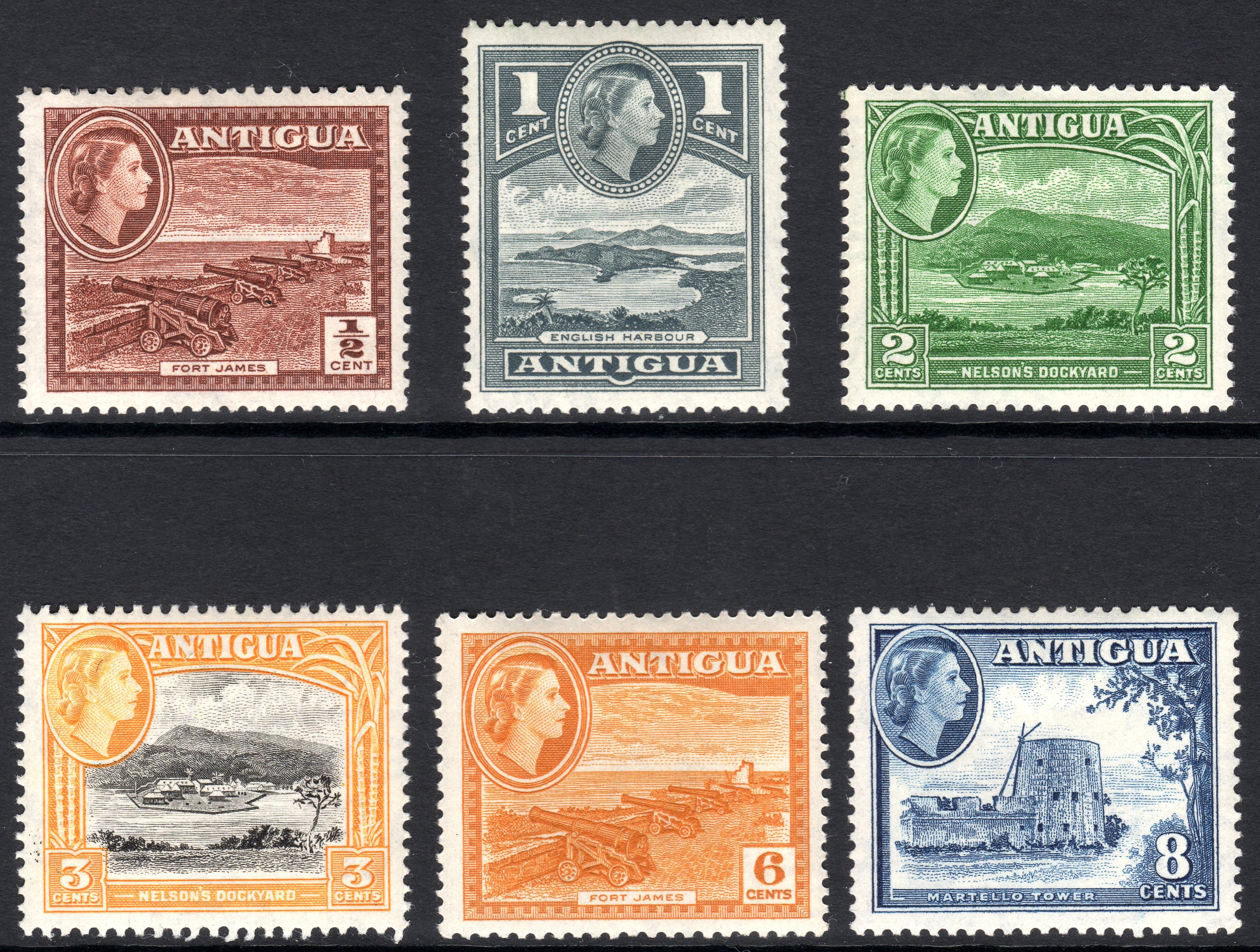
Part of the Leeward Islands colony, Antigua and Barbuda became part of the short-lived West Indies Federation from 1958 to 1962. Antigua and Barbuda subsequently became an associated state of the United Kingdom with full internal autonomy on 27 February 1967. The 1970s were dominated by discussions as to the islands' future and the rivalry between Vere Bird of the Antigua and Barbuda Labour Party (ABLP) (Premier from 1967 to 1971 and 1976 to 1981) and the Progressive Labour Movement (PLM) of George Walter (Premier 1971–1976). Eventually, Antigua and Barbuda gained full independence on 1 November 1981; Vere Bird became prime minister of the new country. The country opted to remain within the Commonwealth, retaining Elizabeth II () as head of state, with the first governor, Sir Wilfred Jacobs, as governor-general. Succeeding Wilfred Jacobs were James Carlisle (1993–2007), Louise Lake-Tack (2007–2014), and the present since 2014 being Rodney Williams.
Independence era
The first two decades of Antigua's independence were dominated politically by the Bird family and the ABLP, with Vere Bird ruling from 1981 to 1994, followed by his son Lester Bird from 1994 to 2004. Also in 1995, Hurricane Luis caused severe damage on Barbuda.
The ABLP's dominance of Antiguan politics ended with the 2004 Antiguan general election, which was won by Winston Baldwin Spencer's United Progressive Party (UPP). However, the UPP lost the 2014 Antiguan general election, with the ABLP returning to power under Gaston Browne. ABLP won 15 of the 17 seats in the 2018 snap election under the leadership of incumbent Prime Minister Gaston Browne.
In 2015, Antigua and Barbuda established the Marine Ecosystem Protected Areas (MEPA) Trust, a mechanism for funding marine conservation and supporting local environmental efforts, alongside the national Environmental Protection and Management Act (EPMA) to create a framework for sustaining marine protected areas and their biodiversity. In 2016, Nelson's Dockyard was designated as a UNESCO World Heritage Site.
Most of Barbuda was devastated in early September 2017 by Hurricane Irma, which brought winds with speeds reaching 295 km/h (185 mph). The storm damaged or destroyed 95% of the island's buildings and infrastructure, leaving Barbuda "barely habitable" according to Prime Minister Gaston Browne. Nearly everyone on the island was evacuated to Antigua. Amidst the following rebuilding efforts on Barbuda that were estimated to cost at least $100 million, the government announced plans to revoke a century-old law of communal land ownership by allowing residents to buy land; a move that has been criticised as promoting "disaster capitalism".
Geography
Main article: Geography of Antigua and Barbuda
Limestone formations, rather than volcanic activity, have had the most impact on the topography of both Antigua and Barbuda, which are both relatively low-lying islands. Boggy Peak, also known as Mt. Obama from 2008 to 2016, is the highest point on both Antigua and Barbuda. It is the remnant of a volcanic crater and rises a total of 402 meters. Boggy Peak is located in the southwest of Antigua (1,319 feet).
Both of these islands have very irregularly shaped coastlines that are dotted with beaches, lagoons, and natural harbours. There are reefs and shoals that surround the islands on all sides. Because of the low amount of rainfall, there are not many streams. On neither of these islands can sufficient quantities of fresh groundwater be found.
Redonda is a small, uninhabited island located about 40 kilometres (25 miles) to the south-west of Antigua. Redonda is a rocky island.
In Antigua and Barbuda, forest cover is about 18% of the total land area, equivalent to 8,120 ha of forests in 2020, down from 10,110 ha in 1990.
Islands
Antigua and Barbuda consists mostly of its two namesake islands, Antigua, and Barbuda. Other than that, Antigua and Barbuda's biggest islands are Guiana Island and Long Island off the coast of Antigua, and Redonda island, which is far from both of the main islands.
Climate
Rainfall averages 990 mm per year, with the amount varying widely from season to season. In general, the wettest period is between September and November. The islands generally experience low humidity and recurrent droughts. Temperatures average 27 °C, with a range from 23 °C to 29 °C in the winter to from 25 °C to 30 °C in the summer and autumn. The coolest period is between December and February.
Hurricanes are common, including the powerful Category 5 Hurricane Irma, on 6 September 2017, which damaged 95% of the structures on Barbuda. Some 1,800 people were evacuated to Antigua.
Officials quoted by Time indicated that over $100 million would be required to rebuild homes and infrastructure. Philmore Mullin, Director of Barbuda's National Office of Disaster Services, said that "all critical infrastructure and utilities are non-existent – food supply, medicine, shelter, electricity, water, communications, waste management". He summarised the situation as follows: "Public utilities need to be rebuilt in their entirety... It is optimistic to think anything can be rebuilt in six months ... In my 25 years in disaster management, I have never seen something like this."
Environmental issues
Demographics
Main article: Demographics of Antigua and Barbuda, Antiguans and Barbudans

The National Bureau of Statistics estimated a population of 106,365 in 2026, making Antigua and Barbuda one of the least populated countries in the Caribbean. This is an increase of 24% from the 2011 census. Between 2008 and 2020, Antigua and Barbuda had an average of 1,188 live births per year, or one birth every seven hours. In 2011, 62% of Antiguans and Barbudans aged fifteen or over were never married, 27% were married, 5% were divorced or separated, and 3% were widowed. In 2022, the total fertility rate stood at 1.6 children per woman, significantly lower than the average of Caribbean small states. The main driver of population growth in Antigua and Barbuda is immigration.
Antigua and Barbuda's population density of 211 people per square kilometre is considerably low for the region, with Barbuda being among the least densely populated islands in the Caribbean. Antigua and Barbuda is one of the least urbanized countries in the world, with only 24% of the country inhabiting an urban area in 2023. The rural population is considered to be growing. Most of the country resides in the All Saints road corridor between St. John's and English Harbour. The centre of population for 2011 was in St. Claire.
In 2011, the majority of Antiguan and Barbudan homes were detached (84%), with eight percent being apartments or condos, and the remainder primarily being duplexes or townhouses. Forty-five percent of homes were owned outright, thirty percent were rented private, and thirteen percent were owned with a mortgage.
Ethnicity
Main article: Ethnicity in Antigua and Barbuda
.svg)
Respondents in the 2011 census self-reported over fifteen ethnic identities. In order of population, the major pan-ethnic groups chosen were African (87.27%), other mixed (3.80%), Hispanic (2.75%), white (1.65%), Indian (India) (1.11%), other (0.94%), mixed black/white (0.93%), not stated (0.88%), and Syrian or Lebanese (0.67%). The following groups were put in the category of "other": Amerindian (0.37% of the total population), Chinese (0.17%), Asian (0.14%), and Portuguese (0.11%). The remaining were some other ethnicity (0.13%).
By proportion, Antigua and Barbuda has the highest foreign-born population in the Americas, with immigrants making up 30% of the population in 2011. Due to this high immigrant population, people among the African descendant population tend to identify with place of origin rather than with their ethnicity. The largest immigrant groups in Antigua and Barbuda are Guyanese (7.12%), Jamaicans (5.22%), Dominica (4.31%), Americans (3.07%), and Dominican Republic (2.46%). Most immigrants to the country are of African ethnicity, with a notable exception being Dominican Republic immigrants who are mostly of Hispanic origin. Immigrants to Antigua and Barbuda, particularly those from lower-income countries, face significant discrimination in all aspects of society, although foreign-born persons have risen to the ranks of prime minister (Lester Bird) and governor-general (Wilfred Jacobs).
Languages
Main article: Languages of Antigua and Barbuda

Antigua and Barbuda has no official language. The most spoken language in the country is Antiguan and Barbudan Creole, with three of its seven varieties native to the country: North Antiguan, the standard variety spoken in most of the country; South Antiguan, a partially-intelligible variety spoken in an area known as "Round South", and Barbudan, spoken only in Barbuda. The unofficial working language of the country is Antiguan and Barbudan English, which is used by all agencies of government and is the main language of business and academic communication. Virtually all persons who speak Antiguan and Barbudan Creole can also speak English, making nearly all people in the country bilingual. As of 2011, the population used the following as their main language: North Antiguan (57.06%), South Antiguan (8.05%), Guyanese Creole (7.11%), standard English (6.12%), Jamaican Patois (5.21%), Spanish (2.45%), and Barbudan Creole (1.71%). 0.67% spoke an unidentified variety of Antiguan and Barbudan Creole, and the remainder primarily spoke other Caribbean dialects.
Religion
Main article: Religion in Antigua and Barbuda
A majority (77%) of Antiguans are Christians, with the Anglicans (17.6%) being the largest single denomination. Other Christian denominations present are Seventh-day Adventist Church (12.4%), Pentecostalism (12.2%), Moravian Church (8.3%), Catholic Church (8.2%), Methodist Church (5.6%), Wesleyan Holiness Church (4.5%), Church of God (4.1%), Baptists (3.6%), Mormonism (
Education
Main article: Education in Antigua and Barbuda
.jpg)
Antigua and Barbuda has a centralised primary and secondary education system supervised by the Director of Education, currently Clare Browne. Education is free and compulsory for all children between ages five and sixteen. Primary education starts in kindergarten and continues through grades one to six. In the sixth grade, most students sit the Grade Six National Assessment that determines their secondary school placement– with the top one-hundred performers nationwide having the option to attend Antigua Grammar School or Antigua Girls' High School and the lowest performers attending Clare Hall Secondary School geography-permitting. Following primary school, students attend secondary school, which is divided into five forms. Most students terminate their education at fifth form, and among Antiguans and Barbudans aged twenty-five and over in 2011, 16.55% had only a primary school education, 48.34% had only a secondary education, and 27.24% finished their education in a tertiary institution such as a college or university. In 2023, 3.1% of Antigua and Barbuda's GDP went to education.
Antigua and Barbuda has several tertiary institutions, including a full campus of the University of the West Indies at Five Islands and the Antigua and Barbuda College of Advanced Studies based primarily in Golden Grove. Significant investments into the country's tertiary institutions since the mid-2010s along with near-universal literacy have resulted in the country attracting a large number of foreign students.
Government and politics
Main article: Politics of Antigua and Barbuda
Government

Antigua and Barbuda is a unitary parliamentary democracy under a constitutional monarchy. The current Constitution of Antigua and Barbuda was adopted upon independence on 1 November 1981. This replaced the pre-independence constitution of the Associated State of Antigua, which did not thoroughly define the relationship between the two islands. The island of Barbuda maintains much autonomy, while the island of Antigua is directly governed by the national government.
The executive branch has two primary leaders. The Governor-General, currently Rodney Williams, exercises the functions of the Monarch of Antigua and Barbuda, in whom executive power is vested in. The Governor-General serves at the pleasure of the Monarch, and usually serves a similar term to that of the Prime Minister. The Prime Minister, currently , is the head of government, and is appointed by the Governor-General. The Prime Minister must be a member of the House of Representatives, and must be the member of the House of Representatives who is most likely to command the support of the majority of members. The Governor-General has the ability to dissolve Parliament on the advice of the Prime Minister, or when the majority of the members of the House of Representatives pass a motion of no confidence, and the Prime Minister does not within seven days resign or advise the Governor-General to dissolve Parliament.
The legislative power of Antigua and Barbuda is vested in Parliament, which is composed of the Monarch, the Senate, and the House of Representatives. The Senate is composed of seventeen members, who are appointed by the Governor-General. Ten of the members are appointed on the advice of the Prime Minister, these members being known as government senators. An eleventh government senator is also appointed on the advice of the Prime Minister, who must be an inhabitant of Barbuda. Four of the members are appointed on the advice of the Leader of the Opposition, these senators being known as opposition senators. One of the members is appointed on the advice of the Barbuda Council, and an independent senator is appointed under the discretion of the Governor-General himself. The House of Representatives is currently composed of seventeen elected members, as well as the Speaker of the House, who is elected by the members of the House itself. The Attorney General, while currently an elected member of Parliament, Steadroy Benjamin, may also be appointed to the House of Representatives as an ex officio member. The Attorney-General also attends sittings of the Senate. Any bill except money bills may be introduced in either chamber: money bills may only be introduced in the House. Parliament may not amend the Barbuda Local Government Act without the consent of the Barbuda Council.
The judiciary of Antigua and Barbuda is composed of the magistrates' courts, the Supreme Court including the High Court and the Court of Appeal, and the Judicial Committee of the Privy Council, the country's final court. Antiguan and Barbudan voters rejected a proposal to make the Caribbean Court of Justice the final court in 2018. Antigua and Barbuda is composed of three magistrates' courts districts, and is part of the Eastern Caribbean Supreme Court system. The acting chief justice of the Supreme Court is Mario Michel, serving since 5 May 2024.
Since the 1990s, the two major parties in Antigua have been the centre-right (formerly left-wing) Antigua and Barbuda Labour Party, and the left-wing social democratic United Progressive Party. The Labour Party and its predecessors have traditionally been the dominant party on the national level since the 1946 general elections, with brief pauses during the Progressive Labour Movement government (predecessor of the UPP) from 1971 to 1976, and the United Progressive Party government from 2004 until 2014. On Barbuda, dominant party is traditionally the Barbuda People's Movement, being the only political grouping in the Barbuda Council since 2021.
Administrative divisions


Antigua and Barbuda is composed of six parishes and two dependencies. Saint John is the most populous parish, home to well over half of Antigua and Barbuda's population. During colonial times, the parishes were governed by parish vestries, however, the parishes now lack any sort of government. Since the 2023 general elections, various proposals have been made to establish parish councils, however, as of January 2025, none have been established. The dependency of Redonda is part of the parish of Saint John under the Redonda Annexation Act, in Magistrates' District "A". Barbuda is composed of eight districts that are eventually intended to have local government powers.
Local government in Antigua and Barbuda is completely inactive, except for the Barbuda Council which is enshrined in the Constitution. Antigua historically had a system of village councils in the 1940s (although the legislation was never repealed), however, the Gaston Browne administration has expressed opposition to all forms of local governance. St. John's also historically had a city council during the late 1800s and early 1900s, however the St. John's Development Corporation has since consumed most of its functions.
Foreign relations
Main article: Foreign relations of Antigua and Barbuda


The Minister of Foreign Affairs, Trade and Barbuda Affairs is responsible for overseeing the foreign relations of Antigua and Barbuda. The current minister is Paul Chet Greene. Antigua and Barbuda is a founding member of the Organisation of Eastern Caribbean States, as well as a member of the United Nations, the Caribbean Community, the Alliance of Small Island States, and the World Trade Organisation.
Antigua and Barbuda's foreign policy has been described by Gaston Browne as "we are friends of all; enemies of none". Antigua and Barbuda has rejected the notion that it is in any country's "backyard". Antigua and Barbuda usually maintains close relations with other Small Island Developing States, and has hosted various summits on that subject. The United Nations has also praised Antigua and Barbuda for its "United Nations-based multilateralism" efforts. Antigua and Barbuda also has close relations with many Caribbean countries and territories, especially Montserrat, which Antigua and Barbuda accepted 3,000 refugees from in 1997 after the Soufrière Hills eruption. Many policies adopted by the Antiguan and Barbudan government have also often had an impact on Montserrat, due to Antigua and Barbuda hosting the main transportation links into the territory.
Defence and national security
Main article: National security of Antigua and Barbuda
The Minister of Finance, Corporate Governance and Public Private Partnerships is responsible for the Antigua and Barbuda Defence Force, the country's military. The Minister of Legal Affairs, Public Safety, Immigration and Labour is responsible for the national security of Antigua and Barbuda. The Defence Force consists of the Regiment (army), the Air Wing, the Coast Guard, the Cadet Corps, and the Service and Support Unit. The Defence Force is led by the Chief of Defence Staff, who is subject to the orders of the Governor-General. The Defence Force is headquartered at Camp Blizzard.
The National Security Council is responsible for the coordination of Antigua and Barbuda's national security. The National Security Adviser is a member of the council and is responsible for the gathering of intelligence and information on national security matters.
The Royal Police Force of Antigua and Barbuda is the national police department. The Special Service Unit is Antigua and Barbuda's police tactical unit. The Police Force is composed of four lettered regional divisions, and subordinated service districts.
Human rights
Main article: Human rights in Antigua and Barbuda
Violations of human rights in Antigua and Barbuda have been increasingly reported since 2017. In particular, a land crisis caused by Hurricane Irma has resulted in a deterioration of the relationship between the two main islands, with the central government repeatedly threatening to abolish the communal land system and allow non-Barbudans to purchase land on the island. Freedom of the press, while guaranteed by the constitution, is not fully protected in Antigua and Barbuda, and members of the government are known to frequently sue political opponents and independent media houses for defamation. Due to attacks on freedom of the press, self-censorship is common in the media, especially in the state-controlled Antigua Broadcasting Service. Antigua and Barbuda has been considered a democracy since 2004.
Constitutionally, the death penalty is legal, however, the constitution explicitly protects against inhumane punishment. Freedom of movement, assembly, and property are all protected under the constitution. The High Court legalized same-sex sexual activity in July 2022. Abortion is illegal in Antigua and Barbuda except to save the mother's life, although 72% of women have an abortion by age 44 and a High Court ruling is pending as of 2025 to legalise it. The court system is considered independent in Antigua and Barbuda, with the courts especially distancing themselves from the government since 2022. Trial by jury was largely abolished in 2024.
Economy
Main article: Economy of Antigua and Barbuda
Tourism dominates the economy, accounting for more than half of the gross domestic product (GDP).
The provision of investment banking and financial services also constitutes a significant portion of the economy. Major international financial institutions such as the Royal Bank of Canada (RBC) and Scotiabank both maintain offices in Antigua. PriceWaterhouseCoopers, Pannell Kerr Forster, and KPMG are some of the other companies in the financial services industry that have offices in Antigua. In February 2009 the United States Securities and Exchange Commission leveled allegations against the Antigua-based Stanford International Bank, part of the Stanford Financial Group, which was owned by Texan Allen Stanford, of orchestrating a massive fraud that resulted in the theft of approximately $8 billion from investors.
The nation, which consists of two islands, directs the majority of its agricultural production toward the markets that are found within the nation. This is done despite the fact that the nation has a limited water supply and a shortage of laborers as a result of the higher wages offered in the tourism and construction industries.
Manufacturing comprises 2% of GDP and is made up of enclave-type assembly for export, the major products being bedding, handicrafts, and electronic components. Prospects for economic growth in the medium term will continue to depend on income growth in the industrialised world, especially in the United States, from which about one-third to one-half of all tourists come.
Access to biocapacity is lower than world average. In 2016, Antigua and Barbuda had 0.8 global hectares of biocapacity per person within its territory, much less than the world average of 1.6 global hectares per person.{{Cite journal|last1=Lin|first1=David|last2=Hanscom|first2=Laurel|last3=Murthy|first3=Adeline|last4=Galli|first4=Alessandro|last5=Evans|first5=Mikel|last6=Neill|first6=Evan|last7=Mancini|first7=MariaSerena|last8=Martindill|first8=Jon|last9=Medouar|first9=FatimeZahra|last10=Huang|first10=Shiyu|last11=Wackernagel
The Citizenship by Investment Unit (CIU) is the government authority responsible for processing all applications for Agent's Licenses as well as all applications for Citizenship by Investment made by applicants and their family members. This unit was established by the Prime Minister and is known as the Citizenship by Investment Unit.
Culture
Main article: Culture of Antigua and Barbuda


The music of Antigua and Barbuda has some African characteristics, with minimal influence from European music, but the music is distinct. Records of music in Antigua and Barbuda dates back to Christopher Columbus' writings in 1493, when it was still home to Arawak and Carib people, still, very little research has been done on early music from the islands. African labourers are documented in history to have danced outside in the 1780s to the toombah (later tum tum), a drum adorned with tin and shell jingles, and the banjar (later bangoe, maybe related to the European banjo). Antigua's indigenous music, known as Benna, came into being after slavery was abolished. Benna uses a call-and-response format, and its audience is typically interested in obscene gossip and rumours. Benna was widely utilised as a popular communication tool by the beginning of the 20th century, disseminating information around the island. Benna has long been eclipsed by calypso and increasingly soca, which includes South Asian rhythms.
The art of Antigua and Barbuda began with the Arawak people. Their artwork included pictographs and petroglyphs. These geometric shapes, animals, and plant artworks are said to have been used for ceremonial or religious purposes. Painting, sculpture, and ceramics were among the artistic traditions that European settlers brought to Antigua and Barbuda. Local painters used European art forms to produce Antiguan and Barbudan art in their own unique styles. Social issues, nature, and Caribbean identity were the subjects of this artwork. Traditional crafts from Antigua and Barbuda include scrimshaw, pottery, sculptures, ethnic dolls, and photography.
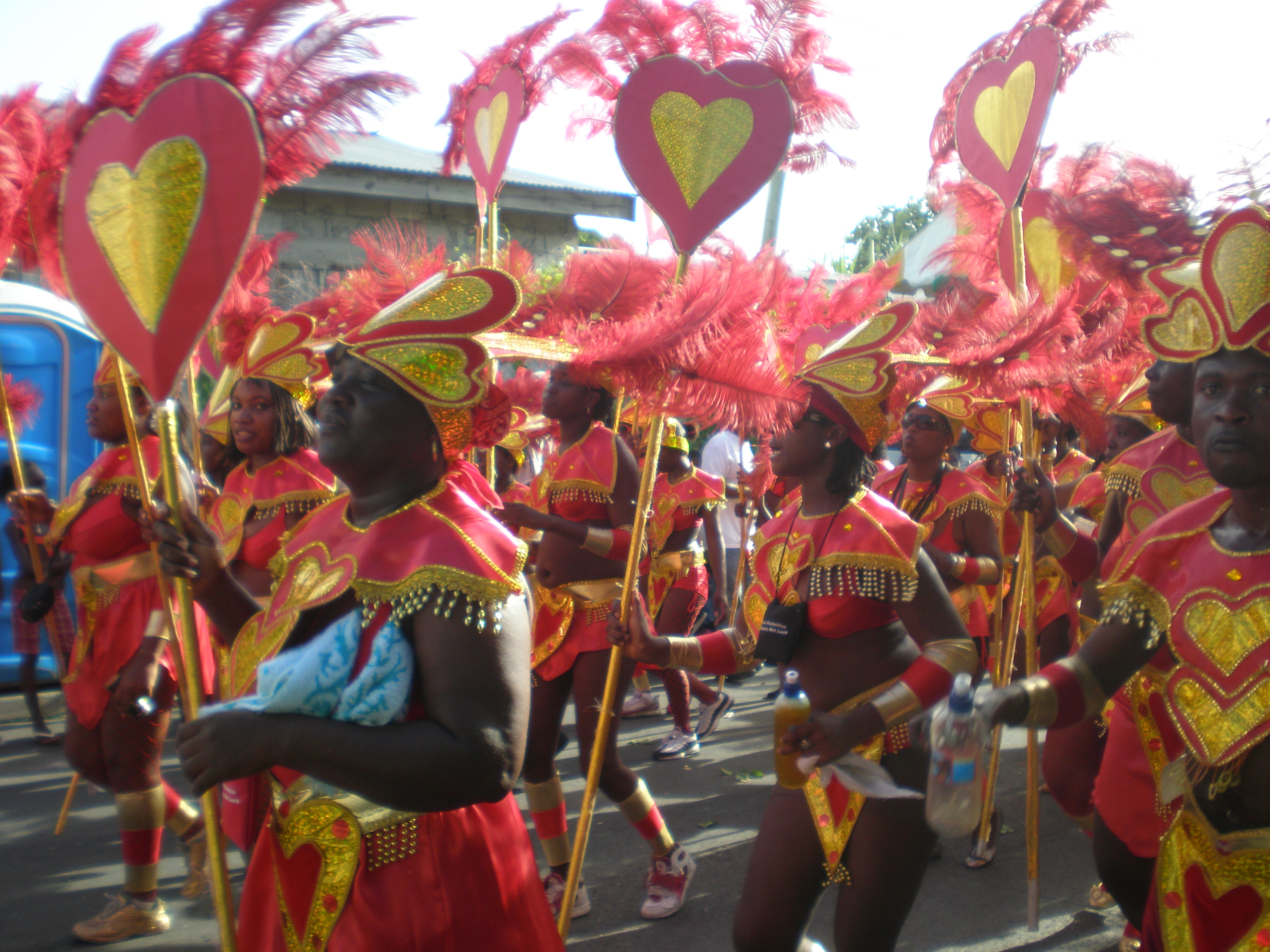
Every year, on the island of Antigua, people celebrate their freedom from slavery with the Antigua Carnival modelled after European pre-Lent Carnival. Over thirteen days, there are brightly coloured costumes, talent events, beauty pageants and music. The celebration runs from late July to Carnival Tuesday, the first Tuesday in August. On the island, Carnival Tuesday and Monday are both observed as public holidays. In an effort to boost travel to Antigua and Barbuda, the Old Time Christmas Festival was replaced in 1957 by the Antiguan Carnival. Another annual festival held in Antigua is Antigua Sailing Week. Sailing Week is a week-long yacht regatta held in the waters of English Harbour. Sailing Week was founded in 1967 and is known for being one of the top regattas in the world. The main festival held in Barbuda is Caribana. Caribana takes place every year during Whit Monday weekend and features various pageants, calypso competitions, and weekend beach parties.
Antigua and Barbuda has eleven public holidays. On the advice of the Cabinet, the Governor-General may also proclaim other holidays. Historically, about three weeks before Christmas Day, carol singers would roam the various villages, carrying carol trees and lanterns. "John Bulls" are replicas of "masked African witch doctors", that often dominated the country's Christmas festivities. Jazz bands were also common sights, dressed in red and green clown costumes.
Cuisine
Main article: Cuisine of Antigua and Barbuda
The islands' cuisine is mostly of European origin (UK and Portugal) with regional ingredients. Fungee (pronounced "foon-jee") and pepperpot are the national dishes. Fungee is a cornmeal-based dish that resembles polenta. Other national foods include saltfish (cod), lobster (from Barbuda), ducana (a sweet dumpling made from sweet potatoes and coconut), and seasoned rice, similar to Palau or arroz con pollo. Additionally, there are confections such as peanut brittle, sugar cake (made from coconut and sugar), fudge, and raspberry (local) and tamarind stew (sauce). The Antigua black pineapple is prized for its juicy, sweet flesh. It is a well-liked fruit in the area and is included in many regional specialties and sweets. It is said to be the sweetest variety of pineapple.
An important part of the Antiguan and Barbudan breakfast is Antigua Sunday bread. It is sold in many bakeries on both islands, and instead of being made with butter, it is made with lard. There are often decorative twists on the crust of the bread. Antiguan raisin buns, often called "bun and cheese", is another traditional bread, which is sweet and most popular during Easter. It is sometimes made with spices such as nutmeg.
Sport
Cricket is the most popular sport within the islands. Sir Isaac Vivian Alexander Richards represented the West Indies cricket team between 1974 and 1991. The Antigua and Barbuda national cricket team represented the country at the 1998 Commonwealth Games, but Antiguan cricketers otherwise play for the Leeward Islands cricket team in domestic matches and the West Indies cricket team internationally. Teams from the various villages and parishes compete in the Parish League.
Association football is the second most popular sport in the country, with the Antigua and Barbuda national football team being founded in 1928.
Notes
References
References
- [https://www.cia.gov/the-world-factbook/countries/antigua-and-barbuda/ Antigua and Barbuda] - CIA World Factbook
- [https://www.britannica.com/place/Antigua-and-Barbuda Antigua and Barbuda] - Encyclopaedia Britannica
- "ECLAC/CELADE Redatam+SP 03/21/2022".
- "National Profiles".
- "Population projections by age group, annual 1991 to 2026". Statistics Division, [[Ministry of Finance and Corporate Governance of Antigua and Barbuda]].
- "Antigua and Barbuda".
- (27 April 2015). "An Assessment of Income Inequality and Poverty in Antigua and Barbuda in 2007".
- (2006). "Comparison of Poverty measurement indicators". [[Economic Commission for Latin America]] (ECLA).
- (6 May 2025). "Human Development Report 2025". [[United Nations Development Programme]].
- "How to pronounce Antigua and Barbuda in English".
- Wells, J. C. (John Christopher). (2000). "Longman pronunciation dictionary". Harlow [England] : Pearson Education Ltd..
- IT. (2020-03-03). "History Of Antigua – Antigua And Barbuda".
- Barzey, Ursula Petula. (2019-03-05). "Exploring The Historic City Of St John's Antigua".
- Murphy, Reg. "Common Myths". Archaeology Antigua.
- (2025-02-03). "Antiguan and Barbudan Creole orthography".
- "Antigua and Barbuda: History". The Commonwealth.
- (2019-12-18). "Reevaluating human colonization of the Caribbean using chronometric hygiene and Bayesian modeling". Science Advances.
- "Caribbean Trade and Networks (U.S. National Park Service)".
- Duval, D. T. (1996). Saladoid archaeology on St. Vincent, West Indies: results of the 1993/1994 University of Manitoba survey
- Handy, Gemma. (24 April 2018). "Archaeologists say early Caribbeans were not 'savage cannibals', as colonists wrote". The Guardian.
- Austin Alchon, Suzanne. (2003). "A pest in the land: new world epidemics in a global perspective". University of New Mexico Press.
- (2020-08-31). "ANTIGUAN SLAVE REVOLT 1735-1736".
- Kras, Sara Louise. (2008). "Antigua and Barbuda". Marshall Cavendish.
- (25 April 1990). "Antigua-Barbuda: Government Finally Orders Probe of Arms Shipment". IPS-Inter Press Service.
- Massiah, David. (8 May 1995). "Prime Minister Lester Bird Promises No Intervention in Brother's Arrest". Associated Press Worldstream.
- (5 September 2015). "20th Anniversary of Hurricane Luis".
- Charles, Jacqueline. "Browne becomes new prime minister of Antigua, youngest ever". The Miami Herald.
- (12 June 2021). "Speculation about early election in Antigua". Barbados Today.
- "Marine Ecosystem Protected Areas (MEPA) Trust Inc - CPDC NGO Directory".
- (6 June 2019). "Environmental Protection and Management Act, 2019".
- "Nelson's Dockyard in Antigua now a Unesco heritage site: Travel Weekly". travelweekly.com.
- (9 September 2017). "Hurricane Irma leaves Caribbean Islands Devastated". [[Los Angeles Times]].
- John, Tara. (11 September 2017). "Hurricane Irma Flattens Barbuda, Leaving Population Stranded".
- (11 February 2019). "After Irma, Disaster Capitalism Threatens Cultural Heritage in Barbuda". [[NACLA]].
- https://www.antiguanice.com/client.php?id=920&news=10952
- (2023). "Terms and Definitions FRA 2025 Forest Resources Assessment, Working Paper 194". Food and Agriculture Organization of the United Nations.
- "Global Forest Resources Assessment 2020, Antigua and Barbuda".
- (6 September 2017). "Hurricane Irma: Powerful storm blamed for three deaths". CNN.
- Panzar, Javier. (9 September 2017). "Hurricane Irma leaves Caribbean islands devastated". Los Angeles Times.
- John, Tara /. "'There Is No Home to Go Back to.' Hurricane Irma Flattens Barbuda, Leaving Population Stranded".
- "Population projection at mid-year estimates 2011 to 2025".
- "Birth and infant mortality rates 2001 to 2020".
- "Q101 Marital Status".
- "World Bank Open Data".
- "2011 Population and Housing Census".
- "Antigua and Barbuda Population Density 1961-2025 {{!}} MacroTrends".
- "Antigua and Barbuda - urbanization 2012-2022 {{!}} Statista".
- (2024-09-03). "Antigua and Barbuda: Baseline population (30 Aug 2024) - Antigua and Barbuda {{!}} ReliefWeb".
- Joseph, Geraldine. (2025-04-17). "Centre of population of Antigua, 2011".
- "Type of dwelling".
- "Type of ownership".
- "Q48 Ethnic".
- "Census 2011 Book of Statistical Tables".
- "Country of birth".
- "Country of birth by ethnicity".
- East, Roger. (2003). "Profiles of People in Power: The World's Government Leaders". Psychology Press.
- "Caribbean Elections Biography {{!}} Wilfred Ebenezer Jacobs".
- "The Laws of Antigua and Barbuda".
- (2016-10-07). "Antigua and Barbuda Creole English {{!}} Ethnologue".
- McDonald, Natalie. (May 2012). "Language Hegemony in Education: An Antiguan Perspective".
- Thomas, Arthur. (2025-02-11). "Estimated main languages of the Antiguan and Barbudan population".
- "Religions in Antigua and Barbuda | Arda".
- (2025-11-17). "Director of education express optimism about new curriculum's impact on teachers, students and parents".
- "Bureau of International Labor Affairs (ILAB) - U.S. Department of Labor".
- "Government primary school enrollment 2009 to 2018".
- "2023 Grade Six National Assessment Top Students".
- Staff, Editorial. (2024-07-06). "Lowest-performing primary school students to be placed in one school".
- Editorial. (2025-10-22). "Top 100 Students Honoured at 2025 Grade Six National Assessment Awards".
- "Government secondary school enrollment 2009 to 2018".
- "Educational Level".
- https://data.worldbank.org/indicator/SE.XPD.TOTL.GD.ZS
- Michael. (2025-09-17). "A&B launches ABCAS in bold push to be among top 40 global nations".
- "UWI Five Islands Campus: Ready for take-off".
- The World Bank - www.worldbank.org. "Education Statistics".
- "Higher Education in Antigua and Barbuda: A Look at Current Universities".
- "Antigua and Barbuda - CLGF".
- (May 2004). "Antigua & Barbuda: Foreign Policy & Government Guide". International Business Publications, USA.
- "The Antigua and Barbuda Constitution Order 1981".
- "Antigua Constitution Order 1967".
- "Countries".
- [http://www.abec.gov.ag/referendum_2018/results.php 2018 Referendum Results] ABEC
- "Magistrate's Code of Procedure Act".
- "Eastern Caribbean Supreme Court".
- "АНТИГУА И БАРБУДА {{!}} Энциклопедия Кругосвет".
- "Local Government".
- (October 2020). "Antigua and Barbuda 2018 Labour Force Survey Report".
- (1805). "The Laws of the Island of Antigua: Consisting of the Acts of the Leeward Islands, Commencing 8. Novem. 1690 Ending 21. April 1798, and the Acts of Antigua Commencing 10. April 1668, Ending 7. May 1804: with Prefixed to Each Volume, Analytical Tables of the Titles of the Acts, and at the End of the Whole, a Copious Digested Index". Bagster.
- "Manifesto".
- "Policy Highlight: Parish Councils".
- "Redonda Annexation Act".
- (2020). "Barbuda Master Plan".
- "Voice, Participation and Governance: The Case of the Eastern Caribbean".
- jennelsa.johnson. (2020-03-12). "The political Neanderthal".
- (2020-09-04). "Hurst Says Request For Barbuda To Separate Is "Nonsense Talk"".
- "The Public Health Act".
- Abbott, W.J.. (13 August 1914). "At a meeting of the Saint John's City Commissioners held at their office in Church Lane on Thursday the 16th day of July, 1914.". [[The Leeward Islands Gazette]].
- "St. John's Development Corporation Act".
- "Ministry of Foreign Affairs, Agriculture, Trade & Barbuda Affairs {{!}} Montevideo Consensus on Population and Development".
- "Government of Antigua and Barbuda".
- Administrator, OECS. (2024-04-18). "About Us".
- Nations, United. "Member States".
- "Member States and Associate Members".
- "Member States – AOSIS".
- "WTO Members and Observers".
- (2024-04-20). "Antigua says it is a friend of both U.S. and China, after Newsweek article".
- "Facebook".
- (2024-05-27). "Small island development 'a test case' for climate and financial justice, says Guterres {{!}} UN News".
- Radio, ABS TV /. (2024-06-18). "UNITED NATIONS PRAISES ANTIGUA & BARBUDA'S MULTILATERALISM EFFORTS - ABS TV Radio Antigua & Barbuda".
- "Antigua and Barbuda and Montserrat Forge Closer Ties". [[Caribbean Community]].
- (23 August 1997). "Antigua wants Montserrat refugee help". United Press International.
- (2022-03-08). "Unvaccinated Travelers To and From Montserrat Given the Green Light to Transit through Antigua".
- "Government of Antigua and Barbuda".
- "Government of Antigua and Barbuda".
- "Defence Act".
- "National Security Council Act".
- "Police Act".
- "Special Service Unit".
- ""B" Division".
- irishcentreforhumanrights. (2025-04-02). "Barbuda: A case study in disaster capitalism and resistance".
- (2024-01-09). "PM Browne adds MP Kelvin Shugy Simon to defamation lawsuit".
- Editorial Staff. (2024-01-10). "PM Browne adds MP Kelvin Shugy Simon and Observer Media Group to Defamation Lawsuit - Antigua News !".
- "PM Browne to sue political opponents for defamation".
- "Broadcast media - The World Factbook".
- lynroy.samuel. (2017-02-23). "Opposition leader charges no access to state media".
- Nohlen, p63
- [http://www.caribbeanelections.com/ag/elections/ag_results_2004.asp Antigua and Barbuda: 2004 election results] {{Webarchive. link. (29 June 2021 Caribbean Elections)
- "Freedom in the World 1998-1999".
- Avery, Daniel. (4 April 2019). "71 Countries Where Homosexuality is illegal". Newsweek.
- (20 March 2019). "State-Sponsored Homophobia".
- Michael. (2024-09-18). "Legal tug-of-war begins over Antigua's abortion laws".
- (2024-06-28). "ANTIGUA & BARBUDA - Study shows high abortion rates, sexual violence, in Antigua & Barbuda amid legal reform debate".
- Campos, Gizane. (2022-07-08). "Antigua and Barbuda Abortion Law".
- "Antigua and Barbuda: Freedom in the World 2022 Country Report".
- Emmanuel, Robert. (2024-05-22). "Trials by Judge Alone made permanent as Senate passes Bill unanimously".
- {{Cite CIA World Factbook. (2021)
- (21 January 2016). "Antigua and Barbuda Government Abolishes Personal Income Tax". Online Guide to Antigua and Barbuda's Government Information and Services.
- "Antigua: a Mature Financial Centre".
- (21 February 2009). "Fraud Case Shakes a Billionaire's Caribbean Realm". The New York Times.
- "Manufacturing, value added (% of GDP) – Antigua and Barbuda, Germany {{!}} Data". World Bank.
- {{citation-attribution. (2021)
- Newsdesk. (2021-09-15). "Antigua and Barbuda's Tourism Growth Continues".
- "Country Trends". Global Footprint Network.
- Citizenship by Investment Unit. "Antigua and Barbuda Citizenship by Investment Program". Antigua and Barbuda.
- McDaniel, pp. 798–800
- Luffman, John. (1788). "A Brief Account of the Island of Antigua".
- [http://www.antiguamuseums.org/cultural.htm#Calypso Antigua and Barbuda's Cultural Heritage] {{webarchive. link. (2005-10-26 and McDaniel, pp 798-800)
- "A' Design Award and Competition – Design Encyclopedia – History Of Art In Antigua And Barbuda".
- "Antigua and Barbuda / Pressroom".
- "History of Antigua's Carnival".
- (2018-09-17). "Antigua's Carnival".
- (2023-07-14). "8 of the best Caribbean carnivals".
- Beckett, Luisa. "Yachting Escapes: The Caribbean". The Escapes Group ltd.
- Vaitilingam, Adam. (31 January 2002). "The Rough Guide to Antigua and Barbuda". Rough Guides.
- "Antigua and Barbuda Public Holidays".
- "the barbudaful community".
- "Public Holidays Act".
- "ANTIGUA & BARBUDA'S CULTURAL HERITAGE".
- [http://recipeisland.com/blog1/recipe-island/antigua-barbuda-recipes/antigua-barbuda-national-dish-recipe "Antigua & Barbuda National Dish & Recipe."] {{webarchive. link. (October 13, 2010 [http://recipeisland.com Recipeisland.com]. Pepperpot is a spinach and okra stew, with and without beef parts or chicken. Accessed July 2011.)
- "Antigua Black Pineapple {{!}} Local Pineapple From Antigua and Barbuda".
- (2019-01-02). "The Antigua Black Pineapple: An Island Treasure {{!}} Sandals Blog".
- admin. (2016-06-01). "Antigua Sunday Bread".
- (2022-09-03). "Antigua's traditional bread shops struggle amid food price hikes". BBC News.
- ChainBaker. (2021-05-02). "Antiguan Raisin Buns, Unique Bun & Cheese Recipe".
- (2 April 2011). "Viv Richards was a complete genius: Imran Khan".
- Featured Columnist. (13 November 2013). "The ICC Ranking System's Top 10 Batsmen in ODI Cricket History". Bleacher Report.
- (2024-01-20). "ACB Antigua Parish League".
- "Antigua & Barbuda taking small steps towards respectability | World Soccer". worldsoccer.com.
- (2021-03-07). "ANTIGUA AND BARBUDA".
This article was imported from Wikipedia and is available under the Creative Commons Attribution-ShareAlike 4.0 License. Content has been adapted to SurfDoc format. Original contributors can be found on the article history page.
Ask Mako anything about Antigua and Barbuda — get instant answers, deeper analysis, and related topics.
Research with MakoFree with your Surf account
Create a free account to save articles, ask Mako questions, and organize your research.
Sign up freeThis content may have been generated or modified by AI. CloudSurf Software LLC is not responsible for the accuracy, completeness, or reliability of AI-generated content. Always verify important information from primary sources.
Report