From Surf Wiki (app.surf) — the open knowledge base
42nd Street–Bryant Park/Fifth Avenue station
New York City Subway station in Manhattan

New York City Subway station in Manhattan
| Field | Value |
|---|---|
| name | 42 Street–Bryant Park/ |
| 5 Avenue | |
| type | complex |
| image | 42nd Street - Bryant Pk Stair.JPG |
| image_caption | An entrance to the IND station |
| address | West 42nd Street between Fifth Avenue & Sixth Avenue |
| New York, New York | |
| borough | Manhattan |
| locale | Midtown Manhattan |
| coordinates | |
| division | IRT/IND |
| line | IND Sixth Avenue Line |
| IRT Flushing Line | |
| levels | 2 |
| structure | Underground |
| service | Bryant Park |
| other | NYCT Bus: |
| MTA Bus: | |
| transfer | At , daytime (6 a.m. to 12 a.m.) only: |
| accessible | mc |
| footnotes |
5 Avenue New York, New York IRT Flushing Line MTA Bus:
The 42nd Street–Bryant Park/Fifth Avenue station is an underground New York City Subway station complex, consisting of stations on the IRT Flushing Line and IND Sixth Avenue Line. Located at 42nd Street between Fifth Avenue and Sixth Avenue (Avenue of the Americas) in Manhattan, it is served by the 7, D and F trains at all times, the B and M trains on weekdays, and during rush hours, the train in the peak direction and the train in the reverse peak direction. A free passageway from the IND platforms to the station, served by the is open during the day from 6 a.m. to 12 a.m. The Times Square transfers are announced only on New Technology Trains.
The Interborough Rapid Transit Company (IRT) built the Flushing Line platform, which opened in 1926 as the first part of an extension of the Queensboro Subway (today's Flushing Line) from Grand Central to Times Square. The Sixth Avenue Line platforms opened in 1940, completing construction of the first phase of the Independent Subway System (IND). Free out-of-system walking transfers between the stations on the two lines began being provided on weekdays in 1967, and an underground passageway was completed in 1971, allowing free in-system transfers. In 1998, the entire station complex was renovated. A free transfer to the Times Square station was opened in 2021 with the completion of a renovation project on the 42nd Street Shuttle. There are plans to add elevators to the station to make it compliant with the Americans with Disabilities Act of 1990.
The IRT station has one island platform and two tracks and runs from west to east. The IND station has two island platforms and four tracks; it runs from north to south and is west of the IRT station. There is a mezzanine above the IRT platform, connected by a corridor to a mezzanine above much of the IND platform. A separate mezzanine exists above the extreme north end of the IND station. The 42nd Street–Bryant Park/Fifth Avenue complex served 17,213,702 passengers in 2019, making it the 13th busiest station in the subway system.
History
Planning for a subway line in New York City dates to 1864. However, development of what would become the city's first subway line did not start until 1894, when the New York State Legislature authorized the Rapid Transit Act. The Rapid Transit Construction Company, organized by John B. McDonald and funded by August Belmont Jr., signed the initial Contract 1 with the Rapid Transit Commission in February 1900, in which it would construct the subway and maintain a 50-year operating lease from the opening of the line. Belmont incorporated the Interborough Rapid Transit Company (IRT) in April 1902 to operate the subway. As part of the project, a section of tunnel under 42nd Street was constructed between the intersections of Park Avenue/41st Street and Broadway/47th Street. Degnon-McLean was awarded the contract to build this section of the line, and construction began on February 25, 1901.
The first section of the line opened on October 27, 1904. The line did not serve Bryant Park directly; the nearest stations were Times Square, a local stop, and Grand Central, an express stop. Additional lines opened in 1918, thereby dividing the original line into an H-shaped system. The old route under 42nd Street became the 42nd Street Shuttle, which ran between Times Square and Grand Central without any intermediate stops.
IRT Flushing Line
The Dual Contracts were formalized in March 1913, specifying new lines or expansions to be built by the IRT and the Brooklyn Rapid Transit Company (BRT). The Dual Contracts involved opening the Steinway Tunnel as part of the new Flushing subway line. The route, traveling under 41st and 42nd Streets in Manhattan, was to go from Times Square through the tunnel over to Long Island City and from there continue toward Flushing. The section of the tunnel between Grand Central–42nd Street and Queens had opened on June 22, 1915.
Construction
In July 1920, the New York State Public Service Commission announced it would extend the Flushing Line two stops west to Times Square, with an intermediate station under Bryant Park. The western end of the Bryant Park station would be 300 ft east of Sixth Avenue, while the eastern end would be about 100 ft west of Fifth Avenue. The 42nd Street Association, a local civic group, regarded the station as very important. In May 1921, it was expected that contracts for the extension would be advertised shortly.
On November 9, 1921, the New York State Transit Commission opened up the contract for the extension for bidding. The extension would take a slightly different route than the one specified in the Dual Contracts. The original proposal had the line constructed under 42nd Street to a point just to the east of Broadway, which would have forced riders transferring to the IRT Broadway–Seventh Avenue Line to walk a long distance. On November 22, 1921, the Powers-Kennedy Contracting Corporation was awarded a contract to construct the extension on a low bid of $3,867,138, below the estimated cost of over $4 million. This low bid was the narrowest margin ever recorded for any large city contract, beating out the next highest bidder by 0.7 percent. While the contractor was provided four years to complete work, engineers expected to reduce the time needed to do so to as little as three years. Since work on the project had to be completed underneath the foundations of several large buildings, such as theatres, and the north end of the New York Public Library, the contractor had to provide a $1 million bond. The project was expected to reduce crowding on the 42nd Street Shuttle by enabling riders to use the Queensboro Subway to directly access Times Square. 24,000 of the estimated 100,000 daily shuttle riders transferred to and from the Queensboro Subway. The line was to extend as far as Eighth Avenue to connect with the proposed IND Eighth Avenue Line.
Powers-Kennedy started excavating the line westward from Grand Central in May 1922. The Flushing Line extension was to run beneath the original line from Vanderbilt to Fifth Avenue, running as little as 4 in under the original line. The tunnel also had to pass under a sewage line at Madison Avenue. The construction of the Fifth Avenue station required underpinning the New York Public Library Main Branch and extending the library's foundation downward. The subway tunnel ran 35 ft below ground level. During construction, workers took precautions to avoid interrupting the flow of traffic above ground and interfering with preexisting tunnels. The contractors had completed the tunnels to Fifth Avenue by May 1923. Local civic groups advocated for the Fifth Avenue station to be used as a temporary terminal while the permanent terminus at Times Square was being completed. By the end of 1923, the Transit Commission had allocated $50,000 for the construction of a temporary crossover east of the Fifth Avenue station.
The temporary terminal at Fifth Avenue was nearly complete by February 1926. The station had two entrances on the south side of 42nd Street (one next to the library and the other next to the park). A third entrance was placed within the Stern's building on the north side. Stern's funded the construction of the entrance inside its building, which also included storefront windows. The entrance through the Stern's building did not open along with the rest of the station, and opened at a later point. These entrances connected with a mezzanine above the platform. The platform was to be 480 ft long, though only a 300 ft section would be used initially as a double crossover to the east of the station still needed to be used while it was a terminal. With the completion of the line to Eighth Avenue, the switch would be removed, and the platform could be extended.
Opening and unification
The Fifth Avenue station opened on March 22, 1926, extending the IRT Flushing Line one stop to the west from the line's previous terminus at Grand Central. Even so, many Flushing Line passengers traveling from Queens to the West Side of Manhattan tended to transfer to the shuttle at Grand Central, rather than leave the train at Fifth Avenue. The Flushing Line was extended to Times Square on March 14, 1927, following various delays. The northern section of Bryant Park, which had been closed for four years during the line's construction, was restored shortly afterward. By 1930, a fourth entrance to the Fifth Avenue station was being constructed from the basement of the Salmon Tower Building.
The city government took over the IRT's operations on June 12, 1940. The New York City Board of Transportation (BOT) announced in January 1950 that it would lengthen the platforms at the Times Square and Fifth Avenue stations from 480 to. The platforms at Fifth Avenue and all other stations on the Flushing Line with the exception of Queensboro Plaza were extended in 1955–1956 to accommodate 11-car trains.
IND Sixth Avenue Line
New York City mayor John Francis Hylan's original plans for the Independent Subway System (IND), proposed in 1922, included building over 100 mi of new lines and taking over nearly 100 mi of existing lines. The lines were designed to compete with the existing underground, surface, and elevated lines operated by the Interborough Rapid Transit Company (IRT) and Brooklyn–Manhattan Transit Corporation (BMT). The IND Sixth Avenue Line was designed to replace the elevated IRT Sixth Avenue Line. In 1924, the IND submitted its list of proposed subway routes to the BOT, which approved the program. One of the routes was a segment of tunnel from Fourth Street to 53rd Street. Part of this stretch was already occupied by the Hudson & Manhattan Railroad (H&M)'s Uptown Hudson Tubes. As a result, negotiations between the city and the H&M continued for several years. The IND and H&M finally came to an agreement in 1930. The city had decided to build the IND Sixth Avenue Line's local tracks around the pre-existing H&M tubes, and add express tracks for the IND underneath the H&M tubes at a later date. Also in 1930, the BOT identified the locations of 104 stations to be built in the IND system. Under this plan, there would have been a local station at Sixth Avenue and 42nd Street.
The IND started advertising bids for the section of the Sixth Avenue Line between 43rd and 53rd Streets in April 1931. Engineers started planning in earnest for the Midtown portion of the Sixth Avenue Line in April 1935. The city government issued corporate stock to pay for the $53 million cost of the project, since the line was not eligible for federal Public Works Administration funds. The first contract, for the section between 40th and 47th Streets, was awarded to Rosoff-Brader Construction in October 1935. The next February, mayor Fiorello H. La Guardia announced that construction would start within six weeks. The contractors were to excavate a construction shaft at Bryant Park (completing the shaft by April 1), upon which they would proceed northward. La Guardia broke ground for the Sixth Avenue subway at Bryant Park on March 23, 1936.
The line was built as a four-track tunnel north of 33rd Street (including the Rockefeller Center station), but there were only two tracks south of that street. The work largely involved cut-and-cover excavations, although portions of the subway had to be tunneled through solid rock. The builders also had to avoid disrupting the Sixth Avenue elevated or the various utility lines on the avenue, and some of the pipes and wires had to be replaced in the process. Excavation work was conducted 24 hours a day, with most of the blasting work being conducted at night. Workers used small charges of dynamite to avoid damaging nearby buildings or the Catskill Aqueduct, which ran below Sixth Avenue and was a major part of the New York City water supply system. The contractors built a compressor plant and a shaft at 46th Street, and they excavated another shaft at Bryant Park.
Work on excavating the 42nd Street station was further complicated by the fact that it had to be built above the Flushing Line tunnel at 41st Street, but below the 42nd Street Shuttle tunnel one block north. The site of the 42nd Street station had been excavated by mid-1937. Contractors constructed subway entrances at 40th and 42nd Street, and portions of the parapet wall surrounding Bryant Park were temporarily removed in the process. The section north of 33rd Street had mostly been excavated by November 1937, including "rough construction work" for the 42nd Street station. The IRT's Sixth Avenue elevated closed in December 1938, just before the Sixth Avenue subway was completed. In advance of the 1939 New York World's Fair, La Guardia proposed installing a visitors' gallery in the 42nd Street station, detailing the Sixth Avenue Line's construction. The 42nd Street–Bryant Park station opened on December 15, 1940, as part of the opening of the IND Sixth Avenue Line from 47th–50th Streets–Rockefeller Center to West Fourth Street. The opening of the Sixth Avenue Line relieved train traffic on the Eighth Avenue Line, which was used by all IND services except for the G Brooklyn–Queens Crosstown service. [[File:42nd_St_Bryant_Park_td_28.jpg|thumb|View of the IND platforms]] The administration of mayor William O'Dwyer studied the possibility of converting the IND mezzanine and the adjacent passageway to Herald Square into a parking garage in mid-1946. The city government examined three separate plans for a parking lot with 100 to 500 spaces. BOT chairman Charles P. Gross dismissed the idea as prohibitively expensive. In a 1951 report concerning the construction of bomb shelters in the subway system in the midst of the Cold War, the BOT proposed constructing a ramp between 40th Street and the 42nd Street–Bryant Park station. In 1956, a marketplace for used books was proposed for the passageway leading to the 34th Street–Herald Square station. By then, a gate at 40th Street blocked off access to the passageway from the 42nd Street–Bryant Park station. The book mart would have housed the Fourth Avenue Booksellers Association, whose members declined an offer to relocate there.
Station complex and later modifications
1940s to 1980s
There initially was no direct connection between the IND's 42nd Street–Bryant Park station and the IRT's Fifth Avenue station, despite the fact that three other stations on the new line contained transfers to other services. Though the BOT created free transfers at many points across the New York City Subway system in 1948, a free transfer was not added between the 42nd Street–Bryant Park and Fifth Avenue stations at the time because of heavy congestion in the "Times Square and 34th Street areas". Starting on December 18, 1967, the New York City Transit Authority (NYCTA) provided paper tickets to passengers, allowing them to transfer between the IND and IRT stations for free during weekdays in the peak direction. Transfers to the IRT were distributed from 5 a.m. to noon, and transfers to the IND were distributed from noon to 8 p.m.. Passengers had to exit one station and use the sidewalk to enter the other. The paper tickets were a temporary measure until the NYCTA completed a passageway within fare control.

The NYCTA started constructing a 300 ft passageway between the two stations in 1969. Workers dug a trench measuring 20 ft wide and 35 ft deep, then covered the trench with a 14 ft layer of fill. The project involved removing 14 plane trees from Bryant Park, which prompted protests from preservationists. The developer of the nearby 1095 Avenue of the Americas office building contributed $500,000 to the station's renovation in exchange for permission to build additional office space. About half of the tunnel was decorated with terrazzo floors; orange brick and tile walls; glass and steel railings; and recessed lighting. The NYCTA completed the tunnel in 1971, upon which it was used by an average of 6,500 passengers during weekdays. The tunnel was decorated with eight porcelain murals, each measuring 10 ft wide. The murals depicted historical and present-day structures at Bryant Park, including the Latting Observatory and New York Crystal Palace.
In the late 1970s, the Flushing Line platform was painted beige as part of Operation Facelift, a system-wide refurbishment program led by Phyllis Cerf Wagner. The IND station had become rundown by the mid-1980s. During this period, the IND mezzanine hosted various art exhibitions, including a showcase of schoolchildren's art and portraits of subway riders from around the world. The 42nd Street/Fifth Avenue station also recorded more felonies than almost any other New York City Subway station during the 1980s. According to a 1986 study, passengers were more likely to be robbed at the 42nd Street/Fifth Avenue station than at any other place in the system.
1990s to 2010s
The Metropolitan Transportation Authority (MTA) announced in 1990 that it would spend $730 million to renovate 74 subway stations, including the 42nd Street station. The passageway to the Herald Square station was closed the following year due to high crime. In 1994, amid a funding shortfall, the administration of mayor Rudy Giuliani proposed delaying the station's renovation. That October, the MTA announced it had "indefinitely" postponed plans for renovating the 42nd Street station. The MTA again proposed renovating the station as part of its 1995–1999 capital plan. Work was underway by mid-1999, but the project had fallen six months behind schedule, with a planned completion date of October 2002. The IND station, which was formerly known simply as 42nd Street, was renamed 42nd Street–Bryant Park around 2003.
In 2011, as part of a renovation of 1095 Avenue of the Americas, the building's owner Blackstone Group relocated the building's subway entrance eastward by several dozen feet. As part of the development of 7 Bryant Park in 2012 and 2013, the station entrance at the southwestern corner of 40th Street and Sixth Avenue was removed, and a new in-building accessible entrance was constructed at the northwestern corner of 39th Street and Sixth Avenue, completed by 2016. The construction of the development had required a relocation of the street staircase at 40th Street to within the building per zoning requirements, but the developer, working with the MTA's Transit-Oriented Development, determined that the building and subway riders would benefit more from having the entrance at 39th Street. Removing the 40th Street entrance enabled the building to have its main entrance face Bryant Park. The easement agreement between the MTA and the property developer was filed on May 14, 2012.
2020s to present

A transfer to the 42nd Street Shuttle at Times Square was built as part of the 2015–2019 MTA Capital Program. A new platform for the shuttle, which would be 28 ft wide and located between Tracks 1 and 4 (the outer tracks of the shuttle tunnel), replaced the existing curved platforms for tracks 1, 3, and 4. The platform was built along the section of the shuttle that runs under 42nd Street, which is located within a straight tunnel. The whole project was estimated to cost $235.41 million. The Times Square shuttle platform was extended 360 ft east, and since an emergency point of egress had to be provided, it was also used to allow for a second point of entry at Sixth Avenue, with a connection to the IND Sixth Avenue Line platforms via a secondary mezzanine at the northern end of the platforms. A construction contract was awarded in early 2019, with an estimated completion date of March 2022. The free transfer opened on September 7, 2021, along with the new shuttle platform.
In January 2020, the MTA announced plans to make the station complex accessible as part of the 42nd Street Connection Project. New elevators would be installed between platform level and the mezzanine of the Sixth Avenue Line station (one from each platform), a new elevator would be installed between the platform and mezzanine of the Flushing Line station, and two new stairs would be installed in the closed passageway to the W. R. Grace Building on the north side of 42nd Street between Fifth Avenue and Sixth Avenue. The project, which was to be completed between October 2021 and October 2023, would be bundled with developer and escalator improvement projects at Grand Central, and would be completed as part of a Design-Build procurement. When the transfer passageway to the 42nd Street Shuttle opened, elevators were planned to be installed between the passageway and at least one of the platforms at a later date.The 39th Street easement entrance, along with eight other easement entrances in Manhattan, were closed early in 2020 at the request of building owners due to the COVID-19 pandemic. The 39th Street entrance was the only entrance that remained closed in March 2022. In a response to a story by The City, an MTA spokesman said the entrance had been closed as the corridor at the bottom of the stairs had attracted illegal activities, and MTA Chairman Janno Lieber said that the agency did not have control over the developer.
In March 2024, the MTA installed low platform fences on the Flushing Line platform to reduce the likelihood of passengers falling onto the tracks. The barriers, spaced along the length of the platform, do not have sliding platform screen doors between them. The station's ADA accessibility project was to be funded by congestion pricing in New York City, but it was postponed in June 2024 after the implementation of congestion pricing was delayed.
On January 31, 2025, the MTA put out an RFP for a design-build project to make the station complex ADA-accessible. Four elevators would be installed as part of the project. One elevator would lead from the Flushing Line platform to the mezzanine, one would lead from each Sixth Avenue Line platform to the mezzanine, and one would lead from the passageway to the 42nd Street Shuttle and the northbound Sixth Avenue Line platform. Bathrooms at the Sixth Avenue Line station would be modified to be ADA-compliant, a station-complex wide fire alarm system would be installed, ADA boarding areas would be constructed on platforms, fare control areas would be modified, and some stairs at the Sixth Avenue Line station would be relocated. State of good repair work would also be made as part of the project, including repairs to platforms, ventilator, and chamber walls. The project was estimated to cost between $50 million and $100 million, and it was planned to take 1,080 days, or about three years. That December, Paul J. Scariano Inc. received an $84 million contract to install the elevators at the 42nd Street–Bryant Park/Fifth Avenue station complex.
Service history
IRT station
When the Flushing Line station opened, it served as the western terminus of trains that traveled eastward to Queens. East of Queensboro Plaza, trains traveled to either Astoria–Ditmars Boulevard or Flushing–Main Street; the IRT shared the route east of Queensboro Plaza with the Brooklyn–Manhattan Transit Corporation (BMT) until 1949. The IRT routes were given numbered designations in 1948 with the introduction of "R-type" rolling stock, which contained rollsigns with numbered designations for each service. The Times Square to Flushing route became known as the 7. Express trains began running during the 1939 New York World's Fair. Super-express 7 trains started serving the station in 1953, running nonstop between Queensboro Plaza and Willets Point Boulevard during rush hours in the peak direction, but the super-express service was discontinued in 1956.
IND station
When the Sixth Avenue Line station opened, the BB train served the station during weekday rush hours only, running local between 168th Street and 34th Street–Herald Square. The station was served at all times by the D train, which ran from 34th Street to the Bronx, and the F train, which ran from Brooklyn to Queens. With the completion of express tracks between West Fourth and 34th Streets in 1967, as well as the portion of the Chrystie Street Connection connecting the Sixth Avenue Line with the Manhattan Bridge, the B and D trains started running express on the Sixth Avenue Line. The 57th Street station opened in 1968, upon which trains to 57th Street began serving the 42nd Street station. The portion of the Chrystie Street Connection connecting the Sixth Avenue Line with the Williamsburg Bridge opened on July 1, 1968, and was used by the KK train until that route was discontinued in 1976.
The Sixth Avenue Line station was also served by the JFK Express from 1978 to 1990 when it was discontinued. When the Manhattan Bridge's north tracks were closed for repairs between 1986 and 1988, the Sixth Avenue Shuttle stopped at the station, running from 57th Street to Grand Street. The Q train started running along the Sixth Avenue Line's express tracks in 1988 and continued to operate on the line until 2001. The V train, which used the Sixth Avenue Line's local tracks, began serving the station in December 2001. The V train was discontinued in 2010 and replaced by the M train.
Station layout
| **Northbound** | toward () → |
|---|
.png)
At 41st Street and Sixth Avenue, the IRT Flushing Line runs west–east and crosses underneath the IND Sixth Avenue Line, which runs north–south. The IRT Flushing Line station is an express stop with two tracks and one island platform, while the IND Sixth Avenue Line station is an express stop with four tracks and two island platforms.
There are three elevators to street level: one each located on the northwestern and southwestern corners of Sixth Avenue and 42nd Street, and one on the western side of Sixth Avenue between 39th and 40th Streets. The first elevator serves a small mezzanine at the northern end of the Sixth Avenue Line platforms, while the latter two elevators serve a primary mezzanine above both sets of platforms. There are no elevators from either of the mezzanines to either platform level, so the station complex is not fully ADA-accessible, although the MTA plans to make the platforms accessible at a later date.
Mezzanines
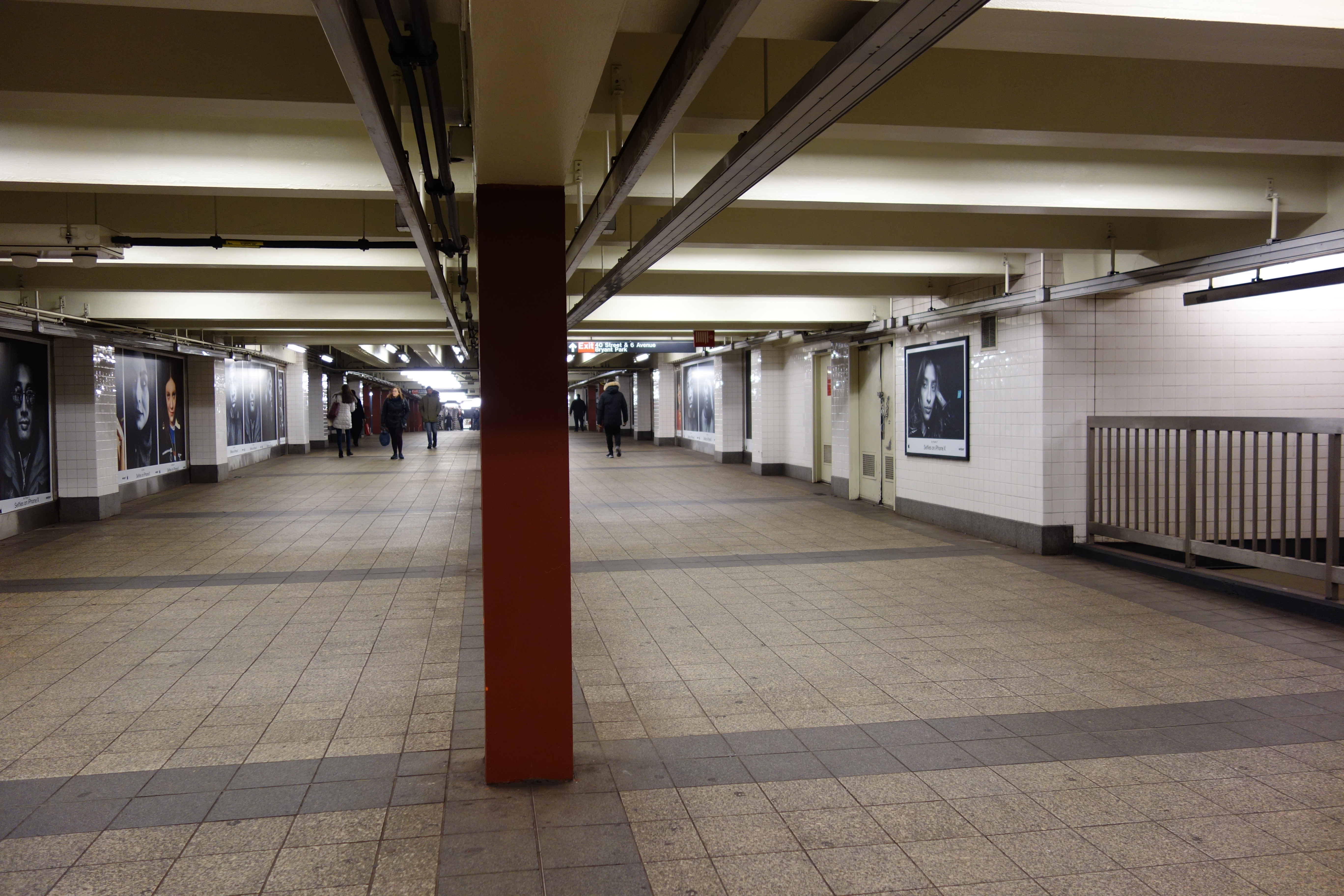
The IND station has two mezzanines above the two island platforms. The 42nd Street Shuttle, which passes perpendicularly over the Sixth Avenue Line at 42nd Street, divides the mezzanines. A staircase from each platform goes up to the northern mezzanine, which consists of a small fare control area on the north side of 42nd Street. The southern mezzanine, south of 42nd Street, connects with the IRT Flushing Line platform and extends south to 40th Street. Four stairs lead from each platform to the southern mezzanine: two at the center of the platform and two near the south end of the platform. The mezzanine has a florist, orange I-beam columns, lit-up ads, and space rentals along the walls.
The IRT mezzanine extends above most of the platform. Six stairs lead from the platform to the center of the mezzanine. The mezzanine slopes upward toward a set of fare control areas at both ends. Near the western end, a ramp slopes down to the IND station.
Artwork
The walls of the passageway between the IRT and IND stations are decorated with a mosaic by Samm Kunce, Under Bryant Park, which was installed in 2002. The artwork depicts pipes, rock outcroppings, and the roots of trees. According to Kunce, the artwork was based on the concept of systems. The artwork also contains various quotations, including those by poets Ovid and James Joyce. At the western end of the passageway (along the wall of the IND station's southern mezzanine) are depictions of dark rocks and plants, as well as a quote from philosopher Carl Jung: "Nature must not win the game, but she cannot lose".
The walls of the mezzanine also contain light boxes for photographic exhibits. The exhibits in the light boxes have included "The Great Escape", a series of nature-inspired photographs by Karine Laval, which were displayed starting in 2021.
Closed Herald Square passageway
The IND station's southern mezzanine originally extended south from 42nd Street to the 34th Street–Herald Square station. Proposed by the Board of Transportation in 1936, the passageway was outside of fare control but was intended to relieve passenger flow at the 42nd and 34th Street stations. At both ends of the passageway, pedestrians could descend to turnstiles at platform level. The passageway itself measured 35 ft wide and was very plain in design, with white-tiled walls. There were entrances at 34th, 35th, 38th, and 40th Streets. At 35th Street, there was a smaller passageway extending westward to Broadway, near the northern end of the BMT Broadway Line station at 34th Street–Herald Square. Another passageway at 34th Street extended west to Eighth Avenue, providing direct access to Pennsylvania Station. According to a 1940 report from the New York Herald Tribune, the passageway was believed to be "the longest of its kind in the world".
In the 1980s, the passageway became a gathering spot for homeless people and drug users. On March 20, 1991, a woman was raped behind a pile of debris in the subway passageway during rush hour. Other commuters passed nearby but were unaware of what was happening. That passageway was closed the day after; it was used by 400 daily riders and recorded 30 felonies since January 1, 1990. In response, on March 28, 1991, the NYCTA ordered the closing of the 15 most dangerous passageways in the system within a week, which the Transit Police and citizen advocacy groups had called for since the previous year. A woman was raped in the passageway in July 1990 with no response, but after another rape took place in August, the passageway's closure was called for by the local community board in September when a woman was raped in this passageway. Bureaucratic delays had prevented their closure, with their presentation to the MTA Board not scheduled until April 1991, after a public hearing on systemwide service reduction was to be held. The agency feared that closing the passageway without public comment would have caused an outcry for advocates for the homeless. The NYCTA's director of public information said that the agency had erred in waiting for formal approval. The locations were chosen based on crime volume, lighting, traffic and physical layout. These entrances were closed under the declaration of a public safety emergency, and were blocked off with plywood and fencing until public hearings were held and official permission was obtained.
Exits
IND section
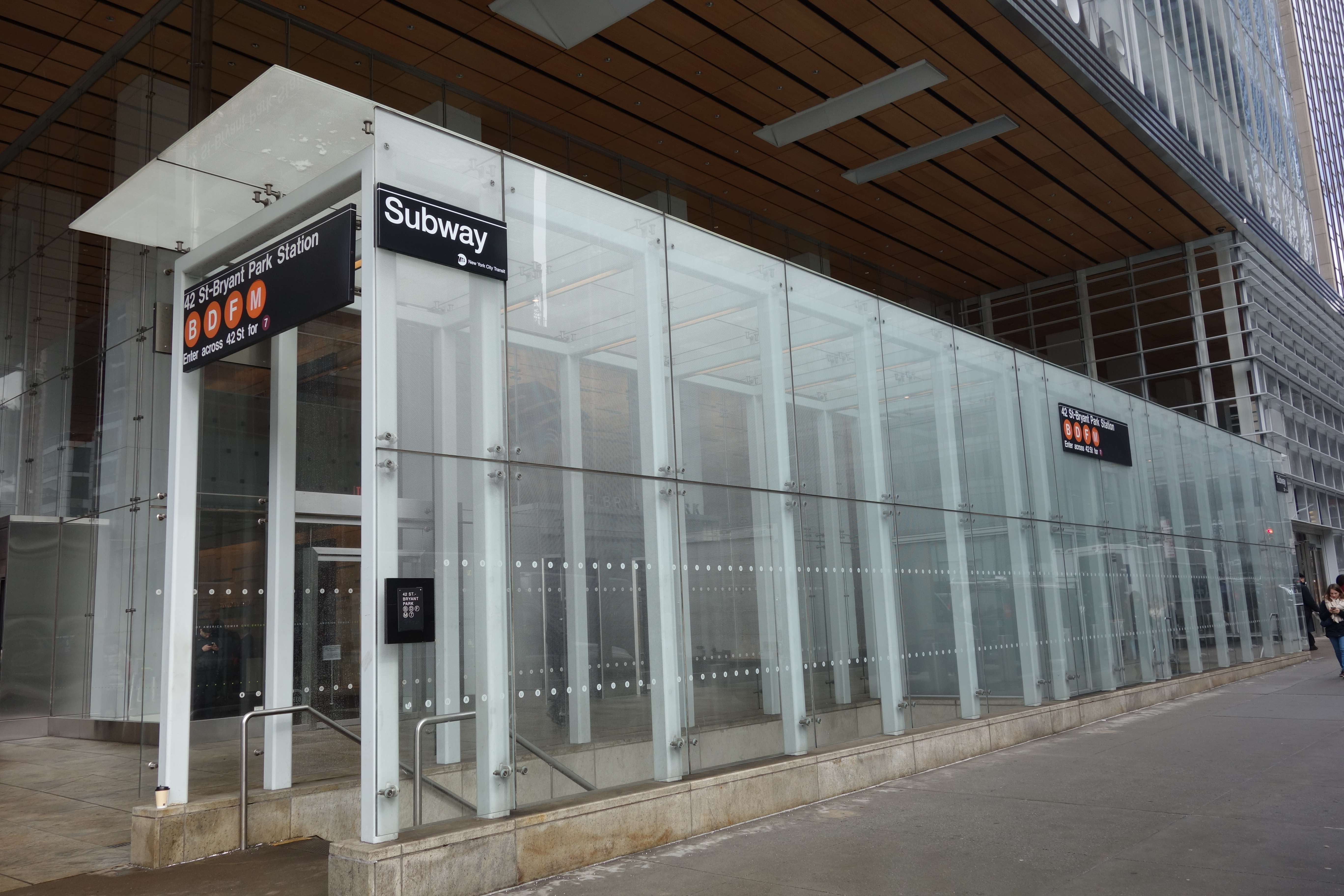
On the north end of the southern mezzanine is a fare control area and the passageway to the IRT Flushing Line. A ramp and staircase leads to an intermediate landing under 1095 Avenue of the Americas, where a stair and elevator leads to the street. Two more staircases go up to the southeast corner of Sixth Avenue and 42nd Street. On the south end of this mezzanine is an unstaffed bank of regular and HEET turnstiles. Outside fare control, there are three staircases going up to the northwest, northeast, and southeast corners of 40th Street and Sixth Avenue with the northwestern one being built inside a building. There is another exit at the northwest corner of Sixth Avenue and 39th Street. The entrance has a 10 ft stairway and elevator from street level to a 15 ft passageway leading to the station. This replaced an entrance at the southwest corner of 40th Street and Sixth Avenue.
IRT section
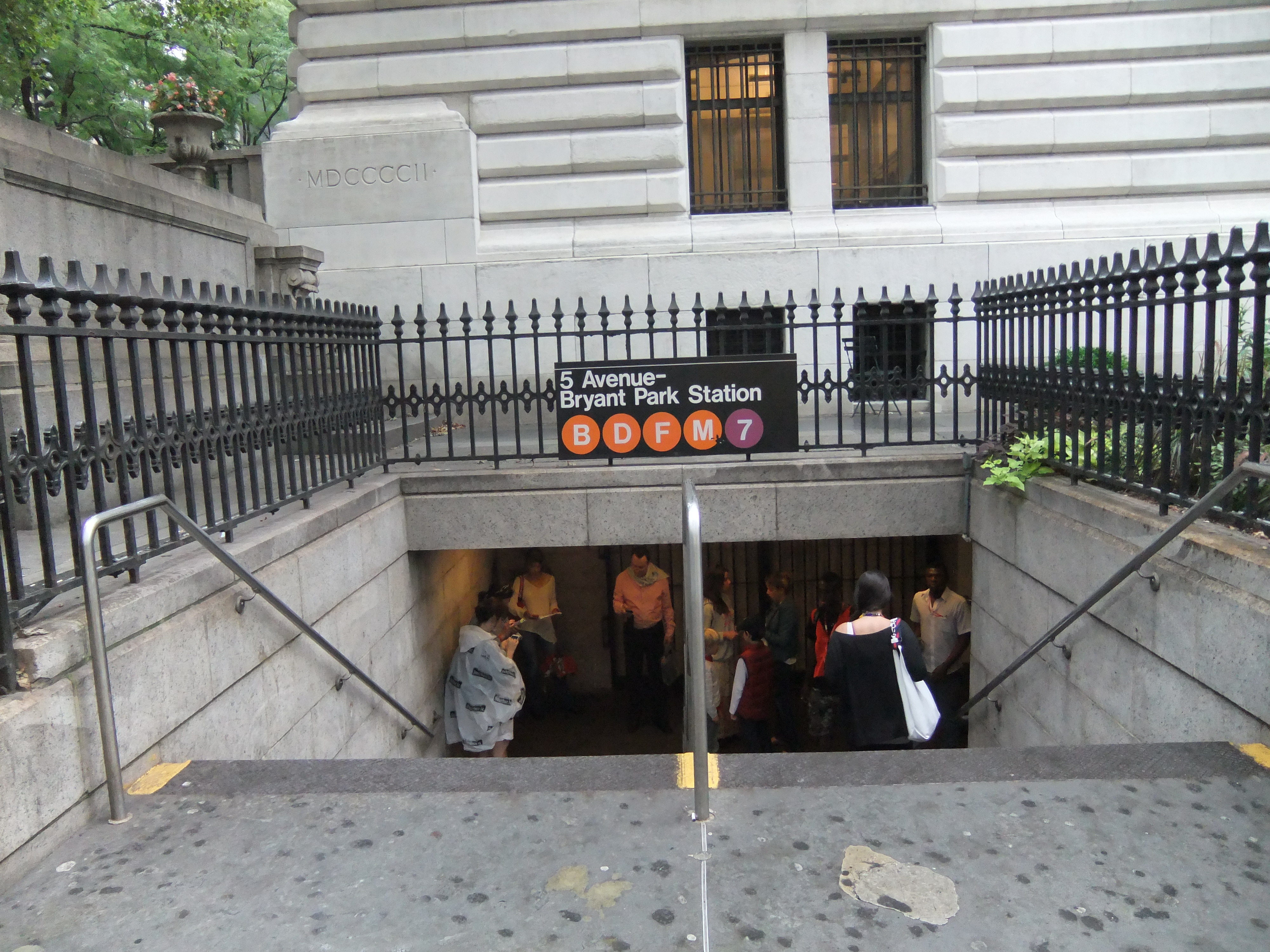
The IRT station has a full-length mezzanine directly above the platform and tracks; the full-time entrance is on the eastern end. A single stair on the southwest corner of 5th Avenue and 42nd Street (in front of the New York Public Library Main Branch) goes down to an area with a turnstile bank. This entrance was built within the library's stone balustrade. Near the western end is another fare control area with HEETs. Past the HEETs, two stairs ascend to the south side of 42nd Street between Fifth and Sixth Avenues on the northern edge of Bryant Park.
There is a closed passageway from the mezzanine to an easement entrance in the Grace Building on the north side of 42nd Street between Fifth Avenue and Sixth Avenue. This entrance closed before 2004.
IND Sixth Avenue Line platforms
cross-platform interchange uvÜSTl\uvÜSTr udSTR\uvÜST\udSTR uvÜSTr\uvÜSTl udSTR\uvÜST\udSTR The 42nd Street–Bryant Park station on the IND Sixth Avenue Line is an express station with four tracks and two island platforms, which are 670 ft long. The and stop here at all times, while the and stop here only on weekdays during the day. The B and D run on the express tracks and the F and M run on the local tracks. On all four Sixth Avenue routes, the station is between 47th–50th Streets–Rockefeller Center to the north and 34th Street–Herald Square to the south.
Both outer track walls have a scarlet red trim line with a chocolate brown border and small tile captions reading "42" in white on black run below them at regular intervals. Red I-beam columns run along both sides of both platforms at regular intervals with alternating ones having the standard black station name plate in white lettering.
The ceiling of the platform level is held up by columns located every 15 ft, which support girders underneath the station's full-length mezzanine. The floor of the mezzanine is also supported by cross beams spaced every 5 ft, placed between the girders. The roof of the mezzanine is about 10 ft below street level.
One stair ascends from the north end of either platform to a passageway, which in turn connects to the 42nd Street Shuttle station at Times Square–42nd Street. This passageway is only open between 6 a.m. and midnight, when the shuttle is operational. The passageway is not connected to either of the mezzanines and is not ADA-accessible. An artwork by Nick Cave, Every One (2021), is installed in the passageway between the Times Square and 42nd Street–Bryant Park stations. It consists of a mosaic flanking 11 digital screens; one side of the mosaic measures 143 ft long and the other measures 179 ft long.
South of this station, there are three sets of crossovers, allowing trains to switch between all four tracks. These switches are not currently used in revenue service. The crossovers were reconfigured to reduce the duplication of track switches of the downtown and uptown tracks, most notably, the switch from the express to local tracks.
IRT Flushing Line platform
The Fifth Avenue station (signed as Fifth Avenue–Bryant Park) on the IRT Flushing Line is a local station, and has two tracks and one island platform, which is 566 ft long. It serves the 7 train at all times and the train on weekdays in the peak direction (westbound in the morning, eastbound in the afternoon). The next station to the west is Times Square, while the next station to the east is Grand Central.
Fixed platform barriers, which are intended to prevent commuters falling to the tracks, are positioned near the platform edges. The ceiling of the platform level is held up by columns located every 15 ft, which support girders underneath the station's full-length mezzanine. The floor of the mezzanine is also supported by cross beams spaced every 5 ft, placed between the girders. Above the mezzanine, there are ventilation grates directly behind the parapet that surrounds Bryant Park. The platform walls have a mosaic golden trimline with "5" tablets at regular intervals along it.
The Fifth Avenue station is the first within the subway system to receive a vending machine that dispenses make up and other retail products. Part of a pilot program to increase retail activity within the MTA system, it capitalized on a new trend in vending machine development when it was installed in 2013.
Notes
References
References
- {{NYCS const. map
- {{NYCS const. riderref
- (1918). "Fifty Years of Rapid Transit — 1864 to 1917". Law Printing.
- (1905). "Report of the Board of Rapid Transit Railroad Commissioners for the City of New York For The Year Ending December 31, 1904 Accompanied By Reports of the Chief Engineer and of the Auditor". Board of Rapid Transit Railroad Commissioners.
- (August 2, 1918). "Open New Subway Lines to Traffic; Called a Triumph". The New York Times.
- (August 2, 1918). "Open New Subway Lines to Traffic; Called a Triumph". The New York Times.
- (March 19, 1913). "Money Set Aside for New Subways; Board of Estimate Approves City Contracts to be Signed To-day with Interboro and B.R.T.". The New York Times.
- Rogoff, David. (1960). "The Steinway Tunnels". Electric Railroaders' Association.
- Hood, Clifton. (2004). "722 Miles: The Building of the Subways and How They Transformed New York". Johns Hopkins University Press.
- (1913). "New Subways For New York: The Dual System of Rapid Transit Chapter 1: Dual System of Rapid Transit". New York State Public Service Commission.
- (June 22, 1915). "Steinway Tunnel Will Open Today; Officials Will Attend Ceremony in the Long Island City Station at 11 A.M. First Public Train At Noon Public Service Commission Renames the Under-River Route the Queensboro Subway.". The New York Times.
- (July 25, 1920). "Plan New Station for 42d Street; Proposed as Part of Extension of the Queensboro Subway.". The New York Times.
- (July 25, 1920). "Subway Station on 42d St. Between 5th and 6th Avs.". New-York Tribune.
- (May 15, 1921). "East River Subway Nears Completion: Transit Commission Consulting Engineer Reports on Tube Construction". New York Herald.
- (November 6, 1922). "Queensboro Tube to be Extended West: Bids for Construction of Subway Over to 8th Ave. to be Opened Wednesday; Two Years' Job". New-York Tribune.
- (November 28, 1921). "Subway Bids 0.7 P.C. Apart: Unprecedentedly Small Difference in Estimates Offered". The Brooklyn Times Union.
- (November 23, 1921). "Queensboro Subway Contract Is Awarded; $3,867,138 Bid for 42d Street Extension Let to Powers-Kennedy by Commission.". The New York Times.
- (November 23, 1921). "Subway Power Expense Added To "L" Burdens: Impoverished System Forced to Foot Bills for Overhead, According to Check-Up of Interborough Transactions Hedley on Stand To-day Auditor Admits Campaign to Raise Fare Was Charged to I. R. T. Operating Cost". New-York Tribune.
- (May 14, 1922). "Start Work on Forty-second Street Extension; New Link Will Run From Lexington Avenue and Forty-second Street to Forty-first Street and Eighth Avenue--Contractors Promise to Rush Work and Keep Streets Clear of Obstructions as Far as Possible". The New York Times.
- (March 21, 1926). "Fifth Av. To Open Subway Station; Final Plans Are Announced for Inaugurating Queensboro Extension Tomorrow". The New York Times.
- (July 30, 1922). "Bryant Park Busy "Mine"". The New York Times.
- (May 20, 1923). "Rushing Work on New Subway: New Tunnel Opened to Point Under Library, Fifth Av. And 42d Street, Last Week.". The New York Times.
- (February 1, 1923). "Queens Subway Extension; Crossover at Fifth Avenue Station Will Hasten Opening.". The New York Times.
- (January 14, 1923). "Want 42d St. Extension Operated in Sections: Need of Transit Is Too Great to Wait for Completion of Entire Tube". New-York Tribune.
- (November 18, 1923). "Queens Borough Subwy.; Committees Ask That Fifth Avenue Station Be Opened.". The New York Times.
- (February 21, 1926). "Queens Tube Trains to 5th Av. In March; Subway Extension Completed From Grand Central to Near Sixth Avenue.". The New York Times.
- (February 21, 1926). "Queensboro Line 5th Ave. Stations Open in March: Tracks Now Installed Between Grand Central and Near Sixth Avenue". The New York Herald, New York Tribune.
- (February 23, 1926). "Store News —' Retail Service: Stern's To Have Subway Entrance; To Open In Fall: Will Provide Only Access To Queensboro Extension On North Side Of 42D Street— Will Instal Display Windows".
- (March 23, 1926). "Fifth Av. Station of Subway Opened; Ceremonies at Library Mark Completion of First Part of Queensboro Extension". The New York Times.
- (March 23, 1926). "Queens Subway Runs to 5th Ave. Amid Ceremony: Bryant Park Station Will Mark Terminal of New Extension Until Tunnel Is Finished to 8th Avenue". The New York Herald, New York Tribune.
- (1925). "Annual Report of the Interborough Rapid Transit Company For The Year Ended June 30, 1925". Interborough Rapid Transit Company.
- (1927-03-06). "Ready for Opening of Subway Station; Officials to Take Part March 14 in Celebration in Queens Station at Times Square". The New York Times.
- (March 15, 1927). "New Queens Subway Opened to Times Sq.; Service Starts at Once After a Celebration by City and Civic Leaders". The New York Times.
- (15 Mar 1927). "Queens Subway Service Opened To Times Square: Mayor Walker and Frank Hed IeyTake Turns at Piloting First Train, but Call on Motorman After Jolting Starts Lunch Celebrates Event A. L. Smith Advocates Further Extension to Hudson River and Thence to New Jersey". New York Herald Tribune.
- (1928). "State of New York Department of Public Service Metropolitan Division Transit Commission Seventh Annual Report For The Calendar Year 1927". New York State Transit Commission.
- (6 Mar 1927). "Times Square Subway Station Of Queens Line Opens Mar. 14". New York Herald Tribune.
- (January 1, 1927). "To Beautify Bryant Park; Many Plans Submitted for Restoration When Subway is Finished.". The New York Times.
- (24 Aug 1930). "New Entrances Lessen Subway Jam on Streets: Passages Inside Buildings Opened and Number of Sidewalk Stairs Reduced". New York Herald Tribune.
- (June 13, 1940). "City Transit Unity Is Now a Reality; Title to I.R.T. Lines Passes to Municipality, Ending 19-Year Campaign". The New York Times.
- (June 13, 1940). "Transit Unification Completed As City Takes Over I. R. T. Lines: Systems Come Under Single Control After Efforts Begun in 1921; Mayor Is Jubilant at City Hall Ceremony Recalling 1904 Celebration". New York Herald Tribune.
- (11 Jan 1950). "Longer Platforms For Flushing Line: Times Square and 5th Ave. Station Work Planned". New York Herald Tribune.
- (1955). "Minutes and Proceedings of the New York City Transit Authority". New York City Transit Authority.
- (August 4, 1923). "Two Subway Routes Adopted by City". The New York Times.
- (March 12, 1924). "Plans Now Ready to Start Subways". The New York Times.
- (January 11, 1930). "Delaney For Razing Elevated Line Now; Work in 6th Av. Could Begin in Six Months if Condemnation Started at Once, He Says. Sees Cut In Subway Cost Eliminating Need for Underpinning Would Save $4,000,000 and Speed Construction, He Holds.". The New York Times.
- (March 21, 1925). "New Subway Routes in Hylan Program to Cost $186,046,000 – Board of Transportation Adopts 22.90 Miles of Additional Lines – Total Now $345,629,000 – But the Entire System Planned by Mayor Involves $700,000,000 – Description of Routes – Heaviest Expenditures Will Be Made on Tunnels – No Allowance for Equipment – New Subway Routes to Cost $186,046,000". The New York Times.
- (November 20, 1924). "6th Av. Subway Plan Hinges On Tubes' Use; City Must Reach Agreement With Hudson & Manhattan to Carry Out Project.". The New York Times.
- (August 1, 1929). "Final Contracts To Finish Subway Awarded By City; Include $20,000,000 for Cars, Equipment and Substations for Manhattan Line. Operation Set For 1931 Board of Transportation Moves to Rid Sixth Avenue of Trolley Tracks. Seeks To Buy Franchise Line Willing to Exchange It for Bus Permit—Negotiations Pushed to Extend Tube.". The New York Times.
- (1930-06-02). "104 Station Sites for City's Subways Chosen by Board; The Layout Calls for 39 in Manhattan, 30 in Brooklyn, 25 in Queens, 10 in Bronx". The New York Times.
- (April 21, 1931). "The Sixth Avenue Subway.". The New York Times.
- (March 1, 1935). "Plans To Be Drawn For 6th Av. Subway; 80 Engineers and Draftsmen to Begin Work at Once on Detailed Specifications.". The New York Times.
- (August 8, 1935). "6th Av. Tube Work to Be Begun Oct. 1; Plans Speeded on $12,000,000 Section From 49th to 39th St. -- Public Hearing Set.". The New York Times.
- (October 8, 1935). "Aug. 23 Set for Hearing On 6th Av. Subway Bids: Proposals for 39th to 49th Sts. Link To Be Considered Then". New York Herald Tribune.
- (October 31, 1935). "Subway Award Goes To Rosoff Company; Sixth Av. Contract Is Let Under Specified Use of Excavated Rock Despite Lower Bid.". The New York Times.
- (October 31, 1995). "$6,040,000 Contract For City Subway Awarded". Wall Street Journal.
- (1936-02-08). "Subway Job Begins in 6th Av. March 15: Construction Work Will Start Between 40th and 42d Sts., La Guardia Announces.". The New York Times.
- (8 Feb 1935). "6th Ave. Subway Digging Starts Within 6 Weeks at Bryant Park: Mayor Reveals Plan to Sink Shaft and Tunnel North Under I. R. T. Tubes on $6,000,000 Section of 2 ¼ Mile, $52,000,000 Project". New York Herald Tribune.
- (1936-02-14). "6th Av. Subway Job to Begin March 23; Ground for Addition to City System Will Be Broken Near Bryant Park.". The New York Times.
- (March 22, 1936). "Mayor to Start Work on Sixth Av. Subway; La Guardia to Use Pneumatic Drill at Ceremony at Noon Tomorrow in Bryant Park.". The New York Times.
- (March 24, 1936). "Mayor Starts Construction of 6th Av. Subway: Demands Razing of "El" as He Breaks Ground at Bryant Park Entrance Appeals for Unification Warns Rate War Is Likely to Follow Failure of Plan". New York Herald Tribune.
- (7 Nov 1937). "The Tube Takes Shape in 6th Av.: Most of the Excavation Is Done, And, Considering, Done Quietly: Despite the Intricacies of Underground Utility Facilities and Overhead Elevated Line, There Are Fewer Inconveniences and Complaints on Tliis Project Than Construction Usually Brings". New York Herald Tribune.
- (May 18, 1937). "Real Estate News and Market Transactions of New York City and Metropolitan Area: 6th Av. Subway, 5 Years to Go, Is Taking Shape Tube That Passes Over and Under Other Tunnels Runs Into Some Problems Mid-Town Sixth ... Subway Station s It Looks Today". New York Herald Tribune.
- (17 Sep 1939). "A Thousand Miles of Buried Pipes and Wires: Maze on 6th Ave. Subway Route Is Dug Up, Sorted and Put Together Again Network Is Straightened Out With No Disruption of the City's Utilities". New York Herald Tribune.
- Harrington, John W.. (1935-05-05). "City Plans Its Costliest Subway; In a Short Two Miles Under Sixth Avenue the Engineers Will Encounter Many Intricate Problems". The New York Times.
- (17 Feb 1938). "6th Av. Subway To Allow for Wide Pavement: Inspection Reveals Plan to Enlarge Street Space When Elevated Comes Down Burrowing Under the Heart of Manhattan for Sixth Avenue's New Subway Line". New York Herald Tribune.
- Harrington, John Walker. (October 18, 1936). "A Subway Creeps Up Sixth Ave.; Pipes and Tracks Are Obstacles: First Section Is Well Started and Two More Are About to Begin Extending City's Line Without Disturbing Elevated or Street Traffic". New York Herald Tribune.
- Robbins, L. h. (May 17, 1936). "With the Subway Surgeons; They Are Performing a Major Operation on Sixth Avenue, Where Formidable Obstacles Are Piled One on Top of the Other". The New York Times.
- (9 Apr 1940). "Bryant Park Quits Shadows After 60 Years: Site of the Nation's First World's Fair, Frequently Disfigured, Now Blooms Bryant Park, After the Sixth Avenue "El" Was Removed". New York Herald Tribune.
- (December 5, 1938). "Gay Crowds On Last Ride As Sixth Ave. Elevated Ends 60-Year Existence; 350 Police On Duty But the Noisy Revelers Strip Cars in Hunt for Souvenirs Suit May Delay Razing Little Threat Seen to Plan, However-Jobless Workers to Press Their Protest Makes Only One Stop Entrances Are Boarded Up Final Trains Run On Elevated Line Police Guard Structure". The New York Times.
- (22 Jul 1939). "Mayor Planning 6th Av. Subway Visitors Gallery: Would Let Sightseers Go Underground and See How Construction Progresses". New York Herald Tribune.
- (December 15, 1940). "New Subway Line on 6th Ave. Opens at Midnight Fete". [[The New York Times]].
- (December 2, 1939). "New Subway to Add 2 Need Services – Opening of 6th Ave. Line to Provide Uptown Local Route and More Queens Expresses". The New York Times.
- McConnell, David. (29 July 1946). "Auto-Parking Lots in Subways And Under Bryant Park Urged: O'Dwyer Reveals Possible Sites for Garages Are 35th to 40th St. Promenade on 6th Ave. Line and 40th to 44th St. Concourse on 8th Ave.". New York Herald Tribune.
- Irwin, Don. (14 Aug 1946). "Gross Against Subway Parking As Too Costly and Inconvenient". New York Herald Tribune.
- (1946-08-14). "Subway Garages Rejected by Gross; 6th Ave. Mezzanine at 42d St. Would Cost Too Much, He Reports to O'Dwyer". The New York Times.
- (1951-05-23). "Air Raid Shelter Plan for Subways Includes "Walk" in 42d St. Shuttle". The New York Times.
- (1956-03-07). "Book Shops Veto Move; Fourth Ave. Group Is Cold to IND Passageway Proposal". The New York Times.
- (6 Mar 1956). "Used-Book Mart Planned In 34th -4 2d St. Passage Of the Sixth Ave. Subway: Center Would Rival the Left Bank in Paris Fourth Ave. Dealers Considering Move". New York Herald Tribune.
- (13 Oct 1940). "6th Av. Subway Opens Dec. 15, A Month Early: $52,000,000 Job Praised by Mayor as 'Brilliant Engineering Achievement". New York Herald Tribune.
- (21 Apr 1948). "How Transfers Will Be Issued On City Transit: Tickets Will Vary in Color Each Day; Some Free, Some 5c and Some 2c". New York Herald Tribune.
- (December 17, 1967). "Some Subway Riders To Get Free Transfers". The New York Times.
- Webster, Bayard. (1969-08-12). "Tunnel in Park Irks Conservationists". The New York Times.
- Burks, Edward C.. (1969-11-13). "City Agency Approves Changes For 39-Story Tower in Midtown". The New York Times.
- Dembart, Lee. (February 18, 1977). "Catch the Subway of the Future". The New York Times.
- Dalton, Dudley. (1971-09-26). "Subway Murals Depict History of Bryant Park Area". The New York Times.
- Goldberger, Paul. (1979-05-03). "Design Notebook". The New York Times.
- (1984-02-10). "New York Day by Day". The New York Times.
- (1985-07-06). "New York Day by Day; Art on the IND". The New York Times.
- (1986-01-08). "New York Day by Day; Faces From the Subways Of Four Cities". The New York Times.
- Brooke, James. (1986-05-29). "42d St. Stations Are Highest in Crime". The New York Times.
- Firestone, David. (30 May 1986). "Crime Study: Subway Safer Than Streets". Newsday.
- McKinley, James C. Jr.. (1994-10-15). "City to Delay Subway Work At 6 Stations". The New York Times.
- Rein, Lisa. (1994-05-24). "Citing cuts, TA derails Main St. rehab". New York Daily News.
- Sachar, Emily. (6 Feb 1994). "The Giuliani Budget; No Free Ride for Rudy Faces wrath of Albany on subway cuts". Newsday.
- Kalikow, Peter. (1994-10-27). "The Coliseum Could Lay a Golden Egg". Newsday.
- Perez-Pena, Richard. (1995-02-21). "New Austerity Might Stall Continued Subway Improvements". The New York Times.
- Lueck, Thomas J.. (1999-06-15). "Satellite Tracking System Planned for Buses, but Subway Renovations Drag On". The New York Times.
- Lee, Denny. (2003-04-27). "Neighborhood Report: Bryant Park; You're a Hot Park When Everyone Wants Your Name". The New York Times.
- Whelan, Robbie. (October 3, 2011). "Midtown Plaza Adds Curb Appeal". Wall Street Journal.
- (August 2012). "1058 Avenue of the Americas". Google Maps.
- (August 2013). "101 West 40th Street". Google Maps.
- (May 2016). "1041 Avenue of the Americas". Google Maps.
- "Transit-Oriented Development Program". Metropolitan Transportation Authority.
- (May 14, 2012). "Pacolet-Milliken Enterprises, Inc. With New York City Transit Authority Easement Agreement Dated: As of April 30, 2012". New York City Department of Finance.
- (July 28, 2016). "Metropolitan Transportation Authority (MTA) Notice of Public Hearing and Description of Projects – Tuesday, August 23, 2016 4:30 P.M. – Request for Federal Financial Assistance Under the Federal Transportation Authorization For Federal Fiscal Year 2017 Capital Improvement Projects". Metropolitan Transportation Authority.
- (October 28, 2015). "MTA Capital Program 2015-2019". [[Metropolitan Transportation Authority]].
- "T7041404 Reconstruction of Times Square Shuttle - Phase 3". Metropolitan Transportation Authority.
- (March 25, 2019). "Capital Program Oversight Committee Meeting - March 2019". [[Metropolitan Transportation Authority]].
- "T7041404 Reconstruction of Times Square Shuttle - Phase 3". Metropolitan Transportation Authority.
- Guse, Clayton. (September 8, 2021). "MTA opens new walkway between Times Square and Bryant Park subway stations, revamped shuttle platforms".
- (January 21, 2020). "Capital Program Oversight Committee Meeting January 2020". [[Metropolitan Transportation Authority]].
- Martinez, Jose. (October 4, 2020). "Closed Private Subway Entrances Give Shuttered Feel to Manhattan Office Buildings and Former Hotspots". The City.
- Martinez, Jose. (March 17, 2022). "Privately Owned Midtown Subway Entrance Still Closed as City Pushes for Comeback". The City.
- (March 25, 2024). "Subway barriers installed at Bryant Park station".
- Collins, Keith. (2024-07-11). "See How Your Subway Service May Suffer Without Congestion Pricing". The New York Times.
- Khalifeh, Ramsey. (October 28, 2025). "Grand Central subway station upgrades finally done after years of construction".
- (January 31, 2025). "Contract Solicitation Notice/Project Overview A37149: Design-Build Services for Accessibility Upgrades at 42nd St-Bryant Park & Fifth Avenue Stations". Metropolitan Transportation Authority.
- Stark-Miller, Ethan. (December 17, 2025). "Subway upgrades: MTA board approves A/C line signal project and new elevators at five stations — all funded by congestion pricing".
- Korman, Joseph. (December 29, 2016). "Line Names".
- Brown, Nicole. (May 17, 2019). "How did the MTA subway lines get their letter or number? NYCurious".
- (April 1960). "A Summary of Services on the IRT Division, NYCTA". Electric Railroaders' Association.
- (April 25, 1939). "Fast Subway Service to Fair Is Opened". The New York Times.
- (1953-03-10). "2 I.R.T. Expresses to Cut Flushing-Times Sq. Run". The New York Times.
- (13 Mar 1953). "Super Express In Its First Run From Flushing: Journey to Times Square Is So Swift That It Even Leaves Bingham Behind". New York Herald Tribune.
- Linder, Bernard. (December 1964). "Service Change". Electric Railroaders' Association.
- (December 5, 1940). "6th Ave. Tube Adds Two New Services – Provides Express Facilities to Queens and Local Trains to Washington Heights – Subway Opens on Dec. 15 – Changes in Routings on Other Lines to Bring Faster Time and Less Congestion". The New York Times.
- (December 5, 1940). "6th Av. Subway To Run 24-Hour Bronx Express: Schedule of Trains Posted for Opening, at 12:01 A. M. on Sunday, Dec. 15". New York Herald Tribune.
- (November 27, 1967). "BMT-IND CHANGES BEWILDER MANY; Transit Authority Swamped With Calls From Riders as New System Starts". [[The New York Times]].
- {{Cite Routes Not Taken
- (June 27, 1968). "Luncheon in Subway Opens Station". The New York Times.
- Kaplan, Morris. (July 2, 1968). "New Subway Line Has Bumpy Debut; Rush-Hour Service Suffers Variety of First-Day Kinks". The New York Times.
- Hofmann, Paul. (July 1, 1968). "Skip-Stop Subway Begins Run Today – KK Line Links 3 Boroughs – Other Routes Changed". The New York Times.
- (August 31, 1976). "Transit Agency Drops 215 Runs". The New York Times.
- Pitt, David E.. (1989-10-22). "Transit Agency Wants to End Airport Express". The New York Times.
- (March 11, 1990). "JFK express subway to be discontinued". [[Observer–Reporter]].
- (June 1, 1990). "Annual Report on 1989 Rapid Routes Schedules and Service Planning". New York City Transit Authority, Operations Planning Department.
- Lyall, Sarah. (1988-12-12). "All Aboard. . .Somewhere. . .for Subway Changes!". The New York Times.
- Dewan, Shaila K.. (2001-07-23). "For Riders, Many Riddles, Written in Q's, D's and W's". The New York Times.
- Kershaw, Sarah. (December 17, 2001). "V Train Begins Service Today, Giving Queens Commuters Another Option". The New York Times.
- DeJesus, Juan. (June 25, 2010). "Last Stop: New Yorkers Bid Adieu to V and W". [[WNBC]].
- (2013). "East Midtown Rezoning and Related Actions Final Environmental Impact Statement". [[New York City Department of City Planning]].
- (2004). "No. 7 Subway Extension—Hudson Yards Rezoning and Development Program Final Generic Environmental Impact Statement - Appendix S4". New York City Department of City Planning.
- Pollak, Michael. (2007-08-19). "The Obscure Underground". The New York Times.
- "Arts & Design - NYCT Permanent Art".
- Newman, Andy. (2004-12-27). "Subway Mosaic Turns Riders Into Underground Philosophers". The New York Times.
- "Photography". [[Metropolitan Transportation Authority]].
- (June 5, 2021). "Karine Laval 'the Great Escape' Installation - MTA Arts & Design".
- "The Great Escape". [[Metropolitan Transportation Authority]].
- Wolff, Craig. (March 23, 1991). "Subway Path Boarded Shut After a Rape". The New York Times.
- (1936-06-18). "Long Walk Under 6th Av. Sought". The New York Times.
- (May 4, 1940). "Underground". New Yorker.
- (9 Apr 1940). "8-Block Walk In New Subway Is Nearly Ready: Pedestrians' Underpass to Connect 34th and 42d St. Stations Under 6th Av". New York Herald Tribune.
- (1940-04-13). "Pedestrian Underpasses". The New York Times.
- Diamond, Randy. (March 22, 1991). "Subway rape". New York Daily News.
- (March 30, 1991). "Tunnel vision". New York Daily News.
- (August 2, 2004). "Bank of America and The Durst Organization Break Ground On the Bank of America Tower at One Bryant Park in New York City". Bank of America Corporation.
- "One Bryant Park".
- Snoonian, Deborah. (Nov 2004). "Green grows up... and up and up and up". Architectural Record.
- (2015). "MTA Neighborhood Maps: Midtown West". [[Metropolitan Transportation Authority]].
- (2019). "Station ADA Accessibility Analysis 2017 Station: 42nd Street". New York City Transit.
- {{NYCS const. timetable. d
- {{NYCS const. timetable. f
- {{NYCS const. timetable. b
- {{NYCS const. timetable. m
- {{NYCS const. serviceguide
- Yakas, Ben. (2021-09-08). "Photos: Nick Cave's Mosaics Grace New 42nd Street Shuttle Connector".
- Zornosa, Laura. (2021-09-06). "Nick Cave Digs Deep, With a Symphony in Glass". The New York Times.
- {{NYCS const. trackref. trackbook3
- {{NYCS const. timetable. 7
- Wassef, Mira. (July 18, 2025). "Platform barriers installed at 56 subway stations in NYC".
- Russo-Lennon, Barbara. (July 20, 2025). "These are the NYC subway stations that now have protective platform barriers".
- (October 30, 2013). "MTA Pilots Virtual Retail in Subway". Metropolitan Transportation Authority.
This article was imported from Wikipedia and is available under the Creative Commons Attribution-ShareAlike 4.0 License. Content has been adapted to SurfDoc format. Original contributors can be found on the article history page.
Ask Mako anything about 42nd Street–Bryant Park/Fifth Avenue station — get instant answers, deeper analysis, and related topics.
Research with MakoFree with your Surf account
Create a free account to save articles, ask Mako questions, and organize your research.
Sign up freeThis content may have been generated or modified by AI. CloudSurf Software LLC is not responsible for the accuracy, completeness, or reliability of AI-generated content. Always verify important information from primary sources.
Report