From Surf Wiki (app.surf) — the open knowledge base
42 Draconis
Star in the constellation Draco
Star in the constellation Draco
| r-i = | v-r = | b-v = 1.18 | u-b = (~479 or ~690 d)
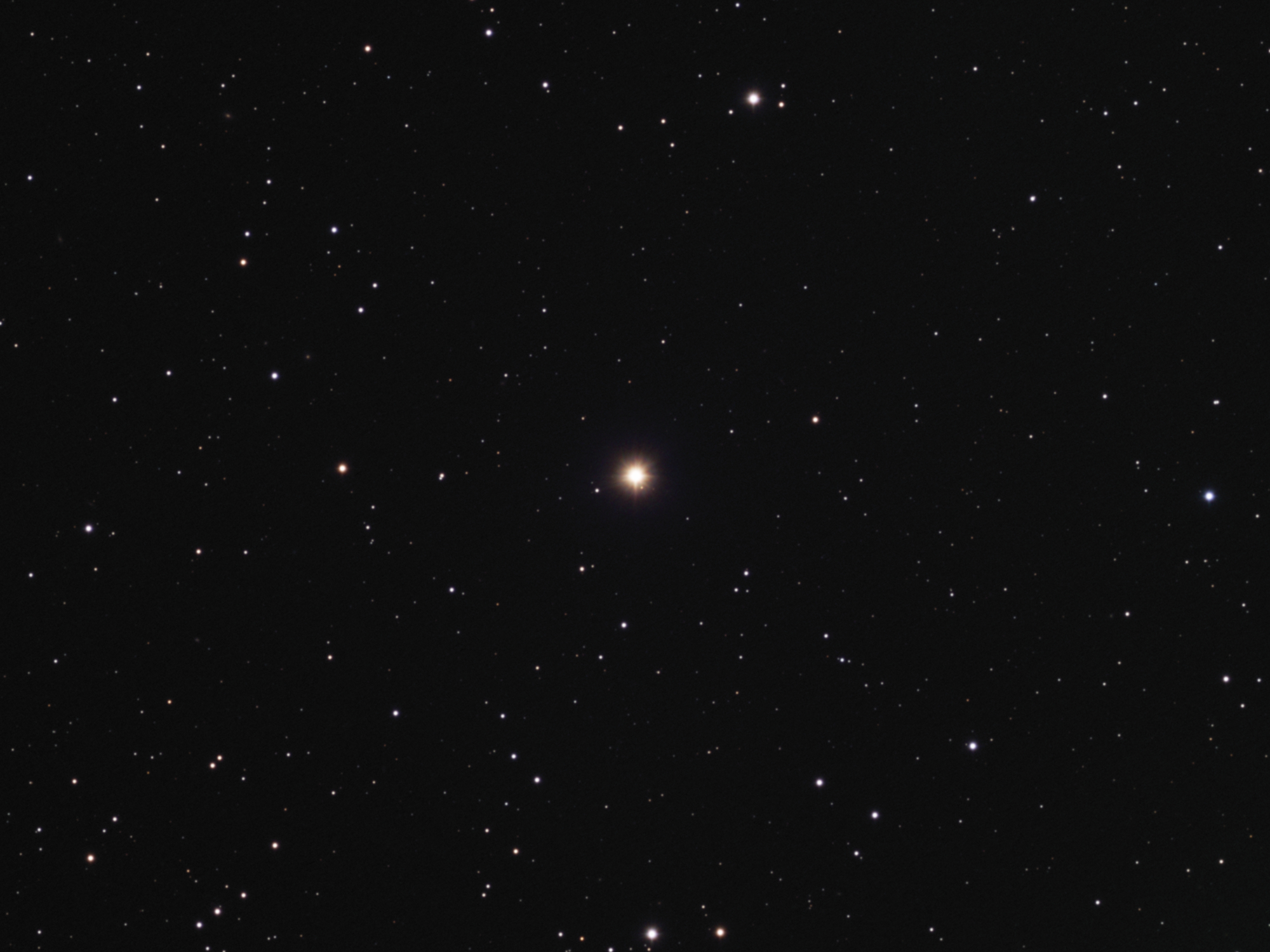
42 Draconis (abbreviated 42 Dra), formally named Fafnir ( or ), is a 5th magnitude K-type giant star located approximately 295 light-years away in the constellation of Draco. An exoplanet (designated 42 Draconis b, later named Orbitar) was once thought to be orbiting the star, but its existence has since been refuted.
Of spectral type K1.5III, the star has a mass similar to the Sun but with a radius 22 times greater. It is a metal-poor star with metallicity as low as 35% that of the Sun and its age is 9.49 billion years. It is the southern pole star of Venus.
A 2019 study using Gaia DR2 data found a companion star to 42 Draconis, about half the Sun's mass, at a separation of 24 arcseconds, corresponding to 2220 AU.
Nomenclature
42 Draconis is the star's Flamsteed designation. Following its discovery the planet was designated 42 Draconis b. In July 2014 the International Astronomical Union launched NameExoWorlds, a process for giving proper names to certain exoplanets and their host stars. The process involved public nomination and voting for the new names. In December 2015, the IAU announced the winning names were Fafnir for this star and Orbitar for its planet.
The winning names were submitted by the Brevard Astronomical Society of Brevard County, Florida, United States. Fafnir was a Norse mythological dwarf who turned into a Germanic dragon. It is also the name of a fictional planet in Larry Niven's Known Space universe of similar description, ('Draco' is Latin for 'dragon'); Orbitar is a contrived word paying homage to the space launch and orbital operations of NASA.
In 2016, the IAU organized a Working Group on Star Names (WGSN) to catalog and standardize proper names for stars. In its first bulletin of July 2016, the WGSN explicitly recognized the names of exoplanets and their host stars approved by the Executive Committee Working Group Public Naming of Planets and Planetary Satellites, including the names of stars adopted during the 2015 NameExoWorlds campaign. This star is now so entered in the IAU Catalog of Star Names.
Disproven planet
The discovery of 42 Draconis b (later named Orbitar) by the radial velocity method was announced in 2009. It was thought to be a super-Jupiter, with a minimum mass 4 times that of Jupiter, an orbital period of 479 days, and an eccentricity of 0.38. However, the existence of this planet was questioned in a 2021 study by the same authors, which found that more recent radial velocity measurements were inconsistent with the proposed planetary orbit. With further observations, by 2025 the planet hypothesis could be conclusively ruled out. The star appears to have intrinsic radial velocity variations that mimic a planetary companion, as observed in other giant stars such as Gamma Draconis and Aldebaran.
In a 2024 study, 42 Draconis b was listed as one of several doubtful planets around giant stars, along with other named planets around 14 Andromedae and 41 Lyncis. With the 2025 refutation, it is now the second named exoplanet to be conclusively disproven, after Fomalhaut b (Dagon) in 2020.
References
References
- {{MW. Fafnir
- "IAU Catalog of Star Names".
- ""Is Polaris the north star for all the other planets just like it is for Earth?" {{!}} Planetarium {{!}} University of Southern Maine".
- [http://www.iau.org/news/pressreleases/detail/iau1404/ NameExoWorlds: An IAU Worldwide Contest to Name Exoplanets and their Host Stars]. IAU.org. 9 July 2014
- "NameExoWorlds The Process".
- [http://www.iau.org/news/pressreleases/detail/iau1514/ Final Results of NameExoWorlds Public Vote Released], International Astronomical Union, 15 December 2015.
- [http://www.brevardastro.org/ Website]
- "NameExoWorlds The Approved Names".
- "IAU Working Group on Star Names (WGSN)".
- "Bulletin of the IAU Working Group on Star Names, No. 1".
- {{Cite DR3. 2256800156349110528
- {{Cite XHIP. 90344
- (2009). "Planetary companion candidates around the K giant stars 42 Draconis and HD 139 357". Astronomy and Astrophysics.
- (December 2019). "Search for stellar companions of exoplanet host stars by exploring the second ESA-Gaia data release". [[Monthly Notices of the Royal Astronomical Society]].
- (April 20, 2020). "New HST data and modeling reveal a massive planetesimal collision around Fomalhaut". [[PNAS]].
- (September 2021). "A Sanity Check for Planets around Evolved Stars". [[The Astrophysical Journal Supplement Series]].
- (September 2024). "Non-radial oscillations mimicking a brown dwarf orbiting the cluster giant NGC 4349 No. 127". [[Astronomy & Astrophysics]].
- (May 2025). "No Planet around the K Giant Star 42 Draconis". [[Astronomy & Astrophysics]].
This article was imported from Wikipedia and is available under the Creative Commons Attribution-ShareAlike 4.0 License. Content has been adapted to SurfDoc format. Original contributors can be found on the article history page.
Ask Mako anything about 42 Draconis — get instant answers, deeper analysis, and related topics.
Research with MakoFree with your Surf account
Create a free account to save articles, ask Mako questions, and organize your research.
Sign up freeThis content may have been generated or modified by AI. CloudSurf Software LLC is not responsible for the accuracy, completeness, or reliability of AI-generated content. Always verify important information from primary sources.
Report