From Surf Wiki (app.surf) — the open knowledge base
.357 SIG
Pistol cartridge designed by SIG Sauer and Federal Premium Ammunition
Pistol cartridge designed by SIG Sauer and Federal Premium Ammunition
| Field | Value | |
|---|---|---|
| name | .357 SIG | |
| image | 357 SIG - FMJ - SB - 1.jpg | image_size = 300px |
| caption | .357 SIG jacketed flat point cartridge | |
| origin | Switzerland | |
| United States | ||
| type | Pistol | |
| designer | SIGARMS / Federal Premium Ammunition | |
| design_date | 1994 | |
| production_date | 1994–present | |
| parent | [10mm Auto](10mm-auto) | |
| case_type | Rimless, bottleneck | |
| is_SI_specs | yes | |
| bullet | 9.02 | |
| land | 8.71 | |
| neck | 9.68 | |
| shoulder | 10.77 | |
| base | 10.77 | |
| rim_dia | 10.77 | |
| rim_thick | 1.40 | |
| case_length | 21.97 | |
| length | 28.97 | |
| case_capacity | 1.27 | |
| rifling | 406 mm (1 in 16 in) | |
| primer | Small pistol | |
| max_pressure | 305.0 | |
| pressure_method | C.I.P. | |
| max_pressure2 | 275.8 | |
| pressure_method2 | SAAMI | |
| bwunit | gram | |
| bw1 | 8.1 | |
| btype1 | Federal FMJ | |
| vel1 | 1350 | |
| en1 | 506 | |
| bw2 | 8.1 | |
| btype2 | Doubletap FMJ-FP | |
| vel2 | 1450 | |
| en2 | 583 | |
| bw3 | 5.83 | |
| btype3 | Grizzly JHP | |
| vel3 | 1900 | |
| en3 | 721 | |
| bw4 | 8.1 | |
| btype4 | Underwood TMJ | |
| vel4 | 1475 | |
| en4 | 604 | |
| bw5 | 6.48 | |
| btype5 | Cor-bon PB | |
| vel5 | 1600 | |
| en5 | 568 | |
| balsrc | 4.5" barrel for [DoubleTap Ammunition](http://www.doubletapammo.net/index.php?route=product/category&path=303_332), NO BARREL LENGTH GIVEN BY [Grizzly Cartridge](http://www.grizzlycartridge.com/?app=ecom&ns=prodshow&ref=GC357S1) and [Underwood Ammo](https://underwoodammo.com/shop/handgun-ammo/357-sig) m and 4.0" barrel for [Corbon PB](https://shopcorbon.com/PB357SIG100-20). See also C.I.P. |
United States
The .357 SIG (designated as the 357 Sig by the SAAMI and 357 SIG by the C.I.P. or 9×22 mm in official metric notation) is a bottlenecked rimless centerfire handgun cartridge developed by the Swiss-German firearms manufacturer SIG Sauer, in cooperation with ammunition manufacturer Federal Premium. The cartridge is used by a number of law enforcement agencies.
History
The .357 SIG is based on a necked-down 10mm Auto case, forgoing the large pistol primer utilized by the 10mm Auto in favor of the small pistol primer used in many common self-defense rounds, such as .40 S&W, .38 Special, 9 mm and other similarly-sized cartridges. Excluding specialized wildcat cartridges used in competition shooting — e.g., the 9×25mm Dillon, which necked a 10mm Auto case down to a 9 mm bullet — the .357 SIG was the first modern bottlenecked handgun cartridge to become commercially available since the 1961 introduction of Winchester's now-obsolete .256 Winchester Magnum, a .257 caliber round based on the .357 Magnum. Later the same year Remington and Smith & Wesson began jointly developing a similar round and, before the year's end, introduced the .22 Remington Jet, a .357 Magnum case necked down to accommodate a .22 caliber bullet.
Despite its favorable ballistics and performance, the .357 SIG has not achieved the widespread adoption seen with similar cartridges. One factor preventing the round from achieving greater popularity could be the cost of the ammunition, which frequently reaches double the expense of 9 mm, .40 S&W or .45 ACP ammunition. Because of this, as well as availability issues, some law enforcement agencies that previously adopted the cartridge have reportedly began to move away from the .357 SIG in favor of more common rounds with comparable performance.
Cartridge dimensions
The .357 SIG has 1.27 ml (19.5 grains H2O) cartridge case capacity.
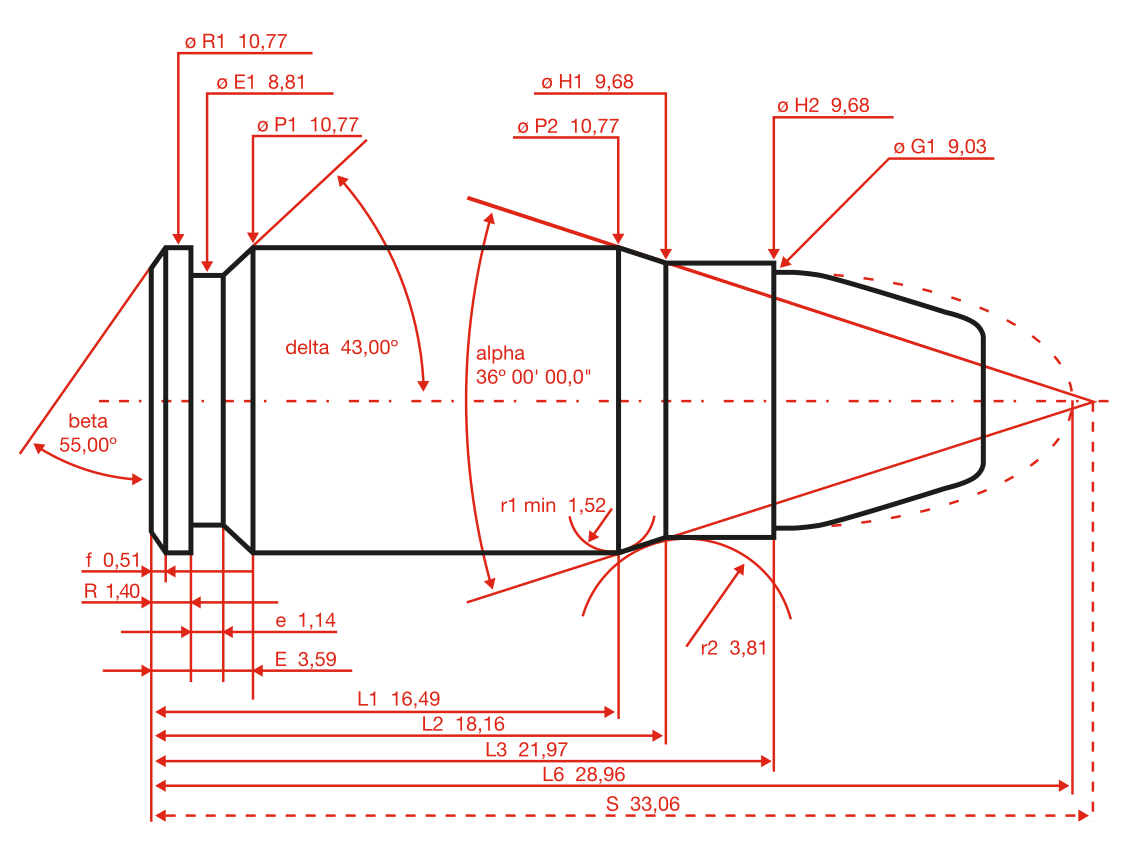
.357 SIG maximum C.I.P. cartridge dimensions. All sizes in millimeters.
Several sources have published contradicting information regarding .357 SIG headspacing. This is due to the cartridge having been originally designed as a .357 (9.02 mm) round, but then rapidly adapted to the .355 (9 mm) bullet. According to the official C.I.P. (Commission Internationale Permanente Pour L'Epreuve Des Armes A Feu Portatives) 2008 revised documents, the .357 SIG headspaces on the case mouth (H2). Some US sources are in conflict with this standard. However, the cartridge and chamber drawing in the ANSI/SAAMI American National Standards also clearly shows the cartridge headspacing on the case mouth. Likewise, US reloading supplier Lyman has published that the .357 SIG headspaces on the case mouth.
According to the C.I.P. rulings the .357 SIG case can handle up to 305 MPa (44,236 psi) piezo pressure. In C.I.P. regulated countries every pistol cartridge combo has to be proofed at 130% of this maximum C.I.P. pressure to certify for sale to consumers.
The SAAMI pressure limit for the .357 SIG is set at 275.80 MPa (40,000 psi), piezo pressure.
Conversions
While it is based on a 10 mm case necked down to accept 0.355 in bullets, the .357 SIG cartridge case is slightly longer than the .40 S&W by 0.009 in to 0.020 in total. Most .40 S&W pistols can be converted to .357 SIG by replacing the barrel, but sometimes the recoil spring must also be changed. Pistols with especially strong recoil springs can accept either cartridge with a barrel change. Magazines will freely interchange between the two cartridges in most pistols. .357 SIG barrel kits have allowed this cartridge to gain in popularity among handgun owners.
Performance
The table below shows common performance parameters for several .357 SIG loads. Bullet weights ranging from 115 to have been offered. Loads are available with energies from 488 ftlbf to 583 ftlbf, and penetration depths from 9 in to over 16.5 in are available for various applications and risk assessments. Underwood now also offers a standard pressure 65 gr .357 SIG Xtreme Defender (XD) round with a muzzle velocity of 2,100 fps, muzzle energy of 636 ft. lbs. and a penetration depth of 17.5 inches.
| Manufacturer | Load | Mass | Velocity | Energy | Expansion | Penetration | PC | TSC |
|---|---|---|---|---|---|---|---|---|
| Triton | Quik-Shok | 115 gr | 1425 ft/s | 518 ftlbf | frag | 9.0 in | 4.1 cuin | 43.2 cuin (est) |
| Winchester | Ranger T | 125 gr | 1385 ft/s | 532 ftlbf | 0.75 in | 11.5 in | 5.1 cuin | 45.0 cuin (est) |
| Federal | Premium JHP | 125 gr | 1430 ft/s | 568 ftlbf | 0.62 in | 12.7 in | 3.8 cuin | 49.5 cuin (est) |
| Speer | Gold Dot JHP | 125 gr | 1385 ft/s | 532 ftlbf | 0.68 in | 16.5 in | 6.0 cuin | 45.0 cuin (est) |
| Remington | JHP | 125 gr | 1350 ft/s | 506 ftlbf | 0.57 in | 14.3 in | 3.6 cuin | 41.7 cuin (est) |
| Federal | Premium JHP | 150 gr | 1210 ft/s | 488 ftlbf | 0.60 in | 15.0 in | 4.2 cuin | 39.4 cuin (est) |
| Underwood | Gold Dot JHP | 125 gr | 1450 ft/s | 583 ftlbf | 0.75 in | 16.5 in | 6.0 cuin | 45.0 cuin (est) |
Key:
Expansion – expanded bullet diameter (ballistic gelatin).
Penetration – penetration depth (ballistic gelatin).
PC – permanent cavity volume (ballistic gelatin, FBI method).
TSC – temporary stretch cavity volume (ballistic gelatin).
Because of its relatively high velocity for a handgun round, the .357 SIG has an unusually flat trajectory, extending the effective range. However, it does not quite reach the performance of the .357 Magnum with bullets heavier than 125 gr. Offsetting this general slight disadvantage in performance is that semi-automatic pistols tend to carry considerably more ammunition than revolvers.
The Virginia State Police has reported that attacking dogs have been stopped dead in their tracks by a single shot, whereas the former 147 grain 9 mm duty rounds would require multiple shots to incapacitate the animals. Proponents of the hydrostatic shock theory contend that the energy available in the .357 SIG is sufficient for imparting hydrostatic shock with well-designed bullets. Users have commented, "We're really impressed with the stopping power of the .357 SIG round."
The bottleneck shape of the .357 SIG cartridge makes feeding problems almost non-existent.
The Accurate Powder reloading manual claims that it is "without a doubt the most ballistically consistent handgun cartridge we have ever worked with".
Characteristics
The goal of the .357 SIG project was to offer a level of performance equal to the highly effective 125 gr .357 Magnum load. Measurements of standard factory .357 SIG cartridges loaded with 125 gr bullets showed approximate muzzle velocities of 1450 ft/s out of a 4 in barrel, which is essentially identical to the .357 Magnum with the same bullet weight and barrel length. These measurements were performed with a Thompson Center Encore 1842 break-action, single-shot pistol-rifle, preventing differing barrel length definitions between semi-automatic pistols and revolvers giving revolvers a potential muzzle velocity advantage.
With a simplistic approach to physics, recoil being directly proportional to "muzzle velocity × bullet mass" (due to conservation of momentum), the recoil of the .357 SIG is equal to or slightly less than that of the .40 S&W, and less than that of the full-power 10mm Auto loads or the original .357 Magnum. This simple approach to recoil is, however, incomplete, since the properties of the bullet alone do not determine the felt recoil; the rocket-like blast of propellant gases exiting the barrel after the bullet leaves the muzzle also plays a role. A more accurate view on recoil is that it is proportional to the mass of all ejecta × velocity of ejecta.
In comparing the energy levels of premium self-defense ammunition, the muzzle energy of 584 ft·lbf of the 125 gr 1450 ft/s .357 SIG load is greater than either the 475 ft·lbf generated by a 155 gr 1175 ft/s Speer GoldDot .40 S&W load or the 400 ft·lbf generated by a 180 gr 985 ft/s Speer GoldDot .40 S&W load.
Implementation
In 1994 Sig released the P229 pistol, the first production handgun chambered in .357 SIG, specifically designed to handle the higher pressures of that round.
However, in 2013 the Texas DPS decided to replace their .357 SIG handguns with 9 mm handguns. The ability to carry more rounds per magazine (9 mm vs. .357 SIG) in a lighter gun were among the stated reasons for the change. That transition was suspended after recruits in the A-2014 class, the first to train with the new S&W M&P 9 mm polymer handguns, experienced numerous malfunctions with those weapons.
The newer SIG Sauer P229 in .357 SIG has been adopted for use by agents and officers of the following national and state law enforcement organizations (LEO):
- Federal Air Marshals
- Delaware State Police
- Texas Ranger Division
- Virginia State Police
- Richmond Police Department
- Rhode Island State Police
- U.S. Secret Service prior to 2019
References
References
- "SAAMI 357 Sig cartridge and chamber drawings".
- "C.I.P. TDCC datasheet 357 SIG".
- ''The Gun Digest Book of Sig-Sauer: a complete look at Sig-Sauer pistols.'' [[Massad Ayoob]]. 2004. pp. 51–53.
- (25 October 2017). "Ammo Showdown: .357 Sig vs .40S&W".
- (23 August 2018). ".357 Sig: What's the Point of this Cartridge?".
- (28 March 2014). "Why .357 Sig Never Caught on".
- (2 August 2019). "The Secret Service is ditching .357 SIG for 9mm".
- (November 17, 1999). "Real Guns - .357 SIG handloads...controlling headspace".
- . (2008-09-23). ["Tables of Dimensions of Cartridges and Chambers - Tab IV - Pistol and revolver cartridges"](http://www.cip-bobp.org/homologation/uploads/tdcc/tab-iv/tabivcal-en-page53.pdf). *[[C.I.P.]]*.
- (December 7, 2000). "Real Guns - The return of the giant .357 SIG headspace Part I".
- . ["American National Standard Voluntary Industry Performance Standards for Pressure and Velocity of Centerfire Pistol and Revolver Ammunition for the Use of Commercial Manufacturers"](https://saami.org/wp-content/uploads/2019/02/ANSI-SAAMI-Z299.3-CFP-and-R-Approved-2015-12-14-Posting-Copy.pdf). *American National Standards Institute*.
- ".357 SIG". Accurate Powder.
- Marshall and Sanow, Stopping Power, Paladin 2001, p. 75.
- "BBTI - Ballistics by the Inch :: .357 Sig Results".
- Ayoob, Massad. (2002). ''The Gun Digest Book of Combat Handgunnery'', 5th edition: Krause Publications. {{ISBN. 0-87349-485-7
- (2008). "Scientific Evidence for Hydrostatic Shock".
- Sturtevant B, Shock Wave Effects in Biomechanics, Sadhana, 23: 579–596, 1998.
- Courtney A, Courtney M: Links between traumatic brain injury and ballistic pressure waves originating in the thoracic cavity and extremities. Brain Injury 21(7): 657–662, 2007.
- Gun Digest Buyer's Guide to Concealed-Carry Handguns By Jerry Ahern. 2010. p. 35.
- recorded results in Street Stoppers pg 173 .357 Magnum and Handgun Stopping Power by Marshall & Sanow
- (2007). "Relative incapacitation contributions of pressure wave and wound channel in the Marshall and Sanow data set".
- "BBTI - Ballistics by the Inch :: .357 Sig Results".
- "BBTI - Ballistics by the Inch :: .357 Mag Results".
- "BBTI - Ballistics by the Inch :: Scope of the Project".
- (May 1, 1996). "Street Stoppers: The Latest Handgun Stopping Power Street Results". Paladin Press.
- "Recoil".
- "Auto-loader vs Revolver recoil...".
- "MidwayUSA - Shop Shooting, Hunting, & Outdoor Products".
- Wiley Clapp. (2011-03-09). ".357 Sig|Shooting Illustrated". Shooting Illustrated.
- Cannon, Dan. (13 April 2014). "Texas Highway Patrol Dropping SIG Pistols in .357 SIG for S&W Pistols in 9mm".
- (11 April 2014). "Texas DPS Ditches S&W M&P Handguns Over Reliability Issues - The Truth About Guns".
- Langford, Terri. (17 April 2014). "DPS Suspends Use of New Handgun Over "Concerns"". The Texas Tribune.
- (January 2013). "Sig Sauer P229: The handgun that protects the President—and you!".
- (2009). "Texas Ranger Hall of Fame and Museum - Texas Rangers Today - Standard Issue Equipment".
This article was imported from Wikipedia and is available under the Creative Commons Attribution-ShareAlike 4.0 License. Content has been adapted to SurfDoc format. Original contributors can be found on the article history page.
Ask Mako anything about .357 SIG — get instant answers, deeper analysis, and related topics.
Research with MakoFree with your Surf account
Create a free account to save articles, ask Mako questions, and organize your research.
Sign up freeThis content may have been generated or modified by AI. CloudSurf Software LLC is not responsible for the accuracy, completeness, or reliability of AI-generated content. Always verify important information from primary sources.
Report