From Surf Wiki (app.surf) — the open knowledge base
336th Air Refueling Squadron
US Air Force Reserve unit

US Air Force Reserve unit
| Field | Value | ||
|---|---|---|---|
| unit_name | 336th Air Refueling Squadron | ||
| image | Kc135-3533-marchafb-lg.jpg | ||
| image_size | 300 | ||
| caption | Squadron KC-135 Stratotanker at March Air Reserve Base | ||
| dates | 1942–1944; 1949–1953; 1953–present | ||
| country | |||
| branch | |||
| role | Aerial refueling | ||
| command_structure | Air Force Reserve Command | ||
| garrison | March Joint Air Reserve Base | ||
| motto | The First and the Finest (1996-present) | ||
| decorations | Air Force Outstanding Unit Award | ||
| Republic of Vietnam Gallantry Cross with Palm | |||
| identification_symbol | [[File:336th Air Refueling Squadron.jpg | 150px]] | |
| identification_symbol_label | 336th Air Refueling Squadron emblem | ||
| identification_symbol_2 | [[File:336 Air Refueling Sq emblem (1996).png | 336 Air Refueling Sq emblem (1996) | 165px]] |
| identification_symbol_2_label | 336th Air Refueling Squadron emblem | ||
| identification_symbol_3 | [[File:536 Bombardment Sq emblem.png | 150px]] | |
| identification_symbol_3_label | 536th Bombardment Squadron emblem | ||
| aircraft_tanker | Boeing KC-135 Stratotanker |
Republic of Vietnam Gallantry Cross with Palm
The 336th Air Refueling Squadron is a United States Air Force Reserve squadron, assigned to the 452d Operations Group, stationed at March Joint Air Reserve Base, California. The squadron shares its aircraft and facility with the 912th Air Refueling Squadron, a USAF Associate Unit assigned to the 92d Air Refueling Wing.
The first predecessor of the squadron was the 536th Bombardment Squadron, active during World War II. It served as a training unit in the southwestern United States before being inactivated in 1944 during a reorganization of the Army Air Force's training units.
The second predecessor of the squadron was organized in the reserves in 1949 as the 336th Troop Carrier Squadron.
Mission
The squadron operates the Boeing KC-135 Stratotanker aircraft conducting air refueling missions.
History
World War II

The first predecessor of the squadron is the 536th Bombardment Squadron, which was activated at Salt Lake City Army Air Base in November 1942 as one of the four original squadrons of the 382d Bombardment Group. The squadron moved to Davis–Monthan Field, Arizona in January 1943 and began to operate as an Operational Training Unit (OTU) for Consolidated B-24 Liberator units. In April 1943, the squadron moved to Pocatello Army Air Field, Idaho, where its mission changed to acting as a Replacement Training Unit (RTU) for Liberator aircrews. RTUs were also oversized units, but their mission was to train individual pilots or aircrews.
However, the Army Air Forces (AAF) was finding that standard military units like the 536th, based on relatively inflexible tables of organization were not well adapted to the training mission. Accordingly the AAF adopted a more functional system in which each base was organized into a separate numbered unit, whose manning and equipment was tailored to the base's mission. As a result of this reorganization, the 536th was inactivated,
Air Force Reserve
Initial activation and the Korean War
.jpg)
The second predecessor of the squadron was organized in the reserves as the 336th Troop Carrier Squadron at Birmingham Municipal Airport, Alabama in June 1949, although it moved to Mitchel Air Force Base, New York in October along with its parent 514th Troop Carrier Group. At Mitchel, it trained under the supervision of Continental Air Command (ConAC)'s 2233d Air Force Reserve Flying Training Center. The 514th Group was equipped with Curtiss C-46 Commandos during this period, but it is not clear if any of the group's operational aircraft were assigned to the squadron.
All reserve combat units were mobilized for the Korean War. The squadron was mobilized on 1 May 1951, The squadron remained at Mitchel and performed airlift missions until relieved from active duty on 1 February 1953.
Return to reserve airlift operations
The reserve began to receive aircraft again in July 1952. While the squadron was still serving on active duty, ConAC had formed the 65th Troop Carrier Wing at Mitchel in 1952 as a reserve airlift unit. On 1 April 1953, the 514th Wing returned to the reserves, replacing the 65th Wing, and the 336th Squadron was activated and absorbed the personnel and equipment of the 13th Troop Carrier Squadron. The squadron again trained with the 2233d Center, flying C-46 Commandos but it completed transition to Fairchild C-119 Flying Boxcars by August 1954. In the summer of 1956, the unit participated in Operation Sixteen Ton during its two weeks of active duty training. Sixteen Ton was performed entirely by reserve troop carrier units and moved United States Coast Guard equipment From Floyd Bennett Naval Air Station, New York to Isla Grande Airport in Puerto Rico and San Salvador in the Bahamas. After the success of this operation, the squadron began to use inactive duty training periods for Operation Swift Lift, transporting high priority cargo for the Air Force and Operation Ready Swap, transporting aircraft engines between Air Materiel Command’s depots.
In 1958, the 2233d Center was inactivated and some of its personnel were absorbed by the squadron. In place of active duty support for reserve units, ConAC adopted the Air Reserve Technician program, in which a cadre of the unit consisted of full-time personnel who were simultaneously civilian employees of the Air Force and also held military rank as members of the reserve. After 1958, the squadron increasingly participated in humanitarian and other airlift missions.
Dispersed squadrons

In April 1959, the 514th Wing reorganized under the Dual Deputy system. Its 514th Troop Carrier Group was inactivated and the squadron was assigned directly to the wing. The 336th Squadron moved to Stewart Air Force Base, New York in March 1961 as part of this program.
Although the dispersal of flying units was not a problem when the entire wing was called to active service, mobilizing a single flying squadron and elements to support it proved difficult. This weakness was demonstrated in the partial mobilization of reserve units during the Berlin Crisis of 1961 To resolve this, at the start of 1962, ConAC determined to reorganize its reserve wings by establishing groups with support elements for each of its troop carrier squadrons. This reorganization would facilitate mobilization of elements of wings in various combinations when needed. However, as this plan was entering its implementation phase, another partial mobilization occurred for the Cuban Missile Crisis. The formation of troop carrier groups was delayed until January for wings that had not been mobilized. The 904th Troop Carrier Group became the squadron's headquarters on 17 January 1963.
,_USA_-_Air_Force_AN1590513.jpg)
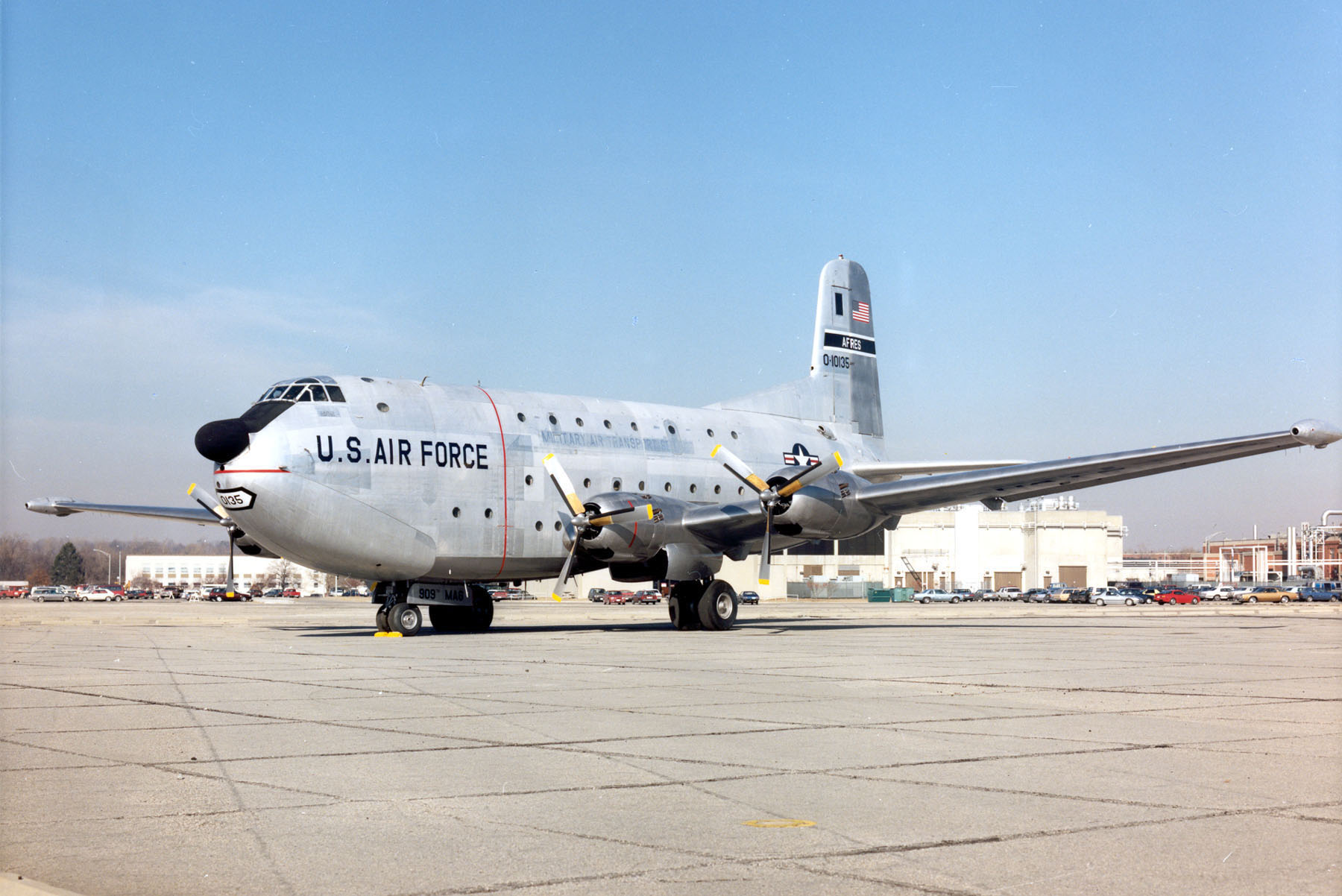
In the fall of 1966, the squadron transition into the Douglas C-124 Globemaster II and was redesignated the 336th Military Airlift Squadron. The squadron, along with its parent 904th Group moved to Hamilton Air Force Base, California at the end of 1969 as reserve flying operations at Stewart ended. 1972 saw another name change to the 336th Tactical Airlift Squadron as the squadron transitioned into the Lockheed C-130 Hercules. The 904th Group was inactivated in 1975 as Air Force Reserve eliminated its groups located on the same bases as their parent wings to avoid duplication. The squadron was assigned directly to the 452d Tactical Airlift Wing at Hamilton.
Air refueling operations
In early 1976, the 336th moved to March Air Force Base, California. Shortly thereafter, it began to fly the Boeing KC-135 Stratotanker and became the 336th Air Refueling Squadron. It has performed air refueling worldwide since 1977.
Lineage
; 536th Bombardment Squadron
- Constituted as the 536th Bombardment Squadron (Heavy) on 28 October 1942 : Activated on 3 November 1942 : Inactivated on 31 March 1944
- Consolidated with the 336th Air Refueling Squadron as the 336th Air Refueling Squadron on 19 September 1985
; 336th Air Refueling Squadron
- Constituted as the 336th Troop Carrier Squadron, Medium on 10 May 1949 : Activated in the reserve on 26 June 1949 : Ordered to active service on 1 May 1951 : Inactivated on 1 February 1953 : Activated in the reserve on 1 April 1953
- Redesignated 336th Military Airlift Squadron on 1 October 1966 : Ordered to active service on 26 January 1968 : Relieved from active service on 2 June 1969
- Redesignated 336th Tactical Airlift Squadron on 1 April 1972
- Redesignated 336th Air Refueling Squadron, Heavy on 1 October 1976
- Consolidated with the 536th Bombardment Squadron on 19 September 1985
- Redesignated 336th Air Refueling Squadron on 1 February 1992
Assignments
- 382d Bombardment Group, 3 November 1942 – 31 March 1944
- 514th Troop Carrier Group, 26 June 1949 – 1 February 1953 1953–1963)
- 514th Troop Carrier Group, 1 April 1953
- 514th Troop Carrier Wing, 14 April 1959
- 904th Troop Carrier Group, (later 904th Military Airlift group, 904th Tactical Airlift Group), 17 January 1963
- 452d Tactical Airlift Wing (later 452d Air Refueling Wing), 1 September 1975
- 452d Operations Group, 1 August 1992
Stations
- Salt Lake City Army Air Base, Utah, 3 November 1942
- Davis–Monthan Field, Arizona, 23 January 1943
- Pocatello Army Air Field, Idaho, 3 April 1943
- Muroc Army Air Field, California, 5 December 1943 – 31 March 1944
- Birmingham Municipal Airport, Alabama, 26 June 1949
- Mitchel Air Force Base, New York, 10 October 1949 – 1 February 1953
- Mitchel Air Force Base, New York, 1 April 1953
- Stewart Air Force Base, New York, 15 March 1961
- Hamilton Air Force Base, California, 31 December 1969
- March Air Force Base (later March Air Reserve Base), California, 1 January 1976 – present
Aircraft
- Consolidated B-24 Liberator (1943–1944)
- Curtiss C-46 Commando (1951–1953)
- Fairchild C-119 Flying Boxcar (1953–1966)
- Douglas C-124 Globemaster II (1966–1972)
- Lockheed C-130 Hercules (1972–1976)
- Boeing KC-135 Stratotanker (since 1976)
Awards and campaigns
: .
| Campaign Streamer | Campaign | Dates | Notes | |
|---|---|---|---|---|
| [[Image:Streamer AC.PNG | 200px]] | American Theater without inscription | 3 November 1942 – 31 March 1944 | 536th Bombardment Squadron |
References
Notes
; Explanatory notes
; Citations
Bibliography
References
- (26 November 2012). "Factsheet 336 Air Refueling Squadron (AFRC)". Air Force Historical Research Agency.
- Maurer, ''Combat Squadrons'', p. 643
- The OTU program involved the use of an oversized parent unit to provide [[cadre (military)
- Goss, p. 75
- (2 January 2008). "Factsheet 514 Operations Group (AFRC)". Air Force Historical Research Agency.
- Cantwell, p. 87
- Cantwell, p. 139
- Ravenstein, pp. 103, 282
- Cantwell, pp. 149-150
- Cantwell, p. 163
- Ravenstein, pp. 281-282
- (2 January 2008). "Factsheet 514 Operations Group (AFRC)". Air Force Historical Research Agency.
- Starting in late 1955, [[Continental Air Command]] (ConAC) had begun to disperse some of its reserve flying squadrons to separate bases in order to improve recruiting and avoid public objection to entire wings of aircraft being stationed near large population centers under what was called the Detached Squadron Concept.Cantwell, p. 156
- Cantwell, pp. 189-191
This article was imported from Wikipedia and is available under the Creative Commons Attribution-ShareAlike 4.0 License. Content has been adapted to SurfDoc format. Original contributors can be found on the article history page.
Ask Mako anything about 336th Air Refueling Squadron — get instant answers, deeper analysis, and related topics.
Research with MakoFree with your Surf account
Create a free account to save articles, ask Mako questions, and organize your research.
Sign up freeThis content may have been generated or modified by AI. CloudSurf Software LLC is not responsible for the accuracy, completeness, or reliability of AI-generated content. Always verify important information from primary sources.
Report