From Surf Wiki (app.surf) — the open knowledge base
317th Fighter-Interceptor Squadron
.jpg)
| Field | Value | ||
|---|---|---|---|
| unit_name | 317th Fighter Interceptor Squadron | ||
| image | 317th Fighter-Interceptor Squadron - Convair F-102A-70-CO Delta Dagger - 56-1259.jpg | ||
| image_size | 300 | ||
| caption | 317th Fighter-Interceptor Squadron F-102 Delta DaggerAircraft is Convair F-102A-70-CO Delta Dagger serial 56-1259 | ||
| dates | 1942–1945; 1947–1969 | ||
| country | |||
| branch | |||
| role | Interceptor | ||
| command_structure | Aerospace Defense Command | ||
| motto | ' | ||
| battles | Mediterranean Theater of Operations | ||
| decorations | Distinguished Unit Citation | ||
| Air Force Outstanding Unit Award | |||
| identification_symbol | [[File:317th Fighter-Interceptor Squadron - Emblem.jpg | 165px]] | |
| identification_symbol_label | Patch with the 317th Fighter-Interceptor Squadron emblemApproved 13 December 1951. | ||
| identification_symbol_2 | [[File:317 Fighter Sq emblem.png | 317 Fighter Sq emblem | 165px]] |
| identification_symbol_2_label | 317th Fighter Squadron emblem |
Air Force Outstanding Unit Award
The 317th Fighter Interceptor Squadron is an inactive United States Air Force unit, last assigned to Aerospace Defense Command, at Elmendorf Air Force Base, Alaska, where it was inactivated on 31 December 1969.
The squadron was first activated as the 317th Fighter Squadron during World War II. After training in the United States, it deployed to North Africa. In combat operations in the Mediterranean Theater of Operations. It was withdrawn from combat from September to December 1943 while it equipped with different aircraft and moved from Africa to Italy. It earned two Distinguished Unit Citations before returning to the United States for inactivation.
The squadron returned to service as an air defense unit in 1947, serving in that role until inactivated in 1969.
History
World War II
The squadron was first organized at Mitchel Field, New York on 3 August 1942 as one of the three original squadrons of the 325th Fighter Group, but moved the same day to Hillsgrove Army Air Field, Rhode Island. It equipped with Curtiss P-40 Warhawks and trained for combat at Hillsgrove until late January 1943, when it began to deploy overseas.
The squadron arrived in the Mediterranean Theater of Operations in February and was established at its first combat station, Tafaraoui Airfield, Algeria by 28 February 1943. It flew its first combat mission on 17 April. It escorted medium bombers. It flew strafing missions and flew sweeps over the Mediterranean Sea from bases in Algeria and Tunisia. The squadron participated in the defeat of Axis forces in Tunisia. It participated in the reduction of Pantelleria and in Operation Husky, the invasion and conquest of Sicily. On 30 July, the 325th Group used diversionary tactics to lure a superior number of enemy planes into the air over Sardinia, destroying more than half of them. The squadron was awarded its first Distinguished Unit Citation for this action. In late September 1943, the squadron was withdrawn from combat to convert to Republic P-47 Thunderbolts and prepare to move to the Italian peninsula.

By early December 1943, the squadron began to operate its Thunderbolts from Foggia Airfield, Italy, flying its first mission with the new plane on 14 December. However, it only operated the P-47 for a short period, converting to North American P-51 Mustangs in March 1944, and moving to Lesina Airfield, Italy on the 29th of the month. However, on 30 January it flew its "T-Bolts" more than 300 miles at very low altitude to make a surprise attack on German interceptors defending airdromes near Villorba. The severe losses it inflicted on the defending forces enabled heavy bombers to attack vital targets in the area without encountering serious opposition. This action resulted in the second award of the Distinguished Unit Citation to the squadron.
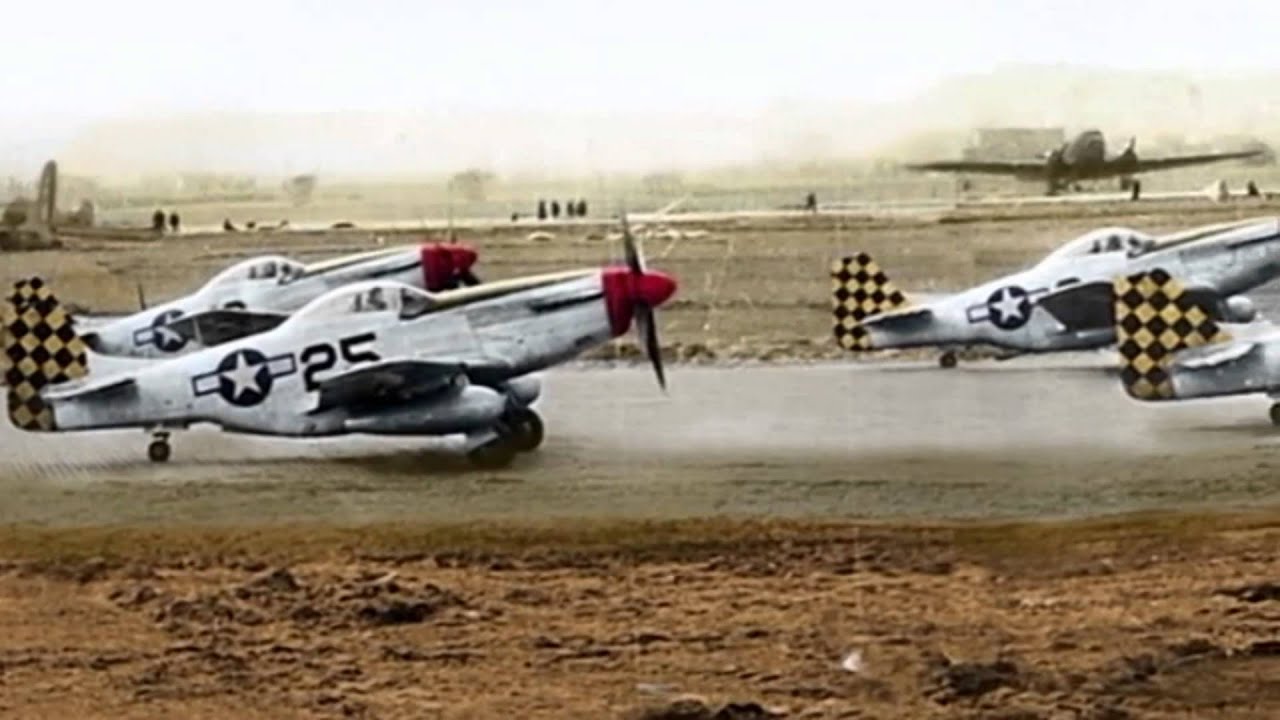
It escorted the heavy bombers of Fifteenth Air Force on long range missions against the Daimler Benz factory in Berlin, the Messerschmitt factory in Regensburg and oil refineries near Vienna. It also flew escort for attacks on other targets, such as airfields and marshalling yards and lines of communication in Italy, France, Germany, Czechoslovakia, Austria, Hungary, Yugoslavia and Romania. It also protected reconnaissance aircraft and strafed trains, vehicles and airfields. The squadron continued operations until May 1945. The 317th was credited with the destruction of 209 enemy aircraft in air to air combat. After V-E Day, it moved to Vincenzo Airfield, Italy, remaining there until October, when it returned to the United States and was inactivated at Camp Kilmer, New Jersey on 28 October.
Air Defense Command

In May 1947, the squadron was reactivated at Mitchel Field, New York and equipped with Northrop P-61 Black Widows. it moved to Moses Lake Air Force Base, Washington, the squadron was re-equipped with the new North American F-82 Twin Mustang in October 1948. The squadron was assigned for the defense of the Hanford Nuclear Reservation in Eastern Washington. One month later it was reassigned to Hamilton Air Force Base, California, and in April 1950, returned to McChord Air Force Base, Washington.

In 1951. the squadron was redesignated as the 317th Fighter Interceptor Squadron, a component of the 25th Air Division, Air Defense Command, During the period between 1947 and 1956. the 317th flew the F-82. the Lockheed F-94 Starfire, and the North American F-86D Sabre interceptor. In 1955 and 1956, at Vincent Air Force Base, Yuma, Arizona, flying the F-86D, the 317th engaged in airborne rocket competition, breaking all records previously set. In August 1956 the squadron was selected as the best air defense unit in the Air Force and was awarded the Hughes Trophy, In addition, the squadron received its first Outstanding Unit Award for high combat readiness for the period of 1953 through 1956. In November 1956, the 317th began transitioning into the Convair F-102 Delta Dagger.
Alaskan Air Command

In November 1956, the 317th began transitioning into the F-102A Delta Dagger, becoming the second squadron to receive the new delta-winged supersonic aircraft. In August 1957, the 317th was reassigned in force, to Elmendorf Air Force Base, Alaska, where it assumed air defense mission of the southern portion of Alaska and the northwestern approaches to the United States.
In the summer of 1960. the 449th Fighter-Interceptor Squadron was inactivated and Ladd Air Force Base was closed. leaving the entire Alaska air defense mission to the 317th. To carry out this mission, the squadron was authorized 40 aircraft and 60 pilots. The squadron received its second Air Force Outstanding Unit Award for maintaining full combat readiness during and after the 1964 Alaska earthquake on 27 March 1964.
In the summer of 1965, the 317th was reduced to 29 aircraft and the manning reduced accordingly, but the air defense mission remained the same. In October 1965, the squadron was awarded the Hughes Trophy for the second time, and a third Air Force Outstanding Unit Award for combat readiness.
In December 1969, due to budget reductions, the 317th Fighter-Interceptor Squadron was inactivated.
Lineage
- Constituted as the 317th Fighter Squadron on 24 June 1942 : Activated on 3 August 1942. : Inactivated on 28 October 1945
- Activated on 25 August 1947 : Redesignated 317th Fighter Squadron (All Weather)' on 10 May 1948 : Redesignated 317th Fighter-All Weather Squadron on 20 January 1950 : Redesignated 317th Fighter-Interceptor Squadron on 1 May 1951 : Inactivated on 31 December 1969
Assignments
- 325th Fighter Group, 3 August 1942 – 28 October 1945
- Fourth Air Force, 25 August 1947
- 325th Fighter Group (later 325th Fighter-All Weather Group, 325th Fighter-Interceptor Group), 31 December 1947
- 4704th Air Defense Wing, 6 February 1952
- 567th Air Defense Group, 16 February 1953
- 325th Fighter Group, 18 August 1955
- 10th Air Division, 15 August 1957
- 5070th Air Defense Wing, 25 August 1960
- Alaskan Air Command, 1 October 1961
- 21st Composite Wing, 8 July 1966 – 31 December 1969
Stations
- Mitchel Field, New York, 3 August 1942
- Hillsgrove Army Air Field, Rhode Island, 3 August 1942 – 23 January 1943
- Tafaraoui Airfield, Algeria, 28 February 1943
- Montesquieu Airfield, Algeria, 19 May 1943
- Souk-el-Khemis Airfield, Tunisia, 3 June 1943
- Mateur Airfield, Tunisia, 21 June 1943
- Soliman Airfield, Tunisia, c. 4 November 1943
- Foggia Airfield, Italy, 10 December 1943
- Lesina Airfield, Italy, 29 March 1944
- Rimini Airport, Italy, c. 5 March 1945
- Mondolfo Airfield, Italy, c. 3 April 1945
- Vincenzo Airfield, Italy, 9 July – October 1945
- Camp Kilmer, New Jersey, 26–28 October 1945
- McChord Field, Washington, 25 August 1947
- Hamilton Air Force Base, California, 24 November 1947
- Moses Lake Air Force Base, Washington, 26 November 1948
- McChord Air Force Base, Washington, 23 April 1950
- Elmendorf Air Force Base, Alaska, 15 August 1957 – 31 December 1969
Aircraft
- Curtiss P-40 Warhawk, 1942–1943
- Republic P-47 Thunderbolt, 1943–1944
- North American P-51 Mustang, 1944–1945
- Northrop P-61 Black Widow, 1947–1948
- North American F-82 Twin Mustang, 1948–1951
- Lockheed F-94A Starfire, 1950–1953
- North American F-86D Sabre, 1953–1956
- Convair F-102 Delta Dagger, 1956–1969
Awards and campaigns
| Campaign Streamer | Campaign | Dates | Notes | |
|---|---|---|---|---|
| [[Image:Streamer EAMEC.PNG | 200px]] | Air Offensive, Europe | 1 March 1943 – 5 June 1944 | 317th Fighter Squadron |
| [[Image:Streamer EAMEC.PNG | 200px]] | Air Combat, EAME Theater | 1 March 1943 – 11 May 1945 | 317th Fighter Squadron |
| [[Image:Streamer EAMEC.PNG | 200px]] | Tunisia | 1 March 1943 – 13 May 1943 | 317th Fighter Squadron |
| [[Image:Streamer EAMEC.PNG | 200px]] | Sicily | 14 May 1943 – 17 August 1943 | 317th Fighter Squadron |
| [[Image:Streamer EAMEC.PNG | 200px]] | Naples-Foggia | 18 August 1943 – 21 January 1944 | 317th Fighter Squadron |
| [[Image:Streamer EAMEC.PNG | 200px]] | Anzio | 22 January 1944 – 24 May 1944 | 317th Fighter Squadron |
| [[Image:Streamer EAMEC.PNG | 200px]] | Rome-Arno | 22 January 1944 – 9 September 1944 | 317th Fighter Squadron |
| [[Image:Streamer EAMEC.PNG | 200px]] | Normandy | 6 June 1944 – 24 July 1944 | 317th Fighter Squadron |
| [[Image:Streamer EAMEC.PNG | 200px]] | Northern France | 25 July 1944 – 14 September 1944 | 317th Fighter Squadron |
| [[Image:Streamer EAMEC.PNG | 200px]] | Southern France | 15 August 1944 – 14 September 1944 | 317th Fighter Squadron |
| [[Image:Streamer EAMEC.PNG | 200px]] | North Apennines | 10 September 1944 – 4 April 1945 | 317th Fighter Squadron |
| [[Image:Streamer EAMEC.PNG | 200px]] | Rhineland | 15 September 1944 – 21 March 1945 | 317th Fighter Squadron |
| [[Image:Streamer EAMEC.PNG | 200px]] | Central Europe | 22 March 1944 – 21 May 1945 | 317th Fighter Squadron |
| [[Image:Streamer EAMEC.PNG | 200px]] | Po Valley | 3 April 1945 – 8 May 1945 | 317th Fighter Squadron |
References
; Notes
; Citations
Bibliography
References
- Maurer, ''Combat Squadrons'', pp. 386–387
- Watkins, p. 45
- Maurer, ''Combat Units'', pp. 206-208
- Newton & Senning, pp. 594-596
- Lineage, including assignments and stations, through 1963 in Maurer, ''Combat Squadrons'', pp. 386–387
- Cornett & Johnson, p. 124
- AF Pamphlet 900-2, Vol, 1, p. 312
- AF Pamphlet 900-2, Vol, 2, p. 58
This article was imported from Wikipedia and is available under the Creative Commons Attribution-ShareAlike 4.0 License. Content has been adapted to SurfDoc format. Original contributors can be found on the article history page.
Ask Mako anything about 317th Fighter-Interceptor Squadron — get instant answers, deeper analysis, and related topics.
Research with MakoFree with your Surf account
Create a free account to save articles, ask Mako questions, and organize your research.
Sign up freeThis content may have been generated or modified by AI. CloudSurf Software LLC is not responsible for the accuracy, completeness, or reliability of AI-generated content. Always verify important information from primary sources.
Report