Primary race overview
Ten candidates vied for the nomination, including retired four-star general Wesley Clark, former Vermont Governor Howard Dean, and Senators John Edwards and John Kerry. For most of 2003, Howard Dean had been the apparent front-runner for the nomination, performing strongly in most polls and leading the pack in fund-raising. However, Kerry won the Iowa caucuses and New Hampshire primary, which gave him enough momentum to carry the majority of the rest of the states.
Election issues
According to exit polls taking during the Iowa Caucuses, the top 4 issues were ranked as follows:
- Economy/Jobs (29% of Respondents)
- Health Care/Medicine (28% of Respondents)
- The war in Iraq (14% of Respondents)
- Education (14% of Respondents)
Economy
Despite being characterized by many as an election on Iraq, the economy and jobs were repeatedly cited as voters' top or one of top three concerns during the course of the primary season. In Iowa, of those who cited the economy as their most important issue, 34% supported Kerry, while 33% supported Edwards, with Dean trailing at 16% and Gephardt at 12%.
Eventual nominee John Kerry, much like other Democrats adopted policy stances of tax-cuts for the middle class, increased spending for Social Security, and assisting small businesses. On the aspect of job creation, Kerry strongly supported the creation and safety of infrastructure-related jobs, like those in the railroad industry. During the course of the primary Kerry continued to advocate positions such as fiscal responsibility and end state fiscal crises by giving states increased fiscal aid.
Runner up John Edwards ran a position of support for the middle class as well as budget caps and enforcement. Strongly opposing Social Security privatization, and interested in middle class tax cuts, Edwards's main economic theme was support for the middle class touting his own struggle, growing up the son of a poor mill worker in South Carolina. Another major component of Edwards's message was to be able to reinstate fiscal responsibility.
Howard Dean, despite taking many of the same positions of his rivals including Edwards and Kerry, had a starkly different approach on the issue of Social Security and tax cuts. On taxes, Dean favored repealing the Bush Tax cuts not only for the wealthiest of Americans as Senator Edwards and Senator Kerry proposed, but for all, including middle and lower classes.
Iraq War
After the 9/11 attacks, the Bush administration argued that the need to remove Saddam Hussein from power in Iraq had now become urgent. Over the course of several months, Bush presented several premises for war, but the turning point was the allegation that Saddam's regime had tried to acquire nuclear material and had not properly accounted for biological and chemical material it was known to have possessed, potential weapons of mass destruction (WMD) in violation of U.N. sanctions. This situation escalated to the point that the United States assembled a group of about forty nations, including the United Kingdom, Spain, Italy, and Poland, which Bush called the "coalition of the willing", to invade Iraq without UN authorization.
The coalition invaded Iraq on March 20, 2003. Most contenders for the nomination were supportive of the effort. Only Dean and Kucinich firmly questioned the aims and tactics of the administration, setting themselves apart in the eyes of war protesters. John Kerry, who had voted in favor of coalition invasion, said Bush had “failed miserably” in building that coalition and that "We need a regime change not just in Iraq. We need a regime change here in the United States." Republicans criticized Kerry for speaking out against a wartime president.
The invasion was swift, with the collapse of the Iraq government and the military of Iraq in about three weeks. The oil infrastructure of Iraq was rapidly secured with limited damage in that time. On May 1, George W. Bush landed on the aircraft carrier USS Abraham Lincoln in a Lockheed S-3 Viking, where he gave a speech announcing the end of major combat in the Iraq war. Clearly visible in the background was a banner stating "Mission Accomplished". Bush's landing was criticized by opponents as being overly theatrical and expensive. The banner, made by White House personnel (according to a CNN story: ) and placed there by the U.S. Navy, was criticized as premature. Nonetheless, Bush's approval rating in the month of May rode at 66%, according to a CNN-USA Today-Gallup poll.
On May 3, 2003, Democrats met at the University of South Carolina in the first formal debate between the nine challengers for the nomination. The candidates disagreed on the war against Iraq, health insurance, President Bush's tax cuts, but united in criticizing Bush's handling of the economy.
Dean emerges as front-runner
Main article: John Kerry 2004 presidential campaign, John Edwards 2004 presidential campaign, Howard Dean 2004 presidential campaign, Wesley Clark 2004 presidential campaign
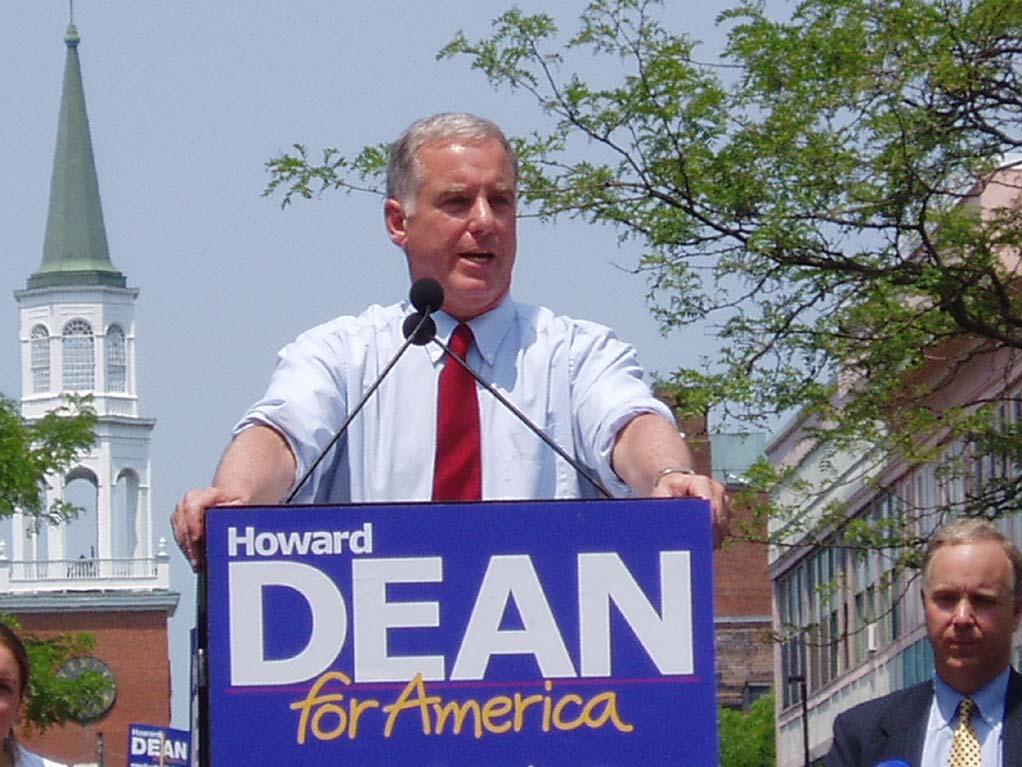
On May 31, 2002, Vermont governor Howard Dean formed a presidential exploratory committee. Though this was almost two years before the Iowa Caucus, Dean hoped the early start would give him some much needed name recognition. As a governor of a small state, Dean was not well known outside of New England.
In December of that year, John F. Kerry, U.S. senator from Massachusetts, announced on NBC's Meet the Press his plans to form an exploratory committee for a possible 2004 presidential run, anticipating a formal announcement "down the road some months". Kerry's experience as a decorated Vietnam veteran generated some excitement among Democrats tired of being on the defensive about their candidates' suitability in the role of "commander in chief".
Two weeks later, former vice president and 2000 Democratic presidential nominee Al Gore announced on the CBS program 60 Minutes that he would not seek election to the presidency in 2004. Gore had recently wrapped up a nationwide book tour and had been widely expected to run.
Other potential candidates were likely waiting to see what Gore's plans were, and thus the floodgates opened in January 2003. Senator Joseph Lieberman, Gore's 2000 vice presidential running mate, had previously promised not to run should Gore seek their party's nomination and was willing to be Gore's running mate again. Freed from that obligation, Lieberman announced his intention to run. Additionally, many other candidates announced their intention to form committees (a formality usually indicating an official run): U.S. Sen. John R. Edwards of North Carolina, U.S. Rep. Richard A. "Dick" Gephardt of Missouri, and Reverend Al Sharpton of New York. In February, more candidates announced their intentions: former Senator from Illinois Carol Moseley Braun, U.S. Representative from Ohio Dennis Kucinich, and Senator Bob Graham of Florida.
There were other potential candidates for whom some speculation was buzzing about a potential run. These candidates felt it necessary to officially state that they would not seek the party nomination. These included United States Senate Minority Leader Tom Daschle, U.S. Senator Christopher Dodd of Connecticut, and former U.S. Senator Gary Hart from Colorado.
In April, Democratic fund-raising totals for the first quarter of 2003 were reported. John Edwards raised $7.4 million, John Kerry raised $7.0 million, Dick Gephardt raised $3.5 million, Joe Lieberman raised $3.0 million, Howard Dean raised $2.6 million, Bob Graham raised $1.1 million, and Dennis Kucinich and Carol Moseley Braun raised less than $1 million each.
In June 2003, Howard Dean aired the first television advertising of the 2004 campaign, spending more than $300,000. During that time, he formally announced his run for president, filing to form a presidential election campaign with the FEC. Later that month, liberal advocacy website MoveOn held the first ever online Democratic "primary", which lasted just over 48 hours. It was an unofficial and nonbinding affair, but with important symbolic and financial value. Of 317,647 votes, Howard Dean received 44%, Dennis Kucinich 24%, and John Kerry 16%. Had any candidate received 50% of the vote, the candidate would have received MoveOn's endorsement and financial support. Instead, MoveOn supported all the candidates.
In July, the Democratic fund-raising numbers for the second quarter of 2003 were reported and announced. Howard Dean surprised many raising $7.5 million, John Kerry raised $6 million, while John Edwards and Joseph Lieberman raised roughly $5 million each. Dean's strength as a fund-raiser was attributed mainly to his innovative embrace of the Internet for campaigning. The majority of his donations came from individual Dean supporters, who came to be known as Deanites, or, more commonly, Deaniacs. His campaign's innovative use of the Internet helped to build a strongly supportive grassroots constituency, much of which remained intensely loyal to him long after the end of his candidacy.
By autumn of 2003, Dean had become the apparent front-runner for the Democratic nomination, performing strongly in most polls. Generally regarded as a pragmatic centrist during his time as governor, Dean emerged during his presidential campaign as something of a populist, denouncing the policies of the Bush administration (especially the 2003 invasion of Iraq) as well as fellow Democrats, who, in his view, failed to strongly oppose them.
During his presidential campaign, critics on the right labeled Dean's political views as those of an extreme liberal; however, in liberal Vermont, Dean, long known as a staunch advocate of fiscal restraint, was regarded as a moderate. Many critics on the left, who supported fellow Democrat Dennis Kucinich or independent Ralph Nader, charged that, at heart, Dean was a "Rockefeller Republican"—socially liberal, while fiscally conservative.
Wesley Clark enters
Over the summer of 2003, several organized groups began a nationwide campaign to "draft" retired four-star general Wesley Clark for the Democratic Party's nomination for the 2004 presidential election. CNN on August 13 showed a commercial by one of these groups and interviewed Clark. He disavowed any connection with the "draft Clark" groups, but said he had been considering his position and that within a few weeks he would likely make public his decision on whether to run. He also fueled speculation with a television interview in which he first declared himself a Democrat.
On September 17, 2003, in Little Rock, Arkansas, Clark announced his intention to run in the presidential primary election for the Democratic Party nomination, becoming the tenth and last Democrat to do so (coming many months after the others): "My name is Wes Clark. I am from Little Rock, Arkansas, and I am here to announce that I intend to seek the presidency of the United States of America." He said, "We're going to run a campaign that will move this country forward, not back."
His campaign focused on themes of leadership and patriotism; early campaign ads relied heavily on biography. His late start left him with relatively few detailed policy proposals. This weakness was apparent in his first few debates, although he soon presented a range of position papers, including a major tax-relief plan. Nevertheless, many Democrats flocked to his campaign. They were drawn by his military background, and saw such foreign policy credentials as a valuable asset in challenging George W. Bush post-September 11. Advisors and supporters portrayed him as more electable than Howard Dean, who was still the front-runner for the party's nomination. Despite the burst of enthusiasm for Clark in late 2003, Dean maintained a strong lead in the polls for the latter half of the year. Clark won the Democratic Presidential Primary in Oklahoma, the only state carried by Clark in the primary election.
Criticism of Clark began almost the moment he entered the race. Originally heralded as an antiwar general, he stumbled in the first few days of his candidacy. He was perceived as changing his answer on how he would have voted on the Iraq war resolution. His supporters argued that his perceived indecision was due to lack of experience with the media and their insistence on short "sound bite" answers.
Iowa and New Hampshire
Throughout the early campaigning season, the Iowa caucuses appeared to be a two-way contest between former Vermont Governor Howard Dean and Missouri Representative Richard Gephardt. Dean, the national front runner, had been able to pour money into Iowa and New Hampshire. In total, Dean spent nearly $40 million in the two states. Gephardt, coming from neighboring Missouri, won the state's caucus in 1988 when he first ran for the party nomination.
However, days before the Iowa caucuses were held, negative campaigning by Dean and Gephardt took a late toll on the two campaigns in Iowa as well as nationally. This, along with the resurgence of John Kerry and the emergence of John Edwards as major contenders in Iowa, put the Gephardt and Dean campaigns on edge.
A poll released by the Des Moines Register days before the caucus was held showed Dean and Gephardt had lost all of their lead in Iowa. In the poll, Kerry led with 26% of those surveyed, Edwards came in second with 23%, Dean came in third with 20%, and Gephardt came in fourth with 18%.
On caucus night, as results were being tallied, it became evident that Kerry and Edwards were in a battle for first and Dean and Gephardt were in a battle for third.

After all votes were tallied, John Kerry received 38% of the delegates, John Edwards received 32%, Howard Dean received 18%, and Richard Gephardt received 11%.
After his poor showing, Gephardt dropped out of the race. Kerry and Edwards claimed newfound momentum, while Dean attempted to downplay the results, which resulted into his infamous Dean scream.
In the New Hampshire primary, Kerry was able to defeat Howard Dean once again, beating him 38%-26%. The final debate before the primary was held at Saint Anselm College; Kerry's performance was superior to the others, helping him win the primary a few days later. Kerry carried nearly all constituencies during the primary according to exit polling data. Clark came in third with 12%, Edwards fourth with 12%, and Lieberman fifth with 9%.
After Kerry's wins, he received attention for using the phrase "Bring it on!" during his speeches before and after the contests in response to potential attacks on his candidacy.
Mini Tuesday, Super Tuesday and later primaries
Nominating contests: 10
- Won by Kerry: 9
- Won by Edwards: 0
Pledged delegates at stake: 1,164
- Delegates won by Kerry: 844
- Delegates won by Edwards: 207
- Delegates won by others: 13
Key results
- New York
- Kerry: 61%
- Edwards: 20%
- Ohio
- Kerry: 52%
- Edwards: 34%
- California
- Kerry: 64%
- Edwards: 20%
- Georgia
- Kerry: 47%
- Edwards: 41% Edwards's late stage momentum, as well as his departure from the negative campaigning which characterized other leading candidates, carried him into a surprising second-place finish in Iowa with the support of 32% of caucus delegates, behind only John Kerry's 38% and ahead of former front-runner Howard Dean at 18%. He finished with 12% in the New Hampshire primary one week later, essentially tied for third-place position with retired general Wesley Clark. The following week, dubbed Mini Tuesday, Edwards won in South Carolina and nearly beat Clark in Oklahoma. However, Kerry won five primaries in various regions of the country to reinforce his status as frontrunner.

After Dean's withdrawal from the contest, Edwards became the only major challenger to Kerry for the nomination. However, Kerry continued to dominate, taking in wins in Michigan, Washington, Maine, Tennessee, Washington, D.C., Nevada, Wisconsin, Utah, Hawaii and Idaho. Remarking on an unexpectedly strong finish in Wisconsin on February 17, Edwards humorously cautioned Kerry: "Objects in your mirror may be closer than they appear." At this point, only Kerry, Edwards, Sharpton and Kucinich remained in the running. Dean, while not officially running, did not release his delegates, and still put in a strong showing considering that he was no longer mounting an official campaign.
Edwards maintained a positive campaign and largely avoided attacking Kerry until a February 29, 2004, debate in New York City, where he attempted to put Kerry on the defensive by characterizing the front-runner as a "Washington insider" and by mocking Kerry's plan to form a committee to examine trade agreements.
In Super Tuesday, March 2, Kerry won decisive victories in the California, Connecticut, Georgia, Maryland, Massachusetts, New York, Ohio and Rhode Island primaries and the Minnesota caucuses. Dean, despite having withdrawn from the race two weeks earlier, won his home state of Vermont. Edwards finished only slightly behind Kerry in Georgia but, failing to win a single state, chose to withdraw, making Kerry the presumptive nominee. President Bush called Senator Kerry to congratulate him that evening.
On March 11, after meetings with Democratic superdelegates in Washington, D.C., and former primary election opponents, Kerry accumulated the 2,162 delegates required to clinch the nomination. The DNC's website acknowledged him as the party's nominee at that time, four and a half months prior to the Convention.
See also the John Kerry 2004 presidential campaign
Nomination
On July 6, John Kerry selected John Edwards as his running mate shortly before the 2004 Democratic National Convention in Boston, Massachusetts, held later that month. Senators Kerry and Edwards were formally nominated by the Democratic Party at the convention. The Kerry/Edwards ticket was on the ballot in all 50 states, plus the District of Columbia. In New York, the ticket was also on the ballot as candidates of the Working Families Party.
New Mexico Governor Bill Richardson served as chairman of the convention while former presidential advisor to Bill Clinton Lottie Shackelford served as vice chairman. Defining moments of the 2004 Democratic National Convention included the featured keynote speech of Barack Obama, a Honolulu native and candidate for the United States Senate from Illinois, Bill Clinton's opening night speech and the confirmation of the nomination of John Kerry as the candidate for president and of John Edwards as the candidate for vice president. Kerry made his Vietnam War experience a prominent theme. In accepting the nomination, he began his speech with "I'm John Kerry and I'm reporting for duty."
Kerry and Edwards faced incumbents George W. Bush and Dick Cheney of the Republican Party in the 2004 presidential election. Following his official nomination at the convention, Kerry received only a small bounce in the polls and remained "neck and neck" with Bush. This was the first time in recent political history that a candidate failed to receive a substantial boost in post-convention poll numbers. Some political pundits attributed this small boost to the unusually small number of undecided voters as compared with previous presidential elections.
The general election was won by Bush, who defeated Kerry. The election was fought primarily on the issue of the conduct of the war on terror. Bush defended the actions of his administration, while Kerry contended that the war had been fought incompetently, and that the Iraq War was a distraction from the war on terror, not a part of it.

