From Surf Wiki (app.surf) — the open knowledge base
200 Series Shinkansen
Japanese high speed train type
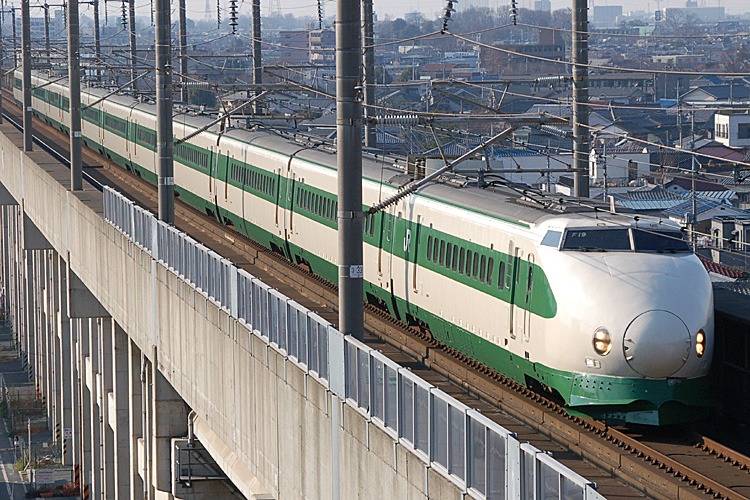
Japanese high speed train type
| Field | Value | |
|---|---|---|
| name | 200 series | |
| image | JR East Shinkansen 200(renewal).jpg | |
| caption | Refurbished 200 series train near Ōmiya Station, July 2008 | |
| service | 23 June 1982 – 14 April 2013 () | |
| manufacturer | {{Ubli | |
| yearconstruction | 1980–1991 | |
| yearservice | 23 June 1982 | |
| refurbishment | 1999–2002 (K sets) | |
| successor | E1, E2, E4 and E5 series | |
| yearscrapped | 1997–2013 | |
| numberbuilt | 700 vehicles (66 sets) | |
| numberservice | None | |
| numberpreserved | 4 vehicles | |
| numberscrapped | 695 vehicles | |
| formation | 8, 10, 12, 13 or 16 cars per set | |
| operator | {{Plainlist | |
| depots | Niigata, Sendai | |
| lines | {{Plainlist | |
| carbody | Aluminium | |
| carlength | 25 m | |
| width | 3.385 m | |
| height | 4.41 m | |
| doors | Two per side, per car | |
| maxspeed | {{Indented plainlist | |
| traction | Thyristor drive | |
| electricsystem | {{Unbulleted list | |
| collectionmethod | Pantograph | |
| safety | ATC-2, DS-ATC | |
| multipleworking | Up to two units: [400](400-series-shinkansen) or E3 series | |
| gauge |
| Hitachi | Kawasaki Heavy Industries | Kinki Sharyo | Nippon Sharyo | Tokyu Car
- JNR (1982–1987)
- JR East (1987–2013)
- Tōhoku Shinkansen
- Jōetsu Shinkansen
- E/G sets: 210 km/h
- F/K sets: 240 km/h
- H sets: 245 km/h
- Sets F90–93: 275 km/h
| Overhead line:
|
| (Set F80)
The 200 series was a Shinkansen high-speed train type introduced by Japanese National Railways (JNR) in June 1982 for use on the newly opened Tōhoku and Jōetsu Shinkansen lines, the first Shinkansen routes built east of Tokyo. Externally, the design was derived from the original 0 series, but were lighter and more powerful to handle the steeper gradients and mountainous terrain on these lines, and incorporated features for winter operation. A total of 700 vehicles, arranged into 66 sets, were built between 1980 and 1991 by Hitachi, Kawasaki, Kinki Sharyo, Nippon Sharyo, and the Tokyu Car Corporation.
The 200 series predated the 100 series; under JNR's numbering scheme, Shinkansen types operating east of Tokyo were assigned even-numbered designations, while those to the west received odd numbers. Following JNR's privatization in 1987, the trains were transferred to the East Japan Railway Company (JR East), and many sets were refurbished during their service lives before being withdrawn from service in 2013.
Design
The 200 Series Shinkansen trains resembled the earlier 0 series trains in styling (some later units had the pointed 'shark nose' of the 100 series), but were lighter and more powerful, since these two lines are mountain routes and have steeper gradients. These lines are also prone to snowfall and the trains had small snowplows fitted, as well as protection of equipment against snow.
It was one of the two recipients of the 23rd Laurel Prize presented by the Japan Railfan Club, the first Shinkansen type to receive that award.
They were originally painted in ivory with a green window band and lower bodyside band, but a number of sets were refurbished and painted into a white-upper/dark blue-lower scheme with new wrap-around cab windows from 1999.
The first units were capable of 210 km/h but later ones can do 240 km/h, and four were converted to be capable of 275 km/h. Some units were also modified with retractable couplers in the nose for coupling with Yamagata Shinkansen Tsubasa and Akita Shinkansen Komachi Mini-shinkansen sets. In addition, some of the later 200 series Shinkansen trains were fitted with double-deck cars, which had semi-open standard-class compartments on the lower deck and green class (first class) seating on the upper deck. These too have been removed from service.
Withdrawal of the earlier units began in 1997, and the last remaining unrefurbished set was withdrawn in May 2007.
Variants
Since their introduction in 1982, the 200 series sets have been operated in a number of different formations as described below.
E sets (1982–1993)
12-car sets for Tōhoku Shinkansen Yamabiko and Aoba services, and for Jōetsu Shinkansen Asahi and Toki services. These had a maximum speed of 210 km/h, and remained in service until early 1993.
The 12-car E sets were formed as follows.
| Car No. | 1 | 2 | 3 | 4 | 5 | 6 | 7 | 8 | 9 | 10 | 11 | 12 | Designation | Numbering |
|---|---|---|---|---|---|---|---|---|---|---|---|---|---|---|
| Mc | M' | M | M' | Mk | M' | Ms | M' | MB | M' | M | M'c | |||
| 221 | 226 | 225 | 226 | 225-400 | 226 | 215 | 226 | 237 | 226 | 225 | 222 |
F sets (1983–2007)
12-car 200-1000 series sets with a maximum speed of 240 km/h which were introduced in November 1983.
From March 1990, four selected 12-car F sets (F90–F93, formerly F54, F59, F14, F16) were upgraded allowing them to run at a maximum of 275 km/h on a small number of down Asahi services. 275 km/h services were discontinued on the Jōetsu Shinkansen from 1998, with the introduction of E2 series trains, and the F90 sets were subsequently used interchangeably with other 240 km/h F sets.
Some F sets are similar to the H sets in that the driving trailer cars were built with a pointed nose, just like the latter. These trains however, feature a solid green line unlike the H sets, where they have two green lines, one thick and one thin, separated by a thin white section near the bottom.
Formations
The 12-car F sets were formed as follows, with car 1 at the Tokyo end. Car 11 was a Green (first class) car, and car 9 had a buffet counter.
| Car No. | 1 | 2 | 3 | 4 | 5 | 6 | 7 | 8 | 9 | 10 | 11 | 12 | Designation | Numbering |
|---|---|---|---|---|---|---|---|---|---|---|---|---|---|---|
| Mc | M' | M | M' | Mk | M' | M | M' | MB | M' | MS | M'c | |||
| 221 | 226 | 225 | 226 | 225-400 | 226 | 225 | 226 | 237 | 226 | 215 | 222 |
Cars 2, 4, 10, and 12 were each fitted with one cross-arm pantograph. (3, 5, 7, and 9 for sets F90-93)
Interior
File:200 F green interior Niigata 20020101.jpg|Green car, January 2002 File:200 F interior Niigata 20020101.jpg|Standard-class car with fixed 3-abreast seating rows, January 2002
Set F80

One F set, F17, was specially modified at Sendai Depot between August 1997 and January 1998 for use on additional Nagano Shinkansen Asama services in February 1998 during the 1998 Winter Olympics held in Nagano. The train was renumbered F80, and modifications included ability to operate on both 25 kV AC 50 Hz and 60 Hz overhead power supplies, weight-saving measures to comply with the 16 tonne axle load restriction, and additional control equipment to cope with the 30‰ gradient of the Nagano Shinkansen. Maximum speed was limited to 210 km/h when operating on the Nagano Shinkansen.
Seats in the end cars, cars 1 and 12, were replaced with E2 series-style seats to reduce weight.
The train was formed as follows, with car 1 at the Tokyo end. Car 11 was a Green (first class) car, and car 9 had a buffet counter.
| Car No. | 1 | 2 | 3 | 4 | 5 | 6 | 7 | 8 | 9 | 10 | 11 | 12 | Designation | Numbering |
|---|---|---|---|---|---|---|---|---|---|---|---|---|---|---|
| Mc | M' | M | M' | Mk | M' | M | M' | MB | M' | MS | M'c | |||
| 221-1514 | 226-1081 | 225-1033 | 226-1082 | 225-1417 | 226-1083 | 225-1034 | 226-1084 | 237-1017 | 226-1085 | 215-1017 | 222-1514 |
Cars 2, 4, 8, and 10 were each fitted with one cross-arm pantograph.
After February 1998, set F80 was used interchangeably with other F sets, and remained in operation until 2004.
G sets (1987–1999)

10-car, and later 8-car, sets formed from the earlier 12-car E sets, with a maximum speed of 210 km/h. These entered service from 18 April 1987.
Formations
The initial 10-car G sets were formed as follows.
| Car No. | 1 | 2 | 5 | 6 | 7 | 8 | 9 | 10 | 11 | 12 | Designation | Numbering |
|---|---|---|---|---|---|---|---|---|---|---|---|---|
| Mc | M' | M4 | M' | Ms | M' | MB | M' | M | M'c | |||
| 221 | 226 | 225-400 | 226 | 215 | 226 | 237 | 226 | 225 | 222 |
The 8-car G sets were formed as follows.
| Car No. | 1 | 2 | 3 | 4 | 5 | 6 | 7 | 8 | Designation | Numbering |
|---|---|---|---|---|---|---|---|---|---|---|
| Mc | M' | M4 | M' | Mhs | M' | MB | M'c | |||
| 221 | 226 | 225-400 | 226 | 215-300 | 226 | 237 | 222 |
Cars 2, 4, 6, and 8 were equipped with cross-arm pantographs. Some sets had an "Mpk" car (numbered 225-400) in place of the 237 buffet car for car 11.
H sets (1990–2005)


Six 13-car and later 16-car sets (H1–H6) were formed with a maximum speed of 240 km/h for use on the Yamabiko (nicknamed Super Yamabiko) services, incorporating two bi-level Green cars (cars 9 and 10). These sets entered service from 23 June 1990.
Regular operations using 16-car H sets ended from the start of the revised timetable on 13 March 2004, but sets H4 and H5 were reinstated as 12-car sets from the middle of 2004 for seasonal use with their Green cars removed. These two sets remained in service until mid-2005.
Formations
The initial 13-car H sets were formed as follows.
| Car No. | 1 | 2 | 3 | 4 | 5 | 6 | 7 | 8 | 9 | 10 | 11 | 12 | 13 | Designation | Numbering |
|---|---|---|---|---|---|---|---|---|---|---|---|---|---|---|---|
| Mc | M' | M | M' | Mk | M' | TsD | Ms | M' | MB | M' | M | M'c | |||
| 221 | 226 | 225 | 226 | 225-400 | 226 | 249 | 215 | 226 | 237 | 226 | 225 | 222 |
The 16-car H sets were formed as follows.
| Car No. | 1 | 2 | 3 | 4 | 5 | 6 | 7 | 8 | 9 | 10 | 11 | 12 | 13 | 14 | 15 | 16 | Designation | Numbering | Seating capacity |
|---|---|---|---|---|---|---|---|---|---|---|---|---|---|---|---|---|---|---|---|
| Mc | M' | M | M' | M | M' | Mk | M' | T'sD | TsD | MCON | M' | M | M' | M | M'c | ||||
| 221-200 | 226-100 | 225 | 226-100 | 225 | 226 | 225-400 | 226-100 | 249 | 248 | 225-100 | 226-100 | 225-200 | 226-100 | 225 | 222-200 | ||||
| 50 | 95 | 80 | 95 | 80 | 95 | 70 | 95 | 67 | 40 | 70 | 95 | 68 | 95 | 80 | 55 |
Cars 2, 4, 8, 12, and 14 were each fitted with one cross-arm pantograph.
The 12-car H sets (H4 & H5) were formed as follows.
| Car No. | 1 | 2 | 3 | 4 | 5 | 6 | 7 | 8 | 9 | 10 | 11 | 12 | Designation | Numbering |
|---|---|---|---|---|---|---|---|---|---|---|---|---|---|---|
| Mc | M' | M | M' | Mk | M' | M | M' | M | M' | Mcon | M'c | |||
| 221-200 | 226-100 | 225 | 226-100 | 225-400 | 226-100 | 225 | 226-100 | 225-200 | 226-100 | 225-100 | 222-200 |
Cars 2, 4, 6, 8, and 10 were each fitted with one cross-arm pantograph.
K sets (1992–2013)
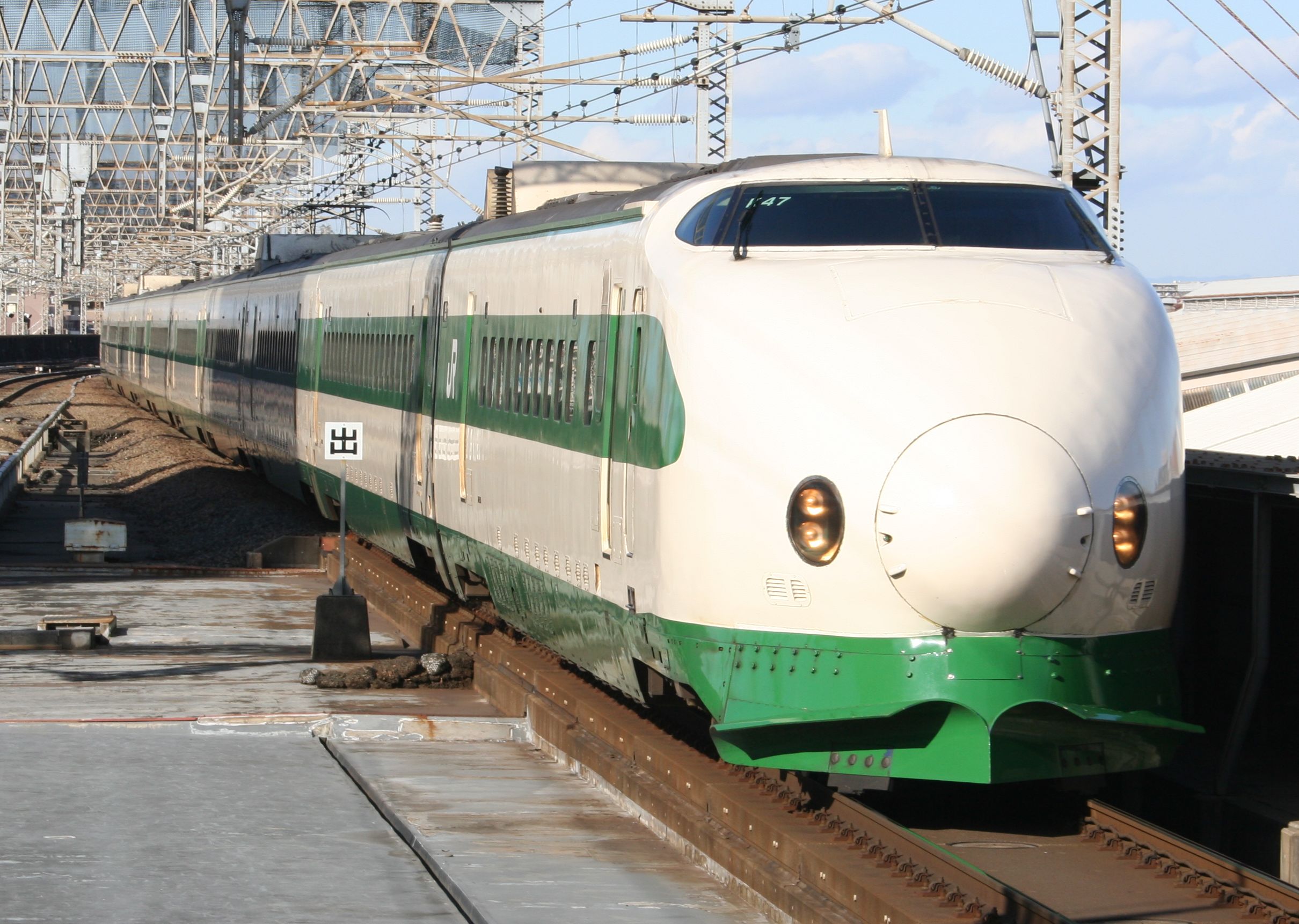
8-car and later 10-car sets with a maximum speed of 240 km/h modified with nose-end couplers to operate in conjunction with 400 series Yamagata Shinkansen sets and E3 series Akita Shinkansen sets.
The remaining sets in use on the Tōhoku Shinkansen were withdrawn from 19 November 2011, but 200 series sets continued to be used on the Jōetsu Shinkansen. The last remaining sets were withdrawn from regular service by the start of the revised timetable on 16 March 2013.
Formations
The K sets are formed as follows.
| Car No. | 1 | 2 | 3 | 4 | 5 | 6 | 7 | 8 | 9 | 10 | Designation | Numbering |
|---|---|---|---|---|---|---|---|---|---|---|---|---|
| Mc | M' | M | M' | M | M' | Mpk | M' | Ms | M'c | |||
| 221 | 226 | 225 | 226 | 225 | 226 | 225 | 226 | 215 | 222 |
Interior
File:200 K refurb green car interior Sendai 20020825.jpg|Refurbished Green car, August 2002 File:200 K refurb interior Echigo-Yuzawa 20020101.jpg|Refurbished standard-class car, January 2002
Special event train services
Tohoku Shinkansen 25th anniversary

On 23 June 2007, 10-car set K47 was used for a special Yamabiko 931 service from Omiya to Morioka to mark the 25th anniversary of the opening of the Tohoku Shinkansen. Set K47 was specially repainted back into its original ivory and green livery for this event.
Tohoku Shinkansen 30th anniversary
On 23 June 2012, 10-car set K47 was used for a special Yamabiko 235 service from Omiya to Morioka to mark the 30th anniversary of the opening of the Tohoku Shinkansen.
Joetsu Shinkansen 30th anniversary
On 17 November 2012, 10-car set K47 was used for a special Joetsu Shinkansen 30th Anniversary service, running as Toki 395, from Omiya to Niigata.
''Sayonara 200 series Yamabiko''
On 30 March 2013, 10-car set K47 was used for a special Sayonara 200 series Yamabiko train operated from Morioka to Tokyo, following the withdrawal of 200 series trains from regular scheduled services on 16 March.
''Arigato 200 series''
On 13 April 2013, a special Arigato 200 series service ran from Sendai to Ueno in Tokyo.
''Sayonara 200 series''
On 14 April 2013, 10-car set K47 was used for two final Sayonara 200 series services from Niigata to Tokyo and from Omiya to Niigata, marking the last public operation of the 200 series trains.
Derailment

A refurbished 200 series train (set K25 on the Toki 325 service) derailed on the Jōetsu Shinkansen line while travelling at a speed of approximately 200 km/h between Nagaoka Station and Urasa Station on 23 October 2004 during the 2004 Chūetsu earthquake. Eight of the ten cars were derailed. This was the first derailment of a Shinkansen train in service. None of the 155 passengers on board were injured. Set K25 was officially withdrawn on 25 March 2005.
Preserved examples
- 221-1 and 237-1 (ex-set E1, later F30) at Sendai General Shinkansen Depot
- 222-35 (ex-set K31) at The Railway Museum in Saitama, Saitama
- 221-1510 (ex-set F13, later K47) outside Niigata City Niitsu Railway Museum in Niitsu, Niigata since June 2013
File:Shinkansen 221-1 and 237-1 at Shinkansen General Rolling Stock Center.jpg|Preserved cars 221-1 and 237-1 at Sendai General Shinkansen Depot in September 2024 File:Shinkansen 200 type-222 35 at the Railway Museum.jpg|Preserved car 222-35 at the Railway Museum in Saitama in January 2015 File:NIIGATA-CITYNiitsuRailwayMuseum02.JPG|Preserved car 221-1510 outside the Niigata City Niitsu Railway Museum in August 2014
Formerly preserved
- 215-1, 222-1, 226-1 (all ex-set E1, later F30), and 249-5 (ex-set H5) stored outdoors at Sendai General Shinkansen Depot,
- 215-15, 221-15 and 237-15 (ex-set E15, later F37) next to Nagareyama Onsen Station on the Hakodate Main Line (cut up in June 2013)
- 221-1505 (ex-set K25) was at JR East General Training Center in Shirakawa City. Fukushima Prefecture where it was displayed until it was scrapped.
File:Rifu Line 701 EMU train runs.JPG|Five cars of former set F30 stored at Sendai General Shinkansen Depot in January 2003 File:200 249-5 H5 Sendai General Shinkansen Depot 20080726.jpg|Car 249-5 of former set H5 stored at Sendai General Shinkansen Depot in July 2008 File:Nagareyama-Onsen station Platform 20110827.jpg|Preserved 200 series cars next to Nagareyama Onsen Station in Hokkaido in August 2011
References
References
- Imada. Tamotsu. (November 1996). [[Japan Railfan Magazine]]. Kōyūsha Co., Ltd.
- (March 2011). JRR
- (July 1998). JRR
- (April 1998). [[Japan Railfan Magazine]]. Kōyūsha Co., Ltd.
- (January 2000). JRR
- Ito. Hisami. (December 2011). [[Japan Railfan Magazine]]. Kōyūsha Co., Ltd.
- (21 December 2012). link. Tetsudo.com. Asahi Interactive Inc.
- (May 2011). [[Japan Railfan Magazine]]. Kōyūsha Co., Ltd.
- (August 2012). Tetsudō Daiya Jōhō Magazine. Kōtsū Shimbun
- (August 2012). Tetsudō Daiya Jōhō Magazine. Kōtsū Shimbun
- (February 2013). [[Japan Railfan Magazine]]. Koyusha Co., Ltd.
- (1 April 2013). link. Japan Railfan Magazine Online. Koyusha Co., Ltd.
- (26 February 2013). link. News release. East Japan Railway Company, Sendai Division
- (15 April 2013). link. Japan Railfan Magazine Online. Koyusha Co., Ltd.
- San-ei. (2009)
- (24 May 2013). link. News release. Hokkaido Railway Company
This article was imported from Wikipedia and is available under the Creative Commons Attribution-ShareAlike 4.0 License. Content has been adapted to SurfDoc format. Original contributors can be found on the article history page.
Ask Mako anything about 200 Series Shinkansen — get instant answers, deeper analysis, and related topics.
Research with MakoFree with your Surf account
Create a free account to save articles, ask Mako questions, and organize your research.
Sign up freeThis content may have been generated or modified by AI. CloudSurf Software LLC is not responsible for the accuracy, completeness, or reliability of AI-generated content. Always verify important information from primary sources.
Report