From Surf Wiki (app.surf) — the open knowledge base
100 Series Shinkansen
Japanese high-speed train type
.jpg)
Japanese high-speed train type
| Field | Value | |||||
|---|---|---|---|---|---|---|
| name | 100 series | |||||
| image | File:Shinkansen100.jpg | |||||
| imagesize | 300px | |||||
| caption | 100 series train on the Tokaido Shinkansen | |||||
| service | 1 October 1985 – 16 March 2012 () | |||||
| manufacturer | {{plainlist | |||||
| yearconstruction | 1984–1992 | |||||
| refurbishment | 2000–2004 | |||||
| yearscrapped | 1999–2012 | |||||
| numberbuilt | 1,056 vehicles (66 sets) | |||||
| numberpreserved | 3 vehicles | |||||
| formation | 4, 6, 12 or 16 cars per trainset | |||||
| fleetnumbers | {{plainlist | |||||
| capacity | {{plainlist | |||||
| operator | {{plainlist | |||||
| depots | Hakata | |||||
| lines | {{plainlist | |||||
| carbody | Steel | |||||
| carlength | {{plainlist | |||||
| *{{Convert | 25 | m | ftin | abbr | on}} (intermediate cars) | |
| *{{Convert | 26.05 | m | ftin | abbr | on}} (end cars) | |
| width | 3383 mm | |||||
| height | 4000 mm | |||||
| 4488 mm | ||||||
| (Bilevel car) | ||||||
| doors | Two per side | |||||
| maxspeed | {{plainlist | |||||
| *{{Convert | 220 | km/h | 0 | abbr | on}} | |
| *{{Convert | 230 | km/h | 0 | abbr | on}} (former V sets) | |
| acceleration | 1.6 km/h/s for the former V sets) | |||||
| deceleration | 2.6 km/h/s | |||||
| traction | Thyristor drive | |||||
| electricsystem | [25 kV AC, 60 Hz](25-kv-ac-60-hz), overhead catenary | |||||
| collectionmethod | Pantograph | |||||
| bogies | DT202 (motored), TR7000 (trailer) | |||||
| safety | ATC-1 | |||||
| gauge |
- Hitachi
- Kawasaki Heavy Industries
- Kinki Sharyo
- Nippon Sharyo
- Tokyu Car Corporation |}}
- X1-X7
- G1-G50
- V1-V9
- K51-K60
- P1-P12 |}}
- 4-car P sets 250
- 6-car K sets 394
- 12-car G sets 1,031 (68 Green + 963 Standard)
- 16-car X sets 1,277 (124 Green + 1,153 Standard)
- 16-car V sets 1,285 (126 Green + 1,159 Standard)
- 16-car G sets 1,321 (168 Green + 1,153 Standard) |}}
- JNR (1985–1987)
- JR Central (1987–2003)
- JR-West (1989–2012) |}}
- Tokaido Shinkansen (1985-2003)
- Sanyo Shinkansen (1985-2012)
- Hakata-Minami Line (2000-2012) |}}
- 25 m (intermediate cars)
- 26.05 m (end cars) |}} 4488 mm (Bilevel car)
- 220 km/h
- 230 km/h (former V sets) |}} The 100 series was a Japanese Shinkansen high-speed electric multiple unit which operated between 1985 and 2012 on the Tokaido Shinkansen and Sanyo Shinkansen high-speed lines. They were introduced after the 200 series trains, but their numbering is such because in the days of Japanese National Railways (JNR), Shinkansen types running east of Tokyo were given even numbers and those west of Tokyo odd numbers, hence they were given the next odd number in line after 0, 100. The last remaining examples of the type were withdrawn from service following the last runs on 16 March 2012.
Overview
As a full-scale redesign of the Tokaido-Sanyo Shinkansen, a total of 1,056 cars were manufactured and put into service between 1985 and 1992, consisting of 66 16-car sets. The train was the first to incorporate the double-decker cars used in Kintetsu Railway's Vista Cars and in railways in Europe and the United States, and was the first to be used in JNR and Shinkansen trains, leading to increased seating capacity and improved service, which helped promote the Shinkansen and improved its image. In terms of interior and technology, many of the equipment and technologies were later installed in Shinkansen trains produced thereafter.
The train capacity and manufacturing costs were set to be the same as those of the 0 Series, and the aim was to shorten travel times while minimising improvements to ground facilities. In addition, it was developed with the intention of being a "symbol of JNR reform," and the development goal was set to be "customers first, crew members second".
This model was the mainstay on the Tokaido and Sanyo Shinkansen lines from the end of the JNR era until the launch of JR, but with the introduction of successor vehicles, it was withdrawn from service on the Tokaido Shinkansen on 16 September 2003, and from service on the Sanyo Shinkansen on 16 March 2012.
Design
They differed visibly from the earlier 0 series in that the nose profile was more pointed. Another less obvious difference with the 16-car sets was that not all the cars were powered; the driving cars on each end were unpowered, as were the two bi-level centre cars. Some later production sets had powered driving cars and four unpowered bi-level trailers in the middle instead. The bi-level trailer cars contained a combination of restaurant cars, and first class compartments, or open-plan first class seating and first class compartments, or open-plan first class seating and refreshment cars. The arrangement of the lights in the signal lights has been changed from two vertical lights in the 0-series to two horizontal lights, giving it a long, narrow shape. This design was proposed by Kinki Sharyo and adopted. When the front signal lights are on, they remain on, and when the rear signal lights are on, a red filter is automatically attached, making them appear to be on in red.
The external livery was white (White No. 3) and blue (Blue No. 20).
Following their removal from front-line service, 100 series sets were later reformed into shorter four- and six-car sets for the slower Kodama services on the Sanyo Shinkansen line. These four- and six-car trains did not have bi-level cars.
Variants
Pre-series unit
Originally numbered X0, the pre-series set X1 was delivered in 1985, with test running commencing from 27 March that year. The X1 set entered revenue service for passenger evaluation trials on the Hikari services from 1 October 1985. This unit differed externally from later production units in having small windows aligned with each seating bay, and also had a slanting headlight arrangement. The type 116 Green (first class) car formed as car 10 initially included one two-seat and two single-seat compartments, but these were removed when the set was modified to full-production standard in 1986.
Set X0 was formed as shown below, with car 1 at the end.
| Car No. | 1 | 2 | 3 | 4 | 5 | 6 | 7 | 8 | 9 | 10 | 11 | 12 | 13 | 14 | 15 | 16 | Designation | Numbering |
|---|---|---|---|---|---|---|---|---|---|---|---|---|---|---|---|---|---|---|
| Tc | M' | M | M' | M | M' | M5 | TDD | TsD | Ms' | M7 | M' | M | M' | M | T'c | |||
| 123-9001 | 126-9001 | 125-9001 | 126-9002 | 125-9002 | 126-9003 | 125-9501 | 168-9001 | 149-9001 | 116-9001 | 125-9701 | 126-9004 | 125-9003 | 126-9005 | 125-9004 | 124-9001 |
Set X1 was withdrawn in March 2000.
File:100 X1 Hamamatsu 19981020.jpg|Pre-series unit X1 on a Kodama service in October 1998 File:100 ns mark.JPG|Bilevel dining car 168-9001 carrying the original "NS" ("New Shinkansen") logo stickers in September 1985 File:Shinkansen 168-9001-inside-2F.jpg|Interior of bilevel restaurant car 168-9001 preserved at SCMaglev and Railway Park in April 2011
16-car X sets

Following passenger evaluation trials with the pre-series set X1, a total of seven X sets were built for use on Tokaido and Sanyo Shinkansen Hikari services. The first four production units entered service from 13 June 1986 as 12-car sets without bilevel trailer cars, numbered G1 to G4, and were used on Tokaido Kodama services until October in the same year. These sets were formed as shown below.
| Car No. | 1 | 2 | 3 | 4 | 5 | 6 | 7 | 8 | 9 | 10 | 11 | 12 | Designation | Numbering |
|---|---|---|---|---|---|---|---|---|---|---|---|---|---|---|
| Tc | M' | M | M' | M7 | M' | M5 | Ms' | M | M' | M | T'c | |||
| 123 | 126 | 125 | 126 | 125-700 | 126 | 125-500 | 116 | 125 | 126 | 125 | 124 |
Cars 2, 4, 6, 8, and 10 were each fitted with cross-arm pantographs.
These units were subsequently renumbered as 16-car sets X2 to X5 with the inclusion of bilevel trailer cars, and were introduced on Hikari services from November 1986.
The noticeable difference over previous (0 series and 200 series) shinkansen designs was the inclusion of two bilevel trailer cars in the centre of the formation. The type 168 car had a restaurant area on the upper deck with kitchen facilities and a small buffet counter on the lower deck. The adjacent type 149 car provided private compartments for Green class passengers on the lower deck, with open-plan green car accommodation on the upper deck.
From March 1998, the X sets were redeployed to Tokaido Kodama services. The restaurant cars were no longer used, and fittings were subsequently removed. The fleet of X sets contained the oldest members of the 100 series fleet, and the first withdrawals started in August 1999. From the new timetable change of 2 October 1999, X sets were no longer assigned to regular workings, with the remaining examples subsequently limited to holiday period extra trains. The last remaining units were withdrawn by April 2000.
Formation
The 16-car X sets were formed as follows.
| Car No. | 1 | 2 | 3 | 4 | 5 | 6 | 7 | 8 | 9 | 10 | 11 | 12 | 13 | 14 | 15 | 16 | Designation | Numbering | Seating capacity |
|---|---|---|---|---|---|---|---|---|---|---|---|---|---|---|---|---|---|---|---|
| Tc | M' | M | M' | M | M' | M5 | TDD | TsD | Ms' | M7 | M' | M | M' | M | T'c | ||||
| 123 | 126 | 125 | 126 | 125 | 126 | 125-500 | 168 | 149 | 116 | 125-700 | 126 | 125 | 126 | 125 | 124 | ||||
| 65 | 100 | 90 | 100 | 90 | 100 | 80 | 44 | 56 | 68 | 73 | 100 | 90 | 100 | 90 | 75 |
Cars 2, 6, and 12 were equipped with cross-arm pantographs. (The pantographs on cars 4, 10, and 14 were removed in 1995.)
16-car G sets

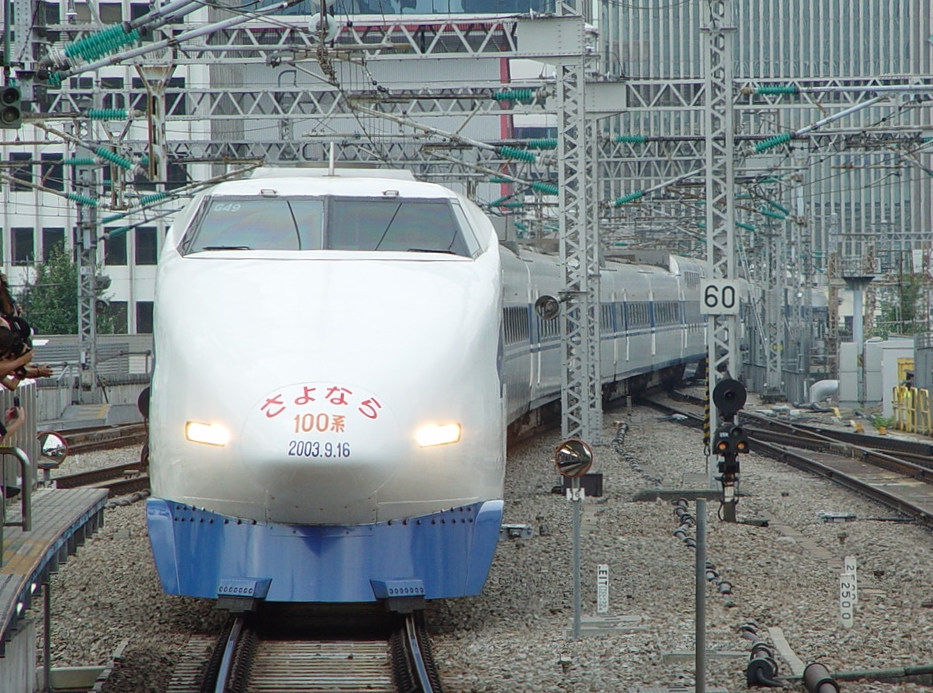
The G sets were officially classified as "100 series", and 50 units were built from 1988. They differed from the initial X sets in having a type 148 bilevel trailer car in place of the type 168 restaurant car. This had open-plan Green car accommodation on the upper deck, and a self-service cafeteria area on the lower deck. While originally used exclusively on Hikari services, in later years, these units were more commonly seen on Tokaido Kodama services. The last remaining sets owned by JR Central and JR-West were withdrawn in September 2003 before the start of the new Tokaido Shinkansen timetable the following October.
Formation
The 16-car G sets were formed as follows.
| Car No. | 1 | 2 | 3 | 4 | 5 | 6 | 7 | 8 | 9 | 10 | 11 | 12 | 13 | 14 | 15 | 16 | Designation | Numbering | Seating capacity |
|---|---|---|---|---|---|---|---|---|---|---|---|---|---|---|---|---|---|---|---|
| Tc | M' | M | M' | M | M' | M5 | TsD | TsD | Ms' | M7 | M' | M | M' | M | T'c | ||||
| 123 | 126 | 125 | 126 | 125 | 126 | 125-500 | 148 | 149 | 116 | 125-700 | 126 | 125 | 126 | 125 | 124 | ||||
| 65 | 100 | 90 | 100 | 90 | 100 | 80 | 42 | 58 | 68 | 73 | 100 | 90 | 100 | 90 | 75 |
Cars 2, 6, and 12 were equipped with cross-arm pantographs.
File:G49 Kodama 462 Hamamatsu 20030428.JPG|Bilevel cars 8 and 9 of set G49 in April 2003
16-car V sets (100-3000 series)

The nine V sets (also referred to as "100N") operated by JR-West included four bilevel trailer cars, which provided 2+2 standard class reserved seating accommodation on the lower decks, and restaurant and Green class accommodation on the upper decks. These sets originally ran under the marketing name Grand Hikari, but from May 2002 onwards were limited to use on the Sanyo Shinkansen only. The restaurant cars in these units were decommissioned from March 2000. Two V sets (V1, V6) were reformed as new 4-car P sets in 2000 to replace life-expired 0 series Q sets on Sanyo Shinkansen Kodama services, and the remaining sets were subsequently used to donate cars as they were withdrawn. The last operational set, V2 (with four bilevel trailer cars from set V9), was withdrawn after being used on special Sayonara Grand Hikari runs in November 2002.
Formation
The 16-car V sets were formed as follows.
| Car No. | 1 | 2 | 3 | 4 | 5 | 6 | 7 | 8 | 9 | 10 | 11 | 12 | 13 | 14 | 15 | 16 | Designation | Numbering | Seating capacity |
|---|---|---|---|---|---|---|---|---|---|---|---|---|---|---|---|---|---|---|---|
| Mc | M' | M | M' | M8 | M' | TsD | TDD | TsD | T'sD | M7 | M' | M | M' | M | M'c | ||||
| 121-3000 | 126-3000 | 125-3000 | 126-3000 | 125-3000 | 126-3000 | 179-3100 | 168-3000 | 179-3700 | 178-3000 | 125-3700 | 126-3000 | 125-3000 | 126-3000 | 125-3000 | 122-3000 | ||||
| 65 | 100 | 90 | 100 | 90 | 100 | 80 | 44 | 58 | 68 | 73 | 100 | 90 | 100 | 90 | 75 |
Cars 4, 6, 12, and 14 were equipped with cross-arm pantographs.
File:100 V restaurant car 19990714.jpg|Interior view of 168-3000 restaurant car in July 1999
4-car P sets
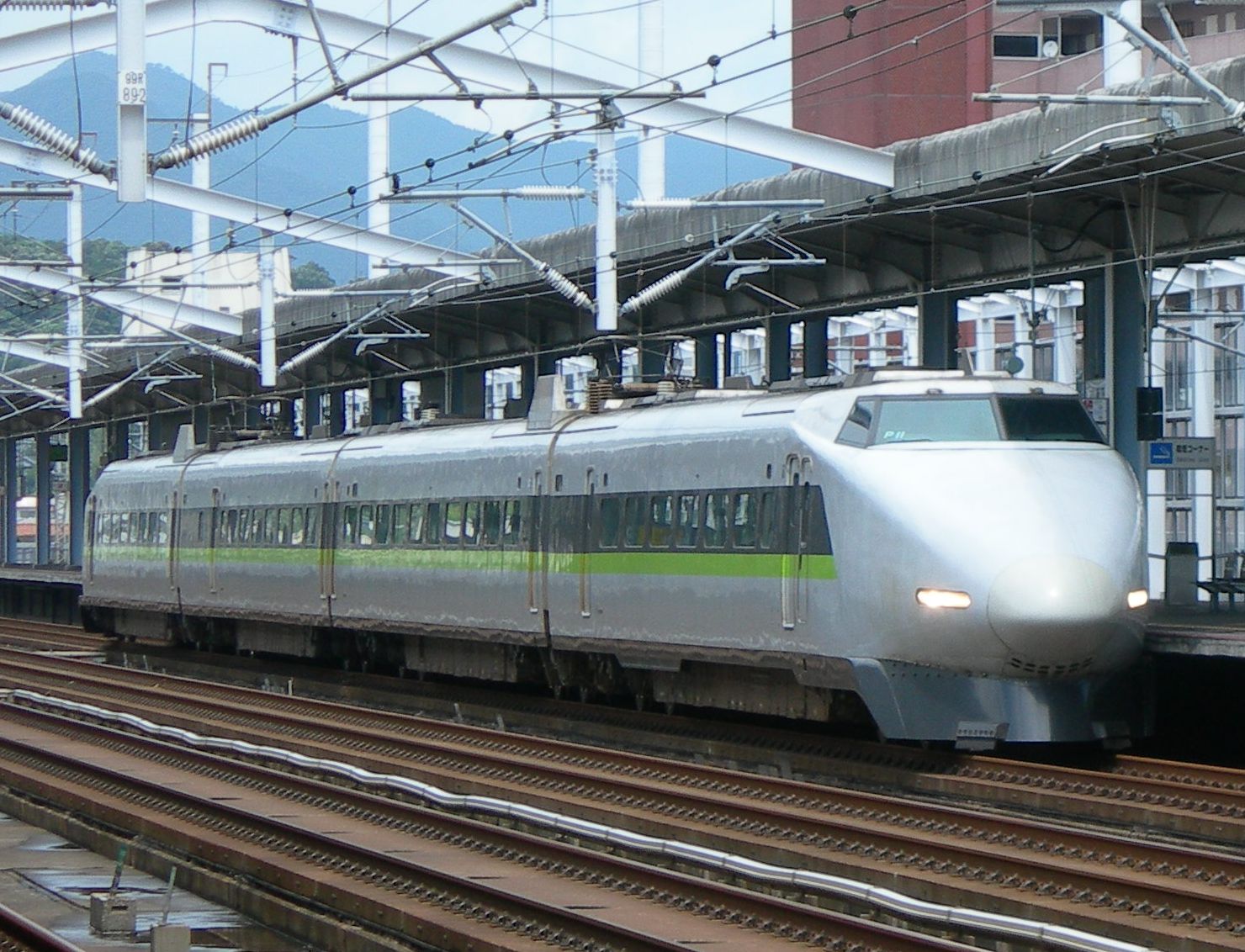

The first of two reformed 4-car P sets was introduced on Sanyo Shinkansen Kodama services from October 2000. P1 was reformed from set V1, with the traction motors in the two end cars (renumbered in -5000 series) replaced by those from surplus JR-West G set cars. P2 was reformed from unit V6 in October 2000. Subsequent sets P3 and P4 were formed in 2001 by transplanting the cab sections of surplus non-powered G set cars onto powered intermediate cars renumbered into the 121-5050 and 122-5050 series. Set P1 was the first to be repainted into the new JR-West "fresh green" Kodama livery, in August 2002, and the entire fleet of twelve sets (P1–P12) had been similarly treated by March 2005.
Formation
| Car No. | 1 | 2 | 3 | 4 | Designation | Numbering | 121-5000 | 126-3000 | 125-3700 | 122-5000 | Seating capacity | ||||
|---|---|---|---|---|---|---|---|---|---|---|---|---|---|---|---|
| Mc | M' | M7 | M'c | ||||||||||||
| 52 | 80 | 58 | 60 |
Cars 2 and 4 were equipped with cross-arm pantographs.
Interior
The first three sets (P1 to P3) were refurbished in February and March 2002 with 2+2 abreast seating using former West Hikari seats. Sets from P4 onward (formed in August 2001) had 2+2 seating from the outset.
File:100 P5 interior Himeji 20020518.jpg|Interior of set P5, showing 2+2 seating, in May 2002
Set P2 was withdrawn on 9 February 2009, and moved to the JR-West training centre at Shimonoseki, where it replaced the former 0 series set Q3 as a static training set. P2's role as a training set ended in March 2013.
The last P sets in revenue service were withdrawn by 11 March 2011.
6-car K sets
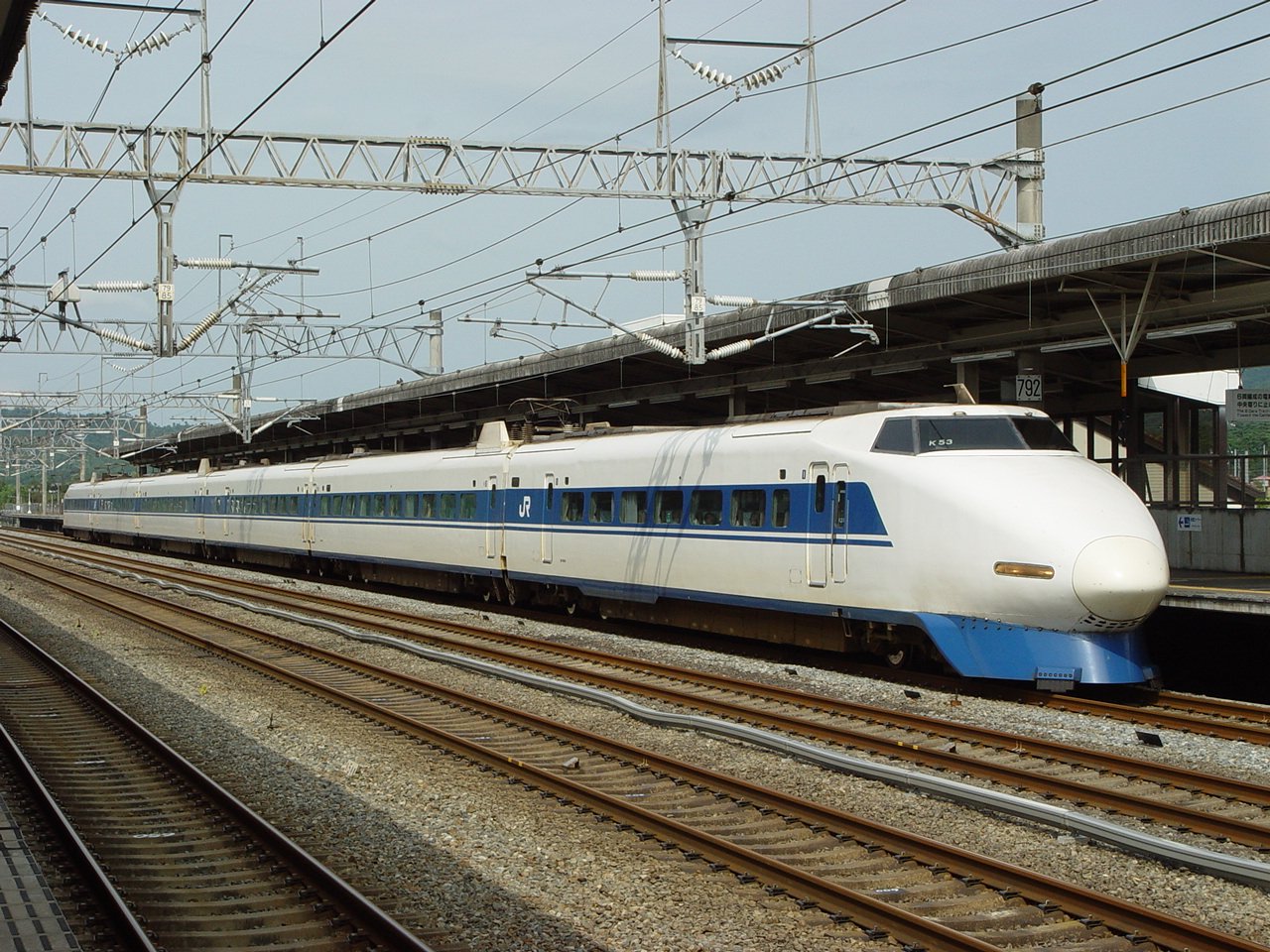

The first six-car K set (K51) was formed in January 2002 for use on Sanyo Shinkansen Kodama services from February 2002. These sets feature 2+2 abreast seating throughout, utilizing former Green class seats from withdrawn 100 series cars. Sets started appearing in the new JR-West Kodama livery from August 2002, with all ten sets (K51–K60) similarly treated by August 2004.
Three K sets were returned to the original white/blue livery from July 2010. The first set treated, K53, was returned to traffic on 14 July 2010.
These sets were withdrawn from service on 16 March 2012.
Formation
| Car No. | 1 | 2 | 3 | 4 | 5 | 6 | Designation | Numbering | Seating capacity |
|---|---|---|---|---|---|---|---|---|---|
| Mc | M' | M7 | M' | M7 | M'c | ||||
| 121-5000 | 126-3000 | 125-3700 | 126-3200 | 125-3000 | 122-5000 | ||||
| 52 | 80 | 58 | 72 | 72 | 60 |
Cars 2 and 6 were equipped with cross-arm pantographs.
Preserved examples
- 123-1 (set X2) and 168-9001 (set X1) at the SCMaglev and Railway Park in Aichi Prefecture since March 2011.
- 122-5003 (from set K54, formerly 122-3003 from set V3) preserved at the Kyoto Railway Museum, which opened in April 2016.
- 168-3009 and 179-3009 (both from set V9) at Hakata General Depot in Fukuoka Prefecture
File:123-1 SCMaglev and Railway Park 20120722.jpg|Preserved car 123-1 (from set X2) at the SCMaglev and Railway Park in July 2012 File:Kyoto railway museum 122-5003 20160508.jpg|Preserved car 122-5003 (from set K54) at the Kyoto Railway Museum in May 2016 File:Shinkansen 168-9001.JPG|Preserved bilevel restaurant car 168-9001 (from set X1) at Hamamatsu Works in July 2007
References
References
- JRR. (July 1998)
- Ikeguchi. Eiji. Tetsudō Daiya Jōhō Magazine. Kōtsū Shimbun. (May 2012)
- Umehara. Jun. Rail Magazine. Neko Publishing Co., Ltd.. (July 2003)
- Ota. Yoshio. Railway Journal. Tetsudō Journal. (September 1986)
- JRR. (December 2006)
- (July 2009). "車両の動き2008-2009". Koyusha Co., Ltd..
- (12 April 2013). "". link. Japan Railfan Magazine Online. Koyusha Co., Ltd.
- [[Japan Railfan Magazine]]. Koyusha Co., Ltd.. (June 2011)
- [[Japan Railfan Magazine]]. Koyusha Co., Ltd.. (5 July 2010). link
- [[Japan Railfan Magazine]]. Koyusha Co., Ltd.. (15 July 2010). link
- link. (16 December 2011). News Release. West Japan Railway Company
- Kotsu Shimbunsha. (June 2009)
- Tetsudō Daiya Jōhō Magazine. Kōtsū Shimbun. (April 2011)
- {{cite magazine. Koyusha Co., Ltd.. (June 2016)
- Sanei Mook. (April 2009)
This article was imported from Wikipedia and is available under the Creative Commons Attribution-ShareAlike 4.0 License. Content has been adapted to SurfDoc format. Original contributors can be found on the article history page.
Ask Mako anything about 100 Series Shinkansen — get instant answers, deeper analysis, and related topics.
Research with MakoFree with your Surf account
Create a free account to save articles, ask Mako questions, and organize your research.
Sign up freeThis content may have been generated or modified by AI. CloudSurf Software LLC is not responsible for the accuracy, completeness, or reliability of AI-generated content. Always verify important information from primary sources.
Report