From Surf Wiki (app.surf) — the open knowledge base
1993 South Australian state election
none
none
| Field | Value | |
|---|---|---|
| election_name | 1993 South Australian state election | |
| country | South Australia | |
| type | parliamentary | |
| ongoing | no | |
| previous_election | 1989 South Australian state election | |
| previous_year | 1989 | |
| next_election | 1997 South Australian state election | |
| next_year | 1997 | |
| seats_for_election | All 47 seats in the House of Assembly | |
| 24 seats needed for a majority | ||
| 11 of 22 seats in the Legislative Council | ||
| election_date | ||
| <!-- Liberal --> | image1 | File:Liberal Party of Australia placeholder portrait.svg |
| leader1 | Dean Brown | |
| leader_since1 | 11 May 1992 | |
| party1 | Liberal | |
| leaders_seat1 | Finniss | |
| popular_vote1 | **481,623** | |
| percentage1 | **52.80%** | |
| swing1 | 8.60 | |
| last_election1 | 22 seats | |
| seats_before1 | 22 | |
| seats1 | **37** | |
| seat_change1 | 15 | |
| <!-- Labor --> | image2 | File:Labor Placeholder.png |
| leader2 | Lynn Arnold | |
| leader_since2 | 4 September 1992 | |
| party2 | Labor | |
| leaders_seat2 | Taylor | |
| popular_vote2 | 277,038 | |
| percentage2 | 30.37% | |
| swing2 | 9.72 | |
| last_election2 | 22 seats | |
| seats_before2 | 22 | |
| seats2 | 10 | |
| seat_change2 | 12 | |
| <!-- National --> | image3 | File:Nationals Placeholder.png |
| leader3 | Peter Blacker | |
| leader_since3 | 10 March 1973 | |
| colour3 | 008000 | |
| party3 | National | |
| leaders_seat3 | Flinders | |
| *(lost seat)* | ||
| popular_vote3 | 10,217 | |
| percentage3 | 1.11% | |
| swing3 | 0.07 | |
| last_election3 | 1 seat | |
| seats_before3 | 1 | |
| seats3 | 0 | |
| seat_change3 | 1 | |
| <!-- TPP --> | 1blank | TPP |
| 2blank | TPP swing | |
| 1data1 | **60.91%** | |
| 2data1 | 8.87 | |
| 1data2 | 39.09% | |
| 2data2 | 8.87 | |
| title | Premier | |
| before_election | Lynn Arnold | |
| before_party | Labor | |
| after_election | Dean Brown | |
| after_party | Liberal | |
| vote_type | Primary |
24 seats needed for a majority 11 of 22 seats in the Legislative Council
(lost seat)
The 1993 South Australian state election was held on Saturday, 11 December 1993, to elect members of the Parliament of South Australia. All 47 seats in the House of Assembly were up for election, along with 11 of the 22 seats in the Legislative Council. The three-term incumbent Arnold Labor government were defeated in a landslide victory for the opposition Liberal Party, led by Dean Brown. The Liberals won 37 seats in the House of Assembly, the highest number of seats ever won by a single party in a South Australian election, and reduced Labor to 10 seats in opposition, their lowest amount since 1938.
This marked the Liberal's first election win since 1979, and only their second since the end of the Playmander after the 1968 election. It brought to an end a decade of Labor governance, led by John Bannon for nine of those years. It was also the first time since 1970 that no crossbenchers were elected to the House of Assembly.
Labor's historic defeat was largely attributed to the collapse of the State Bank of South Australia in 1991, which led to the resignation of Premier John Bannon the next year.
Background
The campaign was dominated by the issue of the collapse of the State Bank of South Australia in 1991. The State Bank's deposits were legally underwritten by the Government of South Australia, putting South Australia into billions of dollars of debt. Labor premier John Bannon had resigned over the issue in 1992, being replaced by Lynn Arnold just over a year before the election. The Liberals also changed leaders in 1992, switching from Dale Baker to Dean Brown. Following the Labor leadership change and by early 1993, Newspoll had recorded a total rise of 13 percent in the Labor primary vote. However, the gains did not last. A warning sign of things to come came with the March 1993 federal election, which saw two of Labor's longest-held seats in South Australia, Hindmarsh and Grey, fall to the Liberals. Hindmarsh had been in Labor hands without interruption since 1919, while Grey had been in Labor hands for all but one term since 1943.
Key dates
- Issue of writ: 4 November 1993
- Close of electoral rolls: 12 November 1993
- Close of nominations: Friday 19 November 1993, at noon
- Polling day: 11 December 1993
- Return of writ: On or before 7 January 1994
Results
House of Assembly
| turnout % = 93.57 | informal % = 3.10 |votes % = 52.80 |votes % = 30.37 |votes % = 9.09 |votes % = 1.11 |votes % = 1.03 |votes % = 3.12 |votes % = 0.68 |votes % = 1.78 |2pp % 1 = 60.91 |2pp % 2 = 39.09 |}
The Liberals under Dean Brown went into the election as unbackable favourites, and swept the 11-year Labor government from power in a massive landslide. They won 37 of 47 seats (78.7 percent of the available seats, a majority of 14) in the South Australian House of Assembly from a 15-seat swing − in terms of seat count and percentage of seats won, the largest majority government in the state's history. By comparison, Sir Thomas Playford never governed with more than 23 seats in a 39-seat legislature during his record 27 years as Premier, and Don Dunstan never governed with more than 27 seats in a 47-seat legislature.
The Liberals won 60.9 percent of the two-party vote, the largest two-party preferred vote in South Australian state history (dating back to the first statewide two-party calculations from 1944). Labor fell to just 39.1 percent of the two-party vote from a two-party swing of 8.9 percent—at the time, the largest two-party swing in South Australian state history (second only to the 9.4 percent swing at the following 1997 election, and still the largest that resulted in a change of government. The 15-seat swing is still the largest in South Australian state history.
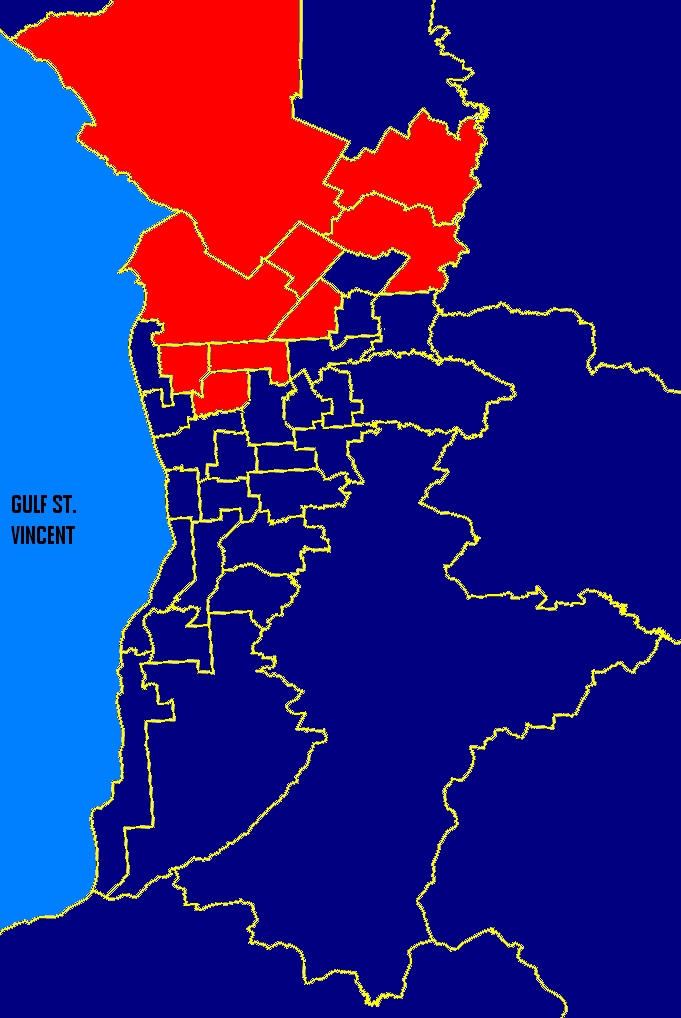
Adelaide, which had been Labor's power base in the state for decades, swung over dramatically to support the Liberals. Labor lost seats in several parts of Adelaide where it had not been seriously threatened in memory, and was cut down to only nine seats in the capital. Additionally, Labor suffered what proved to be permanent swings in much of country South Australia; it was cut down to only one seat outside of Adelaide, the Whyalla-based seat of Giles.
The stratospheric records for seat count and percentage of seats in the House led to predictions of a generation of Liberal government. However, the Liberal gains were short lived. Factional stoushes between the moderate and conservative wings of the Liberal Party led to Brown's factional rival, John Olsen, successfully challenging Brown for the Liberal leadership in 1996. In turn, the Liberals were reduced to a minority government as a result of the 1997 election, following another record two-party swing in the other direction of 9.5 percent.
A 1994 Torrens by-election saw Labor take the seat from the Liberals. The 1994 Elizabeth by-election and 1994 Taylor by-election saw Labor retain both seats.
Legislative Council
| turnout % = 93.62 | informal % = 3.54 |votes % = 51.81 |votes % = 27.40 |votes % = 8.04 |votes % = 1.80 |votes % = 1.60 |votes % = 1.30 |votes % = 1.17 |votes % = 1.03 |votes % = 0.72 |votes % = 0.44 |votes % = 0.39 |votes % = 0.38 |votes % = 3.93 |}
Seats changing hands
| Seat | Pre-1993 | Swing | Post-1993 | Party | Member | Margin | Margin | Member | Party | ||
|---|---|---|---|---|---|---|---|---|---|---|---|
| Elder | Labor | *Notional - New Seat* | 4.6 | 8.0 | 3.4 | David Wade | Liberal | ||||
| Elizabeth | Independent | Martyn Evans* | N/A | N/A | 7.6 | Martyn Evans | Labor | ||||
| Flinders | National SA | Peter Blacker | 6.8 | 14.6 | 7.8 | Liz Penfold | Liberal | ||||
| Florey | Labor | Bob Gregory | 1.8 | 12.2 | 10.4 | Sam Bass | Liberal | ||||
| Hart | Independent | *Norm Peterson** | N/A | N/A | 8.5 | Kevin Foley | Labor | ||||
| Kaurna | Labor | *Don Hopgood** | 3.6 | 6.4 | 2.8 | Lorraine Rosenberg | Liberal | ||||
| Lee | Labor | Kevin Hamilton* | 8.1 | 9.2 | 1.1 | Joe Rossi | Liberal | ||||
| Mawson | Labor | *Susan Lenehan** | 2.6 | 12.2 | 9.6 | Robert Brokenshire | Liberal | ||||
| Mitchell | Labor | *Paul Holloway** | 3.6 | 13.0 | 9.4 | Colin Caudell | Liberal | ||||
| Norwood | Labor | Greg Crafter | 3.0 | 10.4 | 7.4 | John Cummins | Liberal | ||||
| Peake | Labor | Vic Heron | 4.0 | 9.6 | 5.6 | Heini Becker | Liberal | ||||
| Reynell | Labor | *Notional - New Seat* | 9.0 | 10.2 | 1.2 | Julie Greig | Liberal | ||||
| Torrens | Labor | John Klunder* | 4.5 | 11.0 | 6.5 | Joe Tiernan | Liberal | ||||
| Unley | Labor | Kym Mayes | 0.6 | 12.1 | 11.5 | Mark Brindal | Liberal | ||||
| Wright | Labor | *Mike Rann** | 5.2 | 9.2 | 4.0 | Scott Ashenden | Liberal |
- Members in italics did not recontest their seats.
- Martyn Evans was elected as an Independent in 1989, then joined Labor in 1993. Pre-election margin is vs. Labor, after margin is vs. Liberal.
- The new district of Hart was largely based on the abolished district of Semaphore, which had been won by Norm Peterson as an Independent in 1989.
- Don Hopgood was the sitting MP for the abolished district of Baudin, which was largely replaced by Kaurna.
- Kevin Hamilton was the sitting Labor MP for the abolished district of Albert Park, which took in parts of the new district of Lee.
- Susan Lenehan instead contested the seat of Reynell and lost.
- Paul Holloway instead contested the seat of Elder and lost.
- John Klunder was the sitting Labor MP for the abolished district of Todd, which took in most of the new district of Torrens.
- The new district of Wright was largely based on the abolished district of Briggs. The sitting Briggs MP Mike Rann instead contested the seat of Ramsay and won.
Redistribution affected seats
- Heini Becker contested the seat of Peake and won.
- Terry Groom was elected as a Labor member in 1989 but quit the party in 1991. He contested the seat of Napier and lost.
Post-election pendulum
Notes
References
- 1993 election maps and results: Antony Green ABC archive
- History of South Australian elections 1857-2006, volume 1: ECSA
;Political parties
References
- "SA voting intention and leader ratings: Newspoll/The Australian".
- "Details of SA 1993 Election". Australian Politics and Elections Database.
- "South Australian 1993 Election Results".
This article was imported from Wikipedia and is available under the Creative Commons Attribution-ShareAlike 4.0 License. Content has been adapted to SurfDoc format. Original contributors can be found on the article history page.
Ask Mako anything about 1993 South Australian state election — get instant answers, deeper analysis, and related topics.
Research with MakoFree with your Surf account
Create a free account to save articles, ask Mako questions, and organize your research.
Sign up freeThis content may have been generated or modified by AI. CloudSurf Software LLC is not responsible for the accuracy, completeness, or reliability of AI-generated content. Always verify important information from primary sources.
Report