From Surf Wiki (app.surf) — the open knowledge base
1988 Summer Olympics
Multi-sport event in Seoul, South Korea
Multi-sport event in Seoul, South Korea
| Field | Value |
|---|---|
| image | 1988 Summer Olympics logo.svg |
| image_size | 160 |
| caption | Emblem of the 1988 Summer Olympics |
| host_city | Seoul, South Korea |
| motto | *Harmony and Progress* |
| () | |
| nations | 160 |
| athletes | 8,453 (6,250 men, 2,203 women) |
| events | 237 in 23 sports (31 disciplines) |
| opening | 17 September 1988 |
| closing | 2 October 1988 |
| opened_by | President Roh Tae-woo |
| cauldron | Sohn Mi-chung |
| Chung Sun-man | |
| Kim Won-tak | |
| stadium | Seoul Olympic Stadium |
| summer_prev | [Los Angeles 1984](1984-summer-olympics) |
| summer_next | [Barcelona 1992](1992-summer-olympics) |
| winter_prev | [Calgary 1988](1988-winter-olympics) |
| winter_next | [Albertville 1992](1992-winter-olympics) |
| closed_by | IOC President Juan Antonio Samaranch |
() Chung Sun-man Kim Won-tak
The 1988 Summer Olympics (), officially the Games of the XXIV Olympiad () and officially branded as Seoul 1988 (), were an international multi-sport event held from 17 September to 2 October 1988 in Seoul, South Korea. 159 nations were represented at the games by a total of 8,391 athletes (6,197 men and 2,194 women). 237 events were held and 27,221 volunteers helped to prepare the Olympics.
The 1988 Seoul Olympics were the second summer Olympic Games held in Asia, after Tokyo 1964, and the first held in South Korea. As the host country, South Korea ranked fourth overall, winning 12 gold medals and 33 medals in the competition. 11,331 media (4,978 written press and 6,353 broadcasters) showed the Games all over the world. These were the last Olympic Games of the Cold War, as well as for the Soviet Union and East Germany, as both ceased to exist before the next Olympic Games in 1992. The Soviet Union dominated the medal count, winning 55 gold and 132 total medals. The results that got closest to that medal haul in the years since are China's and the United States's 48 gold medals in 2008 and 2012, respectively, and the United States's 126 total medals in 2024.
Compared to the 1980 Summer Olympics (Moscow) and the 1984 Summer Olympics (Los Angeles), which were divided into two camps by ideology, the 1988 Seoul Olympics was a competition in which the boycotts virtually disappeared, although they were not completely over. A boycott of the 1988 Seoul Olympics took place, with North Korea Albania and the Seychelles did not respond to invitations sent by the IOC. Nonetheless, the much larger boycotts seen in the three previous editions were avoided, resulting in the largest number of participating nations during the Cold War era.
For South Korea, the 1988 Olympics was a symbolic milestone that elevated its international standing while fostering national pride. Only thirty five years after the devastation of the Korean War, and following decades of authoritarian rule and social unrest which concluded with the June Democratic Struggle just a year earlier, the games were staged successfully. The event was regarded as the peak of the "Miracle on the Han River". In 1999, 11 years after the games, the IOC returned to Seoul for the 109th IOC Session, which saw Turin elected as the host city for the 2006 Winter Olympics.
Host city selection
Seoul was chosen to host the Summer Games through a vote held on 30 September 1981, finishing ahead of Nagoya, Japan.{{cite web | access-date =12 March 2010| archive-url=https://web.archive.org/web/20091004191226/http://www.olympic.org/en/content/Olympic-Games/All-Past-Olympic-Games/Summer/Seoul-1988/| archive-date= 4 October 2009 | url-status=live}} The awarding to Seoul was internationally considered to be surprising, with Nagoya having been considered a favourite. Below was the vote count that occurred at the 84th IOC Session and 11th Olympic Congress in Baden-Baden, West Germany.
| City | Country (NOC) |
|---|---|
| **Round 1** | |
| **Seoul** | **South Korea** |
| Nagoya | Japan |
Seoul had previously hosted many international events, but the most noteworthy ones were the Miss Universe 1980 and the 1986 Asian Games, thus demonstrating that it had the appropriate capability.
Highlights
-
Soviet Vladimir Artemov won four gold medals in gymnastics. Daniela Silivaş of Romania won three and equalled compatriot Nadia Comăneci's record of seven perfect 10s in one Olympic Games.{{cite web | title = Honored Inductees – Daniela Silivas |url=http://www.ighof.com/honorees/honorees_silivas.html |work=www.ighof.com | access-date =6 October 2007 | archive-url=https://web.archive.org/web/20070927194910/http://www.ighof.com/honorees/honorees_silivas.html| archive-date= 27 September 2007 | url-status=dead}}
-
After having demolished the world record in the 100-metre dash at the US Olympic trials in Indianapolis, sprinter Florence Griffith Joyner set an Olympic record (10.62) in the 100-metre dash and a still-standing world record (21.34) in the 200-metre dash to capture gold medals in both events. To these medals, she added a gold in the 4×100 relay and a silver in the 4×400.
-
This was the first Olympic Games where women's sailing was its own event. It was won by Americans Allison Jolly and Lynne Jewell.
-
Canadian Ben Johnson won the 100-metre final with a world-record time of 9.79 seconds, but was disqualified after he tested positive for stanozolol. Johnson has since claimed that his positive test was the result of sabotage.{{cite news
-
In the women's artistic gymnastics team all-around competition, the United States women's team was penalized five-tenths of a point from their team score by the Fédération Internationale de Gymnastique (FIG) after the compulsory round. East German judge Ellen Berger noticed that Rhonda Faehn, who was the American team alternate and not competing, had been standing on the uneven bars podium for the duration of Kelly Garrison-Steve's compulsory uneven bars routine. Although Faehn was not a coach, Berger assessed the penalty under a rule prohibiting coaches from remaining on the podium while an athlete competes. The deduction caused the United States to fall to fourth place with a combined score of 390.575, three-tenths of a point behind East Germany. This incident remains controversial in the sport of gymnastics, as the United States outperformed the East German team and would have taken the bronze medal in the team competition had they not been penalized.
-
Phoebe Mills won an individual bronze medal on the balance beam, shared with Romania's Gabriela Potorac, making history as the first medal (team or individual) ever won by a US woman in artistic gymnastics at a fully attended games.
-
The USSR won their final team gold medals in artistic gymnastics on both the men's and women's sides with scores of 593.350 and 395.475 respectively. The men's team was led by Vladimir Artemov, while Elena Shushunova led the women's team.
-
Lawrence Lemieux, a Canadian sailor in the Finn class, was in second place and poised to win a silver medal when he abandoned the race to save an injured competitor in mortal peril. He finished in 21st place, but was recognized by the International Fair Play Committee with the Pierre de Coubertin World Trophy honoring his bravery and sacrifice.
-
American diver Greg Louganis won back-to-back titles on both diving events despite striking his head on the springboard during his third-round dive and suffering a concussion.
-
Christa Luding-Rothenburger of East Germany won the silver medal in the women's sprint event in cycling. Combined with the two medals she won in speed skating in the Winter Games in Calgary, she became the first athlete to win medals in two Olympics held in the same year; this feat is no longer possible due to the current scheduling of the Olympic Games.
-
Anthony Nesty of Suriname won his country's first Olympic medal by winning the men's 100-metre butterfly, prevailing over American Matt Biondi by .01 of a second (thwarting Biondi's attempt to match Mark Spitz's record seven golds in one Olympics). Nesty was the first black person to win an individual swimming gold.{{cite web | access-date =6 October 2007 | archive-url=https://web.archive.org/web/20071017015346/http://www.liceus.com/cgi-bin/ac/pu/Alejandro_Guevara_Deporte.asp| archive-date= 17 October 2007 | url-status=live}}
-
Swimmer Kristin Otto of East Germany won six gold medals. Other multi-gold medalists in the pool were Matt Biondi (five) and Janet Evans (three).{{cite web |title=United States Olympic Committee – Evans, Janet |url=http://www.usoc.org/26_37840.htm |work=usoc.com |access-date=6 October 2007 |archive-url=https://web.archive.org/web/20071011230617/http://www.usoc.org/26_37840.htm |archive-date=11 October 2007 |url-status=dead }}
-
Swedish fencer Kerstin Palm became the first woman to take part in seven Olympics.
-
Mark Todd of New Zealand won his second consecutive individual gold medal in the three-day event in equestrian on Charisma, only the second time in eventing history that a gold medal has been won consecutively.{{cite web |access-date=6 October 2007 |archive-url=https://web.archive.org/web/20070927231704/http://www.powerupdates.com/clients/halberg/pages/a_article.asp?pid=0&cid=-630935410&aid=789227824 |archive-date=27 September 2007 |url-status=dead
-
Baseball{{cite web | access-date =6 October 2007 }} and Taekwondo{{cite web |access-date=6 October 2007 |archive-url=https://web.archive.org/web/20071005052615/http://www.wtf.org/site/about_wtf/history.htm |archive-date=5 October 2007 |url-status=live
-
This was the last time the United States was represented by an all-amateur basketball team that did not feature NBA players; the team won the bronze medal after losing to the Soviet Union (that was represented by veteran professionals) which went on to win the gold medal.{{cite news | title = THE SEOUL OLYMPICS: Men's Basketball; After 16-Year Wait, Soviets Stun U.S. Again, 82–76 |url=https://www.nytimes.com/1988/09/28/sports/seoul-olympics-men-s-basketball-after-16-year-wait-soviets-stun-us-again-82-76.html?n=Top%2fReference%2fTimes%20Topics%2fSubjects%2fO%2fOlympic%20Games&pagewanted=print |newspaper=The New York Times |first=Peter |last=Alfano |date=28 September 1988 | access-date =6 October 2007 }}
-
For the first time in history, all the dressage events were won by women.{{cite web |access-date = 6 October 2007 |archive-url = https://web.archive.org/web/20071013023535/http://www.sportsofworld.com/olympics/country-performance/canada/1988-seoul.html |archive-date = 13 October 2007 |url-status = dead
-
Women's judo was held for the first time, as a demonstration sport.{{cite web |access-date = 6 October 2007 |url-status = dead |archive-url = https://web.archive.org/web/20071228094748/http://www.obukan.org/History.htm |archive-date = 28 December 2007
-
Bowling was held as a demonstration sport, with Kwon Jong Yul of South Korea and Arianne Cerdeña from the Philippines winning the men's and women's gold medals, respectively.
-
Table tennis was introduced at the Olympics, with China and South Korea both winning two titles.{{cite web | access-date =6 October 2007 | archive-url=https://web.archive.org/web/20071020015722/http://usatt.org/organization/champions/olympic_champions.shtml| archive-date= 20 October 2007 | url-status=dead}}
-
Tennis returned to the Olympics after a 64-year absence.{{cite news |access-date = 6 October 2007 |url-status = dead |archive-url = https://web.archive.org/web/20080807155847/http://www.eltenis.net/tenis-femenino/steffi-graf-la-mejor.php |archive-date = 7 August 2008 |access-date = 6 October 2007 |archive-url = https://web.archive.org/web/20071018024552/http://www.idolosdeportivos.com/tenis/gabriela-sabatini.php |archive-date = 18 October 2007 |url-status = usurped
-
Two Bulgarian weightlifters were stripped of their gold medals after failing doping tests, and the team withdrew after this event.{{cite news |url-access=subscription | access-date =6 October 2007
-
In boxing, Roy Jones Jr. of the United States dominated his opponents, never losing a single round en route to the final. In the final, he controversially lost a 3–2 decision to South Korean fighter Park Si-Hun despite pummeling Park for three rounds and landing 86 punches to Park's 32.{{cite web | access-date =22 August 2008 }}
-
In another boxing controversy, Riddick Bowe of the United States lost a controversial match in the final to Canadian future world heavyweight champion Lennox Lewis. Bowe had a dominant first round, landing 33 of 94 punches thrown (34%) while Lewis landed 14 of 67 (21%). In the first round the referee from East Germany gave Bowe two cautions for headbutts and deducted a point for a third headbutt, although replay clearly showed there was none. Commentator Ferdie Pacheco disagreed with the deduction, saying they did not hit heads. In the second round, Lewis landed several hard punches. The referee gave Bowe two standing eight counts and waved the fight off after the second one, even though Bowe seemed able to continue. Pacheco disagreed with the stoppage, calling it "very strange".
-
Soviet weightlifter Yury Zakharevich won the men's heavyweight (up to 110 kg class) with a 210 kg snatch and 245 kg clean and jerk for a 455 kg total. Zakhareivich had dislocated his elbow in 1983 attempting a world record and had it rebuilt with synthetic tendons.
-
Indonesia gained its first medal in Olympic history when the women's team won a silver medal in archery.
Ceremonies
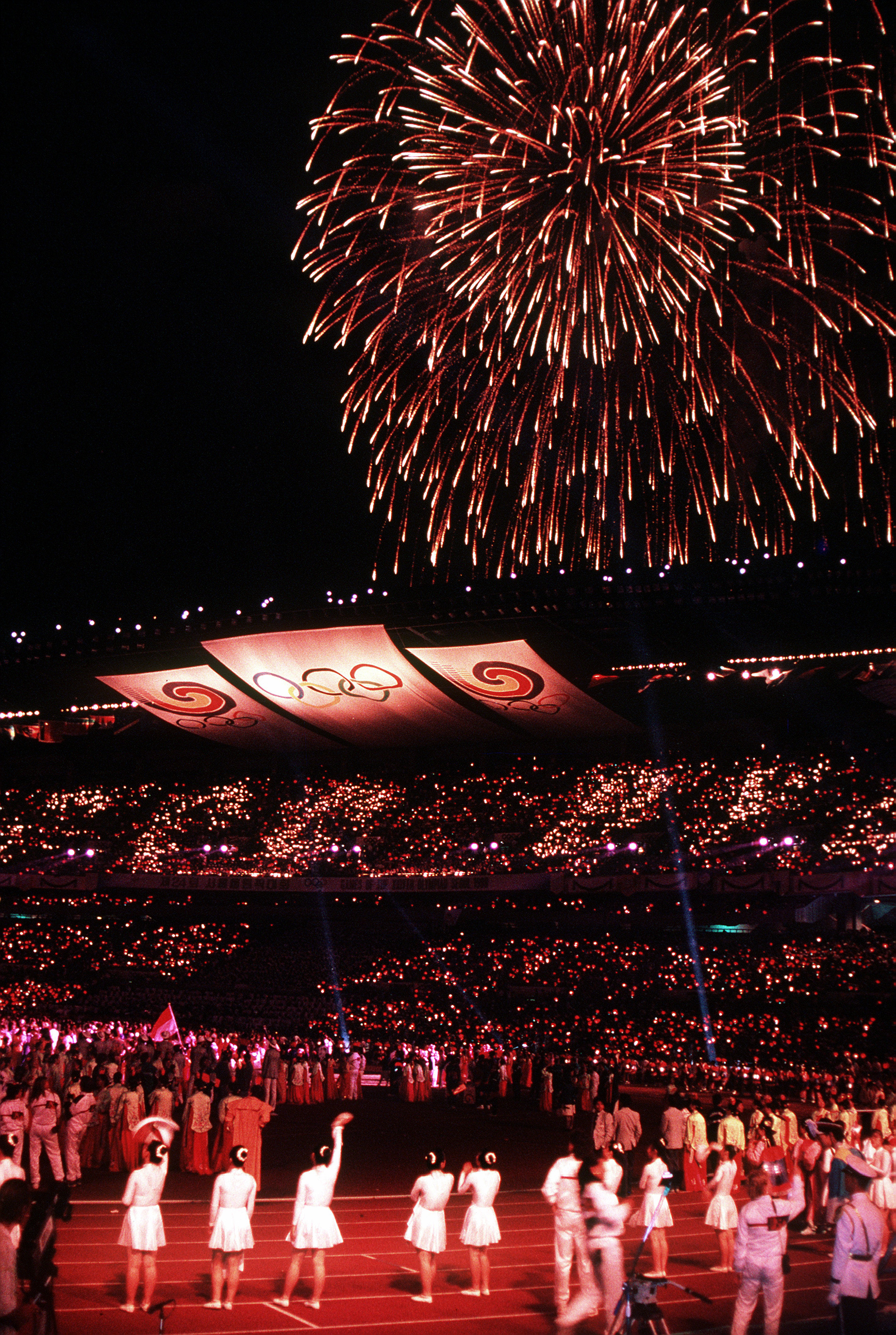
Live doves were released during the opening ceremony as a symbol of world peace, but a number of the doves were burned alive or suffered major trauma by the lighting of the Olympic cauldron. As a result of protests following the incident, the last time live doves were released during the opening ceremony was in 1992 in Barcelona, at the start of the ceremony. Balloon doves were released in 1994 Winter Olympics and the 1998 Winter Olympics and paper doves were used at the Atlanta Ceremony in 1996.
These were also the last Summer Olympic Games to hold the opening ceremony during the daytime. The opening ceremony featured a skydiving team descending over the stadium and forming the five-colored Olympic Rings, as well as a mass demonstration of taekwondo. The skydiving team trained at SkyDance SkyDiving and had hoped the opening ceremony appearance would set the stage for skydiving becoming a medal event by 2000.
Domestic historical significance

The idea for South Korea to place a bid for the 1988 Games emerged during the last days of the Park Chung Hee administration in the late 1970s, as hosting the Olympics was a big opportunity to bring international attention to South Korea. But before that, it was necessary to prove the country's capacity, as South Korea was seen as an exotic and risky destination for large events. The project continued to run even after President Park's assassination in 1979. With the successful staging of Miss Universe 1980, and the subsequent decision to host the 1986 Asian Games in Seoul, Chun Doo-hwan, Park's successor, submitted Korea's bid to the IOC in September 1981, in hopes that the increased international exposure brought by the Olympics would legitimize his authoritarian regime amidst increasing political pressure for democratization and less rigidity in state policies. Further, he hoped it would provide protection from increasing threats from North Korea, and showcase the economic strength that the country was experiencing to the world. Seoul was awarded the bid on 30 September 1981, becoming the 16th nation in the Summer Olympics, as well as the second Asian nation (following Japan in the 1964 Summer Olympics) and the first mainland Asian nation to host the Olympics.
Influenced by the model of 1964 Summer Olympics held in Tokyo, which served as a rite of passage for the Japanese economy and re-integration of Japan in the international community in the post-war era, the South Korean government hoped to use the Olympics as a "coming-out party". The Olympics gave a powerful impetus to the development of South Korea's relations with Eastern Europe, the Soviet Union and with China. In January 1982, South Korea's curfew that had been in place since 1945 was lifted.
In utilizing media events theory, Larson and Park investigated the Seoul Olympics as a form of political communication. They revealed the significance of South Korea's military government throughout the period of the Olympic bid and preparation, followed by the many advantages of the hosting the Games: rapid economic modernization, social mobilization and the legitimization of the military dictatorship.
Homeless camp expansion
Existing camps for "vagrants" (homeless persons) were ramped up before the 1988 Olympics. An Associated Press article states that homeless people and alcoholics, "but mostly children and the disabled" were arrested and sent to these camps to prepare for the Olympics. In addition, a prosecutor had his investigation into the Brothers Home camp limited at a number of levels of government "in part out of fear of an embarrassing international incident on the eve of the Olympics."
In 1975, the previous president of South Korea had begun a policy of rounding up vagrants. According to government documents obtained by the Associated Press, from 1981 to 1986 the number of people held increased from 8,600 to more than 16,000. Police officers often received promotions based on the number of vagrants they had arrested, and owners of facilities received a subsidy based on the number of people held. There were multiple reports of inmates raped or beaten, and sometimes beaten to death.
4,000 of these "vagrants" were held at the Brothers Home facility. Many of the guards were former inmates who had been "promoted" because of loyalty to the camp's owner. Various money-making operations were conducted such as manufacturing ball-point pens and fishing hooks, as well as clothing for Daewoo. Only a few inmates were paid belatedly for this work.
By accident while on a hunting trip, prosecutor Kim Yong-won heard about and visited a work detail of prisoners in ragged clothes overseen by guards with wooden bats and dogs. In his words, he knew immediately that "a very serious crime" was occurring, and in January 1987, he led a raid on the facility and found beaten and malnourished inmates. He was politically pressured at various levels to reduce the charges against the owner, managers, and guards. In the end, the owner only served years in prison.
The Brothers Home was a religious facility based on the Christian faith. There were, in fact, inspections by both city officials and church officials. However, these were scheduled inspections in which healthier inmates were presented in carefully planned and orchestrated circumstances. There were no unannounced inspections.
In the 1990s, construction workers found about 100 human bones on a mountainside outside the location of the former Brothers Home. Victims of the Brothers Home are seeking a government investigation into the crimes committed and accountability.
Boycott
Main article: 1988 Summer Olympics boycott

The games were boycotted by North Korea and its allies Cuba, Nicaragua, Ethiopia, and Madagascar.
North Korea had insisted upon co-hosting the Games, something that had been encouraged by Cuban president Fidel Castro, who called for North Korea to be considered joint host of the Games. On 8 and 9 January 1986 in Lausanne, Switzerland, the IOC President chaired a meeting of the North and South Korean Olympic Committees. North Korea demanded that eleven of the 23 Olympic sports be carried out on its territory, special opening and closing ceremonies, and a joint organizing committee and a united team. The negotiations were continued into another meeting, but were not successful.
North Korea then announced its boycott on September 3, 1988. The North Korean Central News Agency stated "this will leave another stain on Olympic history", and that "the 24th Olympic Games will be inevitably another crippled Olympiad where not all Olympic member states will participate".
Nicaragua had previously announced its intention to boycott on May 20, 1987. Moises Hassan Morales, the Nicaraguan NOC president, stated "if the 1988 Olympics are not carried out in Pyongyang and Seoul, the two Korean capitals, Nicaragua will not attend this event".
Cuba made its boycott announcement on January 16, 1988, where it stated "Cuba deeply laments this decision, but our people and our athletes live by profound ethical norms and a great sense of honor".
Ethiopia announced on January 20, 1988, that it would boycott the 1988 Summer Olympics in solidarity with North Korea, Cuba, Nicaragua, and Madagascar, which had all criticized the decision disallowing North Korea to jointly organize the Games. The Ethiopian NOC said "at a time when the Korean people, who are divided against their will, are struggling for peaceful negotiations, Ethiopia strongly objects to the Olympic Games being conducted in South Korea which further strengthens disunity", adding that Ethiopia would participate "if the decision to keep the games in South Korea were reversed".
The Seoul Olympic Organizing Committee (SLOOC) closed the receipt of final entry applications for athletics on September 8, 1988. Among the 161 NOCs which officially notified their intention to participate in the Olympics, Madagascar failed to send in an entry form by the closing date, thus, its athletes did not compete at the Games. According to the SLOOC, Madagascar did this "in support of North Korea's co-hosting request".
Albania and the Seychelles did not respond to the invitations sent by the IOC.
Official theme song
Main article: Hand in Hand (Olympic theme song)
The Seoul Olympic Organizing Committee (SLOOC) also produced and distributed an official song of the Seoul Games to publicize the Games to all National Olympic Committees, encouraging their participation and consolidating the idea of harmony and friendship of the entire world through the song. "Hand in Hand" was commissioned for the Italian composer Giorgio Moroder and the American songwriter Tom Whitlock, and was performed by local group Koreana.
Venues
Main article: Venues of the 1988 Summer Olympics
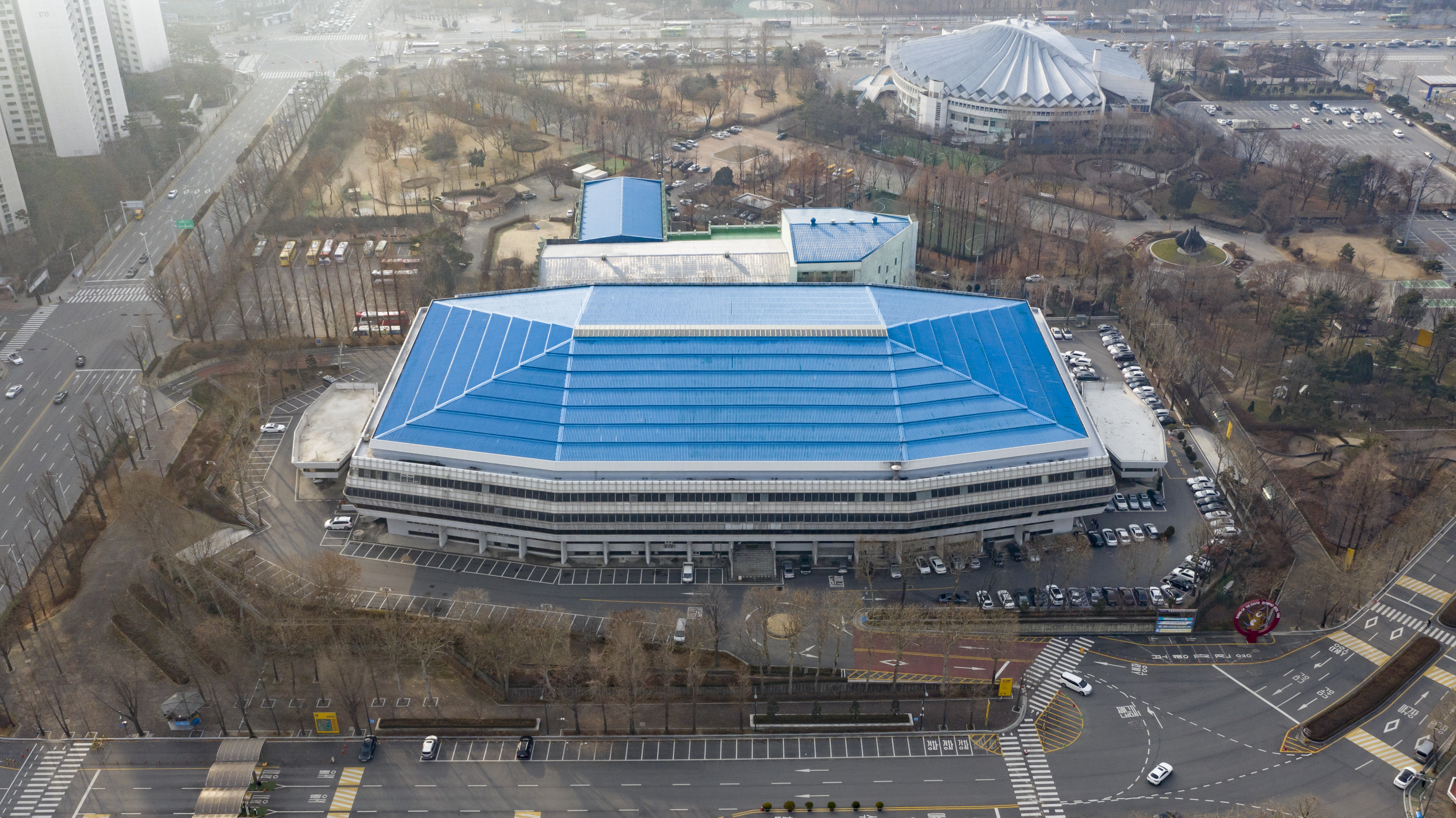
- Seoul Sports Complex venues
- Seoul Olympic Stadium – opening/closing ceremonies, athletics, equestrian (jumping individual final), football (final)
- Jamsil Indoor Swimming Pool – diving, modern pentathlon (swimming), synchronized swimming, swimming, water polo
- Jamsil Gymnasium – basketball, volleyball (final)
- Jamsil Students' Gymnasium – boxing
- Jamsil Baseball Stadium – baseball (demonstration)
- Olympic Park venues
- Olympic Velodrome – cycling (track)
- Olympic Weightlifting Gymnasium – weightlifting
- Olympic Fencing Gymnasium – fencing, modern pentathlon (fencing)
- Olympic Gymnastics Hall – gymnastics
- Olympic Tennis Center – tennis
- Mongchon Tosong – modern pentathlon (running)
- Other venues in metropolitan Seoul
- Seoul Equestrian Park– equestrian (all but jumping individual final), modern pentathlon (riding)
- Han River Regatta Course/Canoeing Site Course – canoeing, rowing
- Saemaul Sports Hall – volleyball preliminaries
- Hanyang University Gymnasium – volleyball preliminaries
- Changchung Gymnasium – judo, taekwondo (demonstration)
- Seoul National University Gymnasium – badminton (demonstration), table tennis
- Royal Bowling Center – bowling (demonstration)
- Dongdaemun Stadium – football preliminaries
- Hwarang Archery Field, Nowon District – archery
- Taenung International Shooting Range, Taenung – modern pentathlon (shooting), shooting
- Streets of Seoul – athletics (20 km/ 50 km walk, marathon)
- Jangchung Gymnasium – taekwondo (demonstration), judo
- Venues outside Seoul
- Sangmu Gymnasium, Seongnam – wrestling
- Daejeon Stadium, Daejeon – football preliminaries
- Daegu Stadium, Daegu – football preliminaries
- Busan Stadium, Busan – football preliminaries
- Gwangju Stadium, Gwangju – football preliminaries
- Suwon Gymnasium, Suwon – handball
- Seongnam Stadium, Seongnam – field hockey
- Busan Yachting Center, Busan – sailing
- Tongillo Road Course – cycling (individual road race, road team time trial)
Existing facilities modified or refurbished in preparation for the Olympic Games.
New facilities constructed in preparation for the Olympic Games.
Cost
According to The Oxford Olympics Study data is not available to establish the cost of the Seoul 1988 Summer Olympics. The cost of the stadium was 491 billion won, approximately US$354 million.
Sports
The 1988 Summer Olympics featured 23 different sports encompassing 31 disciplines, and medals were awarded in 237 events. In the list below, the number of events in each discipline is noted in parentheses.
Aquatics
- Road (3)
- Track (6)
- Dressage (2)
- Eventing (2)
- Show jumping (2)
- Artistic (14)
- Rhythmic (1)
- Freestyle (10)
- Greco-Roman (10)

Demonstration
- Women's
Exhibition
Badminton and bowling were held as exhibition sports, which did not require IOC approval and were not part of the official Olympic schedule.
Calendar
:All times are local KST (UTC+10) Note: between May 8 and October 9, 1988, all the clocks in the country were advanced by one hour as a test of the possibility of adopting the daylight summer time in the country in the future. This advance also enabled the development of a sports calendar in which the main events were scheduled to be broadcast in major Western markets in television prime time.
| ● | Opening ceremony | Event competitions | ● | Event finals | ● | Closing ceremony |
|---|
| Date | September | October | 17th | ||||||||||||||||||||||||||||||||||||||||||||||||||
|---|---|---|---|---|---|---|---|---|---|---|---|---|---|---|---|---|---|---|---|---|---|---|---|---|---|---|---|---|---|---|---|---|---|---|---|---|---|---|---|---|---|---|---|---|---|---|---|---|---|---|---|---|---|
| Sat | 18th | ||||||||||||||||||||||||||||||||||||||||||||||||||||
| Sun | 19th | ||||||||||||||||||||||||||||||||||||||||||||||||||||
| Mon | 20th | ||||||||||||||||||||||||||||||||||||||||||||||||||||
| Tue | 21st | ||||||||||||||||||||||||||||||||||||||||||||||||||||
| Wed | 22nd | ||||||||||||||||||||||||||||||||||||||||||||||||||||
| Thu | 23rd | ||||||||||||||||||||||||||||||||||||||||||||||||||||
| Fri | 24th | ||||||||||||||||||||||||||||||||||||||||||||||||||||
| Sat | 25th | ||||||||||||||||||||||||||||||||||||||||||||||||||||
| Sun | 26th | ||||||||||||||||||||||||||||||||||||||||||||||||||||
| Mon | 27th | ||||||||||||||||||||||||||||||||||||||||||||||||||||
| Tue | 28th | ||||||||||||||||||||||||||||||||||||||||||||||||||||
| Wed | 29th | ||||||||||||||||||||||||||||||||||||||||||||||||||||
| Thu | 30th | ||||||||||||||||||||||||||||||||||||||||||||||||||||
| Fri | 1st | ||||||||||||||||||||||||||||||||||||||||||||||||||||
| Sat | 2nd | ||||||||||||||||||||||||||||||||||||||||||||||||||||
| Sun | Total gold medals | 5 | 7 | 9 | 14 | 17 | 12 | 30 | 26 | 9 | 15 | 9 | 11 | 36 | 37 | 9 | Date | 17th | |||||||||||||||||||||||||||||||||||
| Sat | 18th | ||||||||||||||||||||||||||||||||||||||||||||||||||||
| Sun | 19th | ||||||||||||||||||||||||||||||||||||||||||||||||||||
| Mon | 20th | ||||||||||||||||||||||||||||||||||||||||||||||||||||
| Tue | 21st | ||||||||||||||||||||||||||||||||||||||||||||||||||||
| Wed | 22nd | ||||||||||||||||||||||||||||||||||||||||||||||||||||
| Thu | 23rd | ||||||||||||||||||||||||||||||||||||||||||||||||||||
| Fri | 24th | ||||||||||||||||||||||||||||||||||||||||||||||||||||
| Sat | 25th | ||||||||||||||||||||||||||||||||||||||||||||||||||||
| Sun | 26th | ||||||||||||||||||||||||||||||||||||||||||||||||||||
| Mon | 27th | ||||||||||||||||||||||||||||||||||||||||||||||||||||
| Tue | 28th | ||||||||||||||||||||||||||||||||||||||||||||||||||||
| Wed | 29th | ||||||||||||||||||||||||||||||||||||||||||||||||||||
| Thu | 30th | ||||||||||||||||||||||||||||||||||||||||||||||||||||
| Fri | 1st | ||||||||||||||||||||||||||||||||||||||||||||||||||||
| Sat | 2nd | ||||||||||||||||||||||||||||||||||||||||||||||||||||
| Sun | September | October | |||||||||||||||||||||||||||||||||||||||||||||||||||
| Archery | ● ● | ● ● | |||||||||||||||||||||||||||||||||||||||||||||||||||
| Athletics | ● | ||||||||||||||||||||||||||||||||||||||||||||||||||||
| ● ● | ● | ||||||||||||||||||||||||||||||||||||||||||||||||||||
| ● ● | ● ● | ||||||||||||||||||||||||||||||||||||||||||||||||||||
| ● ● ● | ● ● ● ● | ||||||||||||||||||||||||||||||||||||||||||||||||||||
| ● ● ● ● | ● ● ● | ||||||||||||||||||||||||||||||||||||||||||||||||||||
| ● ● | ● ● | ||||||||||||||||||||||||||||||||||||||||||||||||||||
| ● ● | ● ● | ||||||||||||||||||||||||||||||||||||||||||||||||||||
| ● ● | ● ● ● | ||||||||||||||||||||||||||||||||||||||||||||||||||||
| ● ● ● | |||||||||||||||||||||||||||||||||||||||||||||||||||||
| ● ● ● | ● | ||||||||||||||||||||||||||||||||||||||||||||||||||||
| Basketball | ● | ● | |||||||||||||||||||||||||||||||||||||||||||||||||||
| Boxing | ● ● ● | ||||||||||||||||||||||||||||||||||||||||||||||||||||
| ● ● ● | ● ● ● | ||||||||||||||||||||||||||||||||||||||||||||||||||||
| ● ● ● | |||||||||||||||||||||||||||||||||||||||||||||||||||||
| Canoeing | ● ● ● | ||||||||||||||||||||||||||||||||||||||||||||||||||||
| ● ● ● | ● ● ● | ||||||||||||||||||||||||||||||||||||||||||||||||||||
| ● ● ● | |||||||||||||||||||||||||||||||||||||||||||||||||||||
| Cycling | ● | ● | ● | ● ● | |||||||||||||||||||||||||||||||||||||||||||||||||
| ● ● | ● | ● | |||||||||||||||||||||||||||||||||||||||||||||||||||
| Diving | ● | ● | ● | ● | |||||||||||||||||||||||||||||||||||||||||||||||||
| Equestrian | ● ● | ● | ● | ● | ● | ||||||||||||||||||||||||||||||||||||||||||||||||
| Fencing | ● | ● | ● | ● | ● | ● | ● | ● | |||||||||||||||||||||||||||||||||||||||||||||
| Field hockey | ● | ● | |||||||||||||||||||||||||||||||||||||||||||||||||||
| Football (soccer) | ● | ||||||||||||||||||||||||||||||||||||||||||||||||||||
| Gymnastics | ● | ● | ● | ● | ● ● ● | ||||||||||||||||||||||||||||||||||||||||||||||||
| ● ● ● | ● ● | ||||||||||||||||||||||||||||||||||||||||||||||||||||
| ● ● | ● | ||||||||||||||||||||||||||||||||||||||||||||||||||||
| Handball | ● | ● | |||||||||||||||||||||||||||||||||||||||||||||||||||
| Judo | ● | ● | ● | ● | ● | ● | ● | ||||||||||||||||||||||||||||||||||||||||||||||
| Modern pentathlon | ● ● | ||||||||||||||||||||||||||||||||||||||||||||||||||||
| Rowing | ● ● | ||||||||||||||||||||||||||||||||||||||||||||||||||||
| ● ● | |||||||||||||||||||||||||||||||||||||||||||||||||||||
| ● ● ● | ● ● | ||||||||||||||||||||||||||||||||||||||||||||||||||||
| ● ● | |||||||||||||||||||||||||||||||||||||||||||||||||||||
| ● ● ● | |||||||||||||||||||||||||||||||||||||||||||||||||||||
| Sailing | ● ● ● ● | ||||||||||||||||||||||||||||||||||||||||||||||||||||
| ● ● ● ● | |||||||||||||||||||||||||||||||||||||||||||||||||||||
| Shooting | ● ● | ● ● | ● ● | ● ● | ● | ● ● | ● ● | ||||||||||||||||||||||||||||||||||||||||||||||
| Swimming | ● ● | ||||||||||||||||||||||||||||||||||||||||||||||||||||
| ● ● | ● ● | ||||||||||||||||||||||||||||||||||||||||||||||||||||
| ● ● ● | ● ● | ||||||||||||||||||||||||||||||||||||||||||||||||||||
| ● ● ● | ● ● | ||||||||||||||||||||||||||||||||||||||||||||||||||||
| ● ● ● | ● ● ● | ||||||||||||||||||||||||||||||||||||||||||||||||||||
| ● ● ● | ● ● ● | ||||||||||||||||||||||||||||||||||||||||||||||||||||
| ● ● ● | |||||||||||||||||||||||||||||||||||||||||||||||||||||
| Synchronized swimming | ● | ● | |||||||||||||||||||||||||||||||||||||||||||||||||||
| Table tennis | ● ● | ● ● | |||||||||||||||||||||||||||||||||||||||||||||||||||
| Tennis | ● ● | ● ● | |||||||||||||||||||||||||||||||||||||||||||||||||||
| Volleyball | ● | ● | |||||||||||||||||||||||||||||||||||||||||||||||||||
| Water polo | ● | ||||||||||||||||||||||||||||||||||||||||||||||||||||
| Weightlifting | ● | ● | ● | ● | ● | ● | ● | ● | ● | ● | |||||||||||||||||||||||||||||||||||||||||||
| Wrestling | ● | ||||||||||||||||||||||||||||||||||||||||||||||||||||
| ● ● | ● ● | ||||||||||||||||||||||||||||||||||||||||||||||||||||
| ● ● | ● | ||||||||||||||||||||||||||||||||||||||||||||||||||||
| ● ● | ● | ||||||||||||||||||||||||||||||||||||||||||||||||||||
| ● ● | ● | ||||||||||||||||||||||||||||||||||||||||||||||||||||
| ● ● | ● ● | ||||||||||||||||||||||||||||||||||||||||||||||||||||
| ● ● | |||||||||||||||||||||||||||||||||||||||||||||||||||||
| Ceremonies | [●](1988-summer-olympics-opening-ceremony) | [●](1988-summer-olympics-closing-ceremony) |
Participating National Olympic Committees


Athletes from 160 nations competed at the Seoul Games. Aruba, American Samoa, Brunei, Cook Islands, Maldives, Vanuatu, Saint Vincent and the Grenadines, and South Yemen made their first Olympic appearance at these Games. Guam made their first Summer Olympic appearance at these games having participated in the 1988 Winter Olympics in Calgary.
In the following list, the number in parentheses indicates the number of athletes from each nation that competed in Seoul:{{cite web |access-date = 7 October 2007 |url-status = dead |archive-url = https://web.archive.org/web/20071012133414/http://olympic-museum.de/part_count/1988.htm |archive-date = 12 October 2007
| Participating National Olympic Committees |
|---|
- When the team from the Dominican Republic marched in during the Parade of Nations, the superimposed map erroneously showed the location of Cuba, a nation that did not take part at the Games.
Number of athletes by National Olympic Committee
8,453 athletes from 159 NOCs
| IOC Letter Code | Country | Athletes |
|---|---|---|
| AFG | AFG | 5 |
| ALG | ALG | 42 |
| ASA | ASA | 6 |
| AND | AND | 3 |
| ANG | ANG | 24 |
| ANT | ANT | 15 |
| ARG | ARG | 118 |
| ARU | ARU | 8 |
| AUS | AUS | 252 |
| AUT | AUT | 73 |
| BAH | BAH | 16 |
| BRN | BRN | 7 |
| BAN | BAN | 6 |
| BAR | BAR | 17 |
| BEL | BEL | 59 |
| BIZ | BIZ | 10 |
| BEN | BEN | 7 |
| BER | BER | 12 |
| BHU | BHU | 3 |
| BOL | BOL | 7 |
| BOT | BOT | 8 |
| BRA | BRA | 160 |
| IVB | IVB | 3 |
| BUL | BUL | 172 |
| BUR | BUR | 6 |
| BRU | BRU | 0 |
| BIR | BIR | 2 |
| CMR | CMR | 15 |
| CAN | CAN | 328 |
| CAY | CAY | 8 |
| CAF | CAF | 15 |
| CHA | CHA | 6 |
| CHI | CHI | 17 |
| CHN | CHN | 273 |
| COL | COL | 40 |
| CGO | CGO | 7 |
| COK | COK | 7 |
| CRC | CRC | 16 |
| CYP | CYP | 9 |
| TCH | TCH | 163 |
| DEN | DEN | 78 |
| DJI | DJI | 6 |
| DOM | DOM | 16 |
| ECU | ECU | 13 |
| EGY | EGY | 49 |
| ESA | ESA | 6 |
| GEQ | GEQ | 6 |
| FIJ | FIJ | 23 |
| FIN | FIN | 78 |
| FRA | FRA | 266 |
| GAB | GAB | 2 |
| GAM | GAM | 6 |
| GDR | GDR | 259 |
| FRG | FRG | 347 |
| PLE | GHA | 16 |
| GBR | GBR | 345 |
| GRE | GRE | 56 |
| GRN | GRN | 6 |
| GUM | GUM | 19 |
| GUA | GUA | 28 |
| GUI | GUI | 6 |
| GUY | GUY | 8 |
| HAI | HAI | 4 |
| HON | HON | 8 |
| HKG | HKG | 48 |
| HUN | HUN | 188 |
| ISL | ISL | 32 |
| IND | IND | 46 |
| INA | INA | 29 |
| IRN | IRI | 23 |
| IRQ | IRQ | 27 |
| IRL | IRL | 61 |
| ISR | ISR | 18 |
| ITA | ITA | 253 |
| CIV | CIV | 28 |
| JAM | JAM | 35 |
| JPN | JPN | 255 |
| JOR | JOR | 7 |
| KEN | KEN | 74 |
| KOR | KOR | 401 |
| KUW | KUW | 25 |
| LAO | LAO | 3 |
| LIB | LIB | 21 |
| LES | LES | 6 |
| LBR | LBR | 8 |
| LBA | LBA | 6 |
| LIE | LIE | 12 |
| LUX | LUX | 8 |
| MAW | MAW | 16 |
| MAS | MAS | 9 |
| MDV | MDV | 7 |
| MLI | MLI | 6 |
| MLT | MLT | 6 |
| MTN | MTN | 6 |
| MRI | MRI | 8 |
| MEX | MEX | 83 |
| MON | MON | 9 |
| MGL | MGL | 28 |
| MAR | MAR | 27 |
| MOZ | MOZ | 8 |
| NEP | NEP | 16 |
| HOL | NED | 147 |
| AHO | AHO | 3 |
| NZL | NZL | 83 |
| NIG | NIG | 6 |
| NGR | NGR | 69 |
| NOR | NOR | 69 |
| OMA | OMA | 8 |
| PAK | PAK | 30 |
| PAN | PAN | 6 |
| NGU | PNG | 11 |
| PAR | PAR | 10 |
| PER | PER | 21 |
| PHI | PHI | 31 |
| POL | POL | 143 |
| POR | POR | 65 |
| PUR | PUR | 47 |
| QAT | QAT | 10 |
| ROM | ROM | 68 |
| RWA | RWA | 6 |
| VIN | VIN | 6 |
| SMR | SMR | 11 |
| KSA | KSA | 9 |
| SEN | SEN | 23 |
| SLE | SLE | 12 |
| SIN | SIN | 8 |
| SOL | SOL | 4 |
| SOM | SOM | 5 |
| URS | URS | 481 |
| ESP | ESP | 229 |
| SRI | SRI | 6 |
| SUD | SUD | 8 |
| SUR | SUR | 6 |
| SWZ | SWZ | 11 |
| SWE | SWE | 184 |
| SUI | SUI | 99 |
| SYR | SYR | 13 |
| TPE | TPE | 61 |
| TAN | TAN | 10 |
| THA | THA | 14 |
| TOG | TOG | 6 |
| TGA | TGA | 5 |
| TRI | TRI | 6 |
| TUN | TUN | 41 |
| TUR | TUR | 41 |
| UGA | UGA | 24 |
| UAE | UAE | 12 |
| USA | USA | 527 |
| URU | URU | 15 |
| VAN | VAN | 4 |
| VEN | VEN | 17 |
| VIE | VIE | 9 |
| ISV | ISV | 22 |
| WSM | WSM | 11 |
| YAR | YAR | 8 |
| YMD | YMD | 5 |
| YUG | YUG | 155 |
| ZAI | ZAI | 15 |
| ZAM | ZAM | 29 |
| ZIM | ZIM | 29 |
Medal table
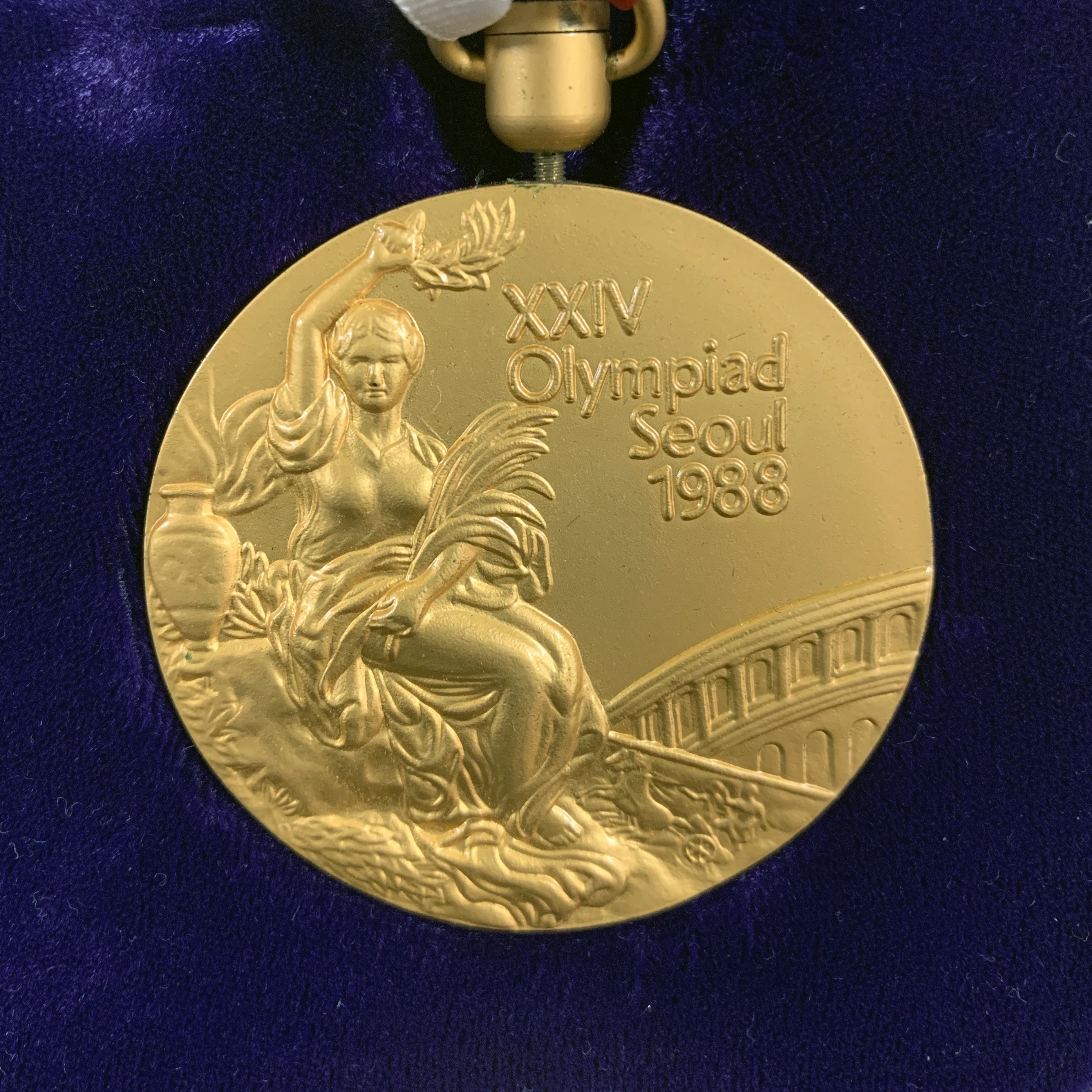
Main article: 1988 Summer Olympics medal table
These are the top ten nations that won medals at the 1988 Games.
Mascot
The official mascot for the 1988 Summer Olympic Games was Hodori. It was a stylized tiger designed by Kim Hyun as an amicable Amur tiger, portraying the friendly and hospitable traditions of the Korean people.{{cite web |access-date = 8 October 2007 |archive-url = https://web.archive.org/web/20071011224332/http://en.beijing2008.com/07/74/article211987407.shtml |archive-date = 11 October 2007 |url-status = dead | access-date =8 October 2007 }}
The name 호돌이 Hodori was chosen from 2,295 suggestions sent in by the public. It is a compound of 호 ho, the Sino-Korean bound morpheme for "tiger" (appearing also in the usual word 호랑이 horangi for "tiger"), and 돌이 dori, a diminutive for "boys".
Broadcasting
In the United States, NBC became the telecast provider hereafter for the Summer Games, after a five-Olympics run by the American Broadcasting Company from 1968 to 1984.
NBC's coverage was their first sporting event to feature the new Quantel Cypher to generate the on-screen graphics. However, the network would continue to use Chyron Corporation for the rest of the year with Quantel being used again for the 1988 World Series. The Cypher would be implemented permanently starting with Super Bowl XXIII in January 1989.
Doping
| Name | Country | Sport | Banned substance | Medals | Ref. | ||||||||
|---|---|---|---|---|---|---|---|---|---|---|---|---|---|
| Ali Dad | AFG | Wrestling | Furosemide | ||||||||||
| Kerrith Brown | GBR | Judo | Furosemide | (71 kg) | |||||||||
| Kalman Csengeri | HUN | Weightlifting | Stanozolol | ||||||||||
| Mitko Grablev | BUL | Weightlifting | Furosemide | (56 kg) | |||||||||
| Angell Guenchev | BUL | Weightlifting | Furosemide | (67.5 kg) | |||||||||
| Ben Johnson | CAN | Athletics | Stanozolol | (men's 100 m) | last=Butler | first=Mark | date=2015 | title=IAAF World Championships Beijing 2015 Statistics Handbook | url=http://iaaf-ebooks.s3.amazonaws.com/2015/Beijing-2015-Statistics-Handbook/index.htm | location=Monaco | publisher=IAAF | chapter=Doping violations Olympic Athletics | pages=419–420}} |
| Fernando Mariaca | ESP | Weightlifting | Pemoline | ||||||||||
| Jorge Quesada | ESP | Modern pentathlon | Propranolol | ||||||||||
| Andor Szanyi | HUN | Weightlifting | Stanozolol | (100 kg) | |||||||||
| Alexander Watson | AUS | Modern Pentathlon | Caffeine |
In 2003, Wade Exum, the United States Olympic Committee's director of drug control administration from 1991 to 2000, released documents that showed Carl Lewis had tested positive three times at the 1988 United States Olympic trials for minimum amounts of pseudoephedrine, ephedrine, and phenylpropanolamine, which were banned stimulants. Bronchodilators are also found in cold medication. Due to the rules, his case could have led to disqualification from the Seoul Olympics and suspension from competition for six months. The levels of the combined stimulants registered in the separate tests were 2 ppm, 4 ppm and 6 ppm. Lewis defended himself, claiming that he had accidentally consumed the banned substances. After the supplements that he had taken were analyzed to prove his claims, the USOC accepted his claim of inadvertent use, since a dietary supplement he ingested was found to contain "Ma huang", the Chinese name for Ephedra (ephedrine is known to help weight loss). Fellow Santa Monica Track Club teammates Joe DeLoach and Floyd Heard were also found to have the same banned stimulants in their systems, and were cleared to compete for the same reason. The highest level of the stimulants Lewis recorded was 6 ppm, which was regarded as a positive test in 1988 but is now regarded as negative test. The acceptable level has been raised to ten parts per million for ephedrine and twenty-five parts per million for other substances. According to the IOC rules at the time, positive tests with levels lower than 10 ppm were cause of further investigation but not immediate ban. Neal Benowitz, a professor of medicine at UC San Francisco who is an expert on ephedrine and other stimulants, agreed that "These [levels] are what you'd see from someone taking cold or allergy medicines and are unlikely to have any effect on performance." Following Exum's revelations the IAAF acknowledged that at the 1988 Olympic Trials the USOC indeed followed the correct procedures in dealing with eight positive findings for ephedrine and ephedrine-related compounds in low concentration. Additionally, in 1988 the federation reviewed the relevant documents with the athletes' names undisclosed and stated that "the medical committee felt satisfied, however, on the basis of the information received that the cases had been properly concluded by the USOC as 'negative cases' in accordance with the rules and regulations in place at the time and no further action was taken".
References
References
- (9 October 2014). "Factsheet – Opening Ceremony of the Games of the Olympiad". International Olympic Committee.
- "Seoul 1988 Torch Relay".
- (30 September 1981). "Seoul surprises Nagoya for Olympic bid". UPI.
- (September 17, 1989). "Official Report of the Games of the XXIVth Olympiad Seoul 1988". Seoul Olympic Organizing Committee.
- (1996). "Historical Dictionary of the Modern Olympic Movement". Greenwood Publishing Group.
- (25 June 2020). "Seoul 1988: South Korea opens up to the world".
- Randy Harvey. (September 14, 1988). "OLYMPICS '88: A PREVIEW : THE HOST CITY : Seoul Rises From Ashes to Become Metropolitan Center of Distinction". Los Angeles Times.
- Bridges, Brian. (2008-12-01). "The Seoul Olympics: Economic Miracle Meets the World". The International Journal of the History of Sport.
- "Vote History". IOC.
- "Past Olympic host city election results". [[GamesBids]].
- "第10届亚运会概况—1986年汉城亚运会".
- "Honored Inductees – Vladimir Artemov". [[International Gymnastics Hall of Fame.
- (23 June 2004). "World Sport – Florence Griffith-Joyner". CNN.
- Praderio, Caroline. (23 August 2016). "There are 2 prestigious awards named for the founder of the modern Olympic movement – here are 8 athletes who have won them".
- "Christa Luding-Rothenburger Encyclopædia Britannica article".
- (29 May 2008). "Odds against Phelps eclipsing Spitz". Reuters.
- "United States Olympic Committee – Biondi, Matt". [[United States Olympic Committee.
- "The Original Dream Team". [[National Basketball Association.
- (April 8, 1989). "Federation Rule Change Opens Olympics to N.B.A. Players". [[The New York Times]].
- "History of basketball at Olympics: A tale of American domination".
- Mamet, David. (7 October 1988). "In Losing, a Boxer Won". The New York Times.
- (26 September 1997). "Sports of The Times – Nice Gesture Substitutes For Justice".
- (13 April 2009). "Lennox Lewis vs Riddick Bowe 88 Olympic Final".
- (12 August 2004). "When messengers of peace were burned alive".
- "Demo Jumps".
- Natt, Lorena. (5 September 1988). "Skydivers aiming to elevate sport with Olympic jump". [[The Orange County Register]].
- "The 'East Asian' Olympic Games: what of sustainable legacies?". Taylor and Francis.
- (1990). "Rites of Passage: The 1988 Seoul Olympics as Public Diplomacy". Western Political Science Association.
- (2012). "The sociocultural legacy of the 1988 Seoul Olympic Games". Leisure Studies.
- Tracy Dahl. (January 18, 1982). "S. Koreans Enjoy Nights Without Curfew". The Washington Post.
- (2011). "The Beijing National Stadium as Media-space". Design and Culture.
- Kim, Tong-Hyung. (20 April 2016). "AP: S. Korea covered up mass abuse, killings of 'vagrants'". Associated Press News.
- Hong, Sukjung. (21 August 2016). "The Heinous Olympification of Seoul".
- Hancocks, Paula. (October 25, 2016). "South Korea's shame: Child victims of Brothers Home abuse still searching for justice".
- Radchenko, Sergey. (December 12, 2011). "Sport and Politics on the Korean Peninsula – North Korea and the 1988 Seoul Olympic". wilsoncenter.org.
- (July 26, 2017). "1987 IAAF World Track and Field Championships - Day 9".
- (September 3, 1988). "North Korea Announces Olympic Boycott". UPI.
- (May 20, 1987). "Nicaragua Conditions Its Attendance at Olympic Games". UPI.
- (January 16, 1988). "Cuba, Following the Lead of North Korea, Will Not Participate in Seoul's Summer Olympic Games". UPI.
- (January 20, 1988). "Ethiopia Says It Will Boycott Seoul Olympics". UPI.
- (2016). "The Oxford Olympics Study 2016: Cost and Cost Overrun at the Games". Saïd Business School Working Papers (Oxford: University of Oxford).
- (2018-07-25). "Competition Management by Sport".
- (14 January 2014). "[1/3] Opening Ceremony – 1988 Seoul Olympic Games".
- [https://www.insidethegames.biz/articles/1028410/brown-steps-down-as-british-judo-association-chairman-to-become-president-of-ufc-partner-immaf Brown steps down as British Judo Association chairman to become President of UFC partner IMMAF]
- Butler, Mark. (2015). "IAAF World Championships Beijing 2015 Statistics Handbook". IAAF.
- Abrahamson, Alan. (April 23, 2003). "Just a Dash of Drugs in Lewis, DeLoach". Los Angeles Times.
- Pete McEntegart. (April 14, 2003). "Scorecard".
- (April 18, 2003). "Carl Lewis's positive test covered up". [[The Sydney Morning Herald]].
- Wallechinsky and Loucky, The Complete Book of the Olympics (2012 edition), page 61.
- (April 30, 2003). "IAAF: USOC followed rules over dope tests".
- Abrahamson, Alan. (May 1, 2003). "USOC's Actions on Lewis Justified by IAAF". Los Angeles Times.
This article was imported from Wikipedia and is available under the Creative Commons Attribution-ShareAlike 4.0 License. Content has been adapted to SurfDoc format. Original contributors can be found on the article history page.
Ask Mako anything about 1988 Summer Olympics — get instant answers, deeper analysis, and related topics.
Research with MakoFree with your Surf account
Create a free account to save articles, ask Mako questions, and organize your research.
Sign up freeThis content may have been generated or modified by AI. CloudSurf Software LLC is not responsible for the accuracy, completeness, or reliability of AI-generated content. Always verify important information from primary sources.
Report