From Surf Wiki (app.surf) — the open knowledge base
1979 oil crisis
Worldwide increase in crude oil prices following the Iranian Revolution
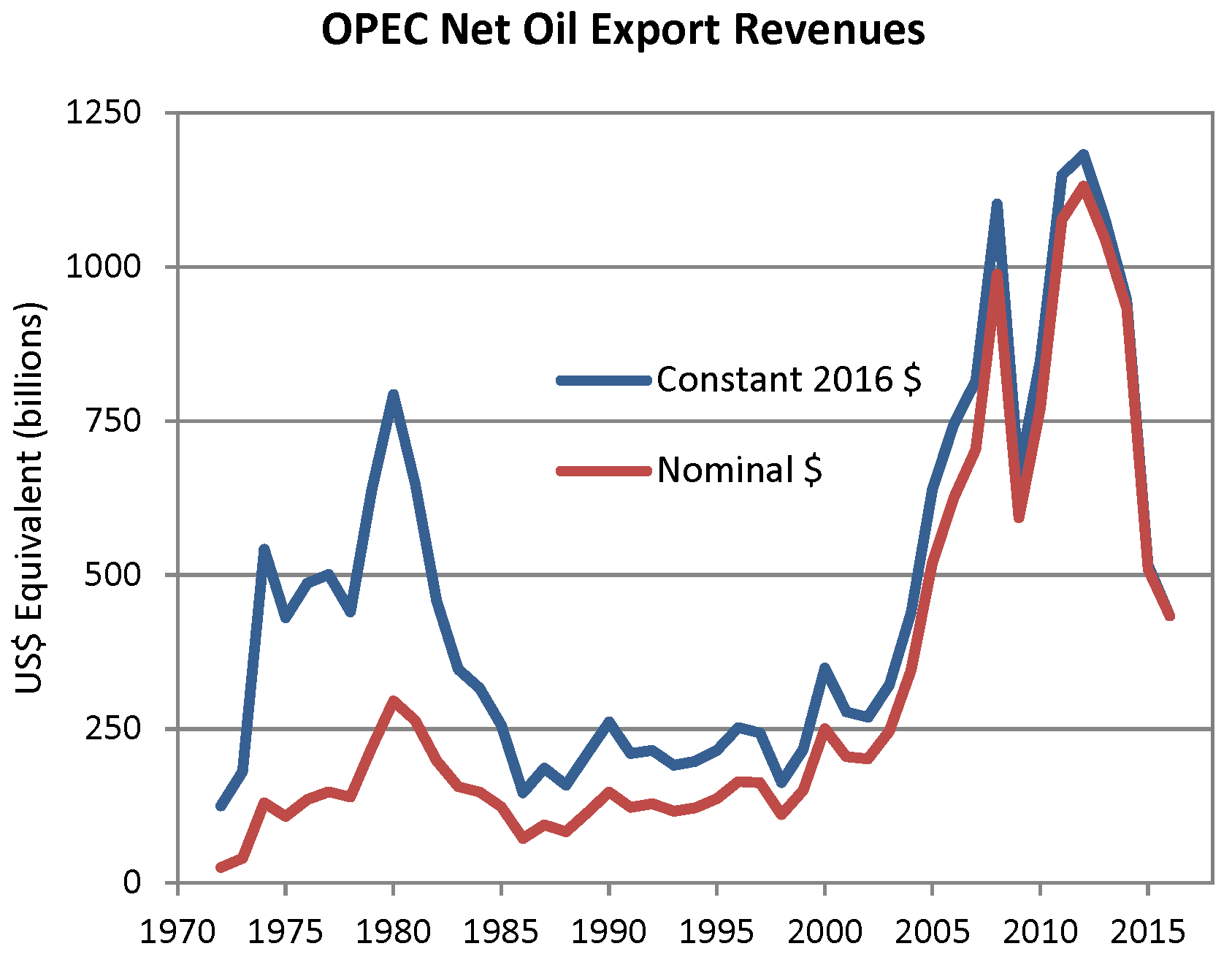
Worldwide increase in crude oil prices following the Iranian Revolution
| Field | Value |
|---|---|
| Event_Name | 1979 oil crisis |
| Image_Name | Top Oil Producing Countries.png |
| Image_Caption | Graph of top oil-producing countries, showing drop in Iran's production |
| AKA | Second oil crisis |
| Date | – |
The 1979 oil crisis, sometimes referred to as the second oil crisis (in reference to the 1973 oil crisis), refers to the drop in oil production in the aftermath of the Iranian Revolution led to an energy crisis in 1979. Although the global oil supply only decreased by approximately four percent, the oil markets' reaction raised the price of crude oil drastically over the next 12 months, more than doubling it to 39.50 $/oilbbl. The sudden increase in price was connected with fuel shortages similar to the 1973 oil crisis.
In 1980, following the onset of the Iran–Iraq War, oil production in Iran fell drastically. Iraq's oil production also dropped significantly, triggering economic recessions worldwide. Oil prices did not return to pre-crisis levels until the mid-1980s.
Oil prices after 1980 began a steady decline over the next 20 years, except for a brief uptick during the Gulf War, which then reached a 60% fall-off in the 1990s. Mexico, Nigeria, and Venezuela's major oil exporters expanded their production during this time. The Soviet Union became the largest oil producer in the world, and oil from the North Sea and Alaska flooded the market.
Iran
In November 1978, a strike consisting of 37,000 workers at Iran's nationalized oil refineries reduced production from 6 Moilbbl per day to about 1.5 Moilbbl.{{cite news | archive-url=https://web.archive.org/web/20090114084508/http://www.time.com/time/magazine/article/0,9171,946149,00.html | url-status=dead | archive-date=January 14, 2009 |access-date=December 5, 2009
On January 16, 1979, the Shah of Iran, Mohammad Reza Pahlavi, and his wife, Farah Pahlavi, left Iran at the behest of Prime Minister Shapour Bakhtiar, who sought to calm the situation.{{cite web |access-date=December 5, 2009
Effects
Other OPEC members
The rise in oil prices benefited a few members of the Organization of Petroleum-Exporting Countries (OPEC), which made record profits. Under the new Iranian government, oil exports later resumed but production was inconsistent and at a lower volume, further raising prices. Saudi Arabia and other OPEC nations, under the presidency of Mana Al Otaiba, increased production to offset most of the decline, and by early 1979 the overall loss in worldwide production was roughly four percent.
The war between Iran and Iraq in 1980 caused a further 7 percent drop in worldwide production and OPEC production was surpassed by other exporters such as the United States as its member nations were divided amongst themselves. Saudi Arabia, a "swing producer", tried to gain back the market share after 1985, increasing production and causing downward pressure on prices, making high-cost oil production facilities less profitable.
United States
The oil crisis had a mixed impact on the United States. Richard Nixon had imposed price controls on domestic oil as a result of the 1973 oil crisis. Since then, gasoline price controls had been repealed, but those on domestic oil remained.
The Jimmy Carter administration began a phased deregulation of oil prices on April 5, 1979, when the average price of crude oil was US15.85 $/oilbbl. Starting with the Iranian revolution, the price of crude oil rose to 39.50 $/oilbbl over the next 12 months (its all-time highest real price until March 3, 2008). Deregulating domestic oil price controls allowed U.S. oil output to rise sharply from the large Prudhoe Bay fields, while oil imports fell sharply.
Although not directly related, the near-disaster at Three Mile Island on March 28, 1979, also increased anxiety about energy policy and availability. Due to memories of the oil shortage in 1973, motorists soon began panic buying, and long lines appeared at gas stations, as they had six years earlier. The average vehicle of the time consumed between two and three liters (about 0.5–0.8 gallons) of gasoline an hour while idling, and it was estimated that Americans wasted up to 150000 oilbbl of oil per day idling their engines in the lines at gas stations.
The amount of oil sold in the United States in 1979 was only 3.5 percent less than the record set for oil sold the previous year. | access-date = November 7, 2008 | archive-url= https://web.archive.org/web/20081006194546/http://www.jewishworldreview.com/cols/sowell110502.asp| archive-date= October 6, 2008 | url-status= live}} A telephone poll of 1,600 American adults conducted by the Associated Press and NBC News and released in early May 1979 found that only 37 percent of Americans thought the energy shortages were real, nine percent were not sure, and 54 percent thought the energy shortages were a hoax.
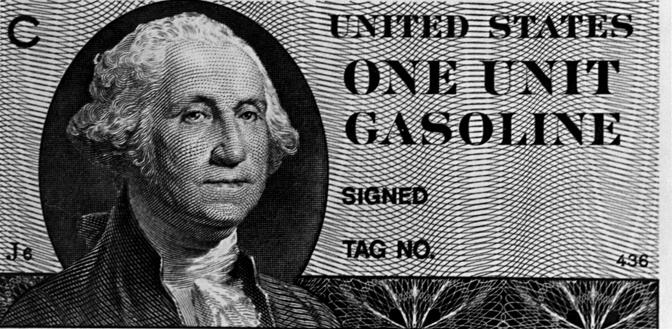
Many politicians proposed gas rationing. One such proponent was Harry Hughes, Governor of Maryland, who proposed odd-even rationing (only people with an odd-numbered license plate could purchase gas on an odd-numbered day), as was used during the 1973 Oil Crisis. Several states implemented odd-even gas rationing, including California, Pennsylvania, New York, New Jersey, Oregon, and Texas. Coupons for gasoline rationing were printed but were never actually used during the 1979 crisis.
On July 15, 1979, President Carter outlined his plans to reduce oil imports and improve energy efficiency in his "Crisis of Confidence" speech (sometimes known as the "malaise" speech). In the speech, Carter encouraged citizens to do what they could to reduce their use of energy. He had already installed water tank heating solar panels on the roof of the White House and a wood-burning stove in the living quarters. However, the panels were removed in 1986, reportedly for roof maintenance, during the administration of his successor, Ronald Reagan.
A speech Carter gave in April 1977 argued the oil crisis was "the moral equivalent of war". In November 1979, Iranian revolutionaries seized the American Embassy, and Carter imposed an embargo on Iranian oil. In January 1980, he issued the Carter Doctrine, declaring: "An attempt by any outside force to gain control of the Persian Gulf region will be regarded as an assault on the vital interests of the United States". Additionally, as part of his administration's efforts at deregulation, Carter proposed removing price controls that had been imposed by the Richard Nixon administration before the 1973 crisis. Carter agreed to remove price controls in phases. They were finally fully dismantled in 1981 under Reagan. Carter also said he would impose a windfall profit tax on oil companies. | access-date = November 6, 2008 |url-status=dead |archive-url= https://web.archive.org/web/20090205174122/http://www.taxhistory.org/thp/readings.nsf/cf7c9c870b600b9585256df80075b9dd/edf8de04e58e4b14852570ba0048848b |archive-date= Feb 5, 2009 }} While the regulated price of domestic oil was kept to $6 a barrel, the world market price was $30.
In 1980, the U.S. government established the Synthetic Fuels Corporation to produce an alternative to imported fossil fuels.
When the price of West Texas Intermediate crude oil increased 250 percent between 1978 and 1980, the oil-producing areas of Texas, Oklahoma, Louisiana, Colorado, Wyoming, and Alaska began experiencing an economic boom and population inflows.
According to one study, individuals who were between the ages of 15 and 18 during the 1979 oil crisis were substantially less likely to use cars once they were in their mid-30s.
Other oil-consuming nations
In response to the high oil prices of the 1970s, industrial nations took steps to reduce their dependence on the Organization of Petroleum-Exporting Countries (OPEC) oil. National governments initiated multibillion-dollar research programs to develop alternatives to oil and commercial exploration developed major non-OPEC oilfields in Siberia, Alaska, North Sea, and the Gulf of Mexico. By 1986, daily worldwide demand for oil dropped by 5 million barrels but, non-OPEC production rose by an even-larger amount. Consequently, OPEC's market share reduced from 50 percent in 1979 to 29 percent in 1985.
Automobile fuel economy
Main article: Fuel economy in automobiles
At the time, Detroit's "Big Three" automakers (Ford, Chrysler, GM) were marketing downsized full-sized automobiles like the Chevrolet Caprice, the Ford LTD Crown Victoria and the Dodge St. Regis which met the CAFE fuel economy mandates passed in 1978. Detroit's response to the growing popularity of imported compacts like the Toyota Corolla and the Volkswagen Rabbit was the Chevrolet Citation and the Ford Fairmont. Ford replaced the Ford Pinto with the Ford Escort and Chrysler, on the verge of bankruptcy, introduced the Dodge Aries K. GM was having unfavorable market reactions to the Citation and introduced the Chevrolet Corsica and Chevrolet Beretta in 1987 which sold better. GM also replaced the Chevrolet Monza, introducing the 1982 Chevrolet Cavalier which was better received. Ford experienced a similar market rejection of the Fairmont and introduced the front-wheel-drive Ford Tempo in 1984.
Detroit was not well prepared for the sudden rise in fuel prices, and imported brands (primarily the Asian models, which were mass-marketed and had a lower manufacturing cost as opposed to British and West German brands). Moreover, the rising value of the Deutsche mark and British pound resulted in the transition to the rise of Japanese manufacturers as they were able to export their product from Japan at a lower cost, resulting in profitable gains (despite accusations of price dumping), and were now more widely available in North America and developing a loyal customer base.
A year after the 1979 Iranian Revolution, Japanese manufacturers surpassed Detroit's production totals, becoming first in the world. Indeed, the share of Japanese cars in U.S. auto purchases rose from 9 percent in 1976 to 21 percent in 1980. Japanese exports would later displace the automotive market once dominated by lower-tier European manufacturers (Renault, Fiat, Opel, Peugeot, MG, Triumph, Citroen). Some would declare bankruptcy (e.g. Triumph, Simca) or withdraw from the U.S. market, especially in the wake of grey market automobiles or the inability of the vehicle to meet DOT requirements (from emission requirements to automotive lighting). Many imported brands utilized fuel-saving technologies such as fuel injection and multi-valve engines over the common use of carburetors. The overall fuel economy of cars in the United States increased from about 15 mpgUS in 1979 to 18 mpgUS by 1985 and 20 mpgUS by 1990. This was one factor leading to the subsequent 1980s oil glut.
References
References
- (November 2015). "Monthly Energy Review". U.S. Energy Information Administration.
- "1970s: Education". National Association of Convenience Stores.
- "The History of Global Oil Production: 1980's Oil Production".
- Brotons, Jean-Charles. (2010). "U.S. Officials and the Fall of the Shah: Some Safe Contraction Interpretations". Lexington Books.
- (January 10, 2006). "OPEC Revenues Fact Sheet". US Energy Information Administration.
- (June 14, 2016). "OPEC Revenues Fact Sheet". U.S. Energy Information Administration.
- (February 5, 1979). "Oil Squeeze".
- Gross, Samantha. (March 5, 2019). "What Iran's 1979 revolution meant for US and global oil markets".
- Mouawad, Jad. (March 3, 2008). "Oil Prices Pass Record Set in the '80s, but Then Recede". The New York Times.
- [http://www.pennlive.com/specialprojects/index.ssf/2009/03/timeline_of_the_accident_at_th.html "Timeline of the accident at Three Mile Island"], ''The Patriot-News'' (Central Pennsylvania), March 22, 2009. This is only indirectly related but is an additional source of anxiety about energy policy.
- Powell, Robert E.. (May 4, 2005). "The Oil Shocks of the 70s".
- Leggett, Jeremy. (2005). "Half Gone: Oil, Gas, Hot Air, and the Global Energy Crisis".
- Witt, Evans. (May 4, 1979). "Energy crisis still doubted by public".
- (June 2, 1984). "Rationing Coupons Shredded". The New York Times.
- Carter, Jimmy. (July 15, 1979). "Crisis of Confidence". The Carter Center.
- Wihbey, John. (November 11, 2008). "Jimmy Carter's Solar Panels: A Lost History That Haunts Today". Yale Climate Connections.
- "Carter Imposes Oil Embargo During Hostage Crisis". The History Channel.
- Carter, Jimmy. (January 23, 1980). "State of the Union Address". Jimmy Carter Presidential Library.
- (January 28, 1981). "Executive Order 12287 – Decontrol of Crude Oil and Refined Petroleum Products". Ronald Reagan Presidential Library, National Archives and Records Administration.
- (April 8, 2005). "U.S. Home Prices: Does Bust Always Follow Boom?".
- (2019). "Formative Experiences and the Price of Gasoline".
- (January 2006). "Oil and nuclear power: Past, present, and future". International Atomic Energy Agency.
- (January 2007). "Renewables in Global Energy Supply: An IEA Fact Sheet". International Energy Agency.
- (June 12, 2013). "Renewable Energy: World Invests $244 billion in 2012, Geographic Shift to Developing Countries". United Nations Environment Programme.
- Bromley, Simon. (2013). "American Power and the Prospects for International Order". John Wiley & Sons.
- Robert, Paul. (2004). "The End of Oil: The Decline of the Petroleum Economy and the Rise of a New Energy Order". [[Houghton Mifflin Company]].
- Boussena, Sadek. (1994). "OPEC's Learning Process". Energy Studies Review.
- (2013). "1979 oil shock meant recession for U.S., depression for autos".
- (1981). "The Japanese Automotive Industry: Model and Challenge for the Future?". University of Michigan Press.
- (1981). "The Japanese Automotive Industry: Model and Challenge for the Future?". University of Michigan Press.
- Truett, Richard. (2006). "Smooth Transition".
- (2022). "Commodity Markets Outlook: The Impact of the War in Ukraine on Commodity Markets, April 2022". World Bank.
This article was imported from Wikipedia and is available under the Creative Commons Attribution-ShareAlike 4.0 License. Content has been adapted to SurfDoc format. Original contributors can be found on the article history page.
Ask Mako anything about 1979 oil crisis — get instant answers, deeper analysis, and related topics.
Research with MakoFree with your Surf account
Create a free account to save articles, ask Mako questions, and organize your research.
Sign up freeThis content may have been generated or modified by AI. CloudSurf Software LLC is not responsible for the accuracy, completeness, or reliability of AI-generated content. Always verify important information from primary sources.
Report