From Surf Wiki (app.surf) — the open knowledge base
1980s oil glut
Significant surplus of crude oil
Significant surplus of crude oil
The 1980s oil glut was a significant surplus of crude oil caused by falling demand following the 1970s energy crisis. The world price of oil had peaked in 1980 at over US$35 per barrel (equivalent to $ per barrel in dollars, when adjusted for inflation); it fell in 1986 from $27 to below $10 ($ to $ in dollars). The glut began in the early 1980s as a result of slowed economic activity in industrial countries due to the crises of the 1970s, especially in 1973 and 1979, and the energy conservation spurred by high fuel prices. The inflation-adjusted real 2004 dollar value of oil fell from an average of $78.2 in 1981 to an average of $26.8 per barrel in 1986.
In June 1981, The New York Times proclaimed that an "oil glut" had arrived{{cite news
After 1980, reduced demand and increased production produced a glut on the world market. The result was a six-year decline in the price of oil, which reduced the price by half in 1986 alone.
Production
Non-OPEC
During the 1980s, reliance on Middle East production dwindled as commercial exploration developed major non-OPEC oilfields in Siberia, Alaska, the North Sea, and the Gulf of Mexico, and the Soviet Union became the world's largest producer of oil. Smaller non-OPEC producers including Brazil, Egypt, India, Malaysia, and Oman doubled their output between 1979 and 1985, to a total of 3 million barrels per day.
United States
In April 1979, U.S. President Jimmy Carter signed an executive order to remove price controls from petroleum products by October 1981 so that prices would be wholly determined by the free market. Carter's successor, Ronald Reagan, signed an executive order on 28 January 1981, which enacted that reform immediately, allowing the free market to adjust oil prices in the United States. That ended the withdrawal of old oil from the market and artificial scarcity, which encouraged an increase in oil production.
Additionally, the Trans-Alaska Pipeline System began pumping oil in 1977. The Alaskan Prudhoe Bay Oil Field entered peak production, supplying 2 million bpd of crude oil in 1988, 25 percent of all U.S. oil production.
North Sea
Phillips Petroleum discovered oil in the Chalk Group at Ekofisk, in Norwegian waters in the central North Sea. Discoveries increased exponentially in the 1970s and 1980s, and new fields were developed throughout the continental shelf.
OPEC
From 1980 to 1986, OPEC decreased oil production several times and nearly in half, in an attempt to maintain oil's high prices. However, it failed to hold on to its preeminent position, and by 1981, its production was surpassed by non-OPEC countries. OPEC had seen its share of the world market drop to less than a third in 1985, from about half during the 1970s. In February 1982, the Boston Globe reported that OPEC's production, which had previously peaked in 1977, was at its lowest level since 1969. Non-OPEC nations were at that time supplying most of the West's imports.
OPEC's membership began to have divided opinions over what actions to take. In September 1985, Saudi Arabia became unhappy with de facto propping up prices by lowering its own production in the face of high output from elsewhere in OPEC. In 1985, daily output was around 3.5 million bpd, down from around 10 million in 1981. During this period, OPEC members were supposed to meet production quotas in order to maintain price stability; however, many countries inflated their reserves to achieve higher quotas, cheated, or outright refused to accord with the quotas. In 1985, the Saudis tired of this behavior and decided to punish the undisciplined OPEC countries. The Saudis abandoned their role as swing producer and began producing at full capacity, creating a "huge surplus that angered many of their colleagues in OPEC". High-cost oil production facilities became less or even not profitable. Oil prices as a result fell to as low as $7 per barrel.
Reduced demand
OPEC had relied on the price inelasticity of demand of oil to maintain high consumption, but underestimated the extent to which other sources of supply would become profitable as prices increased. Electricity generation from coal, nuclear power and natural gas;{{cite journal |access-date=4 January 2008 |archive-url=https://web.archive.org/web/20071203152254/http://www.iaea.org/OurWork/ST/NE/Pess/assets/oil%2Bnp_toth%2Brogner0106.pdf |archive-date=3 December 2007 |url-status=live
United States
New passenger car fuel economy in the United States changed from 14 mpgus in 1975 to 22 mpgus in 1982, a change of more than 50 percent.
The United States imported 28 percent of its oil in 1982 and 1983, down from 46.5 percent in 1977, due to lower consumption.
Brazil
Impact
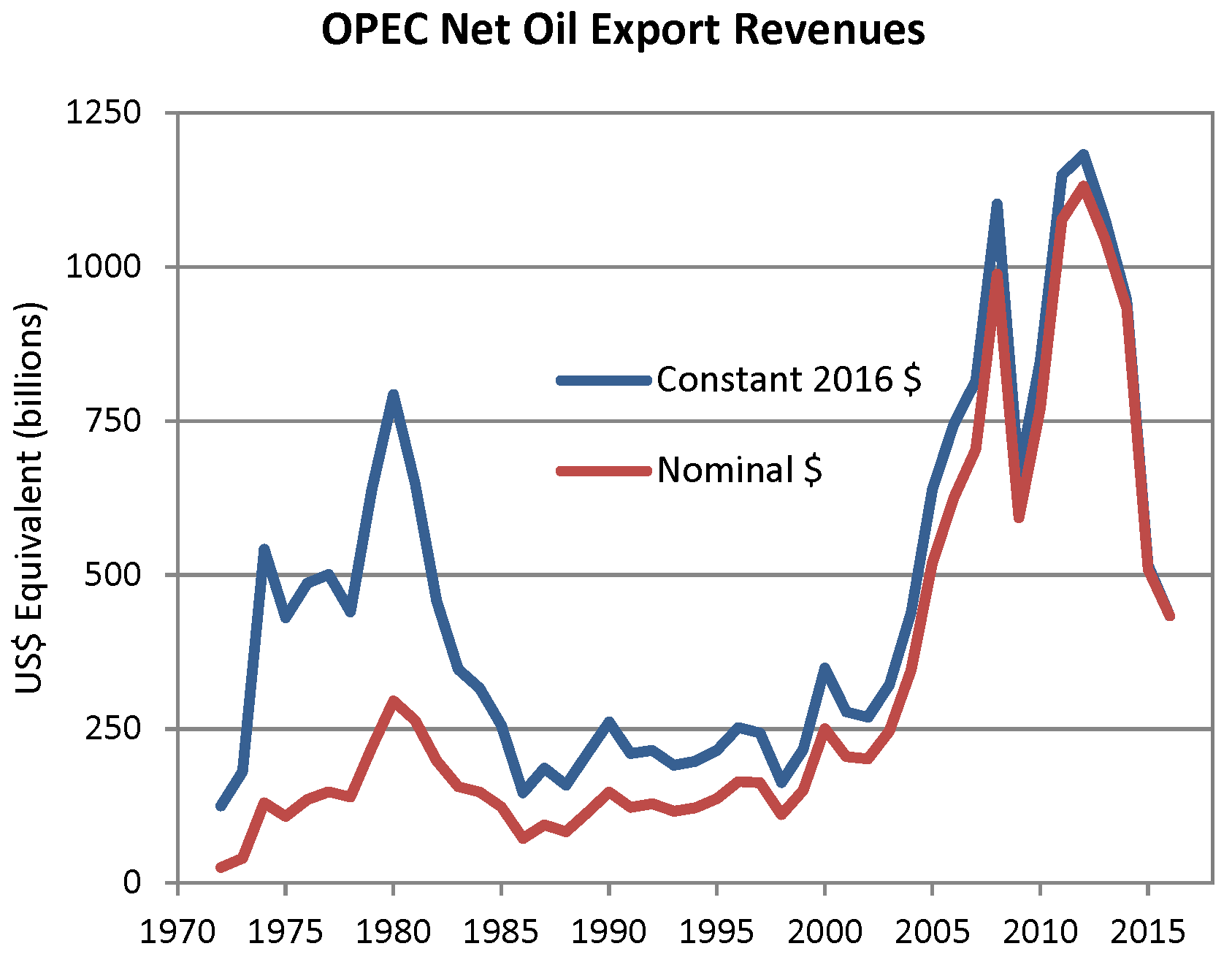
The 1986 oil price collapse benefited oil-consuming countries such as the United States and Japan, countries in Europe, and developing nations but represented a serious loss in revenue for oil-producing countries in Northern Europe, the Soviet Union, and OPEC.
In 1981, before the brunt of the glut, Time Magazine wrote that in general, "A glut of crude causes tighter development budgets" in some oil-exporting nations. Mexico had an economic and debt crisis in 1982.{{cite book |author-link=Ramón Eduardo Ruiz
Iraq had fought a long and costly war against Iran and had particularly weak revenues. It was upset by Kuwait contributing to the glut |access-date=14 January 2008 |archive-url=https://web.archive.org/web/20071217234053/http://www.nmhschool.org/tthornton/mehistorydatabase/gulf_war.php |archive-date=17 December 2007
|access-date=12 January 2008 |archive-url=https://web.archive.org/web/20080227032238/http://www.cnr.vt.edu/lsg/intro/oil.pdf |archive-date=27 February 2008
The glut directed Algeria into an economic recession and directly influenced the politics: the authoritarian regime of Chadli Bendjedid had to compromise with Islamic opposition in 1984 and start economic reforms dismantling socialism in 1987. After the 1988 October Riots he reformed the constitution twice, liberalized the political space amid growing discontent, and was ousted from office by the military after his party lost the first multi-party elections to Islamists, eventually leading to the Algerian Civil War.
The Soviet Union had become a major oil producer before the glut. The drop of oil prices contributed to the nation's final collapse.
In the United States, domestic exploration and the number of active drilling rigs were cut dramatically. In late 1985, there were nearly 2,300 rigs drilling wells; a year later, there were barely 1,000. The number of U.S. petroleum producers decreased from 11,370 in 1985 to 5,231 in 1989, according to data from the Independent Petroleum Association of America. Oil producers held back on the search for new oilfields for fear of losing on their investments. In May 2007, companies like ExxonMobil were not making nearly the investment in finding new oil that they did in 1981. |author-link=Justin Fox |access-date=8 January 2008 |archive-url=https://web.archive.org/web/20080113233033/http://www.time.com/time/magazine/article/0%2C9171%2C1626994%2C00.html |archive-date=13 January 2008
Canada responded to high energy prices in the 1970s with the National Energy Program (NEP) in 1980. The program was in place until 1985.
References
References
- "Crude Oil Prices – 70 Year Historical Chart". MacroTrends.
- Mouawad, Jad. (8 March 2008). "Oil Prices Pass Record Set in '80s, but Then Recede". The New York Times.
- (18 August 1980). "Oil Glut, Price Cuts: How Long Will They Last?". [[U.S. News & World Report]].
- [http://cta.ornl.gov/data/tedb26/Spreadsheets/Table10_03.xls Oak Ridge National Lab data]{{dead link. (January 2016)
- Yergin, Daniel. (28 June 1981). "The Energy Outlook; Lulled to Sleep by the Oil Glut Mirage". The New York Times.
- [http://www.eia.doe.gov/emeu/international/contents.html EIA – International Energy Data and Analysis]
- Bromley, Simon. (2013). "American Power and the Prospects for International Order". John Wiley & Sons.
- "World: Saudis Edge U.S. on Oil". ''Washington Post'', 3 January 1980, p. D2.
- Gately, Dermot. (1986). "Lessons from the 1986 Oil Price Collapsey". Brookings Papers on Economic Activity.
- (28 January 1981). "Executive Order 12287 – Decontrol of Crude Oil and Refined Petroleum Products".
- Weiner, Edward. (1999). "Urban Transportation Planning in the United States An Historical Overview". Greenwood Publishing Group.
- "NETL: Arctic Energy Office – Fossil Energy – Alaska Oil History".
- (1982). "The History of the British Petroleum Company". Cambridge University Press.
- Swartz, Kenneth I.. (16 April 2015). "Setting the Standard". Vertical Magazine.
- Denning, Liam. (1 June 2016). "How OPEC Won the Battle and Lost the War". Bloomberg News.
- Warsh, David. (28 February 1982). "The economy: the Oil Glut deepens; OPEC's grip loosens; but a boom or a bomb could spur prices back up". The Boston Globe.
- Yergin, Daniel. (1991). "The Prize: The Epic Quest for Oil, Money, and Power". Simon & Schuster.
- Koepp, Stephen. (14 April 1986). "Cheap Oil!".
- Hershey Jr., Robert D.. (30 December 1989). "Worrying Anew Over Oil Imports". The New York Times.
- (10 January 2006). "OPEC Revenues Fact Sheet". US Energy Information Administration.
- (14 June 2016). "OPEC Revenues Fact Sheet". U.S. Energy Information Administration.
- (2002). "Financial Times World Desk Reference". Dorling Kindersley.
- [http://www.indexmundi.com/venezuela/inflation_rate_(consumer_prices).html "Venezuela Inflation rate (consumer prices)"]. Indexmundi. 2010. Retrieved 16 August 2010.
- "A political economy of low oil prices in Algeria".
- Gaidar, Yegor. (April 2007). "The Soviet Collapse: Grain and Oil". [[American Enterprise Institute]].
- McMaken, Ryan. (7 November 2014). "The Economics Behind the Fall of the Berlin Wall". [[Mises Institute]].
- Gold, Russell. (13 January 2015). "Back to the Future? Oil Replays 1980s Bust". The Wall Street Journal.
- (21 January 2015). "Crude Collapse Has Investors Braced for '80s-Like Oil Casualties". Bloomberg.
- (24 July 2006). "Oil, Oil Everywhere". Forbes.
- "National Energy Program (1980–1984) - Natural Gas - Alberta's Energy Heritage".
- "Energy Wars - Oil Sands - Alberta's Energy Heritage".
This article was imported from Wikipedia and is available under the Creative Commons Attribution-ShareAlike 4.0 License. Content has been adapted to SurfDoc format. Original contributors can be found on the article history page.
Ask Mako anything about 1980s oil glut — get instant answers, deeper analysis, and related topics.
Research with MakoFree with your Surf account
Create a free account to save articles, ask Mako questions, and organize your research.
Sign up freeThis content may have been generated or modified by AI. CloudSurf Software LLC is not responsible for the accuracy, completeness, or reliability of AI-generated content. Always verify important information from primary sources.
Report