From Surf Wiki (app.surf) — the open knowledge base
1976 Portuguese legislative election
none
none
| Field | Value | |
|---|---|---|
| election_name | 1976 Portuguese legislative election | |
| country | Portugal | |
| type | parliamentary | |
| ongoing | no | |
| previous_election | 1975 Portuguese Constituent Assembly election | |
| previous_year | 1975 | |
| next_election | 1979 Portuguese legislative election | |
| next_year | 1979 | |
| seats_for_election | All 263 seats in the Assembly of the Republic | |
| previous_mps | Constituent Assembly of Portugal | |
| elected_mps | 1st Legislature of the Third Portuguese Republic | |
| majority_seats | 132 | |
| registered | 6,564,667 5.4% | |
| turnout | 5,483,461 (83.5%) | |
| 8.2 pp | ||
| election_date | 25 April 1976 | |
| image1 | ||
| leader1 | Mário Soares | |
| party1 | Socialist Party (Portugal) | |
| leader_since1 | 19 April 1973 | |
| leaders_seat1 | Lisbon | |
| last_election1 | 116 seats, 37.9% | |
| seats1 | **107** | |
| seat_change1 | 9 | |
| popular_vote1 | **1,912,921** | |
| percentage1 | **34.9%** | |
| swing1 | 3.0 pp | |
| image2 | ||
| leader2 | Francisco Sá Carneiro | |
| party2 | PPD | |
| colour2 | FFA500 | |
| leader_since2 | 6 May 1974 | |
| leaders_seat2 | Porto | |
| last_election2 | 81 seats, 26.4% | |
| seats2 | 73 | |
| seat_change2 | 8 | |
| popular_vote2 | 1,335,381 | |
| percentage2 | 24.4% | |
| swing2 | 2.0 pp | |
| image3 | ||
| leader3 | Diogo Freitas do Amaral | |
| colour3 | 0093DD | |
| party3 | CDS | |
| leader_since3 | 19 July 1974 | |
| leaders_seat3 | Lisbon | |
| last_election3 | 16 seats, 7.6% | |
| seats3 | 42 | |
| seat_change3 | 26 | |
| popular_vote3 | 876,007 | |
| percentage3 | 15.9% | |
| swing3 | 8.4 pp | |
| image4 | ||
| colour4 | DA251E | |
| leader4 | Álvaro Cunhal | |
| party4 | PCP | |
| leader_since4 | 31 March 1961 | |
| leaders_seat4 | Lisbon | |
| last_election4 | 30 seats, 12.5% | |
| seats4 | 40 | |
| seat_change4 | 10 | |
| popular_vote4 | 788,830 | |
| percentage4 | 14.4% | |
| swing4 | 1.9 pp | |
| image5 | [[File:União Democrática Popular logo, 1975.svg | 85px]] |
| colour5 | ||
| leader5 | Acácio Barreiros | |
| party5 | UDP | |
| leader_since5 | 1976 | |
| leaders_seat5 | Lisbon | |
| last_election5 | 1 seat, 0.8% | |
| seats5 | 1 | |
| seat_change5 | 0 | |
| popular_vote5 | 91,690 | |
| percentage5 | 1.7% | |
| swing5 | 0.9 pp | |
| <!-- Map --> | title | Prime Minister |
| posttitle | Prime Minister after election | |
| before_election | Vasco de Almeida e Costa *(interim)* | |
| before_party | Independent (politician) | |
| after_election | Mário Soares | |
| after_party | Socialist Party (Portugal) | |
| map | {{Switcher |
8.2 pp
| [[File:1976 Portuguese legislative election - Results.svg|230px]] | Vote winner strength by district | [[File:1976 Portuguese legislative election district results.svg|272px]] | Results by constituency
The 1976 Portuguese legislative election was held on Sunday 25 April, exactly one year after the previous election, and two years after the Carnation Revolution. With a new Constitution approved, the country's main aim was economic recovery and strengthening its democratic institutions. The election renewed all 263 members of the Assembly of the Republic.
The Socialist Party won a plurality of votes, almost 35 percent, and legislative seats, and its leader Mário Soares became the Prime Minister of the 1st Constitutional Government on 23 July 1976. The lack of a socialist majority forced his party to form an unexpected coalition with the Democratic and Social Center, a right-wing party. The nature of this coalition, between a socialist party and a conservative party that voted against the new constitution because of its socialist influences, surprised most Portuguese voters and marked the start of the Socialist Party's right-wing turn that would soon be attacked by all the left due to the new government's measures against left-wing reforms following the Carnation Revolution, mainly concerning agrarian reform, in what was called the PS putting "Socialism in the drawer".
The Social Democratic Party (then known as the Democratic People's Party, PPD) won the second most votes and seats, 24 percent of the votes, but polled 10 points below the PS. The Portuguese Communist Party (PCP) achieved considerable gains that reflected its growing influence, mainly in the south of the country, gaining 14 percent of the votes. The big surprise in the elections was the strong showing of the Democratic and Social Center (CDS), which polled ahead of PCP and gathered 16 percent of the votes. Only 19 years later, in 1995, would the CDS again surpass the PCP in number of votes.
Voter turnout fell to 83.5 percent, compared with the 91.7 percent just a year before.
Background
Main article: Portuguese transition to democracy
Ongoing Revolutionary Process
Main article: Processo Revolucionário Em Curso
The previous elections, held on April 25, 1975, elected a new assembly to write a new Constitution. The election results gave the two main moderate parties (PS and PPD) a clear majority in Parliament, with almost 38 percent for the PS and more than 26 percent for the PPD. The PCP achieved a weak result, just 12.5 percent, while the CDS polled ahead of the MDP. The election results started a conflict of legitimacy between parties, the Armed Forces Movement and the Revolutionary Council. It was the start of the Ongoing Revolutionary Process, which culminated in the Hot Summer of 1975.
On May 1, 1975, the PS and the PCP held separate rallies and some violent clashes occurred between PS and PCP supporters. A few days later, in what was called "The República case", far-left supporters invaded the headquarters of República newspaper. The reason was a strike by the typographers and other workers, many close to the far-left UDP, accusing the editorial board of being too aligned with the PS. The case drew widespread international attention, and the PS started a full blown attack against the PCP and Prime Minister Vasco Gonçalves' government.
Positions become extreme as Vasco Gonçalves led the Ongoing Revolutionary Process. He started facing big opposition from the so-called "reactionaries" (the Catholic Church, groups close to the former Estado Novo regime and, unofficially, from the PS, PPD and CDS.), therefore, Vasco Gonçalves continued and forced his Democratic socialism policies with the nationalization of huge parts of the Portuguese economy.
Hot Summer of 1975
Main article: Hot Summer of 1975
By the beginning of the summer of 1975, the country was deeply divided. The "Hot summer of 1975" was starting. During this period, huge clashes between left and right supporters spread all across the country, some with big violence. The possibility of the country entering in a full blown Civil war was feared by many. On 19 July 1975, the PS held a massive rally in Lisbon, with the help of the Catholic Church and others, to fight against the PCP and Vasco Gonçalves government. Mário Soares, PS leader, accused the Gonçalves government, and those who support it, of being "Paranoids", "Demented" and "Irresponsibles who do not represent the Portuguese people".
During the summer of 1975, headquarters of the PCP, and other left-wing parties, in many cities in the North and Center of the country were vandalized and destroyed. Many leftwing supporters were also violently beaten by anti-left protesters. The violence and increased tensions across the country were damaging Vasco Gonçalves leadership in the government and divisions between the Armed Forces Movement and the Revolutionary Council were starting to show. When COPCON commander, Otelo Saraiva de Carvalho, withdrew his support from Gonçalves, the government was on its last days. On 20 September, Gonçalves leaves the government and Pinheiro de Azevedo is nominated as Prime Minister. Shortly after, on 26 September, the assault of the Spanish embassy in Lisbon by far-left supporters, in retaliation to the attacks on left-wing parties headquarters in the North and Center, drew widespread attention as it was broadcast by US network CBS.
25 November Coup and normalization
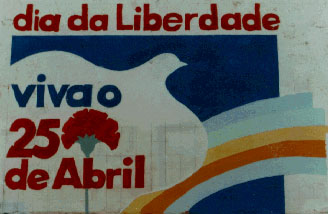
Main article: Coup of 25 November 1975
Main article: Portuguese Constitution of 1976
The new government was unable to control the tensions in the country and by mid November the government made the extraordinary announcement that they were on strike because there were no conditions to govern the country. Just before this announcement, construction workers unions surrounded Parliament and blocked MPs from leaving the building for two days.
All of this culminated in the events of the Coup of 25 November 1975. The coup was an attempt by left-wing activists who hoped to hijack the Portuguese transition to democracy in favor of Communists. The coup failed and shortly after a counter-coup led by Ramalho Eanes, a pro-democracy moderate, and supported by PS leader Mário Soares, re-established the democratic process.
By March 1976, the Constitutional Assembly had finally drafted the Constitution text and was sent to approval in April 1976. The Constitution draft was heavily ideological, with many references to Socialism and with many phrases that echoed Karl Marx's Communist Manifesto. On 2 April 1976, the new Constitution was approved with the votes of all parties with the exception of CDS, which voted against citing the ideological content of the document. However, the party agreed to abide by it in the interim.
Electoral system
The Assembly of the Republic has 263 members elected to four-year terms. The total number of MPs increased to 263 from the 1975 total of 250 MPs. Governments do not require absolute majority support of the Assembly to hold office, as even if the number of opposers of government is larger than that of the supporters, the number of opposers still needs to be equal or greater than 132 (absolute majority) for both the Government's Programme to be rejected or for a motion of no confidence to be approved.
The number of seats assigned to each district depends on the district magnitude. The use of the d'Hondt method makes for a higher effective threshold than certain other allocation methods such as the Hare quota or Sainte-Laguë method, which are more generous to small parties.
For these elections, and compared with the 1975 elections, the MPs distributed by districts were the following:
| District | Number of MPs | Map |
|---|---|---|
| Lisbon | 58 | |
| Porto | 38 | |
| Setúbal | 17 | |
| Aveiro and Braga | 15 | |
| Santarém | 13 | |
| Coimbra | 12 | |
| Leiria and Viseu | 11 | |
| Faro | 9 | |
| Castelo Branco, Viana do Castelo and Vila Real | 7 | |
| Beja, Évora, Guarda and Funchal | 6 | |
| Bragança | 5 | |
| Portalegre | 4 | |
| Ponta Delgada | 3 | |
| Angra do Heroísmo, Europe and Outside Europe | 2 | |
| Horta | 1 |
Parties
The table below lists the parties represented in the Assembly of the Republic during the Constitutional Assembly (1975–1976) and that also, some, contested the elections:
| Name | Ideology | Political position | Leader | 1975 result | Seats at |
|---|---|---|---|---|---|
| dissolution | % | Seats | |||
| Socialist Party (Portugal)}};" | **PS** | Socialist Party | |||
| Partido Socialista | Social | ||||
| democracy | Centre-left | Mário Soares | 37.9% | ||
| Social Democratic Party (Portugal)}};" | **PPD** | Democratic People's Party | |||
| Partido Popular Democrático | Liberalism | Centre | Francisco | ||
| Sá Carneiro | 26.4% | ||||
| Portuguese Communist Party}};" | **PCP** | Portuguese Communist Party | |||
| Partido Comunista Português | Communism | Far-left | Álvaro Cunhal | 12.5% | |
| CDS – People's Party}};" | **CDS** | Democratic and Social Center | |||
| Centro Democrático e Social | Christian | ||||
| democracy | Centre-right | Diogo Freitas | |||
| do Amaral | 7.6% | ||||
| Democratic Electoral Commission}};" | **MDP/CDE** | Portuguese Democratic Movement | |||
| Movimento Democrático Português | Left-wing nationalism | ||||
| Democratic socialism | Left-wing | José Manuel | |||
| Tengarrinha | 4.1% | ||||
| Left Bloc (Portugal)}};" | **UDP** | Popular Democratic Union | |||
| União Democrática Popular | Marxism | ||||
| Socialism | Left-wing | Mário Tomé | 0.8% | ||
| Association for the Defense of Macau Interests}};" | **ADIM** | Association for the Defense of Macau Interests | |||
| Associação para a Defesa dos Interesses de Macau | Conservatism | ||||
| Macau interests | Right-wing | Diamantino | |||
| Ferreira | 0.0% | ||||
| Independent}};" | **Ind.** | Independent | |||
| Independente | Various PPD members |
Seat changes
- On 9 December 1975, a total of 21 PPD MPs, including the party's caucus leader, Carlos Mota Pinto, leave the party and become Independents, following deep disagreements with the party leader, Francisco Sá Carneiro, regarding the ideology and policies of the party.
Campaign period
Party slogans
| Party or alliance | Original slogan | English translation | Refs | |
|---|---|---|---|---|
| Socialist Party (Portugal)}}" | PS | « Queremos e podemos reconstruir o país » | "We want and we can rebuild the country" | |
| Social Democratic Party (Portugal)}}" | PPD | « Portugal com Sá Carneiro » | "Portugal with Sá Carneiro" | |
| Portuguese Communist Party}}" | PCP | « Para uma maioria de esquerda » | "For a left-wing majority" | |
| CDS – People's Party}}" | CDS | « A resposta é muito simples » | "The answer is very simple" |
Candidates' debates
The day after the elections, a round table was held on RTP1, moderated by Carlos Veiga Pereira, on the electoral results, with the participation of Mário Soares (Socialist Party), Francisco Sá Carneiro, (Social Democratic Party), Diogo Freitas do Amaral (Social Democratic Center), and Filipe Faria (UDP). Álvaro Cunhal (Portuguese Communist Party) declined to participate in the roundtable.
| 1975 Portuguese Constituent Assembly election | Date | Organisers | Moderator(s) | Present Absent invitee Non-invitee | PS | PPD | CDS | PCP | UDP | Refs | Socialist Party (Portugal)}};" | Social Democratic Party (Portugal)}};" | CDS – People's Party}};" | Portuguese Communist Party}};" | Left Bloc (Portugal)}};" | |||||
|---|---|---|---|---|---|---|---|---|---|---|---|---|---|---|---|---|---|---|---|---|
| 26 Apr | RTP1 | Carlos Veiga Pereira | **Soares** | **Sá Carneiro** | **Freitas** | **A** | **Faria** | date=26 April 1976 | url=https://arquivos.rtp.pt/conteudos/legislativas-76-mesa-redonda/ | title=Legislativas 76: Mesa Redonda | language=pt | work=RTP Arquivos | access-date=5 February 2022}} |
Results
National summary
Distribution by constituency
|- class="unsortable" !rowspan=2|Constituency!!%!!S!!%!!S!!%!!S!!%!!S!!%!!S !rowspan=2|Total S |- class="unsortable" style="text-align:center;" !colspan=2 | PS !colspan=2 | PPD !colspan=2 | CDS !colspan=2 | PCP !colspan=2 | UDP |- | 30.4 | 1 | 1
| 12.1 |
|---|
| 1.5 |
| - |
| 2 |
| - |
| 30.8 |
| 5 |
| 6 |
| 22.5 |
| 4 |
| 3.7 |
| - |
| 0.9 |
| - |
| 15 |
| - |
| 32.0 |
| 2 |
| 8.2 |
| - |
| 4.2 |
| - |
| 4 |
| 2.2 |
| - |
| 6 |
| - |
| 6 |
| 28.6 |
| 5 |
| 21.2 |
| 4 |
| 4.2 |
| - |
| 1.0 |
| - |
| 15 |
| - |
| 22.6 |
| 1 |
| 2 |
| 28.3 |
| 2 |
| 2.7 |
| - |
| 0.8 |
| - |
| 5 |
| - |
| 3 |
| 22.6 |
| 2 |
| 19.9 |
| 2 |
| 6.7 |
| - |
| 1.1 |
| - |
| 7 |
| - |
| 6 |
| 26.7 |
| 4 |
| 12.5 |
| 1 |
| 7.3 |
| 1 |
| 1.2 |
| - |
| 12 |
| - |
| 30.3 |
| 2 |
| 9.2 |
| - |
| 8.0 |
| - |
| 4 |
| 2.6 |
| - |
| 6 |
| - |
| 6 |
| 19.3 |
| 2 |
| 6.8 |
| - |
| 14.5 |
| 1 |
| 2.6 |
| - |
| 9 |
| - |
| 24.9 |
| 1 |
| 4 |
| 13.3 |
| 1 |
| 1.5 |
| - |
| 1.3 |
| - |
| 6 |
| - |
| 25.2 |
| 2 |
| 25.7 |
| 2 |
| 2 |
| 2.9 |
| - |
| 1.1 |
| - |
| 6 |
| - |
| 34.2 |
| - |
| 1 |
| 4.3 |
| - |
| 1.5 |
| - |
| 1 |
| - |
| 31.1 |
| 4 |
| 4 |
| 19.4 |
| 2 |
| 7.3 |
| 1 |
| 1.0 |
| - |
| 11 |
| - |
| 25 |
| 16.4 |
| 10 |
| 13.2 |
| 8 |
| 21.8 |
| 14 |
| 2.6 |
| 1 |
| 58 |
| - |
| 35.4 |
| 1 |
| 2 |
| 11.8 |
| - |
| 1.5 |
| - |
| 3 |
| - |
| 3 |
| 10.1 |
| - |
| 13.9 |
| - |
| 22.0 |
| 1 |
| 1.0 |
| - |
| 4 |
| - |
| 18 |
| 27.0 |
| 11 |
| 15.7 |
| 6 |
| 8.4 |
| 3 |
| 1.5 |
| - |
| 38 |
| - |
| 6 |
| 19.5 |
| 3 |
| 13.9 |
| 2 |
| 16.1 |
| 2 |
| 1.7 |
| - |
| 13 |
| - |
| 32.2 |
| 7 |
| 8.4 |
| 1 |
| 4.4 |
| - |
| 9 |
| 2.8 |
| - |
| 17 |
| - |
| 25.5 |
| 2 |
| 3 |
| 23.5 |
| 2 |
| 6.6 |
| - |
| 0.9 |
| - |
| 7 |
| - |
| 26.3 |
| 2 |
| 4 |
| 18.3 |
| 1 |
| 3.1 |
| - |
| 0.9 |
| - |
| 7 |
| - |
| 23.0 |
| 3 |
| 4 |
| 31.2 |
| 4 |
| 2.3 |
| - |
| 0.9 |
| - |
| 11 |
| - |
| 1 |
| 32.2 |
| 1 |
| 6.9 |
| - |
| 10.1 |
| - |
| 0.8 |
| - |
| 2 |
| - |
| 6.3 |
| - |
| 1 |
| 33.7 |
| 1 |
| 1.4 |
| - |
| 0.4 |
| - |
| 2 |
| - |
| - class="unsortable" style="background:#E9E9E9" |
| 107 |
| 24.4 |
| 73 |
| 16.0 |
| 42 |
| 14.4 |
| 40 |
| 1.7 |
| 1 |
| 263 |
| - |
| } |
5 largest municipalities
|- class="unsortable" ! class="wikitable sortable" style="width:140px;" rowspan="2"| Municipality ! class="wikitable sortable" style="width:60px;" | PS ! class="wikitable sortable" style="width:60px;" | PPD ! class="wikitable sortable" style="width:60px;" | CDS ! class="wikitable sortable" style="width:60px;" | PCP ! class="wikitable sortable" style="width:60px;" | UDP ! class="wikitable sortable" style="width:40px;" rowspan="2"| Others ! class="wikitable sortable" style="width:40px;" rowspan="2"| Turnout |- ! style="background:#FF66FF;"| ! style="background:#FF9900;"| ! style="background:#0093DD;"| ! style="background:red;" | ! style="background:;" | |- (205,659) | 17.2 (95,751) | 16.6 (92,250) | 19.2 (106,897) | 2.8 (15,626) | 4.3 (23,571)
| 82.8 |
|---|
| (81,879) |
| 26.0 |
| (54,892) |
| 16.4 |
| (34,583) |
| 12.0 |
| (25,418) |
| 2.5 |
| (5,239) |
| 1.9 |
| (3,968) |
| 88.2 |
| - |
| (61,860) |
| 14.4 |
| (22,982) |
| 10.6 |
| (16,899) |
| 26.6 |
| (42,330) |
| 3.1 |
| (4,918) |
| 3.9 |
| (6,230) |
| 83.5 |
| - |
| (55,380) |
| 11.8 |
| (15,754) |
| 7.2 |
| (9,669) |
| 29.2 |
| (39,028) |
| 2.4 |
| (3,183) |
| 4.6 |
| (6,173) |
| 84.6 |
| - |
| (58,165) |
| 25.5 |
| (31,978) |
| 11.8 |
| (14,862) |
| 9.0 |
| (11,227) |
| 1.4 |
| (1,756) |
| 2.0 |
| (2,501) |
| 89.5 |
| } |
Highest and lowest by party
|- class="unsortable" ! colspan="2" class="wikitable sortable" style="width:140px;" | Party ! Highest ! Lowest |- (56.0) (4.7) |- (84.2) (4.1) |- (50.5) (1.2) |- (61.8) (0.3) |- (7.4) (0.2) |}
Maps
File:1976 Portuguese legislative election district results.svg|Winner and seats by constituency. File:Legislativas portuguesas de 1976 (Mapa).png|Most voted political force by municipality.
Aftermath
Fall of the government
By the fall of 1977, the situation of the Portuguese economy was deteriorating. During that year's summer, Prime Minister Mário Soares asked for a loan from the International Monetary Fund (IMF) and several austerity measures were implemented like the rise of interest rates, the devalue of the Escudo and budget cuts. However, the policies were quite unpopular and by late 1977 Soares was facing large opposition in the Parliament. In November 1977, he proposed a sizeable memorandum between parties and associations to seek common economic and social policies, which was rejected. Because of this rejection, Soares presented a motion of confidence in Parliament, which he lost by a 59 vote margin.
| Ballot → | 8 December 1977 | Required majority → | Result → | |
|---|---|---|---|---|
| Simple | ||||
| {{Collapsible list | title = Yes | • PS (100) | ||
| {{Collapsible list | title = No | • PSD (72) | • CDS (41) | • PCP (40) |
| Abstentions | ||||
| {{Collapsible list | title = Absentees | • PS (2) | • PSD (1) | • Ind. Carlos Galvão de Melo (1) |
| Rejected | ||||
| Sources |
Following this vote, Soares was still able to form a second cabinet, in coalition with the Democratic Social Center (CDS), but it only lasted 8 months and after August 1978, a series of Presidential appointed cabinets were nominated which culminated in the 2 December 1979 snap election.
Notes
| Portuguese Democratic Movement won 5 seats and the Independent Democratic Association of Macau won 1 seat in the 1975 election. Neither party contested this election.
References
References
- (10 January 2017). "Mário Soares e o "socialismo na gaveta"". TSF Rádio Notícias.
- "Quando o PS desceu à rua". [[Público (Portugal).
- "Caso "República"". [[Rádio e Televisão de Portugal.
- "Nacionalizações de 1975". [[Rádio e Televisão de Portugal.
- "Portugal, o Verão Quente de 1975 visto pela CIA". [[Sábado]].
- "O comício da Alameda feito em aliança com a Igreja para combater o PCP". [[Jornal i]].
- "O Norte a ferro e fogo". [[Correio da Manhã (Portugal).
- "Mas quem é este Vasco Gonçalves?". [[Expresso (newspaper).
- "25 de Abril: O assalto à embaixada espanhola e o impacto da revolução no ambiente em Espanha". [[Expresso (newspaper).
- "Governo em greve". [[Rádio e Televisão de Portugal.
- "O cerco ao Palácio de São Bento (12/13 de novembro)". [[Assembly of the Republic (Portugal).
- "Toda a história do 25 de Novembro, a "dramática aventura" que ditou o fim da Revolução". [[Expresso (newspaper).
- "Constituição da República Portuguesa". [[Assembly of the Republic (Portugal).
- "Constitution of the Portuguese Republic".
- "Effective threshold in electoral systems". Trinity College, Dublin.
- Gallaher, Michael (1992). "[https://www.tcd.ie/Political_Science/staff/michael_gallagher/BJPS1992.pdf Comparing Proportional Representation Electoral Systems: Quotas, Thresholds, Paradoxes and Majorities]"
- "Eleição da Assembleia da República de 25 de Abril de 1976". CNE - Comissão Nacional de Eleições - Eleição da Assembleia da República de 25 de Abril de 1976.
- (9 September 2018). "Quando as divergências políticas acabavam em cisão no PSD".
- (9 September 2018). "Sociais-democratas batem de frente contra Sá Carneiro".
- "Comunicação Política em eleições legislativas em Portugal: uma análise a partir dos cartazes eleitorais (1975-2009)". Francisco Teixeira.
- "ELEIÇÕES LEGISLATIVAS DE 1983 – PSD". EPHEMERA.
- "Comunicação Política em eleições legislativas em Portugal: uma análise a partir dos cartazes eleitorais (1975-2009)". Francisco Teixeira.
- "Comunicação Política em eleições legislativas em Portugal: uma análise a partir dos cartazes eleitorais (1975-2009)". Francisco Teixeira.
- (26 April 1976). "Legislativas 76: Mesa Redonda". RTP Arquivos.
- "1º Programa de Assistência Económico-Financeira do FMI a Portugal". Observatório Nacional de Luta contra a Pobreza.
- (25 August 1977). "Comunicação ao país do Primeiro-ministro Mário Soares". RTP.
- (25 August 1977). "Mário Soares". Museu da Presidência da Republica.
- (8 December 1977). "Queda do I Governo Constitucional". RTP.
- (10 November 2015). "MOÇÕES / CENSURA - CONFIANÇA - REJEIÇÃO DO PROGRAMA". [[Assembly of the Republic (Portugal).
- "Debates Parlamentares". [[Assembly of the Republic (Portugal).
- (25 August 1977). "Mário Soares exonerado por Ramalho Eanes da liderança do II Governo Constitucional". RTP.
This article was imported from Wikipedia and is available under the Creative Commons Attribution-ShareAlike 4.0 License. Content has been adapted to SurfDoc format. Original contributors can be found on the article history page.
Ask Mako anything about 1976 Portuguese legislative election — get instant answers, deeper analysis, and related topics.
Research with MakoFree with your Surf account
Create a free account to save articles, ask Mako questions, and organize your research.
Sign up freeThis content may have been generated or modified by AI. CloudSurf Software LLC is not responsible for the accuracy, completeness, or reliability of AI-generated content. Always verify important information from primary sources.
Report