From Surf Wiki (app.surf) — the open knowledge base
1953 Canadian federal election
none
none
| Field | Value | ||
|---|---|---|---|
| election_name | 1953 Canadian federal election | ||
| country | Canada | ||
| flag_year | 1921 | ||
| type | parliamentary | ||
| ongoing | no | ||
| party_colour | no | ||
| party_name | no | ||
| previous_election | 1949 Canadian federal election | ||
| previous_year | 1949 | ||
| next_election | 1957 Canadian federal election | ||
| next_year | 1957 | ||
| seats_for_election | 265 seats in the House of Commons | majority_seats = 133 | |
| turnout | 67.5%{{cite web | title=Voter Turnout at Federal Elections and Referendums | |
| url | http://www.elections.ca/content.aspx?section=ele&dir=turn&document=index&lang=e | website=Elections Canada | access-date=10 March 2019}} ( 6.3 pp) |
| election_date | August 10, 1953 | ||
| elected_members | 22nd Canadian Parliament | ||
| outgoing_members | 21st Canadian Parliament | ||
| image_size | x175px | ||
| image1 | Louis St. Laurent portrait.jpg | ||
| colour1 | |||
| leader1 | Louis St. Laurent | ||
| leader_since1 | [August 7, 1948](1948-liberal-party-of-canada-leadership-election) | ||
| party1 | |||
| leaders_seat1 | Quebec East | ||
| last_election1 | 191 seats, 49.15% | ||
| seats1 | **169** | ||
| seat_change1 | 22 | ||
| popular_vote1 | **2,731,633** | ||
| percentage1 | **48.43%** | ||
| swing1 | 0.72 pp | ||
| image2 | GeorgeDrew (cropped).jpg | ||
| colour2 | |||
| leader2 | George A. Drew | ||
| leader_since2 | [October 2, 1948](1948-progressive-conservative-leadership-convention) | ||
| party2 | |||
| leaders_seat2 | Carleton | ||
| last_election2 | 41 seats, 29.65% | ||
| seats2 | 51 | ||
| seat_change2 | 10 | ||
| popular_vote2 | 1,749,579 | ||
| percentage2 | 31.02% | ||
| swing2 | 1.37 pp | ||
| image4 | Major James Coldwell (cropped).jpg | ||
| colour4 | |||
| leader4 | Major James Coldwell | ||
| leader_since4 | March 22, 1942 | ||
| party4 | |||
| leaders_seat4 | Rosetown—Biggar | ||
| last_election4 | 13 seats, 13.42% | ||
| seats4 | 23 | ||
| seat_change4 | 10 | ||
| popular_vote4 | 636,310 | ||
| percentage4 | 11.28% | ||
| swing4 | 2.14 pp | ||
| image5 | File:Solon Earl Low (cropped2).jpg | ||
| colour5 | |||
| leader5 | Solon Earl Low | ||
| leader_since5 | April 6, 1944 | ||
| party5 | |||
| leaders_seat5 | Peace River | ||
| last_election5 | 10 seats, 2.31% | ||
| seats5 | 15 | ||
| seat_change5 | 5 | ||
| popular_vote5 | 304,553 | ||
| percentage5 | 5.40% | ||
| swing5 | 3.09 pp | ||
| map | {{switcher | ||
| title | Prime Minister | ||
| posttitle | Prime Minister after election | ||
| before_election | Louis St. Laurent | ||
| before_party | |||
| after_election | Louis St. Laurent | ||
| after_party | |||
| map2_image | Chambre des Communes 1953.png | ||
| map2_caption | The Canadian parliament after the 1953 election |
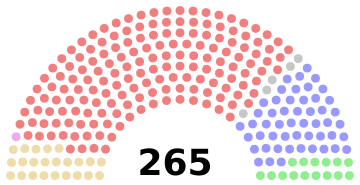
| [[File:1953 Canadian General Election.svg|350px]] | Results by electoral district | [[File:Canada 1953 Federal Election.svg|350px]] | Results by province and territory}} The 1953 Canadian federal election was held on August 10, 1953, to elect members of the House of Commons of Canada of the 22nd Parliament of Canada. Prime Minister Louis St. Laurent led his Liberal Party of Canada to its second consecutive majority government, although the party lost seats to the other parties.
The Progressive Conservative Party, led by former Premier of Ontario, George Drew, formed the official opposition, but for the last time until 1993, the party was unable to win the popular vote in any of Canada's provinces or territories.
This was the last election until 1988 in which any party won back-to-back majorities, and the last until 1997 in which the Liberals would accomplish this feat. This election is the last time that the Liberals would win more seats in Alberta than the largest right-of-centre party in Canada, and the last time they would win more seats than the Tories in Alberta until 1993.
Overview
Liberal Party
Throughout the years since the previous federal election, St. Laurent had been an active and popular Prime Minister, increasing the country's autonomy from the United Kingdom, overseeing the construction of the Trans-Canada Highway, and introducing various welfare programmes. With the Liberals remaining well ahead in the polls, St. Laurent decided there was little to be gained by waiting out his whole mandate, and called an early federal election a year before his mandate was due to expire.
As with the previous election, the campaign was largely based around St. Laurent's personal image, and was light on any actual policies beyond a continuation of what his government had already been doing. While they would lose support in relatively equal measure to all the other three major parties, the majority that they had won four years earlier still held up, and delivered St. Laurent his second majority government.
Progressive Conservatives
While party leader George A. Drew had largely escaped blame for the poor showing at the previous election, the years ahead saw much debate about the party's future direction. Many believed that Ontario, where Drew remained personally very popular and his successor as Premier, Leslie Frost had maintained the party's heavy dominance of the provincial legislature, was key to any prospect of the Progressive Conservatives forming another government. Others within the party pointed out that even if they won every single seat in Ontario, it would leave them 48 seats short of a majority, and that they would need to make up the numbers elsewhere. Western Canada seemed the only realistic prospect of building a political base elsewhere in the country due to the Liberals' heavy domination of Quebec and (to a lesser degree) Atlantic Canada, but the party establishment largely dismissed this prospect, seeing the west as CCF and Socred territory. All the while, the party generally polled better than it had done in the 1945-1949 parliament, but there rarely looked to be any prospect of them forming the next government.
Ultimately, the election result would do little to settle these factional disputes, as the party made something of a recovery in Ontario, and won two extra seats apiece in Quebec and Manitoba, but saw a further drop in their popular vote share west of Manitoba.
Co-Operative Commonwealth Federation
For this election, the CCF scaled back the scope of their campaign. Having tried to win seats throughout the country in the previous two elections, this time the party's goal was to re-establish its political base in Western Canada and retake the seats that it had lost to the Liberals. The party therefore abandoned any pretence of trying to make a breakthrough in Ontario, nominating very few candidates east of Manitoba, and almost none in Quebec.
In the end, despite suffering the largest popular vote share loss of the major parties, the CCF's strategy paid off, largely reversing the losses they had suffered in the previous election. They earned a firm majority of seats in their political base of Saskatchewan, and also performed well in British Columbia, coming a close second to the Liberals in the province's seat total. Their final total of 23 seats nationally was 5 fewer than they had earned in 1945, but still the second-best showing since the party's formation.
Social Credit Party
While little changed in the Social Credit Party's political base of Alberta, with them winning the same total of 10 seats that they had at the previous federal election, this election marked an important breakthrough for the Socreds, who were able to capitalise on the newly-formed Social Credit provincial government of W. A. C. Bennett in British Columbia, and win seats in the province for the first time. They won a total of five seats, while coming a very close third (within half a percentage point) behind the CCF in the province's popular vote. For the first time, the Socreds held more seats than the Progressive Conservatives in two provinces.
During the campaign, leader Solon Earl Low was largely able to side-step any questions of whether his party would be willing to prop up a potential minority Progressive Conservative government, as there was little doubt that the Liberals would win another majority. However, the Socreds' breakthrough into a new province and the PCs' seeming disinterest in the west soon resulted in much debate about Social Credit's potential role in a federal government (or at least supporting one on matters of confidence) in the years ahead.
National results
See also Results of the 1953 Canadian federal election
| Party | Party leader | # of | ||||||||||||||||
|---|---|---|---|---|---|---|---|---|---|---|---|---|---|---|---|---|---|---|
| candidates | Seats | Popular vote | [1949](1949-canadian-federal-election) | **Elected** | % Change | # | % | pp Change | Total | 897 | 262 | 265 | +1.1% | 5,640,938 | 100% | |||
| Liberal | Louis St. Laurent | 262 | 191 | **169** | -11.5% | 2,731,633 | 48.43% | -0.72 | Progressive Conservative | George Drew | 248 | 41 | **51** | +24.4% | 1,749,579 | 31.02% | +1.37 | Co-operative Commonwealth |
| **Sources:** http://www.elections.ca [History of Federal Ridings since 1867](http://www.parl.gc.ca/information/about/process/house/hfer/hfer.asp?Language=E) |
Notes:
-
- not applicable - the party was not recognized in the previous election
x - less than 0.005% of the popular vote
1 The Liberal-Labour MP sat with the Liberal caucus.
Vote and seat summaries
|File:Ternary CA1949.svg |1949 |File:Ternary CA1953.svg |1953
Results by province
| Party name | BC | AB | SK | MB | ON | QC | NB | NS | PE | NL | NW | YK | Total | Total Seats | 22 | 17 | 17 | 14 | 85 | 75 | 10 | 12 | 4 | 7 | 1 | 1 | 265 | Parties that won no seats: |
|---|---|---|---|---|---|---|---|---|---|---|---|---|---|---|---|---|---|---|---|---|---|---|---|---|---|---|---|---|
| Liberal | Seats: | 8 | 4 | 5 | 7 | 50 | 66 | 7 | 10 | 3 | 7 | 1 | 1 | 169 | Vote (%): | 30.9 | 35.1 | 37.3 | 37.0 | 46.0 | 61.0 | 52.7 | 53.0 | 51.1 | 67.2 | 49.4 | 78.7 | 48.4 |
| Vote (%): | 2.2 | 2.7 | 1.1 | 2.3 | 1.0 | 0.7 | 0.2 | 1.1 | Nationalist | Vote (%): | 0.5 | 0.1 |
- xx - less than 0.05% of the popular vote
References
This article was imported from Wikipedia and is available under the Creative Commons Attribution-ShareAlike 4.0 License. Content has been adapted to SurfDoc format. Original contributors can be found on the article history page.
Ask Mako anything about 1953 Canadian federal election — get instant answers, deeper analysis, and related topics.
Research with MakoFree with your Surf account
Create a free account to save articles, ask Mako questions, and organize your research.
Sign up freeThis content may have been generated or modified by AI. CloudSurf Software LLC is not responsible for the accuracy, completeness, or reliability of AI-generated content. Always verify important information from primary sources.
Report