From Surf Wiki (app.surf) — the open knowledge base
1935 Canadian federal election
none
none
| Field | Value | ||
|---|---|---|---|
| election_name | 1935 Canadian federal election | ||
| country | Canada | ||
| flag_year | 1921 | ||
| type | parliamentary | ||
| ongoing | no | ||
| party_colour | no | ||
| party_name | no | ||
| previous_election | 1930 Canadian federal election | ||
| previous_year | 1930 | ||
| next_election | 1940 Canadian federal election | ||
| next_year | 1940 | ||
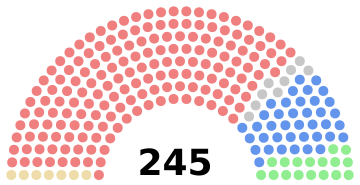
| seats_for_election | 245 seats in the House of Commons | ||
| majority_seats | 123 | ||
| turnout | 74.2%{{cite web | title=Voter Turnout at Federal Elections and Referendums | |
| url | http://www.elections.ca/content.aspx?section=ele&dir=turn&document=index&lang=e | website=Elections Canada | access-date=10 March 2019}} ( 0.7 pp) |
| election_date | October 14, 1935 | ||
| elected_members | 18th Canadian Parliament | ||
| outgoing_members | 17th Canadian Parliament | ||
| image_size | x160px | ||
| image1 | Wm Lyon Mackenzie King (cropped).jpg | ||
| colour1 | |||
| leader1 | W. L. Mackenzie King | ||
| leader_since1 | [August 7, 1919](1919-liberal-party-of-canada-leadership-election) | ||
| party1 | |||
| leaders_seat1 | Prince Albert | ||
| last_election1 | 89 seats, 44.03% | ||
| seats1 | **173** | ||
| seat_change1 | 84 | ||
| popular_vote1 | **1,967,839** | ||
| percentage1 | **44.68%** | ||
| swing1 | 0.65 pp | ||
| image2 | Richard Bedford Bennett (cropped2).jpg | ||
| colour2 | |||
| leader2 | R. B. Bennett | ||
| leader_since2 | [October 12, 1927](1927-conservative-leadership-convention) | ||
| party2 | |||
| leaders_seat2 | Calgary West | ||
| last_election2 | 137 seats, 47.79% | ||
| seats2 | 39 | ||
| seat_change2 | 98 | ||
| popular_vote2 | 1,290,671 | ||
| percentage2 | 29.84% | ||
| swing2 | 18.48 pp | ||
| image3 | W aberhart (cropped).jpg | ||
| colour3 | |||
| leader3 | William Aberhart *(unofficial)* | ||
| leader_since3 | October 14, 1935 | ||
| party3 | |||
| leaders_seat3 | *Did not run* | ||
| last_election3 | *New party* | ||
| seats3 | 17 | ||
| seat_change3 | 17 | ||
| popular_vote3 | 180,679 | ||
| percentage3 | 4.10% | ||
| swing3 | *New party* | ||
| image4 | Ac.woodsworth.jpg | ||
| colour4 | |||
| leader4 | J. S. Woodsworth | ||
| leader_since4 | August 1, 1932 | ||
| party4 | |||
| leaders_seat4 | Winnipeg North Centre | ||
| last_election4 | *New party* | ||
| seats4 | 7 | ||
| seat_change4 | 7 | ||
| popular_vote4 | 410,125 | ||
| percentage4 | 9.31% | ||
| swing4 | *New party* | ||
| image5 | Henry Herbert Stevens (cropped).jpg | ||
| colour5 | |||
| leader5 | H. H. Stevens | ||
| leader_since5 | July 7, 1935 | ||
| party5 | |||
| leaders_seat5 | Kootenay East | ||
| last_election5 | *New party* | ||
| seats5 | 1 | ||
| seat_change5 | 1 | ||
| popular_vote5 | 384,462 | ||
| percentage5 | 8.73% | ||
| swing5 | *New party* | ||
| map | {{Switcher | ||
| title | Prime Minister | ||
| posttitle | Prime Minister after election | ||
| before_election | R. B. Bennett | ||
| before_party | |||
| after_election | William Lyon Mackenzie King | ||
| after_party | |||
| map2_image | Chambre des Communes 1935.png | ||
| map2_size | 380px | ||
| map2_caption | The Canadian parliament after the 1935 election |
| [[File:1935 Canadian Election by Riding.svg|350px]] | Results by electoral district, shaded by winners' vote share | [[File:Canada 1935 Federal Election.svg|350px]] | Results by province and territory}} The 1935 Canadian federal election was held on October 14, 1935, to elect members of the House of Commons of Canada of the 18th Parliament of Canada. The Liberal Party of William Lyon Mackenzie King won a majority government, defeating Prime Minister R. B. Bennett's Conservatives.
The central issue was the economy, which was still in the depths of the Great Depression. In office since the 1930 election, Bennett had sought to stimulate the economy during his first few years through a policy of high tariffs and trade within the British Empire. In the last months of his time in office, he reversed his position, copying the popular New Deal of Franklin Roosevelt in the United States. Upset about high unemployment and inaction by the federal government, voters were unwilling to allow the Conservatives to continue to govern, despite their change of policy.
The Conservatives were also suffering severe internal divisions. During his first years in office, Bennett had alienated those in his party who supported intervention in the economy. His last minute conversion to interventionism alienated the rest of the party. Former cabinet minister H.H. Stevens left to form the Reconstruction Party. Senior minister Sir Joseph Flavelle announced he would be supporting the Liberals.
Voters opted for Mackenzie King's promise of mild reforms to restore economic health. The Liberals crushed the Tories, winning 173 seats to the Conservatives' 39, the worst ever performance by the Tories until their collapse in 1993. The Liberal Party would continue to hold power until 1957.
The 1935 election was also important in it saw the final demise of the Progressive Party and the United Farmers of Alberta. The Progressive Party, having been in gradual decline over the previous decade, did not run any candidates under its own banner. The federal party, always highly decentralized, ceased to exist sometime circa 1940. However, Liberal-Progressive Premier of Manitoba John Bracken brought the name back into formal use when he moved to federal politics in 1942; his first act as leader of the Conservatives was to rechristen them the Progressive Conservative Party.
The United Farmers of Alberta, whose credibility was ruined by a sex scandal involving former leader John E. Brownlee, lost all their seats in the provincial election earlier that year, and subsequently withdrew from electoral politics, likewise fielding no candidates in this federal election.
Two new movements rose out of the west, however. The new Co-operative Commonwealth Federation, a social democratic party, first competed in this election and won seven seats (including Tommy Douglas' first stint in elective office), promising social reform. The Social Credit Party of Canada was even more successful, capturing seventeen seats on its platform of monetary reform despite winning less of the popular vote than the former. Fifteen of these seats were in Alberta, where the party dominated after having swept to power in a landslide less than two months before the federal vote. John Horne Blackmore was chosen to lead the Social Credit caucus after the election. The de facto leader of the national movement was Alberta Premier William Aberhart, who did not stand in the federal election himself.
National results
| Party | Party leader | # of | ||||||||||
|---|---|---|---|---|---|---|---|---|---|---|---|---|
| candidates | Seats | Popular vote | Total | 891 | 245 | 245 | - | 4,404,301 | 100% | |||
| [1930](1930-canadian-federal-election) | **Elected** | % Change | # | % | pp Change | Liberal | W. L. Mackenzie King | 245 | 90 | **173** | +92.2% | 1,967,839 |
| **Sources:** http://www.elections.ca -- [History of Federal Ridings since 1867](https://web.archive.org/web/20090609211221/http://www2.parl.gc.ca/Sites/LOP/HFER/hfer.asp?Language=E) |
Notes:
- The party did not nominate candidates in the previous election.
x - less than 0.005% of the popular vote
Vote and seat summaries
|File:Ternary CA1930.svg |1930 |File:Ternary CA1935.svg |1935
Results by province
| Party name | BC | AB | SK | MB | ON | QC | NB | NS | PE | YK | Total | Parties that won no seats: |
|---|---|---|---|---|---|---|---|---|---|---|---|---|
| Liberal | Seats won by party: | 6 | 1 | 16 | 10 | 56 | 59 | 9 | 12 | 4 | - | 173 |
| **Total Seats** | **16** | **17** | **21** | **17** | **82** | **65** | **10** | **12** | **4** | **1** | **245** | |
| Vote: | 0.5 | 1.1 | 0.8 | 0.7 | 0.5 | 0.3 | 0.5 | Farmer-Labour |
- xx - less than 0.05% of the popular vote
Notes
References
References
- Reid, Escott. (1936). "The Canadian Election of 1935—and After". American Political Science Review.
This article was imported from Wikipedia and is available under the Creative Commons Attribution-ShareAlike 4.0 License. Content has been adapted to SurfDoc format. Original contributors can be found on the article history page.
Ask Mako anything about 1935 Canadian federal election — get instant answers, deeper analysis, and related topics.
Research with MakoFree with your Surf account
Create a free account to save articles, ask Mako questions, and organize your research.
Sign up freeThis content may have been generated or modified by AI. CloudSurf Software LLC is not responsible for the accuracy, completeness, or reliability of AI-generated content. Always verify important information from primary sources.
Report