From Surf Wiki (app.surf) — the open knowledge base
191st Street station
New York City Subway station in Manhattan

New York City Subway station in Manhattan
| Field | Value | ||
|---|---|---|---|
| name | 191 Street | ||
| image | 191st Street Station - April 2025.jpg | ||
| image_caption | View of the downtown platform with a 1 train arriving in the distance. | ||
| address | West 191st Street & Saint Nicholas Avenue | ||
| New York, New York | |||
| borough | Manhattan | ||
| locale | Washington Heights | ||
| coordinates | |||
| division | IRT | ||
| line | IRT Broadway–Seventh Avenue Line | ||
| service | Broadway-Seventh north | ||
| other | NYCT Bus: | ||
| structure | Underground | ||
| depth | 173 ft | ||
| platforms | 2 side platforms | ||
| tracks | 2 | ||
| opened | |||
| accessible | mf | ||
| services | {{Adjacent stations | system=New York City Subway | |
| line | Broadway-Seventh north | left=Dyckman Street | right=181st Street}} |
| footnotes | |||
| route_map | {{NYCS 2-tracked side platform station | inline=y | |
| deg | 330 | ||
| 1 | Dyckman Street | ||
| 2 | 181st Street | ||
| code | IRT Broadway–Seventh Avenue Line |
New York, New York
The 191st Street station is a station on the IRT Broadway–Seventh Avenue Line of the New York City Subway. Located at the intersection of St. Nicholas Avenue and 191st Street in the Washington Heights neighborhood of Manhattan, it is served by the 1 train at all times. It is the deepest station in the New York City Subway system at about 173 ft below street level. Access to the station's main entrance is only provided by four elevators from the mezzanine situated above the platforms. A 1000 feet pedestrian tunnel also extends west from the station to Broadway, connecting it with the Fort George neighborhood.
Built by the Interborough Rapid Transit Company (IRT), the station opened on January 14, 1911, as an infill station along the first subway. Even though the line through the area had opened five years earlier, no station was constructed at this location because the surrounding neighborhood had a lower population than other areas of Manhattan. Before the opening of the pedestrian tunnel two years later, the area's hilly topography made it hard for area residents to access the station. The opening of the station and the tunnel led to the development of the surrounding area, including the construction of apartment buildings. Hundreds of lots held by the Bennett family since 1835 were sold at an auction in 1919. These provided additional housing opportunities for the middle class, taking advantage of the area's improved transportation access.
History
Construction
Planning for a subway line in New York City dates to 1864, but development of what became the city's first subway line did not start until 1894, when the New York State Legislature passed the Rapid Transit Act. The subway plans were drawn up by a team of engineers led by William Barclay Parsons, the Rapid Transit Commission's chief engineer. It called for a subway line from New York City Hall in lower Manhattan to the Upper West Side, where two branches would lead north into the Bronx. A plan was formally adopted in 1897, and all legal conflicts over the route alignment were resolved near the end of 1899.
The Rapid Transit Construction Company, organized by John B. McDonald and funded by August Belmont Jr., signed the initial Contract 1 with the Rapid Transit Commission in February 1900, under which it would construct the subway and maintain a 50-year operating lease from the opening of the line. In 1901, the firm of Heins & LaFarge was hired to design the underground stations. Belmont incorporated the Interborough Rapid Transit Company (IRT) in April 1902 to operate the subway.
The tunnel leading to what would become the 191st Street station was built as part of the IRT's West Side Line (now the Broadway–Seventh Avenue Line) from a point 100 ft north of 182nd Street to Hillside Avenue. Work on this section was conducted by L. B. McCabe & Brother, who started building the tunnel segment on March 27, 1901. The 168th Street, 181st Street, and 191st Street stations were built as part of the Washington Heights Mine Tunnel (also known as the Fort George Tunnel), which stretches for over 2 mi. The tunnel was dug through the hard rock under Washington Heights, with work proceeding from either end as well as from construction shafts at 168th and 181st Streets.
Station
The West Side Branch was extended northward from 157th Street to a temporary terminus at 221st Street and Broadway on March 12, 1906. There was no station at 191st Street. With the construction of the line, the population in Washington Heights grew rapidly. It was determined that a station should be built at 191st Street to bridge the 4802 feet gap between the 181st Street and Dyckman Street stations, which had become overcrowded. A station had not been deemed necessary as this area of Manhattan was less densely populated, and it was thought that there was no need to have stations as close together as they were downtown.
The opening of the station was expected to spur development in the Fort George area. Its original sponsor was David Stewart. He and other property owners had pushed for the station's construction seeking better accessibility to their land. Following the announcement of the station's construction, and before it began, interest in nearby real estate, having been nonexistent in the previous two years, increased.
Construction of the station began on July 20, 1909. Work on new shafts began on August 18, 1909, after legal and engineering difficulties were straightened out in the previous months. Preliminary work involved the clearing of a site in a vacant lot south of 191st Street on the west side of St. Nicholas Avenue for a shaft 177 ft deep. More than 20,000 cuyd of rock was blasted and removed from the shaft. It was designed to accommodate four elevators and a steel emergency staircase from the surface to platform level. The four elevator wells were in the four corners of the main shaft with the staircase between them. The emergency staircase, along with those at the 168th Street and 181st Street stations, whose platforms were also accessed mainly by elevators, were used for the first time on March 23, 1914, after the elevators stopped working due to a problem at the Dyckman power station. This resulted in extreme congestion.
Construction of the station proved difficult. It required the sinking of a shaft and the widening of the tunnel bore on both sides to accommodate the platforms; this was accomplished without interrupting subway service. The station platforms were constructed by building two new tunnels alongside the existing tunnel, and connecting them once the platforms were complete. Blasting for the station was limited to between midnight and 5:00 a.m. when subway service was less frequent. The station platforms were designed to be 480 feet long to accommodate 10-car express trains. Originally, part of the old tunnel arch was to be used for the station roof. However, the discovery of a mud seam, and the development of cracks in the roof, made it necessary to build a flat roof over the tracks, and filling in the space between the arch and the roof with concrete.
Pedestrian tunnel
Along with the construction of the station, a 1000 feet tunnel was built to connect the station at 191st Street and St. Nicholas Avenue with Broadway, located 59 feet west of Fairview Avenue. James A. Lynch, counsel for many subway contractors, recommended the construction of a tunnel street to provide better access to the station, and convinced local property owners and the city to fund it. The tunnel street cost $76,000, with $5,000 provided by the IRT and the remainder levied on the neighborhood property owners at their request. Engineers found the construction of the tunnel to be feasible since the subway platforms would be on almost the same level as Broadway.
On October 5, 1909, the Board of Improvements of Washington Heights approved plans for the construction of a 1900 feet tunnel to Riverside Drive. Three entrances to the tunnel were proposed at Broadway, Fort Washington Avenue, and Riverside Drive. The entrances to Broadway and Riverside Drive would have been located at street-level, as the tunnel was to be at the same elevation as the streets at these locations. Two elevators would be required for the entrance to Fort Washington Avenue, which was located at a higher elevation. The tunnel would have been bored from both sides, and was expected to be completed within 14 months.
Since the tunnel was to be located underneath private property, easements had to be obtained to allow for its construction. They were acquired in a proceeding under a provision of the City Charter, not under the terms of the Rapid Transit Act. In June 1910, the local board of directors sent a resolution calling for the construction of the street tunnel to the New York City Board of Estimate (NYCBOE). At the time, funding had been acquired for slightly more than half the length of the tunnel, with the remainder expected to be secured by easements. The NYCBOE approved the petition for the improvement and agreed to hold a public hearing on December 29, 1910. Unlike other streets in the city, easements were only acquired to a height of 14 feet above the tunnel. In January, construction was expected to begin that summer. The contract for the underground street was let on September 9, 1911, and was awarded to the Bell-Ross Contracting Company, headed by Roswell D. Williams, on September 25. The company was given a year to finish the work, but expected to complete it in nine months. In October 1911, construction of the tunnel was expected to be completed on April 1, 1912; construction began in January 1912.
In December 1911, the local Board of Improvements authorized plans to extend the tunnel west at grade across Broadway and Bennett Avenue and to tunnel to a point underneath Fort Washington Avenue, the highest point in Manhattan, where elevators would take passengers to the surface. An extension of the tunnel was expected to lead quickly to development in the area. As such, an extension was discussed and questions were raised concerning which agency would operate the elevators. In June 1912, blasting on the tunnel was completed, with its expected opening date being September 1912. To cut down the danger of accidents, the contractors sank a shaft halfway up the hill and tunneled east to the subway station and west to Broadway.
The tunnel opened on March 8, 1913. At a ceremony for the tunnel's opening, Manhattan Borough President George McAneny, Commissioner Williams of the Public Service Commission and other officials unanimously allowed the street to be named Tunnel Street. The tunnel was also intended to be used as an easy way for pedestrians to get to St. Nicholas Avenue at the top of the hill; pedestrians were allowed to use the elevators free of charge. A new ticket booth opened on May 18, 1913. On December 31, 1913, the Appellate Division of the New York Supreme Court issued a decision denying a revision to the awards made for the easements for the tunnel's construction. Since it was very windy at both entrances to the tunnel, storm doors were later installed at either end of the tunnel.
At its connection to the subway station elevator, it is 225 feet below the surface. The tunnel was built underneath a steep hill to save people a walk of 1/4 to 1/3 mi and a steep climb. Before the tunnel opened, riders used circuitous routes to get to either the Dyckman Street or 181st Street stations. The tunnel provided better access westward to the Hudson River in the valley between 187th Street and Nagle Avenue. The tunnel was built to be 12 feet wide and 12 feet high in the center, with 6 feet sides, and an arched roof with a radius of 6 feet. The tunnel was built of concrete reinforced with steel, and excavated through solid rock, except for 173 feet at the street end of the tunnel, which was built as a roofed-over cut. The tunnel's construction was expected to increase development in this area of Manhattan as the difficult terrain would no longer be a deterrent. The underground street remains the only one of its kind in Manhattan. The tunnel was lined with glazed tile, lit for its entire length, and guarded at all times. It had a stationary post where a policeman was always on duty. Policemen were stationed at either end of the tunnel. The tunnel's grade from the steps at the Broadway entrance to the subway platform is one percent to allow water used in cleaning that collects around the walls to drain through a sewer to the subway. The difference between the two ends is 9.5 feet.
The approach to the entrance through the building at the southwest corner of 191st Street and St. Nicholas Avenue was rebuilt by the Morgenthau Realty Company in conjunction with the construction of a building at this location. In November 1916, work on rebuilding the station entrance was completed.
Opening and early years
As of June 1910, the station was expected to open in the coming fall. Work on the station was 65 percent complete as of that month. On July 18, 1910, several tons of rail fell through the roof of the tunnel onto the northbound track after an overcharge of powder was set off, nearly seriously injuring a dozen workers. The accident delayed service for two hours. Although not fully completed, the 191st Street station opened to the public on January 14, 1911. The ticket booths, which were to be in vestibules at street level, had not been finished, and temporary booths for the sale of tickets were built and put in the mezzanine. A special train with guests, including top IRT officials and Henry Morgenthau, ran from 137th Street to the station. Initially, the station was served by West Side local and express trains. Express trains began at South Ferry in Manhattan or Atlantic Avenue in Brooklyn, and ended at 242nd Street in the Bronx. Local trains ran from City Hall to 242nd Street during rush hours, continuing south from City Hall to South Ferry at other times. In 1918, the Broadway–Seventh Avenue Line opened south of Times Square–42nd Street, and the original line was divided into an H-shaped system. The original West Side Line thus became part of the Broadway–Seventh Avenue Line. Local trains were sent to South Ferry, while express trains used the new Clark Street Tunnel to Brooklyn.
By the time the station opened, several apartment buildings had been completed, though some lots still remained available for development. In the words of The New York Times, "prior to the opening of the 191st Street subway station ... no high-class residential building was to be found north of 187th Street." The newspaper expected the Fort George area to become one of the "choicest" apartment areas of the city.
In January and February 1912, work was completed on the station finish, and a small amount of work was done toward the completion of the elevators. Construction of the station cost $381,000 and was done as a modification to Contract 1 between New York City and the IRT for the construction of the first subway. Space for four elevators in one shaft was included in the station going down to the mezzanine, however, only two of the elevators were installed. The remaining elevators were to be added once ridership at the station justified it. These elevators rise to the surface on a plot given to the city by the Henry Morgenthau Company. The elevators were lent out to one of the company's buildings, which was completed at the end of 1916. The Henry Morgenthau Company was involved in real estate development and had profited from the increasing value land around the station. In 1915, the station's users complained to the IRT about elevator service, noting there was often a five, six and sometimes a ten-minute wait for an elevator. At the time, except during a few hours at night and in the early morning, there was only one elevator operator.
Within a year after the station opened, the walls were black and stained, ironwork was covered in rust, and portions of cement in the walls and ceiling had crumbled away due to water damage. The rock-bed above the station consisted of clay and shale, which allowed surface water to seep into the station. A similar problem occurred at the 181st Street station, and it took time to fix the leaks and waterproof that station. Drains were installed in this station and leaks were made watertight. These temporary fixes were made until the city's construction of the pedestrian tunnel was completed. On January 3, 1912, IRT officials hinted that if the problems could not be fixed, the station would be eliminated. The problems were eventually fixed.
On June 10, 1919, 500 lots in Washington Heights owned by the Bennett family since 1835 were sold to the highest bidder. The land sale was expected to provide additional housing opportunities for the middle class. The construction of a new station in between the 181st Street and 191st Street stations, similar to the construction of the 191st Street station, with entrances at 186th Street and 187th Street, was expected to relieve projected overcrowding at those two stops. It would also serve the development of the Broadway block, bounded by Broadway, Bennett Avenue, and 187th Street, that was owned by the Bennett Family. A tunnel would have connected the deep station to Riverside Drive and Fort Washington Avenue. The construction of the stop was considered a "practical certainty."
On August 13, 1925, the New York City Board of Transportation (NYCBOT) announced two additional elevators would be added to the station as ridership had increased with the opening of the George Washington High School. It opened in February 1925, adding 3,500 more daily passengers to those already using the station. The elevators at the stop handled 2,001 passengers a day in 1915, increasing by 200 percent to 5,187 in 1925. Bids for the project were received on August 28, with construction expected to be completed eight months after the contract was awarded. On October 14, 1925, the $107,865 contract was awarded to the Otis Elevator Company; the bid was the only one received. The NYCBOT found that other firms did not compete in the bidding as they were unable to meet the requirement that elevators be equipped with floor leveling safety devices. The elevators opened on September 16, 1926, coinciding with the start of classes at George Washington High School. Their installation required additional power supply.
Mid- and late 20th century

The city government took over the IRT's operations on June 12, 1940. Platforms at IRT Broadway–Seventh Avenue Line stations between and , including those at 191st Street, were lengthened to 514 ft between 1946 and 1948, allowing full ten-car express trains to stop at these stations. Unlike the other stations being extended on the line, the 191st Street station could already accommodate ten-car trains, but because the platforms were 480 feet long, not all doors of the first and last cars could open at the station. On April 6, 1948, the platform extension project at 191st Street was completed. Simultaneously, the IRT routes were given numbered designations with the introduction of "R-type" rolling stock, which contained rollsigns with numbered designations for each service. The route to 242nd Street became known as the 1. In 1959, all 1 trains became local.
On December 28, 1950, the NYCBOT issued a report concerning the feasibility of constructing bomb shelters in the subway system. Five deep stations in Washington Heights, including the 191st Street station, were considered ideal for use as bomb-proof shelters. The program was estimated to cost $104 million (equivalent to $ billion in ). The shelters were expected to provide limited protection against conventional bombs, while protecting against shock waves and air blasts, as well the heat and radiation from an atomic bomb. To become suitable as shelters, the stations would require water-supply facilities, first-aid rooms, and additional bathrooms. However, the program, which required federal funding, was never completed.
In Fiscal Year 1961, the installation of fluorescent lighting at the station was completed. In addition, work began on the replacement of two of the station's elevators with automatic elevators, which did not require elevator operators. During fiscal year 1962, two of the station's elevators were replaced. Funding for the rehabilitation of the other two elevators was initially provided in the 1976 New York State budget, but was reallocated. $940,000 would have been required to improve these elevators and those at 181st Street on the IND Eighth Avenue Line. On May 18, 1983, bids for the rehabilitation of elevators at the two stops were put out to tender.
In 1981, the Metropolitan Transportation Authority (MTA) listed the 191st Street station among the 69 most deteriorated stations in the subway system. A renovation of the 191st Street station was funded as part of the MTA's 1980–1984 capital plan. The MTA received a $106 million grant from the Urban Mass Transit Administration in October 1983; most of the grant would fund the renovation of eleven stations, including 191st Street.
On August 21, 1989, with the start of 1/ weekday skip-stop service, 1 trains began skipping this station between 6:30 am and 7:00 pm, while 9 trains served the station during these times. On September 4, 1994, midday skip-stop service was discontinued, and 191st Street was no longer a skip-stop station. Skip-stop service ended on May 27, 2005, as a result of a decrease in the number of riders who benefited.
21st century
In 2001, the nonprofit group Upper Manhattan Together made it a priority to improve the 191st Street station. At the time, passengers had to wait on long lines to get to the platforms because only one or two of the elevators at the station usually worked. The group had persuaded the New York City Department of Transportation (NYCDOT) to paint and improve the lighting in the pedestrian tunnel, and turned their attention to the station's elevators. According to an MTA spokesperson, three elevators were supposed to be running during rush hours - one of the elevators was being renovated, with a second to be done later - and the station would be completely overhauled in 2003. The station and pedestrian tunnel were closed between July 1 and December 31, 2003, for the renovation project. The $15 million renovation was done by New York City Transit crews in-house. As part of the project, the station's elevators were upgraded. New lighting, ceramic wall tiles, granite floor tiles, and public information systems were installed, and steel and concrete supports were repaired. All of the deteriorating tiles and mosaics were replaced with faithful reproductions made by Serpentile. The token booth was moved to the opposite wall as part of the project.Compare the two images:
Several of the elevators in the station are staffed by elevator attendants, who are also employed at four other deep-level stations in Washington Heights. The attendants serve as a way to reassure passengers as the elevators are the only entrance to the platforms, and passengers often wait for the elevators with an attendant. The attendants at the five stations are primarily maintenance and cleaning workers who have had injuries that made it hard for them to continue doing their original jobs. In July 2003, to reduce costs, the Metropolitan Transportation Authority (MTA) announced that as part of its 2004 budget it would eliminate 22 elevator operator positions at the 191st Street station and four others in Washington Heights, leaving one full-time operator per station. The agency had intended to remove all the attendants at these stops, but kept one in each station after many riders protested. In addition, the MTA began operating all elevators at all times; prior to the change, each elevator only operated if it was staffed by an elevator operator. The change took effect on January 20, 2004, and was expected to save $1.15 million a year.
In November 2007, the MTA proposed savings cuts to help reduce the agency's deficit. As part of the plan, all elevator operators at 191st Street, along with those in four other stations in Washington Heights, would have been cut. MTA employees had joined riders in worrying about an increase in crime as a result of the cuts after an elevator operator at 181st Street on the Broadway–Seventh Avenue Line helped save a stabbed passenger. The move was intended to save $1.7 million a year. However, on December 7, 2007, the MTA announced that it would not remove the remaining elevator operators at these stations, due to pushback from elected officials and residents from the area. In October 2018, the MTA once again proposed removing the elevator operators at the five stations, but this was reversed after dissent from the Transport Workers' Union. The MTA again suggested reassigning elevator operators to station-cleaner positions in June 2023, prompting local politicians to sue to prevent the operators' reassignments. On August 4, 2023, Manhattan Supreme Court Justice Machelle Sweeting ordered the MTA to keep the operators from being reassigned. Additional hearings will be held to determine whether their proposed removal violates the city's Human Rights Law by eliminating a services provided to subway riders with mobility impairments.
The elevators at this station closed on February 1, 2020, so they could be replaced. Work was expected to be complete in February 2021, but was accelerated; the elevators reopened on November 24, 2020. The station remained open during the work via the exit to Broadway. The new elevators are equipped with CCTV cameras, a back-up power supply, and technology that allows for quicker response times to elevator malfunctions. The rear boarding areas of two of the elevators, originally closed to the public, were reopened to provide additional points of entry to reduce crowding. While the elevators were closed, a temporary M191 shuttle bus service was operated between the Broadway and St. Nicholas Avenue entrance; it was suspended from May 9 to July 1, 2020, due to the COVID-19 pandemic in New York City, and ultimately did not run after July 26, 2020.
Over the weekend of January 19–21, 2024, low barriers were installed at the edges of the station's platforms. The yellow barriers, spaced along the length of the platform, do not have sliding platform screen doors between them.
As part of its 2025–2029 Capital Program, the MTA has proposed making the station wheelchair-accessible in compliance with the Americans with Disabilities Act of 1990.
Station layout
| Side platform |
|---|
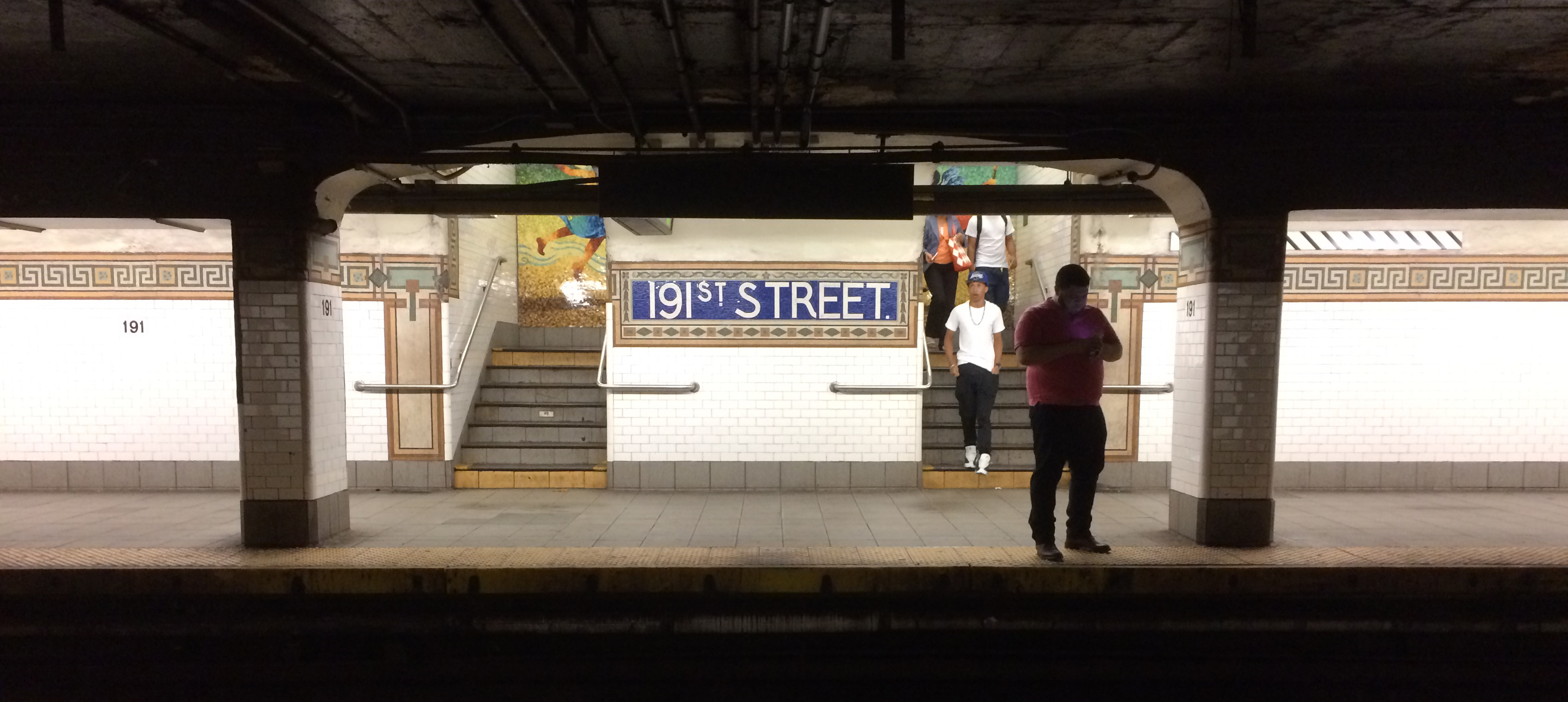
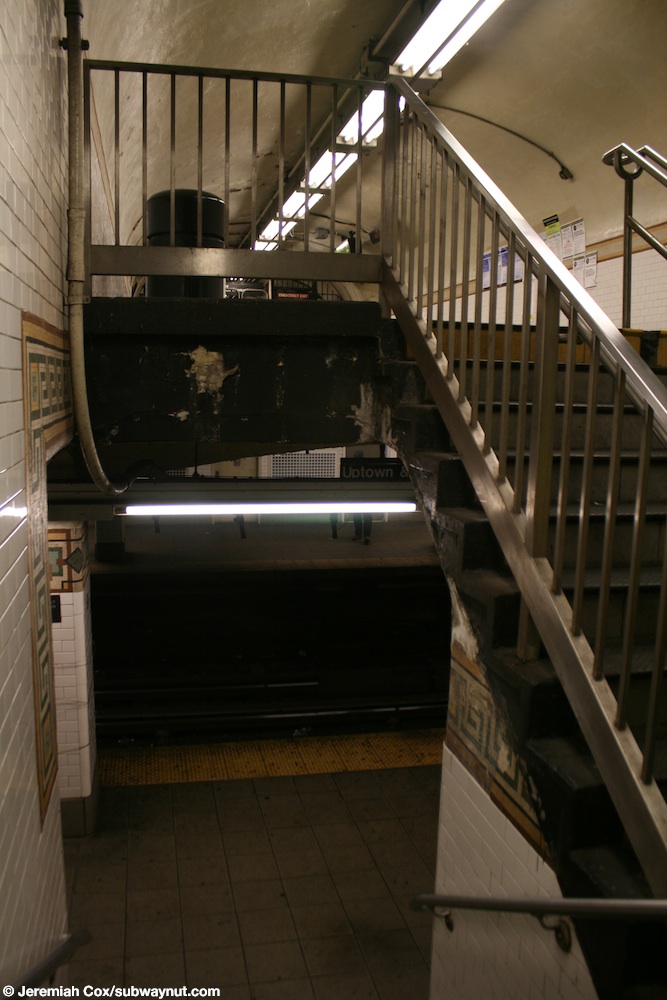
The 191st Street station has two tracks and two side platforms, and is served by the 1 train at all times. The station is between Dyckman Street to the north and 181st Street to the south. Fixed platform barriers, which are intended to prevent commuters falling to the tracks, are positioned near the platform edges. Above the platforms is a mezzanine and covered pedestrian footbridges connecting the two platforms; people on the footbridges cannot see the tracks and platforms (and vice versa). The mezzanine and footbridges are finished in glazed white tile and ceramic sheet marble. The station ceiling is supported by 34 steel columns encased in concrete.
At approximately 173 ft below street level, it is the deepest station in the New York City Subway system. It is one of three in the deep-level Fort George Mine Tunnel, along with the 168th Street and 181st Street stations to the south; the tunnel allows the Broadway–Seventh Avenue Line to travel under the high terrain of Washington Heights. In 1947, Victor Hess, who won the 1936 Nobel Prize in Physics for his discovery of cosmic rays, wrote to the NYCBOT asking if he could use the station "to carry out experiments on the radiation emitted from rocks at a location well protected from cosmic rays." Ultimately, Hess was allowed to conduct his experiments in the nearby 190th Street station on the IND Eighth Avenue Line, which is also far below ground. Despite the 191st Street station's depth, the next station north, Dyckman Street, is just above ground level, at a lower elevation above sea level. This is because 191st Street is under nearly the highest point on the island of Manhattan, deep in the Washington Heights Mine Tunnel, while Dyckman Street runs along a deep valley almost at sea level and its station is at the tunnel portal.
As part of the MTA's Arts for Transit Program, during the station's 2003 renovation, $88,360 was allocated for the creation and installation of a mosaic tile piece of art titled Primavera by Raul Colon.
Exits
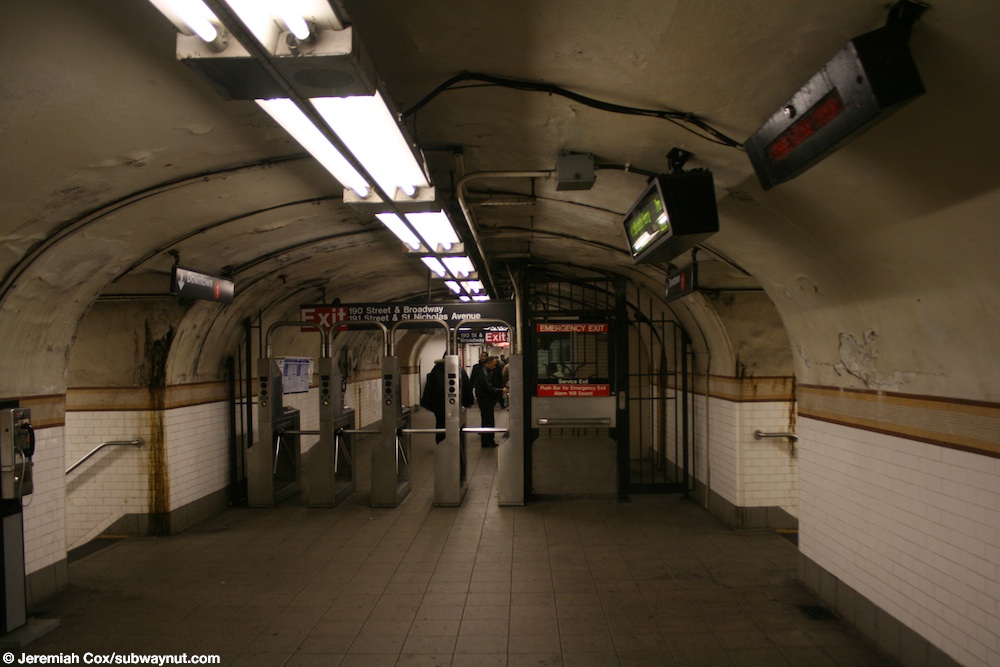
There are two entrances/exits from this station via the same fare control. The main entrance/exit at the southwest corner of 191st Street and St. Nicholas Avenue is at the summit of a hill and accessible only by a set of four elevators. The elevators to the mezzanine still utilize elevator operators—one of the few stations in the system to do so. The other entrance/exit, at 190th Street and Broadway west of the station, is located at a hillside and is accessed via a three-block long passageway, which passes under Wadsworth Terrace and Avenue. The station is not compliant with the Americans with Disabilities Act of 1990 (ADA), and thus cannot be used by patrons with wheelchairs, because access from the fare control area to the platforms, as well as access from both the elevators and passageway to street level, are only possible via stairways.
Pedestrian tunnel
|File:2005 BwyWalk0505 Station191stBroadway crop.jpg | Tunnel entrance as seen in 2005 | File:2013 191st Street subway station Broadway at 190th Street entrance.jpg |Tunnel entrance as seen in 2013, with artwork titled New York is a Rollercoaster| File:2015 191st Street IRT station Broadway at 190th Street entrance.jpg |Tunnel entrance as seen in 2015 with newly painted murals}}
The 900 ft passageway between the station's Broadway entrance and the station itself is not maintained by the MTA, despite being marked as a subway entrance. It is a property of the New York City Department of Transportation, and is officially called "Tunnel Street". The tunnel is also used as a connector between western and eastern Washington Heights; passengers using the other entrance, at 191st Street and St. Nicholas Avenue, need to take an elevator to access the station due to that intersection's height. The elevators at that entrance, which are outside fare control, are considered a convenient way to traverse the neighborhood without walking up a hill.
In the early 1990s the city's crime rates reached an all-time high. The station was considered very dangerous, with 11 crimes having taken place there in 1990; many of them were suspected to have happened in the tunnel. At the time, the tunnel was dimly lit, covered with graffiti, and strewn with garbage. Brighter lights were installed in 2000. In February 2006, State Senator Eric Schneiderman and others proposed the city turn the tunnel over to the MTA. They felt the MTA had more experience in maintaining tunnels, noting it owned the tunnels at the 181st Street and 190th Street stations on the IND Eighth Avenue Line, which were in better condition. In September 2014, improvements began on the tunnel, which area residents had complained about. The tunnel, which had graffiti and was frequented by cyclists riding bikes illegally, was slated to get several murals and new LED lighting.
The passageway has been painted with murals since the late 2000s to beautify the tunnel. In 2008, a mural was painted on the passageway leading up from Broadway to the station, as part of the Groundswell Community Mural Project. It was called New York is a Rollercoaster. It was later vandalized, and in May 2015, it was painted over. Since then, the passageway's artwork has consisted of five murals. As part of a tunnel beautification program, the NYCDOT chose four artists and one team of artists, mostly local, from an applicant pool of 158. They were chosen to paint a 200 ft section of the tunnel. From the Broadway entrance to the station fare control, the artworks are: Queen Andrea's Prismatic Power Phrases; Jessie Unterhalter and Katey Truhn's Caterpillar Time Travel; Cekis's It's Like A Jungle/Aveces Es Como Una Jungle; Nick Kuszy's Warp Zone; and Cope2's Art is Life. Awarded $15,000 each, the artists worked for over a week on their art. After the murals in the tunnel were heavily graffitied, the NYCDOT covered the entire tunnel with white paint in January 2023, which elicited criticism from the surrounding community. At the time, the NYCDOT said that it planned to commission new artwork for the tunnel.
| File:2014 191st Street IRT station tunnel.jpg |The pedestrian tunnel before artwork was installed (2014) | File:2015 191st Street IRT station tunnel 2.jpg |Caterpillar Time Travel by Jessie Unterhalter and Katey Truhn | File:2015 191st Street IRT station tunnel plants.jpg |It's Like A Jungle by Nelson Cekis | File:2015 191st Street IRT station tunnel Big City Dreams.jpg |Prismatic Power Phrases by Queen Andrea | File:2015 191 Street tunnel 2 vc.jpg |Another view of Prismatic Power Phrases by Queen Andrea| File:2015 191st Street IRT station tunnel Pow!.jpg |Art is Life by Cope2}}
Ridership
In Fiscal Year 1914, shortly after the station's opening, it had 546,447 boardings, significantly lower than the figures for the adjacent 181st Street and Dyckman Street stations, which were 6,133,256 and 923,785, respectively. In 2018, the station had 2,526,932 boardings, making it the 186th most used station in the 424-station system. This amounted to an average of 8,032 passengers per weekday.
In popular culture
- The station was a filming location in the 2021 film In the Heights.
References
Notes
Citations
References
- (January 22, 1911). "Era of Building Activity Opening for Fort George: New Subway Station at 191st Street and Proposed Underground Road to Fairview Avenue Important Factors in Coming Development–One Block Of Apartments Finished". The New York Times.
- (1918). "Fifty Years of Rapid Transit — 1864 to 1917". Law Printing.
- (October 23, 1979). "Interborough Rapid Transit System, Underground Interior". [[New York City Landmarks Preservation Commission]].
- (1905). "Report of the Board of Rapid Transit Railroad Commissioners for the City of New York For The Year Ending December 31, 1904 Accompanied By Reports of the Chief Engineer and of the Auditor". Board of Rapid Transit Railroad Commissioners.
- (March 30, 2005). "181st Street Subway Station (IRT)". [[National Register of Historic Places]], [[National Park Service]].
- Scott, Charles. (1978). "Design and Construction of the IRT: Civil Engineering". Historic American Engineering Record.
- Interborough Rapid Transit Company. (1904). "New York Subway: Its Construction and Equipment". Interborough Rapid Transit Company.
- (March 13, 1906). "Trains To Ship Canal — But They Whiz by Washington Heights Stations". The New York Times.
- (January 14, 1911). "Big Subway Station, 172 Feet Under Street Surface, Opened". [[The Telegram (Herkimer).
- (August 29, 1909). "Shaft Started for New Subway Station". The New York Times.
- (January 15, 1911). "Subway Station Opened. New Entrance at 191st Street and St. Nicholas Avenue in Use. Realty Men At Ceremony. Undertaking Will Greatly Increase Land Values, Says Henry Morgenthau.". [[New-York Tribune]].
- (June 27, 1909). "Latest Dealings By Brokers". The New York Times.
- (June 26, 1909). "Private Sales Reported.". The Evening Post.
- (July 29, 1909). "Miscellaneous". [[The Sun (New York City).
- (January 15, 1911). "Subway Station Opened - New Entrance at 191st Street and St. Nicholas Avenue in Use". [[New-York Tribune]].
- (May 20, 1911). "The 191st Street Subway Station". New York City Engineering Record.
- (March 24, 1914). "Thousands Climb As Subway Lifts Stop". [[The Sun (New York City).
- (January 13, 1911). "New Subway Station. Cut Out of the Solid Rock at 191st Street in Record Time.". The New York Times.
- (September 10, 1911). "Subway For Pedestrians: Contracts Let for Passageway to 191st Street Station.". [[New-York Tribune]].
- (January 1913). "A Novel Street". The General Contractors Association.
- (1912). "Minutes of the Board of Estimate and Apportionment of the City of New York Financial and Franchise Matters From September 1, 1912, to October 31, 1912". [[New York City Board of Estimate]].
- (August 3, 1913). "Residents of "Broadway Canyon" Conquer a Mountain". The Sun.
- (October 6, 1909). "3 New Outlets For Subway On Heights. Tunnel to Run from St. Nicholas Avenue West to Riverside Drive. To Open At 3 Streets. Will Bring Fine Residential Section Within Easy Reach of Down Town. Millions In Improvements. Branch Line Will Run to Stations at Broadway, Fort Washington Avenue and Riverside Drive.". [[New York Herald]].
- (1915). "Minutes of the Board of Estimate and Apportionment of The City of New York From February 1, 1915, to March 31, 1915. Volume II". [[New York City Board of Estimate]].
- (June 12, 1910). "Riverside Drive Sale. The Bedford Estate Property to Go Under the Hammer Tuesday.". The New York Times.
- (December 2, 1910). "1000-Foot Tunnel to Subway Under Washington Heights". [[New York Herald]].
- (September 11, 1911). "Straight Thro' Solid Rock. New York to have 800-Foot Thoroughfare 185 Feet Underground". [[The Burlington Free Press]].
- (September 26, 1911). "First Underground Street. Contract Let for Tunnel Thoroughfare at 191st Street". Daily [[Arkansas Gazette]].
- (October 5, 1911). "Begin Tunnel Into Fort George Hill. Contractors Promise Bore to 191st Street Subway Station Will Be Ready in Nine Months.". [[New York Herald]].
- (October 4, 1911). "Commence Work on Fort George Tunnel". [[New York Herald]].
- (June 20, 1912). "Leaks In Subway, Near New Station; At 191st Street Water Makes Walls Crumble and Leaves Pools on Platform.". The New York Times.
- (December 3, 1911). "Plan to Extend Subway Tunnel for Fort Washington Ridge Dwellers". [[New York Herald]].
- (April 28, 1912). "Building A Street 200 Feet Underground Uptown". [[The New York Press]].
- (April 27, 1913). "Northward And Skyward Growth Of The Local West Side". [[New York Herald]].
- (1912). "Minutes of the Board of Estimate and Apportionment of the City of New York Public Improvement Matters From January 1, 1912, to March 31, 1912.". [[New York City Board of Estimate]].
- (June 23, 1912). "New Heights Subway.". The New York Times.
- (April 25, 1913). "City Now Has A Tunnel Street". [[Herald News.
- (March 8, 1913). "Tunnel Opening To-Day. Celebration to Mark the End of Hill Climbing at 191st Street.". The New York Times.
- (March 9, 1913). "Tunnel to Subway Opened. New Street Cost $75,000 and Does Away With Fort George Hill.". [[The Sun (New York City).
- (1914). "Report of the Public Service Commission For The First District Of The State of New York For The Year Ending December 31, 1913 Vol. 1". [[New York State Public Service Commission]].
- (January 1, 1914). "Deny Subway Easements. Court Calls Demands for Tunnel Street Damages 'Fanciful.'". The New York Times.
- (January 5, 1921). "Here Is The Ideal Street.". [[The Billings Gazette]].
- (October 7, 1911). "A Novel Undertaking in Street Construction in New York City". E. L. Powers Company.
- (March 28, 1913). "Live Topics About Town". [[The Sun (New York City).
- (March 17, 1912). "Our Tunnel Street Built By The City. A Way, Novel Here, of Overcoming the Hills That Bother the Upper Part of Town. In Washington Heights. It Leads From Broadway Under Fairview Avenue to 191st Street Subway Elevators.". [[The Sun (New York City).
- (1918). "Report of the Public Service Commission For The First District of the State Of New York For the Year Ending December 31, 1917 Volume 1". [[New York State Public Service Commission]].
- (1917). "Report of the Public Service Commission For The First District of the State Of New York For the Year Ending December 31, 1917 Volume 1". [[New York State Public Service Commission]].
- (June 12, 1910). "A Variety of Sales: Speculative Parcels Among the Auction Offerings. The Budget Attractive. Bedford Estates Plots, on Washington Heights, To Be Sold Next Week.". [[New-York Tribune]].
- (1910). "1909-1910 Annual Report of the Interborough Rapid Transit Company for the Year Ended June 30, 1910". Interborough Rapid Transit Company.
- (July 18, 1910). "Tons of Rails Fall In Subway, Blocking Trains. Rock Blasters Near Death When Roof of Tunnel Collapse Under Greater Weight. Traffic About 137th Street Delayed Hours. Anxious Passengers See Brilliant Electrical Display from Third Rail and Are Shaken Up.". [[The Telegram (Herkimer).
- (1912). "Report of the Public Service Commission for the First District of the State of New York For The Year Ending December 31, 1911 Volume I". [[New York State Public Service Commission]].
- (1911). "1910–1911 Annual Report of the Interborough Rapid Transit Company For The Year Ended June 30, 1911". Interborough Rapid Transit Company.
- (January 15, 1911). "Its Newest Station Opened by the Subway. Washington Heights Dwellers Now Can Get Trains at 191st Street. A Celebration Is Held. Interborough Manager Says Corporation Is Carrying 1,000,000 Instead of 400,000 Passengers.". [[New York Herald]].
- (January 15, 1911). "New Subway Station Open. At West 191st Street and St. Nicholas Avenue, Manhattan–Officials Speak". [[The Brooklyn Daily Eagle]].
- (January 13, 1911). "New Subway Station Open Saturday.". The New York Times.
- (1916). "Brooklyn Daily Eagle Almanac". Brooklyn Daily Eagle.
- (August 2, 1918). "Open New Subway Lines to Traffic; Called a Triumph". The New York Times.
- (January 15, 1911). "New Station Now Open". The New York Times.
- (September 17, 1911). "Rapid Apartment House Development Throughout The Upper West Side. Era of Active Building Movement Opening in the Fort George and Dyckman Tract Regions–207th Street Becoming a Great Business Center–Ancient Farm Lands Giving Way to Solid Blocks of Houses for Hundreds of Families–Notable Changes in the Fort Washington Section Around 181st Street". The New York Times.
- (January 13, 1913). "Report of the Public Service Commission For The First District of The State of New York For The Year Ending December 31, 1912 Vol. I.". New York State Public Service Commission.
- Walker, James Blaine. (1911). "State Regulation of Public Service Corporations in the City of New York: Work of Public Service Commission For The First District, 1907 to 1911, In Supervising". [[New York State Public Service Commission]].
- (March 1911). "Notes". Compressed Air Magazine.
- (February 27, 1917). "$165,000 Heights Sale". The Sun.
- (January 15, 1910). "Heights Plot Sold for Improvement.". The New York Times.
- (March 14, 1915). "Hodge Grants Hearing On Subway Protests. P. S. Commissioner to Receive Washington Heights Citizens' Representatives. Use of 3d Track Demanded. Better Broadway Express Service from 157th Street Principal Issue.". The [[New York Press]].
- (January 4, 1912). "Springs Baffle Subway Experts: Unable to Stop Water from Drenching One Hundred and Ninety-First Street Station". [[New York Herald]].
- (February 5, 1918). "Canal Street Water Menace in Subway Is To Be Remedied: Public Service Commission Engineers Have Undertaken to Provide Dry Passage.". [[New York Herald]].
- (June 8, 1919). "Real Estate History Will Be Made Next Tuesday At Sale Of The Bennett Property On Washington Heights". [[New York Herald]].
- (August 14, 1925). "New Lifts For Tube Station: Traffic at 191st Street Increases 200 P.C.–Forces More Elevators". [[New York Evening Post]].
- (August 14, 1925). "New Subway Elevators. Two More to Be Installed to Care for 191st Street Traffic.". The New York Times.
- (October 18, 1925). "More Subway Elevators.". The New York Times.
- (October 14, 1925). "Otis Firm to Build Tube Lifts". [[New York Evening Post]].
- (October 14, 1925). "Subway Elevators. Contract for Two Awarded the Otis Company.". [[The Sun (New York City).
- (September 10, 1926). "For Pupils' Needs: New Elevator at High School Subway Station.". [[The New York Sun]].
- (1926). "State of New York Transit Commission Sixth Annual Report For the Calendar Year 1926". New York State Transit Commission.
- (1940-06-13). "City Transit Unity Is Now a Reality; Title to I.R.T. Lines Passes to Municipality, Ending 19-Year Campaign". The New York Times.
- (June 13, 1940). "Transit Unification Completed As City Takes Over I. R. T. Lines: Systems Come Under Single Control After Efforts Begun in 1921; Mayor Is Jubilant at City Hall Ceremony Recalling 1904 Celebration". New York Herald Tribune.
- (1949). "Report for the three and one-half years ending June 30, 1949.". [[New York City Board of Transportation]].
- (July 10, 1948). "More Long Platforms – Five Subway Stations on IRT to Accommodate 10-Car Trains". The New York Times.
- Brown, Nicole. (May 17, 2019). "How did the MTA subway lines get their letter or number? NYCurious".
- (April 1960). "A Summary of Services on the IRT Division, NYCTA". Electric Railroaders' Association.
- (February 7, 1959). "Wagner Praises Modernized IRT — Mayor and Transit Authority Are Hailed as West Side Changes Take Effect". The New York Times.
- Ronan, Thomas P.. (December 29, 1950). "Subway Shelters to Cost $104,000,000 Proposed for City". The New York Times.
- Lister, Walter Jr.. (29 Dec 1950). "Subway Bomb Shelters Outlined, City Seeks U.S. Aid on Financing: Bingham Plans Sleeping Quarters for 101,500, Standing Room for a Million More". New York Herald Tribune.
- O'Flaherty, Mary. (January 5, 1957). "Stein's Plan For Subway Cash. Would Utilize Extensions For Shelters, Let U.S. Pay". [[New York Daily News]].
- (1961). "New York City Transit Authority Annual Report For The Year Ended July 1, 1960 to June 30, 1961". New York City Transit Authority.
- (1962). "New York City Transit Authority Annual Report For The Year Ending June 30, 1962". [[New York City Transit Authority]].
- (1976). "Laws of the State of New York". [[New York State Legislature]].
- (1983). "Rehabilitation of Elevators at 181st and 190th Street Stations 8th Avenue Line, "B" Division (IND) and 191st Street Station". McGraw-Hill.
- (June 11, 1981). "Agency Lists Its 69 Most Deteriorated Subway Stations". The New York Times.
- Goldman, Ari L.. (April 28, 1983). "M.T.A. Making Major Addition to Capital Plan". The New York Times.
- Moses, Charles T.. (October 3, 1983). "TA Gets Funds to Fix Subways". Newsday.
- Gargan, Edward A.. (October 3, 1983). "City Speeding Its Subway Repairs". The New York Times.
- (August 1989). "Announcing 1 and 9 Skip-Stop Service on the Broadway-Seventh Avenue Line". [[New York City Transit Authority]].
- Brozan, Nadine. (June 4, 1989). "'Skip-Stop' Subway Plan Annoys No. 1 Riders". The New York Times.
- Lorch, Donatella. (August 22, 1989). "New Service For Subways On West Side". The New York Times.
- Chan, Sewell. (January 12, 2005). "MTA Proposes Dropping No. 9 Train". The New York Times.
- ''New York Division Bulletin''. Electric Railroaders' Association. '''37 station''' (9). September 1994.
- Chan, Sewell. (May 25, 2005). "On Its Last Wheels, No. 9 Line Is Vanishing on Signs". The New York Times.
- Kugel, Seth. (January 7, 2001). "Neighborhood Report: Washington Heights; 2 Elevators for 2 Riderships At Nearby Subway Stations". The New York Times.
- (July 1, 2003). "MTA NYC Transit Subway Line Information". Metropolitan Transportation Authority.
- Weinberg, Brian. (August 3, 2003). "Broadway pedestrian tunnel @ 191 St (1). Tunnel was closed while the station was rehabilitated.".
- (December 12, 2002). "Contract Capers Excess Costs and Politics in MTA Contracting". Public Policy and Education Fund of New York.
- Donohue, Pete. (June 28, 2003). "191st St. station to close for fixup". [[New York Daily News]].
- Sangha, Soni. (July 2, 2003). "Doin' Shuffle at 191st St.". [[New York Daily News]].
- Brown, Susan. (April 2024). "Serpentile".
- Grynbaum, Michael M.. (April 28, 2011). "The Subway's Elevator Operators, a Reassuring Amenity of Another Era". The New York Times.
- Brachfeld, Ben. (July 13, 2023). "Espaillat, TWU sue MTA over plan to stop staffing uptown subway elevators".
- Waller, Nikki. (November 23, 2003). "Why They Take the A Train (and the 1/9) – Neighborhood Report: Washington Heights". The New York Times.
- Piazza, Jo. (December 7, 2003). "M.T.A. Urged Not to Cut Elevator Jobs At 5 Stations". The New York Times.
- Sanchez, Ray. (8 Dec 2003). "Deep Fears In Heights". Newsday.
- Luo, Michael. (2003-12-16). "Likely M.T.A Budget Cuts 22 Subway Elevator Operators' Jobs". The New York Times.
- Sangha, Soni. (21 Jan 2004). "Riders fear elevator cutbacks Operators not standing by". New York Daily News.
- Neuman, William. (November 30, 2007). "M.T.A. Savings Proposal May Mean Service Cuts". The New York Times.
- Gould, Joe. (1 Dec 2007). "Subway Elevator Cuts a Downer, Say Riders". New York Daily News.
- Sangha, Soni. (January 21, 2004). "Riders fear elevator cutbacks. Operators not standing by.". [[New York Daily News]].
- (December 8, 2007). "Changing Course, M.T.A. Will Keep Elevator Operators On". The New York Times.
- Krisel, Brendan. (October 31, 2018). "Uptown Subway Stations Won't Lose Elevator Operators, Union Says".
- Mocker, Greg. (June 16, 2023). "Transit union and MTA debate future of elevator operators at Uptown subway stations".
- Simko-Bednarski, Evan. (June 15, 2023). "MTA reassigning elevator operators deepest NYC subway stations".
- Saltonstall, Gus. (July 13, 2023). "MTA Elevator Job Cuts Endanger Wash Heights Straphangers: Pol's Suit".
- McShane, Larry. (August 5, 2023). "Manhattan judge orders MTA to keep elevator operators working at five Washington Heights stations". New York Daily News.
- (November 5, 2020). "MTA Announces Acceleration of Elevator Replacement Project in Upper Manhattan". Metropolitan Transportation Authority.
- (November 2020). "Replacing the elevators at uptown A and 1 stations". Metropolitan Transportation Authority.
- (November 2, 2020). "Traffic & Transportation November Committee Meeting".
- (2020). "Replacing the Elevators at 191 St 1 Station". Metropolitan Transportation Authority.
- (August 3, 2019). "Elevators at Uptown AC and 1 Stations". Metropolitan Transportation Authority.
- "MTA to Replace Deepest Elevator in System at 191 St. on 1 Line". Metropolitan Transportation Authority.
- Roberts-Grmela, Julian. (January 21, 2024). "MTA testing subway platform barriers in Manhattan, Brooklyn aimed at preventing track falls".
- Wassef, Mira. (January 21, 2024). "MTA installs safety barriers at Manhattan subway station".
- "MTA Board - Capital Program Committee Meeting - 3/24/2025".
- {{NYCS const. trackref. trackbook3
- {{NYCS const. timetable. 1
- {{NYCS const. map
- Wassef, Mira. (July 18, 2025). "Platform barriers installed at 56 subway stations in NYC".
- Russo-Lennon, Barbara. (July 20, 2025). "These are the NYC subway stations that now have protective platform barriers".
- Cox, Jeremiah. (December 31, 2010). "The split of the staircase down to the uptown platform the lights of the mezzanine and the station tracks are visible".
- Cox, Jeremiah. (December 31, 2010). "After fare control on the small overpass area before the platforms.".
- Nalewicki, Jennifer. (April 15, 2016). "12 Secrets of the New York Subway".
- Hood, C.. (2004). "722 Miles: The Building of the Subways and How They Transformed New York". Johns Hopkins University Press.
- {{cite aia5
- Solis, Julia. (2005). "New York Underground: The Anatomy of a City". Routledge.
- (2012). "The Wheels That Drove New York: A History of the New York City Transit System". Springer Berlin Heidelberg.
- "The Physical Tourist: Physics and New York City". [[Physics in Perspective]].
- (August 21, 2016). "A train facts, figures and history of the Eighth Avenue, Fulton and Rockaway lines". [[AM New York]].
- (June 2007). "IRT Interborough Rapid Transit / the New York City Subway: Its Design and Construction". [[Interborough Rapid Transit Company]].
- (July 2002). "MTA Board Action Items July 2002". Metropolitan Transportation Authority.
- "MTA Arts & Design 191st Street Raul Colon Primavera, 2003". Metropolitan Transportation Authority.
- (April 2018). "191st Street Neighborhood Map". Metropolitan Transportation Authority.
- Kurtz, Josh. (August 12, 1991). "Washington Heights Journal; A Subway Passageway Just for the Courageous". The New York Times.
- "Accessible Stations in the MTA Network". Metropolitan Transportation Authority.
- Mindlin, Alex. (February 19, 2006). "Neighborhood Report: Washington Heights; A Passage Through Gloom Gives a Tunnel a Bad Name". The New York Times.
- Armstrong, Lindsay. (September 2, 2015). "Dark, Dirty 191st Street 1 Train Tunnel to Get Safety Improvements". [[DNAinfo.
- (March 2015). "2015 191st Street Tunnel Beautification Request for Qualifications". [[New York City Department of Transportation]].
- Armstrong, Lindsay. (May 6, 2015). "Top Street Artists Picked to Paint 191st Street 1 Train Tunnel". [[DNAinfo.
- (May 18, 2015). "Vivid Street Art Breathes Life Into 191st Street Subway Tunnel". [[Gothamist]].
- Garcia, Sandra E.. (May 31, 2015). "Bringing a Little Color to a Passage at the 191st Street Station". The New York Times.
- Chasan, Aliza. (January 23, 2023). "Graffiti-covered 191st Street subway tunnel painted over".
- Parascandola, Rocco. (January 23, 2023). "Graffiti-covered Manhattan subway tunnel painted over by city workers".
- (January 23, 2023). "Surprise graffiti cleanup at 191st Street subway tunnel causing controversy".
- (2023-01-23). "Backlash After 191st Street Station Tunnel Completely Painted Over".
- (January 24, 2023). "Days after walls painted white, graffiti returns to 191st Street subway tunnel".
- (September 26, 1914). "Subway Station Sales Were 340,413,103 Tickets". [[The Wall Street Journal]].

This article was imported from Wikipedia and is available under the Creative Commons Attribution-ShareAlike 4.0 License. Content has been adapted to SurfDoc format. Original contributors can be found on the article history page.
Ask Mako anything about 191st Street station — get instant answers, deeper analysis, and related topics.
Research with MakoFree with your Surf account
Create a free account to save articles, ask Mako questions, and organize your research.
Sign up freeThis content may have been generated or modified by AI. CloudSurf Software LLC is not responsible for the accuracy, completeness, or reliability of AI-generated content. Always verify important information from primary sources.
Report