From Surf Wiki (app.surf) — the open knowledge base
181st Street station (IRT Broadway–Seventh Avenue Line)
New York City Subway station in Manhattan

New York City Subway station in Manhattan
| Field | Value | ||
|---|---|---|---|
| name | 181 Street | ||
| image | 181st street station repaired.jpg | ||
| image_caption | Renovated platform view | ||
| alt | View of the renovated platform | ||
| address | West 181st Street & Saint Nicholas Avenue | ||
| New York, New York | |||
| borough | Manhattan | ||
| locale | Washington Heights | ||
| coordinates | |||
| division | IRT | ||
| line | IRT Broadway–Seventh Avenue Line | ||
| service | Broadway-Seventh north | ||
| other | NYCT Bus: | ||
| GWB Bus Station (at 179th Street) | |||
| platforms | 2 side platforms | ||
| tracks | 2 | ||
| structure | Underground | ||
| depth | 120 ft | ||
| opened | |||
| accessible | mezzanine | ||
| services | {{Adjacent stations | system=New York City Subway | |
| line | Broadway-Seventh north | left=191st Street | right=168th Street}} |
| footnotes | |||
| embedded | {{Infobox NRHP | ||
| embed | yes | ||
| name | 181st Street Subway Station (IRT) | ||
| added | March 30, 2005 | ||
| mpsub | New York City Subway System MPS | ||
| refnum | 05000224 | ||
| route_map | {{NYCS 2-tracked side platform station | inline=y | |
| deg | 330 | ||
| 1 | 191st Street | ||
| 2 | 168th Street | ||
| code2 | IRT Broadway–Seventh Avenue Line | ||
| former | 181st Street–George Washington Bridge |
New York, New York GWB Bus Station (at 179th Street)
The 181st Street station (signed as 181st Street–George Washington Bridge) is a station on the IRT Broadway–Seventh Avenue Line of the New York City Subway. Located at the intersection of St. Nicholas Avenue and 181st Street in the Washington Heights neighborhood of Manhattan, it is served by the 1 train at all times.
Built by the Interborough Rapid Transit Company (IRT), the station opened on May 30, 1906, as part of the first subway, although the line had opened two months earlier and trains were skipping the station. It is one of three stations in the Fort George Mine Tunnel, which carries the Broadway–Seventh Avenue Line under Washington Heights, and is 120 ft below ground level. Due to the station's depth, the tunnel was blasted through the hillside; during the station's construction, a 300-ton boulder had killed 10 miners. The station's platforms were lengthened in 1948. The station was closed from December 2020 to November 2021 for elevator replacement.
The 181st Street station contains two side platforms and two tracks. The station was built with tile and mosaic decorations as well as a ceiling vault. The platforms contain exits to 181st Street and St. Nicholas Avenue. 181st Street is one of three New York City Subway stations that can be accessed only by elevators; however, the station's four elevators are not compliant with the Americans with Disabilities Act of 1990 (ADA). The station is listed on the National Register of Historic Places.
History
Construction and opening
Construction
Planning for a subway line in New York City dates to 1864, but development of what became the city's first subway line did not start until 1894, when the New York State Legislature passed the Rapid Transit Act. The subway plans were drawn up by a team of engineers led by William Barclay Parsons, the Rapid Transit Commission's chief engineer. It called for a subway line from New York City Hall in lower Manhattan to the Upper West Side, where two branches would lead north into the Bronx. A plan was formally adopted in 1897, and all legal conflicts over the route alignment were resolved near the end of 1899.
The Rapid Transit Construction Company, organized by John B. McDonald and funded by August Belmont Jr., signed the initial Contract 1 with the Rapid Transit Commission in February 1900, under which it would construct the subway and maintain a 50-year operating lease from the opening of the line. In 1901, the firm of Heins & LaFarge was hired to design the underground stations. Belmont incorporated the Interborough Rapid Transit Company (IRT) in April 1902 to operate the subway.
The 181st Street station was constructed as part of the IRT's West Side Line (now the Broadway–Seventh Avenue Line) from 133rd Street to a point 100 ft north of 182nd Street. Work on this section was conducted by L. B. McCabe & Brother, who started building the tunnel segment on May 14, 1900. The 168th Street, 181st Street, and 191st Street stations were built as part of the Washington Heights Mine Tunnel (also known as the Fort George Tunnel), which stretches for over 2 mi. The tunnel was dug through the hard rock under Washington Heights, with work proceeding from either end as well as from construction shafts. Construction shafts were excavated at 168th and 181st Streets, and elevators were installed inside these construction shafts after the tunnel was completed. The tunnel was mined in the early morning to minimize disruption. Much of the rock was crushed for concrete, including the concrete floor. The rails and arched roof were laid using travelers that proceeded the length of the tunnel. During construction, on October 24, 1903, a 300-ton boulder weakened by an explosive gave way, killing 10 miners (six instantly) and injuring eight more. The dead miners consisted of nine Italian immigrants (including the foreman) as well as an electrician from Germany.
Opening
The original New York City Subway line from City Hall to 145th Street on the West Side Branch opened in 1904, with the line being extended to 157th Street that year. The West Side Branch was extended northward from 157th Street to a temporary terminus at 221st Street, near the Harlem River Ship Canal, on March 12, 1906, with the station at 181st Street not yet open. The 181st Street station opened on May 30, 1906, when express trains began running through to 221st Street. On the following day, new feeder streetcar lines operated by the Interborough Railway Company began running from the Bronx, over the Washington Bridge, and along 181st Street, to the station to provide transfers with the subway at the new station. These routes ran along Aqueduct Avenue, Fordham Road, 189th Street, Southern Boulevard, and 180th Street in the Bronx, connecting the West Bronx with the new subway line.
The opening of the first subway line, and particularly the 181st Street station, in conjunction with the streetcar routes over the Washington Bridge, helped contribute to a development boom in the direct vicinity of the station and the development of Washington Heights. Within five years, five- and six-story apartment buildings occupied most of the area around the station. The opening of the subway transformed the sparsely populated area into a growing neighborhood with apartment buildings and thriving business district along 181st Street.
After the first subway line was completed in 1908, the station was served by West Side local and express trains. Express trains began at South Ferry in Manhattan or Atlantic Avenue in Brooklyn, and ended at 242nd Street in the Bronx. Local trains ran from City Hall to 242nd Street during rush hours, continuing south from City Hall to South Ferry at other times.
Due to the draftiness of the 181st Street and 168th Street stations, many women's petticoats would fly about. In February 1908, engineers at the New York Public Service Commission (PSC) were almost done devising a solution to the problem.
Service changes and station renovations
1910s to 1930s
The station was originally built with two elevators on the southern end of the uptown platform. In fiscal year 1909, work was done to increase the carrying load of the elevators. On June 25, 1909, the New York City Board of Estimate approved an appropriation of $160,000 () for the installation of four additional elevators on the northern end of the uptown platform. These elevators measured 8.75 by each and could carry up to 8000 lb. In June 1910, work on the additional elevators was about 50 percent complete and was on track to be completed by March 1, 1911, although some of the elevators were to be placed in service before then. Work to install the elevators was nearly complete in 1911, and the final finishes were installed by January and February 1912. On February 3, 1913, the PSC was informed that the IRT had let a contract to construct an additional elevator at the station, which would be completed in April. The elevator would supplement the four elevators already in service at the station and would make use of the space provided in the elevator shaft for two additional elevators. The PSC had ordered that the IRT install two additional elevators in the station a few months prior. On May 19, 1915, residents of Washington Heights requested that the PSC install additional elevators at the 181st Street and 168th Street stations.
To address overcrowding, in 1909, the PSC proposed lengthening the platforms at stations along the original IRT subway. As part of a modification to the IRT's construction contracts made on January 18, 1910, the company was to lengthen station platforms to accommodate ten-car express and six-car local trains. In addition to $1.5 million (equivalent to $ million in ) spent on platform lengthening, $500,000 (equivalent to $ million in ) was spent on building additional entrances and exits. It was anticipated that these improvements would increase capacity by 25 percent. The northbound platform at the 181st Street station was extended 176 ft to the north; timbering was used to support the arched ceiling during the extension work, thereby allowing it to retain structural integrity. The southbound platform was not lengthened. Six-car local trains began operating in October 1910, and ten-car express trains began running on the West Side Line on January 24, 1911. Subsequently, the station could accommodate six-car local trains, but ten-car trains could not open some of their doors.
In 1918, the Broadway–Seventh Avenue Line opened south of Times Square–42nd Street, and the original line was divided into an H-shaped system. The original West Side Line thus became part of the Broadway–Seventh Avenue Line. Local trains were sent to South Ferry, while express trains used the new Clark Street Tunnel to Brooklyn.
On March 10, 1925, members of a committee of the Cheskchamay Democratic Club of the 23rd Assembly District requested that the New York City Board of Transportation (NYCBOT) construct additional elevators at 180th Street and 182nd Street on the west side of St. Nicholas Avenue to reduce congestion at the station's six elevators. Transit Commissioner John O'Ryan said he would look into the issue and said that having the four north elevators run to the northbound platform instead of running only to the mezzanine level as a short-term measure could help address some of the congestion.
1940s to 1990s

The city government took over the IRT's operations on June 12, 1940. Platforms at IRT Broadway–Seventh Avenue Line stations between and , including those at 181st Street, were lengthened to 514 ft between 1946 and 1948, allowing full ten-car express trains to stop at these stations. A contract for the platform extensions at 181st Street and eight other stations on the line was awarded to Spencer, White & Prentis Inc. in October 1946, with an estimated cost of $3.891 million (). The platform extensions at these stations were opened in stages. On April 6, 1948, the platform extension at 181st Street opened. Simultaneously, the IRT routes were given numbered designations with the introduction of "R-type" rolling stock, which contained rollsigns with numbered designations for each service. The route to 242nd Street became known as the 1. In 1959, all 1 trains became local.
On December 28, 1950, the NYCBOT issued a report concerning the construction of bomb shelters in the subway system. Five deep stations in Washington Heights, including the 181st Street station, were considered to be ideal for being used as bomb-proof shelters. The program was expected to cost $104 million (equivalent to $ billion in ). These shelters were expected to provide limited protection against conventional bombs while protecting against shock waves and air blast, as well as from the heat and radiation from an atomic bomb. To become suitable as shelters, the stations would require water-supply facilities, first-aid rooms, and additional bathrooms. However, the program, which required federal funding, was never completed.
On July 28, 1959, the New York City Transit Authority (NYCTA) released an invitation to contractors to bid on a project to remove an entrance kiosk at street level and replace it with an underpass under 181st Street to the street's northern building line. Work on the project was to be completed within eight months of the letting of the contract. The old entrance kiosk was demolished with a ceremony in April 1960. City officials claimed it was the highest subway kiosk in Manhattan, at 188 ft above sea level. Additionally, in Fiscal Year 1959, two elevators in the station were replaced with automatic ones that could travel at higher speeds. In Fiscal Year 1961, the installation of fluorescent lighting at the station was completed. In 1963, one of the elevators at the station was replaced, while work replacing two more was underway. In June 1964, it was expected that the replacement of another elevator would be completed in September.

The mezzanine to the southern elevators was closed in 1981. The station was closed for the installation of new elevators in the late 1990s and reopened on November 22, 1999, upon the completion of the installation.{{efn|According to Patch and the MTA, in 2020 the elevators were more than eighty years old. However, directly contradicts a 1999 bulletin in the Daily News that announced the installation of new elevators.
In April 1988, the NYCTA unveiled plans to speed up service on the Broadway–Seventh Avenue Line through the implementation of a skip-stop service: the 9 train. When skip-stop service started in 1989, it was only implemented north of 137th Street–City College on weekdays, and 181st Street was served by both the 1 and the 9. Skip-stop service ended on May 27, 2005, as a result of a decrease in the number of riders who benefited.
21st century
Several of the elevators in the station are staffed by elevator attendants, who are also employed at four other deep-level stations in Washington Heights. The elevator attendants are intended to reassure passengers, as the elevators are the only entrance to the platforms, and passengers often wait for the elevators with an attendant. The attendants at the five stations are primarily maintenance and cleaning workers who suffered injuries that made it hard for them to continue doing their original jobs. In July 2003, to reduce costs, the Metropolitan Transportation Authority (MTA) announced that as part of its 2004 budget it would eliminate 22 elevator operator positions at the 181st Street station and four others in Washington Heights, leaving one full-time operator per station. The agency had intended to remove all the attendants at these stops, but kept one in each station after many riders protested. In addition, the MTA began operating all elevators at all times; prior to the change, each elevator only operated if it was staffed by an elevator operator. The change took effect on January 20, 2004, and was expected to save $1.15 million () a year.
In November 2007, the MTA proposed savings cuts to help reduce the agency's deficit. As part of the plan, all elevator operators at 181st Street, along with those in four other stations in Washington Heights, would have been cut. MTA employees had joined riders in worrying about an increase in crime as a result of the cuts after an elevator operator at 181st Street on the Broadway–Seventh Avenue Line helped save a stabbed passenger. The move was intended to save $1.7 million a year. However, on December 7, 2007, the MTA announced that it would not remove the remaining elevator operators at these stations, due to pushback from elected officials and residents from the area. In October 2018, the MTA once again proposed removing the elevator operators at the five stations, but this was reversed after dissent from the Transport Workers' Union. The MTA again suggested reassigning elevator operators to station-cleaner positions in June 2023, prompting local politicians to sue to prevent the operators' reassignments.

The station was added to the National Register of Historic Places in 2005. There was a partial ceiling collapse at the station in 2007. After that collapse, protective scaffolding was erected, and officials devised a master plan for ceiling repairs. However, funds for the ceiling repairs were not approved by the New York State Legislature until August 14, 2009. Two days later, on August 16 at around 10:30 pm, a 25-foot section of the bricks collapsed onto both tracks and platforms. Nobody was injured in the incident. This caused suspension of 1 service between 168th Street and Dyckman Street stations in both directions for eight days with free shuttle buses providing replacement. End-to-end service on the 1 was restored on August 24, and the 181st Street station reopened one week later. An internal MTA audit found that the ceiling had been allowed to decay for a decade prior to the collapse. A $30 million () repair of the 168th and 181st Street stations was to start in early 2012, but was delayed by several months due to scheduling conflicts. The renovation, which started in late 2012, was scheduled to take two and a half years. The project received the 2018 Design Award of Excellence from the Society of American Registered Architects' New York chapter.
This station was closed from December 5, 2020, to November 30, 2021, for elevator repair; this was accelerated from an original date range of March 2021 to February 2022. As part of the reconstruction, the elevators were extended to directly serve the northbound platform. During construction, the frequency of M3 bus service between 191st Street and 168th Street was increased. According to a study conducted by New York University researchers and published in 2024, the 181st Street station had some of the highest particulate matter pollution levels of any subway station in New York City.
Station layout
| Side platform |
|---|
The 181st Street station, which has two tracks and two side platforms, is served by the 1 train at all times. The station is between 191st Street to the north and 168th Street to the south. The station is 120 ft below the surface. It is one of three in the deep-level Fort George Mine Tunnel, along with the 168th Street station to the south and the 191st Street station to the north; the tunnel allows the Broadway–Seventh Avenue Line to travel under the high terrain of Washington Heights. The 181st Street station is one of three stations in the New York City Subway system that can be accessed solely by elevators. The other two, also located on the Broadway–Seventh Avenue Line, are 168th Street, as well as Clark Street on the in Brooklyn. However, this station is not ADA-accessible.
Near the northern end of the station, there are four elevators adjacent to the northbound platform, which lead from the fare control level to one level above the platforms and the northbound platform itself. On the second level, a footbridge connects the side platforms. There is a second footbridge near the center of the station. It leads to a shaft next to the northbound platform, which formerly contained two elevators leading to the fare control area. The footbridge and southern elevator bank were closed in 1981; the shaft is used for ventilation and contains a staircase. There was also a third footbridge in the station.
Design
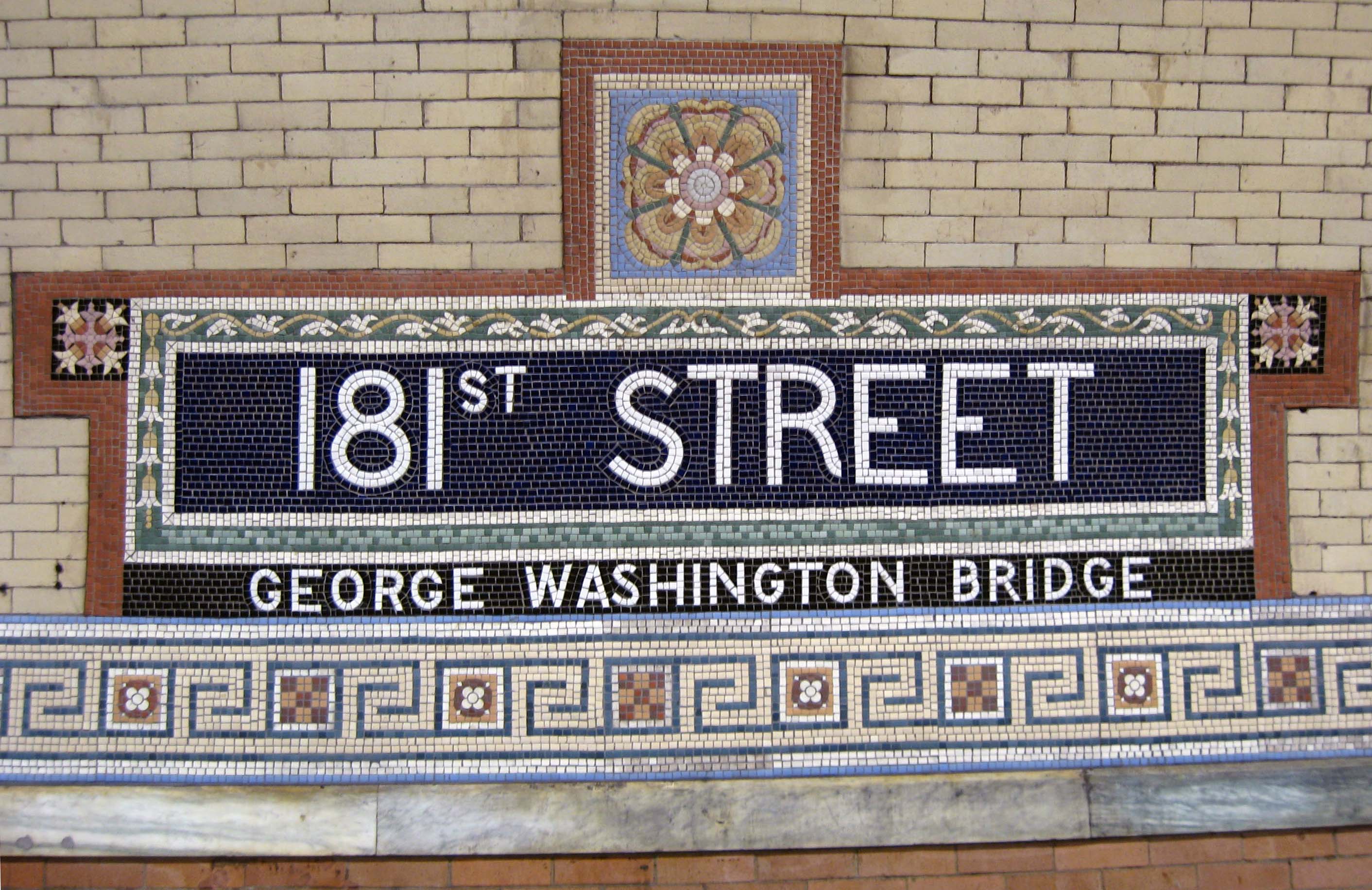
Much of the station is contained within a vault that measures 50 ft wide. The lowest 6 ft of the vault walls are wainscoted with rust-colored brick. Atop the brick wainscoting are a belt course made of marble and a multicolored mosaic frieze measuring about 16 in thick. The tops of the walls contain tan brick. Tile name tablets are placed above the frieze at regular intervals, with white letters on a dark background surrounded by floral designs. Some of these plaques consist of a single mosaic tablet with the words "181st StreetGeorge Washington Bridge" on two lines of text, in reference to the nearby George Washington Bridge. Others contain a primary plaque with the words "181st Street", a secondary plaque with the words "George Washington Bridge" beneath it, and a mosaic flower atop the primary plaque.
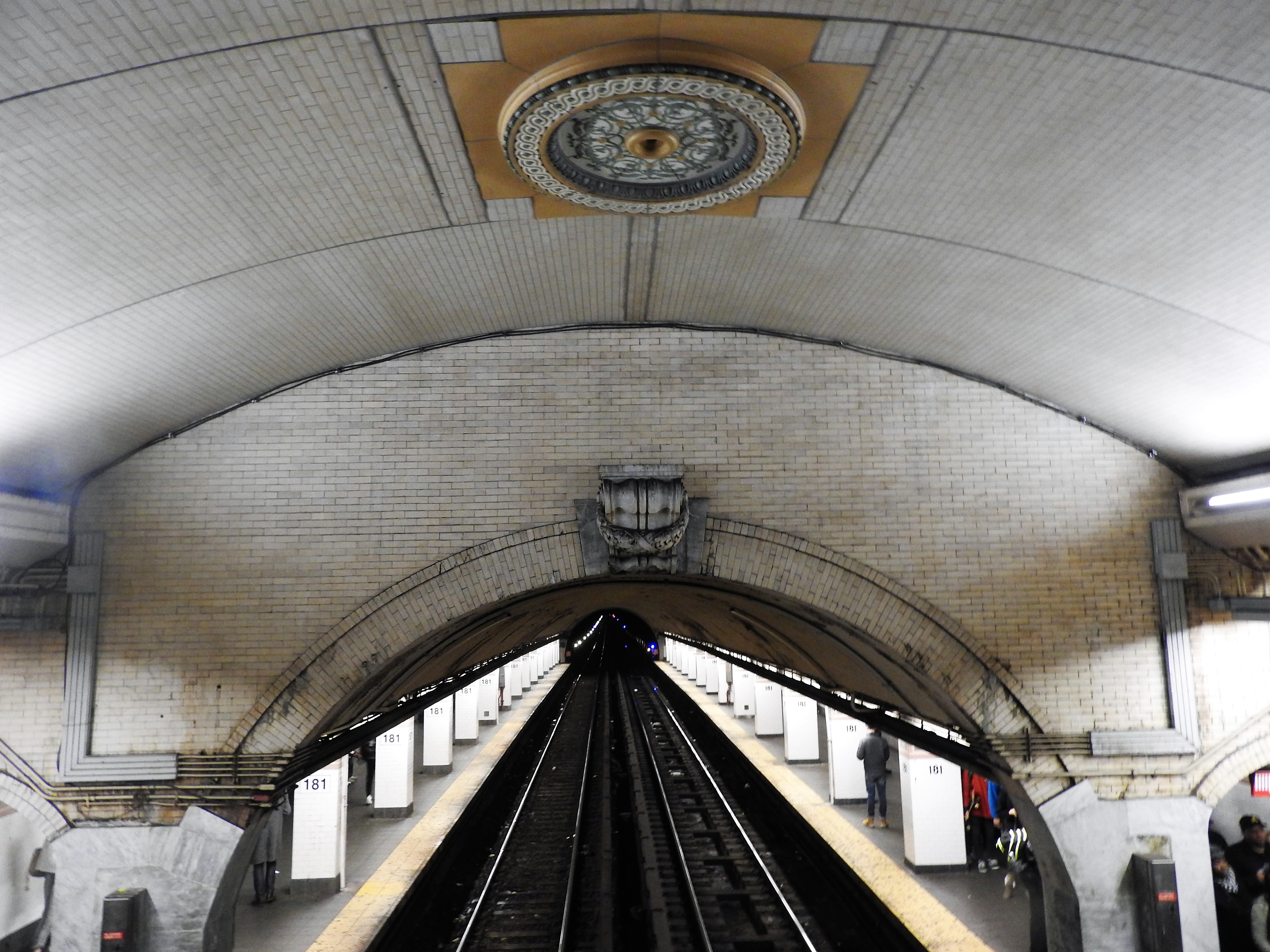
The top of the vault ceiling is approximately three stories above the platform level. The center of the vault ceiling has six multicolored terracotta medallions at regular intervals; these formerly held lighting fixtures. The medallions contain foliate rings surrounded by egg-and-dart moldings, followed by guilloche moldings. Similar, smaller rosettes are on the side walls of the vault. The modern lighting fixtures are fluorescent tubes on the vault walls.
The station's platform extensions have ceilings that are 10 to above the platform level. At the portals between the original vault and the much lower ceilings of the platform extensions, there is a wide arch over the tracks flanked by narrow arches over each platform. These transitions are clad with tan brick. The arch over the tracks has a volute with a laurel wreath. The walls of the platform extensions have white ceramic tiles with mosaic friezes as well as plaques with the words "181st StreetGeorge Washington Bridge". The walls are divided every 15 ft by multicolored tile pilasters that are 16 in wide. Columns near the platform edge, clad with white tile, support the jack-arched concrete station roof.
The northern elevator mezzanine is the only one that is open to the public, as the southern mezzanine was shuttered in 1981 when that elevator bank closed. The walls of the mezzanine and connecting passageways are clad with white ceramic tiles, while the tops of the walls contain multicolored friezes similar to at platform level. The mezzanine and passageway ceilings are made of concrete. The fare control area contains two retail spaces and is clad with ceramic and glazed tile.
Exits
There are two exits to this station, one at either eastern corner of St. Nicholas Avenue and 181st Street. The northeast-corner entrance is inside a building and the southeast-corner entrance is on the street. The station serves Yeshiva University and the George Washington Bridge Bus Terminal.
Notes
References
References
- (1918). "Fifty Years of Rapid Transit — 1864 to 1917". Law Printing.
- (October 23, 1979). "Interborough Rapid Transit System, Underground Interior". [[New York City Landmarks Preservation Commission]].
- (1905). "Report of the Board of Rapid Transit Railroad Commissioners for the City of New York For The Year Ending December 31, 1904 Accompanied By Reports of the Chief Engineer and of the Auditor". Board of Rapid Transit Railroad Commissioners.
- (March 30, 2005). "181st Street Subway Station (IRT)". [[National Register of Historic Places]], [[National Park Service]].
- Scott, Charles. (1978). "Design and Construction of the IRT: Civil Engineering". Historic American Engineering Record.
- Interborough Rapid Transit Company. (1904). "New York Subway: Its Construction and Equipment". Interborough Rapid Transit Company.
- Dwyer, Jim. (August 18, 2009). "Subway Station Ceilings Were Built to Last, but Not Forever". The New York Times.
- (2012). "The Wheels That Drove New York: A History of the New York City Transit System". Springer Berlin Heidelberg.
- Mannes, Elena. "New York Underground Transcript".
- (1910). "Report of the Public Service Commission For The First District of the State of New York For The Year Ending December 31, 1909". Public Service Commission.
- (January 14, 1907). "Farthest North in Town by the Interborough". The New York Times.
- (March 13, 1906). "Trains To Ship Canal — But They Whiz by Washington Heights Stations". The New York Times.
- (May 30, 1906). "Express to 221st Street: Will Run In the Subway To-day–New 181st Street Station Ready.". The New York Times.
- (May 31, 1906). "From Battery to Kingsbridge.". Yonkers Statesman.
- (May 26, 1906). "New Bronx Lines Ready. The Interborough Subway Feeders to Start Next Thursday". The New York Times.
- (September 19, 1909). "The Real Estate Market: Changes Take Place On Washington Heights". The New York Sun.
- (January 22, 1911). "Era of Building Activity Opening for Fort George: New Subway Station at 191st Street and Proposed Underground Road to Fairview Avenue Important Factors in Coming Development–One Block Of Apartments Finished". The New York Times.
- (December 9, 1917). "West 181st Street Centre of Thriving Upper Washington Heights Residential and Business Community". The New York Times.
- (August 2, 1908). "Our First Subway Completed At Last — Opening of the Van Cortlandt Extension Finishes System Begun in 1900 — The Job Cost $60,000,000 — A Twenty-Mile Ride from Brooklyn to 242d Street for a Nickel Is Possible Now". The New York Times.
- (1916). "Brooklyn Daily Eagle Almanac". Brooklyn Daily Eagle.
- (February 8, 1908). "Must Keep Skirts Sedate. New York Officials Order Engineers to Stop Drafts.". The Salina Evening Journal.
- (April 23, 1909). "More Lifts for 181st St. Subway Station". The New York Times.
- (1909). "1908-1909 Annual Report of the Interborough Rapid Transit Company for the Year Ended June 30, 1909". Interborough Rapid Transit Company.
- (June 26, 1909). "$160,000 For Subway Elevators.". The Evening Post.
- (1907). "The Elevator and Escalator Equipment of the New York Subway". The Engineering Record, Building Record and the Sanitary Engineer.
- (1910). "1909-1910 Annual Report of the Interborough Rapid Transit Company for the Year Ended June 30, 1910". Interborough Rapid Transit Company.
- (1913). "Report of the Public Service Commission for the First District of the State of New York". New York State Public Service Commission.
- (February 4, 1913). "New Lift At 181st Street: First of Two More Elevators Being Put in Subway Station". New-York Tribune.
- (May 20, 1915). "Brief News Notes". The Bridgeport Times and Evening Farmer.
- Hood, Clifton. (1978). "The Impact of the IRT in New York City". Historic American Engineering Record.
- (1911). "Report of the Public Service Commission for the First District of the State of New York For The Year Ending December 31, 1910". Public Service Commission.
- (January 23, 1911). "Ten-car Trains in Subway to-day; New Service Begins on Lenox Av. Line and Will Be Extended to Broadway To-morrow.". The New York Times.
- (August 2, 1918). "Open New Subway Lines to Traffic; Called a Triumph". The New York Times.
- (March 11, 1925). "Contract Urged For Subway Platforms: Delaney Board Asks Board of Estimate to Make Awards for Lengthening.". The Brooklyn Standard Union.
- (1940-06-13). "City Transit Unity Is Now a Reality; Title to I.R.T. Lines Passes to Municipality, Ending 19-Year Campaign". The New York Times.
- (June 13, 1940). "Transit Unification Completed As City Takes Over I. R. T. Lines: Systems Come Under Single Control After Efforts Begun in 1921; Mayor Is Jubilant at City Hall Ceremony Recalling 1904 Celebration". New York Herald Tribune.
- Crowell, Paul. (October 11, 1946). "Improvement Costs Voted for Subway; Board of Estimate Appropriates $31,291,000 for New Cars and Station Lengthening". The New York Times.
- (11 Oct 1946). "City Approves $35,153,000 Subway Outlay: Board of Estimate Awards Contract for 400 Cars and 10 Station Projects". New York Herald Tribune.
- (1949). "Report for the three and one-half years ending June 30, 1949.". New York City Board of Transportation.
- (July 10, 1948). "More Long Platforms – Five Subway Stations on IRT to Accommodate 10-Car Trains". The New York Times.
- Brown, Nicole. (May 17, 2019). "How did the MTA subway lines get their letter or number? NYCurious".
- (April 1960). "A Summary of Services on the IRT Division, NYCTA". Electric Railroaders' Association.
- (February 7, 1959). "Wagner Praises Modernized IRT — Mayor and Transit Authority Are Hailed as West Side Changes Take Effect". The New York Times.
- Ronan, Thomas P.. (December 29, 1950). "Subway Shelters to Cost $104,000,000 Proposed for City". The New York Times.
- Lister, Walter Jr.. (29 Dec 1950). "Subway Bomb Shelters Outlined, City Seeks U.S. Aid on Financing: Bingham Plans Sleeping Quarters for 101,500, Standing Room for a Million More". New York Herald Tribune.
- O'Flaherty, Mary. (January 5, 1957). "Stein's Plan For Subway Cash. Would Utilize Extensions For Shelters, Let U.S. Pay". [[New York Daily News]].
- (August 11, 1959). "Invitation to Contractors (Contract C-133)". New York Daily News.
- Johnston, Richard J. h. (1960-04-08). "City Escorts a Subway Kiosk Into Limbo; Uptown Ceremony Full of Pomp and Press Agentry". The New York Times.
- (1959). "Annual Report For The Year Ending June 30, 1959". New York City Transit Authority.
- (1961). "New York City Transit Authority Annual Report For The Year Ended July 1, 1960 to June 30, 1961". New York City Transit Authority.
- (1963). "New York City Transit Authority Annual Report For The Year Ended July 1, 1962 to June 30, 1963". New York City Transit Authority.
- (1964). "New York City Transit Authority Annual 1963-1964". New York City Transit Authority.
- (December 5, 1972). "WABCO Sets Transit Orders". Pittsburgh Post-Gazette.
- (November 19, 1999). "1 9 The 181st Street station will reopen on Monday, November 22. Elevator installation is complete.". New York Daily News.
- Brozan, Nadine. (June 4, 1989). "'Skip-Stop' Subway Plan Annoys No. 1 Riders". The New York Times.
- Moore, Keith. (June 10, 1988). "TA's skip-stop plan hit". New York Daily News.
- (August 20, 1989). "#1 Riders: Your Service is Changing". New York Daily News.
- (August 1989). "Announcing 1 and 9 Skip-Stop Service on the Broadway-Seventh Avenue Line". New York City Transit Authority.
- Lorch, Donatella. (August 22, 1989). "New Service For Subways On West Side". The New York Times.
- Chan, Sewell. (May 25, 2005). "On Its Last Wheels, No. 9 Line Is Vanishing on Signs". The New York Times.
- (May 7, 2005). "Noteworthy – 9 discontinued". Metropolitan Transportation Authority.
- Grynbaum, Michael M.. (April 28, 2011). "The Subway's Elevator Operators, a Reassuring Amenity of Another Era". The New York Times.
- Brachfeld, Ben. (July 13, 2023). "Espaillat, TWU sue MTA over plan to stop staffing uptown subway elevators".
- Waller, Nikki. (November 23, 2003). "Why They Take the A Train (and the 1/9) – Neighborhood Report: Washington Heights". The New York Times.
- Piazza, Jo. (December 7, 2003). "M.T.A. Urged Not to Cut Elevator Jobs At 5 Stations". The New York Times.
- Sanchez, Ray. (8 Dec 2003). "Deep Fears In Heights". Newsday.
- Luo, Michael. (2003-12-16). "Likely M.T.A Budget Cuts 22 Subway Elevator Operators' Jobs". The New York Times.
- Sangha, Soni. (21 Jan 2004). "Riders fear elevator cutbacks Operators not standing by". New York Daily News.
- Neuman, William. (November 30, 2007). "M.T.A. Savings Proposal May Mean Service Cuts". The New York Times.
- Gould, Joe. (1 Dec 2007). "Subway Elevator Cuts a Downer, Say Riders". New York Daily News.
- Sangha, Soni. (January 21, 2004). "Riders fear elevator cutbacks. Operators not standing by.". [[New York Daily News]].
- (December 8, 2007). "Changing Course, M.T.A. Will Keep Elevator Operators On". The New York Times.
- Krisel, Brendan. (October 31, 2018). "Uptown Subway Stations Won't Lose Elevator Operators, Union Says".
- Mocker, Greg. (June 16, 2023). "Transit union and MTA debate future of elevator operators at Uptown subway stations".
- Simko-Bednarski, Evan. (June 15, 2023). "MTA reassigning elevator operators deepest NYC subway stations".
- Saltonstall, Gus. (July 13, 2023). "MTA Elevator Job Cuts Endanger Wash Heights Straphangers: Pol's Suit".
- (August 18, 2009). "Subway station repairs to take days". [[WABC-TV]] news.
- Grynbaum, Michael M.. (August 24, 2009). "Service on No. 1 Subway Line Is Largely Restored". The New York Times.
- (August 30, 2009). "No. 1 Line Service Restored to 181st Street". Metropolitan Transportation Authority.
- "Subway Misery Has Express Stop At 181st Street". [[NY1]].
- Hasselle, Della. (June 29, 2010). "MTA Negligence Led to Subway Station Ceiling Collapse, Report Says". DNAinfo New York.
- Redwine, Tina. (October 11, 2011). "Washington Heights Straphangers Annoyed At Long-Delayed Subway Station Repairs". [[NY1]].
- (October 13, 2011). "MTA to Revamp 168th Street 1 Train Platform in 2012". DNAinfo New York.
- Zanoni, Carla. (May 7, 2012). "MTA Delays Overhaul of 168th and 181st Street 1 Train Stations Until Fall". DNAinfo New York.
- Chiwaya, Nigel. (March 6, 2013). "Repairs to 168th and 181st Street 1 Stations to Begin in Spring, MTA Says". DNAinfo New York.
- "2018 Design Awards Winners".
- (2021-12-01). "Wash Heights 181st Street 1 Station Reopens With New Elevators".
- (November 2, 2020). "Traffic & Transportation November Committee Meeting".
- (December 18, 2018). "5 subway stations will get replacement elevators". WPIX 11 New York.
- (December 18, 2018). "Five Subway Stations in Upper Manhattan to Receive New Elevators". Metropolitan Transportation Authority.
- (December 3, 2020). "Washington Heights 181st 1 Station Set To Close: What To Know". Washington Heights-Inwood, NY Patch.
- Barron, James. (November 26, 2024). "The Air in Subway Stations Is Bad for You, Study Finds".
- Khalifeh, Ramsey. (August 7, 2024). "Toxic NYC subway air puts Black, Hispanic riders at higher health risk, NYU study finds".
- {{NYCS const. trackref. trackbook3
- {{NYCS const. timetable. 1
- {{NYCS const. map
- Walsh, Kevin. (April 7, 2010). "181st Street". Forgotten NY.
- (April 2018). "181st Street Neighborhood Map". Metropolitan Transportation Authority.
This article was imported from Wikipedia and is available under the Creative Commons Attribution-ShareAlike 4.0 License. Content has been adapted to SurfDoc format. Original contributors can be found on the article history page.
Ask Mako anything about 181st Street station (IRT Broadway–Seventh Avenue Line) — get instant answers, deeper analysis, and related topics.
Research with MakoFree with your Surf account
Create a free account to save articles, ask Mako questions, and organize your research.
Sign up freeThis content may have been generated or modified by AI. CloudSurf Software LLC is not responsible for the accuracy, completeness, or reliability of AI-generated content. Always verify important information from primary sources.
Report