From Surf Wiki (app.surf) — the open knowledge base
1861 Sumatra earthquake
Natural disaster in Indonesia
Natural disaster in Indonesia
| Field | Value | |
|---|---|---|
| title | 1861 Sumatra earthquake | |
| pre-1900 | yes | |
| local-date | ||
| map2 | {{Location map | Indonesia Sumatra |
| lat | 1.0 | |
| long | 97.5 | |
| mark | Bullseye1.png | |
| marksize | 40 | |
| position | top | |
| width | 250 | |
| float | right | |
| caption | }} | |
| magnitude | 8.5 Mw | |
| intensity | VIII (*Heavily damaging*) | |
| location | ||
| countries affected | Sumatra, Dutch East Indies | |
| fault | Sunda megathrust | |
| tsunami | Yes | |
| casualties | Several thousand |
|pre-1900 = yes |local-date=
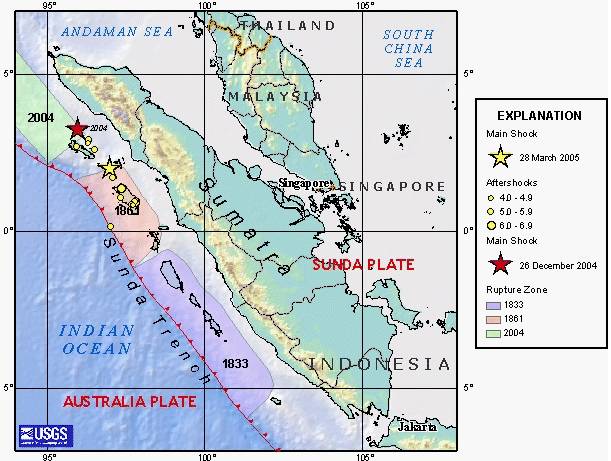
The 1861 Sumatra earthquake occurred on 16 February and was the last in a sequences of earthquakes that ruptured adjacent parts of the Sumatran segment of the Sunda megathrust. It caused a devastating tsunami which led to several thousand fatalities. The earthquake was felt as far away as the Malay peninsula and the eastern part of Java. The rupture area for the 2005 Nias–Simeulue earthquake is similar to that estimated for the 1861 event.
Background
The island of Sumatra lies on the convergent plate boundary between the Indo-Australian plate and the Eurasian plate. The convergence between these plates is highly oblique near Sumatra, with the displacement being accommodated by near pure dip-slip faulting along the subduction zone, known as the Sunda megathrust, and near pure strike-slip faulting along the Great Sumatran fault. The major slip events on the subduction zone interface are typically of megathrust type. Historically, great or giant megathrust earthquakes have been recorded in 1797, 1833, 1861, 2004, 2005 and 2007, most of them being associated with devastating tsunamis. Smaller (but still large) megathrust events have also occurred in the small gaps between the areas that slip during the larger events, in 1935, 1984, 2000 and 2002.
Damage
Villages along the seaward side of the Batu Islands were devastated. The combined effects of the earthquake and tsunami caused several thousand fatalities.
Characteristics
Earthquake
There is evidence of coseismic uplift of Nias, with exposure of reefs and rock piers. There were six major aftershocks over the next seven months, the last of which, on 27 September caused a damaging tsunami. Based on studies of coral growth patterns, researchers have demonstrated that the 1861 event was the culmination of a 32 year long "slow-slip" seismic event, rendering it the longest known example of such a sequence ever recorded.
Tsunami
At least 500 km (310.7 mi) of coastline were affected by the tsunami with run-ups of up to 7m (23 ft) recorded on the southwest side of Nias.
References
References
- Tsunami Laboratory. "Destructive historical tsunamis at the western coast of Sumatra".
- Newcomb, K.R.. (1987). "Seismic history and seismotectonics of the Sunda Arc". Journal of Geophysical Research.
- Natawidjaja, D. H.. (2006). "Source parameters of the great Sumatran megathrust earthquakes of 1797 and 1833 inferred from coral microatolls". Journal of Geophysical Research.
- Wei-Haas, Maya. (2021-05-28). "An earthquake lasted 32 years, and scientists want to know how".
- Pappas, Stephanie. (2021-05-26). "The Longest Known Earthquake Lasted 32 Years".
- (2022). "Gempa Nusantara: A Database of 7380 Macroseismic Observations for 1200 Historical Earthquakes in Indonesia from 1546 to 1950". Bulletin of the Seismological Society of America.
This article was imported from Wikipedia and is available under the Creative Commons Attribution-ShareAlike 4.0 License. Content has been adapted to SurfDoc format. Original contributors can be found on the article history page.
Ask Mako anything about 1861 Sumatra earthquake — get instant answers, deeper analysis, and related topics.
Research with MakoFree with your Surf account
Create a free account to save articles, ask Mako questions, and organize your research.
Sign up freeThis content may have been generated or modified by AI. CloudSurf Software LLC is not responsible for the accuracy, completeness, or reliability of AI-generated content. Always verify important information from primary sources.
Report