From Surf Wiki (app.surf) — the open knowledge base
1836 United States presidential election
none
none
| Field | Value | |
|---|---|---|
| election_name | 1836 United States presidential election | |
| country | United States | |
| flag_year | 1836 | |
| type | presidential | |
| ongoing | no | |
| previous_election | 1832 United States presidential election | |
| previous_year | 1832 | |
| next_election | 1840 United States presidential election | |
| next_year | 1840 | |
| votes_for_election | 294 members of the Electoral College | |
| needed_votes | 148 electoral | |
| turnout | 56.5% 0.5 pp | |
| election_date | ||
| image1 | File:Martin Van Buren circa 1837 crop.jpg | |
| image_size | 150x150px | |
| nominee1 | **Martin Van Buren** | |
| party1 | Democratic Party (United States) | |
| home_state1 | New York | |
| running_mate1 | **Richard Mentor Johnson** | |
| electoral_vote1 | **170** | |
| states_carried1 | **15** | |
| popular_vote1 | **764,176** | |
| percentage1 | **50.8%** | |
| image2 | File:William Henry Harrison by James Reid Lambdin, 1835 crop.jpg | |
| nominee2 | William Henry Harrison | |
| party2 | Whig Party (United States) | |
| alliance2 | Anti-Masonic | |
| home_state2 | Ohio | |
| running_mate2 | Francis Granger | |
| electoral_vote2 | 73 | |
| states_carried2 | 7 | |
| popular_vote2 | 550,816 | |
| percentage2 | 36.6% | |
| image3 | File:Unsuccessful 1836 2.jpg | |
| nominee3 | Hugh Lawson White | |
| party3 | Whig Party (United States) | |
| colour3 | 800080 | |
| home_state3 | Tennessee | |
| running_mate3 | John Tyler | |
| electoral_vote3 | 26 | |
| states_carried3 | 2 | |
| popular_vote3 | 146,109 | |
| percentage3 | 9.7% | |
| image4 | File:Black Dan (cropped).jpg | |
| nominee4 | Daniel Webster | |
| party4 | Whig Party (United States) | |
| colour4 | F88379 | |
| home_state4 | Massachusetts | |
| running_mate4 | Francis Granger | |
| electoral_vote4 | 14 | |
| states_carried4 | 1 | |
| popular_vote4 | 41,201 | |
| percentage4 | 2.7% | |
| image5 | [[File:Willie p magnum crop.jpg | x150px]] |
| nominee5 | Willie P. Mangum | |
| party5 | Whig Party (United States) | |
| alliance5 | Nullifier Party | |
| colour5 | 006D61 | |
| home_state5 | North Carolina | |
| running_mate5 | John Tyler | |
| electoral_vote5 | 11 | |
| states_carried5 | 1 | |
| popular_vote5 | *N/A* | |
| percentage5 | *N/A* | |
| map_size | 350px | |
| map | ||
| map_caption | Presidential election results map. Blue denotes states won by Van Buren/Johnson, Yellow denotes those won by Harrison/Granger, Maroon denotes those won by White/Tyler, Pink denotes those won by Webster/Granger, and Teal denotes those won by Mangum/Tyler. Numbers indicate the number of electoral votes allotted to each state. | |
| title | President | |
| before_election | Andrew Jackson | |
| before_party | Democratic Party (United States) | |
| after_election | Martin Van Buren | |
| after_party | Democratic Party (United States) | |
| module | {{Infobox election | |
| child | yes | |
| election_name | 1837 contingent U.S. vice presidential election | |
| type | presidential | |
| ongoing | no | |
| election_date | February 8, 1837 | |
| votes_for_election | 52 United States senators | |
| needed_votes | 27 | |
| vote_type | Senate | |
| image1 | [[File:Richard Mentor Johnson A29919 (cropped 3x4).jpg | x150px]] |
| candidate1 | **Richard Mentor Johnson** | |
| party1 | Democratic Party (United States) | |
| popular_vote1 | **33** | |
| percentage1 | **63.46%** | |
| image2 | [[File:Francis Granger (cropped 3x4).jpg | x150px]] |
| candidate2 | Francis Granger | |
| party2 | Whig Party (United States) | |
| popular_vote2 | 16 | |
| percentage2 | 30.77% | |
| map_size | 350px | |
| map_image | File:1837 US Contingent VP Election.svg | |
| map_caption | Senate by state. Blue denotes states that voted for Johnson, Yellow denotes those that voted for Granger, Green denotes those that did not vote. State with multiple colors had Senators that voted differently from each other. |
Presidential elections were held in the United States from November 3 to December 7, 1836. Incumbent Vice President Martin Van Buren, candidate of the Democratic Party, defeated four candidates fielded by the nascent Whig Party.
The 1835 Democratic National Convention chose a ticket of Van Buren (President Andrew Jackson's handpicked successor) and U.S. Representative Richard Mentor Johnson of Kentucky. The Whig Party, which had only recently emerged and was primarily united by opposition to Jackson, was not yet sufficiently organized to agree on a single candidate. Hoping to compel a contingent election in the House of Representatives by denying the Democrats an electoral majority, the Whigs ran multiple candidates. Most Northern and border state Whigs supported the ticket led by former Senator William Henry Harrison of Ohio, while most Southern Whigs supported the ticket led by Senator Hugh Lawson White of Tennessee. Two other Whigs, Daniel Webster and Willie Person Mangum, carried Massachusetts and South Carolina respectively on single-state tickets.
Despite facing multiple candidates, Van Buren won a majority of the electoral vote, and he won a majority of the popular vote in both the North and the South. Nonetheless, the Whig strategy came very close to success, as Van Buren won the decisive state of Pennsylvania by just over two points. As Virginia's electors voted for Van Buren but refused to vote for Johnson, Johnson fell one vote short of an electoral majority, compelling a contingent election for vice president. In that contingent election, the United States Senate elected Johnson over Harrison's running mate, Francis Granger.
Van Buren was the third incumbent vice president elected president, which would not happen again until 1988, when George H. W. Bush was elected president. He is also the most recent Democrat elected to succeed an outgoing Democratic president, and the only sitting Democratic vice president to win the presidency. This also marks the last time that the sitting vice president was elected president after only serving for one term. Harrison finished second in both the popular and electoral vote, and his strong performance helped him win the Whig nomination in the 1840 presidential election. The election of 1836 was crucial in developing the Second Party System and a stable two-party system more generally. By the end of the election, nearly every independent faction had been absorbed by either the Democrats or the Whigs.
Nominations
Democratic Party nomination
Main article: 1835 Democratic National Convention
| [](martin-van-buren) | [](richard-mentor-johnson) | ||||
|---|---|---|---|---|---|
| ***for President*** | ***for Vice President*** | ||||
| [[File:Martin Van Buren MET ap93.19.2.jpg | center | 200x200px]] | [[File:Richard Mentor Johnson A29919.jpg | center | 200x200px]] |
| 8th | |||||
| Vice President of the United States | |||||
| (1833–1837) | U.S. Representative | ||||
| from Kentucky | |||||
| (1807–1819, 1829–1837) |
The 1835 Democratic National Convention was held in Baltimore, Maryland, from May 20 to 22, 1835. The early date of the convention was selected by President Andrew Jackson to prevent the formation of opposition to Martin Van Buren. Twenty-two states and two territories were represented at the convention with Alabama, Illinois, and South Carolina being unrepresented. The delegate amount per state varied from Maryland having 188 delegates to cast its ten votes while Tennessee's fifteen votes were cast by one delegate.
The convention saw the first credentials dispute in American history with two rival delegations from Pennsylvania claiming the state's votes. The issue was solved by seating both delegations and having them share the state's votes. An attempt to remove the two-thirds requirement for the selection of a candidate was passed by a vote of 231 to 210, but was later restored through a voice vote.
Some Southerners opposed Johnson's nomination, due to his open relationship with an enslaved woman, whom he had regarded as his common-law wife. At the convention, Van Buren was nominated unanimously with all 265 delegates in favor, but the Virginia delegates supported Senator William Cabell Rives against Johnson. However, Rives got little support and Johnson was nominated with one more vote than the two-thirds requirement.
| Presidential vote | Vice presidential vote |
|---|---|
| Martin Van Buren | 265 |
Whig Party nomination
| Whig presidential candidates | Whig vice-presidential candidates | |
|---|---|---|
| [[File:William Henry Harrison by James Reid Lambdin, 1835 crop.jpg | 75px]] | William Henry Harrison |
| Former United States Minister to Gran Colombia | ||
| [[File:Black Dan (cropped).jpg | 75px]] | Daniel Webster |
| U.S. Senator from Massachusetts | ||
| [[File:HLWhite.jpg | 75px]] | Hugh Lawson White |
| U.S. Senator from Tennessee | ||
| [[File:Willie p magnum crop.jpg | 75px]] | Willie Person Mangum |
| U.S. Senator from North Carolina | ||
| [[File:Francis Granger (cropped 3x4).jpg | 75px]] | Francis Granger |
| U.S. Representative from New York | ||
| [[File:John Tyler (cropped 3x4).png | 75px]] | John Tyler |
| U.S. Senator from Virginia |
The Whig Party emerged during the 1834 mid-term elections as the chief opposition to the Democratic Party. The party was formed from members of the National Republican Party, the Anti-Masonic Party, disaffected Jacksonians, and small remnants of the Federalist Party (people whose last political activity was with them a decade before). Some Southerners who were angered by Jackson's opposition to states' rights, including Sen. John C. Calhoun and the Nullifiers, also temporarily joined the Whig coalition.
Unlike the Democrats, the Whigs did not hold a national convention. Instead, state legislatures and state conventions nominated candidates, being the reason why so many candidates from the Whig party ran in the general election. Southern Nullifiers placed Tennessee Senator Hugh Lawson White into contention for the presidency in 1834 soon after his break with Jackson. White was a moderate on the states' rights issue, which made him acceptable in the South, but not in the North. The state legislatures of Alabama and Tennessee officially nominated White. The South Carolina state legislature nominated Senator Willie Person Mangum of North Carolina. By early 1835, Massachusetts Senator Daniel Webster was building support among Northern Whigs. Both Webster and White used Senate debates to establish their positions on the issues of the day, as newspapers carried the text of their speeches nationwide. The Pennsylvania legislature nominated popular former general William Henry Harrison, who had led American forces at the Battle of Tippecanoe. The Whigs hoped that Harrison's reputation as a military hero could win voter support. Harrison soon displaced Webster as the preferred candidate of Northern Whigs. State legislatures, particularly in larger states, also nominated various vice presidential candidates.
Despite multiple candidates, there was only one Whig ticket in each state. The Whigs ended up with two main tickets: William Henry Harrison for president and Francis Granger for vice president in the North and Kentucky, and Hugh Lawson White for president and John Tyler for vice president in the middle and lower South. In Massachusetts, the ticket was Daniel Webster for president and Granger for vice president. In South Carolina, the ticket was Mangum for president and Tyler for vice president. In Maryland, it was Harrison and Tyler. Of the four Whig presidential candidates, only Harrison was on the ballot in enough states for it to be mathematically possible for him to win a majority in the Electoral College, and even then, it would have required him to win Van Buren's home state of New York.
Anti-Masonic Party nomination
After the negative views of Freemasonry among a large segment of the public began to wane in the mid-1830s, the Anti-Masonic Party began to disintegrate. Some of its members began moving to the Whig Party, which had a broader issue base than the Anti-Masons. The Whigs were also regarded as a better alternative to the Democrats.
A state convention for the Anti-Masonic Party was held in Harrisburg, Pennsylvania, from December 14 to 17, 1835, to choose presidential electors for the 1836 election. The convention unanimously nominated William Henry Harrison for president and Francis Granger for vice president. The Vermont state Anti-Masonic convention followed suit on February 24, 1836. Anti-Masonic leaders were unable to obtain assurance from Harrison that he was not a Mason, so they called a national convention. The second national Anti-Masonic nominating convention was held in Philadelphia on May 4, 1836. The meeting was divisive, but a majority of the delegates officially stated that the party was not sponsoring a national ticket for the presidential election of 1836 and proposed a meeting in 1837 to discuss the future of the party.
Nullifier Party nomination
The Nullifier Party had also begun to decline sharply since the previous election, after it became clear that the doctrine of nullification lacked sufficient support outside of the party's political base of South Carolina to ever make the Nullifiers more than a fringe party nationwide. Many party members began to drift towards the Democratic Party, but there was no question of the party endorsing Van Buren's bid for the presidency, as he and Calhoun were sworn enemies. Seeing little point in running their own ticket, Calhoun pushed the party into backing the White/Tyler ticket, as White had previously sided against Jackson during the Nullification Crisis.
General election
Campaign
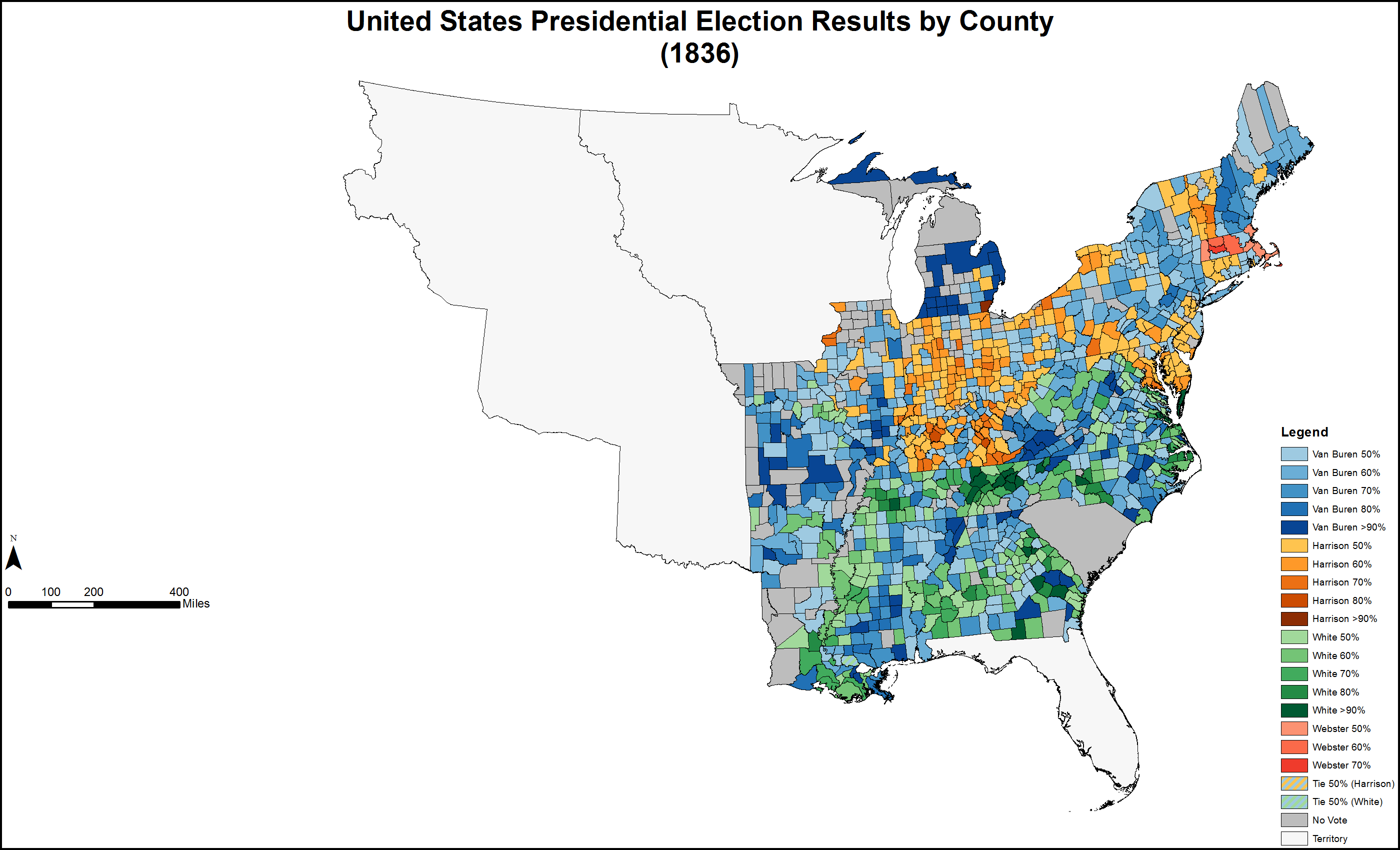
In the aftermath of the Nat Turner's Rebellion and other events, slavery emerged as an increasingly prominent political issue. Calhoun attacked Van Buren, saying that he could not be trusted to protect Southern interests and accusing the sitting Vice President of affiliating with abolitionists. Van Buren defeated Harrison by a margin of 51.4% to 48.6% in the North, and he defeated White by a similar margin of 50.7% to 49.3% in the South.
Disputes
A dispute similar to that of Indiana in 1817 and Missouri in 1821 arose during the counting of the electoral votes. Michigan only became a state on January 26, 1837, and had cast its electoral votes for president before that date. Anticipating a challenge to the results, Congress resolved on February 4, 1837, that during the counting four days later the final tally would be read twice, once with Michigan and once without Michigan. The counting proceeded in accordance with the resolution. The dispute had no bearing on the final result: either way, Van Buren was elected, and either way no candidate had a majority for vice-president.
Results
22.4% of the voting age population and 56.5% of eligible voters participated in the election.
The Whigs' strategy narrowly failed to prevent Van Buren's victory in the Electoral College, though he earned a somewhat lower share of the popular vote and fewer electoral votes than Andrew Jackson had in either of the previous two elections. The key state in this election was ultimately Pennsylvania, which Van Buren won from Harrison with a narrow majority of just 4,222 votes or 2.4%. Had Harrison won the state, Van Buren would have been left eight votes short of an Electoral College majority - despite receiving a majority (50.48%) in the popular vote - and the Whig goal to force the election into the House of Representatives (per the Twelfth Amendment to the United States Constitution) would have succeeded. Thus, the 11.8% difference between the margin in the tipping point state of Pennsylvania and the margin in the national popular vote, is the largest gap in American history. Alternatively Van Buren won AR, CT, LA, MS and RI by only 2,569 votes total, and had the leading Whig won each of those states Van Buren would have been short of the necessary 148 electoral votes.
In a contingent election, the House would have been required to choose between Van Buren, Harrison, and White as the three candidates with the most electoral votes. Jacksonians controlled enough state delegations (14 out of 26) and enough Senate seats (31 out of 52) to win both the presidency and the vice presidency in a contingent election.
This was the last election in which the Democrats won Connecticut, Rhode Island, and North Carolina until 1852. This was also the only election where South Carolina voted for the Whigs, and the last time it voted against the Democrats until 1868. It was also the last time that a Democrat was elected to the U.S. presidency succeeding a Democrat who had served two terms as U.S. president.

Source (Popular Vote): Source (Electoral Vote):
(a) The popular vote figures exclude South Carolina where the electors were chosen by the state legislature rather than by popular vote.
(b) Mangum received his electoral votes from South Carolina where the electors were chosen by the state legislatures rather than by popular vote.
Source:
Geography of results
Cartographic gallery
1836 US Presidential election by county.svg|Map of presidential election results by county, shaded according to winning candidate's percentage of the vote DemocraticPresidentialCounty1836Colorbrewer.png|Map of Democratic presidential election results by county HarrisonWhigPresidentialCounty1836Colorbrewer.png|Map of Harrison Whig presidential election results by county WhiteWhigPresidentialCounty1836Colorbrewer.png|Map of White Whig presidential election results by county WebsterWhigPresidentialCounty1836Colorbrewer.png|Map of Webster Whig presidential election results by county
Results by state
Source: Data from Walter Dean Burnham, Presidential ballots, 1836-1892 (Johns Hopkins University Press, 1955) pp 247–57.
| States/districts won by a Whig candidate |
|---|
| Martin Van Buren | ||||||||||||||||||||||||||||||||||||||||||||||||||||||||||||||||||||||||||||||||||||||||||||||||||||||||||||||||||||||||||||||||
|---|---|---|---|---|---|---|---|---|---|---|---|---|---|---|---|---|---|---|---|---|---|---|---|---|---|---|---|---|---|---|---|---|---|---|---|---|---|---|---|---|---|---|---|---|---|---|---|---|---|---|---|---|---|---|---|---|---|---|---|---|---|---|---|---|---|---|---|---|---|---|---|---|---|---|---|---|---|---|---|---|---|---|---|---|---|---|---|---|---|---|---|---|---|---|---|---|---|---|---|---|---|---|---|---|---|---|---|---|---|---|---|---|---|---|---|---|---|---|---|---|---|---|---|---|---|---|---|---|
| Democratic | William H. Harrison | |||||||||||||||||||||||||||||||||||||||||||||||||||||||||||||||||||||||||||||||||||||||||||||||||||||||||||||||||||||||||||||||
| Whig | Hugh L. White | |||||||||||||||||||||||||||||||||||||||||||||||||||||||||||||||||||||||||||||||||||||||||||||||||||||||||||||||||||||||||||||||
| Whig | Daniel Webster | |||||||||||||||||||||||||||||||||||||||||||||||||||||||||||||||||||||||||||||||||||||||||||||||||||||||||||||||||||||||||||||||
| Whig | Willie Person Mangum | |||||||||||||||||||||||||||||||||||||||||||||||||||||||||||||||||||||||||||||||||||||||||||||||||||||||||||||||||||||||||||||||
| Whig | Margin | Total | State | electoral | ||||||||||||||||||||||||||||||||||||||||||||||||||||||||||||||||||||||||||||||||||||||||||||||||||||||||||||||||||||||||||||
| votes | Votes cast | % | electoral | |||||||||||||||||||||||||||||||||||||||||||||||||||||||||||||||||||||||||||||||||||||||||||||||||||||||||||||||||||||||||||||
| votes | Votes cast | % | electoral | |||||||||||||||||||||||||||||||||||||||||||||||||||||||||||||||||||||||||||||||||||||||||||||||||||||||||||||||||||||||||||||
| votes | Votes cast | % | electoral | |||||||||||||||||||||||||||||||||||||||||||||||||||||||||||||||||||||||||||||||||||||||||||||||||||||||||||||||||||||||||||||
| votes | Votes cast | % | electoral | |||||||||||||||||||||||||||||||||||||||||||||||||||||||||||||||||||||||||||||||||||||||||||||||||||||||||||||||||||||||||||||
| votes | electoral | |||||||||||||||||||||||||||||||||||||||||||||||||||||||||||||||||||||||||||||||||||||||||||||||||||||||||||||||||||||||||||||||
| votes | # | % | # | style"text-align:left" | [Alabama](1836-united-states-presidential-election-in-alabama) | 7 | AL | style"text-align:left" | [Arkansas](1836-united-states-presidential-election-in-arkansas) | 3 | AR | style"text-align:left" | [Connecticut](1836-united-states-presidential-election-in-connecticut) | 8 | CT | style"text-align:left" | [Delaware](1836-united-states-presidential-election-in-delaware) | 3 | DE | style"text-align:left" | [Georgia](1836-united-states-presidential-election-in-georgia) | 11 | GA | style"text-align:left" | [Illinois](1836-united-states-presidential-election-in-illinois) | 5 | IL | style"text-align:left" | [Indiana](1836-united-states-presidential-election-in-indiana) | 9 | IN | style"text-align:left" | [Kentucky](1836-united-states-presidential-election-in-kentucky) | 15 | KY | style"text-align:left" | [Louisiana](1836-united-states-presidential-election-in-louisiana) | 5 | LA | style"text-align:left" | [Maine](1836-united-states-presidential-election-in-maine) | 10 | ME | style"text-align:left" | [Maryland](1836-united-states-presidential-election-in-maryland) | 10 | MD | style"text-align:left" | [Massachusetts](1836-united-states-presidential-election-in-massachusetts) | 14 | MA | style"text-align:left" | [Michigan](1836-united-states-presidential-election-in-michigan) | 3 | MI | style"text-align:left" | [Mississippi](1836-united-states-presidential-election-in-mississippi) | 4 | MS | style"text-align:left" | [Missouri](1836-united-states-presidential-election-in-missouri) | 4 | MO | style"text-align:left" | [New Hampshire](1836-united-states-presidential-election-in-new-hampshire) | 7 | NH | style"text-align:left" | [New Jersey](1836-united-states-presidential-election-in-new-jersey) | 8 | NJ | style"text-align:left" | [New York](1836-united-states-presidential-election-in-new-york) | 42 | NY | style"text-align:left" | [North Carolina](1836-united-states-presidential-election-in-north-carolina) | 15 | NC | style"text-align:left" | [Ohio](1836-united-states-presidential-election-in-ohio) | 21 | OH | style"text-align:left" | [Pennsylvania](1836-united-states-presidential-election-in-pennsylvania) | 30 | PA | style"text-align:left" | [Rhode Island](1836-united-states-presidential-election-in-rhode-island) | 4 | RI | style"text-align:left" | [South Carolina](1836-united-states-presidential-election-in-south-carolina) | 11 | SC | style"text-align:left" | [Tennessee](1836-united-states-presidential-election-in-tennessee) | 15 | TN | style"text-align:left" | [Vermont](1836-united-states-presidential-election-in-vermont) | 7 | VT | style"text-align:left" | [Virginia](1836-united-states-presidential-election-in-virginia) | 23 | VA | TOTALS: | 294 | 763,291 | 50.79 | 170 | 549,907 | 36.59 | 73 | 146,107 | 9.72 | 26 | 41,201 | 2.74 | 14 | 11 | 213,384 | 14.20 | 1,502,811 | US | TO WIN: | 148 |
| 20,638 | 55.34 | 7 | *no ballots* | 16,658 | 44.66 | 0 | *no ballots* | *no ballots* | 3,980 | 10.68 | 37,296 | |||||||||||||||||||||||||||||||||||||||||||||||||||||||||||||||||||||||||||||||||||||||||||||||||||||||||||||||||||||
| 2,380 | 64.08 | 3 | *no ballots* | 1,334 | 35.92 | 0 | *no ballots* | *no ballots* | 1,046 | 28.16 | 3,714 | |||||||||||||||||||||||||||||||||||||||||||||||||||||||||||||||||||||||||||||||||||||||||||||||||||||||||||||||||||||
| 19,294 | 50.65 | 8 | 18,799 | 49.35 | 0 | *no ballots* | *no ballots* | *no ballots* | 495 | 1.30 | 38,093 | |||||||||||||||||||||||||||||||||||||||||||||||||||||||||||||||||||||||||||||||||||||||||||||||||||||||||||||||||||||
| 4,154 | 46.70 | 0 | 4,736 | 53.24 | 3 | *no ballots* | *no ballots* | *no ballots* | -582 | -6.54 | 8,895 | |||||||||||||||||||||||||||||||||||||||||||||||||||||||||||||||||||||||||||||||||||||||||||||||||||||||||||||||||||||
| 22,778 | 48.20 | 0 | *no ballots* | 24,481 | 51.80 | 11 | *no ballots* | *no ballots* | -1,703 | -3.60 | 47,259 | |||||||||||||||||||||||||||||||||||||||||||||||||||||||||||||||||||||||||||||||||||||||||||||||||||||||||||||||||||||
| 18,369 | 54.69 | 5 | 15,220 | 45.31 | 0 | *no ballots* | *no ballots* | *no ballots* | 3,149 | 9.38 | 33,589 | |||||||||||||||||||||||||||||||||||||||||||||||||||||||||||||||||||||||||||||||||||||||||||||||||||||||||||||||||||||
| 32,478 | 44.03 | 0 | 41,281 | 55.97 | 9 | *no ballots* | *no ballots* | *no ballots* | -8,803 | -11.94 | 73,759 | |||||||||||||||||||||||||||||||||||||||||||||||||||||||||||||||||||||||||||||||||||||||||||||||||||||||||||||||||||||
| 33,229 | 47.41 | 0 | 36,861 | 52.59 | 15 | *no ballots* | *no ballots* | *no ballots* | -3,632 | -5.18 | 70,090 | |||||||||||||||||||||||||||||||||||||||||||||||||||||||||||||||||||||||||||||||||||||||||||||||||||||||||||||||||||||
| 3,842 | 51.74 | 5 | *no ballots* | 3,583 | 48.26 | 0 | *no ballots* | *no ballots* | 259 | 3.48 | 7,425 | |||||||||||||||||||||||||||||||||||||||||||||||||||||||||||||||||||||||||||||||||||||||||||||||||||||||||||||||||||||
| 22,825 | 58.92 | 10 | 14,803 | 38.21 | 0 | *no ballots* | *no ballots* | *no ballots* | 8,022 | 20.71 | 38,740 | |||||||||||||||||||||||||||||||||||||||||||||||||||||||||||||||||||||||||||||||||||||||||||||||||||||||||||||||||||||
| 22,267 | 46.27 | 0 | 25,852 | 53.73 | 10 | *no ballots* | *no ballots* | *no ballots* | -3,585 | -7.46 | 48,119 | |||||||||||||||||||||||||||||||||||||||||||||||||||||||||||||||||||||||||||||||||||||||||||||||||||||||||||||||||||||
| 33,486 | 44.81 | 0 | *no ballots* | *no ballots* | 41,201 | 55.13 | 14 | *no ballots* | -7,715 | -10.32 | 74,687 | |||||||||||||||||||||||||||||||||||||||||||||||||||||||||||||||||||||||||||||||||||||||||||||||||||||||||||||||||||||
| 7,122 | 56.22 | 3 | 5,545 | 43.78 | 0 | *no ballots* | *no ballots* | *no ballots* | 1,577 | 12.44 | 12,667 | |||||||||||||||||||||||||||||||||||||||||||||||||||||||||||||||||||||||||||||||||||||||||||||||||||||||||||||||||||||
| 10,297 | 51.28 | 4 | *no ballots* | 9,782 | 48.72 | 0 | *no ballots* | *no ballots* | 515 | 2.56 | 20,079 | |||||||||||||||||||||||||||||||||||||||||||||||||||||||||||||||||||||||||||||||||||||||||||||||||||||||||||||||||||||
| 10,995 | 59.98 | 4 | *no ballots* | 7,337 | 40.02 | 0 | *no ballots* | *no ballots* | 3,658 | 19.96 | 18,332 | |||||||||||||||||||||||||||||||||||||||||||||||||||||||||||||||||||||||||||||||||||||||||||||||||||||||||||||||||||||
| 18,697 | 75.01 | 7 | 6,228 | 24.99 | 0 | *no ballots* | *no ballots* | *no ballots* | 12,469 | 50.02 | 24,925 | |||||||||||||||||||||||||||||||||||||||||||||||||||||||||||||||||||||||||||||||||||||||||||||||||||||||||||||||||||||
| 25,592 | 49.47 | 0 | 26,137 | 50.53 | 8 | *no ballots* | *no ballots* | *no ballots* | -545 | -1.06 | 51,729 | |||||||||||||||||||||||||||||||||||||||||||||||||||||||||||||||||||||||||||||||||||||||||||||||||||||||||||||||||||||
| 166,795 | 54.63 | 42 | 138,548 | 45.37 | 0 | *no ballots* | *no ballots* | *no ballots* | 28,247 | 9.26 | 305,343 | |||||||||||||||||||||||||||||||||||||||||||||||||||||||||||||||||||||||||||||||||||||||||||||||||||||||||||||||||||||
| 26,631 | 53.10 | 15 | *no ballots* | 23,521 | 46.90 | 0 | *no ballots* | *no ballots* | 3,110 | 6.20 | 50,153 | |||||||||||||||||||||||||||||||||||||||||||||||||||||||||||||||||||||||||||||||||||||||||||||||||||||||||||||||||||||
| 96,238 | 47.56 | 0 | 104,958 | 51.87 | 21 | *no ballots* | *no ballots* | *no ballots* | -8,720 | -4.31 | 202,333 | |||||||||||||||||||||||||||||||||||||||||||||||||||||||||||||||||||||||||||||||||||||||||||||||||||||||||||||||||||||
| 91,457 | 51.18 | 30 | 87,235 | 48.82 | 0 | *no ballots* | *no ballots* | *no ballots* | 4,222 | 2.36 | 178,692 | |||||||||||||||||||||||||||||||||||||||||||||||||||||||||||||||||||||||||||||||||||||||||||||||||||||||||||||||||||||
| 2,964 | 52.24 | 4 | 2,710 | 47.76 | 0 | *no ballots* | *no ballots* | *no ballots* | 254 | 4.48 | 5,674 | |||||||||||||||||||||||||||||||||||||||||||||||||||||||||||||||||||||||||||||||||||||||||||||||||||||||||||||||||||||
| *no popular vote* | *no popular vote* | *no popular vote* | *no popular vote* | 11 | - | - | 0 | |||||||||||||||||||||||||||||||||||||||||||||||||||||||||||||||||||||||||||||||||||||||||||||||||||||||||||||||||||||||||
| 26,170 | 42.08 | 0 | *no ballots* | 36,027 | 57.92 | 15 | *no ballots* | *no ballots* | -9,857 | -15.84 | 62,197 | |||||||||||||||||||||||||||||||||||||||||||||||||||||||||||||||||||||||||||||||||||||||||||||||||||||||||||||||||||||
| 14,037 | 40.07 | 0 | 20,994 | 59.93 | 7 | *no ballots* | *no ballots* | *no ballots* | -6,957 | -19.86 | 35,031 | |||||||||||||||||||||||||||||||||||||||||||||||||||||||||||||||||||||||||||||||||||||||||||||||||||||||||||||||||||||
| 30,556 | 56.64 | 23 | *no ballots* | 23,384 | 43.35 | 0 | *no ballots* | *no ballots* | 7,172 | 13.29 | 53,945 |
States that flipped from National Republican to Whig
- Delaware
- Kentucky
- Maryland
- Massachusetts
States that flipped from National Republican to Democratic
- Connecticut
- Rhode Island
States that flipped from Anti-Masonic to Whig
- Vermont
States that flipped from Democratic to Whig
- Georgia
- Indiana
- New Jersey
- Ohio
- Tennessee
States that flipped from Nullifer to Whig
- South Carolina
Close states
States where the margin of victory was under 5%:
- New Jersey 1.06% (545 votes)
- Connecticut 1.3% (495 votes)
- Pennsylvania 2.36% (4,222 votes) (tipping point state for a Van Buren victory)
- Mississippi 2.56% (515 votes)
- Louisiana 3.48% (259 votes)
- Georgia 3.6% (1,703 votes)
- Ohio 4.31% (8,720 votes)
- Rhode Island 4.48% (254 votes)
States where the margin of victory was under 10%:
- Kentucky 5.18% (3,632 votes)
- North Carolina 6.2% (3,110 votes)
- Delaware 6.54% (582 votes)
- Maryland 7.46% (3,585 votes)
- New York 9.26% (28,247 votes) (tipping point state for a Harrison victory)
- Illinois 9.38% (3,149 votes)
Breakdown by ticket
| Candidate | Total | Martin Van Buren | |||||||||||||||
|---|---|---|---|---|---|---|---|---|---|---|---|---|---|---|---|---|---|
| Democratic | William H. Harrison | ||||||||||||||||
| Whig | Hugh L. White | ||||||||||||||||
| Whig | Daniel Webster | ||||||||||||||||
| Whig | Willie P. Mangum | ||||||||||||||||
| Whig | Electoral Votes for President | 294 | 170 | 73 | 26 | 14 | 11 | For Vice President, Richard Mentor Johnson | For Vice President, Francis Granger | For Vice President, John Tyler | For Vice President, William Smith | ||||||
| 147 | 147 | ||||||||||||||||
| 77 | 63 | 14 | |||||||||||||||
| 47 | 10 | 26 | 11 | ||||||||||||||
| 23 | 23 |
1837 contingent election for vice president
In an unusual turn of events, Virginia's 23 electors, who were all pledged to Van Buren and his running mate Richard Mentor Johnson, became faithless electors due to dissension related to Johnson's interracial relationship with a slave and refused to vote for Johnson, instead casting their vice-presidential votes for former South Carolina senator William Smith.
This left Johnson one electoral vote short of an Electoral College majority. Since no vice presidential candidate received a majority of electoral votes, for the only time in American history, the Senate decided the vice presidential race in a contingent election.
On February 8, 1837, Johnson was elected on the first ballot by a vote of 33 to 16; the vote proceeded largely along party lines, albeit with three Whigs voting for Johnson, one Democrat voting for Granger, and three abstentions (Hugh L. White declined to vote out of respect for his own running-mate, John Tyler, while the two Nullifier Party senators refused to back either candidate).
| Members voting for: | Johnson | Granger | Members not voting: |
|---|---|---|---|
|}
Electoral college selection
Notes
References
Works cited
References
- "National General Election VEP Turnout Rates, 1789-Present". [[CQ Press]].
- (November 12, 1836}}). "Presidential Elections". Weekly Messenger.
- Murse, Tom. (December 16, 2020). "Last Time Consecutive Democratic Presidents Were Elected". ThoughtCo..
- Cole, Donald B.. (1984). "Martin Van Buren and the American Political System". Princeton University Press.
- (1979). "National Party Conventions, 1831-1976". [[Congressional Quarterly]].
- (2010). "Presidential Elections, 1789-2008: County, State, and National Mapping of Election Data". University of Michigan Press.
- United States Congress. (1837). "Senate Journal".
- (16 December 2020). "Last Time Consecutive Democratic Presidents Were Elected".
- Burke, ''Window To The Past''
- (2015). "A People and a Nation: A History of the United States". Wadsworth Publishing.
- "The Senate Elects a Vice President". Office of the Secretary of the Senate.
- "''Cong. Globe'', 24th Cong., 2nd Sess. 166(1837)". [[Library of Congress]].
- "24th Congress Senate Vote 334 (1837)". UCLA Department of Political Science and Social Science Computing.
This article was imported from Wikipedia and is available under the Creative Commons Attribution-ShareAlike 4.0 License. Content has been adapted to SurfDoc format. Original contributors can be found on the article history page.
Ask Mako anything about 1836 United States presidential election — get instant answers, deeper analysis, and related topics.
Research with MakoFree with your Surf account
Create a free account to save articles, ask Mako questions, and organize your research.
Sign up freeThis content may have been generated or modified by AI. CloudSurf Software LLC is not responsible for the accuracy, completeness, or reliability of AI-generated content. Always verify important information from primary sources.
Report