From Surf Wiki (app.surf) — the open knowledge base
176th Street station
New York City Subway station in the Bronx
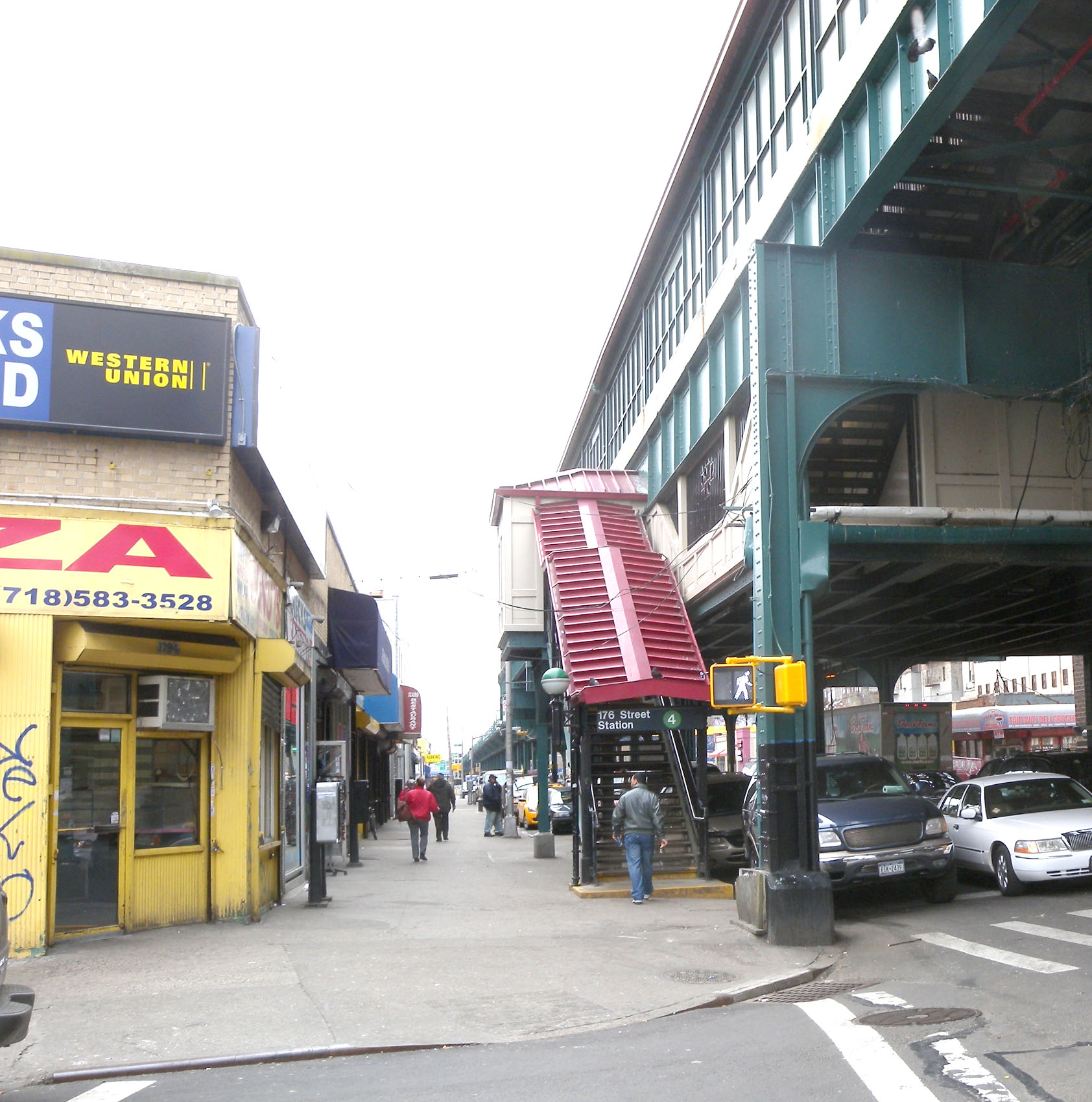
New York City Subway station in the Bronx
| Field | Value | ||
|---|---|---|---|
| name | 176 Street | ||
| image | 176th Street station with departing downtown train.jpg | ||
| image_caption | View south from northbound platform, with southbound R142 4 train leaving | ||
| address | 176th Street & Jerome Avenue | ||
| Bronx, New York | |||
| borough | The Bronx | ||
| locale | Morris Heights | ||
| coordinates | |||
| division | IRT | ||
| line | IRT Jerome Avenue Line | ||
| service | Jerome local | ||
| other | NYCT Bus: | ||
| platforms | 2 side platforms | ||
| tracks | 3 | ||
| structure | Elevated | ||
| opened | |||
| services | {{Adjacent stations | system=New York City Subway | |
| line | Jerome local | left=Burnside Avenue | right=Mount Eden Avenue}} |
| footnotes | |||
| route_map | {{NYCS 3-tracked local station | inline=y | |
| 1 | Burnside Avenue | ||
| 2 | Mount Eden Avenue | ||
| deg | 330 |
Bronx, New York
The 176th Street station is a local station on the IRT Jerome Avenue Line of the New York City Subway. Located at the intersection of 176th Street and Jerome Avenue in the Morris Heights neighborhood of the Bronx, it is served by the 4 train at all times. This station was constructed by the Interborough Rapid Transit Company as part of the Dual Contracts and opened in 1917.
History
The Dual Contracts, which were signed on March 19, 1913, were contracts for the construction and/or rehabilitation and operation of rapid transit lines in the City of New York. The contracts were "dual" in that they were signed between the City and two separate private companies (the Interborough Rapid Transit Company and the Brooklyn Rapid Transit Company), all working together to make the construction of the Dual Contracts possible. The Dual Contracts promised the construction of several lines in the Bronx. As part of Contract 3, the IRT agreed to build an elevated line along Jerome Avenue in the Bronx.
176th Street station opened as part of the initial section of the line to Kingsbridge Road on June 2, 1917. Service was initially operated as a shuttle between Kingsbridge Road and 149th Street. Through service to the IRT Lexington Avenue Line began on July 17, 1918. The line was completed with a final extension to Woodlawn on April 15, 1918. This section was initially served by shuttle service, with passengers transferring at 167th Street. The construction of the line encouraged development along Jerome Avenue, and led to the growth of the surrounding communities. The city government took over the IRT's operations on June 12, 1940.
On July 5, 2004, this station, 170th Street, and Fordham Road closed for four months so they could be renovated. As part of the project, new canopy roofs, walls, lighting, staircases, floors, and a public address system would be installed at each station.
Station layout
This elevated station has three tracks with two side platforms. The 4 stops here at all times.
The station has old style signs painted over and covered up with new style signs, and features new fare control railings as a crossunder.
The 2006 artwork here is called Reaching Out For Each Other by Juan Sánchez. It features stained glass windows on the platform windscreens and station house that each feature a hand as a central element to depict their use as a universal language.
Exits
The fare control is in a mezzanine below the tracks. Outside fare control, stairs lead to either southwest corner of Jerome Avenue and 176th Street.
References
References
- {{cite NYC bus map. Bx
- (1913). "New Subways For New York: The Dual System of Rapid Transit Chapter 5: Terms and Conditions of Dual System Contracts". New York Public Service Commission.
- (1912). "The Dual System of Rapid Transit (1912)". New York State Public Service Commission.
- (September 9, 1917). "Most Recent Map of the Dual Subway System Which Shows How Brooklyn Borough Is Favored In New Transit Lines". The Brooklyn Daily Eagle.
- (June 1917). "Service Begun on the Jerome Avenue Line". Public Service Record.
- (1917). "Annual report of the Interborough Rapid Transit Company For The Year Ended June 30, 1917". Interborough Rapid Transit Company.
- (1922). "Brooklyn Daily Eagle Almanac". The Brooklyn Daily Eagle.
- (April 13, 1918). "Jerome Av. Line Ordered Opened.". The New York Times.
- (1916). "Brooklyn Daily Eagle Almanac". The Brooklyn Daily Eagle.
- (1993). "A History of the New York City Subway System". J. Schmidt, R. Giglio, and K. Lang.
- (1940-06-13). "City Transit Unity Is Now a Reality; Title to I.R.T. Lines Passes to Municipality, Ending 19-Year Campaign". The New York Times.
- (June 13, 1940). "Transit Unification Completed As City Takes Over I. R. T. Lines: Systems Come Under Single Control After Efforts Begun in 1921; Mayor Is Jubilant at City Hall Ceremony Recalling 1904 Celebration". New York Herald Tribune.
- (July 5, 2004). "Three Bronx subway stations closed to undergo renovations for four months". news12.
- {{NYCS const. trackref. trackbook
- {{NYCS const. timetable. 4
- "176th Street - Juan Sánchez - Reaching Out For Each Other, 2006". Metropolitan Transportation Authority.
- (April 2018). "176th Street Neighborhood Map". Metropolitan Transportation Authority.
This article was imported from Wikipedia and is available under the Creative Commons Attribution-ShareAlike 4.0 License. Content has been adapted to SurfDoc format. Original contributors can be found on the article history page.
Ask Mako anything about 176th Street station — get instant answers, deeper analysis, and related topics.
Research with MakoFree with your Surf account
Create a free account to save articles, ask Mako questions, and organize your research.
Sign up freeThis content may have been generated or modified by AI. CloudSurf Software LLC is not responsible for the accuracy, completeness, or reliability of AI-generated content. Always verify important information from primary sources.
Report