SMAD2
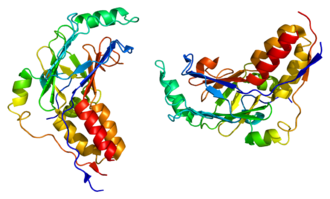
Protein found in humans
title: "SMAD2" type: doc version: 1 created: 2026-02-28 author: "Wikipedia contributors" status: active scope: public tags: ["developmental-genes-and-proteins", "mh1-domain", "mh2-domain", "r-smad", "transcription-factors", "human-proteins"] description: "Protein found in humans" topic_path: "arts/film" source: "https://en.wikipedia.org/wiki/SMAD2" license: "CC BY-SA 4.0" wikipedia_page_id: 0 wikipedia_revision_id: 0
::summary Protein found in humans ::
Mothers against decapentaplegic homolog 2, also known as SMAD family member 2 or SMAD2, is a protein that in humans is encoded by the SMAD2 gene. MAD homolog 2 belongs to the SMAD, a family of proteins similar to the gene products of the Drosophila gene 'mothers against decapentaplegic' (Mad) and the C. elegans gene Sma. SMAD proteins are signal transducers and transcriptional modulators that mediate multiple signaling pathways.
Function
SMAD2 mediates the signal of the transforming growth factor (TGF)-beta, and thus regulates multiple cellular processes, such as cell proliferation, apoptosis, and differentiation. This protein is recruited to the TGF-beta receptors through its interaction with the SMAD anchor for receptor activation (SARA) protein. In response to TGF-beta signal, this protein is phosphorylated by the TGF-beta receptors. The phosphorylation induces the dissociation of this protein with SARA and the association with the family member SMAD4. The association with SMAD4 is important for the translocation of this protein into the cell nucleus, where it binds to target promoters and forms a transcription repressor complex with other cofactors. This protein can also be phosphorylated by activin type 1 receptor kinase, and mediates the signal from the activin. Alternatively spliced transcript variants encoding the same protein have been observed.
Like other SMADs, SMAD2 plays a role in the transmission of extracellular signals from ligands of the Transforming Growth Factor beta (TGFβ) superfamily of growth factors into the cell nucleus. Binding of a subgroup of TGFβ superfamily ligands to extracellular receptors triggers phosphorylation of SMAD2 at a Serine-Serine-Methionine-Serine (SSMS) motif at its extreme C-terminus. Phosphorylated SMAD2 is then able to form a complex with SMAD4. These complexes accumulate in the cell nucleus, where they are directly participating in the regulation of gene expression.
Nomenclature
The SMAD proteins are homologs of both the drosophila protein, mothers against decapentaplegic (MAD), and the C. elegans protein SMA. The name is a combination of the two. During Drosophila research, it was found that a mutation in the gene MAD in the mother repressed the gene decapentaplegic in the embryo. The phrase "Mothers against" was added, since mothers often form organizations opposing various issues, e.g., Mothers Against Drunk Driving, or (MADD). The nomenclature for this protein is based on a tradition of such unusual naming within the gene research community.
Interactions
Mothers against decapentaplegic homolog 2 has been shown to interact with:
- ANAPC10,
- DAB2,
- EP300,
- FOXH1,
- HDAC1,
- TGIF1,
- Insulin receptor,
- LEF1,
- Myc,
- MEF2A,
- PIAS3,
- PIN1,
- SKI protein,
- SKIL,
- SMAD3,
- SMURF2,
- SNW1,
- STRAP
- WWTR1
References
References
- (August 1996). "MADR2 maps to 18q21 and encodes a TGFbeta-regulated MAD-related protein that is functionally mutated in colorectal carcinoma". Cell.
- (July 1996). "Mad-related genes in the human". Nat. Genet..
- "Entrez Gene: SMAD2 SMAD family member 2".
- [https://psmag.com/sonic-hedgehog-dicer-and-the-problem-with-naming-genes-113c58df8f7a#.os08udsyk "Sonic Hedgehog, DICER, and the Problem With Naming Genes"], Sep 26, 2014, Michael White. psmag.com
- (May 2004). "Direct interaction between Smad3, APC10, CDH1 and HEF1 in proteasomal degradation of HEF1". BMC Cell Biol..
- (June 2001). "The adaptor molecule Disabled-2 links the transforming growth factor β receptors to the Smad pathway". EMBO J..
- (January 1999). "FAST-2 Is a Mammalian Winged-Helix Protein Which Mediates Transforming Growth Factor β Signals". Mol. Cell. Biol..
- (December 1997). "Dual role of the Smad4/DPC4 tumor suppressor in TGFβ-inducible transcriptional complexes". Genes Dev..
- (September 2000). "BF-1 Interferes with Transforming Growth Factor β Signaling by Associating with Smad Partners". Mol. Cell. Biol..
- (September 1997). "Smad4 and FAST-1 in the assembly of activin-responsive factor". [[Nature (journal).
- (April 1999). "A Smad transcriptional corepressor". Cell.
- (May 2001). "c-Jun interacts with the corepressor TG-interacting factor (TGIF) to suppress Smad2 transcriptional activity". [[PNAS.
- (April 1997). "Interaction of MAD2 with the carboxyl terminus of the insulin receptor but not with the IGFIR. Evidence for release from the insulin receptor after activation". J. Biol. Chem..
- (July 2000). "Association of Smads with lymphoid enhancer binding factor 1/T cell-specific factor mediates cooperative signaling by the transforming growth factor-β and Wnt pathways". [[PNAS.
- (January 2002). "Direct interaction of c-Myc with Smad2 and Smad3 to inhibit TGF-beta-mediated induction of the CDK inhibitor p15(Ink4B)". Mol. Cell.
- (February 2001). "Smad proteins function as co-modulators for MEF2 transcriptional regulatory proteins". Nucleic Acids Res..
- (January 2004). "Activation of Smad transcriptional activity by protein inhibitor of activated STAT3 (PIAS3)". [[PNAS.
- (March 2009). "Pin1 down-regulates transforming growth factor-beta (TGF-beta) signaling by inducing degradation of Smad proteins". J. Biol. Chem..
- (October 2003). "Requirement of the co-repressor homeodomain-interacting protein kinase 2 for ski-mediated inhibition of bone morphogenetic protein-induced transcriptional activation". J. Biol. Chem..
- (September 1999). "The Ski oncoprotein interacts with the Smad proteins to repress TGFβ signaling". Genes Dev..
- (November 2001). "Smad3 recruits the anaphase-promoting complex for ubiquitination and degradation of SnoN". Genes Dev..
- (October 1999). "Negative feedback regulation of TGF-beta signaling by the SnoN oncoprotein". [[Science (journal).
- (September 1997). "TGF-beta receptor-mediated signalling through Smad2, Smad3 and Smad4". EMBO J..
- (January 1999). "Roles of pathway-specific and inhibitory Smads in activin receptor signaling". Mol. Endocrinol..
- (November 2000). "Smurf2 is a ubiquitin E3 ligase mediating proteasome-dependent degradation of Smad2 in transforming growth factor-beta signaling". J. Biol. Chem..
- (June 2001). "TGF-beta induces assembly of a Smad2-Smurf2 ubiquitin ligase complex that targets SnoN for degradation". Nat. Cell Biol..
- (May 2001). "Ski-interacting protein interacts with Smad proteins to augment transforming growth factor-beta-dependent transcription". J. Biol. Chem..
- (May 2000). "STRAP and Smad7 Synergize in the Inhibition of Transforming Growth Factor β Signaling". Mol. Cell. Biol..
::callout[type=info title="Wikipedia Source"] This article was imported from Wikipedia and is available under the Creative Commons Attribution-ShareAlike 4.0 License. Content has been adapted to SurfDoc format. Original contributors can be found on the article history page. ::