From Surf Wiki (app.surf) — the open knowledge base
Zircon
Zirconium silicate mineral

Zirconium silicate mineral
| Field | Value | |
|---|---|---|
| boxbgcolor | #b56042 | name = Zircon |
| boxtextcolor | #fff | |
| category | Nesosilicates | |
| image | Zircon-dtn1a.jpg | |
| imagesize | 260px | |
| caption | A lustrous crystal of zircon perched on a tan matrix of calcite from the Gilgit District of Pakistan | |
| formula | zirconium silicate | |
| IMAsymbol | Zrn | |
| strunz | 9.AD.30 | |
| system | Tetragonal | |
| class | Ditetragonal dipyramidal (4/mmm) | |
| H-M symbol: (4/m 2/m 2/m) | ||
| symmetry | *I*41/amd (No. 141) | |
| unit cell | a = 6.607(1), c = 5.982(1) [Å]; Z = 4 | |
| color | Reddish brown, yellow, green, blue, gray, colorless; in thin section, colorless to pale brown | |
| habit | tabular to prismatic crystals, irregular grains, massive | |
| twinning | On {101}. Crystals shocked by meteorite impact show polysynthetic twins on {112} | |
| cleavage | {110} and {111} | |
| fracture | Conchoidal to uneven | |
| tenacity | Brittle | |
| mohs | 7.5 | |
| luster | Vitreous to adamantine; greasy when metamict. | |
| refractive | nω = 1.925–1.961 | |
| nε = 1.980–2.015, 1.75 when metamict | ||
| opticalprop | Uniaxial (+) | |
| birefringence | δ = 0.047–0.055 | |
| pleochroism | Weak | |
| streak | White | |
| gravity | 4.6–4.7 | |
| fusibility | close to 2,550 °C depend on Hf,Th,U,H,etc... concentrations. | |
| solubility | Insoluble | |
| diaphaneity | Transparent to opaque | |
| other | Fluorescent and [[Image:Radioactive.svg | 25px]] radioactive, |
| May form pleochroic halos, | ||
| Relief: high | ||
| references |
the mineral and gemstone
H-M symbol: (4/m 2/m 2/m) nε = 1.980–2.015, 1.75 when metamict May form pleochroic halos, Relief: high
Zircon () is a mineral belonging to the group of nesosilicates and is a source of the metal zirconium. Its chemical name is zirconium(IV) silicate, and its corresponding chemical formula is ZrSiO4. An empirical formula showing some of the range of substitution in zircon is (Zr1–y, REEy)(SiO4)1–x(OH)4x–y. Zircon precipitates from silicate melts and has relatively high concentrations of high field strength incompatible elements. For example, hafnium is almost always present in quantities ranging from 1 to 4%. The crystal structure of zircon is tetragonal crystal system. The natural color of zircon varies between colorless, yellow-golden, red, brown, blue, and green.
The name derives from the Persian zargun, meaning "gold-hued". This word is changed into "jargoon", a term applied to light-colored zircons. The English word "zircon" is derived from Zirkon, which is the German adaptation of this word. Yellow, orange, and red zircon is also known as "hyacinth", from the flower hyacinthus, whose name is of Ancient Greek origin.
Properties
Zircon is common in the crust of Earth. It occurs as a common accessory mineral in igneous rocks (as primary crystallization products), in metamorphic rocks and as detrital grains in sedimentary rocks. Its resistance to weathering, together with its relatively high specific gravity (4.68), make it an important component of the heavy mineral fraction of sandstones.
Because of their uranium and thorium content, some zircons undergo metamictization. Connected to internal radiation damage, these processes partially disrupt the crystal structure and partly explain the highly variable properties of zircon. As zircon becomes more and more modified by internal radiation damage, the density decreases, the crystal structure is compromised, and the color changes.
Zircon occurs in many colors, including reddish brown, yellow, green, blue, gray, and colorless. In geological settings, the development of pink, red, and purple zircon occurs after hundreds of millions of years, if the crystal has sufficient trace elements to produce color centers. Color in this red or pink series is annealed in geological conditions above temperatures of around 400 C.
Structurally, zircon consists of parallel chains of alternating silica tetrahedra (silicon ions in fourfold coordination with oxygen ions) and zirconium ions, with the large zirconium ions in eightfold coordination with oxygen ions.
Applications

Zircon is mainly consumed as an opacifier, and has been known to be used in the decorative ceramics industry.
It is also the principal precursor not only to metallic zirconium, although this application is small, but also to all compounds of zirconium including zirconium dioxide (), an important refractory oxide with a melting point of 2717 C.
Other applications include use in refractories and foundry casting and a growing array of specialty applications as zirconia and zirconium chemicals, including in nuclear fuel rods, catalytic fuel converters and in water and air purification systems.
Ford Motor Company used a sand casting method known as the Cosworth Casting Method for the cylinder heads of its Duratec V6 engine. The process, developed by noted scientist John Campbell used zircon as its casting aggregate to improve material uniformity and create dimensional accuracy, high strength, and a dense, low- or no-porosity structure.{{cite web
Zircon is one of the key minerals used by geologists for geochronology.
Zircon is a part of the ZTR index to classify highly-weathered sediments.
- Large specimens are appreciated as gemstones, owing to their high refractive index. (Zircon has a refractive index of approximately 1.95; diamond's is approximately 2.4.)--
Gemstone
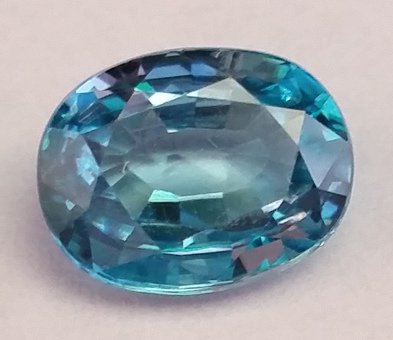

Transparent zircon is a well-known form of semi-precious gemstone, favored for its high specific gravity (between 4.2 and 4.86) and adamantine luster. Because of its high refractive index (1.92) it has sometimes been used as a substitute for diamond, though it does not display quite the same play of color as a diamond. Zircon is one of the heaviest types of gemstone. Its Mohs hardness is between that of quartz and topaz, at 7.5 on the 10 point scale, though below that of the similar manmade stone cubic zirconia (8-8.5). Zircons may sometimes lose their inherent color after long exposure to bright sunlight, which is unusual in a gemstone. It is immune to acid attack except by sulfuric acid and then only when ground into a fine powder.
Most gem-grade zircons show a high degree of birefringence which, on stones cut with a table and pavilion cuts (i.e., nearly all cut stones), can be seen as the apparent doubling-up of the latter when viewed through the former, and this characteristic can be used to distinguish them from diamonds and cubic zirconias (CZ) as well as soda-lime glass, none of which show this characteristic. However, some zircons from Sri Lanka display only weak or no birefringence at all, and some other Sri Lanka stones may show clear birefringence in one place and little or none in another part of the same cut stone. Other gemstones also display birefringence, so while the presence of this characteristic may help distinguish a given zircon from a diamond or a CZ, it will not help distinguish it from, for example, a topaz gemstone. The high specific gravity of zircon, however, can usually separate it from any other gem and is simple to test.
Also, birefringence depends on the cut of the stone in relation to its optical axis. If a zircon is cut with this axis perpendicular to its table, birefringence may be reduced to undetectable levels unless viewed with a jeweler's loupe or other magnifying optics. The highest grade zircons are cut to minimize birefringence.
The value of a zircon gem depends largely on its color, clarity, and size. Prior to World War II, blue zircons (the most valuable color) were available from many gemstone suppliers in sizes between 15 and 25 carats; since then, stones even as large as 10 carats have become very scarce, especially in the most desirable color varieties.
Synthetic zircons have been created in laboratories. They are occasionally used in jewellery such as earrings. Zircons are sometimes imitated by spinel and synthetic sapphire, but are not difficult to distinguish from them with simple tools.
Zircon from Ratanakiri province in Cambodia is heat treated to produce blue zircon gemstones, sometimes referred to by the trade name cambolite.
Occurrence
Zircon is a common accessory to trace mineral constituent of all kinds of igneous rocks, but particularly granite and felsic igneous rocks. Due to its hardness, durability and chemical inertness, zircon persists in sedimentary deposits and is a common constituent of most sands. Zircon can occasionally be found as a trace mineral in ultrapotassic igneous rocks such as kimberlites, carbonatites, and lamprophyre, owing to the unusual magma genesis of these rocks.
Zircon forms economic concentrations within heavy mineral sands ore deposits, within certain pegmatites, and within some rare alkaline volcanic rocks (for example the Toongi Trachyte in Dubbo, Australia) in association with the zirconium-hafnium minerals eudialyte and armstrongite.
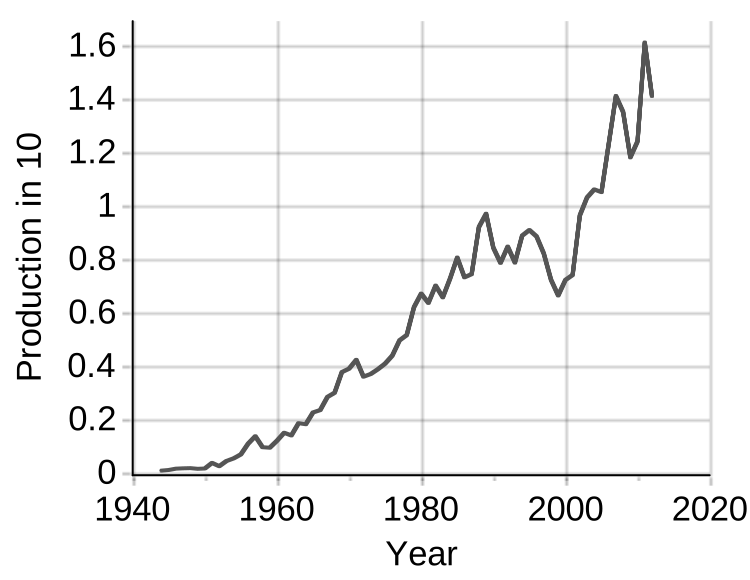
Australia leads the world in zircon mining, producing 37% of the world total and accounting for 40% of world EDR (economic demonstrated resources) for the mineral. The largest zircon mine in the world, Jacinth-Ambrosia, produces around 25 per cent of the global supply of zircon.
South Africa is Africa's main producer, with 30% of world production, second after Australia.
Radiometric dating
Zircon has played an important role during the evolution of radiometric dating. Zircons contain trace amounts of uranium and thorium (from 10 ppm up to 1 wt%) and can be dated using several modern analytical techniques. Because zircons can survive geologic processes like erosion, transport, and even high-grade metamorphism, they contain a rich and varied record of geological processes. Currently, zircons are typically dated by uranium–lead (U–Pb), fission-track, and U+Th/He techniques. Imaging the cathodoluminescence emission from fast electrons can be used as a prescreening tool for high-resolution secondary-ion mass spectrometry (SIMS) to image the zonation pattern and identify regions of interest for isotope analysis. This is done using an integrated cathodoluminescence and scanning electron microscope. Zircons in sedimentary rock can identify the sediment source.
Zircons from Jack Hills in the Narryer Gneiss terrane, Yilgarn craton, Western Australia, have yielded U–Pb ages up to 4.404 billion years, interpreted to be the age of crystallization, making them the oldest minerals so far dated on Earth. In addition, the oxygen isotopic compositions of some of these zircons have been interpreted to indicate that more than 4.3 billion years ago there was already liquid water on the surface of the Earth. This interpretation is supported by additional trace element data, but is also the subject of debate. In 2015, "remains of biotic life" were found in 4.1-billion-year-old rocks in the Jack Hills of Western Australia. According to one of the researchers, "If life arose relatively quickly on Earth ... then it could be common in the universe."
Similar minerals
Hafnon (), xenotime (), béhierite, schiavinatoite (), thorite (), and coffinite () all share the same crystal structure (IVX IVY O4, IIIX VY O4 in the case of xenotime) as zircon.
Gallery
Image:Zircon.GIF|Crystal structure of zircon Image:Zirconcrystal-model.png|Unit cell of zircon Image:Zirkon 372.jpg|Scanning electron microscope image of zircon Image:Zircon-tuc1001a.jpg|Unusual olive-green zircon Image:Zircon-j08-23a.jpg|Cluster of three compound crystals of zircon
References
References
- Warr, L.N.. (2021). "IMA–CNMNC approved mineral symbols". Mineralogical Magazine.
- (1995). "Handbook of Mineralogy". [[Mineralogical Society of America]].
- "Zircon: Mineral information, data and localities". [[Mindat.org]].
- "Zircon Mineral Data". Webmineral.
- (1985). "Manual of Mineralogy". Wiley.
- (2013). "Correlating planar microstructures in shocked zircon from the Vredefort Dome at multiple scales: Crystallographic modeling, external and internal imaging, and EBSD structural analysis". American Mineralogist.
- {{cite Collins Dictionary. zircon
- {{cite American Heritage Dictionary. zircon
- {{cite Merriam-Webster. zircon
- "Materials Explorer".
- Stwertka, Albert. (1996). "A Guide to the Elements". Oxford University Press.
- {{OEtymD. zircon
- "Hyacinth (gem)". Encyclopædia Britannica Inc..
- Nesse, William D.. (2000). "Introduction to mineralogy". Oxford University Press.
- (2019). "Computer modeling of Zircon (ZrSiO4)—Coffinite (USiO4) solid solutions and lead incorporation: Geological implications". Stratigraphy & Timescales.
- (2002). "Integration of zircon color and zircon fission-track zonation patterns in orogenic belts: Application to the Southern Alps, New Zealand". Tectonophysics.
- Nielsen, Ralph. (2000). "Ullmann's Encyclopedia of Industrial Chemistry".
- (1 January 2010). "Molecular dynamics simulation of zirconia melting". Open Physics.
- "Products".
- (1980). "Origin of sedimentary rocks". Prentice-Hall.
- Brauns, Reinhard. (1912). "The Mineral Kingdom (Volume 1)". J.F. Schreiber.
- Oliver Cummings Farrington. (1903). "Gems and Gem Minerals". A.W. Mumford.
- L.J. Spencer. (1905). "Report of the Seventy-Fourth Meeting of the British Association for the Advancement of Science". John Murray.
- "Physical & Optical Properties of Zircon". Colored Gemstones Guide.
- (January 2004). "In situ determination of the compressibility of synthetic pure zircon (ZrSiO4) and the onset of the zircon-reidite phase transition". American Mineralogist.
- ""Blue Zircon Cambolite"".
- (2021-12-15). "Zircon megacrysts from Devonian kimberlites of the Azov Domain, Eastern part of the Ukrainian Shield: Implications for the origin and evolution of kimberlite melts". Lithos.
- (2021-09-30). "Lamprophyre as the Source of Zircon in the Veneto Region, Italy". Minerals.
- Staff. (June 2007). "Dubbo Zirconia Project Fact Sheet June 2014". Alkane Resources Limited.
- "The Mineral Sands Industry Factbook".
- (14 January 2026). "'Cosmic clock' of tiny crystals reveals the rise and fall of our ancient landscapes".
- "Heavy Minerals Mining in Africa – Titanium And Zirconium".
- "Zircons – Application Note".
- (October 2012). "Detrital zircon record and tectonic setting". Geology.
- (2001). "Evidence from detrital zircons for the existence of continental crust and oceans on the Earth 4.4 Gyr ago". Nature.
- (2001). "Oxygen-isotope evidence from ancient zircons for liquid water at the Earth's surface 4,300 Myr ago". Nature.
- (2002). "A cool early Earth". Geology.
- (2005). "4.4 billion years of crustal maturation: Oxygen isotopes in magmatic zircon.". Contributions to Mineralogy and Petrology.
- (2008). "Lithium in Jack Hills zircons: Evidence for extensive weathering of Earth's earliest crust". Earth and Planetary Science Letters.
- (June 13, 2008). "Ancient mineral shows early Earth climate tough on continents". Physorg.com.
- (2006). "Re-evaluation of the origin and evolution of >4.2 Ga zircons from the Jack Hills metasedimentary rocks". Earth and Planetary Science Letters.
- (2005). "Magmatic δ18O in 4400–3900 Ma detrital zircons: A record of the alteration and recycling of crust in the Early Archean". Earth and Planetary Science Letters.
- (2014). "Hadean age for a post-magma-ocean zircon confirmed by atom-probe tomography". Nature Geoscience.
- Borenstein, Seth. (19 October 2015). "Hints of life on what was thought to be desolate early Earth". [[Mindspark Interactive Network]].
- (2015). "Potentially biogenic carbon preserved in a 4.1 billion-year-old zircon". Proceedings of the National Academy of Sciences.
This article was imported from Wikipedia and is available under the Creative Commons Attribution-ShareAlike 4.0 License. Content has been adapted to SurfDoc format. Original contributors can be found on the article history page.
Ask Mako anything about Zircon — get instant answers, deeper analysis, and related topics.
Research with MakoFree with your Surf account
Create a free account to save articles, ask Mako questions, and organize your research.
Sign up freeThis content may have been generated or modified by AI. CloudSurf Software LLC is not responsible for the accuracy, completeness, or reliability of AI-generated content. Always verify important information from primary sources.
Report