From Surf Wiki (app.surf) — the open knowledge base
Zion
Synonym for Jerusalem or Land of Israel
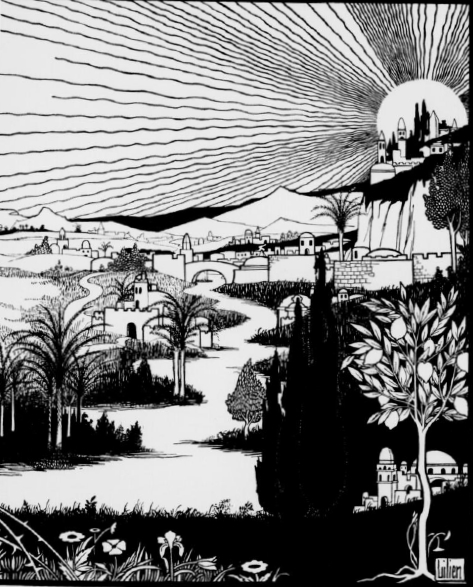
Synonym for Jerusalem or Land of Israel
Zion (; ) is a placename in the Tanakh, often used as a synonym for Jerusalem as well as for the Land of Israel as a whole.
The name is found in 2 Samuel (), one of the books of the Tanakh dated to approximately the mid-6th century BCE. It originally referred to a specific hill in Jerusalem, Mount Zion, located to the south of Mount Moriah (the Temple Mount). According to the narrative of 2 Samuel 5, Mount Zion held the Jebusite fortress of the same name that was conquered by David and was renamed the City of David. That specific hill ("mount") is one of the many squat hills that form Jerusalem.
The term Tzion came to designate the area of Davidic Jerusalem where the Jebusite fortress stood, and was used as well as synecdoche for the entire city of Jerusalem; and later, when Solomon's Temple was built on the adjacent Mount Moriah (which, as a result, came to be known as the Temple Mount), the meanings of the term Tzion were further extended by synecdoche to the additional meanings of the Temple itself, the hill upon which the Temple stood, the entire city of Jerusalem, the entire biblical Land of Israel, and "the World to Come", the Jewish understanding of the afterlife.
Over many centuries, until as recently as the 16th century (Ottoman period), the city walls of Jerusalem were rebuilt many times in new locations, so that the particular hill known in biblical times as Mount Zion is no longer within the city walls, but its location is now just outside the Old City and southeast of it. Most of the original City of David itself is thus also outside the current "Old City" wall. Adding to the confusion, another ridge, the Western Hill rather than the original Southeastern Hill (City of David) or the Southern Hill (Temple Mount), has been called 'Mount Zion' for the last two millennia.
Etymology
The etymology of the word Zion (ṣiyyôn) is uncertain.
Mentioned in the Old Testament in the Books of Samuel (2 Samuel 5:7) as the name of a Jebusite fortress conquered by David, its origin seems to predate the Israelites. origin.
Orthography The form ציון (Tzion, Tiberian transliteration: Ṣiyyôn) appears 108 times in the Tanakh, and once with article, as HaTzion.
Tsade is usually rendered as z in English translations, hence the spelling Zion (rather than Tzion). This convention originates in German orthography, where z stands for the consonant [t͡s]. A tz would only be used if the preceding vowel is short, hence the use of Zion in 19th-century German Biblical criticism. -- 19th-century German has nothing to do with it, as Zion was well established in the KJV during the 1600s. If this is from German, it is from 16th-century German This orthography was adopted because in German, the correct transliteration can only be rendered from the one instance of HaTzion in Kings II 23:17, where the a vowel is followed by a double consonant tz.--
Judaism: religion and Zionism
Hebrew Bible: Zion, daughter(s) of Zion
Daughter of Zion
Zion is mentioned 152 times in the Hebrew Bible (Tanakh), most often in the Prophetic books, the Book of Psalms, and the Book of Lamentations, besides six mentions in the Historical books (Kings, Samuel, Chronicles) and a single mention of the "daughters of Zion" in the Song of Songs (3:11)
Out of the 152 mentions, 26 instances are within the phrase of "Daughter of Zion" (Hebrew "bat Tzion"). This is a personification of the city of Jerusalem, or of its population.
In Psalm 137, Zion (Jerusalem) is remembered from the perspective of the Babylonian Captivity. "By the waters of Babylon, there we sat down and wept, when we remembered Zion. On the willows[a] there we hung up our lyres. For there our captors required of us songs, and our tormentors, mirth, saying, “Sing us one of the songs of Zion!”
Psalm 147 uses "Jerusalem" and "Zion" interchangeably to address the faithful: "The Lord builds up Jerusalem; He gathers the outcasts of Israel. He heals the brokenhearted and binds up their wounds. His delight is not in the strength of the horse, nor his pleasure in the legs of a man, but the Lord takes pleasure in those who fear him, in those who hope in his steadfast love. Praise the Lord, O Jerusalem! Praise your God, O Zion!"
Religious practice; exegesis
The location of the Temple, and in particular its Holy of Holies (innermost sanctum), is the most holy place in the world for the Jewish people, seen as the connection between God and humanity. Observant Jews recite the Amidah three times a day facing the Temple Mount in Jerusalem, praying for the rebuilding of the Holy Temple, the restoration of the Temple service, the redemption of the world, and for the coming of the Messiah.
In Kabbalah, the more esoteric reference is made to Tzion being the spiritual point from which reality emerges, located in the Holy of Holies of the First, Second and future Third Temple. According to Rabbi Abraham Joshua Heschel, "Zion is not a symbol, but a home, and the land is not an allegory but a possession."
Jewish–Roman wars
The name "Zion" appears in the coins minted by the revolutionary government in Jerusalem during the Great Jewish Revolt against Rome (66–73 CE). Bronze coins from the revolt bear inscriptions such as 'freedom of Zion' (from years two and three) and 'for the redemption of Zion' (from year four). David Goodblatt argues that these slogans were used to communicate the rebels' goals to the masses, serving as a unifying rallying cry for the fight for Zion. James S. McLaren suggests that its appearance on the coins may specifically refer to the Temple Mount, as part of a set of terms conveying varying layers of identity: 'Jerusalem,' representing its location and the city's as the national capital, and 'Israel,' reflecting the new independent state. According to Ya'akov Meshorer, the name "Zion" was used on the coins as a 'poetic term' with nationalistic connotations, symbolizing not only Jerusalem but also "its history, religion, culture and desire for freedom".
Zionism
Main article: Zionism, Types of Zionism, Labor Zionism, Religious Zionism, Post-Zionism, Neo-Zionism
The term "Zionism", coined by Austrian Nathan Birnbaum, was derived from the German rendering of Tzion in his journal Selbstemanzipation ("self emancipation") in 1890. Zionism as a modern political movement started in 1897 and supported a "national home", and later a state, for the Jewish people in the Land of Israel. The Zionist movement declared the establishment of the State of Israel in 1948, following the United Nations Partition Plan for Palestine. Since then, and with varying ideologies, Zionists have focused on developing and protecting this state.
The movement is controversial, with critics often characterizing it as a supremacist, colonialist,{{bulleted list| | | | | | | Lustick, Ian, For the Land and the Lord ... | | | | |
- Quoting Mr. Abouchaer of Syria, on p. 31:
- Citing Soviet ideology, on p. 136:
- Harkabi, Yehoshafat, Arab attitudes to Israel, pp. 247–248 and/or as a settler colonialist movement.{{bulleted list| | | | |
Islamic tradition
Ṣahyūn (, Ṣihyawn) is the word for Zion in Arabic and Syriac. Drawing on biblical tradition, it is one of the names accorded to Jerusalem in Arabic and Islamic tradition. A valley called Wādī Sahyũn seemingly preserves the name and is located approximately one and three-quarter miles from the Old City's Jaffa Gate.
For example, the reference to the "precious cornerstone" of the new Jerusalem in the Book of Isaiah 28:16 is identified in Islamic scholarship as the Black Stone of the Kaaba. This interpretation is said by ibn Qayyim al-Jawziyya (1292–1350) to have come from the People of the Book, though earlier Christian scholarship identifies the cornerstone with Jesus.
Latter Day Saint
Main article: Zion (Latter Day Saints)
Within the Latter Day Saint movement, Zion is often used to connote a peaceful ideal society. In the Latter Day Saints belief system the term Zion is often used to denote a place of gathering for the saints. It is also often used to denote an area or city of refuge for the saints.
Rastafari movement
|Rastaman Chant|Bob Marley and the Wailers|}} In Rastafari, "Zion" stands for a utopian place of unity, peace and freedom, as opposed to "Babylon", the oppressing and exploiting system of the materialistic modern world and a place of evil.
It proclaims Zion, as reference to Ethiopia, the original birthplace of humankind, and from the beginning of the movement calls to repatriation to Zion, the Promised Land and Heaven on Earth. Some Rastafari believe themselves to represent the real Children of Israel in modern times, and their goal is to repatriate to Ethiopia, or to Zion. The Ge'ez-language Kebra Nagast serves as inspiration for the idea that the "Glory of Zion" transferred from Jerusalem to Ethiopia in the time of Solomon and Sheba, c. 950 BCE.
Rastafari reggae contains many references to Zion; among the best-known examples are the Bob Marley songs "Zion Train", "Iron Lion Zion", the Bunny Wailer song "Rastaman" ("The Rasta come from Zion, Rastaman a Lion!"), The Melodians song "Rivers of Babylon" (based on Psalm 137, where the captivity of Babylon is contrasted with the freedom in Zion), the Bad Brains song "Leaving Babylon", the Damian Marley song featuring Nas "Road to Zion", The Abyssinians' "Forward Unto Zion" and Kiddus I's "Graduation in Zion", which is featured in the 1977 cult roots rock reggae film Rockers, and "Let's Go to Zion" by Winston Francis. Reggae groups such as Steel Pulse and Cocoa Tea also have many references to Zion in their various songs.
The Jewish longing for Zion, starting with the deportation and enslavement of Jews during the Babylonian captivity, was adopted as a metaphor by Christian black slaves in the United States. Thus, Zion symbolizes a longing by wandering peoples for a safe homeland. This could be an actual place such as Ethiopia for Rastafari or Israel for the Jews. Rastafari, while not identifying as "Jews", identify themselves and Africa as Zion. Specifically, Ethiopia is acknowledged as the mountains of Zion. Further, Rastafari ontology views all Africans as God's Chosen People. This differs from Judaic narratives.
Bahá’í Faith
References to Zion occur in the writings of the Bahá’í Faith. Bahá’u’lláh, the prophet-founder of the Bahá’í Faith wrote, concerning the Bahá’í Revelation,
Mount Zion
Main article: Mount Zion
Today, Mount Zion refers to a hill south of the Old City's Armenian Quarter, not to the Temple Mount. This apparent misidentification dates at least from the 1st century AD, when Josephus calls Jerusalem's Western Hill "Mount Zion". The Abbey of the Dormition and King David's Tomb are located upon the hill currently called Mount Zion.
Notes
References
Bibliography
- Ludlow, D. H. (Ed.) (1992). Vol 4. Encyclopedia of Mormonism. New York: Macmillan Publishing Company.
- McConkie, B. R. (1966). Mormon Doctrine. (2nd ed). Utah: Bookcraft.
- Steven Zarlengo: Daughter of Zion: Jerusalem's Past, Present, and Future. Dallas: Joseph Publishing, 2007.
References
- ''Sion'' is the spelling in the [[Vulgate]], also adopted in modern French.
- Hebrew Academy 2006 convention for the romanization of Hebrew, [http://hebrew-academy.huji.ac.il/hahlatot/TheTranscription/Documents/LAT-HEB.pdf Announcements of the Academy of the Hebrew Language] {{webarchive. link. (2013-10-15)
- (2008). "Dictionary of the Old Testament: Wisdom, Poetry & Writings: A Compendium of Contemporary Biblical Scholarship". InterVarsity Press.
- Anderson, Arnold Albert. (1981). "The book of Psalms". [[Wm. B. Eerdmans Publishing]].
- Bromiley, Geoffrey W.. (1995). "The International Standard Bible Encyclopedia". [[Wm. B. Eerdmans Publishing]].
- Mendenhall, George. (1973). "The Tenth Generation: The Origins of the Biblical Tradition". [[The Johns Hopkins University Press]].
- ''The Responsa Project: Version 13'', Bar Ilan University, 2005
- Kline, D.E., ''A Comprehensive Etymological Dictionary of the Hebrew Language for readers of English'', Carta Jerusalem, [[University of Haifa]], 1987, pp. xii–xiii
- Joseph Dixon, ''A general introduction to the Sacred Scriptures: in a series of dissertations, critical hermeneutical and historical'', J. Murphy, 1853, p. 132
- Joseph Addison Alexander, ''Commentary on the Prophecies of Isaiah'' (1878), [https://books.google.com/books?id=q_hFAQAAMAAJ&pg=PA65 p. 65].
- Rabbi Heshy Grossman. "The Weekly Parsha: A New Dimension. Parshas Devarim: Tisha b'Av".
- Heschel, Abraham Joshua. ''Israel: An Echo of Eternity''. New York: Farrar, Straus and Giroux, 1967. p. 15.
- Goodblatt, David. (2006). "Elements of Ancient Jewish Nationalism". Cambridge University Press.
- McLaren, James S.. (2011-01-01). "Going to War against Rome: The Motivation of the Jewish Rebels". Brill.
- Meshorer, Ya'akov. (1982). "Ancient Jewish Coinage". Amphora Press.
- De Lange, Nicholas, ''An Introduction to Judaism'', [[Cambridge University Press]] (2000), p. 30. {{ISBN. 0-521-46624-5.
- See for example: {{harvnb. Alam. 2009, or {{harvnb. Gould-Wartofsky. 2010
- Palestine Exploration Fund. (1977). "Palestine Exploration Quarterly, Volumes 109–110". Published at the Fund's Office.
- Gil, Moshe. (1997). "A History of Palestine, 634–1099". [[Cambridge University Press]].
- Freund, Richard A.. (2009). "Digging Through the Bible: Modern Archaeology and the Ancient Bible". [[Rowman & Littlefield]].
- Wheeler, Brannon M.. (2002). "Moses in the Quran and Islamic Exegesis". [[Psychology Press]].
- "Definition of Babylon (chiefly among Rastafari)". [[Oxford University Press]].
- (2003-05-30). "What Do Rastafarians Believe". Jamaicans.com.
- Condon, R.. (1994). ZION AT THE CROSSROADS: "African Zion, the Sacred Art of Ethiopia". Nka Journal of Contemporary African Art. 1994. 49-52. 10.1215/10757163-1-1-49.
- Bahá’u’lláh. "Gleanings from the Writings of Bahá'u'lláh".
- Bahá’u’lláh. "Tablets of Baháʼu'lláh Revealed After the Kitáb-i-Aqdas".
- Pixner, Bargil. (2010). "Paths of the Messiah and Sites of the Early Church from Galilee to Jerusalem: Jesus and Jewish Christianity in Light of Archaeological Discoveries". [[Ignatius Press]].
This article was imported from Wikipedia and is available under the Creative Commons Attribution-ShareAlike 4.0 License. Content has been adapted to SurfDoc format. Original contributors can be found on the article history page.
Ask Mako anything about Zion — get instant answers, deeper analysis, and related topics.
Research with MakoFree with your Surf account
Create a free account to save articles, ask Mako questions, and organize your research.
Sign up freeThis content may have been generated or modified by AI. CloudSurf Software LLC is not responsible for the accuracy, completeness, or reliability of AI-generated content. Always verify important information from primary sources.
Report