From Surf Wiki (app.surf) — the open knowledge base
Zaragoza
Capital of Aragon, Spain
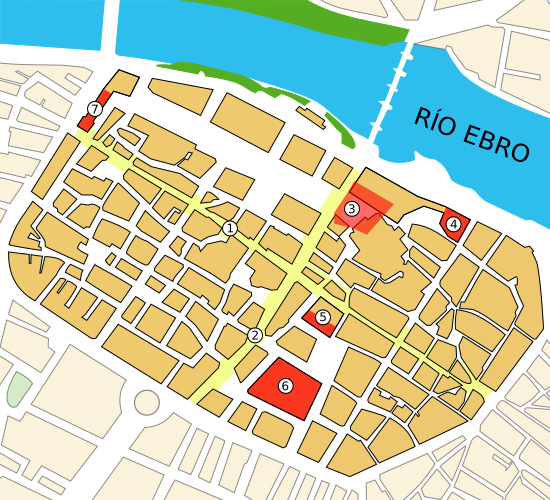
Capital of Aragon, Spain
| Field | Value | ||||||||||||||
|---|---|---|---|---|---|---|---|---|---|---|---|---|---|---|---|
| <!-- Basic info ----------------> | name | Zaragoza | |||||||||||||
| nickname | The Florence of Spain | ||||||||||||||
| other_name | Saragossa | ||||||||||||||
| settlement_type | Municipality | ||||||||||||||
| motto | |||||||||||||||
| image_skyline | {{Multiple image | ||||||||||||||
| perrow | 1/2/3 | ||||||||||||||
| border | infobox | ||||||||||||||
| total_width | 280 | ||||||||||||||
| caption_align | center | ||||||||||||||
| image1 | Zaragoza - Basílica del Pilar y río Ebro.jpg | ||||||||||||||
| alt1 | Cathedral-Basilica of Our Lady of the Pillar | ||||||||||||||
| caption1 | Cathedral-Basilica of Our Lady of the Pillar | ||||||||||||||
| image2 | La Seo-Zaragoza - P1410404.jpg | ||||||||||||||
| alt2 | La Seo del Salvador | ||||||||||||||
| caption2 | La Seo | ||||||||||||||
| image3 | Aljafería Palace.jpg | ||||||||||||||
| alt3 | Aljafería | ||||||||||||||
| caption3 | Aljafería | ||||||||||||||
| image4 | WLM14ES - 27072008 121549 ZGZ 3155 - .jpg | ||||||||||||||
| alt4 | Gran Vía de Zaragoza | ||||||||||||||
| caption4 | Gran Vía | ||||||||||||||
| image5 | Zaragoza - Torre del agua2.jpg | ||||||||||||||
| alt5 | Torre del Agua (Expo 2008) | ||||||||||||||
| caption5 | Torre del Agua | ||||||||||||||
| image6 | Zaragoza - Centro Comercial Gran Casa y WTCZ.jpg | ||||||||||||||
| alt6 | World Trade Center Zaragoza and Grancasa Mall | ||||||||||||||
| caption6 | WTCZ | ||||||||||||||
| image_flag | Flag of Zaragoza.svg | ||||||||||||||
| flag_size | 120px | ||||||||||||||
| image_shield | Coat of Arms of Saragossa.svg | ||||||||||||||
| shield_size | 110px | ||||||||||||||
| pushpin_map | Spain#Spain Aragon#Europe | ||||||||||||||
| image_map | [[File:Zaragoza municipality.png | 250px]] | |||||||||||||
| {{Maplink | frame | yes | plain=y | frame-width=285 | frame-height=180 | frame-align=center | frame-coordinates= | zoom=4 | type=point | title=Zaragoza | marker=city | type2=shape | stroke-width2=2 | stroke-color2=#808080 | text=Interactive map of Zaragoza.}} |
| map_caption | Location of Zaragoza | ||||||||||||||
| subdivision_type | Country | ||||||||||||||
| subdivision_name | Spain | ||||||||||||||
| subdivision_type1 | Autonomous community | ||||||||||||||
| subdivision_name1 | Aragon | ||||||||||||||
| subdivision_type2 | Province | ||||||||||||||
| subdivision_name2 | Zaragoza | ||||||||||||||
| subdivision_type3 | Comarca | ||||||||||||||
| subdivision_name3 | Zaragoza | ||||||||||||||
| parts_type | Districts | ||||||||||||||
| parts_style | para | ||||||||||||||
| p1 | Centro | ||||||||||||||
| p2 | Casco Histórico | ||||||||||||||
| p3 | Delicias | ||||||||||||||
| p4 | Universidad | ||||||||||||||
| p5 | San José | ||||||||||||||
| p6 | Las Fuentes | ||||||||||||||
| p7 | La Almozara | ||||||||||||||
| p8 | Oliver-Valdefierro | ||||||||||||||
| p9 | Torrero-La Paz | ||||||||||||||
| p10 | Actur-Rey Fernando | ||||||||||||||
| p11 | El Rabal | ||||||||||||||
| p12 | Casablanca | ||||||||||||||
| p13 | Santa Isabel | ||||||||||||||
| p14 | Miralbueno | ||||||||||||||
| p15 | Sur | ||||||||||||||
| p16 | Distrito Rural | ||||||||||||||
| government_type | Ayuntamiento | ||||||||||||||
| governing_body | Ayuntamiento de Zaragoza | ||||||||||||||
| leader_party | People's Party | ||||||||||||||
| leader_title | Mayor | ||||||||||||||
| leader_name | Natalia Chueca | ||||||||||||||
| established_title | |||||||||||||||
| established_date | |||||||||||||||
| area_total_km2 | 973.78 | ||||||||||||||
| area_water_percent | |||||||||||||||
| elevation_footnotes | tags-- | ||||||||||||||
| elevation_m | 243 | ||||||||||||||
| population_as_of | 2024 | ||||||||||||||
| population_footnotes | |||||||||||||||
| population_total | 691,037 | ||||||||||||||
| population_metro | 765,168 | ||||||||||||||
| population_metro_footnotes | |||||||||||||||
| population_urban | 736,649 | ||||||||||||||
| population_urban_footnotes | |||||||||||||||
| population_density_km2 | 682 | ||||||||||||||
| population_demonym | Zaragozan | ||||||||||||||
| (Zaragozano) (male)(Zaragozana) (female) | |||||||||||||||
| <!-- GDP ---------------> | demographics_type2 | GDP | |||||||||||||
| demographics2_footnotes | |||||||||||||||
| demographics2_title1 | Metro | ||||||||||||||
| demographics2_info1 | €26.004 billion (2020) | ||||||||||||||
| <!-- General information ---------------> | timezone1 | CET | |||||||||||||
| utc_offset1 | +01:00 | ||||||||||||||
| timezone1_DST | CEST | ||||||||||||||
| utc_offset1_DST | +02:00 | ||||||||||||||
| coordinates | |||||||||||||||
| postal_code_type | Postal codes | ||||||||||||||
| postal_code | 50001–50022 | ||||||||||||||
| website | |||||||||||||||
| blank_name_sec1 | ISO 3166-2 | ||||||||||||||
| blank_info_sec1 | ES-Z |
(Zaragozano) (male)(Zaragozana) (female) Zaragoza (), traditionally known in English as Saragossa ( ), is the capital city of the province of Zaragoza and of the autonomous community of Aragon, Spain. It lies by the Ebro river and its tributaries, the Huerva and the Gállego, roughly in the centre of both Aragon and the Ebro basin.
In the 1st century BCE, Romans founded the colony of Caesaraugusta over the Sedetani settlement of Salduie. The city was the capital of the Upper March of Al-Andalus under Umayyad rule, later thriving as a capital of a rump state ruled by the Banu Hud, the taifa of Zaragoza. It swiftly became the political and spiritual centre of the Kingdom of Aragon after the 1118 Christian conquest, and its inhabitants managed to preserve and consolidate initially granted privileges over the course of the Late Middle Ages.
As of 2025, Zaragoza had a population of 699,007 inhabitants,{{cite web |access-date=12 December 2025
Zaragoza hosted Expo 2008 in mid-2008, a world's fair on water and sustainable development. It was also a candidate for the European Capital of Culture in 2012.
The city is famous for its folklore, local cuisine, and landmarks such as the Basílica del Pilar, La Seo Cathedral and the Aljafería Palace. Together with La Seo and the Aljafería, several other buildings form part of the Mudéjar Architecture of Aragon which is a UNESCO World Heritage Site. The Fiestas del Pilar are among the most celebrated festivals in Spain.
Etymology
The Iberian town that preceded Roman colonisation was called Salduie or Salduba. The Romans and Greeks called the ancient city Caesaraugusta (in Greek Καισαραυγοῦστα, grc), from which derive the Arabic name سرقسطة Saraqusṭa (used during the Al-Andalus period), the medieval Çaragoça, and the modern Zaragoza.
History
The Sedetani, a tribe of ancient Iberians, populated a village called (Salduba in Roman sources).
Roman Caesaraugusta
Main article: Caesaraugusta
Augustus founded the city as Caesaraugusta between 25 BC and 11 BC as a colony to settle army veterans from the Cantabrian wars. As a Roman city, it had all the typical public buildings: forum, baths, theatre, and was an important economic centre. Many Roman ruins can still be seen in Zaragoza today.
It is thought it might have been the Apostle James who had built a chapel on the site of the Cathedral-Basilica of Our Lady of the Pillar.
On the spot where Saint Engratia and her companions were said to have been martyred on Valerian's orders was the Church of Santa Engracia de Zaragoza. Only the crypt and the doorway survived the Peninsular War. Around the early 20th century it was rebuilt, and is now a functioning parish church.
Middle Ages
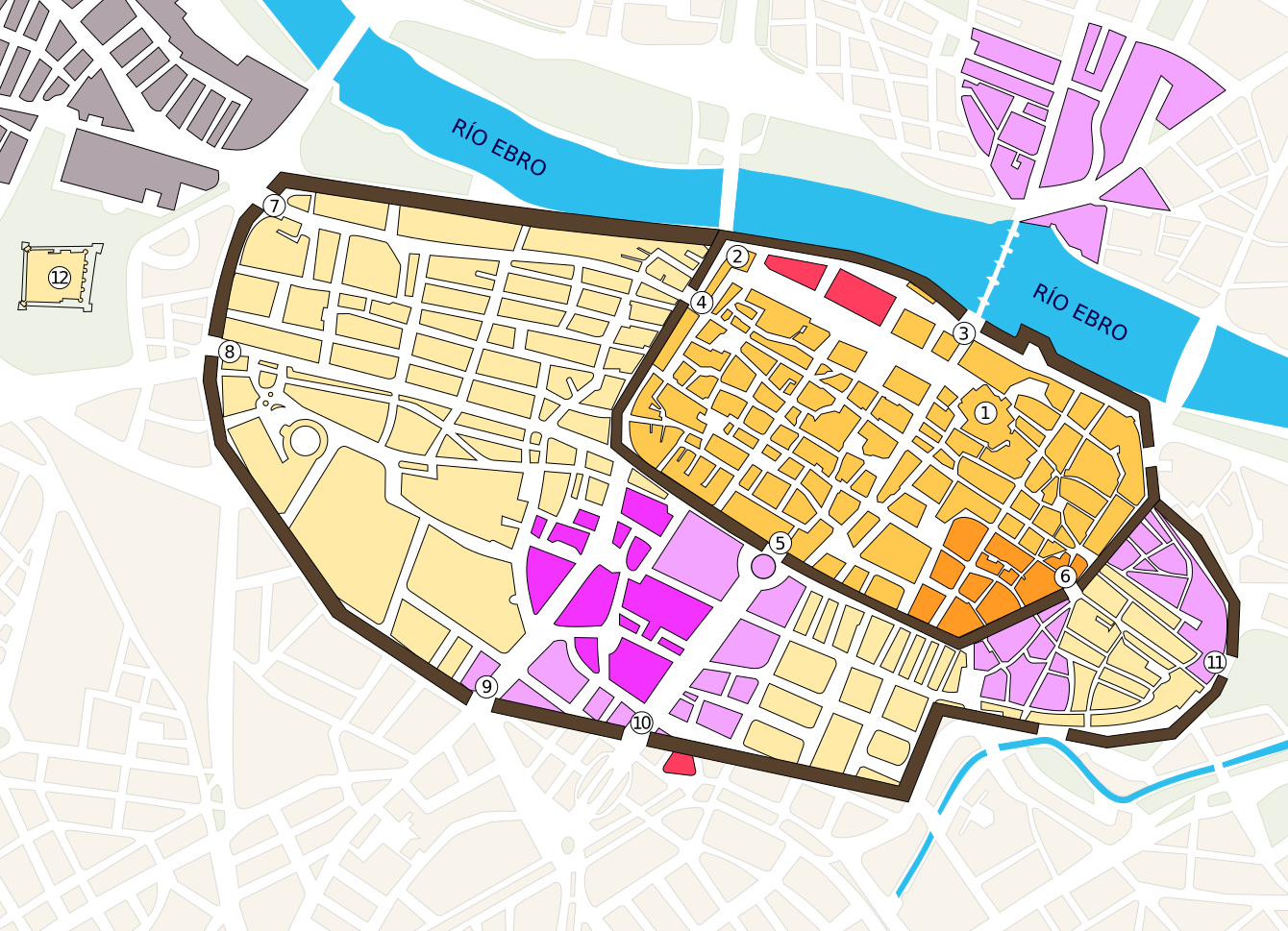
Despite the general decline of the last centuries of the Roman empire, Zaragoza suffered little. Capture by the Goths in the fifth century AD was without significant bloodshed or destruction.
In the eighth century, following the Umayyad conquest of the Iberian Peninsula, Zaragoza became the capital of the Upper March of al-Andalus.
In 1018, amid the collapse of the Caliphate of Córdoba, Zaragoza became an independent Taifa of Zaragoza, initially controlled by the Tujibid family, The taifa greatly prospered in a cultural and political sense in the late 11th century, and being later governed by Ahmad al-Muqtadir, Yusuf al-Mu'taman ibn Hud and Al-Musta'in II. It fell to the Almoravids in 1110.
On 18 December 1118, Alfonso I of Aragon conquered the city from the Almoravids, and made it the capital of the Kingdom of Aragon. The aforementioned monarch created a jurisdictional dominion in the city, which was gifted to Gaston of Béarn. The city remained a lordship up until the early 13th century.
Jewish community
There was a Jewish community in medieval Zaragoza, a notable center where yeshivas also incorporated the study of philosophy alongside Talmud studies. In the 11th century, the city was home to several notable Jewish physicians, including Menahem ibn al-Fawwal and Jonah ibn Janah, the latter of whom also gained renown as a Hebrew grammarian. Ibn Janah authored Kitāb al-Talkhīṣ, which included detailed descriptions of drugs, weights and measures used in medicine. Another prominent figure was Jonah ibn Biklārish, who served as court physician to Sultan Al-Musta'in II and authored Kitāb al-Musta'īnī, a drug manual written in table form that included names and properties of drugs.
The Jewish community of Zaragoza had seven synagogues, two of which are known by location today: Le Mayor (the main synagogue) and the synagogue "de los Callizos" or "de Cehán." The community was spared from the 1391 pogroms, in large part due to the presence of the king and the intervention of the prominent Jewish leader Ḥasdai Crescas. In 1481, the Crown appointed the monk Miguel Ferrer to enforce the segregation of Jewish households in Zaragoza, but his extreme cruelty led King Ferdinand II to remove him from the post. On 29 April 1492, the Crown's decision to expel the Jews was announced in Zaragoza to the kingdom's procurators, two days before the Edict of Expulsion was formally proclaimed in Castile. The city's rabbi, Açach Chaqon, was ordered on 13 May to leave the Jewish quarter within a day and the kingdom within three. Most of the Jewish community eventually departed Zaragoza between 27 and 29 July, traveling to the port of Sagunto to go into exile.
In the months following the expulsion, the Crown and the Inquisition supervised the confiscation and transfer of communal property, including Torah scrolls, silver crowns, decorative cloths, and other ritual objects, many of which were dismantled, redistributed, or given to city authorities and religious institutions. In late 1493, Zaragoza formally received the Jewish quarter and its associated buildings.
Early modern history
An outbreak of bubonic plague decimated the city in 1564. It reportedly killed about 10,000 people out of an estimated population of 25–30,000.

In the context of the 1701–1714 War of the Spanish Succession, the city rose in arms in favour of the Archduke Charles, who was proclaimed "King of Aragon" in the city on 29 June 1706, following the uprising of other parts of the Kingdom of Aragon in December 1705. Charles entered the city in July 1706, directing the attack on those places of Aragon that had sided with the Bourbon faction such as Borja or the Cinco Villas. Following the April 1707 battle at Almansa, the tide turned with the Austracist forces fleeing in disarray, and the Bourbon forces commanded by the Duke of Orléans entering the city on 26 May 1707. As he seized control of the kingdom, he began to enact the series of institutional reforms known as the Nueva Planta, abolishing the Aragonese institutions in favour of the Castilian ones. The war turned around again in 1710 after the Battle of Almenar, and, following another Bourbon defeat near Zaragoza on 20 August 1710, Archduke Charles returned to the city on the next day. This was for only a brief period, though, as following the entry of Philip V in Madrid and the ensuing Battle of Villaviciosa in December 1710, the Habsburg armies fled from Zaragoza in haste in December 1710 and Philip V proceeded to consolidate his rule over the kingdom of Aragon, resuming administrative reforms after a period of institutional void.
An important food riot caused by the high price of bread and other necessity goods took place in the city in April 1766, the so-called motín de los broqueleros, named after the repressive agents, volunteer farmers and craftsmen who wielded swords and bucklers (broqueles). The repression left about 300 wounded, 200 detainees and 8 deaths and it was followed by 17 public executions, and an indeterminate number of killings at the dungeons of the Aljafería.
Late Modern history
Zaragoza suffered two famous sieges during the Peninsular War against the Napoleonic army: a first from June to August 1808; and a second from December 1808 to February 1809, surrendering only after some 50,000 defenders had died.
Railway transport came to Zaragoza on 16 September 1861 with the inauguration of the Barcelona–Zaragoza line with the arrival of a train from the former city to the Estación del Norte.
The July 1936 coup d'état (with Gen. Miguel Cabanellas, Col. , , , Major Cebollero and Gen. at the centre of the Mola-led conspiration in Zaragoza) triumphed in the city. After the military uprising in Africa on 17 July, the military command easily attained its objectives in Zaragoza in the early morning of 19 July, despite the city's status as stronghold of organised labour (mostly CNT anarcho-syndicalists but also UGT trade unionists), as the civil governor critically refused to give weapons to the people in time. Many refugees, including members of the provincial committees of parties and unions, fled to Caspe, the capital of the territory of Aragon, which was still controlled by the Republic.
The rearguard violence committed by the putschists, with at least 12 murders on 19 July, would only go in crescendo along the beginning of the conflict. Thus one of the two big cities under Rebel control since the early stages of the Spanish Civil War along with Seville, Zaragoza profited from an increasing industrial production vis-à-vis the war economy, playing a key role for the Francoist faction as ammunition manufacturer.
The General Military Academy, a higher training center of the Spanish Army, was re-established on 27 September 1940 by José Enrique Varela, the Francoist Minister of the Army.
The 1953 Accords ensued with the installment of a joint US–Spain air base in Zaragoza.
Following the declaration of Zaragoza as Polo de Desarrollo Industrial ("Pole for Industrial Development") by the regime in 1964, the city doubled in population in a short time. The increase in population ran parallel to the rural flight and depopulation in the rest of Aragon.
In 1979, a fire at the Hotel Corona de Aragón fire killed at least 80 people, including members of the family of Francisco Franco. The armed Basque nationalist and separatist organization ETA carried out the Zaragoza barracks bombing in 1987 which killed eleven people, including a number of children, leading to 250,000 people taking part in demonstrations in the city.
Since 1982, the city has been home to a large factory built by General Motors for the production of Opel cars, some of which are exported to the United Kingdom and sold under the Vauxhall brand. The city took advantage of the entry of Spain into the European Communities (later European Union).
Geography
Location

Zaragoza lies in the north-east of the Iberian Peninsula, in the rather arid depression formed by the valley of the Ebro. The Ebro cuts across the city in a west north-west by east south-east direction, entering the municipality at 205 metres above sea level and exiting the municipality at a level of 180 metres above sea level.
The city enjoys a beneficial location at the geographical centre of the rough hexagon formed by the Spanish cities of Bilbao, Madrid, Valencia and Barcelona and the French cities of Bordeaux and Toulouse.
The municipality has a surface of 973.78 km2, making it the ninth largest municipality in Spain.
While the river banks are largely flat, the territory flanking them can display a rugged terrain, featuring muelas and escarpments.
The Roman core of Caesaraugusta was founded on the right bank of the Ebro, with the north-east corner limiting the confluence of the Ebro with the Huerva river, a modest right-bank tributary of the Ebro. The Huerva runs through the city buried for much of its lower course. Zaragoza is also located near the confluence of the Ebro with the Gállego, a more voluminous left-bank tributary born in the Pyrenees.
Climate
Zaragoza has a semi-arid climate (Köppen: BSk), as it lies in a wide basin entirely surrounded by mountains which block off moist air from the Atlantic and Mediterranean. The average annual precipitation is a scanty 328 mm with abundant sunny days, and the rainiest seasons are spring (April–May) and autumn (September–November), with a relative drought in summer (July–August) and winter (December–March).
Temperatures in summer are hot, and in winter a cold and dry wind blows from the northwest, the Cierzo. Night frost is common and there is sporadic snowfall. Fog can be persistent in late autumn and early winter.{{Weather box | Jan record high C = 20.6 | Feb record high C = 25.5 | Mar record high C = 28.7 | Apr record high C = 32.4 | May record high C = 37.5 | Jun record high C = 43.2 | Jul record high C = 44.5 | Aug record high C = 42.8 | Sep record high C = 39.2 | Oct record high C = 33.9 | Nov record high C = 28.4 | Dec record high C = 22.0 | year record high C = | Jan record low C = -10.4 | Feb record low C = -11.4 | Mar record low C = -6.3 | Apr record low C = -2.4 | May record low C = 0.5 | Jun record low C = 5.2 | Jul record low C = 8.0 | Aug record low C = 8.4 | Sep record low C = 4.8 | Oct record low C = 0.6 | Nov record low C = -5.6 | Dec record low C = -9.5 | year record low C =
Administrative subdivisions
Zaragoza is administratively divided into 15 urban districts and 14 rural neighborhoods:
| # | colspan = 2 | Urban district | |
|---|---|---|---|
| 1 | |||
| 2 | |||
| 3 | |||
| 4 | |||
| 5 | |||
| 6 | |||
| 7 | |||
| 8 | |||
| 9 | |||
| 10 | |||
| 11 | |||
| 12 | |||
| 13 | |||
| 14 | |||
| 15 |
Demographics
.JPG)
Religion
According to a survey carried out by the Centro de Investigaciones Sociológicas (CIS) in 2019 with a sample size of 300, 51.0% of the surveyed people described themselves as non-practising Catholic, 24.0% as practising Catholic, 6.7% as indifferent/non-believer, 5.0% as agnostic, 4.3% as atheist and 2.3% as "other religions", while a 6.7% did not answer.
Immigration
In 2017, there were 64,003 foreign citizens in Zaragoza, which represent 9.6% of the total population. From 2010 to 2017 immigration dropped from 87,735 to 64,003 people, a 27% drop. Romanians represent 29.8% of foreigners living in Zaragoza, or 2.9% of the total city population, followed by Moroccans (9.1%) and Chinese (7%).
| Foreign Nationals in Zaragoza in 2017 | Position | Nationality | People |
|---|---|---|---|
| 1st | Romania | 19,064 | |
| 2nd | Morocco | 5,804 | |
| 3rd | China | 4,497 | |
| 4th | Ecuador | 3,302 | |
| 5th | Colombia | 2,488 | |
| 6th | Algeria | 2,470 | |
| 7th | Senegal | 2,117 | |
| 8th | Dominican Republic | 1,115 | |
| 9th | Ukraine | 1,030 |
Economy

An Opel factory was opened in 1982 in Figueruelas, a small village nearby. The automotive industry is a main pillar of the regional economy along with Balay, which manufactures household appliances; CAF, which builds railway rolling stock for both the national and international markets; SAICA and Torraspapel in the stationery sector; and various other local companies, such as Pikolin, Lacasa, and Imaginarium SA.
The city's economy benefited from projects like the Expo 2008, the official World's Fair, whose theme was water and sustainable development, held between 14 June and 14 September 2008, Plataforma Logística de Zaragoza (PLAZA), and the Parque Tecnológico de Reciclado (PTR). Furthermore, since December 2003, it has been a city through which the AVE high-speed rail travels. Currently, Zaragoza Airport is a major cargo hub in the Iberian Peninsula, behind only Madrid, Barcelona, and Lisbon.
Zaragoza is home to a Spanish Air and Space Force base, which was shared with the U.S. Air Force until 1992. In English, the base was known as Zaragoza Air Base. The Spanish Air Force maintained a McDonnell Douglas F/A-18 Hornet wing at the base. No American flying wings (with the exception of a few KC-135s) were permanently based there, but it served as a training base for American fighter squadrons across Europe. It also hosts the main Spanish Army academy, Academia General Militar, a number of brigades at San Gregorio, and other garrisons.
Culture
Christianity took root in Zaragoza at an early date. According to legend, St. Mary appeared miraculously to Saint James the Great in Zaragoza in the first century, standing on a pillar. This apparition is commemorated by a famous Catholic basilica called Nuestra Señora del Pilar ('Our Lady of the Pillar').
The Aragonese language, in decline for centuries and restricted mostly to northern Aragon, has recently attracted more people in the region. Thus, nowadays, in Zaragoza, up to 7,000 people speak Aragonese.
Festivals

The annual Fiestas del Pilar lasts for nine days, with its main day on 12 October. This date also coincides with Spain's national holiday, El Día de la Hispanidad (Day of Hispanicity), which celebrates Spain's cultural and historical ties with Hispanic America. October 12 also corresponds to the arrival of Christopher Columbus in the Americas.
There are many activities during the festival, from the massively attended pregon (opening speech) to the final fireworks display over the Ebro; they also include marching bands, dances such as jota aragonesa (the most popular folk music dance), a procession of gigantes y cabezudos, concerts, exhibitions, vaquillas, bullfights, fairground amusements, and fireworks. Some of the most important events are the Ofrenda de Flores, or Flower Offering to St. Mary of the Pillar, on 12 October, when an enormous surface resembling a cloak for St. Mary is covered with flowers, and the Ofrenda de Frutos on 13 October, when all the autonomous communities of Spain offer their typical regional dishes to St. Mary and donate them to soup kitchens.
Holy Week in Zaragoza, although not as elaborate an affair as its Andalusian or Bajo Aragón counterparts, has several processions passing through the city centre every day with dramatic sculptures, black-dressed praying women and hundreds of hooded people playing drums. It has been a Festival of International Tourist Interest since 2014.
Education
The University of Zaragoza is based in the city. As one of the oldest universities in Spain and a major research and development centre, this public university awards all the highest academic degrees in dozens of fields. Zaragoza is also home to the MIT-Zaragoza International Logistics Program, a unique partnership between MIT, the Government of Aragon and the University of Zaragoza.
There is a French international primary and secondary school, Lycée Français Molière de Saragosse.
Transport
.jpg)
Roads
The city is connected by motorway with the main cities in central and northern Spain, including Madrid, Barcelona, Valencia, and Bilbao, all of which are located about 300 kilometres (200 miles) from Zaragoza.
Buses
The city has a network of buses which is controlled by the Urban Buses of Zaragoza (AUZSA). The network consists of 31 regular lines (two of them circle lines), two scheduled routes, six shuttle buses (one free), and seven night buses operating on Fridays, Saturdays and other festivities. Zaragoza also has an interurban bus network operated by Transport Consortium Zaragoza Area (CTAZ) that operates 17 regular lines.
Bicycle
Zaragoza's bicycle lanes facilitate non-motorised travel and help cyclists to avoid running into pedestrians and motor vehicles. The city council also has a public bicycle-hire scheme, the bizi zaragoza, which has an annual charge.
Tram
The first line of the Zaragoza tram (Valdespartera-Parque Goya) is fully operational.
Railway
Zaragoza is a part of the Spanish high-speed railway operated by Renfe, AVE, which connects Madrid, Lleida, Tarragona, Barcelona and Figueres via high-speed rail. Madrid can be reached in 75 minutes, and Barcelona in approximately 90 minutes. The central station is Zaragoza–Delicias railway station, which serves both railway lines and coaches. In addition to long-distance railway lines and the high-speed trains, Zaragoza has a network of commuter trains operated by Renfe called Cercanías Zaragoza.
Airport
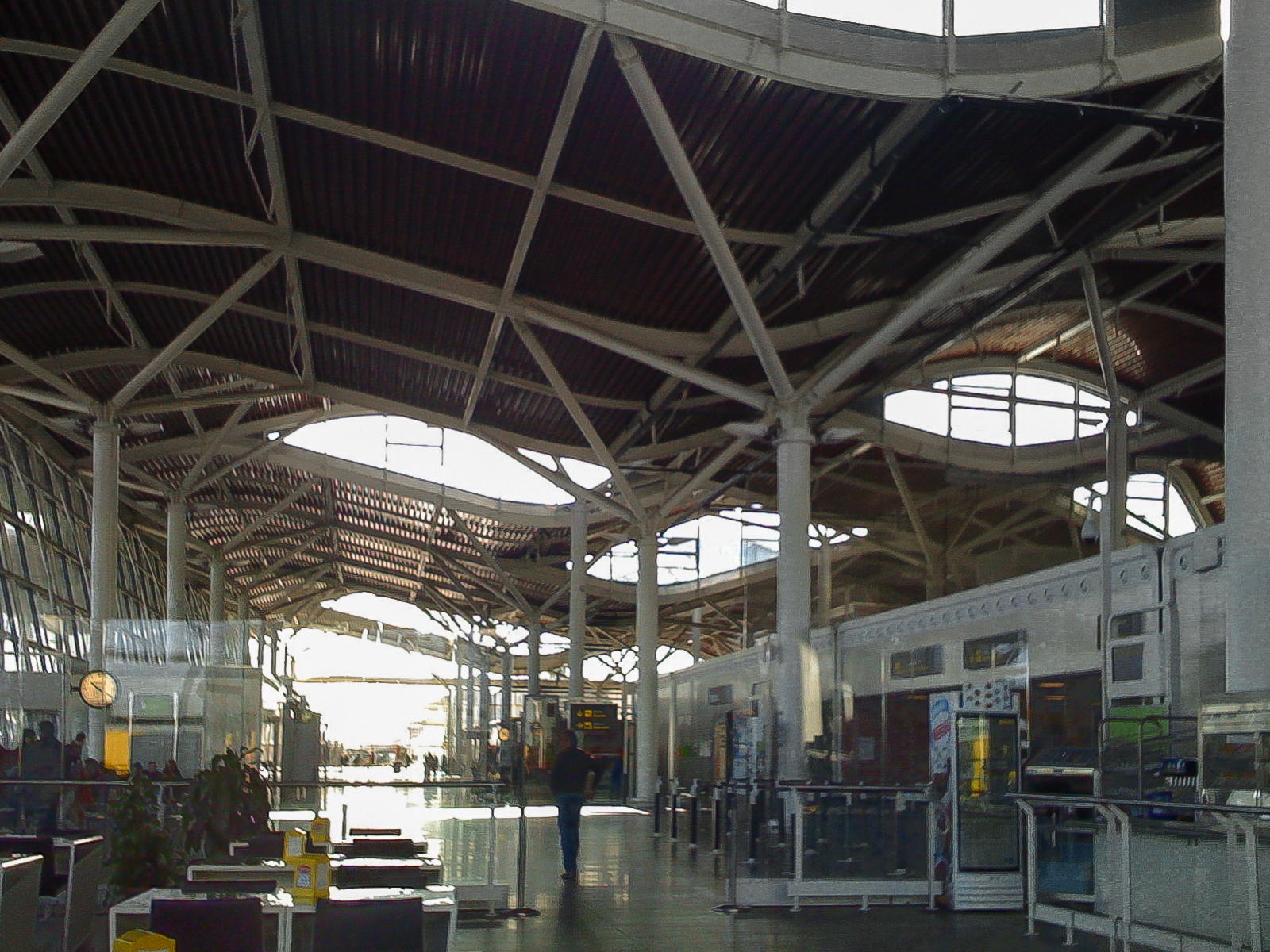
Zaragoza Airport is located in the Garrapinillos neighbourhood, 10 kilometres from the city centre.
It is a major commercial airport, its freight traffic surpassing that of Barcelona El Prat in 2012, and serves as the home of the Spanish Air Force's 15th Group. It was also used by NASA as a contingency landing site for the Space Shuttle in the case of a Transoceanic Abort Landing (TAL).
Public transportation statistics
The average amount of time people spend commuting with public transit in Zaragoza, for example to and from work, on a weekday is 48 minutes. 9% of public transit riders ride for more than two hours every day. The average amount of time people wait at a stop or station for public transit is 11 minutes, while 12% of riders wait for over 20 minutes on average every day. The average distance people usually ride in a single trip with public transit is 4.2 km, while 5% travel over 12 km in a single direction.
Sports
Football
Zaragoza's main football team, Real Zaragoza, plays in the Segunda División. Founded on 18 March 1932, its home games are played at La Romareda, which seats 34,596 spectators. The club has spent the majority of its history in La Liga. One of the most remarkable events in the team's recent history is the winning of the former UEFA Cup Winners' Cup in 1995. The team has also won the Spanish National Cup, Copa del Rey, six times: 1965, 1966, 1986, 1994, 2001 and 2004 and an Inter-Cities Fairs Cup (1964). A government survey in 2007 found that 2.7% of the Spanish population support the club, making them the seventh-most supported in the country.
Zaragoza's second football team is CD Ebro. Founded in 1942, it plays in Segunda División B – Group 2, holding home games at Campo Municipal de Fútbol La Almozara, which has a capacity of 1,000 seats.
Zaragoza CFF is a Spanish women's football team from Zaragoza playing in Segunda Federación Femenina, that once played in the top división.
Zaragoza was one of the Spanish cities which hosted the FIFA World Cup 1982. Three matches were played at La Romareda.
Its current stadium (La Romareda) will be demolished and a new one will be built, as Zaragoza is expected to be one of the eleven Spanish cities to host the FIFA World Cup 2030.
Basketball

The main basketball team, Basket Zaragoza, known as Casademont Zaragoza for sponsorship reasons, plays in the Liga ACB. The Basket Zaragoza women's team also plays at the highest level in Spain, being the current finalist of the Liga Femenina Endesa. They play their home games at the Pabellón Príncipe Felipe with a capacity of 10,744. This pavilion will be the final venue for EuroLeague Women from 2025 to 2027.
Stadium Casablanca, a.k.a. Mann Filter for sponsorship reasons, is the Spanish women's basketball club from Zaragoza that plays in the Primera Division.
Futsal
The main futsal team, is Dlink Zaragoza, plays in the LNFS Primera División. They play at the Pabellón Siglo XXI with a capacity of 2,600.
Other sports
Zaragoza's handball team, BM Aragón, plays in the Liga ASOBAL.
The Spanish Baja or Baja Aragon is a Rally raid event held in the region of Aragon in northern Spain. This event was launched in 1983, and chose the desert of Monegros because of the scenery and availability of service infrastructure in Zaragoza.
Zaragoza was strongly associated with Jaca in its failed bid for the 2014 Winter Olympics.
There are three Rugby Union teams playing in the regional league:
- Ibero Club de Rugby Zaragoza
- Fénix Club de Rugby
- Club Deportivo Universitario de Rugby
In June, 2025, Zaragoza will host the ITSF World Cup and World Championships, an international foosball tournament held by the International Table Soccer Federation.
A permanent feature built for Expo 2008 is the pump-powered artificial whitewater course El Canal de Aguas Bravas.
Main sights
Main article: List of tourist attractions in Zaragoza
Near the basilica on the banks of the Ebro are located the city hall, the Lonja (old currency exchange), La Seo (literally 'the See' in the Aragonese language) or Cathedral of San Salvador, a church built over the main mosque (partially preserved in the 11th-century north wall of the Parroquieta), with Romanesque apses from the 12th century; inside, the imposing hall church from the 15th to 16th centuries, the Baroque tower, and finally, with its famous Museum of Tapestries near the Roman ruins of forum and port city wall.
Also in the city centre, there is the palace of the Aljafería, conceived in the third quarter of the 11th century on behalf of the Hudid dynasty, featuring in its interior one of the most rich and complex instances of ornamental Islamic art, either Western or Eastern. It currently serves as the site of the Aragonese parliament.
The churches of San Pablo, Santa María Magdalena and San Gil Abad were built in the 14th century, but the towers may be old minarets dating from the 11th century; San Miguel (14th century); Santiago (San Ildefonso) and the Fecetas monastery are Baroque with Mudéjar ceilings of the 17th century. All the churches are Mudéjar monuments that comprise a World Heritage Site.
File:Torreón de la Zuda-Muralla.jpg|The Roman walls File:WLM14ES - P9148476 - .jpg|Interior of the Aljafería File:Basilica del Pilar-sunset.jpg|Cathedral-Basilica of Our Lady of the Pillar and the Puente de Piedra bridge on the Ebro River File:20070408 Catedral Zaragoza.jpg|View from the Cathedral Other important sights are the stately houses and palaces in the city, mainly of the 16th century: palaces of the count of Morata or Luna (Audiencia), Deán, Torrero (colegio de Arquitectos), Don Lope or Real Maestranza, count of Sástago, count of Argillo (today the Pablo Gargallo museum), archbishop, etc. On 14 June 2008, the site of Expo 2008 opened its doors to the public. The exhibition ran until 14 September.
Other sights

- Puente de Piedra
- San Ildefonso church
- Santa Engracia Monastery
- Fuente de la Hispanidad
Museums in Zaragoza are:
- Museum of Fine Arts Zaragoza, with paintings by early Aragonese artists, 15th century, and by El Greco, Ribera and Goya.
- Museo Goya - Colección Ibercaja - Museo Camón Aznar with works by Rubens, Rembrandt, Van Dyck, Velazquez and Goya to Renoir, Manet and Sorolla.
Twin towns and sister cities
Zaragoza is twinned with:
Zaragoza has special bilateral collaboration agreements with:
Notable people
- Abraham Abulafia (1240–1291), founder of the school of "Prophetic Kabbalah"
- Alonso Fernández de Heredia (died March 19, 1782), Captain General and governor of Honduras (1747), Florida (1751–1758), Yucatán (in modern-day Mexico; 1758–?), the Captaincy General of Guatemala (1761–1771) and Nicaragua (1761–1771).
- Levi ibn al-Tabban (12th century), Jewish grammarian and poet
- Hasdai Crescas, a Jewish philosopher and author of Or Adonai
- Amaral (band) (established 1992), popular musical band in Spain and America.
- Félix Anaut (born 1944), painter
- Avempace (1085–1138), polymath
- Bahya ben Joseph ibn Paquda (1050–1120), Jewish philosopher and the author of Chovot HaLevavot
- Ramón Ferreñac (1763–1832), composer
- José Luis Gil (born 1957), actor
- Luis de Horruytiner (? – ?), governor of Spanish Florida (1633 – 1638), and viceroy of Sardinia
- José Antonio Jiménez Salas (1916 – 2000), geotechnical engineer, professor of civil engineering, and academic member of the Spanish Royal Academy of Sciences
- Mapi León (born 1995), footballer for the Spain national team
- David Loera (born 1998), Spanish-born soccer player
- Eliezer Mayenda (born 2005), footballer for Sunderland AFC
- Rafael Navarro (born 8 October 1940), photographer
- Salma Paralluelo (born 2003), footballer for the Spain national team
- Sebastián Pozas (1876–1946), military officer
- Al-Saraqusti (died 1143), twelfth century Andalusi lexicographer, poet, philologist
- María del Pilar Sinués de Marco (1835-1893), prolific 19th-century writer
- Irene Vallejo, writer
- Dino Valls (born 1959), painter.
- Ignacio García Velilla (born 1967), film director
- José María Vigil (born 1946), theologian
- St. Vincent of Saragossa (died 304), Christian proto-martyr of Spain
References
;Citations
;Bibliography
References
- Martí Font, J. M.. (2017). "La España de las ciudades: El Estado frente a la sociedad urbana". ED Libros.
- (2024-01-01). "Zaragoza (Zaragoza, Aragón, Spain)".
- Español, Álvaro Sierra / Marcos. (2023-05-03). "El área metropolitana es un lastre para Zaragoza a pesar de alcanzar a Sevilla en población".
- (2023-01-01). "Zaragoza (Aragón, Urban Areas, Spain)".
- "Gross domestic product (GDP) at current market prices by metropolitan regions".
- ["Zaragoza (conventional Saragossa)"](https://www.britannica.com/EBchecked/topic/655940/Zaragoza}} {{Cite web).
- "Archived copy".
- Lafuente Gómez, Mario. (2015–2016). "Pragmatismo y distinción: el estatus privilegiado de la ciudad de Zaragoza en la baja edad media". [[University of Alicante.
- (6 September 2012). "Multilingualism in the Graeco-Roman Worlds". Cambridge University Press.
- (1854). "A Dictionary of Greek and Roman Geography". Walton and Maberly London.
- [http://www.perseus.tufts.edu/hopper/text?doc=urn:cts:greekLit:tlg0099.tlg001.perseus-grc1:3.2.15 Strabo, Geography, 3.2.15]
- [http://www.perseus.tufts.edu/hopper/text?doc=Perseus:text:1999.04.0059:entry=Caesaraugusta Charlton T. Lewis, Charles Short, A Latin Dictionary, Caesăraugusta]
- "Places: 246344 (Col. Caesaraugusta)". Pleiades.
- It is nowadays thought likely that she died during the earlier persecution. It was previously assumed that she had been killed during the [[Diocletian persecution]] in around 303 under the prefect [[Dacian (prefect). Dacian]].
- "Los reinos de Taifas en la Marca Superior (Zaragoza-Albarracín)". Institución Fernando el Católico.
- Espada Torres, Diana María. (2019). "Historia, memoria y ciudad. La recuperación de la imagen de Alfonso I, El Batallador.". [[Universidad de Bogotá Jorge Tadeo Lozano]].
- (2010). "The Oxford Encyclopedia of Medieval Warfare and Military Technology". Oxford University Press.
- "Aragon {{!}} region, Spain". Encyclopedia Britannica.
- Falcón, Isabel. (2014). "Honos alit artes. Studi per il settantesimo compleanno di Mario Ascheri. Il cammino delle idee dal medioevo all'età moderna". [[Firenze University Press]].
- Marciano, Yoel. (2019). "Sages of Spain in the Eye of the Storm: Jewish Scholars of Late Medieval Spain". Bialik.
- (2021). "Science and Medicine". Cambridge University Press.
- Mann, Vivian B.. (2019-10-18). "Synagogues of Spain and Portugal during the Middle Ages". Brill.
- Meyerson, Mark. (2018). "The Cambridge History of Judaism: Volume 6: The Middle Ages: The Christian World". Cambridge University Press.
- Beinart, Haim. (2001). "The Expulsion of the Jews from Spain". The Littman Library of Jewish Civilization in association with Liverpool University Press.
- Alfaro Pérez, Fco. José. (2019). "Zaragoza 1564. El año de la peste". Institución Fernando el Católico.
- "La Guerra de Sucesión en Ibdes y su comarca. Una villa privilegiada en la aplicación de los decretos de Nueva Planta<!--". Institución Fernando el Católico.
- (7 March 2007). "Napoleon's Total War". Historynet.com.
- Muñoz Padrós, A. (28 August 2011). "El tren cumple 150 años en Zaragoza".
- García, Mariano. (18 July 2010). "La primera gran fábrica de guerra de Franco".
- Zazo, Ana. (2010). "El espacio agrícola entre el campo y la ciudad". [[Universidad Politécnica de Madrid]].
- (20 November 1979). "El incendio del Corona de Aragón, fue provocado, según "El Alcázar"". PRISA.
- (1987-12-12). "11 Killed by Bomb in Northern Spain". The New York Times.
- "Datos del Registro de Entidades Locales". Ministerio de Asuntos Económicos y Transformación Digital.
- (12 August 2020). "Zaragoza Natural. Un mosaico de paisajes y de biodiversidad". Ayuntamiento de Zaragoza.
- Valiente, Marga. (31 January 2010). "El Huerva, el cauce más agraviado".
- "Zaragoza, Spain Köppen Climate Classification (Weatherbase)".
- "AEMET OpenData". AEMET.
- "Zaragoza Aeropuerto - Valores exremos".
- Velasco, Javier L.. (28 May 2018). "La ciudad revisará las fronteras de sus distritos".
- "INEbase. Alterations to the municipalities in the Population Censuses since 1842". [[National Institute of Statistics (Spain).
- (2019). "Postelectoral Elecciones Autonómicas y Municipales 2019. Zaragoza (Municipio de); Results on page 47".
- "Población por sexo, municipios y nacionalidad (principales nacionalidades) - Zaragoza".
- "La Zaragoza americana".
- "Spanish Army units at Zaragoza".
- Albert Frederick Calvert. (1908). "Valladolid, Oviedo, Segovia, Zamora, Avil, & Zaragoza: An Historical & Descriptive Account". Lane.
- J. Gordon Melton. (15 January 2014). "Faiths Across Time: 5,000 Years of Religious History". ABC-CLIO.
- Panti, Madalina. (22 April 2021). "La lucha por la conservación del aragonés: "Tenim un patrimonio inmaterial que estam dixant perder y morir"". [[elDiario.es]].
- "Hispanic Day 2024 in Spain".
- "Boletín Oficial del Estado".
- "Puente del Tercer Milenio – Third Millennium Bridge". Sociedad Estatal para la Gestión de la Innovación y las Tecnologías Turísticas, S.A. (SEGITTUR).
- "Avanza Zaragoza".
- "portada - consorciozaragoza.es".
- (13 September 2012). "El aeropuerto de Zaragoza supera al de Barcelona en tráfico de mercancías". Heraldo de Aragon Editora Digital.
- (2017-10-16). "Zaragoza Public Transportation Statistics". Global Public Transit Index by Moovit.
- ARAGÓN, BEGOÑA ORTEGA {{!}} RTVE. (2025-02-11). "Zaragoza, reconfirmada como sede para el Mundial 2030".
- (2 December 2024). "Zaragoza será sede de la Final Six de la Euroliga femenina de baloncesto en 2025, 2026 y 2027".
- "Copa del mundo de futbolín - Zaragoza". [[International Table Soccer Federation]].
- Robinson, Cynthia. (2012). "La Aljafería y el arte del islam occidental en el siglo XI: Actas del Seminario Internacional celebrado en Zaragoza los días 1, 2 y 3 de diciembre de 2004". Institución "Fernando el Católico" (C.S.I.C.), Excma. Diputación de Zaragoza.
- Centre, UNESCO World Heritage. "Mudejar Architecture of Aragon".
- "Municipal Museums and Exhibitions".
- www.area25.es, Area25 IT -. "Provincial Museum of Fine Arts".
- "Zaragoza Internacional: Hermanamientos con Zaragoza". Ayuntamiento de Zaragoza.
- "International Zaragoza: Town Twinnings". Zaragoza Council.
- "Gobierno Municipal de Zapopan | Relaciones Internacionales".
- Fortnight - Issues 440-448 - Page 23 2006 "Constraints of time, space and blisters explain the omission of Paul Mckinley at OMAC, Felix Anaut at the Arttank and the Disembodied Eye at the Golden Thread."
This article was imported from Wikipedia and is available under the Creative Commons Attribution-ShareAlike 4.0 License. Content has been adapted to SurfDoc format. Original contributors can be found on the article history page.
Ask Mako anything about Zaragoza — get instant answers, deeper analysis, and related topics.
Research with MakoFree with your Surf account
Create a free account to save articles, ask Mako questions, and organize your research.
Sign up freeThis content may have been generated or modified by AI. CloudSurf Software LLC is not responsible for the accuracy, completeness, or reliability of AI-generated content. Always verify important information from primary sources.
Report