From Surf Wiki (app.surf) — the open knowledge base
Yucca baccata
Yucca with banana-shaped fruit
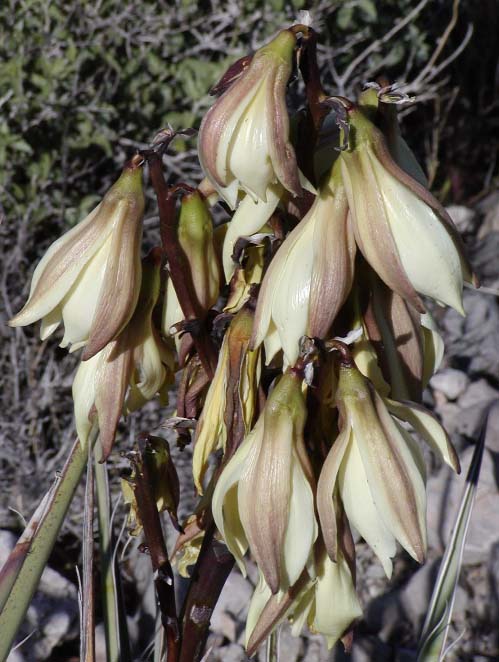
Yucca with banana-shaped fruit
| Sarcoyucca baccata | (Torr.) Linding. | Yucca baccata f. genuina | Engelm.
Yucca baccata (datil yucca or banana yucca, also known as Spanish bayonet and broadleaf yucca) is a common species of yucca native to the deserts of the southwestern United States and northwestern Mexico, from southeastern California north to Utah, east to western Texas and south to Sonora and Chihuahua. It is also reported in the wild in Colombia.
The species gets its common name "banana yucca" from its banana-shaped fruit. The specific epithet baccata means 'with berries'. Banana yucca is closely related to the Yucca schidigera, the Mojave yucca, with which it is interspersed where their ranges overlap; hybrids between them occur.
Description
Yucca baccata is recognized by having leaves 50-76 cm long with a blue-green color, and short or nonexistent trunks. It flowers in the spring, starting in April to July depending on locality (altitude), and the flowers range from 5 to 13 cm long, in six segments, white to cream-coloured with purple shades. The flower stalk is not especially tall, typically 1–1.5 m. The seeds are rough, black, wingless, 3–8 mm long and wide, 1–2 mm thick; they ripen in 6–8 weeks. The indehiscent fleshy fruit is 8–18 cm long and 6 cm across, cylindrical, and tastes similar to sweet potato.
Subspecies
Yucca baccata has been divided into three varieties:
- Yucca baccata var. baccata
- Yucca baccata var. brevifolia (Schott ex Torr.) L. Benson & Darrow
- Yucca baccata var. vespertina (McKelvey) Hochstätter
As of 2023 the status of these subspecies is uncertain. In Plants of the World Online (POWO) and World Flora Online only Yucca baccata var. brevifolia and the autonym are listed as accepted.
Several botanical synonyms are listed by POWO for each of the species recognized there. Yucca baccata var. baccata: | Yucca baccata f. fragilifolia | (Baker) Voss | Yucca baccata var. hystrix | Baker | Yucca baccata subsp. vespertina | (McKelvey) Hochstätter | Yucca baccata var. vespertina | McKelvey | Yucca filifera | Engelm. | Yucca fragilifolia | Baker | Yucca hanburyi | Baker | Yucca scabrifolia | Baker | Yucca vespertina | (McKelvey) S.L.Welsh
Yucca baccata var. brevifolia: | Yucca arizonica | McKelvey | Yucca baccata subsp. thornberi | (McKelvey) Hochstätter | Yucca brevifolia | Schott ex Trel. | Yucca confinis | McKelvey | Yucca thornberi | McKelvey | Yucca treleasei | J.F.Macbr.
Distribution and habitat
The plant is known from the Great Basin, the Mojave, Sonoran, and Chihuahuan Deserts, plus the Arizona/New Mexico Mountains ecoregion and lower, southern parts of the Rocky Mountains. It occurs primarily in the US states of Utah, California, Nevada, Arizona, Colorado, New Mexico, and Texas, and the Mexican state of Chihuahua. It can be found in several habitat types including Pinyon-Juniper, desert grassland, Creosote bush scrub, sagebrush, and ponderosa pine colonies at elevations generally between 1,500 and 2,500 m.
It is associated with Yucca schidigera, Yucca brevifolia, Yucca arizonica, Yucca faxoniana, Agave utahensis, and other Agave species. It can be found among Sclerocactus, Pediocactus, Navajoa, and Toumeya species.
The plant occurs in a large area of the North American deserts and exhibits much variation across its range. Yucca baccata specimens from the higher, mountainous regions of the Rocky Mountains is winterhardy and tolerates extreme conditions.
Ecology
It is a larval host to the ursine giant skipper, yucca giant skipper, and various yucca moths, including Tegeticula baccatella. After feeding, the skippers pupate in the yucca's roots.
Uses
The young flower stalks can be cooked and eaten, with the tough outer rind discarded. The fruit can be eaten raw or cooked, in the latter case resembling sweet potato.
The Paiutes dried the fruits for use during the winter. It is still a popular food amongst Mexican Indians. The flowers are often eaten by rural residents.
Ancestral Puebloan peoples used the fibers derived from the leaves to create sandals and cordage, and the root was used as soap, although with less frequency than that of Yucca elata.
References
References
- Hodgson, W.. (2020). "''Yucca baccata''".
- "Plant Name Details for ''Yucca baccata''". [[International Plant Names Index.
- (2009). "Edible Wild Plants: A North American Field Guide to Over 200 Natural Foods". [[Sterling Publishing.
- (2016-06-22). "Broadleaf Yucca {{!}} Colorado's Wildflowers".
- [http://apps.kew.org/wcsp/namedetail.do?name_id=291585 Kew World Checklist of Selected Plant Families]
- Spellenberg, Richard. (2001). "National Audubon Society Field Guide to North American Wildflowers: Western Region". Knopf.
- Whitney, Stephen. (1985). "Western Forests (The Audubon Society Nature Guides)". Knopf.
- "''Yucca baccata'' Torr.".
- (2023). "''Yucca baccata'' Torr.".
- "''Yucca baccata'' var. ''baccata''".
- "''Yucca baccata'' var. ''brevifolia'' L.D.Benson & Darrow".
- "Species: Yucca baccata".
- The Xerces Society (2016), ''Gardening for Butterflies: How You Can Attract and Protect Beautiful, Beneficial Insects'', Timber Press.
- (Organization), Archaeology Southwest. (1999). "Archaeology Southwest magazine: a quarterly publication of Archaeology Southwest.". Archaeology Southwest.
This article was imported from Wikipedia and is available under the Creative Commons Attribution-ShareAlike 4.0 License. Content has been adapted to SurfDoc format. Original contributors can be found on the article history page.
Ask Mako anything about Yucca baccata — get instant answers, deeper analysis, and related topics.
Research with MakoFree with your Surf account
Create a free account to save articles, ask Mako questions, and organize your research.
Sign up freeThis content may have been generated or modified by AI. CloudSurf Software LLC is not responsible for the accuracy, completeness, or reliability of AI-generated content. Always verify important information from primary sources.
Report