From Surf Wiki (app.surf) — the open knowledge base
Yemeni cuisine
Culinary traditions of Yemen

Culinary traditions of Yemen
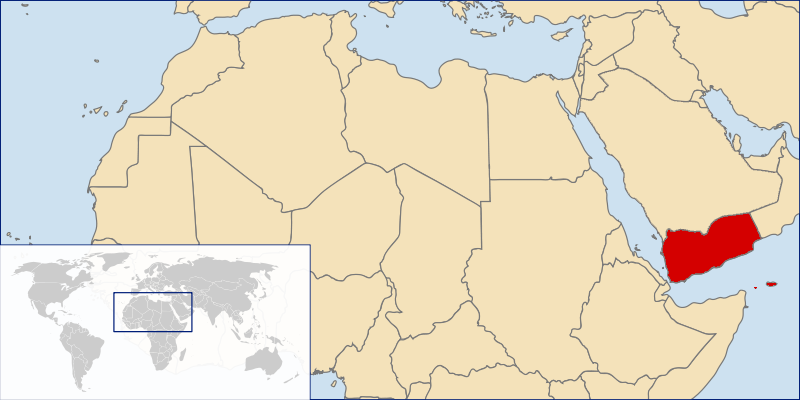
Yemeni cuisine is distinct from the wider Middle Eastern cuisines with regional variation. Despite being an Arab country, Yemeni cooking traditions have been influenced more by Indian and Indonesian methods as a result of its maritime history.
Customs
The generous offering of food to guests is one of the customs in Yemeni culture, and a guest not accepting the offering is considered an insult. Meals are typically consumed while sitting on the floor or ground. Unlike the tradition in most Arab countries, lunch is the main meal of the day in Yemen, not dinner.
Food preparation
In Yemen, many kitchens have a tandoor (also called tannur), which is a round clay oven.
Fruits and vegetables
Tomatoes, onions, and potatoes are some of the staple fruits and vegetables in Yemen.
Meat and dairy
Chicken, goat, and lamb are the staple meats in Yemen. They are eaten more often than beef. Fish is also eaten, especially in the coastal areas.
Cheese, butter, and other dairy products are less common in the Yemeni diet. Buttermilk, however, is enjoyed almost daily in some villages where it is most available. The most commonly used fats are vegetable oil and ghee used in savory dishes, while clarified butter, known as semn (سمن), is the choice of fat used in pastries.
Pork consumption is forbidden to Muslims in Yemen, in accordance with Islamic dietary laws.
The city of Taiz is famous for its production of smoked cheese, called "Taiz cheese".
Legumes
Broad beans are used in Yemeni dishes, such as bean salad. Lentils are also used in dishes such as stews.
Yemeni dishes
Breakfast dishes
Yemeni people prefer to have warm dishes in the morning. Typically, the meal consists of different types of pastries with a cup of Yemeni coffee or tea.
A more hearty meal often includes legumes, eggs, or even roasted meat or kebab, which is usually served with a type of bread either aside or as a sandwich. People in Yemen also make a breakfast dish from lamb or beef liver, which is considered a bizarre delicacy to non-Yemenis.
Dishes common at breakfast include masoub, fatoot, ful medames, mutabbaq, and shakshouka.
Lunch dishes
Unlike most countries, and like Spain and Portugal, lunch is the main meal of the day in Yemen, not dinner. The largest amount of meat, poultry, and grains are consumed at lunch.

Dishes common at lunch include:
- Aseed—a dish made from a cooked wheat-flour lump of dough, sometimes with added butter or honey
- Fahsa—a Yemeni stew made from lamb cutlets with lamb broth

- Fattah—a dish made with pieces of fresh, toasted, grilled, or stale flatbread covered with other ingredients
- Haneeth—a slow-roasted lamb dish cooked in a tannour with a spice rub, usually served on a plate of rice
- Harees—boiled, cracked, or coarsely ground wheat, mixed with meat and seasoned
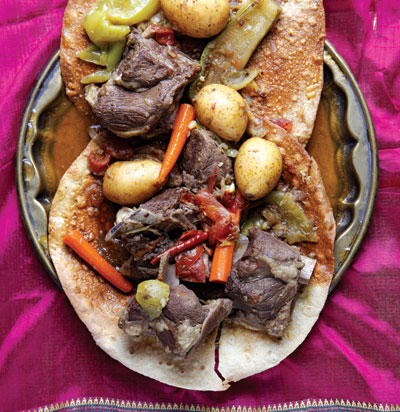
- Jachnun—a Adeni Jewish pastry, traditionally served on Shabbat morning
- Kabsa—a mixed rice dish, served on a communal platter
- Komroh—made with fava beans, garlic, ghee, black pepper, and salt
- Mandi—meat and rice with a special blend of spices, cooked in a pit underground
- Samak mofa—Yemeni-style grilled fish
- Shafut— typically made with lahoh (a sourdough flatbread) or shredded bread, hakeen (traditional buttermilk) or yogurt, zhug, and leek
- Shawiyah—Yemeni-style rotisserie chicken
- Thareed—pieces of bread in a vegetable or meat broth
- Sahawiq— a spicy green sauce made of fresh herbs, garlic, chilies, olive oil, lemon, and freshly ground spices.
- Zurbiyan— made with lamb, rice, and saffron
National dish
After Yemen united in 1990, both North and South Yemen had similar cuisines. Despite its regional variations, saltah is considered to be the national dish of Yemen. The most common dishes consumed all over Yemen are made with rice and lamb.
There are many ways of preparing lamb in Yemen. In general though, the lamb is usually bone-in large chunks. It can be boiled in its broth and called maraq, it can be roasted in an oven like haneeth, or underground like mandi.
Yemeni bread varieties
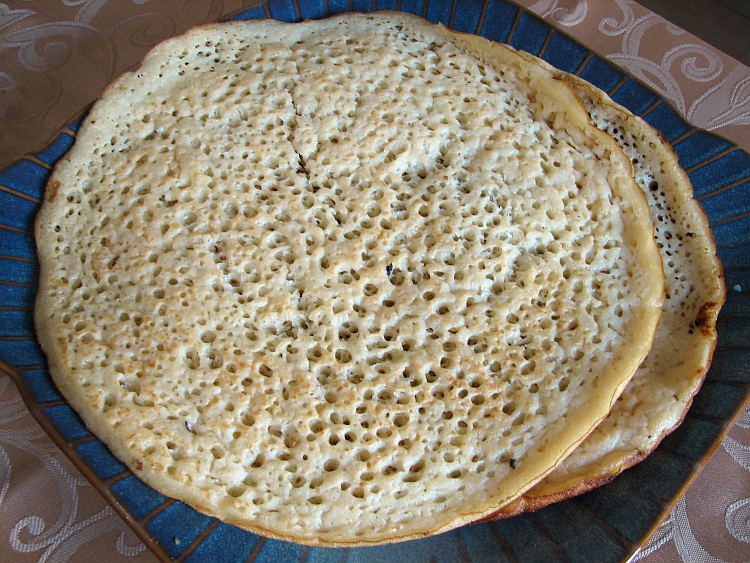
Breads are an integral part of Yemeni cuisine, most of which are prepared from local grains. Unleavened flatbreads are common. Ṣalūf, a flatbread made from wheat flour, is the most common of all breadstuffs. The dough is allowed to ferment with ḫamīra (yeast), while some would baste the surface of the dough with a prepared batch of unseasoned fenugreek (ḥilba) prior to baking. These were almost always baked at home in an earthenware oven called tannour (تنور) in Arabic, the size of each bread roughly being 2 in thickness with a diameter of 20 to 30.
Khobz al tawa, ar, malooga, kader, kubane, fateer, kudam, khameer, and mulawah are also popular breads eaten in Yemen. Malooj, khubz, and khamir are popular homemade breads. Store-bought pita bread and roti (bread rolls like French bread) are also common. Khaliat Naḥl (), or "honeycomb bread", is commonly associated with Yemeni cuisine.
Other Yemeni grain dishes
- ʻAṣīṭ—sorghum meal, cornmeal, or green barley meal made into a thick paste after being boiled in water. Before eating, samneh or oil is added. Some eat ʻaṣīṭ during the afternoon meal (usually scooped up with one's fingers), where soup and meat are served, while others place it in the soup, along with ḥilba ("fenugreek dollop").
- Harīš—a thick dish (groats), made with cracked wheat, – of the kernel's full size, known collectively as ğašūš. There are some who add samneh (clarified butter), honey or sugar to harīš. In Yemen, harīš is usually eaten on cold winter mornings, and, because of perceived health benefits, is given to women during the first weeks after childbirth, also to the infirm, the weak, and the frail. :Similarly, harīs is a thick grain dish (groats), made with broken wheat, rice, lentils or beans, pre-cooked in water with an added fatty portion of meat or bone marrow, along with vegetables—spring onions (scallions), garlic, tomatoes, and more.
- Maṭīṭ—a thin, farinaceous dish (porridge), made with ground wheat or barley (maṭīṭ šiʻīr), drunk with samneh, and occasionally with grated onions or sweet marjoram, which gives it a bitter taste.
- Našūf—a thin, grain-based dish (porridge), made with broken wheat, cooked with either samneh, sugar or honey, and sipped from a bowl, usually for breakfast. Villagers cook našūf with sour milk, adding sahawiq (a hot cayenne-pepper sauce) for added flavoring, a dish known locally as našūf ʻalā zūm.
Spices
A spice mixture known as hawaij is employed in many Yemeni dishes. Hawaij includes aniseed, fennel seeds, ginger, and cardamom.
Yemeni cuisine is often prepared hot and spicy with the use of chili peppers, cumin, coriander seeds, turmeric, and other spices. Herbs such as fenugreek, mint, and cilantro are also used. Fenugreek is used as one of the main ingredients in the preparation of a paste or sauce called holba (also spelled hulba). A popular spice used in breads (including kubane and sabayah) is black cumin, which is also known by its Arabic name habasoda (habbat as sowda).
Desserts and sweets
Bint al-sahn (sabayah) is a sweet honey cake or bread from Yemeni cuisine. It is prepared from a dough with white flour, eggs, and yeast, which is then served dipped in a honey and butter mixture. The tulumba of the city of Taiz are popular as a Ramadan sweet.
Other common desserts include fresh fruit (mangoes, bananas, grapes, etc.), baklawa, basbousa, kunafah, zalābiya, halwa, rawani, and masoob. Masoob is a banana-based dessert made from over-ripe bananas, ground flatbread, cream, cheese, dates, and honey.
Honey
In Yemen, honey is produced within the country, and is considered a delicacy. Locally produced honey is in high demand, and it is also considered as a status symbol in the country.
Beverages
Shahi haleeb (milk tea), black tea (with cardamom, clove, or mint), qishr (coffee husks), qahwa (Arabic coffee), karkade (an infusion of dried hibiscus flowers), naqe'e al zabib (cold raisin drink), and diba'a (squash nectar) are examples of popular Yemeni drinks. Mango and guava juices are also popular.
Although coffee and tea are consumed throughout Yemen, coffee is the preferred drink in Sana'a, whereas black tea is the beverage of choice in Aden and Hadhramaut. Tea is consumed along with breakfast, after lunch (occasionally with sweets and pastries), and along with dinner. Popular flavorings include cloves with cardamom and mint. A drink made from coffee husks, called qishr, is also enjoyed.
Alcoholic beverages are considered improper due to cultural and religious reasons.
References
References
- Alan Davidson and Tom Jaine, ''The Oxford Companion to Food'' (Oxford: Oxford University Press, 2014).
- (25 May 2018). "من الشفوت إلى بنت الصحن... أكلات يمنية في رمضان". The New Arab.
- (2022-09-16). "Spicy Skhug Sauce (Zhug, Shug or Zhoug)".
- Avshalom Mizrachi, ''The Yemenite Cuisine'', First published in ''Bat-Teman'' (Heb. "Daughter of Yemen"), edited by Shalom Seri, Tel-Aviv 1993, p. 96 (Hebrew)
- Qafih, Y.. (1982). "Halichot Teman (Jewish Life in Sanà)". [[Ben-Zvi Institute]].
- (21 May 2025). "New Peoria shop offers Yemeni coffee and culture". Peoria Journal Star.
- (17 January 2025). "Restaurant news: Ripple Ray's comes to Carytown while Roots to open in Chesterfield". Axios.
- Avshalom Mizrachi, "The Yemenite Cuisine", in: ''Ascending the Palm Tree – An Anthology of the Yemenite Jewish Heritage'', Rachel Yedid & Danny Bar-Maoz (ed.), E'ele BeTamar: Rehovot 2018, p. 135 {{OCLC. 1041776317
- Avshalom Mizrachi, ''The Yemenite Cuisine'', first published in ''Bat-Teman'' (Heb. "Daughter of Yemen"), edited by Shalom Seri, Tel-Aviv 1993, p. 98 (Hebrew)
- Avshalom Mizrachi, ''The Yemenite Cuisine'', first published in ''Bat-Teman'' (Heb. "Daughter of Yemen"), edited by Shalom Seri, Tel-Aviv 1993, p. 99 (Hebrew)
- Avshalom Mizrachi, ''The Yemenite Cuisine'', first published in ''Bat-Teman'' (Heb. "Daughter of Yemen"), edited by Shalom Seri, Tel-Aviv 1993, pp. 98–99 (Hebrew)
- (16 May 2020). "حلوى شعبية في تعز جعلت من صاحبها رمزاً رمضانياً". Al-Mushahid.
- (20 July 2020). "Revani (Ravani) cake recipe".
- Salloum, Habeeb. (2014). "Asian Cooking Made Simple: A Culinary Journey along the Silk Road and Beyond". Habeeb Salloum.
- (2009). "Yemen". Marshall Cavendish.
- Etheredge, Laura. (2011). "Saudi Arabia and Yemen". The Rosen Publishing Group.
This article was imported from Wikipedia and is available under the Creative Commons Attribution-ShareAlike 4.0 License. Content has been adapted to SurfDoc format. Original contributors can be found on the article history page.
Ask Mako anything about Yemeni cuisine — get instant answers, deeper analysis, and related topics.
Research with MakoFree with your Surf account
Create a free account to save articles, ask Mako questions, and organize your research.
Sign up freeThis content may have been generated or modified by AI. CloudSurf Software LLC is not responsible for the accuracy, completeness, or reliability of AI-generated content. Always verify important information from primary sources.
Report