From Surf Wiki (app.surf) — the open knowledge base
Yellow Sea
Sea in northeast Asia between China and Korea

Sea in northeast Asia between China and Korea
| Field | Value |
|---|---|
| name | Yellow Sea |
| pushpin_map | China |
| pushpin_map_alt | Location in China |
| location | East Asia |
| coords | |
| rivers | Yellow River, Hai River, Yalu River, Taedong River, Han River |
| basin_countries | China, North Korea, and South Korea |
| area | 380000 km2 |
| depth | Avg. 44 m |
| max-depth | Max. 152 m |
| max-depth = Max. 152 m
The Yellow Sea (; ), also known as the North Sea, is a marginal sea of the Western Pacific Ocean located between mainland China and the Korean Peninsula, and can be considered the northwestern part of the East China Sea.
Names
It is one of four seas named after color terms (the others being the Black Sea, the Red Sea and the White Sea), and its name is descriptive of the golden-yellow color of the silt-ridden water discharged from major rivers.
The innermost bay of northwestern Yellow Sea is called the Bohai Sea (previously Gulf of Zhili / Beizhili), into which flow some of the most important rivers of northern China, such as the Yellow River (through Shandong province and its capital Jinan), the Hai River (through Beijing and Tianjin) and the Liao River (through Liaoning province). The northeastern extension of the Yellow Sea is called the Korea Bay, into which flow the Yalu River, the Chongchon River and the Taedong River.
Geography
Extent
The International Hydrographic Organization defines the limits of the Yellow Sea ("Hwang Hai") as follows:
Physiography
The Yellow Sea, excluding the Bohai, extends by about 960 km from north to south and about 700 km from east to west; it has an area of approximately 380000 km2 and a volume of about 17000 km3. Its depth is only 44 m on average, with a maximum of 152 m. The sea is a flooded section of continental shelf that formed after the last glacial period (some 10,000 years ago) as sea levels rose 120 m to their current levels. The depth gradually increases from north to south. The sea annually receives so much sand and silt from rivers such as the Yellow River, that it turns into a golden-yellow colour.

The seas surrounding Korea, which occupy a corner of Northeast Asia, border the "island nation" from the east, south, and west. Korea has named these the East Sea, South Sea, and West Sea (officially known as the Yellow Sea), respectively.
Major islands of the sea include Anmado, Baengnyeongdo, Daebudo, Deokjeokdo, Gageodo, Ganghwado, Hauido, Heuksando, Hongdo, Jejudo, Jindo, Muuido, Sido, Silmido, Sindo, Wando, Yeongjongdo and Yeonpyeongdo (all in South Korea).
Climate and hydrology
The area has cold, dry winters with strong northernly monsoons blowing from late November to March. Average January temperatures are -10 C in the north and 3 C in the south. Summers are wet and warm with frequent typhoons between June and October. Air temperatures range between 10 and. The average annual precipitation increases from about 500 mm in the north to 1000 mm in the south. Fog is frequent along the coasts, especially in the upwelling cold-water areas.
The sea has a warm cyclone current, forming part of the Kuroshio Current, which diverges near the western part of Japan and flows northward into the Yellow Sea at a speed of less than 0.8 km/h. Southward currents prevail near the sea coast, especially in the winter monsoon period.
The water temperature is close to freezing in the northern part in winter, so drift ice patches and continuous ice fields form and hinder navigation between November and March. The water temperature and salinity are homogeneous across the depth. The southern waters are warmer at 6 -. In spring and summer, the upper layer is warmed up by the sun and diluted by the fresh water from rivers, while the deeper water remains cold and saline. This deep water stagnates and slowly moves south. Commercial bottom-dwelling fishes are found around this mass of water, especially at its southern part. Summer temperatures range between 22 and. The average salinity is relatively low, at 30‰ in the north to 33–34‰ in the south, dropping to 26‰ or lower near the river deltas. In the southwest monsoon season (June to August) the increased rainfall and runoff further reduce the salinity of the upper sea layer. Water transparency increases from about 10 m in the north up to 45 m in the south.
Tides are semidiurnal, i.e. rise twice a day. Their amplitude varies between about 0.9 and at the coast of China. Tides are higher at the Korean Peninsula, typically ranging between 4 and and reaching the maximum in spring. The tidal system rotates in a counterclockwise direction. The speed of the tidal current is generally less than 1.6 km/h in the middle of the sea, but may increase to more than 5.6 km/h near the coasts.
The tide-related sea level variations result in a land pass 2.9 km long and 10 - wide opening for approximately an hour between Jindo and Modo islands. The event occurs about twice a year, at the beginning of May and in the middle of June. It had long been celebrated in a local festival called "Jindo Sea Parting Festival", but was largely unknown to the outside world until 1975, when the French ambassador Pierre Randi described the phenomenon in a French newspaper.
Flora and fauna

The sea is rich in seaweed (predominantly kelp, Laminaria japonica), cephalopods, crustaceans, shellfish, clams, and especially in blue-green algae which bloom in summer and contribute to the water color (see image above). For example, the seaweed production in the area was as high as 1.5 million tonnes in 1979 for China alone. The abundance of all these plant and animal species increases toward the south and indicates a high sea productivity, accounting for the diversity of fish species and high fish yield from the sea. Several species of goby new to science have been discovered recently in the Yellow Sea.
The southern part of the Yellow Sea, including the entire west coast of Korea, contains a 10 km belt of intertidal mudflats, which has the total area of 2850 km2 and is maintained by 4 -. Those flats consist of highly productive sediments with a rich benthic fauna and are of great importance for migratory waders and shorebirds. Surveys show that the area is the single most important site for migratory birds on northward migration in the entire East Asian – Australasian Flyway, with more than 35 species occurring in internationally significant numbers. Two million birds, at minimum, pass through at the time, and about half that number use it on southward migration. About 300,000 migrating birds were transiting annually only through the Saemangeum tidal flat area. This estuary was however dammed by South Korea in 1991–2006 that resulted in drying off the land. Land reclamation also took 65% of the intertidal area (of China, North Korea and South Korea) between the 1950s and 2002,
Populations of oceanic megafauna, such as marine mammals, sea turtles, and larger fish, have decreased in modern times, not only due to pollution but also due to hunting. Japanese industrial whaling and illegal mass operations by the Soviet Union with support from Japan have been major drivers of population decline. Species that reside in the area today include spotted seals, and cetaceans such as minke whales, killer whales, false killer whales, and finless porpoises, but nonetheless all the remnants of species listed could be in very small numbers. Historically, large whales were abundant either for summering and wintering in the Yellow and Bohai Seas. For example, a unique population of resident fin whales and gray whales were historically presented, or possibly hosted some North Pacific right whales and Humpback whales (3 whales including a cow calf pair was observed at Changhai County in 2015) year-round other than migrating individuals, and many other migratory species such as Baird's beaked whales. Even blue whales, Japanese sea lions, dugongs (in southern regions only), and leatherback turtles used to breed or migrate into Yellow and Bohai seas.
Spotted seals are the only resident species of seal in the Yellow Sea. A sanctuary for these seals is situated at Baengnyeongdo, which is also known for its finless porpoises. Great white sharks have also been known to prey on seals in the area.
Economy
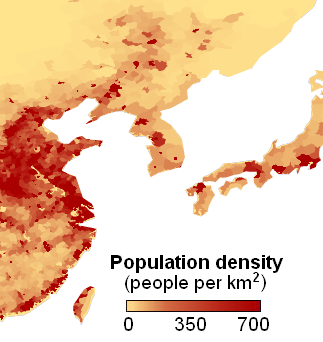
The coasts of the Yellow Sea are very densely populated, at approximately 250 PD/km2. and jellyfish. The intensity of fishing has been gradually increasing for China and Korea and decreasing for Japan. For example, the production volumes for China rose from 619,000 tonnes in 1985 to 1,984,400 tonnes in 1996. All species are overfished, however, and while the total catchments are rising, the fish population is continuously declining for most species.
Navigation is another traditional activity in the Yellow Sea. The main Chinese ports are Dalian, Tianjin, Yantai, Qingdao, Tangshan and Qinhuangdao. The major South Korean ports on the Yellow Sea are Incheon, Gunsan and Mokpo, and that for North Korea is Nampho, the outport of Pyongyang. The Bohai Train Ferry provides a shortcut between the Liaodong Peninsula and Shandong.
Oil exploration has been successful in the Chinese and North Korean portions of the sea, with the proven and estimated reserves of about 9 and 20 billion tonnes, respectively. However, the study and exploration of the sea is somewhat hindered by insufficient sharing of information between the involved countries. China initiated collaborations with foreign oil companies in 1979, but this initiative declined later.
A major oil spill occurred on 16 July 2010 when a pipeline exploded at the north-east port of Dalian, causing a wide-scale fire and spreading about 1,500 tonnes of oil over the sea area of 430 km2. The port had been closed and fishing suspended until the end of August. Eight hundred fishing boats and 40 specialized vessels were mobilized to relieve the environmental damage.
State of the environment
The Yellow Sea is considered among the most degraded marine areas on earth. Loss of natural coastal habitats due to land reclamation has resulted in the destruction of more than 60% of tidal wetlands around the Yellow Sea coastline in approximately 50 years. Rapid coastal development for agriculture, aquaculture and industrial development are considered the primary drivers of coastal destruction in the region.
In addition to land reclamation, the Yellow Sea ecosystem is facing several other serious environmental problems. Pollution is widespread and deterioration of pelagic and benthic habitat quality has occurred, and harmful algal blooms frequently occur. Invasion of introduced species are having a detrimental effect on the Yellow Sea environment. There are 25 intentionally introduced species and 9 unintentionally introduced species in the Yellow Sea Large Marine Ecosystem. Declines of biodiversity, fisheries and ecosystem services in the Yellow Sea are widespread.
The tidal flats of the Yellow Sea are considered endangered.
Location of Korean Peace Zones
On 1 November 2018, officials from South Korea's Ministry of National Defense confirmed that "peace zones" had been established by the North and South Korean militaries in the Yellow Sea area that touches the North and South Korean demarcation line. A buffer zone was also created in the Yellow Sea's Northern Limit Line (NLL).
References
Bibliography
- Chikuni, S. (1985). The Fish Resources of the Northwest Pacific, Food and Agriculture Organization,
- From the Arctic Ocean to the Yellow Sea (1892). The narrative of a journey, in 1890 and 1891, across Siberia, Mongolia, the Gobi desert, and north China. Julius M. Price (1857-1924). New York: Charles Scribner's Sons.
References
- (1953). "Limits of Oceans and Seas". International Hydrographic Organization.
- link. (30 June 2010 , NASA, 2002)
- [http://bse.sci-lib.com/article039304.html Yellow Sea], [[Great Soviet Encyclopedia]] (in Russian)
- The sea bottom and shores are dominated by sand and silt brought by the rivers through the Bohai Sea ([[Liao River]], [[Yellow River]], [[Hai He]]) and the Korea Bay ([[Yalu River]]). These deposits, together with sand storms are responsible for the yellowish colour of the water referenced in the sea's name.[http://www.britannica.com/EBchecked/topic/652686/Yellow-Sea Yellow Sea], Encyclopædia Britannica on-line
- "A yellow sea". WWF.
- (2016). "Origin of the Yellow Sea: an insight". Science Bulletin.
- "The Seas of Korea".
- [http://earthobservatory.nasa.gov/IOTD/view.php?id=8477 Sand storm over Yellow Sea], nasa.gov
- The fastest tides reaching {{convert. 20. km/h. 0-7277-3091-6 pp. 175, 177
- [http://www.impactlab.net/2010/07/17/the-moses-miracle-of-jindo-island/ The Moses Miracle Of Jindo Island] {{Webarchive. link. (27 November 2020 , 17 July 2010)
- [http://vestnik.tripod.com/articles/korea-festivals.html Майские фестивали в Чолладо – от "чуда Моисея" до боя быков] {{webarchive. link. (31 July 2009 (in Russian))
- link. (3 March 2012 , Jindo County)
- [https://alaska.usgs.gov/science/biology/shorebirds/barg_updates.html Bar-tailed Godwit Updates] {{webarchive. link. (20 February 2013 , USGS)
- Chikuni, pp. 8, 16, 19
- esa. "Earth from Space: The Yellow Sea of China".
- 1-4020-1903-3 p. 60
- Barter, M.A. (2002). ''Shorebirds of the Yellow Sea – importance, threats and conservation status''. Wetlands International Global Series Vol. 9. International Wader Studies Vol. 12. Canberra {{ISBN. 90-5882-009-2
- Barter, M.A. (2005). ''Yellow Sea – driven priorities for Australian shorebird researchers''. pp. 158–160 in: "Status and Conservation of Shorebirds in the East Asian – Australasian Flyway". Proceedings of the Australasian Shorebird Conference, 13–15 December 2003, Canberra, Australia. International Wader Studies 17. Sydney.
- [http://www.birdskorea.org/Habitats/Wetlands/Saemangeum/BK-HA-Saemangeum-Mainpage.shtml Saemangeum and the Saemangeum Shorebird Monitoring Program (SSMP) 2006–2008], Birds Korea
- 0-643-09089-4 p. 172
- Weller, D.. (2023). "The western gray whale: a review of past exploitation, current status and potential threats". J. Cetacean Res. Manage.
- (2008). "The Truth About Soviet Whaling: A Memoir". DigitalCommons@University of Nebraska - Lincoln.
- "Distribution of Whales and Dolphins in Korean Waters Based on a Sighting Survey from 2000 to 2010".
- "A Gray Area: On the Matter of Gray Whales in the Western North Pacific (PDF Download Available)".
- Mizroach A.S.. Rice W.D.. Zwiefelhoffer D.. Waite J.. Perryman L.W.. 2009. [http://onlinelibrary.wiley.com/doi/10.1111/j.1365-2907.2009.00147.x/abstract Distribution and movements of fin whales in the North Pacific Ocean]. on The Wiley Online Library. Retrieved on 3 January. 2015
- "我国沿海鲸类(–)– – 须鲸篇(下)_科学公园_传送门".
- Monsarrat Sophie. (2016). "A spatially explicit estimate of the prewhaling abundance of the endangered North Atlantic right whale". Conservation Biology.
- "长海又现鲸鱼 这回是好几条".
- [http://www.wedalian.com/wxarticle-show-id-180141.html 大连长海又见鲸鱼 – 家亲!三条!四条] {{webarchive. link. (2 June 2016)
- Huogen W.. (1998). "A Baird's Beaked Whale From the East China Sea". Fisheries Science, 1998-05.
- "Yellow Sea | WWF".
- Mr.Z. Charlie. 2008. [https://archive.today/20150103130634/http://wenwen.sogou.com/z/q103329192.htm?ch=from.t.qq 我国的渤海里有没有鲸鱼] on [[Sogou]] – Wenwen. Retrieved on 3 January. 2015
- "백령도 어부들의 친구 쇠돌고래".
- (19 August 2009). "백상아리, 백령도서 물범 공격장면 국내 첫 포착 – 민중의소리".
- link. (22 July 2010 , NASA, 1994)
- The sea waters had been used for fishing by the Chinese, Korean and Japanese ships for centuries. The bottom layers are especially rich in fish with about 200 fish species exploited commercially, especially [[Sparidae. sea bream]], [[Sciaenidae. croaker]]s, [[Synodontidae. lizard fishes]], [[prawn]]s, [[cutlassfish]], [[Japanese horse mackerel. horse mackerel]], squid, [[eel]], [[filefish]], [[Pacific herring]], [[chub mackerel]], [[flounder]]Chikuni, p. 25
- AFP, Agence France-Presse. (22 November 2016). "China's jellyfish-hauling mules a dying breed".
- [http://www.lib.noaa.gov/retiredsites/china/fishing.htm Fishing Industry] {{webarchive. link. (27 May 2010 , noaa.gov)
- [http://newsru.com/finance/03may2007/bohajvan.html China found new large oil field in the Yellow Sea], News.ru, 3 May 2007 (in Russian)
- [https://www.theguardian.com/environment/2010/jul/21/china-oil-spill-disaster-wildlife China's worst-ever oil spill threatens wildlife as volunteers assist in clean-up], Guardian, 21 July 2010
- UNDP/GEF. (2007) The Yellow Sea: Analysis of Environmental Status and Trends. p. 408, Ansan, Republic of Korea.
- (2014). "Tracking the rapid loss of tidal wetlands in the Yellow Sea". Frontiers in Ecology and the Environment.
- Liang Bin. (2019). "Report on Marine Environmental Status and Trends of the Yellow Sea".
- "China's largest algal bloom turns the Yellow Sea green". The Guardian.
- (November 2018). "Koreas halt all 'hostile' military acts near border".
This article was imported from Wikipedia and is available under the Creative Commons Attribution-ShareAlike 4.0 License. Content has been adapted to SurfDoc format. Original contributors can be found on the article history page.
Ask Mako anything about Yellow Sea — get instant answers, deeper analysis, and related topics.
Research with MakoFree with your Surf account
Create a free account to save articles, ask Mako questions, and organize your research.
Sign up freeThis content may have been generated or modified by AI. CloudSurf Software LLC is not responsible for the accuracy, completeness, or reliability of AI-generated content. Always verify important information from primary sources.
Report