From Surf Wiki (app.surf) — the open knowledge base
Yamnaya culture
Archaeological culture in the Pontic steppe circa 3300 BCE)

Archaeological culture in the Pontic steppe circa 3300 BCE)
| Field | Value | |
|---|---|---|
| name | Yamnaya culture | |
| map | Yamnaya culture.jpg | |
| altnames | {{Plainlist | |
| region | Pontic–Caspian steppe in Europe | |
| period | Copper Age, Bronze Age | |
| dates | –2600 BC | |
| precededby | Sredny Stog culture, Samara culture, Khvalynsk culture, Dnieper–Donets culture, Repin culture, Maykop culture, Cucuteni–Trypillia culture, Cernavodă culture, Usatove culture, Novosvobodnaya culture, Mykhailivka culture (3600–3000 BCE) | |
| followedby | {{plainlist | |
| definedby | Vasily Gorodtsov |
- Pit Grave culture
- Yamna culture
- Ochre Grave culture
- Yamnaya Horizon
- North: Corded Ware culture
- West: Catacomb culture, Vučedol culture
- East: Poltavka culture}}
The Yamnaya ( ) or Yamna culture ( ), also known as the Pit Grave culture or Ochre Grave culture, is a late Copper Age to early Bronze Age archaeological culture of the region between the Southern Bug, Dniester, and Ural rivers (the Pontic–Caspian steppe), dating to 3300–2600 BC. It was discovered by Vasily Gorodtsov following his archaeological excavations near the Donets River in 1901–1903. Its name derives from its characteristic burial tradition: ru (я́мная) is a Russian adjective that means (), as these people buried their dead in tumuli (kurgans) containing simple pit chambers. Research in recent years has found that Mykhailivka, on the lower Dnieper River, Ukraine, formed the core Yamnaya culture (c. 3600–3400 BC).
The Yamnaya culture is of particular interest to archaeologists and linguists, as the widely accepted Kurgan hypothesis posits that the people who produced the Yamnaya culture spoke a stage of the Proto-Indo-European language. The speakers of the Proto-Indo-European (PIE) language embarked on the Indo-European migrations that gave rise to the widely dispersed Indo-European languages of today.
The Yamnaya economy was based upon animal husbandry, fishing, and foraging, and the manufacture of ceramics, tools, and weapons. The people of the Yamnaya culture were nomads or semi-nomads, organized in a chiefdom system, and relied on horse riding to manage large herds as well as wheeled carts and wagons for long-distance travel. They are also closely connected to Final Neolithic cultures, which later spread throughout Europe and Central Asia, especially the Corded Ware people and the Bell Beaker culture, as well as the peoples of the Sintashta, Andronovo, and Srubnaya cultures. Back migration from Corded Ware also contributed to Sintashta and Andronovo. In these groups, several aspects of the Yamnaya culture are present.Yamnayan cultural aspects, for example, were horse-riding, burial styles, and to some extent the pastoralist economy. Yamnaya material culture was very similar to the Afanasievo culture of South Siberia, and the populations of the two cultures are genetically indistinguishable. This suggests that the Afanasievo culture may have originated from the migration of Yamnaya groups to the Altai region or, alternatively, that both cultures developed from an earlier shared cultural source.
Genetic studies have suggested that the people of the Yamnaya culture can be modelled as a genetic admixture between a population related to Eastern European Hunter-Gatherers (EHG)The Eastern European hunter-gatherers were themselves mostly descended from ancient North Eurasians, related to the palaeolithic Mal'ta–Buret' culture. and people related to hunter-gatherers from the Caucasus (CHG) in roughly equal proportions, an ancestral component which is often named "Steppe ancestry", with additional admixture from Anatolian, Levantine, or Early European farmers. Genetic studies also indicate that populations associated with the Corded Ware, Bell Beaker, Sintashta, and Andronovo cultures derived large parts of their ancestry from the Yamnaya or a closely related population. Recent genetic analyses indicate that the Anatolian component in the Yamnaya comes via the Caucasus Neolithic population and not Anatolia-derived European farmers.
Origins
The Yamnaya culture was defined by Vasily Gorodtsov in order to differentiate it from the Catacomb and Srubnaya cultures that existed in the area, but were considered to be of a later period. Due to the time interval to the Yamnaya culture, and the reliance on archaeological findings, debate as to its origin is ongoing. In 1996, Pavel Dolukhanov suggested that the emergence of the Pit-Grave culture represents a social development of various different local Bronze Age cultures, thus representing "an expression of social stratification and the emergence of chiefdom-type nomadic social structures" which in turn intensified inter-group contacts between essentially heterogeneous social groups.
The origin of the Yamnaya culture continues to be debated, with proposals for its origins pointing to both the Khvalynsk and Sredny Stog cultures. The Khvalynsk culture (4700–3800 BC) (middle Volga) and the Don-based Repin culture (–3300 BC) in the eastern Pontic-Caspian steppe, and the closely related Sredny Stog culture (–3500 BC) in the western Pontic-Caspian steppe, preceded the Yamnaya culture (3300–2500 BC).

Further efforts to pinpoint the location came from Anthony (2007), who suggested that the Yamnaya culture (3300–2600 BC) originated in the Don–Volga area at , preceded by the middle Volga-based Khvalynsk culture and the Don-based Repin culture (–3300 BC), arguing that late pottery from these two cultures can barely be distinguished from early Yamnaya pottery. Earlier continuity from eneolithic but largely hunter-gatherer Samara culture and influences from the more agricultural Dnieper–Donets II are apparent.
He argues that the early Yamnaya horizon spread quickly across the Pontic–Caspian steppes between and 3200 BC:
The spread of the Yamnaya horizon was the material expression of the spread of late Proto-Indo-European across the Pontic–Caspian steppes.
[...] The Yamnaya horizon is the visible archaeological expression of a social adjustment to high mobility – the invention of the political infrastructure to manage larger herds from mobile homes based in the steppes.}}
Alternatively, Parpola (2015) relates both the Corded ware culture and the Yamnaya culture to the late Trypillia (Tripolye) culture. He hypothesizes that "the Tripolye culture was taken over by PIE speakers by c. 4000 BC", and that in its final phase the Trypillian culture expanded to the steppes, morphing into various regional cultures which fused with the late Sredny Stog (Serednii Stih) pastoralist cultures, which, he suggests, gave rise to the Yamnaya culture. Dmytro Telegin viewed Sredny Stog and Yamnaya as one cultural continuum and considered Sredny Stog to be the genetic foundation of the Yamna. Telegin's view has been recently confirmed by genetic analyses.
The Yamnaya culture was succeeded in its western range by the Catacomb culture (2800–2200 BC); in the east, by the Poltavka culture (2700–2100 BC) at the middle Volga. These two cultures were followed by the Srubnaya culture (18th–12th century BC).
File:Sredny Stog culture.jpg|Sredny Stog culture (c. 4500–3500 BC) File:Usatovo culture.jpg|Usatovo culture (c. 3500–3000 BC) File:Khvalynsk culture.jpg|Khvalynsk culture (c. 4900–3500 BC) File:Early Yamna.jpg|Early Yamnaya culture (3400 BC), according to File:Lower Mikhaylovka culture.jpg|Mykhailivka culture (c. 3600–3400 BC)
Characteristics
The Yamnaya culture was nomadic or semi-nomadic, with some agriculture practiced near rivers, and a few fortified sites, the largest of which is Mikhaylivka.
Characteristic of the culture are the burials in pit graves surmounted by kurgans (tumuli), often accompanied by animal offerings. Some graves contain large anthropomorphic stelae, with carved human heads, arms, hands, belts, and weapons. The bodies were placed in a supine position with bent knees and covered in ochre. Some kurgans contained "stratified sequences of graves". Kurgan burials may have been rare, and were perhaps reserved for special adults, who were predominantly male. Status and gender are marked by grave goods and position, and in some areas, elite individuals are buried with complete wooden wagons. Grave goods are more common in eastern Yamnaya burials, which are also characterized by a higher proportion of male burials and more male-centred rituals than western areas.
The Yamnaya culture had and used two-wheeled carts and four-wheeled wagons, which are thought to have been oxen-drawn at this time, and there is evidence that they rode horses. For instance, several Yamnaya skeletons exhibit specific characteristics in their bone morphology that may have been caused by long-term horseriding. The evidence is disputed by archaeozoologist William T. Taylor, who argues that domestication of the horse long postdates the Yamnaya culture. Recent genetic studies indicate that horse domestication in Eurasia happened after c. 2700 BC.
Metallurgists and other craftsmen are given a special status in Yamnaya society, and metal objects are sometimes found in large quantities in elite graves. New metalworking technologies and weapon designs are used.
Stable isotope ratios of Yamnaya individuals from the Dnipro Valley suggest the Yamnaya diet was terrestrial protein based with insignificant contribution from freshwater or aquatic resources. Anthony speculates that the Yamnaya ate meat, milk, yogurt, cheese, and soups made from seeds and wild vegetables, and probably consumed mead.
Mallory and Adams suggest that Yamnaya society may have had a tripartite structure of three differentiated social classes, although the evidence available does not demonstrate the existence of specific classes such as priests, warriors, and farmers.
Gallery
File:KAM56.jpg|Daggers, arrowheads and bone artefacts File:Yamna03.jpg|Yamnaya decorative artifacts File:Керносовский идол.png|The Kernosivsky idol (late Yamnaya) File:Yamna 1.png|Western Yamnaya artefacts File:Yamnaya artefacts and burials from Taraclia, Moldova.png|Yamnaya burials from Moldova File:Yamnaya 1.png|Copper alloy artifacts at the Hermitage Museum File:Yamnaya culture silver and gold jewellery, Bulgaria.png|Silver and gold jewellery from Bulgaria File:Yamnaya pottery of the Azov-Black Sea steppes.png|Yamnaya pottery File:Yamna01.jpg|Corded ware vessel File:Yamna 2.png|Cis-Ural Yamnaya artefacts and burials File:Artefacts of the Yamna culture of the steppe Urals.png|Yamnaya artefacts from the steppe-Urals, early (1) and late (2) File:Yamnaya metal artefacts.png|Copper, gold and silver artefacts from western Ukraine
Archaeogenetics

According to Jones et al. (2015) and Haak et al. (2015), autosomal tests indicate that the Yamnaya people were the result of a genetic admixture between two different hunter-gatherer populations: distinctive "Eastern Hunter-Gatherers" (EHG), from Eastern Europe, with high affinity to the Mal'ta–Buret' culture or other, closely related people from Siberia and a population of "Caucasus hunter-gatherers" (CHG) who probably arrived from the Caucasus or Iran. Each of those two populations contributed about half the Yamnaya DNA. This admixture is referred to in archaeogenetics as Western Steppe Herder (WSH) ancestry.

Admixture between EHGs and CHGs is believed to have occurred on the eastern Pontic-Caspian steppe starting around 5,000 BC, while admixture with Early European Farmers (EEF) happened in the southern parts of the Pontic-Caspian steppe sometime later. More recent genetic studies have found that the Yamnaya were a mixture of EHGs, CHGs, and to a lesser degree Anatolian farmers and Levantine farmers, but not EEFs from Europe due to lack of WHG DNA in the Yamnaya. This occurred in two distinct admixture events from West Asia into the Pontic-Caspian steppe.

Haplogroup R1b, specifically the Z2103 subclade of R1b-L23, is the most common Y-DNA haplogroup found among the Yamnaya specimens. This haplogroup is rare in Western Europe and mainly exists in Southeastern Europe today. Additionally, a minority are found to belong to haplogroup J2 and I2. They are found to belong to a wider variety of West Eurasian mtDNA haplogroups, including U, T, and haplogroups associated with Caucasus hunter-gatherers and Early European Farmers. A small but significant number of Yamnaya kurgan specimens from Northern Ukraine carried the East Asian mtDNA haplogroup C4.
People of the Yamnaya culture are believed to have had mostly brown eye colour, light to intermediate skin, and brown hair colour, with some variation.
Some Yamnaya individuals are believed to have carried a mutation to the KITLG gene associated with blond hair, as several individuals with Steppe ancestry are later found to carry this mutation. The Ancient North Eurasian Afontova Gora group, who contributed significant ancestry to Western Steppe Herders, are believed to be the source of this mutation. A study in 2015 found that Yamnaya had the highest ever calculated genetic selection for height of any of the ancient populations tested. It has been hypothesized that an allele associated with lactase persistence (conferring lactose tolerance into adulthood) was brought to Europe from the steppe by Yamnaya-related migrations.

A 2022 study by Lazaridis et al. found that the typical phenotype among the Yamnaya population was brown eyes, brown hair, and intermediate skin colour. None of their Yamnaya samples were predicted to have either blue eyes or blond hair, in contrast with later Steppe groups in Russia and Central Asia, as well as the Bell Beaker culture in Europe, who did carry these phenotypes in significant proportions.
The geneticist David Reich has argued that the genetic data supports the likelihood that the people of the Yamnaya culture were a "single, genetically coherent group" who were responsible for spreading many Indo-European languages. Reich's group recently suggested that the source of Anatolian and Indo-European subfamilies of the Proto-Indo-European (PIE) language may have been in west Asia and the Yamnaya were responsible for the dissemination of the latter. Reich also argues that the genetic evidence shows that Yamnaya society was an oligarchy dominated by a small number of elite males. Recent (2024 and 2025) publications confirmed the tight clustering of most of Yamnaya genetic profiles, but shifted the origins of PIE towards the Caucasus-Lower Volga (CLV) region.
The genetic evidence for the extent of the role of the Yamnaya culture in the spread of Indo-European languages has been questioned by Russian archaeologist Leo Klejn and Balanovsky et al., who note a lack of male haplogroup continuity between the people of the Yamnaya culture and the contemporary populations of Europe. Klejn has also suggested that the autosomal evidence does not support a Yamnaya migration, arguing that Western Steppe Herder ancestry in both contemporary and Bronze Age samples is lowest around the Danube in Hungary, near the western limits of the Yamnaya culture, and highest in Northern Europe, which Klejn argues is the opposite of what would be expected if the geneticists' hypothesis is correct.
Language
Marija Gimbutas identified the Yamnaya culture with the late Proto-Indo-Europeans (PIE) in her Kurgan hypothesis. In the view of David Anthony, the Pontic-Caspian steppe is the strongest candidate for the Urheimat (original homeland) of the Proto-Indo-European language, citing evidence from linguistics and genetics which suggests that the Yamnaya culture may be the homeland of the Indo-European languages, with the possible exception of the Anatolian languages. On the other hand, Colin Renfrew has argued for a Near Eastern origin of the earliest Indo-European speakers.
According to David W. Anthony, the genetic evidence suggests that the leading clans of the Yamnaya were of EHG (Eastern European hunter-gatherer) and WHG (Western European hunter-gatherer) paternal origin and implies that the Indo-European languages were the result of "a dominant language spoken by EHGs that absorbed Caucasus-like elements in phonology, morphology, and lexicon." It has also been suggested that the PIE language evolved through trade interactions in the circum-Pontic area in the 4th millennium BC, mediated by the Yamnaya predecessors in the North Pontic steppe.
Guus Kroonen et al. 2022 found that the "basal Indo-European stage", also known as Indo-Anatolian or Pre-Proto-Indo-European language, largely but not totally, lacked agricultural-related vocabulary, and only the later "core Indo-European languages" saw an increase in agriculture-associated words. According to them, this fits a homeland of early core Indo-European within the westernmost Yamnaya horizon, around and west of the Dnieper, while its basal stage, Indo-Anatolian, may have originated in the Sredny Stog culture, as opposed to the eastern Yamnaya horizon. The Corded Ware culture may have acted as major source for the spread of later Indo-European languages, including Indo-Iranian, while Tocharian languages may have been mediated via the Catacomb culture. They also argue that this new data contradicts a possible earlier origin of Pre-Proto-Indo-European among agricultural societies South of the Caucasus, rather "this may support a scenario of linguistic continuity of local non-mobile herders in the Lower Dnieper region and their genetic persistence after their integration into the successive and expansive Yamnaya horizon". Furthermore, the authors mention that this scenario can explain the difference in paternal haplogroup frequency between the Yamnaya and Corded Ware cultures, while both sharing similar autosomal DNA ancestry.
Yamnaya-related migrations

Western Europe
Genetic studies have found that Yamnaya autosomal characteristics are very close to the Corded Ware culture people, with up to 75% Yamnaya-like ancestry in the DNA of Corded Ware skeletons from Central and Eastern Europe. Yamnaya–related ancestry is found in the DNA of modern Central, and Northern Europeans (c. 38.8–50.4%), and is also found in lower levels in present-day Southern Europeans (c. 18.5–32.6%), Sardinians (c. 2.4–7.1%), and Sicilians (c. 5.9–11.6%).
However, according to Heyd, et al. (2023), the specific paternal DNA haplogroup that is most commonly found in male Yamnaya specimens cannot be found in modern Western Europeans, or in males from the nearby Corded Ware culture. This makes it unlikely that the Corded Ware culture can be directly descended from the Yamnaya culture, at least along the paternal line.
Autosomal tests also indicate that the Yamnaya are the vector for "Ancient North Eurasian" admixture into Europe. "Ancient North Eurasian" is the name given in literature to a genetic component that represents descent from the people of the Mal'ta–Buret' culture or a population closely related to them. That genetic component is visible in tests of the Yamnaya people as well as modern-day Europeans.
Eastern Europe and Finland
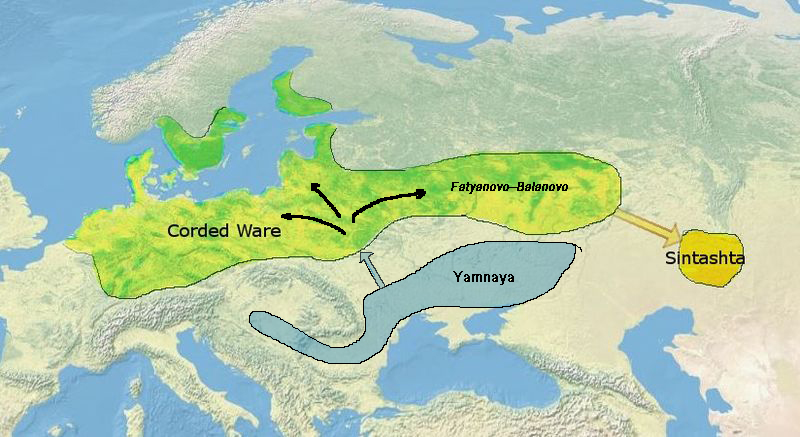
In the Baltic, Jones et al. (2017) found that the Neolithic transition – the passage from a hunter-gatherer economy to a farming-based economy – coincided with the arrival en masse of individuals with Yamnaya-like ancestry. This is different from what happened in Western and Southern Europe, where the Neolithic transition was caused by a population that came from Anatolia, with Pontic steppe ancestry being detected from only the late Neolithic onward.
Per Haak et al. (2015), the Yamnaya contribution in the modern populations of Eastern Europe ranges from 46.8% among Russians to 42.8% in Ukrainians. Finland has the highest Yamnaya contributions in all of Europe (50.4%).Per , adding a north-Siberian people as a fourth reference population improves residuals for northeastern European populations. This accounts for the higher than expected Yamnaya contribution and brings it down to expected levels (67.8–50.4 % in Finns, 64.9–46.8 % in Russians).
Central and South Asia
There is a significant presence of Yamnaya descent in the nations of South Asia, especially in groups that are referred to as Indo-Aryans. Lazaridis et al. (2016) estimated (6.5–50.2%) steppe-related admixture in South Asians, though the proportion of Steppe ancestry varies widely across ethnic groups. According to Pathak et al. (2018), the "North-Western Indian & Pakistani" populations (PNWI) showed significant Middle-Late Bronze Age Steppe (Steppe_MLBA) ancestry along with Yamnaya Early-Middle Bronze Age (Steppe_EMBA) ancestry, but the Indo-Europeans of Gangetic Plains and Dravidian people only showed significant Yamnaya (Steppe_EMBA) ancestry and no Steppe_MLBA. The study also noted that ancient south Asian samples had significantly higher Steppe_MLBA than Steppe_EMBA (or Yamnaya). According to Narasimhan et al. (2019), the Yamnaya-related ancestry, termed Western_Steppe_EMBA, that reached central and south Asia was not the initial expansion from the steppe to the east, but a secondary expansion that involved a group possessing c. 67% Western_Steppe_EMBA ancestry and c. 33% ancestry from the European cline. This group included people similar to that of Corded Ware, Srubnaya, Petrovka, and Sintashta. Moving further east in the central steppe, it acquired c. 9% ancestry from a group of people that possessed West Siberian Hunter Gatherer ancestry, thus forming the Central Steppe MLBA cluster, which is the primary source of steppe ancestry in South Asia, contributing up to 30% of the ancestry of the modern groups in the region.
According to Unterländer et al. (2017), all Iron Age Scythian Steppe nomads can best be described as a mixture of Yamnaya-related ancestry and an East Asian–related component, which most closely corresponds to the modern North Siberian Nganasan people of the lower Yenisey River, to varying degrees, but generally higher among Eastern Scythians.
Notes
References
Sources
References
- Reich, David. (24 April 2024). "The Transformation of Europe in the Third Millennium BC". International Conference, HUN-REN RCH Institute of Archaeology.
- (16 November 2015). "Europe's fourth ancestral 'tribe' uncovered". BBC.
- Gibbons, Ann. (10 June 2015). "Nomadic herders left a strong genetic mark on Europeans and Asians". AAAS.
- Telegin, D. Y.. (1973). "Serednʹo-stohivsʹka kulʹtura epokhy midi". Naukova Dumka.
- Anthony, David. "The Horse, the Wheel, and Language".
- P., Mallory, J.. (2003). "In search of the Indo-Europeans: language, archaeology, and myth". Thames and Hudson.
- Taylor, William T.. (December 2024). "When Horse became Steed". Scientific American.
- (July 2024). "Widespread horse-based mobility arose around 2200 bce in Eurasia". Nature.
- Gerling, Claudia. (1 July 2015). "Prehistoric Mobility and Diet in the West Eurasian Steppes 3500 to 300 BC: An Isotopic Approach". De Gruyter.
- (1997). "Encyclopedia of Indo-European culture". Fitzroy Dearborn.
- (2002). "Cudgel Culture".
- (3 July 2020). "Skin colour and vitamin D: An update". Experimental Dermatology.
- (30 May 2022). "The spatiotemporal patterns of major human admixture events during the European Holocene". eLife.
- (4 February 2019). "Ancient human genome-wide data from a 3000-year interval in the Caucasus corresponds with eco-geographic regions". Nature Communications.
- Eske, Allentoft. (2015). "Population genomics of Bronze Age Eurasia". University of Copenhagen, Denmark.
- (20 September 2018). "Maternal genetic features of the Iron Age Tagar population from Southern Siberia (1st millennium BC)". Public Library of Science (PLoS).
- Gibbons, A.. (24 July 2015). "Revolution in human evolution". Science.
- (September 2020). "Skin colour and vitamin D: An update". Experimental Dermatology.
- (March 2018). "The genomic history of southeastern Europe". Nature.
- Heyd, Volker. (April 2017). "Kossinna's smile". Antiquity.
- (24 December 2015). "Genome-wide patterns of selection in 230 ancient Eurasians". Nature.
- (2020). "Why and when was lactase persistence selected for? Insights from Central Asian herders and ancient DNA". PLOS Biology.
- "DNA data explosion lights up the Bronze Age". Nature.
- (2018). "Massive Migrations? The Impact of Recent DNA Studies on our View of Third Millennium Europe". European Journal of Archaeology.
- (2020). "Human Genetics: Lactase Persistence in a Battlefield". Current Biology.
- Reich, David. (2018). "[[Who we are and how we got here]]: ancient DNA and the new science of the human past".
- Reich, David. (2018). "Who we are and how we got here: ancient DNA and the new science of the human past".
- (2017). "The Steppe Hypothesis of Indo-European Origins Remains to be Proven". Acta Archaeologica.
- (2017). "Genetic differentiation between upland and lowland populations shapes the Y-chromosomal landscape of West Asia". Human Genetics.
- {{harvnb. Klejn. 2017
- Zimmer, Carl. (10 June 2015). "DNA Deciphers Roots of Modern Europeans". New York Times.
- (23 August 2019). "Tracing the Indo-Europeans". Oxbow Books.
- Olsen, Birgit A.. (11 May 2023). "Marriage Strategies and Fosterage among the Indo-Europeans: A Linguistic Perspective". Cambridge University Press.
- (2023). "Language Contact in Ancient Egypt". LIT Verlag Münster.
- (2024). "Cultural Evolution: Society, Technology, Language, and Religion". MIT Press.
- (28 November 2022). "Long-distance exchanges along the Black Sea coast in the Eneolithic and the steppe genetic ancestry problem". Cambridge Open Engage.
- (12 October 2022). "Indo-European cereal terminology suggests a Northwest Pontic homeland for the core Indo-European languages". PLOS ONE.
- (24 January 2023). "Genomic perspectives on human dispersals during the Holocene". Proceedings of the National Academy of Sciences.
- (11 May 2023). "The Indo-European Puzzle Revisited: Integrating Archaeology, Genetics, and Linguistics". Cambridge University Press.
This article was imported from Wikipedia and is available under the Creative Commons Attribution-ShareAlike 4.0 License. Content has been adapted to SurfDoc format. Original contributors can be found on the article history page.
Ask Mako anything about Yamnaya culture — get instant answers, deeper analysis, and related topics.
Research with MakoFree with your Surf account
Create a free account to save articles, ask Mako questions, and organize your research.
Sign up freeThis content may have been generated or modified by AI. CloudSurf Software LLC is not responsible for the accuracy, completeness, or reliability of AI-generated content. Always verify important information from primary sources.
Report