From Surf Wiki (app.surf) — the open knowledge base
Xiang Chinese
Primary branch of Chinese spoken in southern China
Primary branch of Chinese spoken in southern China
| Field | Value |
|---|---|
| name | Xiang |
| imagecaption | "Xiang language" written in Chinese characters |
| image | Xiangyu.png |
| imagescale | 0.7 |
| altname | Hunanese |
| nativename | 湘語/湘语 |
| states | China |
| region | Central and southwestern Hunan, northern Guangxi, parts of Guizhou, Guangdong, Sichuan, Jiangxi and Hubei provinces |
| ethnicity | Hunanese |
| speakers | million |
| date | 2021 |
| ref | e26 |
| familycolor | Sino-Tibetan |
| fam2 | Sinitic |
| fam3 | Chinese |
| dialect_label | Varieties |
| dia1 | Old Xiang (Lou–Shao) |
| dia2 | New Xiang (Chang–Yi) |
| dia3 | Chen–Xu Xiang (Ji–Xu) |
| dia4 | Hengzhou Xiang |
| dia5 | Yong–Quan Xiang |
| map | Xiang in China.png |
| iso3 | hsn |
| glotto | xian1251 |
| glottorefname | Xiang Chinese |
| lingua | 79-AAA-e |
| script | Chinese characters |
| pronunciation |
Xiang or Hsiang (Chinese: 湘; Changsha Xiang: , Mandarin: ), also known as Hunanese, is a group of linguistically similar and historically related Sinitic languages, spoken mainly in Hunan province but also in northern Guangxi and parts of neighboring Guizhou, Guangdong, Sichuan, Jiangxi and Hubei provinces. Scholars divided Xiang into five subgroups: Lou–Shao (Old Xiang), Chang–Yi (New Xiang), Chen–Xu or Ji–Xu, Hengzhou, and Yong–Quan. Among those, Lou–Shao, or Old Xiang, still exhibits the three-way distinction of Middle Chinese obstruents, preserving the voiced stops, fricatives, and affricates. Xiang has also been heavily influenced by Mandarin, which adjoins three of the four sides of the Xiang-speaking territory, and Gan in Jiangxi Province, from where a large population immigrated to Hunan during the Ming dynasty.
Xiang-speaking Hunanese people have played an important role in Modern Chinese history, especially in those reformatory and revolutionary movements such as the Self-Strengthening Movement, Hundred Days' Reform, Xinhai Revolution and Chinese Communist Revolution. Some examples of Xiang speakers are Mao Zedong, Zuo Zongtang, Huang Xing and Ma Ying-jeou.
Historical linguists such as W. South Coblin have been in doubt of a taxonomic grouping of Xiang. However, counterargument suggests that shared innovations can be identified for Xiang.
History
Prehistory
Prehistorically, the main inhabitants were the ancient country of Ba, Nanman, Baiyue and other tribes whose languages cannot be studied. During the Warring States period, large numbers of Chu migrated into Hunan. Their language blended with that of the original natives to produce a new dialect, Nanchu (Southern Chu). During Qin and Han dynasty, most part of today's Eastern Hunan belonged to Changsha Kingdom. According to Yang Xiong's Fangyan, people in this region spoke Southern Chu, which is considered the ancestor of Xiang Chinese today.
Middle ages and recent history
During the Tang dynasty, a large-scale emigration took place with people emigrating from the north to the south, bringing Middle Chinese into Hunan. Today's Xiang still keeps some Middle Chinese words, such as {{linktext|嬉}} (to have fun), {{linktext|薅}} (to weed), {{linktext|行}} (to walk). Entering tone vowels started weakening in Hunan at this time. Migrants who came from the North mainly settled in northern Hunan, followed by western Hunan. For this reason, northern and western Hunan are Mandarin districts.
Migrants from Jiangxi concentrated mainly in southeastern Hunan and present day Shaoyang and Xinhua districts. They came for two reasons: The first is that Jiangxi became too crowded, and its people sought expansion. The second is that Hunan suffered greatly during the Mongol conquest of the Song dynasty, when there was mass slaughter. The late Yuan dynasty peasant uprising caused a great many casualties in Hunan.
During the Ming dynasty, a large-scale emigration from Jiangxi to Hunan took place. In the early Ming dynasty, large numbers of migrants came from Jiangxi and settled in present day Yueyang, Changsha, Zhuzhou, Xiangtan, and Hengyang districts. After the middle of the Ming dynasty, migrants came more diverse, and came more for economic reasons and commerce. Gan, which was brought by settlers from Jiangxi, influenced Xiang. The speech in east Hunan differentiated into New Xiang during that period.
Quanzhou County became part of Guangxi province after the adjustment of administrative divisions in the Ming dynasty. Some features of Xiang at that time were kept in this region.
Languages and dialects
Since the classification of Yuan Jiahua (1960), Xiang has been considered one of seven major groups of varieties of Chinese. Jerry Norman classified Xiang, Gan and Wu as central groups, intermediate between the Mandarin group to the north and the southern groups, Min, Hakka and Yue.
In Xiang languages, the voiced initials of Middle Chinese yield unaspirated initials in all tone categories. A few varieties have retained voicing in all tones, but most have voiceless initials in some or all tone categories.
| gloss | Middle Chinese | Chengbu | Shuangfeng | Shaoyang | Changsha |
|---|---|---|---|---|---|
| peach | 桃 ltc | 2 | 2 | 2 | 2 |
| sit | 坐 ltc | 6 | 6 | 6 | 6 |
| together | 共 ltc | 6 | 6 | 6 | 5 |
| white | 白 ltc | 7 | 6 | 6 | 7 |
Yiyang Yueyang Changsha Yongzhou Quanzhou Jishou Chenxi Hengyang Shaoyang Shuangfeng Zixing
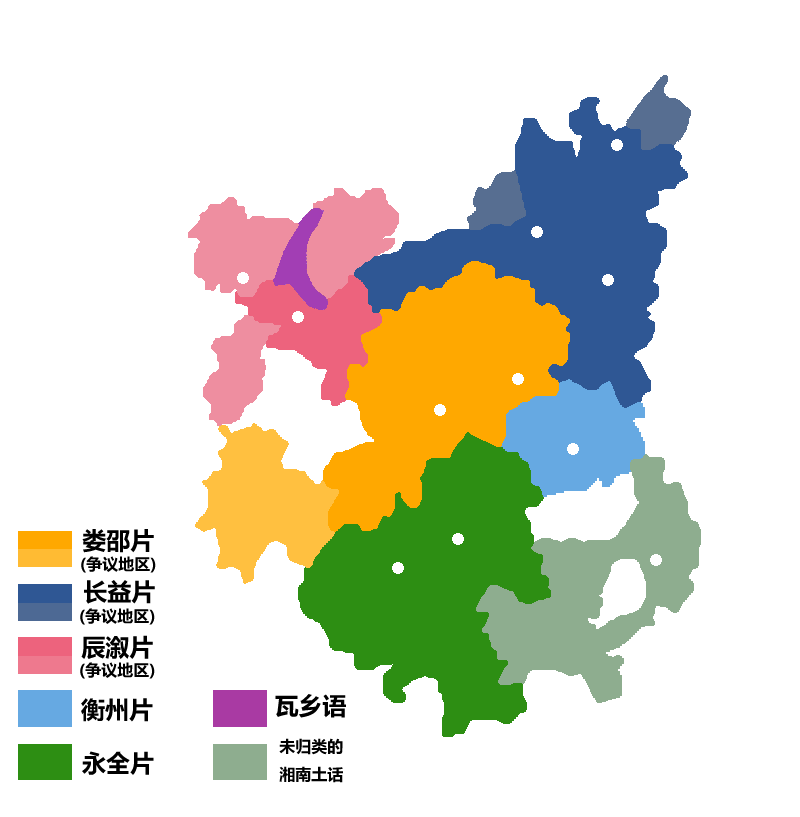
|#335690|New Xiang (Chang–Yi) |#a239af|Waxiang |#65a6de|Hengzhou |#8cac8f|Xiangnan Tuhua |#ee607c|Chen–Xu (Ji–Xu) || |#ffa72e|Old Xiang (Lou–Shao) || |#2b8f2a|Yong-Quan ||
Pervasive influence from Mandarin dialects has made Xiang dialects difficult to classify. Yuan Jiahua divided Xiang into New Xiang, in which voicing has been lost completely, and Old Xiang varieties, which retain voiced initials in at least some tones. The Changsha dialect is usually taken as representative of New Xiang, while Shuangfeng dialect represents Old Xiang. Norman describes the boundary between New Xiang and Southwestern Mandarin as one of the weakest in China, with considerable similarities between dialects near either side of the boundary, though more distant dialects are mutually unintelligible. Indeed, Zhou Zhenhe and You Rujie (unlike most authors) classified New Xiang as part of Southwestern Mandarin.
The Language Atlas of China relabelled the New and Old Xiang groups as Chang-Yi and Lou-Shao respectively, and identified a third subgroup, Ji-Xu, in some parts of Western Hunan. Bao & Chen (2005) split out part of ''Atlas'''s Chang-Yi subgroup as a new Hengzhou subgroup, and part of Lou-Shao as a Yong-Quan subgroup. They also reclassified parts of the Ji–Xu subgroup as Southwestern Mandarin, renaming the remainder of the subgroup as Chen-Xu Xiang. Their five subgroups are:
;Chang-Yi :(17.8 million speakers) voiced initials in Middle Chinese become unaspirated voiceless consonant. Most of the dialects retain the entering tone as a separate category. ;Lou-Shao :(11.5 million speakers) Voiced initials still exist. The entering tone does not exist in most of the dialects. ;Chen-Xu Xiang :(3.4 million speakers) Some of the voiced consonants are retained. ;Hengzhou Xiang :(4.3 million speakers) ;Yong-Quan Xiang :(6.5 million speakers) Voiced consonants still exist.
Geographic distribution
Xiang is spoken by over 36 million people in China, primarily in the most part of the Hunan province, and in the five counties of Quanzhou, Guanyang, Ziyuan, Xing'an and Longsheng in northeastern Guangxi province, and in several places of Guizhou and Sichuan provinces. It is abutted by Southwestern Mandarin-speaking areas to the north and west, as well as by Gan in the eastern parts of Hunan and Jiangxi. Xiang is also in contact with the Qo-Xiong Miao and Tujia languages in West Hunan.
| Subgroup | Division | Main cities and counties |
|---|---|---|
| New Xiang | Chang-Tan | Urban Changsha, Changsha County, Wangcheng District, Ningxiang, Liuyang*, Urban Zhuzhou, Zhuzhou County, Urban Xiangtan, Xiangyin, Miluo, Nanxian, Anxiang* |
| Yi-Yuan | Urban Yiyang, Yuanjiang, Taojiang, Anhua, Nanxian* | |
| Yueyang | Yueyang County, Urban Yueyang | |
| Old Xiang | Xiang-Shuang | Xiangtan County, Shuangfeng, Shaoshan, Urban Loudi, Hengshan* |
| Lian-Mei | Lianyuan, Lengshuijiang*, Anhua*, Ningxiang* | |
| Xinhua | Xinhua, Lengshuijiang | |
| Shao-Wu | Urban Shaoyang, Wugang, Shaodong, Shaoyang County, Xinshao, Longhui, Xinning, Chengbu, Dongkou* | |
| Sui-Hui | Suining, Huitong | |
| Hengzhou | Hengyang | Urban Hengyang, Hengyang County, Hengnan |
| Hengshan | Hengshan, Hengdong, Nanyue | |
| Chen-Xu | – | Chenxi, Xupu, Luxi, Jishou**, Baojing**, Huayuan**, Guzhang**, Yuanling* |
| Yong-Quan | Dong-Qi | Urban Yongzhou, Dong'an, Qiyang, Qidong |
| Dao-Jiang | Jiangyong, Daoxian, Jianghua*, Xintian* | |
| Quan-Zi | Quanzhou County, Xing'an, Guanyang, Ziyuan, Longsheng | |
| *Small part of this territory belongs to this Xiang subgroup. | ||
| **Included in Xiang only in *Language Atlas of China*. |
References
Bibliography
- .
References
- (1999). "长沙方言研究". 江苏教育出版社.
- 鲍. 鲍. 方言. (24 August 2005)
- 徐. 明. link. 人民网
- Qi. Feng. 文史博览. (October 2010). link
- Ma. Na. link. 中国共产党新闻网
- Liu. Shuangshuang. link. (20 July 2005)
- Coblin, W.S.. (2011). "Comparative Phonology of the Central Xiāng Dialects". Institute of Linguistics, Academia Sinica.
- "A Diachronic Comparative Analysis for the Phonology of Xiāng Dialects".
- (2022). "A Diachronic Comparative Analysis for the Phonology of Xiāng Dialects".
- 袁家骅. (1983). 语文出版社
- zh-hans. 中原多故,襄邓百姓,两京衣冠,尽投江湘,故荆南井邑,十倍其初,乃置荆南节度使。
- (2011). "Comparative Phonology of the Central Xiāng Dialects". Institute of Linguistics, Academia Sinica.
This article was imported from Wikipedia and is available under the Creative Commons Attribution-ShareAlike 4.0 License. Content has been adapted to SurfDoc format. Original contributors can be found on the article history page.
Ask Mako anything about Xiang Chinese — get instant answers, deeper analysis, and related topics.
Research with MakoFree with your Surf account
Create a free account to save articles, ask Mako questions, and organize your research.
Sign up freeThis content may have been generated or modified by AI. CloudSurf Software LLC is not responsible for the accuracy, completeness, or reliability of AI-generated content. Always verify important information from primary sources.
Report