From Surf Wiki (app.surf) — the open knowledge base
XCB
X protocol C language binding library
X protocol C language binding library
| Field | Value | |
|---|---|---|
| name | XCB | |
| logo | Xcb logo.svg | |
| logo size | 200px | |
| screenshot | ||
| author | Bart Massey | |
| developer | Jamey Sharp, Josh Triplett, Bart Massey | |
| released | ||
| latest release version | latest release date = | |
| latest preview date | ||
| programming language | C | |
| operating system | POSIX | |
| genre | X11 client library | |
| license | MIT License | |
| website |
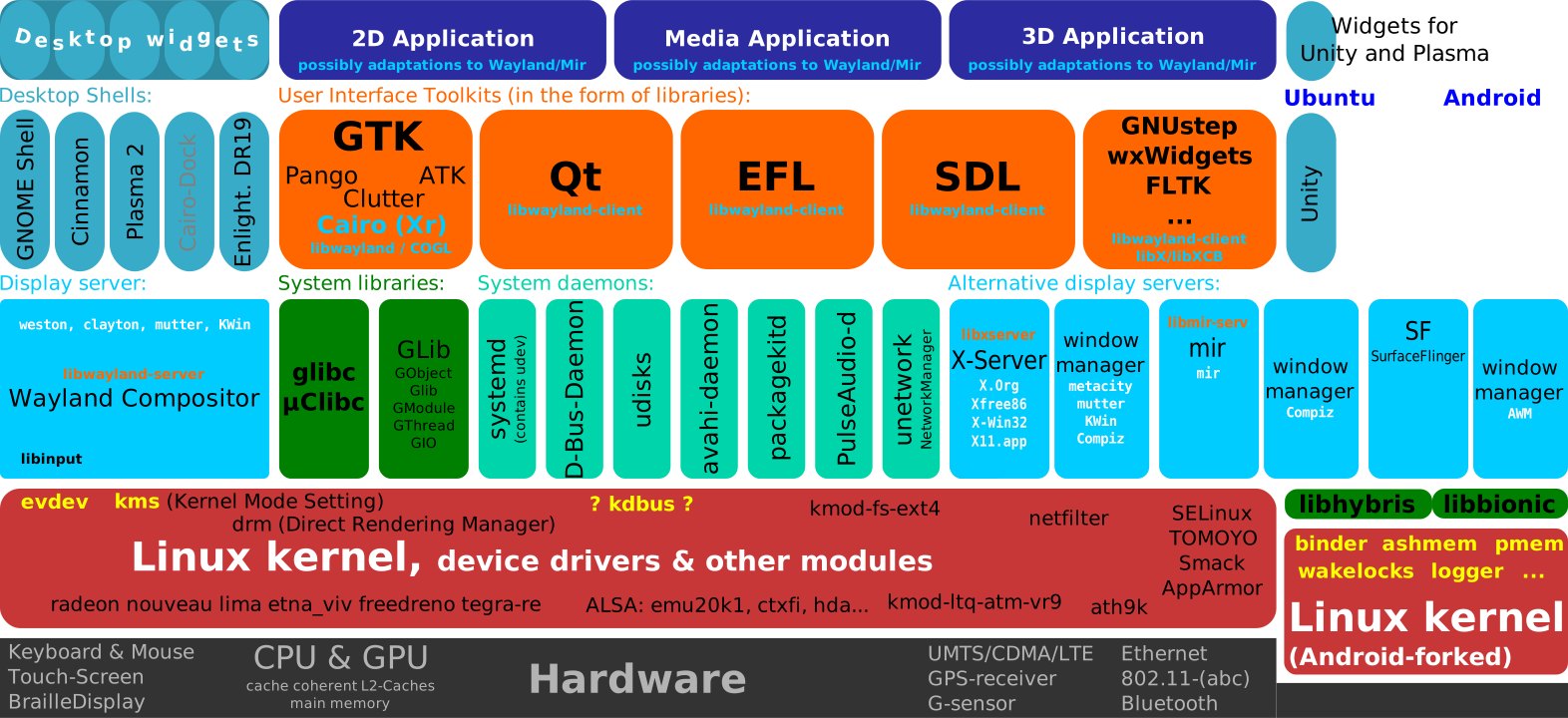
XCB (X protocol C-language Binding) is a library implementing the client side of the X11 display server protocol. XCB is written in the C programming language and distributed under the MIT License. The project was started in 2001 by Bart Massey and aims to replace Xlib.
Overview
XCB was designed as a smaller, modernized replacement for Xlib, previously the primary C library for communicating with the X window system, coinciding with a more complete overhaul of the X implementation that took place during the early 2000s. The main goals of XCB are to:
- reduce library size and complexity
- provide direct access to the X11 protocol
The required size reduction is achieved primarily by restricting XCB's scope to handling the X protocol and omitting Xlib functionality such as its extensive utility library, much of which saw little use by applications. This results in a factor thirty reduction of the compiled library size (as of 2004). Secondary goals include making the C interface asynchronous, facilitating better multithreading and making it easier to implement extensions (via XML protocol descriptions).
The core and extension protocol descriptions are in XML, with a program written in Python creating the C bindings. (Previous versions used XSLT and M4.)
A further goal is to be able to use these protocol descriptions to create protocol documentation, more language bindings, and server-side stubs.
Massey and others have worked to prove key portions of XCB formally correct using Z notation. (Xlib has long been known to contain errors.)
Xlib compatibility
Xlib/XCB provides application binary interface compatibility with both Xlib and XCB, providing an incremental porting path. Xlib/XCB uses the protocol layer of Xlib, but replaces the Xlib transport layer with XCB, and provides access to the underlying XCB connection for direct use of XCB. Xlib/XCB allows an application to open a single connection to the X display server and use both XCB and Xlib, possibly through a mixture of libraries designed for one or the other.
Example
// Simple XCB application for opening a window and drawing a box in it

// To compile it using GNU, use:
// gcc x.c -lxcb

#include <stdio.h>
#include <stdlib.h>
#include <xcb/xcb.h>

int main(void)
{
  xcb_connection_t    *c;
  xcb_screen_t        *s;
  xcb_window_t         w;
  xcb_gcontext_t       g;
  xcb_generic_event_t *e;
  uint32_t             mask;
  uint32_t             values[2];
  int                  done = 0;
  xcb_rectangle_t      r = { 20, 20, 60, 60 };

  // open connection to the server
  c = xcb_connect(NULL, NULL);
  if (xcb_connection_has_error(c)) {
    printf("Cannot open display\n");
    exit(EXIT_FAILURE);
  }
  // get the first screen
  s = xcb_setup_roots_iterator( xcb_get_setup(c) ).data;

  // create black graphics context
  g = xcb_generate_id(c);
  w = s->root;
  mask = XCB_GC_FOREGROUND | XCB_GC_GRAPHICS_EXPOSURES;
  values[0] = s->black_pixel;
  values[1] = 0;
  xcb_create_gc(c, g, w, mask, values);

  // create window
  w = xcb_generate_id(c);
  mask = XCB_CW_BACK_PIXEL | XCB_CW_EVENT_MASK;
  values[0] = s->white_pixel;
  values[1] = XCB_EVENT_MASK_EXPOSURE | XCB_EVENT_MASK_KEY_PRESS;
  xcb_create_window(c, s->root_depth, w, s->root,
                    10, 10, 100, 100, 1,
                    XCB_WINDOW_CLASS_INPUT_OUTPUT, s->root_visual,
                    mask, values);

  // map (show) the window
  xcb_map_window(c, w);

  xcb_flush(c);

  // event loop
  while (!done && (e = xcb_wait_for_event(c))) {

    switch (e->response_type & ~0x80) {
    case XCB_EXPOSE:    // draw or redraw the window
      xcb_poly_fill_rectangle(c, w, g,  1, &r);
      xcb_flush(c);
      break;
    case XCB_KEY_PRESS:  // exit on key press
      done = 1;
      break;
    }
    free(e);
  }
  // close connection to server
  xcb_disconnect(c);

  exit(EXIT_SUCCESS);
}
The bitwise and operation a-response_type & ~0x80 removes a bit that indicates where the event came from.
XCB has a comparable, but slightly lower-level API than Xlib, as can be seen with this example.
Protocol description
Creators of XCB have invented a specialized interface description language to model X11 protocol in language-neutral way and facilitate generation of bindings to other programming languages. libxcb itself is implemented as a code generator and a tiny C stub of utility functions.
An example:
<xcb header="bigreq" extension-xname="BIG-REQUESTS"
    extension-name="BigRequests" extension-multiword="true"
    major-version="0" minor-version="0">

  <request name="Enable" opcode="0">
    <reply>
      <pad bytes="1" />
      <field type="CARD32" name="maximum_request_length" />
    </reply>
  </request>
</xcb>
Logo
The XCB logo was produced by Gearóid Molloy, author of the web comic Neko the Kitty, and donated to the project.
Other language bindings
- XCB.pm - Perl module implementing bindings to XCB.
- xpyb - The Python binding to the X Window System using XCB. As of June 2013, it does not support Python 3. Provided by freedesktop.org.
- xcffib - Another Python binding which supports Python 2 & 3 as well as several more X extensions than xpyb.
- Version 1.9.1 has Python 3 support.
No, don't confuse; you need python to build libxcb, and libxcb itself is a C binding. The cited mail says 1.9.1 has a bugfix to use python-3 to build libxcb.
--
Notes
References
- {{cite conference | book-title = Proceedings of the XFree86 Technical Conference | access-date = 2012-03-12}}
- {{cite conference | book-title = Proceedings of the FREENIX Track: 2002 USENIX Annual Technical Conference | access-date = 2008-11-07
- {{cite conference | book-title = Proceedings of the FREENIX Track: 2002 USENIX Annual Technical Conference | access-date = 2008-11-07
References
- (2004). "The (Re) Architecture of the X Window System".
- Sharp, Jamey. (2004). "How Xlib is Implemented (And What We're Doing About It)".
- [[#refMasseyBauer2002. Massey and Bauer, 2002]].
- [[#refSharpMassey2002. Sharp and Massey, 2002]], §2.4. "While Xlib was designed to support threaded applications, and while that support is not unusable, there are known race conditions that cannot be eliminated without changing the Xlib interface."
- (31 March 2018). "Low Level X Window Programming: An Introduction by Examples". Springer.
- (2008-01-11). "Xlib/XCB: Xlib with XCB transport".
- Jamey Sharp and Josh Triplett. (2006-11-26). "libx11 with Xlib/XCB now in experimental; please test with your packages".
- "X Window System Protocol".
- (2002). "XCL : An Xlib Compatibility Layer For XCB". USENIX 2002 Annual Technical Conference, Freenix Track.
- [http://xcb.freedesktop.org/KittyLogo/ KittyLogo] (xcb.freedesktop.org)
This article was imported from Wikipedia and is available under the Creative Commons Attribution-ShareAlike 4.0 License. Content has been adapted to SurfDoc format. Original contributors can be found on the article history page.
Ask Mako anything about XCB — get instant answers, deeper analysis, and related topics.
Research with MakoFree with your Surf account
Create a free account to save articles, ask Mako questions, and organize your research.
Sign up freeThis content may have been generated or modified by AI. CloudSurf Software LLC is not responsible for the accuracy, completeness, or reliability of AI-generated content. Always verify important information from primary sources.
Report