From Surf Wiki (app.surf) — the open knowledge base
Wright R-975 Whirlwind
Radial aircraft engines in the US
Radial aircraft engines in the US
| Field | Value |
|---|---|
| name | R-975 Whirlwind |
| image | File:Wright R-975 für Sherman-Panzer.jpg |
| caption | A Continental-built R-975 from a Sherman tank |
| engine_type | Air-cooled 9-cylinder radial piston engine |
| manufacturer | Wright Aeronautical |
| builder | Continental Motors |
| national_origin | United States |
| major_applications | |
| produced | 1929-1950s |
| number_built |
The Wright R-975 Whirlwind was a series of nine-cylinder air-cooled radial aircraft engines built by the Wright Aeronautical division of Curtiss-Wright. These engines had a displacement of about 975 cuin and power ratings of 300 -. They were the largest members of the Wright Whirlwind engine family to be produced commercially, and they were also the most numerous.
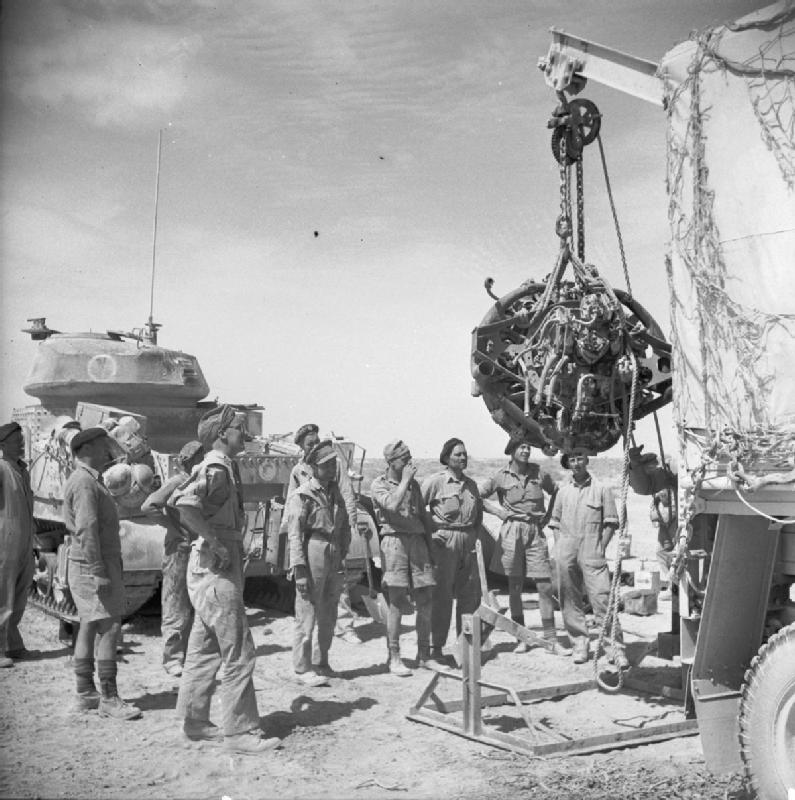
During World War II, Continental Motors built the R-975 under license as a powerplant for Allied tanks and other armored vehicles. Tens of thousands of engines were built for this purpose, dwarfing the R-975's usage in aircraft, where it was overshadowed by the similar Pratt & Whitney R-985. After the war, Continental continued to produce its own versions of the R-975 into the 1950s. Some of these produced as much as 550 hp.
The R-975 powered the American World War II M18 Hellcat tank destroyer which was claimed to have been the fastest tracked armored vehicle until the introduction of the turbine powered M1 Abrams in the 1980s.
Design and development
Wright introduced the J-6 Whirlwind family in 1928 to replace the nine-cylinder R-790 series. The J-6 family included varieties with five, seven, and nine cylinders. The nine-cylinder version was originally known as the J-6 Whirlwind Nine, or J-6-9 for short. The U.S. government designated it as the R-975; Wright later adopted this and dropped the J-6 nomenclature.
Like all the members of the J-6 Whirlwind family, the R-975 had larger cylinders than the R-790. The piston stroke of 5.5 in (14.0 cm) was unchanged, but the cylinder bore was expanded to 5.0 in (12.7 cm) from the R-790's bore of 4.5 in (11.4 cm). While the R-790 was naturally aspirated, the R-975, like the other J-6 engines, had a gear-driven supercharger to boost its power output.
Wright gradually developed the R-975, at first using suffix letters to indicate successive versions. The original R-975 (or J-6-9) was rated for 300 hp (224 kW), while the R-975E of 1931 could do 330 hp (246 kW) thanks to an improved cylinder head design. Wright later added numeric suffixes to show different power levels. The R-975E-1, introduced the same year as the R-975E, was rated at 365 hp (272 kW) thanks to higher-compression pistons and a slightly greater RPM limit. An even more powerful version, the R-975E-3, was also introduced that year, with greater supercharging and a still higher RPM limit, and was progressively refined until the final model of 1935 could reach 450 hp (336 kW) for takeoff.
Operational history
As the most powerful Whirlwind to be produced, commercially it was also the most successful. It powered a wide variety of civil utility aircraft, such as the Beechcraft Staggerwing, and various airliners, such as the Ford 4-AT-E Trimotor and the Lockheed 10B Electra. In addition, it powered U.S. military training aircraft including the North American BT-9 and Vultee BT-15 Valiant for the Army and the Curtiss-Wright SNC Falcon for the Navy. The Curtiss F9C Sparrowhawk parasite fighter operated from U.S. Navy airships was also powered by the R-975.
One notable record set by a Wright J-6 Whirlwind-powered aircraft occurred during July 28–30, 1931, when Russell Norton Boardman and John Louis Polando flew non-stop from Floyd Bennett Field, on Long Island to Istanbul, Turkey in the Cape Cod, a Bellanca Special J-300 high-wing monoplane in 49:20 hours, establishing a distance record of 5011.8 mi, the first nonstop record flight to surpasse 5000 mi.
However, the R-975 faced heavy competition from Pratt & Whitney's R-985 Wasp Junior and from their larger R-1340 Wasp. Pratt & Whitney R-985 outsold the Wright R-975 by a wide margin.
Wright's production of the R-975 ceased in 1945, with over 7,000 engines being produced by the company.
Production by Continental Motors
In 1939 the U.S. Army, which had been using Continental R-670 radial engines in its light tanks, chose Continental Motors to build the R-975 under license as the engine for its M2 medium tanks. Subsequently, the same engine was selected for the M3 Lee medium tank, the M4 Sherman medium tank, the Canadian Ram tank (which used the M3 chassis), the M7 Priest self-propelled gun, the M18 Hellcat tank destroyer, and other Allied armored vehicles based on these. Continental versions of the R-975 for armored vehicles included the R-975E-C2, the R-975-C1, and the R-975-C4. In contrast to the 7,000 built by Wright, Continental built over 53,000 R-975 engines.
When installed in a tank, the R-975 did not have the benefit of being cooled by air slipstream or propeller blast, so a cooling fan was attached to the power shaft and surrounded by a shroud to provide the same effect.
After the war, Continental introduced its own R-975 version for aircraft, the R9-A. Though it was basically similar to other R-975 engines, and its compression ratio and supercharger gear ratio were unchanged from the R-975E-3, other improvements in the R9-A allowed it to achieve 525 hp for takeoff, surpassing any Wright version. A military version, the R-975-46, could reach 550 hp, and was used in Piasecki's HUP Retriever and H-25 Army Mule helicopters. Continental's production of R-975 engines continued into the 1950s.
Other license-built R-975s
The engine was built in Spain as the Hispano-Suiza 9Q or Hispano-Wright 9Q without modification apart from the use of Hispano's patented nitriding finishing process and, on one version only, the 9Qdr, an epicyclic output speed reducer. The R-975 was also produced under licence by Fábrica Nacional de Motores in Brazil.
Variants
;J-6-9 (R-975) :300 hp at 2,000 RPM. ;R-975-20 :300 hp for airship use ;R-975E :330 hp at 2,000 RPM. Higher power from improved cylinder head. ;R-975E-1 :365 hp at 2,100 RPM. Higher compression ratio. ;R-975E-3 :420 hp at 2,200 RPM up to 1400 ft, 450 hp at 2,250 RPM for takeoff. Increased supercharging, slightly higher compression ratio. ;R-975E-C2 :400 hp at 2,400 RPM. Built by Continental Motors under license for use in armored vehicles. ;Continental R9-A :500 hp at 2,300 RPM at 4000 ft, 525 hp at 2,300 RPM for takeoff. Continental's improved post-war version. ;Hispano-Suiza 9Q :Licence-built R-975 J-6 Whirlwind ;Hispano-Suiza 9Qa :variant of the licence-built R-975 J-6 Whirlwind ;Hispano-Suiza 9Qb :variant of the licence-built R-975 J-6 Whirlwind ;Hispano-Suiza 9Qc :variant of the licence-built R-975 J-6 Whirlwind ;Hispano-Suiza 9Qd :variant of the licence-built R-975 J-6 Whirlwind ;Hispano-Suiza 9Qdr :variant of the licence-built R-975 J-6 Whirlwind
Applications
Wright J-6-9 and R-975
- ASJA L2
- Avro Anson Mk IV
- Beechcraft Staggerwing B17R, C17R, and D17R
- Bellanca CH-300 Pacemaker
- Berliner-Joyce OJ-2
- Caribbean Traders Husky III
- Cessna DC-6A Chief
- Curtiss Kingbird
- Curtiss-Wright CW-14 Travel Air/Speedwing/Sportsman Deluxe/Osprey
- Curtiss-Wright CW-22
- Curtiss-Wright SNC-1 Falcon
- de Havilland DH.75B Hawk Moth
- Dewoitine D.31
- Dewoitine D.35
- Douglas RD-1 & C-21/OA-3 Dolphin
- Emsco B-5 Challenger
- Goodyear K-1
- Curtiss F9C Sparrowhawk
- Fokker Universal
- Fokker C-5
- Fokker C-7
- Fokker C.XIV
- Fokker T.VIII
- Ford 4-AT-E Trimotor
- Interstate XTD3R
- Ireland N-2B Neptune
- Keystone XOK
- Keystone-Loening K-84 Commuter
- Koolhoven F.K.56
- Lockheed Model 12B Electra Junior
- McDonnell XV-1
- Messerschmitt M 18
- Noorduyn Norseman Mk.1
- North American BT-9
- North American NA-57
- North American NA-64 Yale
- Pitcairn PA-19
- Pitcairn-Cierva PCA-2/OP-1
- Pitcairn PA-33 & 34/OP-2
- Ryan B-5 Brougham
- Spartan C4-300
- Stearman Model 6C Cloudboy
- Stinson SM-1F Detroiter
- Timm T-840
- Townsend Thunderbird (as rebuilt)
- Travel Air B9-4000
- Travel Air 6000B
- Travel Air Type R Mystery Ship
- VL Pyry
- Vultee BT-15 Valiant
- Waco JTO
- Waco JYO
- Waco JWM and JYM mailplanes
- M4 Sherman
Continental R-975
- Beech D-18C
- Grizzly I cruiser – Canadian production of M4A1 Sherman tank
- Kangaroo armoured personnel carrier modification of M7 Priest and other vehicles
- Kellett XR-10
- M3 Lee
- M4 Sherman
- M7 Priest
- M18 Hellcat
- M12 gun motor carriage
- M40 gun motor carriage
- McDonnell XV-1
- Piasecki HUP Retriever
- Ram tank
- Sexton self-propelled gun
- Sikorsky XHJS-1 (S-53) – prototype helicopter
- Skink anti-aircraft tank – anti-aircraft vehicle based on Grizzly I
Engines on display
Some museums which have R-975 engines on display:
- Pima Air & Space Museum in Tucson, Arizona has a Wright R-975.
- Hiller Aviation Museum in San Carlos, California has a Wright R-975.
- National Museum of Naval Aviation near Pensacola, Florida has a Continental R-975.
- Southern Museum of Flight in Birmingham, Alabama has a Continental R-975.
- Queensland Air Museum in Caloundra, Queensland, Australia has a Continental R-975.
Specifications (Whirlwind R-975E-3)
and start a new, fully formatted line with -- |power/weight=0.62 hp/lb (1.02 kW/kg)
| Engine | Power, continuous | Power, takeoff | Compression ratio | Supercharger gear ratio | Octane rating | Dry weight | R-975E | R-975E-1 | R-975E-3 | Continental R9-A |
|---|---|---|---|---|---|---|---|---|---|---|
| 330 hp (246 kW) at 2,000 RPM | 5.1:1 | 7.8:1 | 73 | 635 lb (288 kg) | ||||||
| 365 hp (272 kW) at 2,100 RPM | 6.1:1 | 7.8:1 | 73 | 660 lb (299 kg) | ||||||
| 420 hp (313 kW) at 2,200 RPM | 450 hp (336 kW) at 2,250 RPM | 6.3:1 | 10.15:1 | 80 | 675 lb (306 kg) | |||||
| 500 hp (373 kW) at 2,300 RPM | 525 hp (391 kW) at 2,300 RPM | 6.3:1 | 10.15:1 | 91 | 705 lb (320 kg) |
References
Notes
Bibliography
- . Available from the Aircraft Engine Historical Society's reference page.
- . Available from the Aircraft Engine Historical Society's reference page. The following Federal Aviation Administration type certificate data sheets, all available from the FAA's Regulatory and Guidance Library :
- R-975E: .
- R-975E-1: .
- R-975E-3: .
- Continental R9-A: .
References
- Patton's Vanguard: The United States Army Fourth Armored Division, By Don M. Fox. P.25
- Curtiss-Wright (1940), p. 11
- Curtiss-Wright (1983), p. 2
- Curtiss-Wright (1940), p. 13
- FAA Type Certificate Data Sheet ATC 21
- Curtiss-Wright (1940), p. 14
- FAA Type Certificate Data Sheet TC 87
- FAA Type Certificate Data Sheet TC 125
- (August 2, 1931). "'Cape Cod's' Success Climaxes 5 Years [of] Bellanca Records". The Sunday Morning Star, Wilmington, DE.
- FAA Type Certificate Data Sheet E-245
- Lage (2004) pp152-163
- (March 21, 2013). "O bom caminhão a casa torna".
- "Wright R-975 Whirlwind 9".
- "Image Galleries by Gary and Janet Brossett: Pima Air and Space Museum in Tucson, Arizona".
- "Aircraft Engines".
- "Image Galleries by Gary and Janet Brossett: National Museum of Naval Aviation in Pensacola, Florida".
- "Continental R-975-46".
- "Queensland Air Museum: The Engine Collection".
- "Queensland Air Museum: Courtesy of Bruce Vander Mark".
This article was imported from Wikipedia and is available under the Creative Commons Attribution-ShareAlike 4.0 License. Content has been adapted to SurfDoc format. Original contributors can be found on the article history page.
Ask Mako anything about Wright R-975 Whirlwind — get instant answers, deeper analysis, and related topics.
Research with MakoFree with your Surf account
Create a free account to save articles, ask Mako questions, and organize your research.
Sign up freeThis content may have been generated or modified by AI. CloudSurf Software LLC is not responsible for the accuracy, completeness, or reliability of AI-generated content. Always verify important information from primary sources.
Report