From Surf Wiki (app.surf) — the open knowledge base
Windsor, Connecticut
Town in Connecticut, United States

Town in Connecticut, United States
| Field | Value |
|---|---|
| name | Windsor, Connecticut |
| settlement_type | Town |
| motto | First in Connecticut, First for its Citizens |
| image_skyline | Windsor Town Hall, Windsor CT.jpg |
| image_caption | Windsor Town Hall, located on Broad Street |
| image_flag | WindsorCTflag.gif |
| image_seal | WindsorCTseal.png |
| image_blank_emblem | WindsorCTlogo.png |
| blank_emblem_type | Emblem |
| blank_emblem_size | 80px |
| image_map | |
| image_map1 | |
| subdivision_type | Country |
| subdivision_name | United States |
| subdivision_type1 | U.S. state |
| subdivision_name1 | Connecticut |
| subdivision_type2 | County |
| subdivision_name2 | Hartford |
| subdivision_type3 | Region |
| subdivision_name3 | Capitol Region |
| government_type | Council-manager |
| leader_title | Town manager |
| leader_name | Peter Souza |
| leader_title1 | Town council |
| leader_name1 | {{Collapsible list |
| title | Members |
| frame_style | border:none; padding: 0; |
| list_style | text-align:left |
| 1 | Mary L. Armstrong |
| 2 | Nuchette Black-Burke (mayor) |
| 3 | Ronald Eleveld |
| 4 | Kristin Gluck-Hoffman |
| 5 | Anthony King |
| 6 | Darleen Klase (deputy mayor) |
| 7 | Ojala Naeem |
| 8 | William Pelkey |
| 9 | Len Walker |
| established_title | Settled |
| established_date | September 26, 1633 |
| established_title2 | Incorporated |
| established_date2 | February 21, 1637 |
| named_for | Windsor, Berkshire |
| unit_pref | Imperial |
| area_total_km2 | 80.2 |
| area_land_km2 | 76.4 |
| area_water_km2 | 3.8 |
| population_as_of | 2020 |
| population_total | 29492 |
| population_density_sq_mi | auto |
| timezone | Eastern |
| utc_offset | −5 |
| timezone_DST | Eastern |
| utc_offset_DST | −4 |
| postal_code_type | ZIP Code |
| postal_code | 06095 |
| area_codes | 860/959 |
| coordinates | |
| elevation_ft | 184 |
| website | |
| blank_name | FIPS code |
| blank_info | 09-87000 |
| blank1_name | GNIS feature ID |
| blank1_info | 212354 |
| population_demonym | Windsor-head |
Windsor is a town in Hartford County, Connecticut, United States, and was the first English settlement in the state. It lies on the northern border of Connecticut's capital, Hartford. The town is part of the Capitol Planning Region. The population of Windsor was 29,492 at the 2020 census.
History
The coastal areas and riverways were traditional areas of settlement by various American Indian cultures, who had been in the region for thousands of years. They relied on the rivers for fishing, water and transportation. Before European contact, the historic Pequot and Mohegan tribes had been one Algonquian-speaking people. After they separated, they became competitors and traditional enemies in the Connecticut region.
During the first part of the 17th century, the Pequot and Mohegan nations had been at war. The Podunk were forced to pay tribute to the more powerful Pequot, who claimed their land. Eventually, the Podunk invited a small party of settlers from Plymouth, Massachusetts, to settle as a mediating force between the other tribes. In exchange they granted them a plot of land at the confluence of the Farmington River and the west side of the Connecticut River. After Edward Winslow came from Plymouth to inspect the land, William Holmes led a small party, arriving at the site on September 26, 1633, where they founded a trading post. The spot of the trading post is at the confluence of the Farmington and Connecticut Rivers. The Loomis Chaffee School currently owns the land as the spot is now the school's sports fields.
Native Americans referred to the area as Matianuck. It was about 50 mi up river from Long Island Sound, at the end of waters navigable by ship and above the Dutch fort at Hartford, offering an advantageous location for the English to trade with the Indians before they reached the Dutch. (The Sicaog tribe had made a similar offer to mediate to the Dutch in New Amsterdam. New Netherland had far fewer European settlers than New England, and they were not in a position to take up the opportunity.)
In 1635, a party of around 30 people, sponsored by Sir Richard Saltonstall, and led by the Stiles brothers, Francis, John and Henry, settled in the Windsor area. Governor John Winthrop of the Massachusetts Bay Company acknowledged in a letter to Saltonstall that the Stiles party was the second group to settle Connecticut.
The first group of 60 or more people were led by Roger Ludlow, primary framer of the Fundamental Orders of Connecticut, having trekked overland from Dorchester, Massachusetts. They had arrived in the New World five years earlier on the ship Mary and John from Plymouth, England, and settled in Dorchester. Reverend Warham promptly renamed the Connecticut settlement "Dorchester". During the next few years, more settlers arrived from Dorchester, outnumbering and soon displacing the original Plymouth contingent, who returned to Plymouth in 1638 after selling their parcel to a Matthew Allyn of Hartford.
On February 21, 1637, the colony's General Court changed the name of the settlement from Dorchester to Windsor, named after the town of Windsor, Berkshire, on the River Thames in England. The same day, Windsor was incorporated as a town along with Hartford and Wethersfield.
Several "daughter towns" were formed from Windsor's original boundaries. These include portions or all of Barkhamsted, Bloomfield, Bolton, Colebrook, Coventry, East Granby, East Windsor, Ellington, Enfield, Granby, Harwinton, Litchfield, Manchester, Morris, Simsbury, South Windsor, Suffield, Tolland, Torrington, Vernon, and Windsor Locks.
The first "highway" in the Connecticut Colony opened in 1638 between Windsor and Hartford. Two years later, the highway was extended north to the colony's 1636 settlement at Springfield, with the road also connecting to Wethersfield and thus the four settlements that came to dominate the region for much of colonial history were connected.
In the summer of 1640, an event took place that would forever change the boundaries of the Connecticut River Valley. During a grain famine, the founder of Springfield, William Pynchon, was given authority by Windsor and Hartford to negotiate a price for grain for the three settlements with the natives. First, the natives refused to sell grain at the usual market price, and then refused to sell it at "a reasonable price". Pynchon refused to buy it, attempting to teach the natives a peaceful lesson about integrity and reliability. Windsor's cattle were starving, however, and the citizens of Hartford were furious. With Windsor's consent, Hartford commissioned the famous Indian fighter John Mason to travel to Springfield with "money in one hand and a sword in the other" to threaten the natives, and thereby force the grain trade. The natives capitulated and ultimately sold their grain. After "negotiating the trade", Mason refused to share the grain with Springfield, and, to add further insult, insisted that Springfield pay a tax when sailing ships passed Windsor. Outraged, Springfield forever sided with the Massachusetts Bay Colony, a Puritan settlement in Boston, rather than with the Connecticut Colony, which was much closer geographically and far more compatible ideologically. Windsor played a neutral role in the colonial rivalry between Hartford and Springfield; however, Windsor's direct border with both settlements caused many discussions about whether to align with Massachusetts or Connecticut. Ultimately, Windsor sided with Connecticut.
The Hartford & Springfield Street Railway, a trolley, connected with the Connecticut Company in Windsor Center until 1925. Buses replaced trolleys between Rainbow (a northern section of Windsor) and Windsor Center in 1930. Trolley cars continued to run from Windsor to Hartford until 1940.
When the Springfield Line of the NY, New Haven & Hartford RR was built, station stops included Windsor station in Windsor Center with stations also at Wilson in the south of town and Hayden in the north, named for owners who provided land for the railroad right of way. The line was double tracked until the late 1990s and redouble tracked in 2018. Sidings at Windsor station allowed cars to be spotted at the freight house and on the Loomis trestle just to its south. The trestle was removed in the late 1980s. An 1856 brownstone arch bridge carries the tracks over Pleasant St and the Farmington River. Incorporating a horizontal curve, its engineering was noteworthy when built. Following a fatal grade crossing accident, a three-track-wide plate girder bridge was installed to carry tracks over Palisado Avenue.
Tobacco farming
Main article: Connecticut shade tobacco
Tobacco farming in Connecticut has a long history. When the first settlers came to the valley in the 1630s, tobacco was already being grown by the native population. By 1700 it was being exported via the Connecticut River to European ports. The use of Connecticut tobacco as a cigar wrapper leaf began in the 1820s.
Area farmers grew tobacco for the two outside layers of cigars, the binder and the wrapper. Approximately 34,000 acre of land in Connecticut is covered by Windsor Soil, named after the town.
Geography

Windsor's highest point is on Day Hill at 230 ft above sea level. Windsor's lowest point is on the Connecticut River, at 5 ft above sea level. The Connecticut River defines Windsor's eastern border. The city of Hartford, the capital of Connecticut, is adjacent to Windsor to the south. The town of Windsor Locks, home of Bradley International Airport, is adjacent to Windsor to the north. Prior to its incorporation in 1854, it was known as the Pine Meadow section of Windsor. The towns of East Windsor and South Windsor are on the east side of the Connecticut River. The town of Bloomfield is to the west. The town of East Granby is to the northwest.
The Farmington River joins the Connecticut River in Windsor. The Farmington River is dammed in the northwestern corner of Windsor to form the 234 acre Rainbow Reservoir.
Principal communities
- Deerfield
- Hayden Station
- Poquonock
- Rainbow
- Wilson
- Windsor Center
Demographics
Population
As of the census of 2010, there were 29,044 people, 11,233 households, and 7,881 families residing in the town. The population density was 984.5 persons per square mile (380.2/km). There were 11,767 housing units at an average density of 398.9 /sqmi. The racial makeup of the town was 54.7% White, 34.3% African American, 0.2% Native American, 4.5% Asian, 0.01% Pacific Islander, 3.1% some other race, and 3.2% from two or more races. Hispanic or Latino of any race were 8.4% of the population.
There were 11,233 households, out of which 28.1% had children under the age of 18 living with them, 50.9% were headed by married couples living together, 14.9% had a female householder with no husband present, and 29.8% were non-families. Of all households, 24.1% were made up of individuals, and 8.8% were someone living alone who was 65 years of age or older. The average household size was 2.54 and the average family size was 3.04.
In the town, the population was spread out, with 21.5% under the age of 18, 7.4% from 18 to 24, 23.9% from 25 to 44, 31.8% from 45 to 64, and 15.3% who were 65 years of age or older. The median age was 43.1 years. For every 100 females, there were 90.9 males. For every 100 females age 18 and over, there were 87.8 males.
Income
According to the U.S. Census Bureau's American Community Survey, for the period 2009–2011, median income for a household in the town was $78,211, and median income for a family was $89,726. Male full-time year-round workers had a median income of $58,668 versus $50,529 for females. The per capita income for the town was $34,899. About 3.1% of families and 4.5% of the population were below the poverty line, including 6.0% of those under age 18 and 4.8% of those age 65 or over.
Windsor was one of a handful of towns in the country where, in the 2000 United States census, median income for black households ($64,159) was larger than white households ($63,624). Asian households had a median income of $75,716. Hispanic or Latino (of any race) households have a median income of $69,808.
Economy
Top employers
Top employers in Windsor according to the town's 2024 Comprehensive Annual Financial Report
| # | Employer | # of Employees |
|---|---|---|
| 1 | Amazon.com | 7,223 |
| 2 | Town of Windsor | 1,181 |
| 3 | Voya Financial | 723 |
| 4 | Walgreens | 700 |
| 5 | SS & C Technologies Inc | 500 |
| 6 | Eversource Energy | 400 |
| 7 | Dollar Tree | 375 |
| 8 | Waste Management | 375 |
| 9 | TLD GSE | 350 |
| 10 | Barnes Aerospace | 300 |
Arts and culture
,_Windsor,_CT_-_April_2016_(1).JPG)
Points of interest include:
- A three-story brick house where sixty men died between 1907 and 1917 while in the care of Amy Archer-Gilligan. Most were proven to be victims of arsenic poisoning. The stage play Arsenic and Old Lace and movie Arsenic and Old Lace was inspired events there.
- A statue of John Mason, a founder of Windsor and colonial leader in the Pequot War.
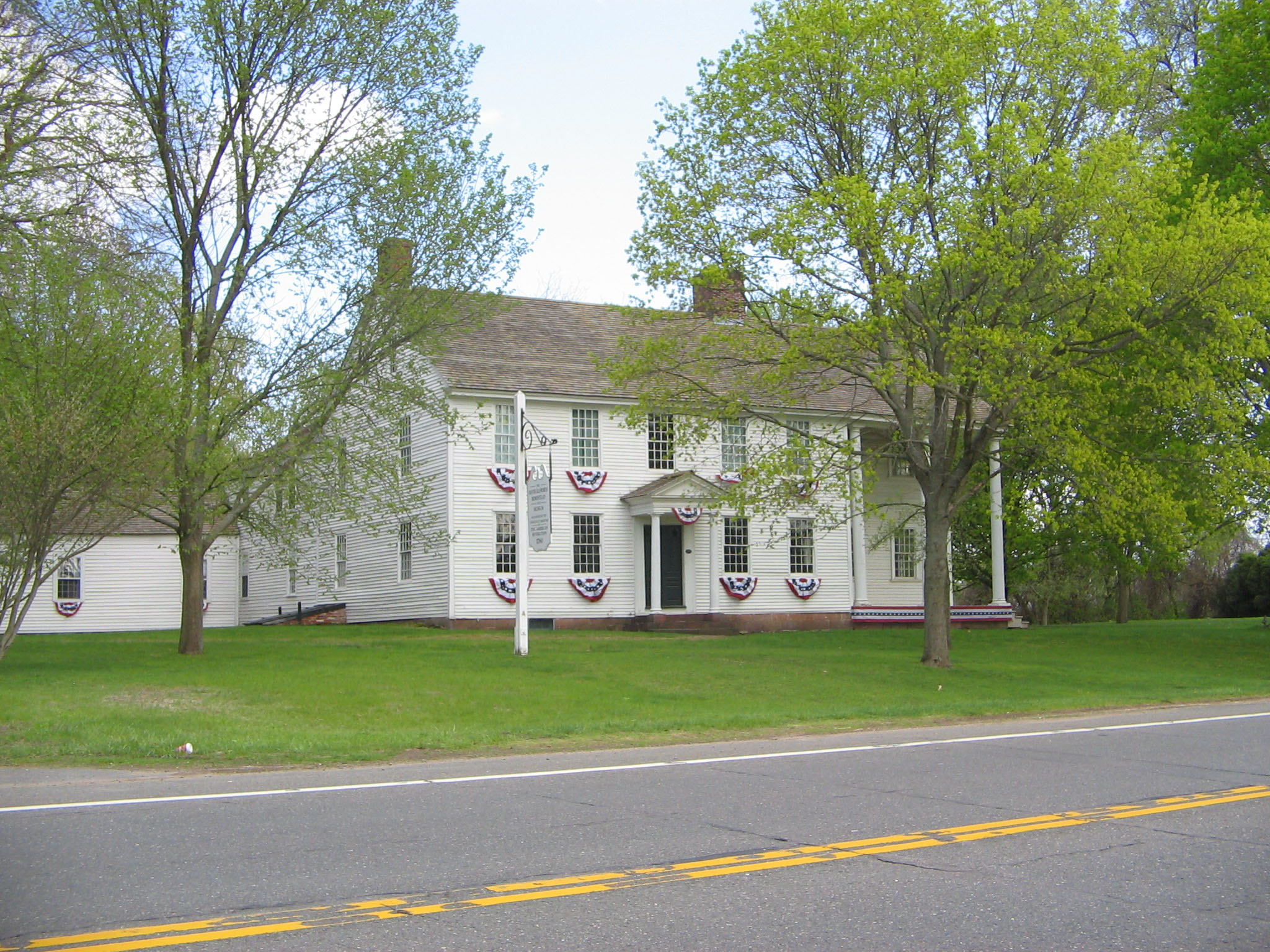
- The home of Oliver Ellsworth, third Chief Justice of the United States.
- A restored Amtrak train station dating to the 1850s.
- The Vintage Radio and Communications Museum of Connecticut.
From 1957 to 2006, the town was the location of the S1C Nuclear Powered Training Unit; a prototype nuclear power plant for the Naval Nuclear Propulsion Program. The former site has the distinction of being the first nuclear reactor site to receive unrestricted release after demolition and decontamination efforts.
There is one public library, Windsor Public Library, with two branches.
Events
The Northwest Park Country Fair is held every fall.
The Shad Derby Festival is held every spring in the town center.
The Carol sing and torchlight parade mark the holiday season in December.
Parks and recreation
Parks include:
- Windsor Meadows State Park, located along the Connecticut River.
- Keney Park, which features cricket fields and a golf course.
- Northwest Park, Windsor's largest park, includes a nature center, trails and a barn with animals.
- Mill Brook Open Space, a 95 acre property, used for recreation, a wildlife habitat, water quality improvement, and storm water protection.
Government
Windsor has a council–manager government. The legislative function is performed by a bipartisan council of nine members, who are elected biennially for two-year terms. The rown council elects a mayor from its membership for the two-year term, and also appoints the rown manager. Peter Souza has served as Windsor's town manager since 2004.
State
| Representative | Chamber | District | Party | |
|---|---|---|---|---|
| Jane Garibay | House of Representatives | 60th | Dem | |
| Bobby Gibson | House of Representatives | 15th | Dem | |
| Maryam Khan | House of Representatives | 5th | Dem | |
| Tami Zawistowski | House of Representatives | 61st | Rep |
| Representative | Chamber | District | Party | |
|---|---|---|---|---|
| Douglas McCrory | Senate | 2nd | Dem | |
| John Kissel | Senate | 7th | Rep |
| Representative | Chamber | District | Party | |
|---|---|---|---|---|
| John B. Larson | Congress | 1st | Dem |
| Voter registration and party enrolment as of October 31, 2024 | Party | Active voters | Inactive voters | Total voters | Total | 22,688 | 1,399 | 24,087 |
|---|---|---|---|---|---|---|---|---|
| Democratic | 10,983 | 587 | 11,570 | |||||
| Republican | 2,845 | 194 | 3,039 | |||||
| Unaffiliated | 8,601 | 591 | 9,192 | |||||
| Minor parties | 259 | 27 | 286 |
The following minor parties have registered voters in Windsor: the Green Party, Libertarian Party, Working Families Party, and Independent Party.
Education
Public schools in Windsor are a part of the Windsor Public Schools. Schools include:
- Clover Street School
- John F. Kennedy School
- Oliver Ellsworth School
- Poquonock School
- Sage Park Middle School
- Windsor High School
Magnet schools administered by the Capitol Region Education Council include the Academy of Aerospace and Engineering Middle School, and the Academy of Aerospace and Engineering High School.
Private schools include:
- Loomis Chaffee School.
- Madina Academy, Connecticut's first full-time Islamic School, offers preschool through 12th grade
- Saint Gabriel's School is a private school that teaches kindergarten through eighth grade.
Media
The movie Parrish (1961) was set and filmed in the tobacco farms of Windsor.
Infrastructure
Transportation

Bradley International Airport, which serves Greater Hartford and the greater Pioneer Valley, borders Windsor.
Connecticut Transit provides bus service.
Highways include:
- Interstate 91
- Interstate 291
- Connecticut Route 20
- Connecticut Route 75
- Route 159 (Connecticut–Massachusetts)
- Connecticut Route 178
- Route 187 (Connecticut–Massachusetts)
- Connecticut Route 218
- Connecticut Route 305
The railroad station in Windsor is served by Amtrak's Hartford Line, Northeast Regional and Valley Eagle trains, and trains on the CTrail Hartford Line.
Emergency services
Emergency services are administered by Windsor Police Department, Windsor Volunteer Fire Department, and Windsor Volunteer Ambulance.
Notable people
- Al Anderson, guitarist, singer and songwriter, best known for his 20-year stint in NRBQ
- Christopher Isaiah Baker (born 1987), nicknamed "Swaggy", is an American football defensive tackle
- Moe Drabowsky (1935–2006), Polish-born Major League Baseball pitcher, raised in Wilson, schooled at Loomis
- Oliver Ellsworth, third Chief Justice of the United States, a drafter of the Constitution and American Founding Father, was born in Windsor
- Roger Enos, veteran of the French and Indian War and American Revolution who commanded the Vermont Militia in the later stages of the American Revolution
- John Fitch, inventor of the steamboat, held several patents, operator of the US's first steamboat line
- Edith Julia Griswold (1863–1926), lawyer and patent expert
- General William Hayden, Connecticut Adjutant General 1835–1836
- Mike Joy (born 1949), TV sports announcer, voice of FOX Sports' NASCAR TV coverage, served four elected terms on the Windsor Town Council
- Christine Ladd-Franklin (1847–1930), American psychologist and logician
- Evelyn Beatrice Longman, first woman sculptor to be elected a full member of the National Academy of Design
- Lancelot Phelps (1784–1866), congressman from Connecticut
- William Phelps (1593–1672), woodworker, judge, civil servant
- Joseph Hayne Rainey (1832–1887), first African American to be elected to Congress, US congressman from South Carolina, lived in a summer house here with his family
- Iceman John Scully, professional boxer, world title challenger, ESPN Classic boxing broadcaster
- John H. Swift (1840–1911), manufacturer member of the New York State Assembly, grew up in Poquonock
- Ethna Beulah Winston (1903–1993), educator, dean of women
- Erastus Wolcott (1722–1793), political and military leader during the American Revolutionary War
- Oliver Wolcott, American Founding Father, born in Windsor
- Roger Wolcott (1679–1767), weaver, colonial governor of Connecticut (1751–1754), father of Oliver Wolcott
References
References
- "Town Council". Townofwindsorct.com.
- "Town Council". Town of Windsor.
- {{gnis. 212354. Town of Windsor
- "Census - Geography Profile: Windsor town, Hartford County, Connecticut". [[United States Census Bureau]].
- Van Dusen, Albert "Connecticut" Random House, 1961, pp 19-20
- The History of Ancient Windsor, Connecticut: Including East Windsor, South Windsor, and Windsor Locks by Henry Reed Stiles, pages 17 through 29
- Thistlewaite, Frank: ''Dorset Pilgrims''
- The History of Ancient Windsor, Connecticut: Including East Windsor, South Windsor, and Windsor Locks by Henry Reed Stiles, page 43
- (February 1, 2001). "Public Records of the Colony of Connecticut, Volume 1, Page 7". Colonialct.uconn.edu.
- (1903). "The Connecticut Magazine: An Illustrated Monthly". Connecticut Magazine Company.
- "Windsor History". Windsor Historical Society.
- "William Pynchon".
- [https://archive.org/details/historyspringfi00barrgoog/page/n61 The History of Springfield in Massachusetts for the Young: Being Also in ... - Charles Henry Barrows - Internet Archive]. Books.google.com. Retrieved on July 15, 2013.
- "Trolley Towns CT: Windsor". Bera.org.
- (December 1, 1992). "Wrapped Up".
- "CT Soils – Windsor | Connecticut NRCS". Ct.nrcs.usda.gov.
- "USGS Hartford North (CT,MA) Topo Map". TopoZone.
- "Rainbow Reservoir – CT". Paddling.net.
- "Census of Population and Housing". Census.gov.
- "Profile of General Population and Housing Characteristics: 2010 Demographic Profile Data (DP-1): Windsor town, Hartford County, Connecticut". U.S. Census Bureau, American Factfinder.
- "Selected Economic Characteristics: 2009-2011 American Community Survey 3-Year Estimates (DP03): Windsor town, Hartford County, Connecticut". U.S. Census Bureau, American Factfinder.
- "town, Hartford County, Connecticut – Select a Race, Ethnic, or Ancestry Group – American FactFinder". Factfinder.census.gov.
- "Town of Windsor For the Fiscal Year Ended June 30, 2024". Town of Windsor.
- "War Memorial, Windsor".
- John F. Kennedy. "Oliver Ellsworth (chief justice of United States) – Britannica Online Encyclopedia".
- "Welcome to the Vintage Radio and Communications Museum of Connecticut!". Vrcmct.org.
- "DOE Reactor Site Returns To Green Field Conditions".
- "Windsor Public Library, Windsor Connecticut". Windsorlibrary.com.
- (September 26, 2009). "Friends of Northwest Park Events". Northwestpark.org.
- "Windsor CT Shad Derby". Windsorshadderby.org.
- "Connecticut State Parks". StateParks.com.
- Kevin McCarthy, Principal Analyst. (March 14, 2005). "Keney Park and PILOTs". Cga.ct.gov.
- (September 8, 2009). "Welcome to Northwest Park". Northwestpark.org.
- Goode, Steven. "Former Golf Course In Windsor Headed For Open Space Acquisition". Courant Community.
- "Mill Brook Open Space". The Trust for Public Land.
- "Mill Brook Open Space Steering Committee Public Input Opportunity!".
- "Windsor Town Council". Town of Windsor.
- "Representative Districts by Town".
- "Registration and Party Enrollment Statistics as of October 31, 2024". Connecticut Secretary of State.
- "Schools". Windsor Public Schools.
- "CREC Schools {{!}} Theme-Based Academies".
- "Madina Academy".
- "Saint Gabriel School of Windsor Connecticut". Stgabrielschool.org.
- [[IMDbTitle:0055279. Parrish (1961)]]
- "Windsor Police Department". Windsorpolice.com.
- "Windsor Volunteer Fire Department". Town of Windsor.
- "Windsor Volunteer Ambulance". www.windsorctems.com.
- Dixon, Ken, "Music Hall of Fame proposed for state", article in ''Connecticut Post'' in Bridgeport, Connecticut, April 26, 2007 ("Al Anderson, longtime guitarist/songwriter for the rock band NRBQ [...] Anderson, who grew up in Windsor")
- "Christine Ladd-Franklin".
- "Evelyn Longman Batchelder". Connecticut Women's Hall of Fame.
This article was imported from Wikipedia and is available under the Creative Commons Attribution-ShareAlike 4.0 License. Content has been adapted to SurfDoc format. Original contributors can be found on the article history page.
Ask Mako anything about Windsor, Connecticut — get instant answers, deeper analysis, and related topics.
Research with MakoFree with your Surf account
Create a free account to save articles, ask Mako questions, and organize your research.
Sign up freeThis content may have been generated or modified by AI. CloudSurf Software LLC is not responsible for the accuracy, completeness, or reliability of AI-generated content. Always verify important information from primary sources.
Report