From Surf Wiki (app.surf) — the open knowledge base
Windows Server 2008
Version of Windows Server, released in 2008
Version of Windows Server, released in 2008
| Field | Value |
|---|---|
| name | Windows Server 2008 |
| version of | Windows NT |
| logo | Windows Server 2008 Logo and Wordmark.png |
| logo size | 220px |
| screenshot | Windows Server 2008.png |
| caption | Screenshot of Windows Server 2008 showing the Server Manager application which is automatically opened when an administrator logs on |
| developer | Microsoft |
| family | Windows Server |
| source model | {{ubl |
| RTM date | |
| GA date | |
| release version | Service Pack 2 with January 2026 monthly update rollup (6.0.6003.23717) |
| release date | |
| marketing target | Business |
| language | |
| update model | Windows Update, Windows Server Update Services, SCCM |
| package manager | |
| supported platforms | IA-32, x86-64, Itanium |
| kernel type | Hybrid (Windows NT kernel) |
| ui | Windows shell (Graphical) |
| license | Proprietary commercial software |
| preceded by | Windows Server 2003 (2003) |
| succeeded by | Windows Server 2008 R2 (2009) |
| website | [Windows Server 2008](https://web.archive.org/web/20080208061615/http://www.microsoft.com/windowsserver2008/en/us/default.aspx) (archived at Wayback Machine) |
| support status | Mainstream support ended on January 13, 2015 |
| ESU (Extended Security Updates) support ended on January 10, 2023, for non-Azure & | |
| January 9, 2024, for Azure. Premium Assurance security update support ended on January 13, 2026. | |
| See for details. |
It is also not to be confused with Windows Server 2012, codenamed "Windows Server 8".
| Closed-source | Source-available (through Shared Source Initiative)
ESU (Extended Security Updates) support ended on January 10, 2023, for non-Azure & January 9, 2024, for Azure. Premium Assurance security update support ended on January 13, 2026.
See for details.
Windows Server 2008, codenamed "Longhorn Server" is the seventh major version of the Windows NT operating system produced by Microsoft to be released under the Windows Server brand name. It was released to manufacturing on February 4, 2008, and generally to retail on February 27, 2008. Derived from Windows Vista, Windows Server 2008 is the successor to Windows Server 2003 R2 and the predecessor to Windows Server 2008 R2. It removed support for computers without ACPI, and is the first version that includes Hyper-V.
It is the last version of Windows Server that supports 32-bit processors (IA-32).
As of July 2019, 60% of Windows Servers were running Windows Server 2008.
History
Microsoft had released Windows Vista to mixed reception, and their last Windows Server release was based on Windows XP. The operating system's working title was Windows Server Codename "Longhorn", but was later changed to Windows Server 2008 when Microsoft chairman Bill Gates announced it during his keynote address at WinHEC on May 16, 2007.{{cite web |access-date=2007-07-09 |archive-date=2007-06-26 |archive-url=https://web.archive.org/web/20070626032336/http://blog.pcmag.com/blogs/miller/archive/2007/05/15/1883.aspx |url-status=dead
Beta 1 was released on July 27, 2005; Beta 2 was announced and released on May 23, 2006, at WinHEC 2006 and Beta 3 was released publicly on April 25, 2007.{{cite web |access-date=2007-04-25 |archive-date=2007-04-28 |archive-url=https://web.archive.org/web/20070428050851/http://blogs.technet.com/windowsserver/archive/2007/04/25/beta-3-is-go.aspx |url-status=dead |access-date=2007-09-24 |archive-date=2007-10-11 |archive-url=https://web.archive.org/web/20071011054059/http://blogs.technet.com/windowsserver/archive/2007/09/24/windows-server-2008-rc0-released.aspx |url-status=dead
Features
Windows Server 2008 is built from the same codebase as Windows Vista and thus it shares much of the same architecture and functionality. Since the codebase is common, Windows Server 2008 inherits most of the technical, security, management and administrative features new to Windows Vista such as the rewritten networking stack (native IPv6, native wireless, speed and security improvements); improved image-based installation, deployment and recovery; improved diagnostics, monitoring, event logging and reporting tools; new security features such as BitLocker and address space layout randomization (ASLR); the improved Windows Firewall with secure default configuration; .NET Framework 3.0 technologies, specifically Windows Communication Foundation, Microsoft Message Queuing and Windows Workflow Foundation; and the core kernel, memory and file system improvements. Processors and memory devices are modeled as Plug and Play devices to allow hot-plugging of these devices. This allows the system resources to be partitioned dynamically using dynamic hardware partitioning – each partition has its own memory, processor and I/O host bridge devices independent of other partitions.
Server Core
Windows Server 2008 includes a variation of installation called Server Core. Server Core is a significantly scaled-back installation where no Windows Explorer shell is installed. It also lacks Internet Explorer, and many other non-essential features. All configuration and maintenance is done entirely through command-line interface windows, or by connecting to the machine remotely using Microsoft Management Console (MMC). Notepad and some Control Panel applets, such as Regional Settings, are available.
A Server Core installation can be configured for several basic roles, including the domain controller (Active Directory Domain Services), Active Directory Lightweight Directory Services (formerly known as Active Directory Application Mode), DNS Server, DHCP server, file server, print server, Windows Media Server, Internet Information Services 7 web server and Hyper-V virtual server roles. Server Core can also be used to create a cluster with high availability using failover clustering or network load balancing.
Andrew Mason, a program manager on the Windows Server team, noted that a primary motivation for producing a Server Core variant of Windows Server 2008 was to reduce the attack surface of the operating system, and that about 70% of the security vulnerabilities in Microsoft Windows from the prior five years would not have affected Server Core.{{cite web |access-date=2008-11-01
Active Directory
The Active Directory domain functionality that was retained from Windows Server 2003 was renamed to Active Directory Domain Services (ADDS).{{cite web |access-date = 2007-05-02
- Active Directory Federation Services (ADFS) enables enterprises to share credentials with trusted partners and customers, allowing a consultant to use their company user name and password to log in on a client's network.
- Active Directory Lightweight Directory Services (AD LDS), (formerly Active Directory Application Mode, or ADAM)
- Active Directory Certificate Services (ADCS) allow administrators to manage user accounts and the digital certificates that allow them to access certain services and systems. Identity Integration Feature Pack is included as Active Directory Metadirectory Services.
- Active Directory Rights Management Services (ADRMS)
- Read-only domain controllers (RODCs), intended for use in branch office or other scenarios where a domain controller may reside in a low physical security environment. The RODC holds a non-writeable copy of Active Directory, and redirects all write attempts to a full domain controller. It replicates all accounts except sensitive ones. In RODC mode, credentials are not cached by default. Also, local administrators can be designated to log on to the machine to perform maintenance tasks without requiring administrative rights on the entire domain.
- Restartable Active Directory allows ADDS to be stopped and restarted from the Management Console or the command-line without rebooting the domain controller. This reduces downtime for offline operations and reduces overall DC servicing requirements with Server Core. ADDS is implemented as a Domain Controller Service in Windows Server 2008.
- All of the Group Policy improvements from Windows Vista are included. Group Policy Management Console (GPMC) is built-in. The Group Policy objects are indexed for search and can be commented on.{{cite web | url-status = dead | archive-url = https://web.archive.org/web/20090804113107/http://reddevnews.com/articles/2007/10/08/top-10-overlooked-windows-server-2008-features-part-2.aspx | archive-date = 2009-08-04 | access-date = 2014-10-10
- Policy-based networking with Network Access Protection, improved branch management and enhanced end user collaboration. Policies can be created to ensure greater quality of service for certain applications or services that require prioritization of network bandwidth between client and server.
- Granular password settings within a single domain – ability to implement different password policies for administrative accounts on a "group" and "user" basis, instead of a single set of password settings to the whole domain.
Failover Clustering
Main article: Microsoft Cluster Server
Windows Server 2008 offers high availability to services and applications through Failover Clustering. Most server features and roles can be kept running with little to no downtime.
In Windows Server 2008, the way clusters are qualified changed significantly with the introduction of the cluster validation wizard. The cluster validation wizard is a feature that is integrated into failover clustering in Windows Server 2008. With the cluster validation wizard, an administrator can run a set of focused tests on a collection of servers that are intended to use as nodes in a cluster. This cluster validation process tests the underlying hardware and software directly, and individually, to obtain an accurate assessment of how well failover clustering can be supported on a given configuration.
This feature is only available in Enterprise and Datacenter editions of Windows Server.
Disk management and file storage
- The ability to resize hard disk partitions without stopping the server, even the system partition. This applies only to simple and spanned volumes, not to striped volumes.
- Shadow Copy based block-level backup which supports optical media, network shares and Windows Recovery Environment.
- DFS enhancements – SYSVOL on DFS-R, Read-only Folder Replication Member. There is also support for domain-based DFS namespaces that exceed the previous size recommendation of 5,000 folders with targets in a namespace.
- Several improvements to Failover Clustering (high-availability clusters).{{cite web |access-date = 2007-07-09
- Internet Storage Name Service (iSNS) enables central registration, deregistration and queries for iSCSI hard drives.
- Self-healing NTFS: In Windows versions prior to Windows Vista, if the operating system detected corruption in the file system of an NTFS volume, it marked the volume "dirty"; to correct errors on the volume, it had to be taken offline. With self-healing NTFS, an NTFS worker thread is spawned in the background which performs a localized fix-up of damaged data structures, with only the corrupted files/folders remaining unavailable without locking out the entire volume and needing the server to be taken down. S.M.A.R.T. detection techniques were added to help determine when a hard disk may fail.{{cite web |access-date=2007-07-09
Hyper-V
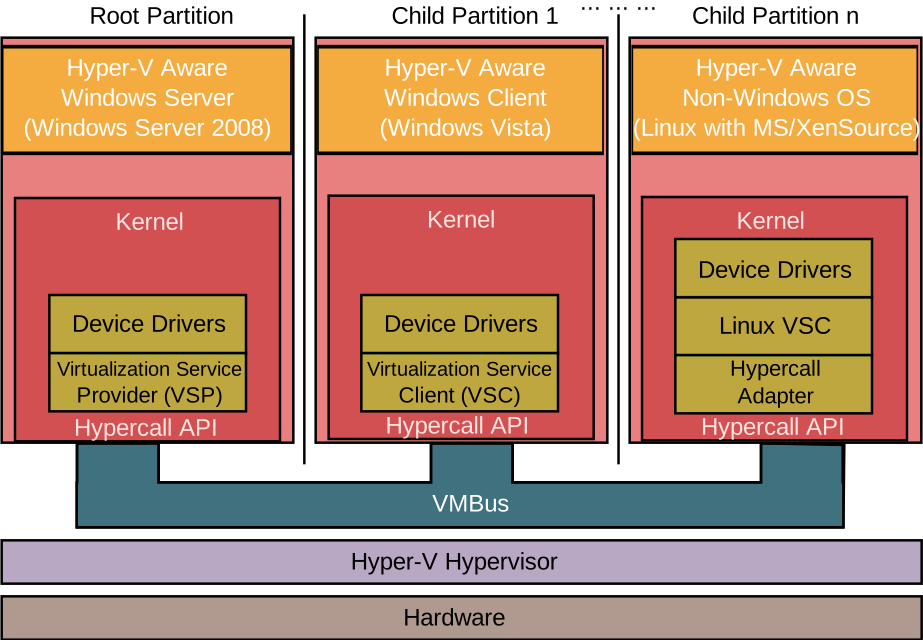
Main article: Hyper-V
Hyper-V is hypervisor-based virtualization software, forming a core part of Microsoft's virtualization strategy. It virtualizes servers on an operating system's kernel layer. It can be thought of as partitioning a single physical server into multiple small computational partitions. Hyper-V includes the ability to act as a Xen virtualization hypervisor host allowing Xen-enabled guest operating systems to run virtualized. A beta version of Hyper-V shipped with certain x86-64 editions of Windows Server 2008, prior to Microsoft's release of the final version of Hyper-V on 26 June 2008 as a free download. Also, a standalone variant of Hyper-V exists; this variant supports only x86-64 architecture.{{cite web |access-date = 2007-07-09
Windows System Resource Manager
Main article: Windows System Resource Manager
Windows System Resource Manager (WSRM) is integrated into Windows Server 2008. It provides resource management and can be used to control the amount of resources a process or a user can use based on business priorities. Process Matching Criteria, which is defined by the name, type or owner of the process, enforces restrictions on the resource usage by a process that matches the criteria. CPU time, bandwidth that it can use, number of processors it can be run on, and allocated to a process can be restricted. Restrictions can be set to be imposed only on certain dates as well.
Server Manager
Server Manager is a new roles-based management tool for Windows Server 2008.{{cite web |access-date=2007-05-02 |archive-date=2007-10-24 |archive-url=https://web.archive.org/web/20071024015129/http://technet2.microsoft.com/windowsserver2008/en/library/b3274a34-7574-4ea6-aec0-e05ba297481e1033.mspx?mfr=true |url-status=dead
Protocol and cryptography
- Support for 128- and 256-bit AES encryption for the Kerberos authentication protocol.
- New cryptography (CNG) API which supports elliptic-curve cryptography and improved certificate management.
- Secure Socket Tunneling Protocol, a new Microsoft proprietary VPN protocol.
- AuthIP, a Microsoft proprietary extension of the IKE cryptographic protocol used in IPsec VPN networks.
- Server Message Block 2.0 protocol in the new TCP/IP stack provides a number of communication enhancements, including greater performance when connecting to file shares over high-latency links and better security through the use of mutual authentication and message signing.
Miscellaneous
- Fully componentized operating system.
- Improved hot patching, a feature that allows non-kernel patches to occur without the need for a reboot.
- Support for being booted from Extensible Firmware Interface (EFI)-compliant firmware on x86-64 systems.
- Dynamic Hardware Partitioning supports hot-addition or replacement of processors and memory, on capable hardware.
- Windows Deployment Services (WDS) replacing Automated Deployment Services Windows Server 2008 home entertainment and Remote Installation Services. Windows Deployment Services supports an enhanced multicast feature when deploying operating system images.
- Internet Information Services 7 – Increased security, Robocopy deployment, improved diagnostic tools, delegated administration.
- Windows Internal Database, a variant of SQL Server Express 2005, which serves as a common storage back-end for several other components such as Windows System Resource Manager, Windows SharePoint Services and Windows Server Update Services. It is not intended to be used by third-party applications.
- An optional "desktop experience" component provides the same Windows Aero user interface as Windows Vista, both for local users, as well as remote users connecting through Remote Desktop.
Removed features
- The Open Shortest Path First (OSPF) routing protocol component in Routing and Remote Access Service was removed.
- Services for Macintosh, which provided file and print sharing via the now deprecated AppleTalk protocol, has been removed. Services for Macintosh were initially removed in Windows XP but were available in Windows Server 2003.
- NTBackup is replaced by Windows Server Backup, and no longer supports backing up to tape drives. As a result of NTBackup removal, Exchange Server 2007 does not have volume snapshot backup functionality; however Exchange Server 2007 SP2 adds back an Exchange backup plug-in for Windows Server Backup which restores partial functionality. Windows Small Business Server and Windows Essential Business Server both include this Exchange backup component.
- The POP3 service has been removed from Internet Information Services 7.0. The SMTP (Simple Mail Transfer Protocol) service is not available as a server role in IIS 7.0, it is a server feature managed through IIS 6.0.
- NNTP (Network News Transfer Protocol) is no longer part of Internet Information Services 7.0.
- ReadyBoost, which is available in Windows Vista, is not supported in Windows Server 2008.
Editions

Most editions of Windows Server 2008 are available in x86-64 and IA-32 variants. These editions come in two DVDs: One for installing the IA-32 variant and the other for x64. Windows Server 2008 for Itanium-based Systems supports IA-64 processors. The IA-64 variant is optimized for high-workload scenarios like database servers and Line of Business (LOB) applications. As such, it is not optimized for use as a file server or media server. Windows Server 2008 is the last 32-bit Windows server operating system.{{cite web |access-date = 2007-07-09 Editions of Windows Server 2008 include: |access-date = 2007-07-09
- Windows Server 2008 Foundation (codenamed "Lima"; x86-64) for OEMs only
- Windows Server 2008 Standard (IA-32 and x86-64)
- Windows Server 2008 Enterprise (IA-32 and x86-64)
- Windows Server 2008 Datacenter (IA-32 and x86-64)
- Windows Server 2008 for Itanium-based Systems (IA-64)
- Windows Web Server 2008 (IA-32 and x86-64)
- Windows HPC Server 2008 (codenamed "Socrates"; replacing Windows Compute Cluster Server)
- Windows Storage Server 2008 (codenamed "Magni"; IA-32 and x86-64)
- Windows Small Business Server 2008 (codenamed "Cougar"; x86-64) for small businesses
- Windows Essential Business Server 2008 (codenamed "Centro"; x86-64) for medium-sized businesses – this edition was discontinued in 2010.
The Microsoft Imagine program, known as DreamSpark at the time, used to provide verified students with the 32-bit variant of Windows Server 2008 Standard Edition, but the version has since then been removed. However, they still provide the R2 release.
The Server Core feature is available in the Web, Standard, Enterprise and Datacenter editions.
Windows Server 2008 Foundation Released on May 21, 2009.
System requirements
System requirements for Windows Server 2008 are as follows:
| Criteria | 2008 | 2008 R2 | url=https://msdn2.microsoft.com/en-us/windowsserver/cc196364.aspx | access-date=2008-03-31 | title=Windows Server 2008 System Requirements | date=31 March 2008}} | Recommended | url=https://www.microsoft.com/windowsserver2008/en/us/system-requirements.aspx | title=Microsoft Windows Server 2008 System Requirements | publisher=Microsoft.com | access-date=2013-01-09}} | Recommended |
|---|---|---|---|---|---|---|---|---|---|---|---|---|
| CPU | 2 GHz or faster | 1.4 GHz (x86-64 or Itanium) | 2 GHz or faster | |||||||||
| RAM | 512 MB | 2 GB or greater | 512 MB | 2 GB or greater | ||||||||
| HDD | 40 GB or greater | |||||||||||
| Devices | DVD drive, 800 × 600 or higher display, keyboard and mouse |
Scalability
Windows Server 2008 supports the following maximum hardware specifications:
| Specification | Windows Server 2008 | Windows Server 2008 R2 |
|---|---|---|
| Physical processors | ||
| ("sockets") | ||
| Logical processors | ||
| when Hyper-V is disabled | 256 | |
| Logical processors | ||
| when Hyper-V is enabled | 64 | |
| Memory | ||
| on IA-32 | ||
| Memory | ||
| on x64 | ||
| Memory | ||
| on Itanium | 2 TB |
Updates
Main article: Windows Vista#Updates
Windows Server 2008 shares most of its updates with Windows Vista, given that the operating systems share a codebase. A workaround using the Microsoft Update Catalog allowed the installation of updates for Windows Server 2008 on Windows Vista, adding nearly 3 years of security updates to that operating system (Support for Windows Vista ended on April 11, 2017, while support for Windows Server 2008 ended on January 14, 2020).
Service Pack 2
Main article: Windows Vista#Service Pack 2
The RTM release of Windows Server 2008 already includes the updates and fixes of Windows Vista Service Pack 1.
Service Pack 2 was initially announced on October 24, 2008{{cite web |access-date=2008-10-29 |archive-date=2008-10-28 |archive-url=https://web.archive.org/web/20081028173310/http://blogs.technet.com/windowsserver/archive/2008/10/24/windows-server-2008-service-pack-2-beta.aspx |url-status=dead
Windows Vista and Windows Server 2008 share the same service pack update binary.
Platform Update
On October 27, 2009, Microsoft released the Platform Update for Windows Server 2008 and Windows Vista. It backports several APIs and libraries introduced in Windows Server 2008 R2 and Windows 7 to Windows Server 2008 and Windows Vista, including the Ribbon API, DirectX 11, the XPS library, the Windows Automation API and the Portable Device Platform. A supplemental update was released in 2011 to provide improvements and bug fixes.
Internet Explorer 9
Main article: Internet Explorer 9
Windows Server 2008 shipped with Internet Explorer 7, the same version that shipped with Windows Vista. The last supported version of Internet Explorer for Windows Server 2008 was Internet Explorer 9, released in 2011. Internet Explorer 9 was continually updated with cumulative monthly update rollups until support for Internet Explorer 9 on Windows Server 2008 ended on January 14, 2020. IE9 continued to receive updates as long as the operating system was with Extended Security Updates until January 10, 2023 for non-Azure customers and January 9, 2024 for Azure customers respectively and January 2026 for Premium Assurance customers.
.NET Framework
The latest supported version of the .NET Framework officially is version 4.6, released on October 15, 2015.
TLS 1.1 and 1.2 support
In July 2017, Microsoft released an update to add TLS 1.1 and 1.2 support to Windows Server 2008, however it is disabled by default after installing the update.
SHA-2 signing support
Starting in March 2019, Microsoft began transitioning to exclusively signing Windows updates with the SHA-2 algorithm. As a result of this Microsoft released several updates throughout 2019 to add SHA-2 signing support to Windows Server 2008.
Monthly update rollups
In June 2018, Microsoft announced that they would be moving Windows Server 2008 to a monthly update model beginning with updates released in September 2018 – two years after Microsoft switched the rest of their supported operating systems to that model.
With the new update model, instead of updates being released as they became available, only two update packages were released on the second Tuesday of every month until Windows Server 2008 reached its end of life – one package containing security and quality updates, and a smaller package that contained only the security updates. Users could choose which package they wanted to install each month. Later in the month, another package would be released which was a preview of the next month's security and quality update rollup.
Installing the preview rollup package released for Windows Server 2008 on March 19, 2019, or any later released rollup package, will update the operating system kernel's build number from version 6.0.6002 to 6.0.6003. This change was made so Microsoft could continue to service the operating system while avoiding "version-related issues".
The last free security update rollup packages were released on January 14, 2020.
Windows Server 2008 R2
Main article: Windows Server 2008 R2
A second release of Windows Server 2008 (codenamed: Windows Server 7) based on Windows 7, Windows Server 2008 R2, was released to manufacturing on July 22, 2009 and became generally available on October 22, 2009. New features added in Windows Server 2008 R2 include new virtualization features, new Active Directory features, Internet Information Services 7.5 and support for up to 256 logical processors. It is the first server operating system by Microsoft to exclusively support 64-bit processors, while consumer-oriented versions of Windows maintained 32-bit support until Windows 11 in 2021. It is also the final version of Windows Server that supports IA-64-based processors.
A service pack for Windows 7 and Windows Server 2008 R2, formally designed Service Pack 1, was released in February 2011.
Support lifecycle
Support for the RTM version of Windows Server 2008 ended on July 12, 2011, and users can no longer receive further security updates for the operating system. As a component of Windows Vista, Windows Server 2008 with Service Pack 2 continued to be supported with security updates, lasting until January 14, 2020, the same respective end-of-life dates of its successor, Windows Server 2008 R2 and Windows 7.
Microsoft planned to end support for Windows Server 2008 on January 12, 2016. However, in order to give customers more time to migrate to newer Windows versions, particularly in developing or emerging markets, Microsoft decided to extend support to January 14, 2020.
Paid extended updates
Windows Server 2008 was eligible for the paid Extended Security Updates (ESU) program. The program allowed volume license customers to purchase, in yearly installments, security updates for the operating system for three additional years, until January 10, 2023. The program was also included with Microsoft Azure purchases, and Azure customers received an extra year of support, until January 9, 2024. The licenses are paid for on a per-machine basis. If a user purchases an Extended Security Updates license in a later year of the program, they must pay for any previous years of Extended Security Updates as well.{{cite web |access-date=January 9, 2022
Prior to the ESU program becoming available, Windows Server 2008 was eligible for the now discontinued, paid Premium Assurance program (an add-on to Microsoft Software Assurance) available to volume license customers. However, Microsoft honored the program for customers who purchased it between March 2017 and July 2018 (while it was available). The program provided an extra six years of security update support. The Extended Security Updates program for Windows Server 2008 ended on January 13, 2026, marking the final end of all security updates for the Windows NT 6.0 product line after 19 years, 2 months, and 5 days.
Paid extended updates were not available for Itanium customers.
Notes
References
References
- (4 February 2008). "As Windows Server 2008 RTMs, Customers and Partners Adopting with Help of New Tools, Training". [[Microsoft]].
- "Build number changing to 6003 in Windows Server 2008".
- "January 13, 2026—KB5073697 (Monthly Rollup)". Microsoft.
- "Product Lifecycle FAQ – Extended Security Updates – Microsoft Lifecycle".
- (12 July 2018). "Announcing new options for SQL Server 2008 and Windows Server 2008 End of Support".
- "Extended Security Updates for SQL Server and Windows Server 2008 and 2008 R2 {{!}} Microsoft".
- Foley, Mary Jo. (December 8, 2016). "Microsoft to offer option of 16 years of Windows Server, SQL Server support through new Premium Assurance offer". [[Red Ventures]].
- "Windows Server Premium Assurance SQL Server Premium Assurance".
- (January 21, 2020). "Not dead yet: Windows Server 2008 users have options".
- Nate Mook. (10 July 2007). "New Windows Server, Visual Studio, SQL Server to Launch in February". BetaNews.
- "Dynamic Hardware Partitioning Architecture". MSDN.
- Archiveddocs. "Active Directory Lightweight Directory Services Overview".
- (16 May 2008). "Deploying Windows Server 2008 Read Only Domain Controllers".
- (2008-03-24). "Q. What is a read-only domain controller (RODC)?".
- (2009-11-04). "Failover Cluster Validation Error 80070005 on Windows Server 2008 R2 x64". Capitalhead.
- Zoeller, Jill. (26 July 2007). "New in Windows Server 2008: Breaking the 5K Folder "Barrier" in Domain-Based Namespaces". Microsoft.
- (2010-01-20). "Benchmarking Hyper-V on Windows Server 2008 R2 x64".
- "Unexpected error refreshing Server Manager-0x800706BE and 1601 on Window Server 2008 R2".
- (29 August 2007). "Multicasting OS deployments with Windows Server 2008". Microsoft.
- (29 August 2011). "Removed technologies in Routing and Remote Access in Windows Server 2008". Microsoft.
- (17 January 2013). "Windows Server Backup Step-by-Step Guide for Windows Server 2008". Microsoft.
- (11 May 2009). "Exchange Server 2007 Service Pack 2 available in Q3 2009". The Exchange Team Blog.
- Bilic, Nino. (18 June 2008). "To Backup or Not to Backup? Yes! To backup!!". The Exchange Team Blog.
- "IIS 7.0 Protocols". Microsoft.
- (2009-04-17). "Windows Server 2008 Foundation: An Entry-Level Server Platform". Petri IT Knowledgebase.
- Ligman, Eric. (7 November 2007). "Announcing Windows Essential Business Server". Microsoft.
- (2010-12-31). "Windows Essential Business Server 2008".
- "Windows Server 2008, Microsoft Lifecycle (Look at the Note below links)".
- (31 March 2008). "Windows Server 2008 System Requirements".
- "Microsoft Windows Server 2008 System Requirements". Microsoft.com.
- "Microsoft Windows Server 2008 System Requirements". Microsoft.
- Savill, John. (October 28, 2011). "Q: What are Windows Server 8's Scalability Numbers?". [[Penton Media]].
- Seldam, Matthijs ten. (October 13, 2012). "Windows Server – Sockets, Logical Processors, Symmetric Multi Threading". Microsoft.
- "Memory Limits for Windows and Windows Server Releases". Microsoft.
- (2017-06-24). "Extend Windows Vista support by installing Windows Server 2008 updates – gHacks Tech News".
- "Windows Vista Lifecycle Policy". [[Microsoft]].
- "Tech ARP – ED#107 : Latest Details on Windows Vista Service Pack 2 Rev. 2.2".
- "Windows Vista Service Pack 2 Beta".
- (27 October 2009). "Announcing Final Releases of Platform Update for Windows Vista Technologies".
- "Platform Update Supplement for Windows Vista and for Windows Server 2008".
- "Cumulative security update for Internet Explorer: January 14, 2020".
- "Microsoft .NET Framework 4.6 (Web Installer)".
- (2017-07-20). "TLS 1.2 Support added to Windows Server 2008".
- "2019 SHA-2 Code Signing Support requirement for Windows and WSUS".
- (June 13, 2018). "Microsoft Switching Windows Server 2008 SP2 to Monthly Update Rollup Model".
- "Community".
- "January 14, 2020—KB4534303 (Monthly Rollup)".
- (2009-07-22). "Windows Server 2008 R2 Reaches the RTM Milestone! – Windows Server Blog – Site Home – TechNet Blogs". Blogs.technet.com.
- (2009-07-22). "When to expect Windows Server 2008 R2 RTM – Windows Server Blog – Site Home – TechNet Blogs". Blogs.technet.com.
- LeBlanc, Brandon. (February 9, 2011). "Announcing Availability of Windows 7 and Windows Server 2008 R2 SP1". Microsoft.
- "Microsoft Product Lifecycle". Microsoft.
- "Microsoft Update Catalog 2022-01".
- "Microsoft Update Catalog 2024-04".
This article was imported from Wikipedia and is available under the Creative Commons Attribution-ShareAlike 4.0 License. Content has been adapted to SurfDoc format. Original contributors can be found on the article history page.
Ask Mako anything about Windows Server 2008 — get instant answers, deeper analysis, and related topics.
Research with MakoFree with your Surf account
Create a free account to save articles, ask Mako questions, and organize your research.
Sign up freeThis content may have been generated or modified by AI. CloudSurf Software LLC is not responsible for the accuracy, completeness, or reliability of AI-generated content. Always verify important information from primary sources.
Report