From Surf Wiki (app.surf) — the open knowledge base
Wind power
Electrical power generation from wind
Electrical power generation from wind

Wind power is the use of wind energy to generate useful work. Historically, wind power was used by sails, windmills and windpumps, but today it is mostly used to generate electricity. This article deals only with wind power for electricity generation. Today, wind power is generated almost completely using wind turbines, generally grouped into wind farms and connected to the electrical grid.
In 2024, wind supplied about 2,500 TWh of electricity, which was over 8% of world electricity. 30 countries generated more than a tenth of their electricity from wind power in 2024 and wind generation has nearly tripled since 2015. To help meet the Paris Agreement goals to limit climate change, analysts say it should expand much faster – by over 1% of electricity generation per year.
Wind power is a sustainable, renewable energy source, and has a much smaller impact on the environment than burning fossil fuels. Wind power is variable, so it needs energy storage or other dispatchable generation energy sources to attain a reliable supply of electricity. Land-based (onshore) wind farms have a greater visual impact on the landscape than most other power stations per energy produced. Wind farms sited offshore have less visual impact and have higher capacity factors, although they are generally more expensive. Offshore wind power currently has a share of about 10% of new installations.
Wind power is one of the lowest-cost electricity sources per unit of energy produced. In many locations, new onshore wind farms are cheaper than new coal or gas plants.
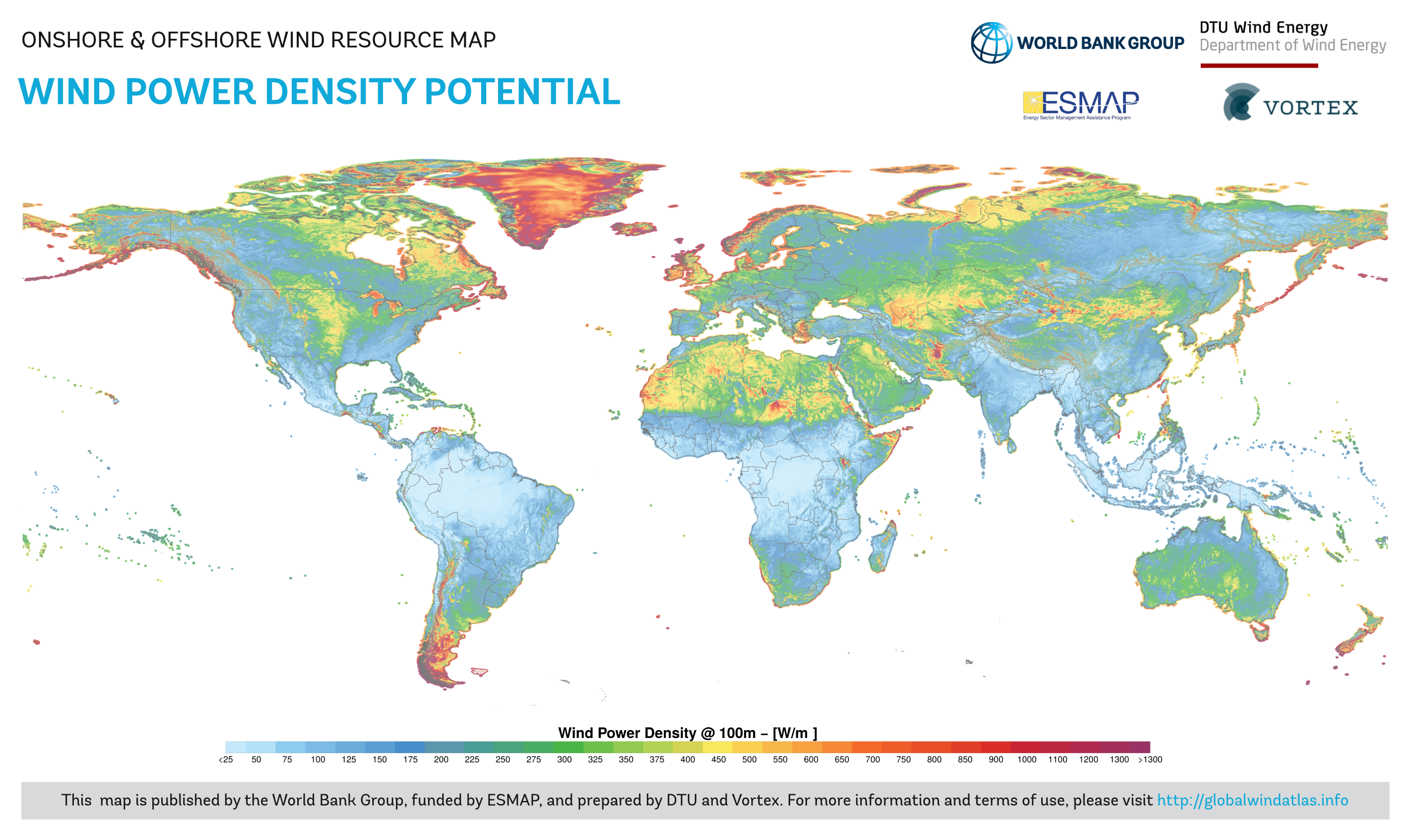
Regions in the higher northern and southern latitudes have the highest potential for wind power. In most regions, wind power generation is higher in nighttime, and in winter when solar power output is low. So combinations of wind and solar power are suitable in many countries.
Wind energy resources


Wind is air movement in the Earth's atmosphere. In a unit of time, say 1 second, the volume of air that had passed an area A is Av. If the air density is \rho, the flow rate of this volume of air is \tfrac{M}{\Delta t}=\rho Av, and the power transfer, or energy transfer per second is P =\tfrac {1}{2}\tfrac{M}{\Delta t} v^{2}= \tfrac {1}{2}\rho A v^{3}. Wind power is thus proportional to the third power of the wind speed; the available power increases eightfold when the wind speed doubles. Change of wind speed by a factor of 2.1544 increases the wind power by one order of magnitude (multiply by 10).
The global wind kinetic energy averaged approximately 1.50 MJ/m2 over the period from 1979 to 2010, 1.31 MJ/m2 in the Northern Hemisphere with 1.70 MJ/m2 in the Southern Hemisphere. The atmosphere acts as a thermal engine, absorbing heat at higher temperatures, releasing heat at lower temperatures. The process is responsible for the production of wind kinetic energy at a rate of 2.46 W/m2 thus sustaining the circulation of the atmosphere against friction.
Through wind resource assessment, it is possible to estimate wind power potential globally, by country or region, or for a specific site. The Global Wind Atlas provided by the Technical University of Denmark in partnership with the World Bank provides a global assessment of wind power potential. Unlike 'static' wind resource atlases which average estimates of wind speed and power density across multiple years, tools such as Renewables.ninja provide time-varying simulations of wind speed and power output from different wind turbine models at an hourly resolution. More detailed, site-specific assessments of wind resource potential can be obtained from specialist commercial providers, and many of the larger wind developers have in-house modeling capabilities.
The total amount of economically extractable power available from the wind is considerably more than present human power use from all sources. The strength of wind varies, and an average value for a given location does not alone indicate the amount of energy a wind turbine could produce there.
To assess prospective wind power sites, a probability distribution function is often fit to the observed wind speed data. Different locations will have different wind speed distributions. The Weibull model closely mirrors the actual distribution of hourly/ten-minute wind speeds at many locations. The Weibull factor is often close to 2 and therefore a Rayleigh distribution can be used as a less accurate, but simpler model.
Wind farms
Main article: Wind farm, List of onshore wind farms
| Wind farm | Capacity | ||
|---|---|---|---|
| (MW) | Country | Refs | |
| Gansu Wind Farm | 7,965 | China | |
| Muppandal Wind Farm | 1,500 | India | |
| Alta (Oak Creek-Mojave) | 1,320 | United States | |
| Jaisalmer Wind Park | 1,064 | India |
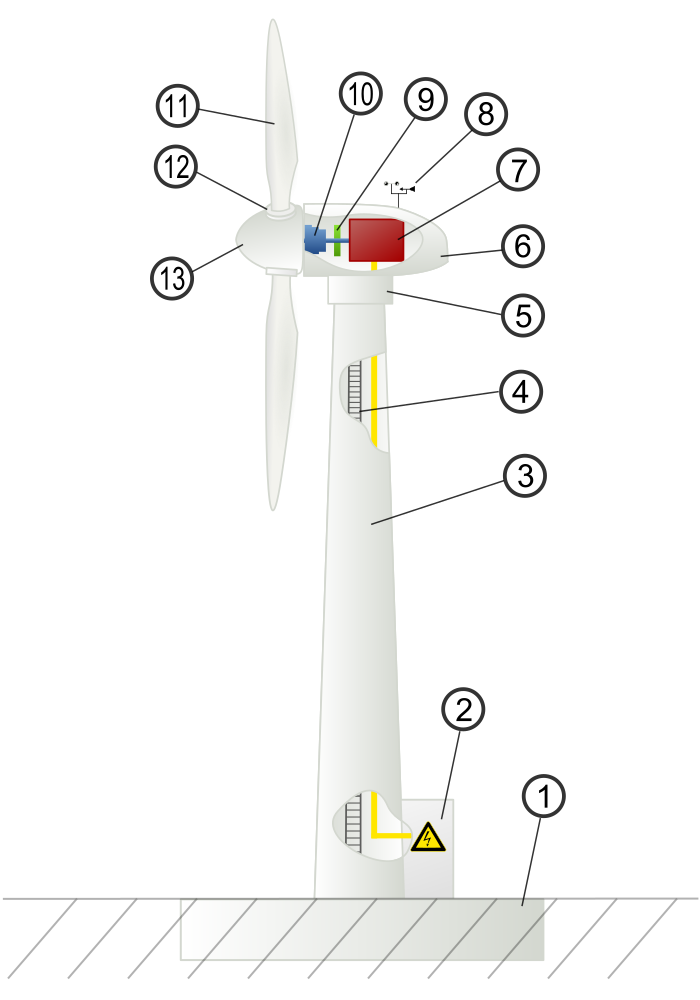
A wind farm is a group of wind turbines in the same location. A large wind farm may consist of several hundred individual wind turbines distributed over an extended area. The land between the turbines may be used for agricultural or other purposes. A wind farm may also be located offshore. Almost all large wind turbines have the same design — a horizontal axis wind turbine having an upwind rotor with 3 blades, attached to a nacelle on top of a tall tubular tower.
In a wind farm, individual turbines are interconnected with a medium voltage (often 34.5 kV) power collection system and communications network. In general, a distance of 7D (7 times the rotor diameter of the wind turbine) is set between each turbine in a fully developed wind farm. At a substation, this medium-voltage electric current is increased in voltage with a transformer for connection to the high voltage electric power transmission system.
Generator characteristics and stability
Most modern turbines use variable speed generators combined with either a partial or full-scale power converter between the turbine generator and the collector system, which generally have more desirable properties for grid interconnection and have low-voltage ride-through capabilities. Modern turbines use either doubly fed electric machines with partial-scale converters or squirrel-cage induction generators or synchronous generators (both permanently and electrically excited) with full-scale converters. Black start is possible and is being further developed for places (such as Iowa) which generate most of their electricity from wind.
Transmission system operators will supply a wind farm developer with a grid code to specify the requirements for interconnection to the transmission grid. This will include the power factor, the constancy of frequency, and the dynamic behaviour of the wind farm turbines during a system fault.
Offshore wind power
Main article: Offshore wind power, List of offshore wind farms
Offshore wind power is wind farms in large bodies of water, usually the sea. These installations can use the more frequent and powerful winds that are available in these locations and have less visual impact on the landscape than land-based projects. However, the construction and maintenance costs are considerably higher.
As of November 2021, the Hornsea Wind Farm in the United Kingdom is the largest offshore wind farm in the world at 1,218 MW.
Collection and transmission network
Near offshore wind farms may be connected by AC and far offshore by HVDC.
Wind power resources are not always located near areas with a high population density. As transmission lines become longer, the losses associated with power transmission increase, as modes of losses at lower lengths are exacerbated and new modes of losses are no longer negligible as the length is increased; making it harder to transport large loads over large distances.
When the transmission capacity does not meet the generation capacity, wind farms are forced to produce below their full potential or stop running altogether, in a process known as curtailment. While this leads to potential renewable generation left untapped, it prevents possible grid overload or risk to reliable service.
One of the biggest current challenges to wind power grid integration in some countries is the necessity of developing new transmission lines to carry power from wind farms, usually in remote lowly populated areas due to availability of wind, to high load locations, usually on the coasts where population density is higher. Any existing transmission lines in remote locations may not have been designed for the transport of large amounts of energy. In particular geographic regions, peak wind speeds may not coincide with peak demand for electrical power, whether offshore or onshore. A possible future option may be to interconnect widely dispersed geographic areas with an HVDC super grid.
Wind power capacity and production
Main article: Wind power by country, Wind power industry
In 2024, wind supplied over 2,494 TWh of electricity, which was 8.1% of world electricity.
Growth trends
| width = 250 | align=right | pos=bottom | content= | width = 280 | height = 280 | stack = 1 | group 1 = 0 : 0 : 0 : 0 : 0 : 0 : 0 : 0 : 0 : 0 : 1 : 1 : 1 : 1 : 1 : 2 : 2 : 2 : 2 | group 2 = 1 : 1 : 3 : 3 : 4 : 5 : 5 : 5 : 5 : 6 : 5 : 7 : 8 : 8 : 9 : 8 : 8 : 10 : 11 | group 3 = 6 : 10 : 10 : 10 : 12 : 12 : 15 : 17 : 19 : 18 : 18 : 18 : 20 : 21 : 22 : 25 : 25 : 26 : 27 | colors = #990000 : #FFaa77 : #FFccaa | group names = installed more than 100 GW : installed between 10 and 100 GW : installed between 1 and 10 GW | units suffix = _countries | hide group legends = 1 | x legends = : 2005 : : : : : 2010: : : : : 2015 : : : : : 2020 : : | caption =Growing number of wind gigawatt-markets | #FFccaa | border=1px solid #ccccaa | Above 1-GW mark}} | {{aligned table | cols=5 | style=width: 50%; text-align: left; font-size: 100%; margin-left: 22px; | 2022 | CRO | KAZ | 2021 | RUS | TAI | VIE | 2019 | ARG | THA | UKR | 2018 | PAK | EGY | 2017 | NOR | 2016 | CHI | URU | KOR | 2015 | SA | FIN | 2012 | MEX | ROM | 2011 | BRA | BEL | 2010 | AUT | POL | TUR | 2009 | GRE | 2008 | IRE | AUS | SWE | 2006 | CAN | FRA | 2005 | UK | CHN | JP | POR | 2004 | NED | ITA | 1999 | SPA | IND | 1997 | DEN | 1995 | GER | 1986 | USA | #FFaa77 | border=1px solid #ccaa77 | Above 10-GW mark}} | {{aligned table | cols=5 | style=width: 50%; text-align: left; font-size: 100%; margin-left: 22px; | 2022 | AUS | 2021 | SWE | TUR | 2018 | ITA | 2016 | BRA | 2015 | CAN | FRA | 2013 | UK | 2009 | IND | 2008 | CHN | 2006 | USA | SPA | 2002 | GER | #990000 | border=1px solid #200000 | Above 100-GW mark}} | {{aligned table | cols=5 | style=width: 50%; text-align: left; font-size: 100%; margin-left: 22px; | 2019 | USA | 2014 | CHN |
|---|
To help meet the Paris Agreement's goals to limit climate change, analysts say it should expand much faster than it currently is – by over 1% of electricity generation per year. Expansion of wind power is being hindered by fossil fuel subsidies.
The actual amount of electric power that wind can generate is calculated by multiplying the nameplate capacity by the capacity factor, which varies according to equipment and location. Estimates of the capacity factors for wind installations are in the range of 35% to 44%.
Capacity factor
Since wind speed is not constant, a wind farm's annual energy production is never as much as the sum of the generator nameplate ratings multiplied by the total hours in a year. The ratio of actual productivity in a year to this theoretical maximum is called the capacity factor. Online data is available for some locations, and the capacity factor can be calculated from the yearly output.
Penetration

Wind energy penetration is the fraction of energy produced by wind compared with the total generation. Wind power's share of worldwide electricity usage in 2021 was almost 7%, up from 3.5% in 2015.
There is no generally accepted maximum level of wind penetration. The limit for a particular grid will depend on the existing generating plants, pricing mechanisms, capacity for energy storage, demand management, and other factors. An interconnected electric power grid will already include reserve generating and transmission capacity to allow for equipment failures. This reserve capacity can also serve to compensate for the varying power generation produced by wind stations. Studies have indicated that 20% of the total annual electrical energy consumption may be incorporated with minimal difficulty. | archive-url=https://web.archive.org/web/20081126220129/http://www.ases.org/images/stories/file/ASES/climate_change.pdf | archive-date=26 November 2008 These studies have been for locations with geographically dispersed wind farms, some degree of dispatchable energy or hydropower with storage capacity, demand management, and interconnected to a large grid area enabling the export of electric power when needed. Electrical utilities continue to study the effects of large-scale penetration of wind generation on system stability.
A wind energy penetration figure can be specified for different duration of time but is often quoted annually. To generate almost all electricity from wind annually requires substantial interconnection to other systems, for example some wind power in Scotland is sent to the rest of the British grid. On a monthly, weekly, daily, or hourly basis—or less—wind might supply as much as or more than 100% of current use, with the rest stored, exported or curtailed. The seasonal industry might then take advantage of high wind and low usage times such as at night when wind output can exceed normal demand. Such industry might include the production of silicon, aluminum, steel, or natural gas, and hydrogen, and using future long-term storage to facilitate 100% energy from variable renewable energy. Homes and businesses can also be programmed to vary electricity demand, for example by remotely turning up water heater thermostats.
Variability
Main article: Variable renewable energy

Wind power is variable, and during low wind periods, it may need to be replaced by other power sources. Transmission networks presently cope with outages of other generation plants and daily changes in electrical demand, but the variability of intermittent power sources such as wind power is more frequent than those of conventional power generation plants which, when scheduled to be operating, may be able to deliver their nameplate capacity around 95% of the time.
Electric power generated from wind power can be highly variable at several different timescales: hourly, daily, or seasonally. Annual variation also exists but is not as significant. Because instantaneous electrical generation and consumption must remain in balance to maintain grid stability, this variability can present substantial challenges to incorporating large amounts of wind power into a grid system. Intermittency and the non-dispatchable nature of wind energy production can raise costs for regulation, incremental operating reserve, and (at high penetration levels) could require an increase in the already existing energy demand management, load shedding, storage solutions, or system interconnection with HVDC cables.
Fluctuations in load and allowance for the failure of large fossil-fuel generating units require operating reserve capacity, which can be increased to compensate for the variability of wind generation.
Utility-scale batteries are often used to balance hourly and shorter timescale variation, but car batteries may gain ground from the mid-2020s. Wind power advocates argue that periods of low wind can be dealt with by simply restarting existing power stations that have been held in readiness, or interlinking with HVDC.
The combination of diversifying variable renewables by type and location, forecasting their variation, and integrating them with dispatchable renewables, flexible fueled generators, and demand response can create a power system that has the potential to meet power supply needs reliably. Integrating ever-higher levels of renewables is being successfully demonstrated in the real world.

Solar power tends to be complementary to wind. On daily to weekly timescales, high-pressure areas tend to bring clear skies and low surface winds, whereas low-pressure areas tend to be windier and cloudier. On seasonal timescales, solar energy peaks in summer, whereas in many areas wind energy is lower in summer and higher in winter. Thus the seasonal variation of wind and solar power tend to cancel each other somewhat. Wind hybrid power systems are becoming more popular.
Predictability
Main article: Wind power forecasting
For any particular generator, there is an 80% chance that wind output will change less than 10% in an hour and a 40% chance that it will change 10% or more in 5 hours.
In summer 2021, wind power in the United Kingdom fell due to the lowest winds in seventy years, In the future, smoothing peaks by producing green hydrogen may help when wind has a larger share of generation.
While the output from a single turbine can vary greatly and rapidly as local wind speeds vary, as more turbines are connected over larger and larger areas the average power output becomes less variable and more predictable. Weather forecasting permits the electric-power network to be readied for the predictable variations in production that occur.
It is thought that the most reliable low-carbon electricity systems will include a large share of wind power.
Energy storage
Main article: Grid energy storage

Typically, conventional hydroelectricity complements wind power very well. When the wind is blowing strongly, nearby hydroelectric stations can temporarily hold back their water. When the wind drops they can, provided they have the generation capacity, rapidly increase production to compensate. This gives a very even overall power supply and virtually no loss of energy and uses no more water.
Alternatively, where a suitable head of water is not available, pumped-storage hydroelectricity or other forms of grid energy storage such as compressed air energy storage and thermal energy storage can store energy developed by high-wind periods and release it when needed. The type of storage needed depends on the wind penetration level – low penetration requires daily storage, and high penetration requires both short- and long-term storage – as long as a month or more. Stored energy increases the economic value of wind energy since it can be shifted to displace higher-cost generation during peak demand periods. The potential revenue from this arbitrage can offset the cost and losses of storage. Although pumped-storage power systems are only about 75% efficient and have high installation costs, their low running costs and ability to reduce the required electrical base-load can save both fuel and total electrical generation costs.
Energy payback
The energy needed to build a wind farm divided into the total output over its life, Energy Return on Energy Invested, of wind power varies, but averages about 20–25. Thus, the energy payback time is typically around a year.
Economics

Onshore wind is an inexpensive source of electric power, cheaper than coal plants and new gas plants. According to BusinessGreen, wind turbines reached grid parity (the point at which the cost of wind power matches traditional sources) in some areas of Europe in the mid-2000s, and in the US around the same time. Falling prices continue to drive the Levelized cost down and it has been suggested that it has reached general grid parity in Europe in 2010, and will reach the same point in the US around 2016 due to an expected reduction in capital costs of about 12%. In 2021, the CEO of Siemens Gamesa warned that increased demand for low-cost wind turbines combined with high input costs and high costs of steel result in increased pressure on the manufacturers and decreasing profit margins.
Northern Eurasia, Canada, some parts of the United States, and Patagonia in Argentina are the best areas for onshore wind: whereas in other parts of the world solar power, or a combination of wind and solar, tend to be cheaper.
Electric power cost and trends
Wind power is capital intensive but has no fuel costs. The price of wind power is therefore much more stable than the volatile prices of fossil fuel sources. However, the estimated average cost per unit of electric power must incorporate the cost of construction of the turbine and transmission facilities, borrowed funds, return to investors (including the cost of risk), estimated annual production, and other components, averaged over the projected useful life of the equipment, which may be more than 20 years. Energy cost estimates are highly dependent on these assumptions so published cost figures can differ substantially.
The presence of wind energy, even when subsidized, can reduce costs for consumers (€5 billion/yr in Germany) by reducing the marginal price and by minimizing the use of expensive peaking power plants.
The cost has decreased as wind turbine technology has improved. There are now longer and lighter wind turbine blades, improvements in turbine performance, and increased power generation efficiency. Also, wind project capital expenditure costs and maintenance costs have continued to decline.
In 2021, a Lazard study of unsubsidized electricity said that wind power levelized cost of electricity continues to fall but more slowly than before. The study estimated new wind-generated electricity cost from $26 to $50/MWh, compared to new gas power from $45 to $74/MWh. The median cost of fully deprecated existing coal power was $42/MWh, nuclear $29/MWh and gas $24/MWh. The study estimated offshore wind at around $83/MWh. Compound annual growth rate was 4% per year from 2016 to 2021, compared to 10% per year from 2009 to 2021.
The value of wind power
While the levelised costs of wind power may have reached that of traditional combustion based power technologies, the market value of the generated power is also lower due to the merit order effect, which implies that electricity market prices are lower in hours with substantial generation of variable renewable energy due to the low marginal costs of this technology.{{cite journal | first1=Lion |last1= Hirth| title=The market value of variable renewables: The effect of solar wind power variability on their relative price|journal=Energy Economics|volume=38 |year=2013|pages= 218–236|issn= 0140-9883| doi= 10.1016/j.eneco.2013.02.004 |bibcode= 2013EneEc..38..218H|url= https://nbn-resolving.org/urn:nbn:de:kobv:b1570-opus4-22900|hdl=1814/27135|hdl-access=free}} The effect has been identified in several European markets.{{ cite journal |first1 =Marijke| last1=Welisch |first2=André |last2=Ortner| first3=Gustav |last3=Resch | title =Assessment of RES technology market values and the merit-order effect – an econometric multi-country analysis|journal = Energy & Environment| volume = 27| number = 1| pages = 105–121| year =2016| doi = 10.1177/0958305X16638574
Incentives and community benefits
Turbine prices have fallen significantly in recent years due to tougher competitive conditions such as the increased use of energy auctions, and the elimination of subsidies in many markets. As of 2021, subsidies are still often given to offshore wind. However, they are generally no longer necessary for onshore wind in countries with even a very low carbon price such as China, provided there are no competing fossil fuel subsidies.
Secondary market forces provide incentives for businesses to use wind-generated power, even if there is a premium price for the electricity. For example, socially responsible manufacturers pay utility companies a premium that goes to subsidize and build new wind power infrastructure. Companies use wind-generated power, and in return, they can claim that they are undertaking strong "green" efforts. Wind projects provide local taxes, or payments in place of taxes and strengthen the economy of rural communities by providing income to farmers with wind turbines on their land.
The wind energy sector can also produce jobs during the construction and operating phase. Jobs include the manufacturing of wind turbines and the construction process, which includes transporting, installing, and then maintaining the turbines. An estimated 1.25 million people were employed in wind power in 2020.
Small-scale wind power
Main article: Small wind turbine
Small-scale wind power is the name given to wind generation systems with the capacity to produce up to 50 kW of electrical power. Isolated communities, that may otherwise rely on diesel generators, may use wind turbines as an alternative. Individuals may purchase these systems to reduce or eliminate their dependence on grid electric power for economic reasons, or to reduce their carbon footprint. Wind turbines have been used for household electric power generation in conjunction with battery storage over many decades in remote areas.
Examples of small-scale wind power projects in an urban setting can be found in New York City, where, since 2009, several building projects have capped their roofs with Gorlov-type helical wind turbines. Although the energy they generate is small compared to the buildings' overall consumption, they help to reinforce the building's 'green' credentials in ways that "showing people your high-tech boiler" cannot, with some of the projects also receiving the direct support of the New York State Energy Research and Development Authority.
Grid-connected domestic wind turbines may use grid energy storage, thus replacing purchased electric power with locally produced power when available. The surplus power produced by domestic microgenerators can, in some jurisdictions, be fed into the network and sold to the utility company, producing a retail credit for the microgenerators' owners to offset their energy costs.
Off-grid system users can either adapt to intermittent power or use batteries, photovoltaic, or diesel systems to supplement the wind turbine. Equipment such as parking meters, traffic warning signs, street lighting, or wireless Internet gateways may be powered by a small wind turbine, possibly combined with a photovoltaic system, that charges a small battery replacing the need for a connection to the power grid.
Airborne wind turbines, such as kites, can be used in places at risk of hurricanes, as they can be taken down in advance.
Impact on environment and landscape
Main article: Environmental impact of wind power

The environmental impact of electricity generation from wind power is minor when compared to that of fossil fuel power. Wind turbines have some of the lowest life-cycle greenhouse-gas emissions of energy sources: far less greenhouse gas is emitted than for the average unit of electricity, so wind power helps limit climate change. Use of engineered wood may allow carbon negative wind power. Wind power consumes no fuel, and emits no local air pollution, unlike fossil fuel power sources.
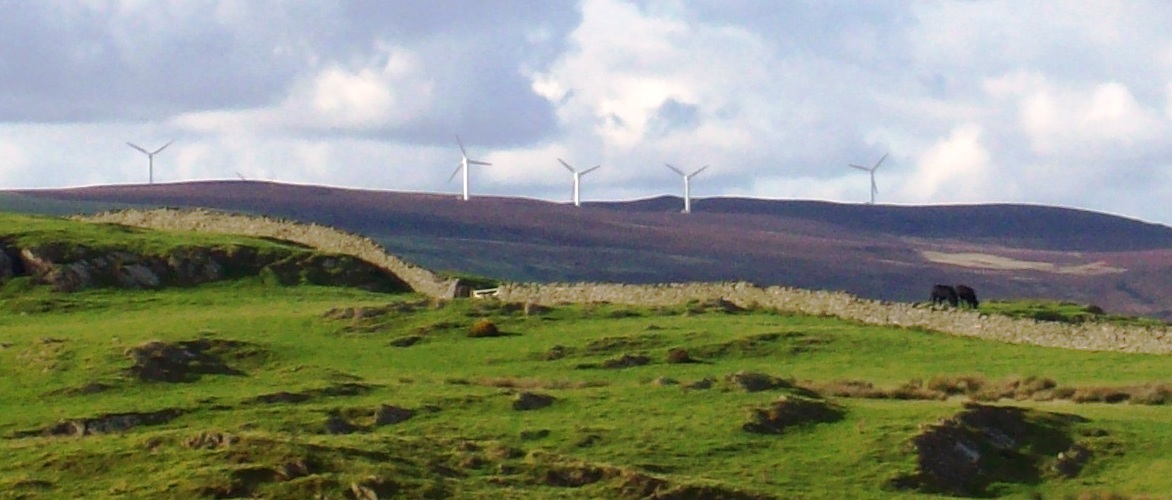
Onshore wind farms can have a significant visual impact. Due to a very low surface power density and spacing requirements, wind farms typically need to be spread over more land than other power stations. Their network of turbines, access roads, transmission lines, and substations can result in "energy sprawl"; although land between the turbines and roads can still be used for agriculture. Some wind farms are opposed for potentially spoiling protected scenic areas, archaeological landscapes and heritage sites. A report by the Mountaineering Council of Scotland concluded that wind farms harmed tourism in areas known for natural landscapes and panoramic views.
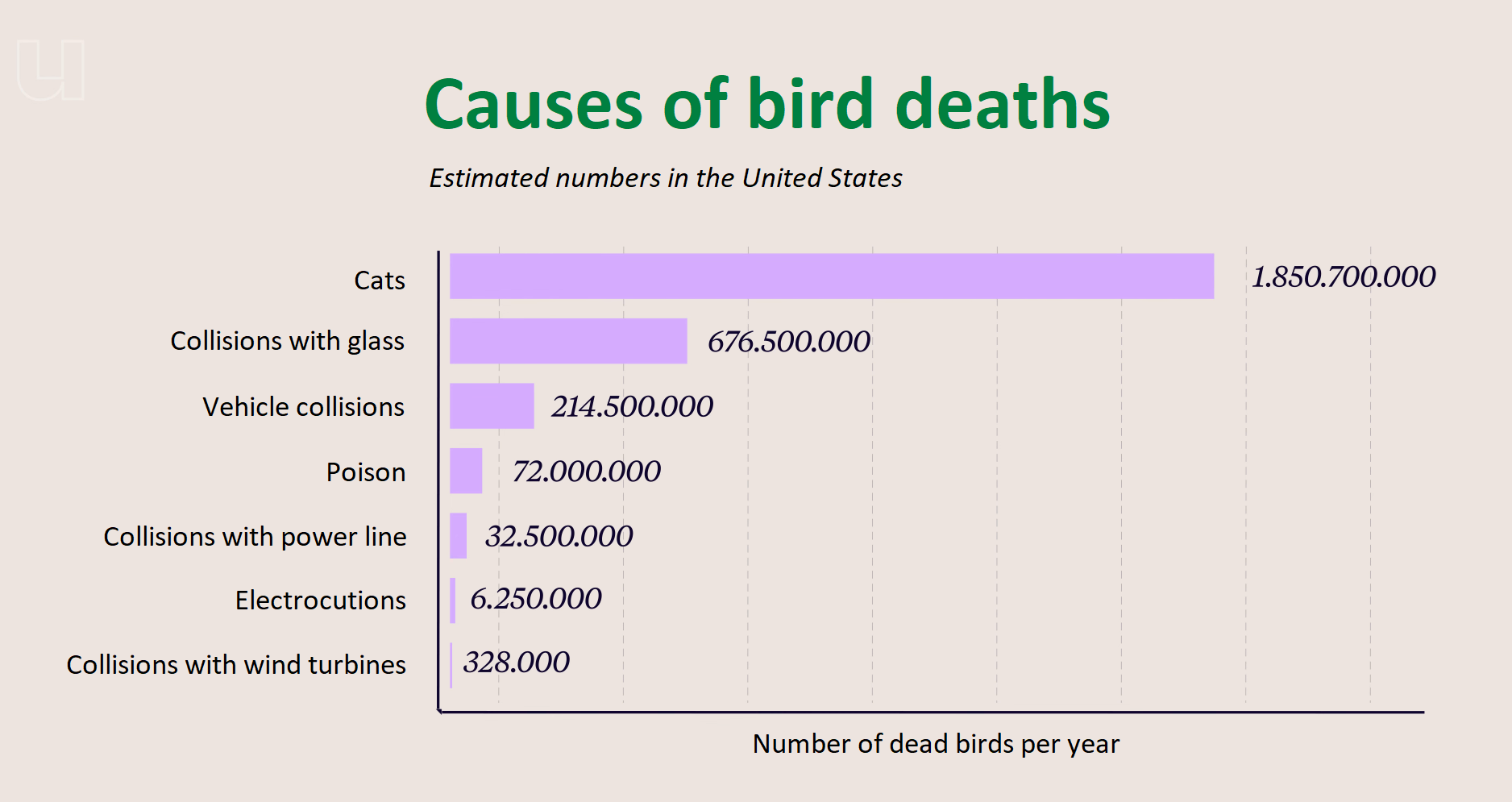
Habitat loss and fragmentation are the greatest potential impacts on wildlife of onshore wind farms, but the worldwide ecological impact is minimal. Thousands of birds and bats, including rare species, have been killed by wind turbine blades, though wind turbines are responsible for far fewer bird deaths than fossil-fueled power stations when climate change effects are included. The effects of wind turbines on birds can be mitigated with proper wildlife monitoring.
Many wind turbine blades are made of fiberglass, and have a lifetime of 20 years. Blades are hollow: some blades are crushed to reduce their volume and then landfilled. However, as they can take a lot of weight they can be made into long lasting small bridges for walkers or cyclists. Blade end-of-life is complicated, and blades manufactured in the 2020s are more likely to be designed to be completely recyclable.
Wind turbines also generate noise. At a distance of 300 m, this may be around 45 dB, which is slightly louder than a refrigerator. At 1.5 km, they become inaudible. There are anecdotal reports of negative health effects on people who live very close to wind turbines. Peer-reviewed research has generally not supported these claims.
Politics
Central government
Although wind turbines with fixed bases are a mature technology and new installations are generally no longer subsidized, floating wind turbines are a relatively new technology so some governments subsidize them, for example to use deeper waters.
Fossil fuel subsidies by some governments are slowing the growth of renewables.
Permitting of wind farms can take years and some governments are trying to speed up – the wind industry says this will help limit climate change and increase energy security – sometimes groups such as fishers resist this but governments say that rules protecting biodiversity will still be followed.
Public opinion

Surveys of public attitudes across Europe and in many other countries show strong public support for wind power. Bakker et al. (2012) found in their study that residents who did not want turbines built near them suffered significantly more stress than those who "benefited economically from wind turbines".
Although wind power is a popular form of energy generation, onshore or near offshore wind farms are sometimes opposed for their impact on the landscape (especially scenic areas, heritage areas and archaeological landscapes), as well as noise, and impact on tourism.
In other cases, there is direct community ownership of wind farms. The hundreds of thousands of people who have become involved in Germany's small and medium-sized wind farms demonstrate such support there.
A 2010 Harris Poll found strong support for wind power in Germany, other European countries, and the United States.
Public support in the United States has decreased from 75% in 2020 to 62% in 2021, with the Democratic Party supporting the use of wind energy twice as much as the Republican Party. President Biden signed an executive order to begin building large scale wind farms.
In China, Shen et al. (2019) found that Chinese city-dwellers may be resistant to building wind turbines in urban areas, with a surprisingly high proportion of people citing an unfounded fear of radiation as driving their concerns. Also, the study finds that like their counterparts in OECD countries, urban Chinese respondents are sensitive to direct costs and wildlife externalities. Distributing relevant information about turbines to the public may alleviate resistance.
Community
Many wind power companies work with local communities to reduce environmental and other concerns associated with particular wind farms. In other cases there is direct community ownership of wind farm projects. Appropriate government consultation, planning and approval procedures also help to minimize environmental risks. Some may still object to wind farms but many say their concerns should be weighed against the need to address the threats posed by air pollution, climate change and the opinions of the broader community.
In the US, wind power projects are reported to boost local tax bases, helping to pay for schools, roads, and hospitals, and to revitalize the economies of rural communities by providing steady income to farmers and other landowners.
In the UK, both the National Trust and the Campaign to Protect Rural England have expressed concerns about the effects on the rural landscape caused by inappropriately sited wind turbines and wind farms.
Some wind farms have become tourist attractions. The Whitelee Wind Farm Visitor Centre has an exhibition room, a learning hub, a café with a viewing deck and also a shop. It is run by the Glasgow Science Centre.
In Denmark, a loss-of-value scheme gives people the right to claim compensation for loss of value of their property if it is caused by proximity to a wind turbine. The loss must be at least 1% of the property's value.
Despite this general support for the concept of wind power in the public at large, local opposition often exists and has delayed or aborted a number of projects. As well as concerns about the landscape, there are concerns that some installations can produce excessive sound and vibration levels leading to a decrease in property values. A study of 50,000 home sales near wind turbines found no statistical evidence that prices were affected.
While aesthetic issues are subjective and some find wind farms pleasant and optimistic, or symbols of energy independence and local prosperity, protest groups are often formed to attempt to block some wind power stations for various reasons.
Some opposition to wind farms is dismissed as NIMBYism, but research carried out in 2009 found that there is little evidence to support the belief that residents only object to wind farms because of a "Not in my Back Yard" attitude.
Geopolitics
Wind cannot be cut off unlike oil and gas so can contribute to energy security.
Turbine design
Main article: Wind turbine, Wind turbine design
|[[File: Scout moor gearbox, rotor shaft and brake assembly.jpg|thumb|right|Typical components of a wind turbine (gearbox, rotor shaft and brake assembly) being lifted into position]]}}
Wind turbines are devices that convert the wind's kinetic energy into electrical power. The result of over a millennium of windmill development and modern engineering, today's wind turbines are manufactured in a wide range of horizontal axis and vertical axis types. The smallest turbines are used for applications such as battery charging for auxiliary power. Slightly larger turbines can be used for making small contributions to a domestic power supply while selling unused power back to the utility supplier via the electrical grid. Arrays of large turbines, known as wind farms, have become an increasingly important source of renewable energy and are used by many countries to reduce their reliance on fossil fuels.
Wind turbine design is the process of defining the form and specifications of a wind turbine to extract energy from the wind. A wind turbine installation consists of the necessary systems needed to capture the wind's energy, point the turbine into the wind, convert mechanical rotation into electrical power, and other systems to start, stop, and control the turbine.
In 1919, the German physicist Albert Betz showed that for a hypothetical ideal wind-energy extraction machine, the fundamental laws of conservation of mass and energy allowed no more than 16/27 (59%) of the kinetic energy of the wind to be captured. This Betz limit can be approached in modern turbine designs, which may reach 70 to 80% of the theoretical Betz limit.
The aerodynamics of a wind turbine are not straightforward. The airflow at the blades is not the same as the airflow far away from the turbine. The very nature of how energy is extracted from the air also causes air to be deflected by the turbine. This affects the objects or other turbines downstream, which is known as "wake effect". Also, the aerodynamics of a wind turbine at the rotor surface exhibit phenomena that are rarely seen in other aerodynamic fields. The shape and dimensions of the blades of the wind turbine are determined by the aerodynamic performance required to efficiently extract energy from the wind, and by the strength required to resist the forces on the blade.
In addition to the aerodynamic design of the blades, the design of a complete wind power system must also address the design of the installation's rotor hub, nacelle, tower structure, generator, controls, and foundation.
History
Main article: History of wind power

Wind power has been used as long as humans have put sails into the wind. Wind-powered machines used to grind grain and pump water, the windmill and wind pump, were developed in what is now Iran, Afghanistan, and Pakistan by the 9th century. Wind power was widely available and not confined to the banks of fast-flowing streams, or later, requiring sources of fuel. Wind-powered pumps drained the polders of the Netherlands, and in arid regions such as the American mid-west or the Australian outback, wind pumps provided water for livestock and steam engines.
The first wind turbine used for the production of electric power was built in Scotland in July 1887 by Prof James Blyth of Anderson's College, Glasgow (the precursor of Strathclyde University). Blyth's 10 m high cloth-sailed wind turbine was installed in the garden of his holiday cottage at Marykirk in Kincardineshire, and was used to charge accumulators developed by the Frenchman Camille Alphonse Faure, to power the lighting in the cottage, thus making it the first house in the world to have its electric power supplied by wind power. Blyth offered the surplus electric power to the people of Marykirk for lighting the main street, however, they turned down the offer as they thought electric power was "the work of the devil". Although he later built a wind turbine to supply emergency power to the local Lunatic Asylum, Infirmary, and Dispensary of Montrose, the invention never really caught on as the technology was not considered to be economically viable.
Across the Atlantic, in Cleveland, Ohio, a larger and heavily engineered machine was designed and constructed in the winter of 1887–1888 by Charles F. Brush. This was built by his engineering company at his home and operated from 1886 until 1900. The Brush wind turbine had a rotor 17 m in diameter and was mounted on an 18-metre (59ft) tall tower. Although large by today's standards, the machine was only rated at 12 kW. The connected dynamo was used either to charge a bank of batteries or to operate up to 100 incandescent light bulbs, three arc lamps, and various motors in Brush's laboratory. With the development of electric power, wind power found new applications in lighting buildings remote from centrally generated power. Throughout the 20th century parallel paths developed small wind stations suitable for farms or residences. From 1932 many isolated properties in Australia ran their lighting and electric fans from batteries, charged by a "Freelite" wind-driven generator, producing 100watts of electrical power from as little wind speed as 10 mph.
The 1973 oil crisis triggered the investigation in Denmark and the United States that led to larger utility-scale wind generators that could be connected to electric power grids for remote use of power. By 2008, the U.S. installed capacity had reached 25.4 gigawatts, and by 2012 the installed capacity was 60 gigawatts. Today, wind-powered generators operate in every size range, from tiny stations for battery charging at isolated residences, up to gigawatt-sized offshore wind farms that provide electric power to national electrical networks. The European Union is working to augment these prospects.
In 2023, the global wind power sector experienced significant growth, with 116.6 gigawatts (GW) of new capacity added to the power grid, representing a 50% increase over the amount added in 2022. This surge in capacity brought the total installed wind power capacity worldwide to 1,021 GW by the end of the year, marking a growth of 13% compared to the previous year.
Notes
References
References
- "Wind Power – Analysis".
- "Wind energy generation vs. installed capacity".
- (2022-03-25). "Global wind industry breezes into new record".
- (2024-05-07). "Global Electricity Review 2025".
- "Expansion of wind and solar power too slow to stop climate change".
- (2018-01-12). "What are the pros and cons of onshore wind energy?". Grantham Research Institute on Climate Change and the Environment, London School of Economics and Political Science.
- (2015-01-22). "The Energy Footprint: How Oil, Natural Gas, and Wind Energy Affect Land for Biodiversity and the Flow of Ecosystem Services". [[BioScience]].
- (19 March 2020). "Global Wind Report 2019". Global Wind Energy Council.
- "Global Wind Atlas". DTU Technical University of Denmark.
- (2022-05-01). "Pieces of a puzzle: solar-wind power synergies on seasonal and diurnal timescales tend to be excellent worldwide". Environmental Research Communications.
- "Global Wind Atlas". [[Technical University of Denmark]] (DTU).
- "Global Wind Atlas".
- (2015). "A 32-year perspective on the origin of wind energy in a warming climate". Renewable Energy.
- [https://www.worldbank.org/en/news/press-release/2017/11/28/mapping-the-worlds-wind-energy-potential Mapping the World's Wind Energy Potential] {{Webarchive. link. (25 September 2018 ''[[World Bank]]'', 28 November 2017.)
- [http://www.vindenergi.dtu.dk/english/news/2017/11/new-global-wind-atlas-to-be-presented-at-windeurope-conference New Global Wind Atlas to be presented at WindEurope Conference] {{Webarchive. link. (25 September 2018 ''[[Technical University of Denmark]]'', 21 November 2017.)
- (1 November 2016). "Using bias-corrected reanalysis to simulate current and future wind power output". Energy.
- Hurley, Brian. "How Much Wind Energy is there?". Claverton Group.
- Savenkov, M. (2009). "On the truncated weibull distribution and its usefulness in evaluating potential wind (or wave) energy sites". University Journal of Engineering and Technology.
- "Describing Wind Variations: Weibull Distribution". Danish Wind Industry Association.
- Watts, Jonathan & Huang, Cecily. [https://www.theguardian.com/world/2012/mar/19/china-windfarms-renewable-energy Winds Of Change Blow Through China As Spending On Renewable Energy Soars] {{Webarchive. link. (15 June 2013 , ''[[The Guardian]]'', 19 March 2012, revised on 20 March 2012. Retrieved 4 January 2012.)
- "Muppandal (India)". thewindpower.net.
- [http://www.terra-genpower.com/News/Terra-Gen-Power-Announces-Closing-of-$650-Million-.aspx Terra-Gen Press Release] {{webarchive. link. (10 May 2012, 17 April 2012)
- [http://www.business-standard.com/india/news/suzlon-creates-country/s-largest-wind-park/164779/on Started in August 2001, the Jaisalmer based facility crossed 1,000 MW capacity to achieve this milestone] {{Webarchive. link. (1 October 2012 . Business-standard.com (11 May 2012). Retrieved on 20 July 2016.)
- "Wind Farm Electrical Systems".
- (1 March 2012). "Optimal turbine spacing in fully developed wind farm boundary layers". Wind Energy.
- "Making of the modern offshore substation".
- (1 October 2014). "IECON 2014 – 40th Annual Conference of the IEEE Industrial Electronics Society".
- (2014). "The state of the art of wind energy conversion systems and technologies: A review". Energy Conversion and Management.
- (2020-11-03). "ScottishPower in 'pioneering world first' after wind farm black-out boost".
- "As the grid adds wind power, researchers have to reengineer recovery from power outages".
- (2005). "Wind plant integration". IEEE Power and Energy Magazine.
- (2005). "Making connections". IEEE Power and Energy Magazine.
- (29 August 2021). "Floating wind turbines could open up vast ocean tracts for renewable power". The Guardian.
- Hulazan, Ned. (16 February 2011). "Offshore wind power – Advantages and disadvantages". Renewable Energy Articles.
- Millborrow, David. (6 August 2010). "Cutting the cost of offshore wind energy". Haymarket.
- (2020-01-30). "World's Largest Offshore Wind Farm Fully Up and Running".
- Action, BMWK-Federal Ministry for Economics Affairs and Climate. "Connecting offshore wind energy to the grid".
- Power System Analysis and Design. Glover, Sarma, Overbye/ 5th Edition
- link. (24 November 2021 . Pressherald.com (4 August 2013). Retrieved on 20 July 2016.)
- (2021-04-07). "From West to East: The Charged Challenge of Delivering Electricity".
- link. (1 July 2017 . ''New York Times'')
- Barnard, Michael. (2021-11-11). "Breaking News: China & USA Joint Declaration On Climate Action Collaboration".
- (5 December 2022). "Share of cumulative power capacity by technology, 2010–2027". International Energy Agency (IEA).
- "Wind energy generation by region".
- (2021-10-29). "UNDP: More spent on fossil fuel subsidies than fighting poverty".
- Mohseni-Cheraghlou, Amin. (2021-02-23). "Fossil fuel subsidies and renewable energies in MENA: An oxymoron?". Middle East Institute.
- (2021-11-15). "COP26: How much is spent supporting fossil fuels and green energy?". BBC News.
- Rick Tidball and others, [http://www.nrel.gov/docs/fy11osti/48595.pdf "Cost and Performance Assumptions for Modeling Electricity Generation Technologies"] {{Webarchive. link. (21 August 2014 , US National Renewable Energy Laboratory, November 2010, p.63.)
- [http://view2.fatspaniel.net/FST/Portal/LighthouseElectrical/maritime/HostedAdminView.html Massachusetts Maritime Academy — Bourne, Mass] {{webarchive. link. (11 February 2007 This 660 kW wind turbine has a capacity factor of about 19%.)
- [http://www.ieso.ca/imoweb/marketdata/windpower.asp Wind Power in Ontario] {{webarchive. link. (10 August 2014 These wind farms have capacity factors of about 28–35%.)
- "Share of electricity production from wind".
- (7 October 2025). "Global Electricity Mid-Year Insights 2025". Ember.
- "Renewable energy". [[BP]].
- "BP Statistical Review of World Energy June 2016 – Electricity". BP.
- "BP Statistical Review of World Energy June 2016 – Renewable energy". BP.
- (2021-12-08). "New research shows Wind turbines, configured right, could provide grid stability".
- (2022-04-01). "Low winds blamed for fall in Scotland's renewable energy production". BBC News.
- Andresen, Tino. "[https://www.bloomberg.com/news/articles/2014-11-27/molten-aluminum-lakes-offer-power-storage-for-german-wind-farms Molten Aluminum Lakes Offer Power Storage for German Wind Farms] {{Webarchive. link. (7 April 2017 " ''[[Bloomberg News). Bloomberg]]'', 27 October 2014.
- Luoma, Jon R.. (13 July 2001). "The Challenge for Green Energy: How to Store Excess Electricity". E360.yale.edu.
- Buczynski, Beth. (23 August 2012). "Power To Gas Technology Turns Excess Wind Energy Into Natural Gas". Revmodo.com.
- "What is demand-side response".
- (2022-07-18). "Managing wind volatility in Ireland with demand response".
- "Demand Response – Analysis".
- Katz, Cheryl. (18 December 2020). "The batteries that could make fossil fuels obsolete".
- (2021-01-14). "Report: An additional 20GWh of battery storage could significantly reduce wind power curtailment in UK".
- (9 September 2021). "Answers to the UK's wind energy storage issues are emerging – NS Energy".
- [http://www.risoe.dk/rispubl/reports/ris-r-1608_186-195.pdf Realisable Scenarios for a Future Electricity Supply based 100% on Renewable Energies] {{webarchive. link. (1 July 2014 Gregor Czisch, University of Kassel, Germany and Gregor Giebel, Risø National Laboratory, Technical University of Denmark)
- "Annual variable renewable energy share and corresponding system integration phase in selected countries/regions, 2018 – Charts – Data & Statistics".
- Wood, Shelby (21 January 2008) [http://blog.oregonlive.com/pdxgreen/2008/01/wind_sun_join_forces_at_washin.html Wind + sun join forces at Washington power plant] {{Webarchive. link. (18 January 2012 . ''The Oregonian''.)
- "Small Wind Systems". Seco.cpa.state.tx.us.
- (10 January 2008). "Lake Erie Wind Resource Report, Cleveland Water Crib Monitoring Site, Two-Year Report Executive Summary". Green Energy Ohio.
- Kaspar, F., Borsche, M., Pfeifroth, U., Trentmann, J., Drücke, J., and Becker, P.: A climatological assessment of balancing effects and shortfall risks of photovoltaics and wind energy in Germany and Europe, Adv. Sci. Res., 16, 119–128, https://doi.org/10.5194/asr-16-119-2019 {{Webarchive. link. (24 November 2021 , 2019)
- (2021-11-23). "Turkish Cengiz evaluates expansion of its giant hybrid power plant".
- "Wind Systems Integration Basics".
- Stevens, Pippa. (2021-09-29). "UK energy titan SSE says low wind, driest conditions in 70 years hit renewable generation".
- "'UK's largest electrolyser' could fuel hundreds of bus journeys with wind power each day".
- (2005). "Variability of Wind Power and other Renewables: Management Options and Strategies". IEA.
- (2020). "Current advances and approaches in wind speed and wind power forecasting for improved renewable energy integration: A review". Engineering Reports.
- (2021-10-22). "Geophysical constraints on the reliability of solar and wind power worldwide". Nature Communications.
- "Dinorwig Hydroelectric Plant, Wales". Thegreenage.co.uk.
- The Future of Electrical Energy Storage: The economics and potential of new technologies 2 January 2009 ID RET2107622
- [https://web.archive.org/web/20160409063616/http://www.eoearth.org/view/article/152560/ Energy return on investment (EROI) for wind energy]. The Encyclopedia of Earth (7 June 2007)
- (2014). "Comparative life cycle assessment of 2.0 MW wind turbines". International Journal of Sustainable Manufacturing.
- "Onshore wind cost per kilowatt-hour".
- [http://www.businessgreen.com/bg/news/2124487/onshore-wind-reach-grid-parity-2016 "Onshore wind to reach grid parity by 2016"] {{Webarchive. link. (17 January 2012 , BusinessGreen, 14 November 2011)
- (16 March 2021). "World's largest offshore wind turbine maker warns of price pressures". Financial Times.
- (2021-07-15). "Low-cost renewable electricity as the key driver of the global energy transition towards sustainability". Energy.
- Dolf Gielen. "[https://web.archive.org/web/20140423214203/http://www.irena.org/DocumentDownloads/Publications/RE_Technologies_Cost_Analysis-WIND_POWER.pdf Renewable Energy Technologies: Cost Analysis Series: Wind Power]" ''[[International Renewable Energy Agency]]'', June 2012. Quote: "wind is capital intensive, but has no fuel costs"
- [http://www.nationalgridus.com/non_html/c3-3_NG_wind_policy.pdf Transmission and Wind Energy: Capturing the Prevailing Winds for the Benefit of Customers] {{Webarchive. link. (23 April 2014. National Grid US (September 2006).)
- Rao, K.R. (October 17, 2019). "Wind Energy for Power Generation: Meeting the Challenge of Practical Implementation". Springer Nature, 2019.
- Danielson, David. (14 August 2012). "A Banner Year for the U.S. Wind Industry". [[whitehouse.gov]].
- "Levelized Cost Of Energy, Levelized Cost Of Storage, and Levelized Cost Of Hydrogen".
- Reed, Stanley. (9 November 2017). "As Wind Power Sector Grows, Turbine Makers Feel the Squeeze". TNT.
- "China's 2022 Wind Power Growth to Stay Strong Despite Subsidy End".
- [https://speakerdeck.com/resourcesolutions/the-2010-green-e-verification-report The 2010 Green-e Verification Report] {{Webarchive. link. (11 June 2013 Retrieved on 20 May 2009)
- American Wind Energy Association (2009) [http://www.slideshare.net/Calion/awea-annual-wind-report-2009 Annual Wind Industry Report, Year Ending 2008] {{Webarchive. link. (13 January 2013 p. 11)
- (1 August 2011). "Direct Federal Financial Interventions and Subsidies in Energy in Fiscal Year 2010". Energy Information Administration.
- "WINDExchange: Wind Energy's Economic Impacts to Communities".
- "Wind energy industry – employment 2020".
- "Small-scale wind energy". Carbontrust.co.uk.
- Dodge, Darrell M.. "Part 2 – 20th Century Developments". TelosNet Web Development.
- link. (9 July 2017 , ''[[The New York Times]]'' website, 26 May 2014, and in print on 27 May 2014, p. A19 of the New York edition.)
- [http://www.thesundaytimes.co.uk/sto/Migration/article100906.ece Home-made energy to prop up grid] {{Webarchive. link. (18 August 2014 [[The Times]] 22 June 2008 Retrieved on 10 January 2013)
- (January 2019). "Potential Analysis of Hybrid Renewable Energy Systems for Self-Sufficient Residential Use in Germany and the Czech Republic". Energies.
- Kart, Jeff. (13 May 2009). "Wind, Solar-Powered Street Lights Only Need a Charge Once Every Four Days".
- Jones, Nicola. (10 March 2022). "The kites seeking the world's surest winds".
- "How Wind Energy Can Help Us Breathe Easier".
- (12 March 2023). "Swedish flatpack wood turbines could give wind power a green boost".
- (2022). "Visual impacts and acceptability of wind farms to councillors and senior council staff in Britain". International Journal of Environmental Studies.
- "What are the pros and cons of onshore wind energy?".
- "Why Australia needs wind power".
- "Wind energy Frequently Asked Questions". British Wind Energy Association.
- (27 March 2021). "Permission to build five turbine wind farm at Kilranelagh refused". [[Irish Independent]].
- (9 April 2021). "Department defends 500ft windfarm in protected Area of Outstanding Beauty". [[The News Letter]].
- (4 November 2019). "Building wind farms 'could destroy Welsh landscape'". BBC News.
- Gordon, David. [https://www.mountaineering.scot/assets/contentfiles/media-upload/Wind_farms_and_tourism_in_Scotland_-_a_review,_Nov_2017_20171106.pdf Wind farms and tourism in Scotland] {{Webarchive. link. (21 September 2020 . [[Mountaineering Council of Scotland]]. November 2017. p.3)
- (2022-02-08). "Predicted wind and solar energy expansion has minimal overlap with multiple conservation priorities across global regions". Proceedings of the National Academy of Sciences.
- Hosansky, David. (April 1, 2011). "Wind Power: Is wind energy good for the environment?". CQ Researcher.
- (2013). "The avian benefits of wind energy: A 2009 update". Renewable Energy.
- (2017). "Industrial wind turbine post-construction bird and bat monitoring: A policy framework for Canada". Journal of Environmental Management.
- Journalist, Energy. (2022-08-29). "How to manage future waste from wind turbine blades".
- (4 September 2019). "Sioux Falls landfill tightens rules after Iowa dumps dozens of wind turbine blades". [[Argus Leader]].
- (2023-09-07). "Renewable energy: The upcycled wind turbines getting a second life". BBC News.
- (2022-03-01). "The complex end-of-life of wind turbine blades: A review of the European context". Renewable and Sustainable Energy Reviews.
- (19 October 2021). "These bike shelters are made from wind turbines.".
- [http://www.gereports.com/post/92442325225/how-loud-is-a-wind-turbine How Loud Is A Wind Turbine?] {{Webarchive. link. (15 December 2014 . GE Reports (2 August 2014). Retrieved on 20 July 2016.)
- Gipe, Paul. (1995). "Wind Energy Comes of Age". John Wiley & Sons.
- Gohlke JM et al. Environmental Health Perspectives. (2008). "Health, Economy, and Environment: Sustainable Energy Choices for a Nation". Environmental Health Perspectives.
- Professor Simon Chapman. "[http://ses.library.usyd.edu.au/handle/2123/10559 Summary of main conclusions reached in 25 reviews of the research literature on wind farms and health] {{Webarchive. link. (22 May 2019 " [[Sydney University]] School of Public Health, April 2015)
- Hamilton, Tyler. (15 December 2009). "Wind Gets Clean Bill of Health". [[Toronto Star]].
- Colby, W. David et al. (December 2009) [http://www.canwea.ca/pdf/talkwind/Wind_Turbine_Sound_and_Health_Effects.pdf "Wind Turbine Sound and Health Effects: An Expert Panel Review"] {{Webarchive. link. (18 June 2020 , Canadian Wind Energy Association.)
- Buljan, Adrijana. (2022-11-11). "RWE Wins Dutch Subsidy-Free Offshore Wind Tender with 760 MW Project Including Green Hydrogen and Floating Solar".
- "Chinese Offshore Wind Capacity Boom Driven By State Subsidies".
- (27 July 2021). "Floating wind could be the key to clean energy transition".
- Timperley, Jocelyn. (2021-10-20). "Why fossil fuel subsidies are so hard to kill". Nature.
- (22 November 2022). "Explainer: What is offshore wind and what does its future look like?".
- Richards, Heather. (2022-12-01). "Biden wants to launch 16 offshore wind farms. Can he?".
- (8 November 2022). "Europe takes emergency action to remove permitting bottlenecks for wind power {{!}} REVE News of the wind sector in Spain and in the world".
- (3 October 2023). "Americans don't hate living near solar and wind farms as much as you might think". The Washington Post.
- "A Summary of Opinion Surveys on Wind Power".
- (28 February 2008). "Public attitudes to wind farms". Eon-uk.com.
- (2012). "Impact of wind turbine sound on annoyance, self-reported sleep disturbance and psychological distress". Science of the Total Environment.
- (2021-03-24). "Opposition to wind farm plans because of negative impact on 'tourism'".
- Schultz, Norm. (29 June 2021). "Wind Farm Opposition in the Great Lakes".
- (26 May 2009). "Community Power Empowers". Dsc.discovery.com.
- (28 February 2008). "Public attitudes to wind farms". Eon-uk.com.
- (8 June 2021). "Most Americans support expanding solar and wind energy, but Republican support has dropped".
- (29 March 2021). "FACT SHEET: Biden Administration Jumpstarts Offshore Wind Energy Projects to Create Jobs". The White House.
- (2019). "Public receptivity in China towards wind energy generators: A survey experimental approach". Energy Policy.
- "Wind Farms in Cumbria".
- Arnold, James. (20 September 2004). "Wind Turbulence over turbines in Cumbria". BBC News.
- "Group Dedicates Opening of 200 MW Big Horn Wind Farm: Farm incorporates conservation efforts that protect wildlife habitat". Renewableenergyaccess.com.
- Fisher, Jeanette. (2006). "Wind Power: MidAmerican's Intrepid Wind Farm". Environmentpsychology.com.
- (19 March 2008). "Stakeholder Engagement". Agl.com.au.
- "Wind Energy and the Environment". Renewable Energy House.
- "National Code for Wind Farms". Environment.gov.au.
- (17 December 2007). "New standard and big investment for wind energy". Publish.csiro.au.
- "Misinformation is derailing renewable energy projects across the United States". NPR.org.
- "Advantages and Challenges of Wind Energy".
- The Australia Institute (October 2006) [http://www.tai.org.au/documents/dp_fulltext/DP91.pdf Wind Farms: The facts and the fallacies] {{Webarchive. link. (25 February 2012 Discussion Paper No. 91, {{ISSN). 1322-5421, p. 28.
- [https://www.bbc.co.uk/news/uk-england-northamptonshire-17367028 "Wind farm to be built near a Northamptonshire heritage site"] {{Webarchive. link. (26 September 2018 , ''BBC News'', 14 March 2012. Retrieved 20 March 2012.)
- Hill, Chris. (30 April 2012). "CPRE calls for action over 'proliferation' of wind turbines". Archant community Media Ltd.
- "Whitelee Windfarm".
- (November 2009). "Wind Turbines in Denmark". section 6.8, p. 22, Danish Energy Agency.
- (2010). "Understanding 'local' opposition to wind development in the UK How big is a backyard?". Energy Policy.
- [http://www.wind-works.org/articles/tilting.html Tilting at Windmills: Public Opinion Toward Wind Energy] {{Webarchive. link. (18 January 2013 . Wind-works.org. Retrieved on 1 October 2013.)
- Yates, Ysabel (15 October 2012) [http://www.ecomagination.com/testing-the-waters-gaining-public-support-for-offshore-wind Testing the Waters: Gaining Public Support for Offshore Wind] {{Webarchive. link. (19 January 2013 . ecomagination.com)
- (30 October 2009). "Town Councilor regrets High Sheldon Wind Farm (Sheldon, NY)".
- Ben Hoen, Jason P. Brown, Thomas Jackson, Ryan Wiser, Mark Thayer and Peter Cappers. "[http://www.nwea.nl/sites/default/files/WOZ%20-%20Spatial%20hedonic%20analysis%20on%20surrounding%20property%20values%20%28Berkely%202013%29.pdf A Spatial Hedonic Analysis of the Effects of Wind Energy Facilities on Surrounding Property Values in the United States] {{webarchive. link. (17 November 2015 " p. 37. ''[[Lawrence Berkeley National Laboratory]]'', August 2013. [http://emp.lbl.gov/sites/all/files/lbnl-6362e.pdf Mirror] {{Webarchive). link. (18 November 2015)
- "Wind Energy Opposition and Action Groups". Wind-watch.org.
- Gourlay, Simon (12 August 2008) [https://www.theguardian.com/commentisfree/2008/aug/12/windpower.alternativeenergy Wind Farms Are Not Only Beautiful, They're Absolutely Necessary] {{Webarchive. link. (5 October 2013 , ''The Guardian''.)
- Aldred, Jessica (10 December 2007) [https://www.theguardian.com/environment/2007/dec/10/windpower.renewableenergy Q&A: Wind Power] {{Webarchive. link. (13 March 2016 , ''The Guardian''.)
- (20 October 2008). "Windmills vs. NIMBYism". Toronto Star.
- Donoghue, Andrew. (30 July 2009). "Wind industry should avoid branding opponents "Nimbys"".
- (2022-03-09). "Why onshore wind, not fracking, offers Boris Johnson a better weapon against Vladimir Putin".
- "Efficiency and performance". UK Department for Business, Enterprise & Regulatory Reform.
- [[Albert Betz. Betz, A.]]; Randall, D. G. (trans.). ''Introduction to the Theory of Flow Machines'', Oxford: [[Pergamon Press]], 1966.
- link. (5 January 2016 , [[John Wiley and Sons]], 2001, {{ISBN). 0-471-48997-2, p. 65.
- (24 July 2009). "What factors affect the output of wind turbines?". Alternative-energy-news.info.
- (27 July 2011). "University Collaboration on Wind Energy". Cornell University [[Atkinson Center for a Sustainable Future]].
- [[Ahmad Y Hassan]], [[Donald Routledge Hill]] (1986). ''Islamic Technology: An illustrated history'', p. 54. [[Cambridge University Press]]. {{ISBN. 0-521-42239-6.
- Lucas, Adam. (2006). "Wind, Water, Work: Ancient and Medieval Milling Technology". Brill Publishers.
- Price, Trevor J. (3 May 2005). "James Blyth – Britain's First Modern Wind Power Engineer". Wind Engineering.
- Shackleton, Jonathan. "World First for Scotland Gives Engineering Student a History Lesson". The Robert Gordon University.
- Anon. [http://www.scientificamerican.com/article/mr-brushs-windmill-dynamo/ Mr. Brush's Windmill Dynamo] {{Webarchive. link. (7 July 2017 , ''[[Scientific American]]'', Vol. 63 No. 25, 20 December 1890, p. 54.)
- [http://www.windpower.org/en/pictures/brush.htm A Wind Energy Pioneer: Charles F. Brush] {{webarchive. link. (8 September 2008, Danish Wind Industry Association. Accessed 2 May 2007.)
- "History of Wind Energy" in Cutler J. Cleveland (ed.) ''Encyclopedia of Energy''. Vol. 6, Elsevier, {{ISBN. 978-1-60119-433-6, 2007, pp. 421–22
- (16 December 1933). ""Freelite"". [[The Longreach Leader]].
- "History of U.S. Wind Energy".
- Widder, Jonathan. (25 October 2023). "Saubere Energie unaufhaltsam, EU beschleunigt Windkraft-Ausbau, Luchse zurück nach Sachsen". Squirrel News.
- Alex. (2024-04-15). "Global Wind Report 2024".
This article was imported from Wikipedia and is available under the Creative Commons Attribution-ShareAlike 4.0 License. Content has been adapted to SurfDoc format. Original contributors can be found on the article history page.
Ask Mako anything about Wind power — get instant answers, deeper analysis, and related topics.
Research with MakoFree with your Surf account
Create a free account to save articles, ask Mako questions, and organize your research.
Sign up freeThis content may have been generated or modified by AI. CloudSurf Software LLC is not responsible for the accuracy, completeness, or reliability of AI-generated content. Always verify important information from primary sources.
Report