From Surf Wiki (app.surf) — the open knowledge base
William Robertson (historian)
Scottish historian, cleric, and educator (1721–1793)

Scottish historian, cleric, and educator (1721–1793)
| Field | Value |
|---|---|
| name | William Robertson |
| image | File:Joshua Reynolds (1723-1792) - Reverend William Robertson (1721–1793), Historian and Principal of Edinburgh University - PG 1393 - National Galleries of Scotland.jpg |
| image_size | 200px |
| caption | Portrait painting of William Robertson, by Joshua Reynolds |
| honorific-suffix | FRSE FSA Scot |
| birth_date | |
| birth_place | Borthwick, Midlothian, Scotland |
| death_date | |
| death_place | Edinburgh, Scotland |
| nationality | British |
| office | Principal and Vice-Chancellor of the University of Edinburgh |
| term_start | 1 February 1762 |
| term_end | 11 June 1793 |
| predecessor | John Gowdie |
| successor | George Baird |
| module | {{Infobox scientist |
| embed | yes |
| field | History |
| alma_mater | University of Edinburgh |
| known_for | Principal of the University of Edinburgh |
| Moderator of the General Assembly of the Church of Scotland | |
| Historiographer Royal |
| honorific-prefix = | honorific-suffix = FRSE FSA Scot Moderator of the General Assembly of the Church of Scotland Historiographer Royal
William Robertson (19 September 1721 – 11 June 1793) was a Scottish historian, cleric, and educator who served as Principal of the University of Edinburgh, Chaplain of Stirling Castle, and one of the King's Chaplains in Scotland.
Robertson made significant contributions to the writing of Scottish history and the history of Spain and Spanish America, and his historiographical approach had considerable contemporary influence (particularly his emphasis on the consistency of human nature across different eras and societies). He was a notable figure in the Scottish Enlightenment, as well as a prominent representative of the Church of Scotland's moderate party.
Early life
Robertson was born at the manse of Borthwick, Midlothian, the son of Rev William Robertson (1686–1745), the local minister, and his wife Eleanor Pitcairn, daughter of David Pitcairne of Dreghorn. He was educated at Borthwick Parish School and Dalkeith Grammar School. The family moved to Edinburgh when his father became appointed minister of Lady Yester's Church in 1733. His father moved to Old Greyfriars Kirk in Edinburgh in 1736.
He studied divinity at the University of Edinburgh (1733–41), and was licensed to preach in 1741. He received a Doctor of Divinity in 1759.{{cite book |access-date = 29 September 2010 |url-status = dead |archive-url = https://web.archive.org/web/20061004113303/http://www.rse.org.uk/fellowship/fells_indexp2.pdf |archive-date = 4 October 2006
The educationalist and writer James Burgh, who founded a dissenting academy on the outskirts of London, was his cousin, describing him as his "much esteemed friend and relation".
Career
He became minister at Gladsmuir (East Lothian) in 1743 and in 1759 at Lady Yester's Kirk and Greyfriars Kirk in Edinburgh. A staunch Presbyterian and Whig, he volunteered to defend the city against the Jacobites led by Prince Charles Edward Stuart in 1745.
In 1754, he was elected an original member of The Select Society, also referred to as the Edinburgh Select Society.
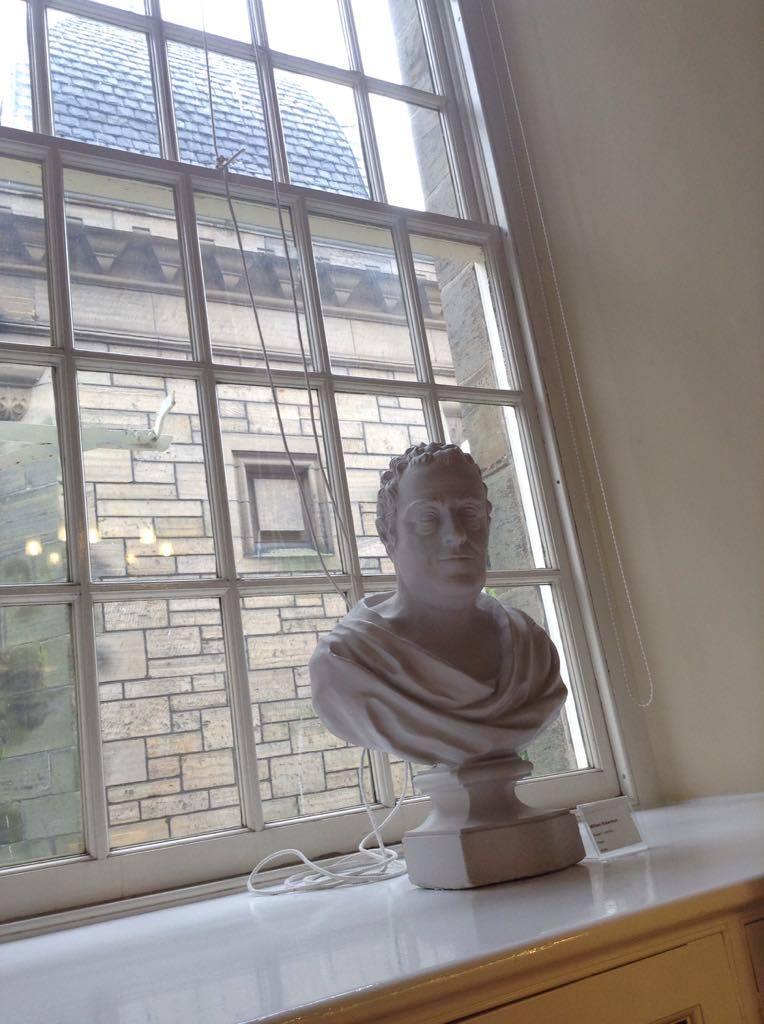

Robertson became royal chaplain to George III (1761), principal of the University of Edinburgh (1762), Moderator of the General Assembly of the Church of Scotland in 1763, and Historiographer Royal in 1764, reviving a role within the Royal household in Scotland that had been in abeyance from 1709 until 1763. One historian has written of Robertson's tenure as Principal of the University of Edinburgh that "the thirty years during which [he] presided over the University perhaps represent the highest point in its history."
He was also a member of The Poker Club.
Writings
One of his most notable works is his History of Scotland 1542–1603, begun in 1753 and first published in 1759. With multivolume history of Spain, Robertson was recognized by the Spanish authorities, and elected to Spain's Royal Academy of History. The work was translated in Spain, with extensive additions from archival sources to which Robertson had no access. A Spanish reviewer of the draft translation of the History of America (1777) took issue with Robertson's claims and the translation was never published. Historian D.A. Brading describes Robertson's history as "the first sustained attempt to describe the discovery, conquest and settlement of Spanish America since Herrera's Décadas." His biography of Charles V "provided a masterly survey of the progress of European society, in which he traced the erosion of the 'feudal system' caused by the rise of free towns, the revival of learning and Roman law, and by the emergence of royal authority and the balance of power between states. It was the development of commerce, assisted by law and private property, which was held to be chiefly responsible for the advance in civilisation."
Later life and death
In 1783, he became a founding member of the Royal Society of Edinburgh.
He died of jaundice on 11 June 1793, at Grange House in south Edinburgh (the large, now-demolished mansion which gave its name to the Grange district). Robertson is buried at Greyfriars Kirkyard, Edinburgh. The grave is within a large stone mausoleum, second only to William Adam's mausoleum immediately to the south. Both stand to the south-west of the church, near the entrance to the Covenanters' Prison.
Legacy
He gives his name to the William Robertson Building of the Old Medical School buildings at the University of Edinburgh on Teviot Place, home to the School of History, Classics and Archaeology. There is also an endowed chair at Edinburgh in his name, the William Robertson Chair of History, for a specialist in non-European modern history.
Family
Robertson married his cousin Mary Nisbet (daughter of Rev James Nisbet of Old Kirk, St Giles) in 1751. They had six children, two daughters and four sons. Three of his children are buried in Greyfriars Kirkyard in individual plots behind their father's mausoleum:
- Hon William Robertson, Lord Robertson FRSE, Senator of the College of Justice (1753–1835)
- General James Robertson (died 1845)
- Lt Col David Robertson MacDonald of Kinlochmoidart FRSE (1761–1845) an important figure in the history of Ceylon
One of his daughters, Mary, married the author Patrick Brydone FRSE. In 1778 his daughter, Eleanora (or Eleanor) Robertson, married John Russell WS FRSE (1753–1792), a Director of the Royal Bank of Scotland. Their children included John Russell WS FRSE (1780–1862), Principal Clerk of Session.
He was great uncle to Dr William Robertson FRSE (1818-1882).
Publications
- The Situation of the World at the Time of Christ's Appearance (1755) (sermon)
- The History of Scotland 1542–1603 (1759) (3 vols.)
- History of the Reign of the Emperor Charles V, with a View of the Progress of Society in Europe (1769) (3 later 4 vols.)
- The History of America (1777, 1796) (3 vols.)
- An Historical Disquisition Concerning the Knowledge Which the Ancients Had of India (1791)
References
References
- R. A. Humphreys, ''William Robertson and his History of America''. London 1954.
- (1997). "The Scottish Enlightenment: an anthology". Canongate.
- Shefr, R. B., ''Church and Society in the Scottish Enlightenment: The Moderate Literati of Edinburgh'', Princeton, 1985.
- (23 September 2004). "The Oxford Dictionary of National Biography".
- "Collection: Certificates, Diplomas etc of Principal William Robertson {{!}} University of Edinburgh Archive and Manuscript Collections".
- ''Fasti Ecclesiae Scoticanae''; by Hew Scott
- (2004). "Burgh, James (1714–1775), educationist and author".
- "Account Suspended". Royalsoced.org.uk.
- [[D. B. Horn. Horn, D. B.]], ''A Short History of the University of Edinburgh: 1556–1889'', 1967, p.76
- "The Poker Club | James Boswell .info". jamesboswell.info.
- David J. Womersley, "The historical writings of William Robertson". ''[[Journal of the History of Ideas]]'' (1986): 497–506. [https://www.jstor.org/stable/2709666 in JSTOR]
- Hamann, Byron Ellsworth, ''The Invention of the Colonial Americas: Data, Architecture, and the Archive of the Indies''. Los Angeles: Getty Publications 2022, 73.
- Cañizares-Esguerra, Jorge. ''How to Write the History of the New World''. Stanford: Stanford University Press 2002, 171-82
- [[David Brading]], ''The First America: The Spanish Monarchy, Creole Patriots, and the Liberal State 1492–1867''. New York: Cambridge University Press 1991, p. 432.
- Brading, ''The First America'', p. 433.
- "Collection: Certificates, Diplomas etc of Principal William Robertson {{!}} University of Edinburgh Archive and Manuscript Collections".
- (2015). "William Robertson Chair of History".
- "Dr. William Robertson".
- (July 2006). "Biographical Index of Former Fellows of the Royal Society of Edinburgh 1783–2002". The Royal Society of Edinburgh.
This article was imported from Wikipedia and is available under the Creative Commons Attribution-ShareAlike 4.0 License. Content has been adapted to SurfDoc format. Original contributors can be found on the article history page.
Ask Mako anything about William Robertson (historian) — get instant answers, deeper analysis, and related topics.
Research with MakoFree with your Surf account
Create a free account to save articles, ask Mako questions, and organize your research.
Sign up freeThis content may have been generated or modified by AI. CloudSurf Software LLC is not responsible for the accuracy, completeness, or reliability of AI-generated content. Always verify important information from primary sources.
Report