From Surf Wiki (app.surf) — the open knowledge base
William Jones (Chartist)
Political radical and Chartist
Political radical and Chartist
| Field | Value | |
|---|---|---|
| name | William Jones | |
| image | William Lloyd Jones - Illustrated Australian News (1874).jpg | |
| caption | 1874 engraving | |
| birth_name | William Jones | |
| birth_date | 1809 | |
| death_date | 20 February 1873 (aged 64) | |
| death_place | Launceston, Tasmania, Australia | |
| resting_place_coordinates | ||
| occupation | {{Plainlist | |
| criminal_charge | High Treason | |
| criminal_penalty | Death, commuted to Transportation | |
| criminal_status | Full Pardon granted 1856 |
- Actor
- Watchmaker
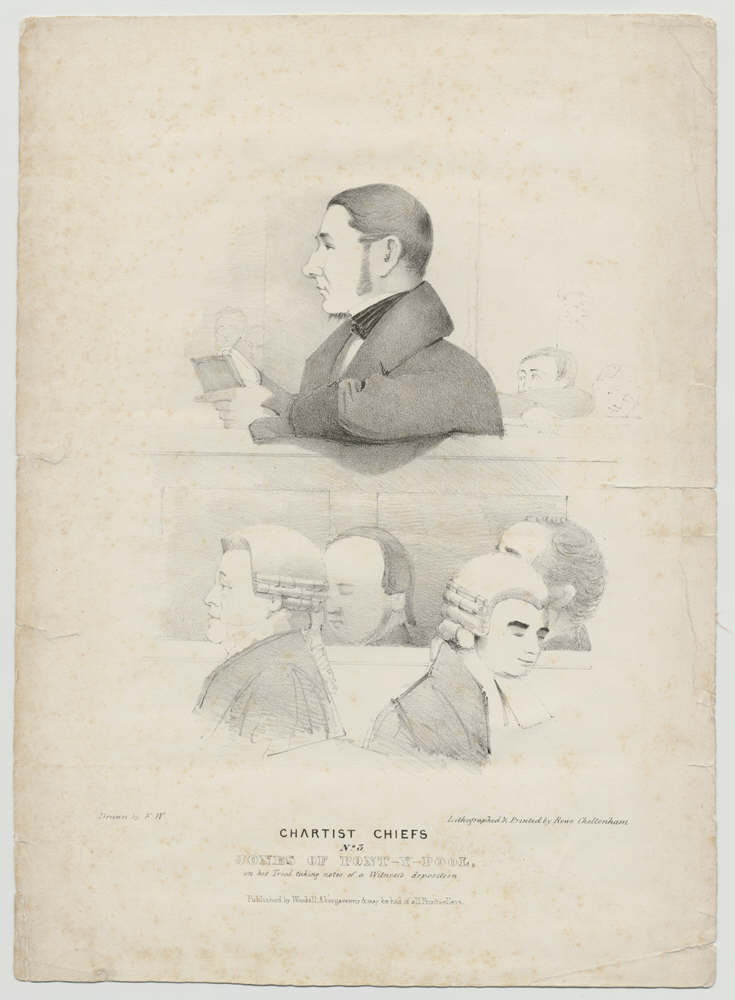
William Jones (1809–1873) was a political Radical and Chartist, who was a former actor, working as a watchmaker at Pontypool in Monmouthshire and also kept a beer house.
He was prosecuted for his part in the Chartist Newport Rising at Newport, Monmouthshire on 4 November 1839.
Along with John Frost and Zephaniah Williams, he was appointed a leader of a column of men in what is sometimes regarded as the greatest armed rebellion in 19th-century Britain.
Jones was supposed to be bringing men to Newport from the Pontypool area and the eastern valleys of Monmouthshire on the night of the rising, but they never arrived, delaying the main body of Chartists final march into Newport into the daylight hours and thus partly contributing to its defeat.
He was captured a few days after the rising. He was imprisoned in Monmouth County Gaol and placed on trial at the Shire Hall in Monmouth. He was sentenced to death for High Treason, but his sentence was commuted and he was sentenced to penal transportation to Australia for life.
Exile in Australia
While in exile, members of the Chartist movement continued to advocate for the repatriation of the leaders of the Newport Rising. In March 1847, the House of Commons debated a proposal for their repatriation, but it was defeated by 196 votes to 31 (including the vote of Disraeli). The convicts won partial pardon in 1854 and total pardon in 1856. John Frost returned to England. Jones decided to remain behind in Australia and stuck by his watchmakers's trade. He died in poverty in 1873.
References
References
- [https://convictrecords.com.au/convicts/jones/william/56279 Convict records]
- Edward Royal, ''Chartism'', Longman, London: 1996
This article was imported from Wikipedia and is available under the Creative Commons Attribution-ShareAlike 4.0 License. Content has been adapted to SurfDoc format. Original contributors can be found on the article history page.
Ask Mako anything about William Jones (Chartist) — get instant answers, deeper analysis, and related topics.
Research with MakoFree with your Surf account
Create a free account to save articles, ask Mako questions, and organize your research.
Sign up freeThis content may have been generated or modified by AI. CloudSurf Software LLC is not responsible for the accuracy, completeness, or reliability of AI-generated content. Always verify important information from primary sources.
Report