From Surf Wiki (app.surf) — the open knowledge base
White-tailed eagle
Species of bird
Species of bird
- H. a. albicilla - (Linnaeus, 1758)
- H. a. groenlandicus - Brehm, CL, 1831 |Falco albicilla |Linnaeus, 1758 |Falco melanaetos |Linnaeus, 1766 |Falco ossifragus |Linnaeus, 1766
The white-tailed eagle (Haliaeetus albicilla), sometimes known as the "sea eagle", is a large bird of prey, widely distributed across temperate Eurasia. Like all eagles, it is a member of the family Accipitridae (or accipitrids) which also includes other diurnal raptors such as hawks, kites, and harriers. One of up to eleven members in the genus Haliaeetus, which are commonly called sea eagles, it is also referred to as the white-tailed sea-eagle. Sometimes, it is known as the ern or erne (depending on spelling by sources), gray sea eagle and Eurasian sea eagle.
While found across a wide range, today breeding from as far west as Greenland and Iceland across to as far east as Hokkaido, Japan, they are often scarce and spottily distributed as a nesting species, mainly due to human activities. These have included habitat alterations and destruction of wetlands, about a hundred years of systematic persecution by humans (from the early 1800s to around World War II) followed by inadvertent poisonings and epidemics of nesting failures due to various manmade chemical pesticides and organic compounds, which have threatened eagles since roughly the 1950s and continue to be a potential concern. Due to this, the white-tailed eagle was considered endangered or extinct in several countries. Some populations have since recovered well, due to governmental protections, dedicated conservationists and naturalists protecting habitats and nesting sites, partially regulating poaching and pesticide usage, as well as careful reintroductions into parts of their former range.
White-tailed eagles usually live most of the year near large bodies of open water, including coastal saltwater areas and inland freshwater lakes, wetlands, bogs and rivers. It requires old-growth trees or ample sea cliffs for nesting, and an abundant food supply of fish and birds (largely water birds) amongst nearly any other available prey. Both a powerful apex predator and an opportunistic scavenger, it forms a species pair with the bald eagle (Haliaeetus leucocephalus), which occupies a similar niche in North America.
Taxonomy
The first formal description of the white-tailed eagle was by the Swedish naturalist Carl Linnaeus in 1758 in the tenth edition of his Systema Naturae under the binomial name Falco albicilla. The genus Haliaeetus was introduced in 1809 by the French naturalist Marie Jules César Savigny in the Description de l'Égypte. The name Haliaeetus is Neo-Latin for "sea-eagle", from Ancient Greek hali-, "sea-" and aetos, "eagle". The specific albicilla, "white-tailed", is from Neo-Latin albi-, "white" and cilla, "tail". The Anglo-Saxon name erne means "soarer", and it is cognate to Swedish örn and Finnish aarni. It has many Gaelic names, including iolar sùil na grèine or 'eagle of the sun's eye.'
Systematics
The white-tailed eagle is a member of the genus Haliaeetus, a monophylic group comprising 11 living species, including the closely related Ichthyophaga fish eagles which may or may not be part of a separate genus. The latter group, comprising the lesser (Haliaeetus humilis) and the grey-headed fish eagle (Haliaeetus ichthyaetus), differ mostly in life history, being more fully devoted to fish eating and habituating wooded areas, especially in mountainous areas. In appearance the two Ichthyaetus are slenderer, longer tailed and more uniform and grey in colour than typical sea eagles. This species pair may not be genetically distinct enough to warrant division into separate genera. Other than these Ichthyophaga-type species found farther north in Asia, Sanford's sea eagle (Haliaeetus sanfordi) of the Solomon Islands is the most atypical Haliaeetus, retaining rufous-brown plumage into adulthood (this particularly resembling the white-bellied sea eagle juvenile, likely a closely related species) more typical of juveniles in other species and it also dwells more so in dense, coastal forests where it feeds mostly on birds and mammals rather than fish and water birds.
Outside of the genus Haliaeetus, among other extant forms, they appear to be most closely related to milvine kites and Old World vultures, based on modern forms from these subfamilies that broadly share morphological and life history traits with sea eagles: the Brahminy kite (Haliastur indus) (historically sometimes referred to as the "red-backed sea eagle") and the palm-nut vulture (Gypohierax angolensis) (which was once widely referred to as the "vulturine fish eagle"). The relation of these species to the sea eagles is partially borne out by their genetic sequencing. Other groups, beyond milvine kites and Old World vulture, of modern accipitrids that are seemingly in some way related, albeit distantly, to the sea eagles include Accipiters, harriers, chanting-goshawks and buteonines. Notably excluded from their relations are most other species referred to as "eagles", including booted eagles and snake and serpent eagles.
The white-tailed eagle itself forms a species pair with the bald eagle. These diverged from other sea eagles at the beginning of the early Miocene (c. 10 mya) at the latest, possibly (if the most ancient fossil record is correctly assigned to this genus) as early as the early or middle Oligocene, about 28 mya. A recent genetic study of mitochondrial DNA is consistent with this idea. Greenlandic white-tailed eagles (proposed as H. a. groenlandicus) form, on evolutionary time scales, a relatively recently founded population that has not yet accumulated many unique genetic characteristics and may not strictly fulfill the distinction of a subspecies. However, the population appears to be demographically isolated and deserves special protection. At one time an eastern subspecies (H. a. brooksi) was proposed as well but there is little evidence supporting this as more than a case of clinal variation in colouring and size (i.e. the eastern average slightly darker and smaller than more westerly ones). As in other sea-eagle species pairs, this one consists of a white-headed (the bald eagle) and a tan-headed species. They probably diverged in the North Pacific, spreading westwards into Eurasia and eastwards into North America. Like the third large northern species, Steller's sea eagle (Haliaeetus pelagicus), adults have yellow feet, beaks and eyes. Another species, likely intermediate between the white-tailed, bald and Steller's sea eagles and the Ichthyophaga type fish eagles, is the Pallas's fish eagle (Haliaeetus leucoryphus), which in life history seems to range farther from water and to higher elevations than the three northern species normally do. Due to the similar dietary and nesting habits of sea eagles, they are mostly allopatric in distribution as competition can be considerable between these eagles.
Currently, eagles occur in the Hawaiian Islands only as vagrants, but Quaternary bones of Haliaeetus have been found on three of the major islands. An ancient DNA study published in 2015 characterized the rapidly evolving mitochondrial control region of one of these specimens. DNA from a ~3,500-year-old sea eagle skeleton found in a lava cave on Maui was sequenced. Phylogenetic analyses suggested that the Hawaiian eagle represents a distinct (3% divergent) mtDNA lineage that is most closely related to extant white-tailed eagles. Based on fossil calibration, the Hawaiian mtDNA lineage probably diverged around the Middle Pleistocene. Thus, although not clearly differentiated in morphology from its relatives, the Hawaiian eagle likely represented an isolated, resident population in the Hawaiian archipelago for more than 100,000 years, where it was the largest terrestrial predator. The reasons for its extinction are unknown.
Description
Size
The white-tailed eagle is one of the largest living birds of prey. It is the largest of the dozen species of eagle found in Europe and the largest eagle across its distribution, excluding the Russian Far East and (during the winter) Hokkaido, Japan, where it co-exists with its larger cousin, Steller's sea eagle. The white-tailed eagle is sometimes considered the fourth largest eagle in the world and is, on average, the fourth heaviest eagle in the world. The only extant eagle species known to be more massive in mean bulk are the Steller's sea eagle (Haliaeetus pelagicus), the harpy eagle (Harpia harpyja) and the Philippine eagle (Pithecophaga jefferyi). The white-tailed eagle measures anywhere from 66 to in total length with a typical wingspan of 1.78 to. This species may have the largest wingspan of any living eagle. The Steller's sea eagle, which is larger in weight, total length and non-wing standard measurements, may be the closest rival for median wingspan amongst living eagles. The white-tailed eagle does appear to outsize the average wingspan of the wedge-tailed eagle (Aquila audax), which is sometimes also titled the largest winged extant eagle due to an exceptionally large individual shot in 1931, although the Steller's sea eagle may rival it in that respect.
In one sample from Norway, five male white-tailed eagles were found to average 2.26 m and eight females were found to average 2.37 m. In another sample of wild birds of unspecified origin, five males were found to average 2.1 m and seven females averaged 2.3 m. Record wingspans have included a specimen from Greenland which measured 2.53 m while another specimen apparently spanned 2.6 m. The bald eagle broadly overlaps in size with the white-tailed eagle. In direct comparison, the white-tailed eagle averages somewhat larger in body mass than the bald eagle and may be marginally larger in bill and talon size, although these linear aspects can be quite similar between the two species. The white-tailed eagle does have a significantly larger wing chord and average wingspan than the bald eagle, but the latter usually possesses a longer tail, resulting in a larger total length than the white-tailed eagle and a larger mean tarsal length.
Size variation is generally a clinal trend and is normally quantified using standard measurements such as wing, tail and tarsal length, or body mass, rather than wingspan or total length. As expected for many widely distributed animals of varied lineages, the white-tailed eagle conforms to Bergmann's rule in that more northerly birds tend to outsize those found relatively closer to the Equator. Average size also decreases from west to east across its distribution. The largest white-tailed eagles appear to be found in Greenland, these being slightly larger than those from Ireland, Scotland and Scandinavia and notably larger than eagles from central Europe, especially in proportions of the wing area. Those from the southerly portions of the breeding range, such as Asia Minor (principally Turkey), southern Kazakhstan, and Korea Bay, appear to be the smallest-bodied population but there have been limited measurements and published weights known for these extremely sporadic and rare Asian populations of eagle. Furthermore, weights of fully grown eagles from Greenland are not known. Unlike many accipitrids, juvenile white-tailed eagles (and seemingly other sea eagles as well) are often of similar weight to the adults, although the juveniles typically have a somewhat larger average wing and tail length than the adults. In the white-tailed eagle, body mass can typically range from 4 to in females. The slightly smaller male may typically weigh from 3.1 to.
Average weights in European white-tailed eagles can range from 4.02 kg in five males and 5.11 kg in nine females to (from the reintroduced birds of Scotland of Norwegian stock) 4.98 kg in 39 males and 6.06 kg in 43 females. In comparison, the weight ranges for white-tailed eagles from Northeast China were claimed to be only 2.8 to in males and 3.75 to in females. The heaviest female white-tailed eagles can apparently weigh as much as 7.5 to and even males can sometimes weigh up to 6.5 kg, which would make the largest males perhaps the heaviest recorded modern male eagle, as male harpy and Philippine eagles (being more sexually dimorphic in favour of the female) are not known to exceed 5 kg (the highest weights for male Steller's sea eagle are not known). The global mean body mass of white-tailed eagles is estimated at approximately 5 kg. The average female Steller's sea eagle may weigh just under 25% more than the average female white-tailed eagle (the average weight of male Steller's is not known) while the average European golden eagle may weigh about 11–12% less than the average European white-tailed eagle and the bald eagle species as a whole about 10% less than the white-tailed eagle species.
Standard measurements and sexual dimorphism
_-_Haliaeetus_albicilla_(418b).jpg)
The most reliable method to sex birds is by tarsus width and depth and beak depth but these are infrequently measured. In some cases females are as much as 25% heavier and 15% greater in linear dimensions, though the sexes are rarely this discrepant in standard measurements. Among standard measurements, the wing chord is 552 to in males, averaging 606 and in European adults and juveniles, respectively, and 646.5 mm in Greenland males. In females, the wing chord may measure 605 to, averaging 668 and in European adults and juveniles, respectively, and 691.3 mm in Greenland females. Adult tail length is 250 to in males, averaging 280 mm, and 276 to in females, averaging 305 mm. Juvenile tail lengths can reach roughly 380 mm in both sexes, however. The tarsus is 90 to, averaging 95.5 mm.
In terms of their killing apparatuses, their hallux claw, the largest talon on all accipitrids, is 37 to in length, averaging 40.9 mm. The exposed culmen is typically large as in all Haliaeetus, ranging from 45 to, with an average of 56.1 mm. The average culmen length of the bald eagle is 54.3 mm, thus averaging slightly smaller. However, the average culmen length in the large bald eagles of Alaska is considerably larger than other bald eagles as well as most white-tailed eagles at up to 75 mm and can even rival the length (but perhaps not the girth) of the truly massive bill of the Steller's sea eagle.
Colouring and field appearance
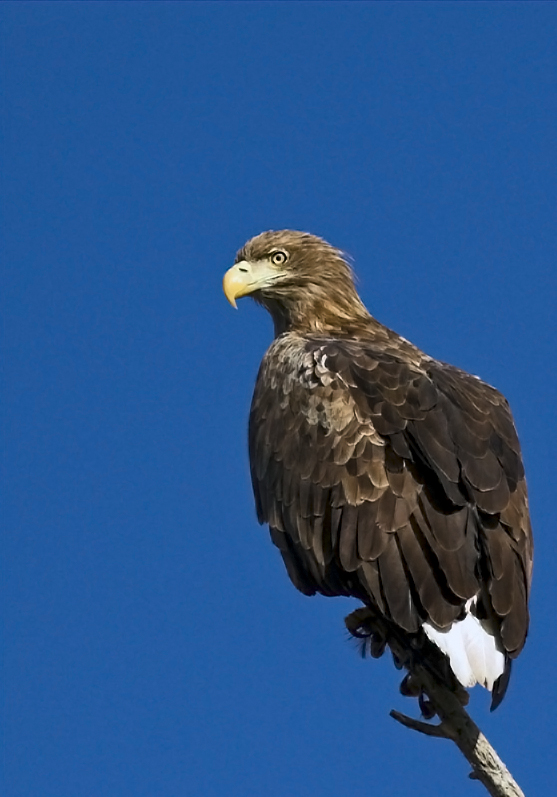
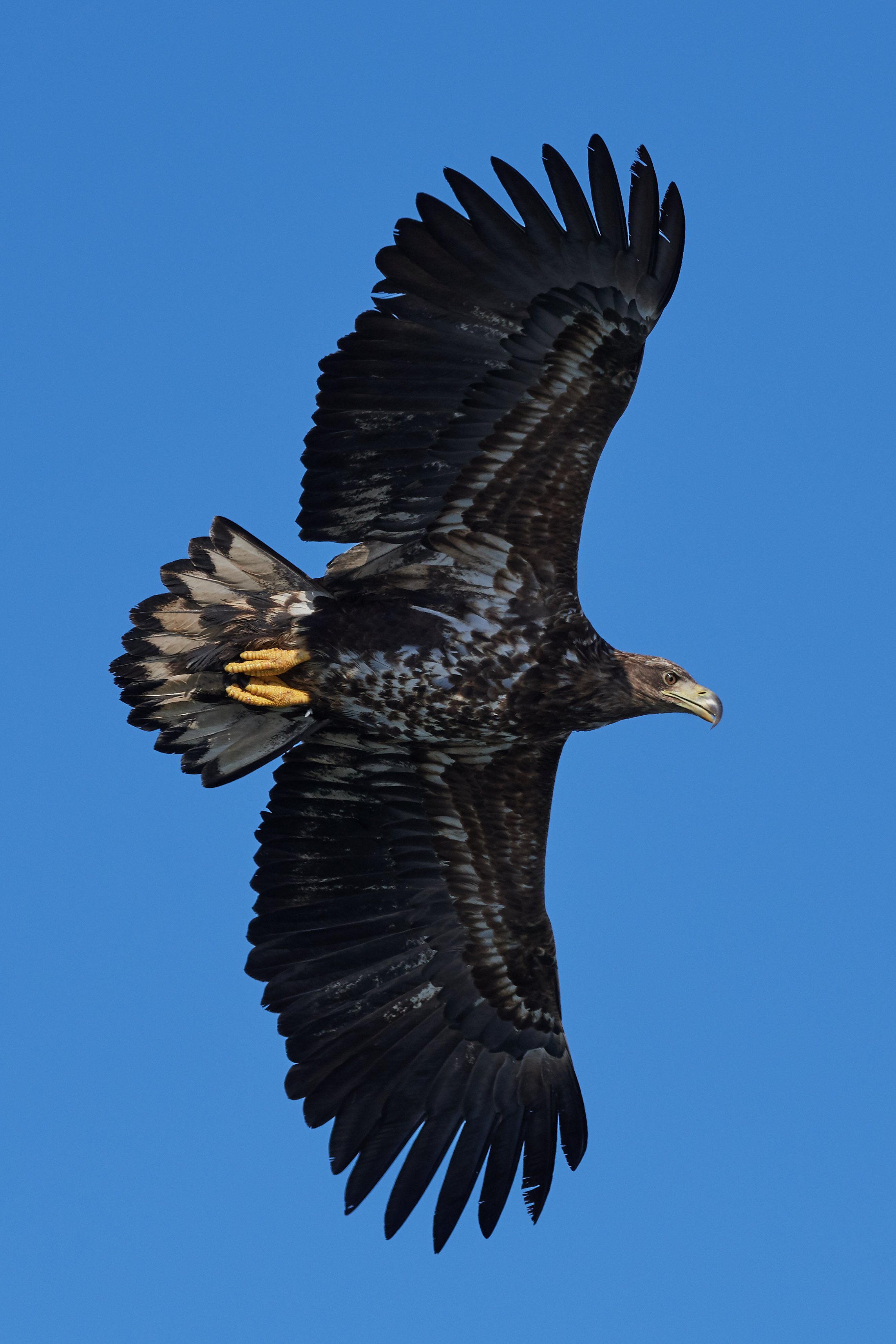
The adult white-tailed eagle is a greyish mid-brown colour overall. The plumage is fairly uniform over most of the body and wings, but the upper wing coverts are typically somewhat paler. In the adult, the head, neck and upper breast have a distinctly paler appearance than the rest of the plumage and most often have a buff colouration. In worn or bleached plumages these light areas can be even paler at times, ranging to almost whitish, which can render a resemblance in such eagles to a washed-out bald eagle. Some of the palest birds can appear anywhere from cream-tawny to light greyish. It is thought that in some populations perhaps paleness increases with age, although it is possible that there is an historical genetic factor to these pale variations. In contrast, some adults can also be a richer, more deeply dark brown (or somewhat rufescent) than average with perhaps a mild increase in average darkness of hue to the east of the species' range. When many of the feathers are freshly moulted, they can take on a slight purplish gloss. The brownish hue of the adult overall makes the somewhat wedge-shaped white tail stand out in contrast. All the bare parts of the adult's body are yellow in colour, including the bill, cere, feet and eyes. Juvenile and immature white-tailed eagles are a much darker brown than the adults and are more unevenly marked, with whitish feather edgings variably showing, mostly manifesting in some small areas of the underside and under-wing, with a narrow white axillary strip usually apparent.
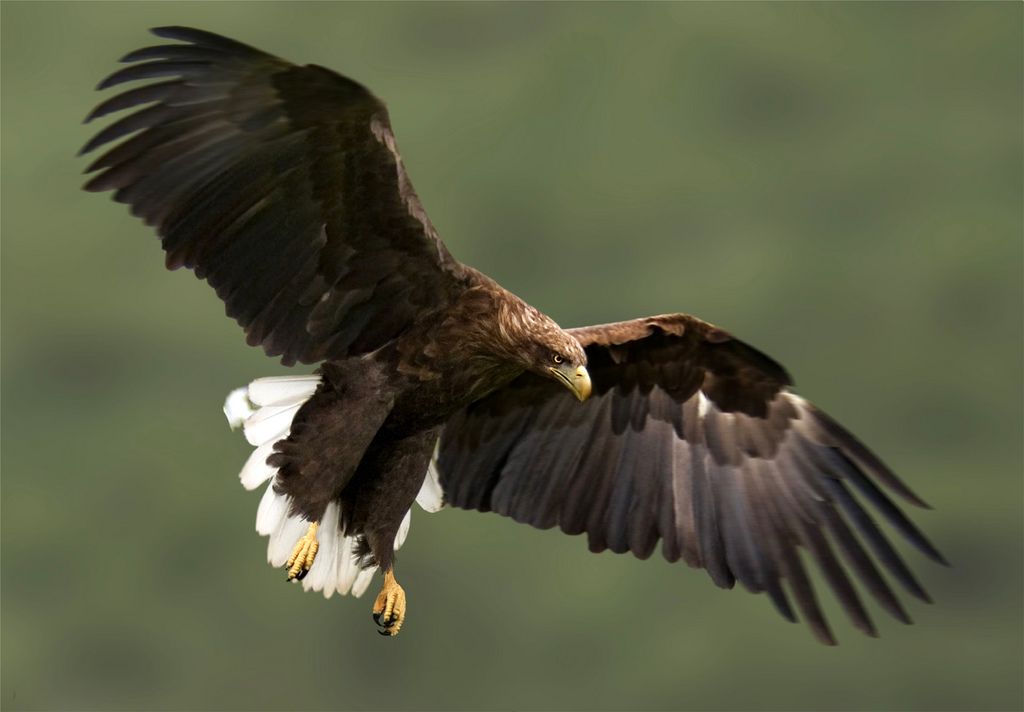
The upperside is usually similarly darkish brown but variable based on extent of blackish-brown tip to otherwise buff-brown feathers of the mantle, back and upper wing. The head of the juvenile is normally a blackish-brown hue, somewhat darker and always more uniform than most of the other feathers. The juvenile's tail tends to be a washed out greyish-cream colour with messy blackish colour on the feather edges and on the tips. Some individual juveniles may exhibit some faint barring on the tail while others may appear largely dirty whitish on the tail. The bill of juveniles is usually almost half dark brown from the tip and half dirty, dull yellowish or grey to the base, while the feet are usually a dirty yellow and the eyes are a darkish brown. Juvenile males may average a slightly darker brown plumage with less speckling on the upper body than like-age females; their head and neck plumes may also appear shorter, which can accentuate the slighter, more angular skull possessed by males. In disposition, the male juveniles are said to be more highly strung and higher voiced than their female counterparts.
The head gradually grows paler over several years. The whitish mottling may increase on the upperparts, belly and especially on the underwing area later into their third year (considered the first subadult plumage) and subadult birds can appear fairly blotched with white but much individual variation in colouring is known at this age. However, this white mottling then fades late into the fourth year and the plumage becomes less contrasting.
White-tailed eagles of all ages typically perch in quite upright positions on exposed branch, rock or other vantage point, but tend to sit more horizontally on the ground or other level surfaces. They have an ample bill with a relatively high culmen, helping to impart a rather narrow and high crowned facial look, especially compared to Aquila eagles. The neck is at times unusually long-looking, more so than in the bald eagle, which can give the upper body a vulturine appearance. The tail is relatively short, and in some adults it can appear disproportionately stubby in relation to the massive body, and slightly wedge-shaped. All ages have a well-feathered tibia but bare tarsi. In flight, the wings are extremely broad and deeply fingered, with the usual tendency for at least six fingers to be visible. Juveniles are longer tailed than adults, which is usually more evident in flying than perched birds, with sometimes a slightly bulging section of feathers manifesting on the wing secondaries. The species tends to fly with shallow wing beats; at times the wing beats can be fairly fast for a bird of this size, but interspersed at times with gliding. At a great distance, this flight style may be suggestive of a large brown heron. The wings are held flat or slightly upraised at the tip in flight and the white-tailed eagle is well known to soar extensively. This species can be surprisingly maneuverable on the wing, usually during aerial displays or dogfights with other birds. These eagles may also maneuver by half-closing both wings or fully closing one wing.
Vocalizations
The white-tailed eagle is considered a vocal bird of prey during the breeding season, although some authors consider their voice "not loud or impressive for the size of the bird". The male call is oft transcribed as gri-gri-gri or krick-krick-krick, while the female is a deeper gra-gra-gra-gra or krau-krau-krau-krau. These will increase in tempo and pitch, with about 15–30 calls in a sequence. Often pairs will duet during early spring, in flight or from a perch. When perched, the male calls kyi-kyi-kyi-kli-kliek-yak with the head thrown back and upwards in the last call ended with a lower ko-ko-ko, the perched call of females is similar but deeper, a krau-krau-krau-uik-ik. Typically, the perched version of their calls tend to be shriller and higher than those issued in flight.
In courtship display, male calls krau-krau-krau-uik-ik-ik answered by females with a lower ra-rack-rack-rack-rack. Young in nest call a shrilly piieh-piieh, while the female when receiving food from male calls out with tschie-tschie or vueee-vueee. Single or repeated krlee or similar component of calls used in other circumstances, can be variable. Alarm calls tend to be 3–4 short, loud klee or klek notes. Sometimes a different call of alarm or anger, a deep gah-gah-gah or jok-jok-jok, similar to alarm calls of a large gull, is also uttered when a nest is approached (usually recorded while directed towards humans). The young let out a monotonous veee-veee when hungry (or "bored") which intensifies if the eaglets are not fed or brooded immediately.
Identification

Given reasonable view, adult white-tailed eagles are difficult to mistake for any other bird. There are no other eagles with fully white tails in their range except for in the easternmost limits of their range, their cousins the bald eagle and Steller's sea eagle, which in adults are different in all other respects of plumage. Even in poor light, the bald species shows a sharp demarcation from white to dark brown whereas the colour contrast is far subtler in white-tailed eagles between their brown body (of a paler hue than that of a bald eagle) and buff-coloured head. At a great distance, the adult may be potentially confusable with the Griffon vulture (Gys fulvus), as the colouring of the two species is vaguely similar and they can overlap somewhat in size although the vulture can average rather heavier and longer winged. However even at long range, the relatively tiny head, distinctly curved trailing wing-edges and more raised wings make the vulture distinctive from the white-tailed eagle.
Juveniles may be harder to distinguish, mainly from other sea eagles in few areas of overlap. In northern Mongolia (perhaps spilling over into southern Siberia), the northern part of the Caspian Sea and some central and southern parts of Kazakhstan, the white-tailed eagle may (or may not) live alongside the rarer, relatively poorly-known Pallas's fish eagle. The Pallas's juveniles are more distinctively whitish marked on the underwing. In flight or perched, the Pallas's fish eagle are usually markedly smaller and slighter than white-tailed eagles with a longer and differently marked tail. At all ages, the white-tailed eagle averages a duller, slightly darker and browner colour overall than the Pallas's fish eagle. Pallas's fish eagles are mid-brown on the body in juvenile plumage with no paler feather edging as seen in juveniles and especially subadults of the larger species. Adult Pallas's fish eagles are immediately distinctive rufous hue with a more restricted but more sharply demarked paler buffy head. Bald eagle juveniles may be found together with white-tailed eagles in the Aleutian islands (where the white-tailed eagle formerly bred until about 30 years ago) and when vagrants of white-tails occur in Alaska. Juveniles of bald and white-tailed eagles often strongly resemble each other but the bald eagles have a shorter neck, a relatively longer and squarer tail, and somewhat less broad wings. In the colouring, the bald juvenile is similarly as dark or even darker brown above as white-tailed eagle juveniles but on the underside often has more extensive whitish mottling, especially on the underwing.
Steller's sea eagles are usually distinctly larger and longer tailed, with a taller, bulkier look in eagles standing on the ground or perched. Steller's juveniles have a different wing shape (roughly paddle-shaped) and a considerably more massive and paler bill, which is yellow even in juveniles unlike in bald and white-tailed eagles. Juvenile Steller's sea eagles are a distinctly darker soot colour than juvenile white-tailed eagles with even less whitish showing on the body than the latter species but, on the other hand, the underwing often as white marked as juvenile bald eagles (dissimilarly from juvenile white-tailed eagles), albeit in different pattern. In all three large northern sea eagles, the tail colour is similar at the various stages of development but the shape is more distinctive, especially the bolder wedge shape of the Steller's.
The cinereous vulture (Aegypius monachus) may too be considered superficially similar to the juvenile white-tailed eagle, but it is considerably larger and longer-winged and possesses a more uniform and darker hue with conspicuous paler legs and a relatively smaller head. Young white-tailed eagles are also potentially confusable with any Aquila, but should be obvious even as a silhouette in its huge wings, relatively truncated and slightly wedge-shaped tail and obvious projection of the neck and head. All Aquila lack pale the axillary band often visible on juvenile and subadult white-tailed eagles. Some greater spotted eagles (Clanga clanga) can suggest the wing shape of a white-tailed eagle but are far smaller and shorter winged and never bear a protruding head. The golden eagle usually appears slightly smaller than the white-tailed eagle and tends to be more dashing in flight, which is usually done with a distinct dihedral. When perched, the golden eagle looks more sleek and compact than the rangier white-tailed eagle and tends to be a darker, richer hue of brown. Golden eagles have a much shorter neck, with a smaller head and bill and a longer, squarer tail. White wing patches of juveniles are also differently distributed in golden than juvenile white-tailed eagles.
Distribution and habitat

.jpg)
Breeding range
This eagle breeds in northern Europe and northern Asia. Their range extends to as far west as southern Greenland (prevented from breeding further north due to the short summers), northern and western Iceland, and the reintroduced populations in some areas of England (re-established in 2019), Ireland and Scotland, particularly conserved coastal spots. In mainland Europe the range is expanding, with Europe's largest population breeding in coastal Norway (broadly), northern and southwestern Finland, eastern Sweden, broadly in Denmark, islands of the Baltic Sea, western Austria, northeastern Germany, northern and eastern Poland, the Czech Republic, much of the east Baltic countries, the non-montane areas of Ukraine, eastern Slovenia, central and southern Hungary (and adjacent northeastern Croatia), sporadically in Greece, the Danube sections of Romania and Bulgaria to the Black Sea and western and eastern Moldova. The bird returned to the Netherlands in 2006 and in 2020 the number of breeding pairs had increased to 20. It might have bred in the Faroe Islands up until the 17th century, but evidence is lacking; there are only about a dozen records of vagrant white-tailed eagles from the archipelago since 1800.
In Anatolia, it only remains as a breeder in sparse and small pockets of Turkey and Georgia, taken as a region there are likely to be fewer than 30 breeding pairs in this region. Discontinuously, they are found as residents in Kazakhstan where they live in a long strip of the southern part of the country starting at the Aral Sea and the northwestern portion (but not, as far as is known, breeding in the Kazakh part of the Caspian Sea coast). Their northern limits occur in Russia to the Ob river to 70 degrees north at the mouth of the Yenisei River and on the Gyda and Yamal Peninsulas, to the Kolyma, Indigirka and Lena rivers to above 72 degrees north, even to 75 degrees north on the Taymyr Peninsula. They are said to be common around the White Sea, reportedly even the most abundant bird of prey locally and found both on coasts and inland lakes, although breeding rates are low due to the frigid weather. From Russia, breeding populations spill somewhat into northernmost Mongolia, extreme northwestern China and northern North Korea. The white-tailed eagle also breeds on Sakhalin Island, the Kuril Islands and Hokkaido, the northernmost island of Japan.
Wintering range
The wintering range is less well understood for the white-tailed eagle given the extreme reductions and fluctuations of northern breeding populations over the last few centuries, so that the delineation of regular wintering areas versus areas of mere vagrancy is difficult to ascertain. It is known that a small number winter on Etang de Lindre of Lorraine, France as well as an area on the border of France to Germany around Strasbourg, with vagrants seen elsewhere in France (e.g. La Hague ), as well as in Spain, Portugal and Malta. A well-defined wintering population may occur in much of the Netherlands, even with infrequent modern breeding in the northern coastal areas. A wintering population is known in western Germany from North Rhine-Westphalia to Bonn, as well as far northern Germany. Other established wintering areas are known in Europe in west-central Italy, northern Austria, fairly broadly in southern Slovakia and northern Hungary and a few protected pockets of Southeast Europe apart from the portions in the north and east where they still breed.
Intermittent forms of vagrancy and migration (most from eagles that breed in or disperse from Russia) are known to occur in several areas of Turkey, the Levant countries, Azerbaijan and Iran down to even the Persian Gulf, albeit seldom is the species to be found commonly or reliably anywhere in these regions. Further east, rare wintering areas are known in a few small, scarce pockets of Turkmenistan, Afghanistan, Uzbekistan, Tajikistan and Pakistan. Scattered pockets of wintering birds are known to occur too in central and southern China, into northeastern Myanmar, and more broadly and regularly in much of Northeast China. Good numbers winter too in much of South Korea and Japan down to as far as Honshu. Some white-tailed eagles even bred in Alaska on Attu Island in the late 1970s to the early 1980s (until 1984 when the last attempts were recorded) but it was not clear whether young were ever successfully fledged.
Habitat

White-tailed eagles may be found in varied habitat but usually are closely associated with water and generally occurs in lowland areas. In many areas, white-tailed eagles can seem to switch freely between usually cliff habitat and wooded spots for nesting sites and the center of their home range habitat. In some areas, such as Japan, this species may occur in regions with intensive human fishing activity and they may become unusually partially habituated to this human presence. Inland, white-tailed eagles usually require secluded woods, forested areas or groups of trees with tall mature trees and access to freshwater wetlands such as lakes, river systems, marshes or extensive, low-disturbance farmland.
In some areas, white-tailed eagles readily visit commercial fish farms, carp ponds and similar areas with easily accessible food but they will usually avoid areas where human disturbances (especially noisy varieties such as construction, water sporting and heavy boating activities and hunting) commonly occur. On the other hand, from studying wintering white-tailed eagles in partially or heavily disturbed wetlands in parts of the Netherlands shows that such areas cannot support the eagles for any long-term period and may only be visited for a day or two by individual eagles.
Behaviour
White-tailed eagles spend much of their day perched on trees or crags, and may often not move for hours. Perhaps up to 90% of a day may be spent perched, especially if weather is poor. Also, they will alternate periods of soaring with perching, especially flying over water or well-watered areas, but do considerably less soaring on average than do golden eagles. Pairs regularly roost together, often near to their nest, either on a crag or tree or crevices, overhung ledges or small isolated trees on a crag.
Migration and dispersal
The white-tailed eagle may be considered a rather inconsistent and partial migrant. The species seldom migrates in the western part of its range, with eagles even breeding as far north as Greenland, Iceland and coastal Norway not moving at all for winter, but for some southward juvenile movements following dispersal. Juveniles overall are more migratory and dispersive and leave natal areas sooner, which is by August–September in northwestern Europe and return later, by March/April, than adults do. In contrast, young from Finland and Sweden tend to distribute to the southwesterly direction to the shores of the Baltic Sea. One from Finland was recovered 520 km west in northern Norway and another was found as far south as Bulgaria. In more southerly areas, winter movements are drawn-out and irregular, with most mature pairs probably never leaving their nesting haunts year-around. In several parts of Russia, quite unlike many European populations, the white-tailed eagle seems to be largely migratory.
In the far east, the species appear to take different migratory routes in autumn and spring, traveling from north-central Kamchatka thru the Kurile Islands to Hokkaido in autumn, while in spring these eagles travel north through Sakhalin and the Okhotsk Coast. In the White Sea area, southward moments begin in September with most white-tailed eagles being gone by November but in mild winters some adults may remain behind. Some white-tailed eagles from the White Sea were found well over 2000 km away to the west, in countries such as Hungary and Italy. Return spring migration to the White Sea is by February–March. During winter, whether long-distance migrants or short-distance dispersers, white-tailed eagles tend to become gregarious, especially younger immature birds. Many such groups can contain up to 10 and, in areas near large breeding populations such as the Scandinavian countries, up to at least 30–50 individuals. Wintering congregations at the Baltic coast and on the River Elbe from 37 winters show that arrivals begin in November, with numbers peaking in January and then declining during March and early April. Although juveniles usually return to their natal area some apparently overshoot these areas, such as those returning to Romania or on the Black Sea which have been recorded 330 km north of their natal site and 510 km northeast of their natal site.
Territoriality
Territory size in white-tailed eagles may vary from 52 to, usually less than 130 km2, per one estimate. While territorial behaviour is known in well more than half of all modern birds, essentially all predatory birds of different lineages are particularly strongly territorial because the live prey necessary to feed a family, including the female of the pair (which must remain near the young for them to survive) and the young themselves, tends to be sparser. Furthermore, appropriate habitat is needed in which to execute this hunting and also, of course, to build a nest with some security. Although a relatively gregarious raptor, especially among wintering birds and juveniles and immature birds, they are territorial and intrusion by a male in adult plumage often provokes vigorous fighting, in which either combatant can even die. In some cases, these vicious fights can cause damage to the nest as the two fighting eagles plummet down trying to slash at each other.
Dietary biology
The white-tailed eagle's diet is varied, opportunistic and seasonal. Prey specimens can often include fish, birds and, mostly in a secondary capacity, mammals. Especially during the winter (and opportunistically in all seasons), many birds of the species live largely as scavengers, usually by coming across available carrion or watching for the activity of corvids, vultures or other raptors. White-tailed eagles in northeastern Germany were shown to hunt mostly from perches, in a "sit-and-wait" style, usually from a prominent tree perch. Like other sea eagles, they can only capture fish normally in the littoral zone, seldom hunting fish when they exceed a water depth of 1.5 to. In addition to trees, they may also use crags, hillocks or high grassy tussocks as hunting perches so long as the perch provides a good overall view of the environment. Fish tend to be grabbed in a shallow dive after a short distance flight from a perch, usually with the eagles only getting their feet wet. Occasionally, though, white-tailed eagles have been recorded plunging right into water, usually while hunting on the wing at a height of at least 200 m. In Norway, plunge-diving is considered rare. At times they will also fish by wading into shallows, often from shores or gravel islands.
The species will at times variously follow fishing boats, readily exploits commercial fisheries, stocked lakes, carp ponds and the like, and scavenges dead fish or fish-offal in a wide range of situations. White-tailed eagles also regularly pirate food from otters and other birds including cormorants, gulls, ospreys, corvids and various other raptors. From studies of captive white-tailed eagles, daily food requirements were estimated at 500 to, which is equivalent to about 10% of the birds' body weight, with crop contents commonly of 190 -. Some semi-captive juveniles on the isle of Rùm, Scotland could eat up to 1.4 kg in one sitting. However, in Norway, it was estimated that a family of wild white-tailed eagles including each adult and three fledglings were consuming on average up to 625 g per bird each day. Furthermore, one male consumed an estimated 2 kg in a single meal upon capturing a large fish. The crop can bulge to the size of a small grapefruit after they've consumed a large meal.
.jpg)
Many studies have reflected that the primary foods of white-tailed eagles are fish and water birds. These are the primary food as well for other sea eagle species. However, unlike most Haliaeetus, including the bald eagle and Steller's sea eagle, the water birds tend to take the primary position in the diet. From 26 accumulated food studies for this species, prey remains and pellets show that about 48.5% of the diet is made up of birds, 39.95% by fish, 9.95% by mammals and 1.6% by other foods. In total, more than 300 prey species are known throughout the bird's range. However, based on studies of prey remains and pellets in laboratories from Greenland white-tailed eagles, birds were shown to be biased in both kinds of remains (pellets and prey remains) whereas in situ study and direct nest observation favour fish. Going on pellet/remains alone here in Greenland from 557 items in the 1979 study, 68% of the diet would have been represented by birds and only 20% by fish but comprehensive observation shifted it to show fish were the primary food at 58% and birds were secondary at 30%. This study claimed this is often because the bones of fish are dissolved by the large digestive tract of the eagles upon consumption and may thus leave almost nothing in remains and to some extent in pellets. Subsequent studies here showed a much stronger preference for fish in Greenland by 1983, as fish comprised an extreme 91.8% of 660 items. However, this kind of direct continuous observation of food deliveries to nests is not always possible. Furthermore, despite similar bias for prey that is large and leaves conspicuous remains (including any larger fish, bird or mammal), in the bald eagle it was found that fish were usually detectable and dominant in remains and pellets. Most modern biologists may need to leave some fish unidentified but will account for different methodologies of prey study to get the most complete picture attainable.
During winter, mammal prey can become more important in foods locally, as indicated in Scotland and shown in Norway and eastern Germany. As much as 41% of the diet can be made up of mammals, as was the case on the Kola Peninsula. Among both fish and bird prey, it is thought that a majority that are caught weigh between 0.5 and. At times it has been said that "most" prey of white-tailed eagles will weigh only 0.5 to. However, the mean prey sizes caught can show greater variability. Three studies showed that mean prey size varied from 578 g in the Wigry National Park, Poland,1062.1 g in the Rybinsk Reservoir, Russia and 1.72 kg in the Volga-Kama Nature Reserve, Russia. Thus, the mean prey size falls just slightly short of the mean prey mass of the golden eagle, which globally averages about 1.35 to.
Fish
.jpg)
Overall, nearly 70 species of fish are known to be taken from throughout the white-tailed eagle's range. While healthy, large fish are often taken as well, white-tailed eagles often take out sickly, injured, or already dead fish. In some cases, the fish prey will float to the surface when infected by fish tapeworm, as is often the case with some fish families such as carp. Fish are also caught after being battered, injured, and killed at power plants, from large-scale fishing nets, or are taken directly from human fishermen. Benthic fish which tend to cling to rocks or sandy soil in shallows may be more vulnerable since they tend to look downward rather than upward and are less competent at escaping predators coming from above the water's surface. Therefore, lurking benthic fish such as lumpsuckers are more vulnerable than many.
Besides vulnerability, habitat, and prey behavior, fish body size may be a driver in the piscivore's dietary preferences. White-tailed eagles usually can take various fish from 0.1 to, but fish ranging 0.5 to typically preferred. Similarly, studies have indicated that fish less than 20 cm are taken infrequently, since they have a lower yield, fish of up to 30 cm are taken secondarily and fish between 30 and are preferred since they have the highest nutritional benefit. Fish taken can exceed 0.9 to but since they can start to considerably exceed the weight of the eagle itself, they may prove too heavy to carry. Since they do not have the waterproofing oils on the plumage of the more accomplished raptorial diver, the osprey (Pandion haliaetus), white-tailed eagles prefer not to get their feathers wet as it can take a long time for them to dry. This may also make them vulnerable to losing their catch to other white-tailed eagles since their flight may be impaired until the wings are dried. Therefore, when hunting fish, they will fly to a feeding perch or nest as soon as possible most of the time.
The most frequently recorded prey species in 18 food studies from across the range is the northern pike (Esox lucius), present in at least 16 of those studies. Pike was found to be the main prey species in both the Baltic Sea and Lapland in Sweden, at three breeding locations in Finland, in two studies from Germany, and in Belarus. The maximum representation of pike known was in Lapland, where they comprised 38.2% of 809 food items. While an average mature weight for a pike is around 1.4 kg, white-tailed eagles often attack larger-sized pike, with an estimated average weight range of 2 to. The largest pike taken by white-tailed eagles were even estimated to weigh around 12 to. The next most widely reported fish prey species is the common bream (Abramis brama). This bream was reported in 10 of 18 dietary studies and was the main prey in the Polesie State Radioecological Reserve, Belarus, in the Ural Mountains region of Russia, and in the Kostomuksha Nature Reserve, Russia. Breams taken by breeding eagles at Augustów Forest, Poland ranged from 0.2 to in weight.
Many varieties of fish are taken opportunistically and randomly, as opposed to pike and bream, which can locally appear to be selected out of proportion to their regional population. In Norway, of 524 fish prey items, the common lumpsucker (Cyclopterus lumpus), which averages up to 1.43 kg but is usually smaller, made up 24% of fish taken and the 2.13 kg Atlantic wolffish (Anarhichas lupus) made up 17% of fish taken. However, fish were secondary to birds overall in Norway. Fish similarly were important to nesting eagles in Hokkaido, Japan where 54% of 533 prey items were fish, led by the 800 g Alaska pollock (Gadus chalcogrammus) at 18.4%. In different studies of the Danube Delta of Romania, from 44.6% to 79% of the diet comprised fish, led by the common carp (Cyprinus carpio) and Prussian carp (Carassius gibelio). Similarly, in Podlaskie Voivodeship, Poland 55% of all the identified fish species brought to the nest were common carps, up to 2.1 kg in weight with the mean mass of 493 g. However, there are reports that white-tailed eagles managed to catch extreme sizes of carps, up to 15 kgin weight.
Birds
White-tailed eagles are known to prey on about 170 species of bird, the most diverse group in their prey spectrum. While hunting birds, this massive, relatively slow-flying eagle requires an element of surprise, with often a tactful use of cover or bright sunlight upon the approach from a nearby perch. For example, grey herons (Ardea cinerea) have been caught after an eagle used a low flight over turbulent water to ambush them. However, even with a stealthy attack, the waterfowl favoured in the avian diet tend to be highly wary and will more often than not escape. The white-tailed eagles must then attack birds at times of vulnerability or injury, or will often utilize the prey's escape tactics against them. Diving ducks and other diving water birds will be taken preferentially where they are available. In hunting diving birds, they utilize a technique of forcing the birds to dive repeatedly to avoid attacks, until the victim is exhausted from the efforts and can then be caught. Usually while hunting like this, the white-tailed eagle tends to circle low to stay close to the intended victim, with birds diving in shallower water being preferred. Ducks with conspicuous plumage, such as male common eiders (Somateria mollissima), with their pale plumage, may be easier to see under water and so may be taken somewhat more via this hunting method. Beyond waterfowl, both loons and grebes have been seen to be successfully hunted in this way.
Eagles were recorded doing up to 12 attacks on eiders in Russia and were usually successful in procuring prey. Even as many as 65 passes have recorded in less than 45 minutes but more than a few attacks also start to exhaust the eagle, as one immature gave up after 15–28 attempts at a little grebe (Tachybaptus ruficollis). White-tailed eagles usually have less success hunting dabbling ducks because their normal predator response behaviour is to take flight. In one instance, a mallard was caught while flying in mid-air, but usually the much larger eagle is unable to capture ducks in flight. While somewhat less swift in flight, healthy geese can usually outpace a heavier eagle as well and one bean goose (Anser fabalis) was even recorded to have defended itself successfully against an eagle's attack even though this goose was injured. They've also been seen to attack numerous waterfowl when the birds are injured by buckshot from duck hunters. As an opportunistic predator, it often takes young birds freely as well as adult and fledged juvenile birds. In general, due to different nesting situations, white-tailed eagles instead of dabbling or diving water birds usually attack the more conspicuous or open nests of gulls, those of several other types of seabird, large corvids or other accipitrids. Cases of white-tailed eagles eating eggs, instead of nestlings or older birds, is considered rare. Nonetheless, they have been recorded eating a few eggs, which they may carry in their beaks rather in their feet, of some seabirds such as kittiwakes, eiders, other anatids, auks, cormorants, gulls and coots.
The most widely recorded avian prey species and, second most widely recorded prey species behind the pike, is the 1.14 kg mallard, due to its circumpolar range and commonality in many wetlands areas. Otherwise the pale plumage of adult male common eiders while they're diving is reported to make them more vulnerable to eagle attacks. There is evidence that a growing white-tailed eagle population is having a net negative effect on eider numbers in some areas, and locally eiders have altered to partial nocturnal foraging apparently to avoid hunting eagles. In inland regions, an avian prey species preferred by white-tailed eagles is the 836 g Eurasian coot (Fulica atra). The coot is the second most widely represented bird prey species (and fourth species of any class known overall) in 18 dietary studies. Coots bunch together in marshy spots when approached by a flying eagle and as many as five eagles at once have been recorded attacking large flocks on the water. Coots' behaviour often endangers them to large raptors: they seldom dive, are weaker and slower fliers than most water birds and are collectively often less wary and more approachable than most waterfowl are. Coot were strongly the dominant food in Wigry National Park, Poland where they made up 44.1% of 299 items, and were also the leading prey in Augustów Primeval Forest (Poland) where they made up 11.59% of the foods. Overall at Wigry and Augustów, birds altogether made up 66.2% and 47.83% of the diets, respectively. In the Danube Delta, Romania, birds climbed in importance of the diet from 21% in 1970 to 50% by 2015, thanks largely to increased numbers of coots.
In total, about 38 species of waterfowl are known to be hunted, as well as all available species of loons and grebes, several types of rails, tubenoses as well as herons, storks and other assorted large waders. White-tailed eagles also are known to hunt some 42 species of shorebird, most significantly gulls and alcids. More than a dozen gulls are known in the prey spectrum from the smallest to all four largest extant species. In the United Kingdom, northern fulmar (Fulmarus glacialis) are noted as a common prey species and as such may contribute to locally high levels of DDT and PCB chemicals in nesting eagles. Alcids such as murres tend to become especially important in the diet of eagles in coastal Norway during winter, especially near offshore islands, when coastal fish tend to move to deeper waters. In Fennoscandia, they are attracted to coastal waters during winter to attack large numbers of diving ducks including eiders, common goldeneye (Bucephala clangula), goosander (Mergus merganser) and red-breasted merganser (Mergus serrator), tufted ducks (Aythya fuligula) and scoters. Year around in Åland, 66.2% of 5161 food items were birds, while in the three sites in different parts of Finland birds made up 51.1% of 3152 food items. In Germany, 52.4% of 1637 prey items were birds, mostly coots and unidentified waterfowl. More locally in Germany, in Müritz National Park the percentage of birds in the diet climbs to 65.73% Birds were strongly dominant in food records from Scotland, making up 73.53% of 1930 prey items, and in Kandalaksha Nature Reserve, where they comprised 75% of 523 prey items.
While most of the aforementioned water birds are modest of size and taken largely due to ease (diving water birds, whether healthy or infirm, and usually infirm or moulting dabbling water birds), white-tailed eagles routinely attack larger water birds as well. In many areas, large numbers of greylag geese (Anser anser), Europe's largest native wild goose, are taken. For example, they were the main prey, making up 28.2% of 192 prey items, for wintering eagles in Oostvaardersplassen, Netherlands, and the second most often recorded prey species in both Müritz National Park (Germany), where they made up 16.42% of 247 prey items, and in Austria, where they made up 9.5% of 349 items. They will take many goslings during summer, as greylag goslings alone can comprise up 23% of the seasonal bird prey. Fully-grown greylag geese up to 4 kg, especially infirm individuals are also taken in other seasons. White-tailed eagles are also known to attack and prey on other geese, ranging in size from the 1.23 kg red-breasted goose (Branta ruficollis) to the non-native 3.69 kg Canada goose (Branta canadensis). Goslings and juveniles are usually targeted, but adult geese are also taken, especially while incubating or weakened by various reasons.
They are reported to have attacked and eaten the largest seabirds they encounter, such as great cormorants (Phalacrocorax carbo), and in some cases, such as in the Baltic Sea, have nearly destroyed whole colonies, from the eggs to the adults which average about 2.57 kg. In the Estonian island of Hiiumaa, home to at least 25 pairs of sea eagles, as many as 26 individuals have been observed simultaneously culling a single cormorant colony. Similarly large numbers were taken of the 2.82 kg Japanese cormorant (Phalacrocorax capillatus), which was the second most numerous prey species, making up 11.63% of 533 prey items in Hokkaido, and opportunistically, when their north Atlantic colonies are accessed, great numbers of 3 kg northern gannets (Morus bassanus). Vagrant white-tailed eagles in Hawaii were recorded to prey on several Laysan albatross (Phoebastria immutabilis) and were suspected to prey on black-footed albatross (Phoebastria nigripes), both weighing about 3.17 kg.
While land birds are a more infrequently part of the diet, at least 60 species have been recorded in the white-tailed eagles prey spectrum. On one hand, small bird prey may be under-recorded since they leave few conspicuous remains but, on the other, are unlikely worthy of much pursuit as they have little food value. However, in one case, a white-tailed eagle was seen to fly into a murmuration of Eurasian starlings (Sturnus vulgaris) and come away with a starling in hand. The only passerine family taken in numbers would be the larger corvids, of which eight species are known in the prey spectrum. In Hokkaido, Japan, two species of corvid were well-represented in the diet, the 519.5 g large-billed crow (Corvus macrorhynchos) and the 570 g carrion crow (Corvus corone), which together comprised 14.8% of 533 prey items.
Mammals and other prey
Mammals are usually a quite secondary component of the diet. Although usually better represented than other non-fish and birds prey, their regional importance is variable. In known dietary studies, the mammalian contribution can vary from 0.49% to 41% of prey by number. A similar contribution of European hares (Lepus europaeus) was found in the diet of Austria, where hares were the leading prey species making up 24.35% of 349 prey items (with mammals making up 34.67% of the overall diet). In studies from Germany, European hares were taken fairly often but were numerically secondary prey. These rabbits and hares have average mature weights from 1.8 kg in rabbits, 2.7 kg for mountain hares, 3.8 kg in European hares. As large prey, they can make a hearty contribution to the prey biomass when available juveniles are attacked as much if not more so than adult rabbits and hares.
The most widely reported mammalian prey known usually as a supplemental prey species are rodents, especially the non-native muskrat (Ondatra zibethicus), which averages about 1.1 kg, and may be taken from "muskrat farms" or feral wetland populations. While largely a supplemental prey item, a respectable number of 137 were recorded in the diet from Finland. Also, a study on the Ili delta in Kazakhstan has shown up to 30–43% of prey remains at eyries to consist of muskrat in spring and autumn but only 14% in summer (for unknown reasons). The smallest rodents known in the prey spectrum are the 27.4 g common vole (Microtus arvalis) and the 23.4 g wood mouse (Apodemus sylvaticus) but mammalian prey down to the size of 8.1 g common shrews (Sorex araneus), indeed the smallest vertebrate known to have been preyed upon, has been recorded. The largest rodents taken by white-tailed eagles are nutria (Myocastor coypus) and kits of Eurasian (Castor fiber) and introduced North American beavers (Castor canadensis).
More than a dozen ungulate species have been found in the foods of white-tailed eagles, but a large proportion of this is likely from carrion found already dead. Wild ungulate species known to have their young attacked by white-tailed eagles in variable numbers may include deer such as reindeer (Rangifer tarandus), red deer (Cervus elaphus) and European roe deer (Capreolus capreolus) and wild boar (Sus scrofa). Boar made up 7.1% of the prey remains at Polesski Reserve, Belarus. A yearling juvenile male eagle scaling 5 kg, newly reintroduced into the wild on the isle of Rùm killed a healthy, 7 kg red deer calf within a couple of days. One of the primary causes of the white-tailed eagles persecution by humans is that white-tailed eagles often feed on domestic sheep (Ovis aries) and goats (Capra aegagrus hircus), especially lambs and kids. However, they do not necessarily take healthy specimens and often feed on them after death, instead. Of 36 cases of feeding on lambs and kids by white-tailed eagles in Norway, only 12 could be proven to have been taken alive by the eagles. A 2024 report by Scotland's Nature Agency analysing the dietary remnants within several nests showed clear evidence of lamb predation and/or scavenging (although no incidence of shetland pony foal predation (a question being actively debated in the summer of 2025)).
Prey of other animal classes is rarely taken by white-tailed eagles. Particularly, the diversity of reptiles known in the prey spectrum, at only six species, is quite paltry when compared to the many species known to be hunted by the bald eagle. Further among amphibians only two species of toad are known to be taken. The Ural mountains is the only region where some diversity of reptile and amphibian species have been reported in their diet. However, the miscellaneous shells of marine mussels and snails found in Norway are probably usually consumed secondarily from the stomachs of eiders. An exceptional number of insects, amounting to 24% of food items by number, were found in the foods of white-tailed eagles in Augustów Primeval Forest, almost entirely Odonata. The source of this food is not clear as the white-tailed eagle is far too large and bulky a raptor to invest much time in pursuit of insects.
Interspecies predatory relationships

As the largest eagle in the majority of its distribution, the white-tailed eagle is an apex predator in its range. In some areas it may compete with other large raptors, especially golden eagles. Relations between these two species are complex and variable. In Scotland, where both eagles have been reintroduced or re-established, competition is considerable. This is, in part, due to their diets being more similar here than elsewhere in their range, with both species preying heavily on rabbits and hares and being reliant on carrion all year round, whereas in most other areas both favour carrion mostly only in winter. As much as 90% of their diets in Scotland can overlap. The white-tailed eagle elsewhere usually prefers fish and water birds. Another factor is the reintroduction of white-tailed eagles occurred after golden eagles had been re-established in Scotland and that some of the golden eagles began to nest beyond their usually rocky, mountainous habitats, in or near trees in coastal or near lowland wet areas historically occupied by white-tailed eagles. More territorial conflicts between the species have been recorded in the last few decades. Given appropriate healthy populations and ample habitat, as in Norway, the golden and white-tailed eagles are considerably segregated in nesting regions and direct competition is much milder. In spite of a size advantage for the white-tailed eagle, the golden eagle is reportedly "strongly dominant" over the white-tailed in food conflicts and, perhaps, in direct nesting competition. This is in part because of the swifter, more agile flight of golden eagles, as well as their greater overall aggression towards other raptors and perhaps due to their somewhat longer toes and larger talons, although there is little evidence that the golden and white-tailed eagles are notably different in strength.
In many intraguild diurnal raptor assemblages, a slightly smaller, swifter-flying species often dominate their heavier competitors unless size differences become extreme, to the contrary of owls and several other predators which often adhere fairly strictly to a size-based dominance hierarchy. Golden eagles won all food conflicts over carrion observed by one author over the course of two winters in Norway, with the white-tailed eagles only displacing goldens after the golden eagles had already fed for some time. However, cases of white-tailed eagles winning food conflicts have been reported as well and perhaps more assured mature white-tailed eagles may fare better in such conflicts. Some territorial conflicts in Scotland have escalated, albeit rarely, to both eagle species killing the other.
Beyond golden eagles, white-tailed eagles may live alongside a wide range of other large raptors, but other eagles are considerably different in dietary and habitat preferences, so there is almost no competitive effect. For example, in Kazakhstan, white-tailed eagles were recorded to nest in proximity to golden eagles, eastern imperial eagles (Aquila heliaca) and steppe eagles (Aquila nipalensis) and all four eagles appear almost entirely indifferent to the presence of the other species, given their considerable partitioning in diet and habitat preferences. More significantly than the Aquila species, the white-tailed eagle seemed to have no issue nesting within a few hundred metres of the other eagles. A more direct effect may be detected on other fish-eating birds, for example recovering numbers of white-tailed eagles in Lithuania was thought to limit local osprey populations. However, in similar habitats, white storks and lesser spotted eagles (Clanga pomarina) appeared to not be competitively effected. Besides competitive effects, white-tailed eagles may adversely effect ospreys by habitually robbing them of their catches. Although the Steller's sea eagle may be somewhat favoured in wintertime food conflicts given its sometimes considerably larger size, both it and the white-tailed eagles have been observed to win conflicts over fish, with golden eagles sometimes entering the fray and sometimes losing or winning conflicts. Given their larger population and farther current range into warmer areas (whereas the modern white-tailed eagle is only common in cold, northern climes), bald eagles (the ecological equivalent of the white-tailed eagle in North America) have a considerably broader prey spectrum than white-tailed eagles that ranges well over 400 species, with more species recorded from nearly all animal taxon. Although about 56% of the bald eagle's diet is comprised by fish, bald eagles often take a higher diversity and numbers of alternate prey such as mammals, reptiles and amphibians than do white-tailed eagles.
Although other birds of prey are seldom caught, given that they are wary, fast and can defend themselves well, the white-tailed eagle can be characterized as an opportunistic predator of such birds. Indicating that they are regarded as a threat to raptors is that they are frequently mobbed by a wide range of raptor species when displaying active flights, to a similar regard that the perhaps more aggressively predatory golden eagle is. Given the difficulty of this prey type, white-tailed eagles are likely to attack other birds of prey when the victims are distracted, whether by migration on windy days, nesting duties or when trying to capture their own prey, are previously injured or they may even capture one while the raptor tries to mob the eagle. Certainly, nestlings and fledglings can certainly comprise a large fraction of the birds of prey caught as well as adult ones. lesser spotted eagle (Clanga pomarina) and eastern imperial eagle, and Eurasian eagle owl (Bubo bubo).
White-tailed eagles occasionally prey on mammalian carnivores. American mink (Neogale vison) was introduced as a furbearer to Finland but then became an invasive pest, as a fast-breeding killer that threatens many native species. In turn, Finnish white-tailed eagles have become the main natural control and may inhibit the mink from breeding via heavy predation. Conversely, the white-tailed eagle has not been known to prey on the critically endangered, native European mink (Mustela lutreola) (perhaps due to its shier habits) which the American mink are known to have been outcompeting in some areas (but the European has mainly declined due to massive overhunting by humans as a furbearer). A few species of native mustelid, including stoats (mustela erminea), European polecats (mustela putorius), pine martens (Martes martes), sables (Martes zibellina) and even European otters (Lutra lutra) can be taken infrequently. Among canids, pups of Arctic foxes (Vulpes lagopus) are the sixth most regular prey species in Greenland, Several red foxes (Vulpes vulpes) were taken or scavenged in Norway and Finland, and suspected predation on red fox have been reported in Belarus and Slovenia. White-tailed eagles are also considered predators of raccoon dogs of all ages, as well as scavenging their carcass. Domestic carnivores, including cats (Felis catus) and small dogs (Canis familiaris) are known to be taken on rare occasions. White-tailed eagles are known to prey on seal pups but most are likely sickly and perhaps both adult and pup seals are most likely to be eaten as carrion. Four Baikal seal (Pusa sibirica) pups were taken in Lake Baikal. They are considered a predator even for live grey seal (Halichoerus grypus) pups that weigh 11.75 kg at birth. Successful attacks on young common seal (Phoca vitulina) weighing up to 18 - have been observed.
As true apex predators, healthy adult white-tailed eagles have no known natural predators. However, there have been reports of eagles losing their lives after accidentally attacking non-prey animals. In one instance, a white-tailed eagle reportedly tried to attack an adult common seal but was immediately dragged into the water and soon surfaced dying with a broken wing. Similarly, in one anecdote, an eagle drowned while apparently attacking an adult harbour porpoise (Phocoena phocoena).
Breeding
Courtship and mating
The breeding season is from January to July in the south of the white-tailed eagles range, and from April to September in the northern part of their range. Nuptial displays may occur almost year-around in some parts of the range, increasing after young disperse in autumn, thence at rare intervals until spring when such behaviour, of course, peaks. Courtship often begins with a bird, often the male, "sky pointing" or "long calling" by throwing their head back. Soaring by pairs follows, with either partner leading by 1 to or soaring opposite directions. One may swoop upon the other who responds by tilting to one side or may roll over to touch talons momentarily before separating. This may be repeated or gain intensity until they are talon-grappling or "mutual cartwheeling", consisting of the pair locking talons mid-air and whirling earthwards in series of spectacular cartwheels. When doing this, the pair may stop only a few feet above the ground.
Talon grappling is usually associated with territorial clashes in most accipitrids, especially between males, but in Haliaeetus such behaviour also seems to be related to courtship and is engaged by pairs as well as males attacking intruding males. When locally common, 2–3 pairs can be seen displaying in the sky quite near each other but each pair in fact are within a border of a well-defined territory. In eastern Germany, densities were reported as 1.6–2 pairs per 100 km2. Norwegian nests appear at no closer than 1 -; territory size on Norwegian coasts were reported as roughly 6 to. Fischer noted 8–9 pairs on the small Norwegian island of Nord-Fugløya due to its huge seabird colonies, with late summer numbers boosting to 75 eagles, all within an area of only 22 km2. Five occupied nests were noted on an 80 km stretch of the Russian Yenisei River. Mating chiefly occurs between mid-March and mid-April in most parts of the range. The pair may copulate be about once every 20 minutes for several hours. Prior to mating, a more skilled and graceful flying than usual may be undertaken by the male as the final stage of courtship. After his final display, the female crouches low, almost flat, with her head and neck outstretched, wings half open, and tail held level with the rest of the body. Mating has been recorded in white-tailed eagles to occur almost anywhere including a low perch, on the nest, on the ground or even on frozen lake surfaces, usually close to the nest at least but also at as far away from the nest as 3 km in Norway. Sometimes both members of the pair will assume the female's typical mating position simultaneously side-by-side until he jumps on her back. Once the male mounts he often calls loudly and flaps both wings to maintain his balance. After about 12 seconds he dismounts and sits quietly, ultimately will do so about 5 to 6 in 1.5 hours and at nearly any time of the day.
Nest characteristics
White-tailed eagles most often nest in large trees, with perhaps coniferous trees preferred and nests may be in a high main fork, on the canopy or a large side branch. 80% of German nests were described as being in forests but eagles exhibited preferences for wooded islands or promontories and most nests were usually towards edge of open space: a clearing, marshy ground or even agricultural land. Among the few eyries in open land were never more than 150 m away from woods. Only one cliff nest was recorded in Germany, on the Baltic island of Rugen. Older records indicated ground nests also recorded in the German Baltic region. Most German nests were at heights from 2 to off ground in the main fork of trees, rarely on ample horizontal tree branches.
Tree nest height is partially based on tree species, i.e. in Romania, on black poplars (Populus nigra) and willows nest height would was recorded at 15 to of the ground but one was on a broken tree at only 7 m from the ground. There in the lower Danube of Romania beyond the mainly utilized black poplars and willows, one was on "a weak oak sapling", six on high, thick oaks, five in white poplars (Populus alba), two in beeches and one in a wild pear tree. Nest height in Hokkaido was similar to that in Europe at 16.5 to above the ground. Nest height on cliffs can be over 75 m above the nearest flat ground. Rarely, they may nest on the ground or a low hummock, as well as smaller trees, low bushes, on sand banks or among reed beds. Showing their adaptability, one pair even nested on a buoy on a Norwegian shipping route.
Nests are usually huge, constructed of sticks and branches, averaging roughly 1 m across and up to 2 m deep, but can be several metres in width & depth, lined variously with moss, greenery, seaweed or wool. Tree nests may be lined with lichen, moss, seaweed, ferns, grass, woodrush, heather or Empetrum; many tree nests may be lined with sheep's wool.
The male of the pair more often brings nesting branches, while the female takes the primary role in construction. A nest may be added to by the resident pair at as early as December onwards, but usually do so starting in March at high latitudes. A new nest may take several months to construct, but if an old nest is lost in late winter, pairs have been known to build a new nest faster than average in less than a month, however egg laying may be inhibited in such cases. In Norway, pairs of ravens, peregrines and white-tailed eagles have been known to successfully nest on the same cliff face. Many small species of bird may nest in the immediate area of white-tailed eagle eyries, presumably due to incidental protection: Eurasian tree sparrow (Passer montanus), white wagtail (Motacilla alba), Eurasian treecreepers (Certhia familiaris), common redstarts (Phoenicurus phoenicurus), European crested tits (Lophophanes cristatus), Eurasian starlings and stock doves (Columba oenas). Like in the golden eagle, pairs of white-tailed eagles often build multiple nests on their home range over time and use them randomly over different years (sometimes using one for several consecutive years or changing nests every year over several years). The species may build from 1 to 11 nests, averaging 2.5 in Norway with pairs with up to five nests being not uncommon in that country.
Eggs and incubation


Individual white-tailed eagles tend to be remarkably consistent on egg-laying times from year to year, seemingly regardless of surrounding weather conditions. Clutch size in Scotland averages 1.56, while in Norway it is 2.16.
Average egg dimension seem to keep in accordance with the female body size, smallest mean size known were from Turkey where the average dimensions were 71.8 x to the largest in three surveys from Greenland, where they were 78 x. In 54 eggs from Scotland they ranged from 67.5 to, averaging 75.8 mm, in height by 53.4 to, averaging 58.7 mm, in width. In comparison, 90 eggs from mainland Europe ranged from 66 to, averaging 73.4 mm, by 54 to, averaging 57.6 mm. Eggs may be compromised quickly by frost and snow in relatively early clutches. Incubation starts as soon as the first egg is laid. In the species, a 2–3 day interval between the first and second egg being laid (as well as hatching) is recorded. The female does up to 80–90% of incubation and all known nighttime incubating. However, in Norway, the male of a pair could contribute up to about 27% of incubation to daylight hours. There may be as many as 11 changes of the incubating individual within a day. The longest period recorded the clutch was unguarded was 20 minutes, although one pair perched nearby the nest without incubating for 48 minutes. The clutches in Norway left alone only 2–4% of the time. In some cases female may do all the incubation alone, however. When the female is off the nest, she sometimes kills prey and returns with a full crop, but prey capture during incubation is often up to the male. Late into incubation, shift changes decreases and the female will sit tight and will crouch down at the approach of a human rather than leave the nest. Calling and displaying are reduced during incubation, but occasionally both may leave the clutch and display still. The time range for incubation can vary from 34 to 46 days, but usually are between 38 and 42 days. A calculated mean time range for incubation of 38.3 days.
Hatching, development and fledgling
In 1983, it was listed that brood size is one 56.5% of the time and two 40.8% of the time in eight studies from different parts of the range; only 2.5% of these studies had a brood size of three and only one from Norway was a brood size of four recorded. From 14 studies, the mean number of chicks in a brood may range from 1.1 in western Germany to 1.9 in southern Kazakhstan, with average overall brood size of 1.52. However, these datasets may be skewered lower than natural brood size as a majority these are from the mid to late 20th century when pesticide use considerably lowered the mean number of hatchlings in many parts of the range. New hatchlings will weigh about 90 to but in Hokkaido new hatchlings were surprisingly notably heavier at 110 to. The sex of nestlings can be identified using field methods, or using DNA. Initially, the hatchlings have a creamy white down which is longest and whitest on the head and often dirty greyish on wings and rump. Before they start walking about the nest, their underside may have several bare patches.
The nestlings first become audible at around 2–3 days and have become active enough to move around the nest and excrete over the nest edge by 10 days old. The initial down is replaced by a thick woolly coat of longer, coarser greyish down, which is usually darker on the crown, underparts and flanks. The legs and cere at this young nestling age can range from pinkish to pale yellow. By about 30 days the first feathers poke through the down. The eaglets can feed themselves starting at 35–40 days. At six weeks (40 days) they are more firm on their feet and between this and the following week feathers take over the down, with patches of down remaining but usually gone by the seventh week. Wing flapping begins only when the wings are partially feathered at 42 days. Around seven weeks of age, the eaglet is more alert and stronger and frequently manipulates sticks and walks more so. At eight weeks, only the long feathers of the wing and tail have yet to develop fully and eaglets tend to start exploring the surrounding branches. The eaglets will attempt their first flight at about 70 days and will usually be flying well by about 90 days of age. Fledgling occurs around mid- to late July in Norway, and about 3–4 weeks later in Russian White Sea.

The female of the white-tailed eagle pair seems to do all the brooding early on and will be especially reluctant to leave the nest as well. Thereafter, at 14 to 28 days, brooding behaviour by the female gradually declines. The male may start to brood occasionally around this time period but will not do so at night. Females may sit on the nest or shelter the fledglings from rain even 28 days after fledging but usually such behaviour is much reduced. Chicks may be fed as many as 11 times in 24 hours by the female who usually dismantles prey brought by the male. To 28 days, male continues to do most of the prey capture but thereafter female does much of it and both parents begin to leave kills on the nest for the eaglets to consume. As the chicks grow older, favoured food often switches from fish to birds to meet their increasing food requirements as well as prey behaviour as waterfowl may be flightless during eclipse. Caches are often depleted quickly late into nestling development. At start of fledgling, 4–5 carcasses may be brought in a week but by the end of fledgling, only one or two are usually brought, probably to encourage the young to start their own prey captures. After leaving the nest, the young usually stay nearby for another 35–40 days and may still be largely fed by their parents but gradually learn to take their own prey. In continental Europe, the young eagles are gone from the nest as early as the beginning of July to about 10 August and fully independent by late August. In this late summer stage, they may learn quickly to feed on stranded fish or to capture ducks flightless in eclipse. Juvenile eagles may remain for a long time on their parents range and apparently are not resented or repelled even to the ages of 1–3 years. However, usually by their first winter they will have congregated with other unrelated juveniles. In regions where many gather during the winter and spring, such as parts of Scandinavia, communal roosts of immatures can maintain up to at least 30–50 white-tailed eagles usually in trees or steep slopes of offshore islands; during the summer immatures are more likely to occur singly. Sexual maturity is reached at 5–6 years of age.
Nesting failures and longevity
_fighting.jpg)
Normally, white-tailed eagles succeed in raising one or two young from a clutch of two, and two from a clutch of three. Despite claims to the contrary, Single cases were reported in the White Sea and Iceland, and it may occur situationally as in many birds of prey when prey populations are low or prey capture is inhibited by poor weather. Siblicide can be avoided in white-tailed eagles with manipulative techniques, which may include taking out and hand-rearing the runt, put a chick into a nest with slightly younger brood which it is about the same size as, or taking the first egg out and putting it back in later so it develops evenly with its younger sibling. Surplus chicks are sometimes removed from nests to use in reintroduction programs in areas where the species has died out. If left in the nest, they often die sooner or later, as with most large eagles. In such programs, the birds are raised in boxes on platforms in the tree canopy and fed in such a way that they cannot see the human supplying their food until they are old enough to fly and thus find their own food.
Known natural predators of white-tailed eagle eggs and nestlings include red foxes, martens and bears, especially if nesting in overly accessible rock formations, while wild boars have been recorded eating eggs and nestlings that have fallen out of the nest too early. Avian predation, overall a seemingly rare occurrence, of white-tailed eagle eggs and nestlings have been reported as crows, common ravens, and western marsh harriers, which are likely to succeed in cases where nest attendance is low or if successful in driving away the parents via fierce mobbing. Following better protection in the Nordic countries and other regions, studies point to a considerably higher survival once fledged. For example, in Norway and Finland, studies showed that, in the 1990s, about 80% or more survived their first two years. In eastern Germany, of 194 white-tailed eagles found dead between 1946 and 1972, of those where cause of death could be determined, 39% had been shot, accidents (especially powerlines) accounted for 6%, territorial disputes 7.5% and conservatively 13% were from poisoning. It is estimated that the survival of those that reach adulthood at 70%.
The average lifespan has often been based on estimates rather than hard data but varies considerably depending on protection from human persecution. In 1968, it was estimated that the average lifespan for those who reach adulthood was just over 12 years. A male white-tailed eagle that was ringed as a chick on the Isle of Skye in 1994, was recorded on the Isle of Mull in early 2022 at the advanced age of 28 years old. His mate, a female white-tailed eagle that hatched in 1992 on Mull, will now be 30 years old although her identity has not been confirmed. Comprehensive ringing records from Germany since the 1980s have shown that a typical wild lifespan is up to about 30 years, exceptionally up to about 35. The oldest known is a female that was ringed as a chick in northern Germany in 1985 and has been part a highly successful breeding pair in southern Denmark since at least 2006. She still paired with the same male at the same location in 2022 and they also fledged a young that year; at 37 years old, she is showing some signs of her age in both colour and feathering.
Relationship with humans

Extirpations
The white-tailed eagle formerly bred over much wider area, extending west to much of western Europe and perhaps south almost continuously in that region to the Mediterranean. From the 19th century, the species underwent a huge, well-documented decline. Ultimately the white-tailed eagle was almost extinct in Europe, extirpated from all but Fennoscandia (mainly remaining in Norway) and some sparse patches of eastern Europe. They were extinct in the entire British Isles by the early 1900s. At one time, the white-tailed eagle bred down to Egypt in Africa, particularly around Lake Manzala with individuals wandering rarely to Algeria and Tunisia. It is likely that habitat degradation and drying conditions caused the extirpation of the species as all but a vagrant in Egypt. Two pairs that nested in the Jordan Valley ceased to breed, apparently due to agricultural chemicals, in the early 1950s. The species also once bred in northern Syria but is not found reliably there even in winter in modern times.
Causes of decline
In Britain, the opinion towards white-tailed eagles became negative in sync with the creation of farmland and commercial fishing, as it was quickly perceived that they were competitors for resources and could deplete the livelihood of flocks for shepherds, which is largely untrue and game animals for gamekeepers. Therefore, laws were passed to facilitate their destruction. Already by the end of the 18th century, down from breeding in all appropriate habitat, the English population was down to only localized breeding, namely in the Isle of Wight, Lundy, Isle of Man and (probably) near Plymouth; within a couple of decades the species only remained in the Lake District. Before the advent of firearms, few people in England and Scotland were highly motivated to kill eagles since this could be time-consuming and hazardous process, therefore the British government raised the bounty on eagles to 5 shillings a head by the turn of the 18th century. Eyries in many coastal sites were found to be easily accessible so that destroying or selling eggs used to be common. Subsequent to systematic persecution, in Greenland 62% of eyries found to be "easily accessible" and only 13% foiled all attempts to reach them. Similar findings were found in sea cliff nests in Iceland, Norway and Scotland.
White-tailed eagles are more vulnerable to direct persecution than golden eagles since most nests are highly accessible for white-tailed eagle but not for golden eagles which usually nest in mountainous, precipitously rocky terrain, in contrast to sea cliff nests of which 67–87% were found to be accessible. Elsewhere in Europe, persecution rates in the 19th and 20th century were just as drastic. In Romania, more than 400 white-tailed eagles were killed in two decades by a single hunter. In Norway between 1959 and 1968, an average of 169 eagles were killed annually; with a maximum of 221 in 1961. Around the year 1860, an author estimated that about 400 were being killed annually throughout Germany. Between 1946 and 1972 in eastern Germany, a total of 194 dead white-tailed eagles were found, about half of them shot, after governmental protection of the species had been instituted there.
Top predators, especially those that are aquatic and coastal, are vulnerable to exposure to DDT. Therefore, white-tailed eagles are highly susceptible to this pesticide, as are similar fish eaters, such as otters, and bird eaters, such as peregrine falcons. Distributed by man nearly across the developed world as an insecticide in the 1950s, by the early 1970s, authors found many species of bird experienced reduced egg shell thickness. Thus the incubating parents inadvertently crushed their normally hardy eggs and, in turn, many water birds and raptors had their nesting success dropped precipitously. In fact, the species was found to have the highest concentration of DDT of any European raptor. Egg shell thickness was found down from 0.62 mm prior to 1935 from 1969 to 1975 down to only 0.52 mm, a 16% reduction. In Sweden, coastal birds were considerably more effected by DDT than the inland birds of Lapland, Sweden. It was estimated that pesticides and metal contaminations reduced the white-tailed eagle population in Hungary from 1957 to 1967 by about 50–60%. Despite regulations on their usage, lead and mercury poisonings were found to be the cause of death of 61 white-tailed eagles found in Germany from 1993 to 2000.
Conservation measures
.jpg)
In order to offset the numerous chemical and metal based poisoning that humans were inadvertently exposing the species to, a widespread operation was undertaken to feed white-tailed eagles uncontaminated foods in Sweden. Here, carcasses from slaughterhouses placed in areas free of human disturbance, usually fields, bogs, marshes or frozen lakes, from October to March (after these months, the eagles will ignore carrion in favour of capture of live prey). Apparently, breeding success improved from 29% to 44% when the program began. In southern Sweden subsequent to the feedings, 5 of 11 breeding pairs were successful and two previously unoccupied territories were taken over by new pairs, thus winter feeding was seemingly highly beneficial to local eagles. Similar winter feeding stations set up in Finland from 1972 to 1978. In Sweden, brood size has varied from 1.3 per nest prior to 1950, down to 0.3 in 1965–1985. Now the brood sizes have increased, at somewhat less than one brood size on average, but still somewhat less productivity than historical numbers.
In several parts of the European range, especially southern Scandinavia and central Europe, protections have allowed white-tailed eagles to recolonize former parts of their range. Since recolonizing Schleswig-Holstein, Germany in 1947, numbers have increased slowly; from 1975–2008, increases were recorded at 6.7% in population per annum and enjoyed much higher productivity. Perhaps particularly key has been conserving white-tailed eagle habitats. In the 1970s, 75% of the potential and current white-tailed eagle territories became protected in Schleswig-Holstein. Similarly, regulations on lead usage in hunting has been inconsistent in comparison with the stronger efforts to ban lead bullet fragments in North America. The residuals of mercury from various fungicides (now banned), air particles and pollution run-off water have caused huge concentrations in fish of many different areas, which continues to effect humans as well as entire ecosystems of wildlife. Unfortunately, methylmercury is still difficult to manage in Europe as it is elsewhere.
Reintroduction
The first attempts at reintroduction in Scotland were in 1959 in Glen Etive, Argyll abortively, followed by a better informed but also ultimately unsuccessful attempt on Fair Isle in 1968. Successful reintroduction into Scotland did not occur until the 1970s, with the isle of Rùm in the inner Hebrides being chosen because of its large size (10600 ha) with access to the Isle of Skye (where last native pair known in Britain last bred in 1916) and it is only 24 km from the mainland. Also Rùm hosts large seabird colonies that make for viable prey, including eider (Somateria mollissima), shag (Phalacrocorax aristotelis), auks and gulls; as well as one of the few in Britain of manx shearwater (Puffinus puffinus). Furthermore, mainly as a source of carrion, were a population of around 1500 red deer and 200 feral goats; otters and gulls were also numerous and available to kleptoparasitize. The birds to be used for reintroduction were gathered as nestlings from western Norway, as this is the nearest native breeding population. The young eagles were either kept in high grade fowl cages or tethered all within reach of an artificial eyrie, cover and feeding stations. Direct human contact, which the naturally wild young eagles tended to shun anyway, is minimal short of veterinary care. Releases were carried by taking bird out tethered, wearing a leather hood to prevent imprinting and then releasing with a radio-monitor. Most of the eagles, despite no direct parenting, turned out to be competent hunters within a couple of weeks or do well at stealing meals, including from other released eagles. Despite some dying before release due to illness and some found dead subsequent to release, most survived. A total of 95 birds were received for the Rùm reintroductions and 82 were successfully released between 1975 and 1987. The white-tailed eagle now breeds throughout the Western Isles and the mainland coast of Wester Ross. However, a low reproductive output of reintroduced Scottish eagles was recorded in 1996, and it was advocated that additional releases were needed. In August 2008, an additional fifteen chicks raised in Norway were released at a secret location in Fife, in expectation of reintroducing the species to the east coast of Scotland as well. Breeding success of reintroduced birds in Scotland (from 1975–1985 & 1993–1998) is moderate compared overall in species, in 1982–1992: productivity was 0.38, with a mean fledgling number 1.61. In comparison, for the years 1993 to 2000, productivity was 0.61 and fledgling number was 1.48, while in 2000–2007, productivity was 0.7 and mean fledgling number 1.44. Overall in Britain, there were estimated 36 breeding pairs in 2006, 40 in 2008 and at least 134 in 2022. Juvenile survival rates are somewhat low overall compared to other areas.
The white-tailed eagle is also being reintroduced to Ireland, where its Irish name of Iolar Mara (sea eagle) reflects its historic association with the island's long coast. The Irish programme was begun in the summer of 2007. Fifteen to twenty young eagles from Norway are being released each spring into the Killarney National Park in the south-west of Ireland. This comprehensive project will last a number of years, with many more eagles being released. The species has a rich history on the island but became extinct in Ireland in the 1900s due to persecution from landowners. The last pair bred on the coast of Mayo in 1912. In 2007, a hundred local sheep farmers gathered at Kerry airport to protest against the eagles' arrival. Irish Farming Association Hill Committee chairman Mr O'Leary said he had no doubt the eagles would take lambs. Since their reintroduction seven eagles have been confirmed poisoned in County Kerry, two suspected of having been poisoned, and one shot. A 13th eagle released in Kerry was shot in Northern Ireland. Twenty more eagles were due for release in 2010. However, Dr Allan Mee, in charge of the sea eagle project, stated "the continuing loss of eagles to poisoning had cast a shadow over the future of the ambitious programme." The first white-tailed eagle breeding pair since 1912 nested one hundred years later on Lough Derg (Loch Deirgeirt), marking a great success for the Irish reintroduction programme. In early May 2013, the first eaglets were born in Ireland since the re-introduction programme began; one in the Killarney National Park and two in County Clare. In Spring 2015, five nests hatched chicks in four counties in Ireland – Clare, Cork, Galway and Kerry.

In 2019, a reintroduction project on the Isle of Wight was approved by the British government. It is hoped that establishing a breeding population in the coastal county will lead to the species re-colonising the South Coast. Following the release of six juveniles on the island in 2019,
In May 2021, the group leading the Isle of Wight reintroduction project, the Roy Dennis Wildlife Foundation, were given permission by Natural England to start a second reintroduction project, this time in Norfolk, thus reintroducing the white-tailed eagle to East Anglia. Up to 60 birds were to be released over a span of 10 years at Wild Ken Hill in West Norfolk but the project was cancelled after the estate withdrew. Wild continental birds are increasingly seen in East Anglia.
Current status
Densities of white-tailed eagles have greatly increased in some parts of the range due to conservation efforts. Some threats still remain, notably illegal persecution by gamebird shooting and egg thieves in Scotland. The Norwegian population in 2008 was claimed to have stood at 9,000–11,000 pairs, much larger than prior estimates, and indeed this may refer to the total number of individuals rather than total breeding pairs.
Beyond the threat of chemical poisonings, a new threat from wind turbines is emerging with significant mortality (considerably in excess of the area's population productivity) occurring at the Smøla Wind Farm in Norway. From 2005 to 2010, 36 birds were killed by wind farm on the isle of Smøla, including four of the 45 recent radio-tagged fledglings. Breeding attempts within 500 - of the wind farm were considerably reduced in success. The white-tailed eagles of the region seem to have no behavioural avoidance capabilities, as in many raptors, since the blades are not visible at close range. In a recovering population in north-east Germany, a trade-off between the distance to neighbouring breeding pairs and to the nearest water body (the birds' favoured foraging habitat) was found. This indicates that pairs may be increasingly selecting suboptimal habitats to reduce competition as the population increases, and has implications in the management of such populations.

White-tailed eagles have re-established themselves as a native breeding species in numerous countries: Austria (now breeding in extreme northwestern portions), Denmark (where broadly re-established as breeders), the Czech Republic and Slovakia (scattered pairs in both now with reintroductions factoring in the Czech Republic), Hungary, and Bulgaria. In Denmark (excluding Greenland where the species never was extirpated as a breeder and there are 150–200 pairs in the south), the breeding population increased from none in 1995 to at least 37 pairs by 2011. In 2021, there were more than 150 breeding pairs in Denmark, far surpassing the initial goals of the species' recovery program in the country, which has focussed on better protection and habitat restoration (it has not involved reintroductions). From 1996 when the first pair bred to 2021, altogether more than 1,350 young have fledged. In Hungary, re-establishment (starting from none in the 1970s) has also been a success, where 114 out of 166 breeding pairs by 2007 were successful producing altogether 182 fledged young. Wintering Hungarian population may now reach about a thousand eagles. In Lithuania, back in 1985 no pairs were known to have bred but established pairs numbered 90 by 2007 and swelled to 120 by 2011. On 22 May 2006, it was announced that a pair of white-tailed eagles breeding in the Oostvaardersplassen nature reserve in the Netherlands had arrived on their own, not as a reintroduction. This was the first time the bird has bred in the Netherlands in living memory. In 2007, 2008 and 2009 the eagles returned to their nest. The Dutch national forestry, which owns the reserve, installed a webcam trained on the nesting eagles. In 2010, it turned out that the white-tailed eagle was also breeding in the Zwarte Meer nature district and in the Lauwersmeer area. There is also a confirmed case of breeding white-tailed eagles in the Biesbosch. Currently (2023), there are over twenty pairs breeding in the Netherlands. They have been spotted at Poole Harbour in Southern England.
Studies of microsatellite and mitochondrial DNA in white-tailed eagles from north-central Europe have shown that the recovering European population has retained appreciable amounts of genetic diversity, implying low risk of inbreeding depression (a serious concern in species with low population density). Therefore, recovery of this formerly endangered species is a true success story for nature conservation. The story also shows how local protection of a species can be successful and important for preserving the species' evolutionary potential. As of 2013, the IUCN estimated the total population of mature breeding white-tailed eagles at 20,000–49,999 individuals.
Heraldry
White-tailed eagles are prominent in ancient Saxon folklore and artwork with many landmarks named after the species. It is believed to be the white eagle shown in the Polish coat of arms. The sea eagle is often blazoned grasping a fish (usually a pike) in its talons, distinguishing it from other eagles.
File:Herb Polski.svg|The white-tailed eagle is depicted in the Polish coat of arms File:Kumlinge.vapen.svg|The white-tailed eagle in the coat of arms of Kumlinge, Åland
Prehistory
On Orkney, Scotland, sea eagle bones have been found in 6,000-year-old burial mounds, among them the Tomb of the Eagles, suggesting that the birds were revered by the prehistoric people there, a belief strengthened by the Pictish stone carvings of sea eagles from Orkney. Cut marks have been found in white-tailed eagle talons in Krapina, suggesting Neanderthals' use of jewellery.
Folklore
In the Shetland Isles, Scotland, fishermen believed that as soon as a sea eagle appeared fish would rise to the surface, belly up; this led to some fishermen using eagle fat, smeared on their bait, to increase their catch.
References
Citations
Cited works
- . The authors' reservations about using the generalized "2%" rate of molecular evolution have since proven to be well founded.
References
- BirdLife International. (2020). "''Haliaeetus albicilla''".
- "Appendices {{!}} CITES".
- Gill F, D Donsker & P Rasmussen (Eds). 2020. IOC World Bird List (v10.2). doi : 10.14344/IOC.ML.10.2.
- "White-tailed eagle | The Wildlife Trusts".
- Helander, B., & Stjernberg, T. (2003). ''Action plan for the conservation of white-tailed sea eagle (''Haliaeetus albicilla'')''. In Convention on the Conservation of European Wildlife and Natural Habitats, Strasbourg, France.
- Love, J. A. (1983). ''The return of the Sea Eagle''. Cambridge University Press, {{ISBN. 0-521-25513-9.
- Amadon, Dean. (1963). "Comparison of fossil and recent species: some difficulties". The Condor.
- Ridgway, R., & Friedmann, H. (1919). ''The birds of North and Middle America: a descriptive catalogue of the higher groups, genera, species, and subspecies of birds known to occur in North America, from the Arctic lands to the Isthmus of Panama, the West Indies and other islands of the Caribbean sea, and the Galapagos Archipelago'' (Vol. 50, No. 8). Govt. Print. Off.
- King, W. B., & Vincent, J. (1978). ''Endangered birds of the world, The ICBP Bird red data book (Vol. 2)''. Smithsonian Inst Press.
- (2005). "Development and multiplex PCR amplification of novel microsatellite markers in the White-tailed Sea Eagle, ''Haliaeetus albicilla'' (Aves: Falconiformes, Accipitridae)". Molecular Ecology Resources.
- (2006). "Mortality factors, helminth burden, and contaminant residues in white-tailed sea eagles (Haliaeetus albicilla) from Finland". Ambio: A Journal of the Human Environment.
- (2001). "''Raptors of the World''". Houghton Mifflin.
- (2010). "The return of the White-tailed Eagle (Haliaeetus albicilla) to northern Germany: modelling the past to predict the future". Biological Conservation.
- Love, J. A. (1988). ''The reintroduction of the white-tailed sea eagle to Scotland: 1975–1987''. Nature Conservancy Council.
- (1758). "Systema Naturæ per regna tria naturae, secundum classes, ordines, genera, species, cum characteribus, differentiis, synonymis, locis. Volume 1". Laurentii Salvii.
- (1979). "Check-list of Birds of the World. Volume 1". Museum of Comparative Zoology.
- (1809). "Description de l'Égypte: Histoire naturelle. Volume 1". Imprimerie impériale.
- (2010). "The Helm Dictionary of Scientific Bird Names". Christopher Helm.
- Seibold, I., & Helbig, A. J. (1996). ''Phylogenetic relationships of the sea eagles (genus Haliaeetus): reconstructions based on morphology, allozymes and mitochondrial DNA sequences''. Journal of Zoological Systematics and Evolutionary Research, 34(2), 103–112.
- Griffiths, C. S., Barrowclough, G. F., Groth, J. G., & Mertz, L. A. (2007). ''Phylogeny, diversity, and classification of the Accipitridae based on DNA sequences of the RAG‐1 exon''. Journal of Avian Biology, 38(5), 587–602.
- Olsen, J. (2016). ''Notes on Sanford's Sea-Eagle Haliaeetus sanfordi and Other Raptors in the Solomon Islands''. Australian Field Ornithology, 17(2).
- Seibold, I., & Helbig, A. J. (1995). ''Evolutionary history of New and Old World vultures inferred from nucleotide sequences of the mitochondrial cytochrome b gene''. Phil. Trans. R. Soc. Lond. B, 350(1332), 163–178.
- Wink, M., & Sauer-Gürth, H. (2004). ''Phylogenetic relationships in diurnal raptors based on nucleotide sequences of mitochondrial and nuclear marker genes''. Raptors worldwide, pp. 483–498.
- (2006). "The Goshawk". T & A D Poyser.
- Oberholser, H.C. (1921). ''Journal of the Washington Academy of Sciences; Abstract: Ornithology''. Washington Academy of Sciences.
- (2015). "Distinct and Extinct: Genetic Differentiation of the Hawaiian Eagle". Molecular Phylogenetics and Evolution.
- (2000). "Identification of the Extinct Hawaiian Eagle (''Haliaeetus'') by mtDNA Sequence Analysis". The Auk.
- (1994). "Handbook of the Birds of the World". Lynx Edicions.
- (2002). "National Geographic Field Guide to the Birds of North America". National Geographic.
- (1983). "The Guinness Book of Animal Facts and Feats". Guinness Superlatives.
- Willgohs, J. F. (1961). ''The white-tailed eagle ''Haliaëtus albicilla albicilla'' (Linné) in Norway''. Norwegian Universities Press.
- (1968). "Eagles, hawks and falcons of the world. Volume 1". Hamlyn Publishing Group.
- (29 March 2011). "World's Largest White-tailed Eagle".
- Krone, O., Kenntner, N., Trinogga, A., Nadjafzadeh, M., Scholz, F., Sulawa, J., Totschek, K., Schuck-Wersig, P. & Zieschank, R. (2009). ''Lead poisoning in white-tailed sea eagles: causes and approaches to solutions in Germany''. Ingestion of Lead from Spent Ammunition: Implications for Wildlife and Humans. The Peregrine Fund, Boise, Idaho, USA. DOI, 10.
- Friedmann, H. (1950). ''Birds of North and Middle America, Pt. 2''. U.S. Nat. Mus. Bull. no. 50.
- Imler, R. H., & Kalmbach, E. R. (1955). ''The Bald Eagle and its economic status (Vol. 30)''. US Government Printing Office.
- Zhengjie, Z. (2001). ''Birds of China, Vol.1 (Non-Sparrow-shaped)'': Jilin Science and Technology Press: 275–276
- Cramp, S., & Brooks, D. J. (1992). ''Handbook of the birds of Europe, the Middle East and North Africa. The birds of the western Palearctic''. Oxford University Press, Oxford.
- 978-1-4200-6444-5.
- Šebík, J. (2013). ''Orel mořský''. Czech Atlas of Oceanic Life.
- (2015). "Spatial, seasonal and individual variation in the diet of White-tailed Eagles Haliaeetus albicilla assessed using stable isotope ratios". Ibis.
- Sutton, A. E. (2015). ''Leadership and management influences the outcome of wildlife reintroduction programs: findings from the Sea Eagle Recovery Project''. PeerJ, 3, e1012.
- (2010). "The Golden Eagle". A&C Black.
- (1998). "Size Variation of Migrant Bald Eagles at Glacier National Park, Montana". Journal of Raptor Research.
- Helander, B. (1981). ''Nestling measurements and weights from two White-tailed Eagle populations in Sweden''. Bird Study, 28(3), 235–241.
- Bortolotti, Gary R.. (1984). "Age and Sex Size Variation in Golden Eagles". Journal of Field Ornithology.
- Zylo, M. T. (2012). ''Bald eagles (Haliaeetus leucocephalus) wintering in northern Arizona select perches based on food availability, visibility and cover'' (Doctoral dissertation, Northern Arizona University).
- "''Haliaeetus albicilla''".
- BirdLife International (2001). ''Threatened birds of Asia: the BirdLife International Red Data Book''. Cambridge, UK : BirdLife International.
- Gilbert, M., Tingay, R., Losolmaa, J., Sureda, N., Gilbert, C., Batmunkh, D., & Gombobaatar, S. (2014). ''Distribution and status of the Pallas's Fish Eagle Haliaeetus leucoryphus in Mongolia: a cause for conservation concern?'' Bird Conservation International, 24(3), 379–388.
- Naoroji, R., & Schmitt, N. J. (2007). ''Birds of prey of the Indian subcontinent''. Om Books International.
- (11 September 2008). "Havørnen har kurs mod Nordgrønland". [[Dansk Ornitologisk Forening]].
- (22 August 2019). "White-tailed eagles return to southern Britain after 240 years". The Guardian.
- (4 August 2021). "Norwegian Sea Eagles".
- Stjernberg, T. (1981). ''Projekt havsörn i Finland.–I Stjernberg, T.(red.): Projekt havsörn i Finland och Sverige''. Förhandlingar från ett havsörnssymposium 8–9.1. 1979 på Tvärminne Zoologiska station, Finland. Luonnonvarainhoitotoimiston julkaisuja (Helsinki), 3, 31–60.
- Ehmsen, E., Pedersen, L., Meltofte, H., Clausen, T., & Nyegaard, T. (2011). ''The occurrence and reestablishment of White-tailed Eagle and Golden Eagle as breeding birds in Denmark''. Dansk Ornitologisk Forenings Tidsskrift, 105(2), 139.
- Bogucki, Z. (1976). ''Status of the White-tailed Eagle in Poland''. In W: Report of WWF symposium on the White-tailed Eagle (pp. 31–32).
- Vagliano, C. 1977. ''The status of birds of prey in Greece''. Pages 118–125 in RD Chancellor [ED.], World conference on birds of prey, Report of Proceedings, International Council for Bird Preservation.
- Puscariu, V., & Filipascu, A. (1975). ''The situation of Birds of Prey in Rumania in 1970–1974''. In World conf. Birds of Prey. Vienna (pp. 148–152).
- "Toename Zeearenden in Nederland | Sovon.nl".
- "Liste over Færøernes fugle". Dansk Ornitologisk Forening.
- Flerov, A. I. (1970). ''The ecology of the White-tailed Eagle of the Kandalaksha Bay''. Proceeding of the Kandalaksha State Nature Reserve, No. VII: 215–232.
- Horizons - Le journal de la commune - septembre/octobre 2025
- "Instagram".
- Bent, A. C. (1937). ''Life histories of North American birds of prey''. US Government Printing Office.
- Rijn, S. V., Zijlstra, M., & Bijlsma, R. G. (2010). ''Wintering white-tailed eagles ''Haliaeetus albicilla'' in The Netherlands: aspects of habitat scale and quality''. Ardea, 98(3), 373–382.
- "Havørn". [[Dansk Ornitologisk Forening]].
- (17 August 2021). "Ny viden om havørne: Kollektive om vinteren, solister om sommeren". [[Dansk Ornitologisk Forening]].
- (1 January 2023). "Havørnen er flyvende: Aldrig før har der været så mange i Vadehavs-området som nu: Læs her, hvor du kan se dem". JydskeVestkysten.
- (1 August 2015). "Sighting of a Juvenile White-Tailed Eagle at Jor Beed Carcass Dump, Bikaner, Rajasthan, India". Journal of the Bombay Natural History Society.
- Mackinnon, J., & Hicks, N. (2017). ''Birds of China''. Bloomsbury Publishing.
- Brazil, M. (2009). ''Birds of East Asia: China, Taiwan, Korea, Japan, and Russia''. A&C Black.
- White-tailed eagles dispersing from their breeding grounds or natal sites in the Russian Far East are known to occasionally disperse across the Bering Sea to North America in several parts of the [[Aleutian Islands]], the [[Pribilof Islands]] and some of mainland coastal [[Alaska]] down to [[Kodiak Island]].Murie, O. J. (1959). ''Fauna of the Aleutian Islands and Alaska peninsula''. North American Fauna, pp. 1–364.
- Tobish Jr, T. G., & Balch, L. G. (1987). ''First North American nesting and occurrence of ''Haliaeetus albicilla'' on Attu Island, Alaska''. The Condor, 89(2), 433–434.
- Evans, R. J., Pearce‐Higgins, J., Whitfield, D. P., Grant, J. R., MacLennan, A., & Reid, R. (2010). ''Comparative nest habitat characteristics of sympatric White‐tailed ''Haliaeetus albicilla'' and Golden Eagles ''Aquila chrysaetos'' in western Scotland''. Bird Study, 57(4), 473–482.
- (6 June 2018). "Havørne-par har igen i år fået unger". VoresBrabrand.
- (19 October 2018). "Havørne har ynglet med udsigt til København". [[Dansk Ornitologisk Forening]].
- Sutherland, W. J. (1998). ''Evidence for flexibility and constraint in migration systems''. Journal of Avian biology, pp. 441–446.
- Helander, B. (1985). ''Colour-ringing of white-tailed sea eagles in northern Europe''. Conservation studies on raptors.–ICBP Technical Publication, (5), 401–407.
-
- km. mi. 1030. km. mi. 1520. km. mi
- (2008). "Migration route of White-tailed Sea Eagles Haliaeetus albicilla in northeastern Asia". Ibis.
- Brown, J. L. (1969). ''Territorial behaviour and population regulation in birds: a review and re-evaluation''. The Wilson Bulletin, pp. 293–329.
- Nadjafzadeh, M., Hofer, H., & Krone, O. (2016). ''Sit-and-wait for large prey: foraging strategy and prey choice of White-tailed Eagles''. Journal of Ornithology, 157(1), 165–178.
- "White-tailed eagle: Feeding". [[RSPB]].
- Vrezec, A. (2016). ''Prehranska niša orla belorepca (''Haliaeetus albicilla'') z idejnim predlogom za izvedbo dodatnega krmljenja vrste v širši okolici Reškega jezera pri Kočevski reki''. Poročilo v okviru projekta LIFE Kočevsko (LIFE13 NAT/SI/000314), Ljubljana.
- Wille, F., & Kampp, K. (1983). ''Food of the white‐tailed eagle ''Haliaeetus albicilla'' in Greenland''. Ecography, 6(1), 81–88.
- Kampp, K. and F. Wille. (1979). ''Fodevaner hos den Gronlandske Havorn ''Haliaeetus albicilla groenlandicus'' Brehm. (Food habits of the Greenland White-tailed Eagle).'' Dansk Ornithologisk Forenings Tidsskrift, 73: 157–64. (In Danish with English summary).
- There is evidence of strong seasonal shifts in food habits in several parts of the range, usually the largest portions of fish are caught during warmer months while birds and mammals are more important in the colder months, especially in coastal areas such as Norway when preferred fish prey often move to deeper water during winter.Dornbusch, M. (1977). ''Der Seeadler ''Haliaeetus albicilla'' (L. 1758) in der Deutschen Demokratischen Republik''. In Report of WWF symposium of the White-tailed Eagle: 17–18.
- Sulkava, S., Tornberg, R., & Koivusaari, J. (1997). ''Diet of the white-tailed eagle ''Haliaeetus albicilla'' in Finland''. Ornis Fennica, 74(2), 65–78.
- Zawadzka, D. (1999). ''Feeding habits of the black kite Milvus migrans, red kite Milvus milvus, white-tailed eagle ''Haliaeetus albicilla'' and lesser spotted eagle Aquila pomarina in Wigry National Park (NE Poland)''. Acta ornithologica, 34(1), 65–75.
- Babushkin, M. V., Kuznetsov, A. V., & Demina, O. A. (2017). ''White-Tailed Eagle on the Rybinsk reservoir: abundance, ecology, migration and wintering sites''. In The collection of Abstracts and Short Notes of the SEA EAGLE 2017 conference (pp. 5–7).
- Ayupov, A.S. (2017). ''The use of camcorder in nesting biology research of ''Haliaeetus albicilla'' (L)''. In The collection of Abstracts and Short Notes of the SEA EAGLE 2017 conference (p. 13).
- (December 2025). ["The food of birds of prey and owls in Fenno-Scandia"](https://britishbirds.co.uk/wp-content/uploads/article_files/V54/V54_N08/V54_N08_P307_320_A051.pdf }}{{Dead link). British Birds.
- Bolam, G. (1913). ''Wild life in Wales''. F. Palmer.
- Tadeusz Mizera: Bielik. Świebodzin: Wydawnictwo Lubuskiego Klubu Przyrodników, 1999, s. 195, seria: Monografie Przyrodnicze, nr 4.
- Another option when taking particularly large fish is for the eagle to stay in the water and row, swimming using their wings, across the water to the nearest bank or shore. While this would leave them waterlogged, of course, the food yield from such a catch is obviously attractive. White-tailed eagles have been photographed doing this with a large fish successfully in Greenland and 35 such cases were reported in Norway alone.Wille, F. (1979). ''Choice of Food of the Greenland White-tailed Eagle- method and preliminary results''. Dansk ornithogisk Forenings Tidsskrit, 73: 165–170.
- Ekblad, C. (2004). ''Havsörnens häckningstida näringsval i olika skärgårdszoner på Åland''. Doktorsavhandling. Institutionen för Ekologi och Systematik. Avdelningen för populationsbiologi. Februari.
- Sternberg, D. (1992). ''Northern Pike and Muskie: Tackle and Techniques for Catching Trophy Pike and Muskie''s. Creative Publishing International.
- GILYAZOV, A. (2005, November). Population of diurnal raptors (Falconiformes) in the Lapland Nature Reserve and adjacent areas: Dynamics in 1930–2005. In Status of Raptor Populations in Eastern Fennoscandia. Proceedings of the Workshop, Kostomuksha, Karelia, Russia (pp. 35-43).
- Yurko, V.V. (2016). ''Diet of the White-Tailed Eagle During the Breeding Season in the Polesski State Radiation-Ecological Reserve, Belarus''. Raptor Conservation, 32: 21–31.
- Samago, L. (1995). ''White-tailed eagle - ''Haliaeetus albicilla'' L.'' Propagation of the Urals and adjacent territories to poly-terrestrial sources: 107–122.
- Zawadzka D., Zawadzki J., Sudnik W. (2006): Rozwój populacji, wymagania środowiskowe I ekologia bielika Haliaeetus albicilla w Puszczy Augustowskiej. Notatki Ornitologiczne 47: 217–229.
- Collette, B., Fernandes, P. & Heessen, H. 2015. ''Anarhichas lupus''. The IUCN Red List of Threatened Species 2015: e.T18155993A44739312.
- Simpson, M.R., Gauthier, J., Benoît, H.P., MacDonald, D., Hedges, K., Collins, R., Mello, L. & Miri, C. (2016). ''A pre-COSEWIC assessment of the Common Lumpfish (Cyclopterus lumpus, Linnaeus 1758) in Canadian Atlantic and Arctic waters''. Canadian Science Adversary.
- Mori, S. (1980). ''Breeding biology of the White-tailed Eagle ''Haliaeetus albicilla'' in Hokkaido, Japan''. Japanese Journal of Ornithology, 29(2–3), 47–68.
- Bailey, K. M., Powers, D. M., Quattro, J. M., Villa, G., Nishimura, A., Traynor, J. J., & Walters, G. (1999). ''Population ecology and structural dynamics of walleye pollock (Theragra chalcogramma)''. Dynamics of the Bering Sea, pp. 581–614.
- Sandor, A. D., Alexe, V., Marinov, M., Dorosencu, A., Domsa, C., & Kiss, B. J. (2015). ''Nest-site selection, breeding success, and diet of white-tailed eagles (''Haliaeetus albicilla'') in the Danube Delta, Romania''. Turkish Journal of Zoology, 39(2), 300–307.
- Tuvia, J., & Välia, Ü. (2007). ''The impact of the White-tailed Eagle ''Haliaeetus albicilla'' and the Osprey ''Pandion haliaetus'' on Estonian Common Carp Cyprinus carpio production: How large is the economic loss?'' Estonian Journal of Ecology, 56(3).
- Mirski, Paweł, and Ervin Komar. "The White-Tailed Eagle, the Apex Predator, Adjusts Diet towards Larger Prey in Suboptimal Territories." Diversity 15.6 (2023): 747.
- Kiss J.B., Sándor A., Alexe V., Doroșencu A., Marinov M. 2014. Date privind situaţia actuală a codalbului Haliaeetus albicilla (L.) în Delta Dunării - România şi contribuţii la cunoaşterea regimului său trofic în perioada reproducerii. Revista Pădurilor. București. 129 (1-2) pp. 77-86
- Buehler, D. A. (2000). ''Bald Eagle (Haliaeetus leucocephalus) '', version 2.0. In The Birds of North America (A. F. Poole and F. B. Gill, Editors). Cornell Lab of Ornithology, Ithaca, NY, USA.
- White-tailed eagles often hunt dabbling ducks and geese most successfully when they are [[moult]]ed into their [[Plumage
- Due to their status as enemy of other large birds, they are frequently [[Mobbing (animal behaviour)
- In Germany and Scotland, up to 86% of gulls taken were nestlings and juveniles.Wolley, J. (1907). ''Ootheca Wolleyana: an illustrated catalogue of the collection of birds' eggs''. Repressed Publishing LLC.
- Ravn Merke, F., & Mosbech, A. (2008). ''Diurnal and nocturnal feeding strategies in common eiders''. Waterbirds, 31(4), 580–586.
- Hipfner, M. J., Blight, L. K., Lowe, R. W., Wilhelm, S. I., Robertson, G. J., Barrett, R., Anker-Nilssen, T. & Good, T. P. (2012). ''Unintended consequences: how the recovery of sea eagle Haliaeetus spp. populations in the northern hemisphere is affecting seabirds''. Recovery of Sea Eagles in the northern hemisphere. Marine Ornithology 40: 39–52.
- Vasilievich, S.B. (2014). ''Nesting of the White-tailed Sea Eagle ''Haliaeetus albicilla'' in the Black Irtysh''. Russian Ornithological Journal, 1007: 1720–1725.
- (1974). "Contamination of birds with Fulmar oil". British Birds.
- "On the Menu". MullWeb.site 2023.
- Black, Jeffrey M., Jouke Prop, and Kjell Larsson. The barnacle goose. Bloomsbury Publishing, 2014.
- Berezovikov, N.N. (2006). ''White-Tailed Eagle Haliaeetus Albicilla and the Local Concentration of Water Birds On Lakes of North Kazakhstan''. Russian Ornithological Journal, 335: 1028–1030.
- Kruckenberg, Helmut, Jochen Bellebaum, and Volkhard Wille. "Escape distances of staging Arctic geese along the flyway." Vogelwelt 129 (2008): 169-173.
- Ouweneel, O., & van Straalen, D. (2016). ''Paalzittende Zeearenden ''Haliaeetus albicilla'' op de Hellegatsplaten''. De takkeling, 24(3), 188–193.
- 4.98. kg. lb. 1. and. 2. kg. lb. 2.93. kg. lb. black]] and the {{convert. 3.44. kg. lb. 5.1. kg. lb. mute]] (''Cygnus olor''), [[Whooper swan. whooper]] (''Cygnus cygnus'') and [[Bewick's swan]]s (''Cygnus columbianus bewickii''). While cygnets and disabled birds (either by natural conditions such as ice or by human hunters) are at the greatest risk for eagle predation, white-tailed eagles have preyed upon even healthy adult swans up to {{convert. 10. kg. lb
- "Turun Sanomat: Merikotkat oppineet syömään aikuisiakin merimetsoja". Hs.fi.
- (13 April 2012). "Kormoraniküttidel läheb hästi".
- Whitfield, D. P., Marquiss, M., Reid, R., Grant, J., Tingay, R., & Evans, R. J. (2013). ''Breeding season diets of sympatric White-tailed Eagles and Golden Eagles in Scotland: no evidence for competitive effects''. Bird study, 60(1), 67–76.
- Zaun, B. J. (2009). ''First modern record of the White-tailed Eagle in Hawaii''. Western Birds, 40: 35–38.
- (1992). "The diet of the Sea Eagle Haliaeetus albicilla and Golden Eagle Aquila chrysaetos in western Scotland". Ibis.
- Forrest, H. E. (1907). ''The vertebrate fauna of North Wales''. Witherby.
- MacGillivray, W. (1836). ''Descriptions of the Rapacious Birds of Great Britain.[With plates.]''. Maclachlan & Stewart.
- Chapman, J. A., & Flux, J. E. (Eds.). (1990). ''Rabbits, hares and pikas: status survey and conservation action plan''. IUCN.
- Angerbjörn, A. (1995). ''Lepus timidus''. Mammalian species, (495), 1–11.
- Tomáš, B., & HORAL, D. The White-tailed Eagle (Haliaeetus albicilla) in the Czech Republic.
- Korpimäki, E., & Norrdahl, K. (1989). ''Avian and mammalian predators of shrews in Europe: regional differences, between-year, and seasonal variation, and mortality due to predation''. In Annales Zoologici Fennici (pp. 389–400). Finnish Zoological Publishing Board, formed by the Finnish Academy of Sciences, Societas Scientiarum Fennica, Societas pro-Fauna et Flora Fennica and Societas Biologica Fennica Vanamo.
- Božić, B., Puškarić, V., Delić, D., Meštrović, L., Mandić, K., Mandić, A., ... & Castle, P. (2022). The first breeding of the White-tailed Eagle Haliaeetus albicilla in the Istria County. Larus-Godišnjak Zavoda za ornitologiju Hrvatske akademije znanosti i umjetnosti, 57(1), 89-90.
- Rosell, F., Bozser, O., Collen, P., & Parker, H. (2005). ''Ecological impact of beavers Castor fiber and Castor canadensis and their ability to modify ecosystems''. Mammal review, 35(3‐4), 248–276.
- Alexander, T. L., & Buxton, D. (Eds.). (1986). ''Management and diseases of deer: a handbook for the veterinary surgeon''. Veterinary Deer Society.
- Gorbet, G.B. & Harris, S. (1991). ''The Handbook of British Mammals, Third Edition''. Blackwell Science Publications. {{ISBN. 0-632-01691-4.
- Marquiss, M., Madders, M., & Carss, D.N. (2003). ''White-tailed Eagles (Haliaeetus Albicilla) and Lambs (Ovis Aries)''.
- "Report to NatureScot on white-tailed eagle work with respect to collection and analysis of prey remains from territories associated with, or possibly implicated in, lamb predation in 2024 - J.R. Grant, 2024 | NatureScot".
- Salo, P., Nordström, M., Thomson, R. L., & Korpimäki, E. (2008). ''Risk induced by a native top predator reduces alien mink movements''. Journal of Animal Ecology, 77(6), 1092–1098.
- Poole, K. G., & Bromley, R. G. (1988). ''Interrelationships within a raptor guild in the central Canadian Arctic''. Canadian Journal of Zoology, 66(10), 2275–2282.
- Janes, S. W. (1985). ''Interspecific Interactions Among Grassland and Shrubsteppe Raptors: The Smaller Species Wins. Behavioral interactions and habitat relations among grassland and shrubsteppe raptors'', 7.
- Voous, K.H. 1988. ''Owls of the Northern Hemisphere''. The MIT Press, 0262220350.
- (1976). "Owls killing and killed by other owls and raptors in Europe". British Birds.
- (2008). "Inter-and intra-specific dominance relationships and feeding behaviour of Golden Eagles Aquila chrysaetos and Sea Eagles Haliatetus albicilla at carcasses". Ibis.
- Pettersson J. 1977. ''White-tailed Eagle, ''Haliaeetus albicilla'', robbing Golden Eagle, ''Aquila chrysaetos'', of its prey''. Var Fagelvarld, 36: 54.
- (16 December 2010). "Golden Eagle surrenders meal to White Tailed Eagle". The Telegraph.
- Whitfield, P. (2000). ''Golden Eagle Aquila chrysaetos ecology and conservation issues''. SNH REVIEW, (132).
- (1998). "Kleptoparasitism by Bald Eagles wintering in South-Central Nebraska". Journal of Field Ornithology.
- Garcelon, D. K. (1988). ''The reintroduction of bald eagles on Santa Catalina Island, California'' (Doctoral dissertation, Humboldt State University).
- (1968). "Encounters between Bald Eagles and Other Birds in Winter". The Auk.
- Katzner, T. E., Bragin, E. A., Knick, S. T., & Smith, A. T. (2003). ''Coexistence in a multispecies assemblage of eagles in central Asia''. The Condor, 105(3), 538–551.
- Treinys, R., Dementavičius, D., Mozgeris, G., Skuja, S., Rumbutis, S., & Stončius, D. (2011). ''Coexistence of protected avian predators: does a recovering population of White-tailed Eagle threaten to exclude other avian predators?'' European journal of wildlife research, 57(6), 1165–1174.
- Masterov, V.B. 1992. ''Ecological energetic and interspecific relations between White-tailed and Steller's Sea eagles (''Haliaeetus albicilla'' L., ''Haliaeetus pelagicus'' Pall.) in Lower Amur and Sakhalin''. The materials of Ph.D. work, 157 pp., (In Russian).
- "Steller's sea eagle photo (Haliaeetus pelagicus) – G113853". Wildscreen.
- Williams, Laura. (12 January 2008). "The Secret Lives of Sea Eagles". The National Wildlife Federation.
- Golden, Laurie. (21 June 2012). "Steller's sea eagle photos".
- Stalmaster, M.V. (1987). ''The Bald Eagle''. Universe Books, New York.
- Grubb, T. G. (1995). ''Food habits of bald eagles breeding in the Arizona desert''. The Wilson Bulletin, pp. 258–274.
- (1987). "Territorial behaviour of Golden Eagles in Western Norway". British Birds.
- Cheke, A. S. (1964). ''Some Notes On Birds in Eastern Hokkaido''. Tori, 18(83): 175–185.
- Other accipitrids they are known to have preyed upon, in increasing order of size are the [[Eurasian sparrowhawk]] (''Accipiter nisus''), [[western marsh harrier]] (''Circus aeruginosus''), [[black kite]] (''Milvus migrans''), [[European honey-buzzard]] (''Pernis apivorus''), [[common buzzard]] (''Buteo buteo''), [[Eurasian goshawk]], [[red kite]] (''Milvus milvus''),Palmer, R. S. (Ed.). (1988). ''Handbook of North American Birds Volume VI: Diurnal Raptors (Part 1)''. Yale University Press.
- Dementavičius, D., Rumbutis, S., Vaitkuvienė, D., Dagys, M. & Treinys, R. (2017). ''Does mesopredator Lesser Spotted Eagle suffers breeding costs in a high-density area of the White-tailed Eagle?'' The Collection of Abstracts and Short Notes of the Sea Eagle Conference 2017.
- in addition to osprey. Non-accipitrid raptorial birds, these more likely restricted to fully independent birds due to their less conspicuous nests, known to fall prey to white-tailed eagles include [[Eurasian pygmy owl]] (''Glaucidium passerinum''), [[boreal owl]] (''Aegolius funereus''), [[Eurasian hobby]] (''Falco subbuteo''), [[long-eared owl]] (Asio otus), [[northern hawk owl]] (''Surnia ulula''), [[short-eared owl]] (''Asio flammeus''), [[peregrine falcon]] (''Falco peregrinus''), [[snowy owl]] (''Bubo scandiacus'')Golovatin, M.G. & Paskhalny, S.P. (2005). ''Distribution, numbers and ecology of White-tailed Eagle in the north of West Siberia''. Berkut, 14 (1): 59–70.
- Accipitrid prey size ranges by body mass ranges from {{convert. 237. g. oz. 3.13. kg. lb. 58.5. g. oz. 2.68. kg. lb
- Salo, P. (2009). ''On lethal and nonlethal impacts of native, alien and intraguild predators-evidence of top-down control''. Section of Ecology, Department of Biology, University of Turku, Finland.
- Arkadevich, M.V., Yuryevna, P.Y., Vladimirovich, T.A. & Valerevna, M.J. (2014). ''Nesting of the White-tailed Eagle (''Haliaeetus albicilla'') and the Long-legged Buzzard (''Buteo rufinus'') in the Rostovsky Reserve''. News of higher educational institutions. North-Caucasian region. Natural Sciences.
- Sidorovich, Vadim. Analysis of vertebrate predator-prey community: Studies within the European Forest zone in terrains with transitional mixed forest in Belarus. Tesey, 2011.
- NOVIKOV, G. A. 1956. Carnivorous mammals of the fauna of the U.S.S.R., 283 pp. (The Israel Program for Scientific Translations, Jerusalem, 1962)
- Miyoshi, Kazuki, and Seigo Higashi. "Home range and habitat use by the sable Martes zibellina brachyura in a Japanese cool-temperate mixed forest." Ecological Research 20 (2005): 95-101.
- Hancox, M. "Some Key Factors in Breeding, Conservation, and Sociology of Otters IUCN Otter Spec." Group Bull 7 (1992): 2-4.
- While adult [[corsac fox]]es (''Vulpes corsac'') are occasionally taken in [[Russia]].Plaksa, S.A., Yarovenko, Y.A. & Gadzhiev, A.A. Status evaluation of corsac fox (Canidae, Vulpes corsac) population in Dagestan. Arid Ecosyst 3, 85–91 (2013). https://doi.org/10.1134/S207909611302008X
- Vrezec, Al, et al. "Population and ecology of the White-tailed Eagle (Haliaeetus albicilla) and its conservation status in Slovenia." Denisia 27 (2009): 103-114.
- Kowalczyk, Rafał, et al. "Reproduction and mortality of invasive raccoon dogs (Nyctereutes procyonoides) in the Białowieża Primeval Forest (eastern Poland)." Annales Zoologici Fennici. Vol. 46. No. 4. Finnish Zoological and Botanical Publishing Board, 2009.
- Bowen, D.. (2016). "''Halichoerus grypus''".
- Simmons, R. E., & Mendelsohn, J. M. (1993). ''A critical review of cartwheeling flights of raptors''. Ostrich, 64(1), 13–24.
- Debus, S. J. S. (2008). ''Biology and diet of the White-bellied Sea-Eagle Haliaeetus leucogaster breeding in northern inland New South Wales''. Australian Field Ornithology, 25(4), 165.
- Another quote on eyrie height along the Danube was at {{convert. 19. to. 33. m. ft. 2.8. m. ft
- Eriksen, E. (2016). Diet and activity pattern of the white-tailed eagle (Haliaeetus albicilla) under the midnight sun (Master's thesis, Norwegian University of Life Sciences, Ås).
- Meyburg, B. U. (1975). ''Protective management of eagles by reduction of nestling mortality''. World Confer. Birds of Prey, Vienna, pp. 387–391.
- Hansen, K. (1979). ''Population status for the Greenland White-tailed Eagle ''Haliaeetus albicilla groenlandicus'' Brehm covering the years 1972–74''. Dansk orn. Foren. Tidsskr., 73: 107–130.
- (2000). "Raptors at Risk". Hancock House Publishers.
- (2003). "Sea Eagle 2000".
- Richards, Xander. (26 January 2022). "'Oldest white-tailed sea eagle on record' found living on Mull by BBC team".
- Secton, Dave. (18 January 2022). "A tale of two white-tails: Skye & Frisa". BBC.
- (23 August 2022). "Vild dansk havørn sætter aldersrekord". [[Dansk Ornitologisk Forening]].
- Maurer, G., Russell, D. G., Woog, F., & Cassey, P. ''The eggs of the extinct Egyptian population of White-tailed Eagle'' Haliaeetus albicilla. Bull. B.O.C. 2010 130(3). 204–210.
- Murton, R. K. (1971). ''Man and birds (Vol. 51)''. HarperCollins UK.
- Before firearms were widely available in Scotland and Norway automatic traps were utilized wherein carrion was laid out to entice an eagle with a person hiding in a near subterranean trap waited until the eagle was distracted, at that point grabbing the eagle by the leg. Petrified by the darkness once dragged below, white-tailed eagles apparently offer no resistance once caught. However, habitat had to be favourable and even when conditions were correct, success at capture as such was low. The main driver of declines before firearms and industrialized poisons was habitat alterations. After about the 1840s, firearms became available and declines accelerated considerably, by 1916 the last nesting pair in all of Britain attempted to raise a brood on the [[isle of Skye]]. While other ecological factors have been considered in this decline, stringent research has shown the extirpation here was fully correlated to intentional, rapacious predation by man. Many [[gamekeeper]]s poisoned and shot eagles and destroyed nearly any nest they encountered. A few more enlightened landowners forbade the killing of eagles but there's evidence that the gamekeepers sometimes chose to destroy eagles regardless of the rule of law. On deer forest, eagles were tolerated later than in other British areas, but destructions accelerated there by the late 1800s. Also many white-tailed eagles were poisoned by shepherds who considered it enemy of the flock.Hudson, W.S. (1906). ''British Birds''. Harper Collins.
- Newton, I. (2010). ''Population ecology of raptors''. A&C Black.
- Jensen, S., Johnels, A. G., Olsson, M. & Westermark, T. (1972). ''The avifauna of Sweden as indicators of environmental contamination with mercury and chlorinated hydrocarbons''. -Proc. XV Int. Ornithol. Congr., Leiden : 455–465
- Joutsamo, E., & Koivusaari, J. (1976). ''White-tailed Eagle in Finland 1970–1976''. In Proceedings from the World Wildlife Fund Sea Eagle Symposium, Norway, September 1976.
- In eastern Germany, where pesticide use was heavy, only 1 out of 28 nesting attempts were known to succeed in 1976. Overall, about 75% nesting attempts failed in western Germany, Finland and the Swedish Baltic area. Other environmental pollutants affecting the species include heavy metals which affect individuals through [[bioaccumulation]]. The amount of white-tailed eagles killed by mercury poisoning rose from 6.4% during 1946–1957 to 24.6% in 1958–1965 in Germany.Oehme, G. (1969). ''Population trends in the white-tailed sea eagle in North Germany''. Peregrine Falcon Populations: Their Biology and Decline, pp. 351–352.
- Koeman, J. H., Hadderingh, R. H., & Bijleveld, M. F. I. J. (1972). ''Persistent pollutants in the white-tailed eagle (''Haliaeetus albicilla'') in the Federal Republic of Germany''. Biological Conservation, 4(5), 373–377.
- Kim, E. Y., Goto, R., Iwata, H., Masuda, Y., Tanabe, S., & Fujita, S. (1999). ''Preliminary survey of lead poisoning of Steller's sea eagle (Haliaeetus pelagicus) and white‐tailed sea eagle (''Haliaeetus albicilla'') in Hokkaido, Japan''. Environmental Toxicology and Chemistry, 18(3), 448–451.
- Iwata, H., Watanabe, M., Kim, E. Y., Gotoh, R., Yasunaga, G., Tanabe, S., Masuda, Y. & Fujita, S. (2000). ''Contamination by chlorinated hydrocarbons and lead in Steller's Sea Eagle and White-tailed Sea Eagle from Hokkaido, Japan''. In First Symposium on Steller's and White-tailed Sea Eagles in East Asia. Wild Bird Society of Japan, Tokyo (pp. 91–106).
- Kenntner, N., Tataruch, F., & Krone, O. (2001). ''Heavy metals in soft tissue of white‐tailed eagles found dead or moribund in Germany and Austria from 1993 to 2000''. Environmental Toxicology and Chemistry, 20(8), 1831–1837.
- Hario, M. (1981). ''Vinterufodring av Havsorn I Finland. In Projekt Hasvorn I Finland och Sverige''. T. Stjernberg (ed.)
- Helander, B., Bignert, A., & Asplund, L. (2008). ''Using raptors as environmental sentinels: monitoring the white-tailed sea eagle ''Haliaeetus albicilla'' in Sweden''. AMBIO: A Journal of the Human Environment, 37(6), 425–431.
- Gómez-Ramírez, P., Shore, R. F., Van Den Brink, N. W., Van Hattum, B., Bustnes, J. O., Duke, G., & Krone, O. (2014). ''An overview of existing raptor contaminant monitoring activities in Europe''. Environment international, 67, 12–21.
- Thomas, V. G., & Guitart, R. (2010). ''Limitations of European Union policy and law for regulating use of lead shot and sinkers: Comparisons with North American regulation''. Environmental Policy and Governance, 20(1), 57–72.
- Guynup, S., & Safina, B. C. (2012). ''Mercury: Sources in the environment, health effects, and politics''. Blue Oceans Institute, pp. 1–54.
- Green, R. E., Pienkowski, M. W., & Love, J. A. (1996). ''Long-term viability of the re-introduced population of the white-tailed eagle ''Haliaeetus albicilla'' in Scotland''. Journal of Applied Ecology, pp. 357–368.
- (13 August 2008). "Birds released in secret location". BBC News.
- (2009). "Growth and demography of a re-introduced population of White-tailed Eagles Haliaeetus albicilla". Ibis.
- (23 January 2008). "Birds of prey: Which birds are threatened?".
- Reintroduction efforts succeeded in the [[Bohemia]] area of the Czech Republic as well, where the biologists similarly followed the guidelines of guarding of occupied eyries and provision of safe foods.Ševčík, J. (1987). ''Hnízdění orla mořského ''(Haliaeetus albicilla'') na Třeboňsku.[Nesting of the White-tailed Eagle (''Haliaeetus albicilla'') in the Třeboň region (south Bohemia)]''. Buteo, 2: 41–50.
- (2010). "Nest Sites and Reproductive Success of a Restored Population of White-tailed Eagles in the Czech Republic". Journal of Raptor Research.
- (16 August 2007). "Rare eagle reintroduced to Ireland". RTÉ News.
- "White-tailed Eagle".
- (4 March 2010). "Farmers protest at the arrival of the Eagles in 2007".
- (4 May 2010). "Sea eagle death in Kerry park brings total to 13". The Irish Times.
- (30 April 2012). "Sea eagles return to Irish nest". The Irish Times.
- (9 May 2013). "First white-tailed eagles born in Ireland in over 100 years". RTÉ News.
- Curran, Finnian. (2 June 2015). "White-tailed eagle chicks hatch in five nests". The Irish Times.
- (1881). "The Museum: Additions Since the Publications of the Last Volume". The Somerset Archaeological and Natural History Society: Proceedings During the Year 1880.
- (2 April 2019). "Sea eagles' return to Isle of Wight given go-ahead". BBC News.
- (3 September 2019). "Reintroduced White-tailed Eagle tours south-east England".
- (11 May 2021). "From Island to Norfolk as Roy Dennis Wildlife Foundation eagle project expands".
- "Polish Birds Directory".
- (3 February 2006). "Wind farm causes eagle deaths". BirdLife International.
- (4 July 2014). "Arrivals & Alarms: White-tailed Eagle Imports Endangered by Windfarms".
- Nygård, T., Bevanger, K., Dahl, E. L., Flagstad, Ø., Follestad, A., Hoel, P. L., & Reitan, O. (2010). ''A study of White-tailed Eagle ''Haliaeetus albicilla'' movements and mortality at a wind farm in Norway''. BOU Proceedings-Climate Change and Birds. British Ornithologists' Union.
- Dahl, E. L., Bevanger, K., Nygård, T., Røskaft, E., & Stokke, B. G. (2012). ''Reduced breeding success in white-tailed eagles at Smøla windfarm, western Norway, is caused by mortality and displacement''. Biological Conservation, 145(1), 79–85.
- Dahl, E. L., May, R., Hoel, P. L., Bevanger, K., Pedersen, H. C., Røskaft, E., & Stokke, B. G. (2013). ''White‐tailed eagles (''Haliaeetus albicilla'') at the Smøla wind‐power plant, Central Norway, lack behavioural flight responses to wind turbines''. Wildlife Society Bulletin, 37(1), 66–74.
- (2016). "Density-dependent effects on reproductive performance in a recovering population of White-tailed Eagles Haliaeetus albicilla". Ibis.
- (6 July 2019). "Havørn". Grønlands Naturinstitut.
- (17 February 2022). "Havørnene fortsætter med at slå rekord: For 30 år siden var der ingen ynglende par, nu er der over 150". [[DR (broadcaster).
- (16 February 2022). "Havørnebestand på himmelflugt". [[Dansk Ornitologisk Forening]].
- Horváth, Z. (2009). ''White-tailed Eagle (''Haliaeetus albicilla'') populations in Hungary between 1987–2007''. Denisia, 27: 85–95.
- Dementavičius, D. (2007). ''White-tailed Eagle (''Haliaeetus albicilla'') in Lithuania: population numbers and trends 1900–2007''. Acta Zoologica Lituanica, 17(4), 281–285.
- "zeearend in beeld [sea eagle in the picture]". [[Staatsbosbeheer]].
- (24 March 2010). "Zeearend nestelt zich in Nederland". [[De Volkskrant]].
- (2024-07-23). "'Huge' birds of prey spotted in Poole Harbour".
- (2015). "Evidence for Neandertal Jewelry: Modified White-Tailed Eagle Claws at Krapina". PLOS ONE.
This article was imported from Wikipedia and is available under the Creative Commons Attribution-ShareAlike 4.0 License. Content has been adapted to SurfDoc format. Original contributors can be found on the article history page.
Ask Mako anything about White-tailed eagle — get instant answers, deeper analysis, and related topics.
Research with MakoFree with your Surf account
Create a free account to save articles, ask Mako questions, and organize your research.
Sign up freeThis content may have been generated or modified by AI. CloudSurf Software LLC is not responsible for the accuracy, completeness, or reliability of AI-generated content. Always verify important information from primary sources.
Report