From Surf Wiki (app.surf) — the open knowledge base
WD-11
Triode vacuum tube

Triode vacuum tube
The WD-11 vacuum tube, a triode, was introduced by the Westinghouse Electric corporation in 1922 for their Aeriola RF model radio and found use in other contemporary regenerative receivers (used as a detector-amplifier) including the Regenoflex and Radiola series.
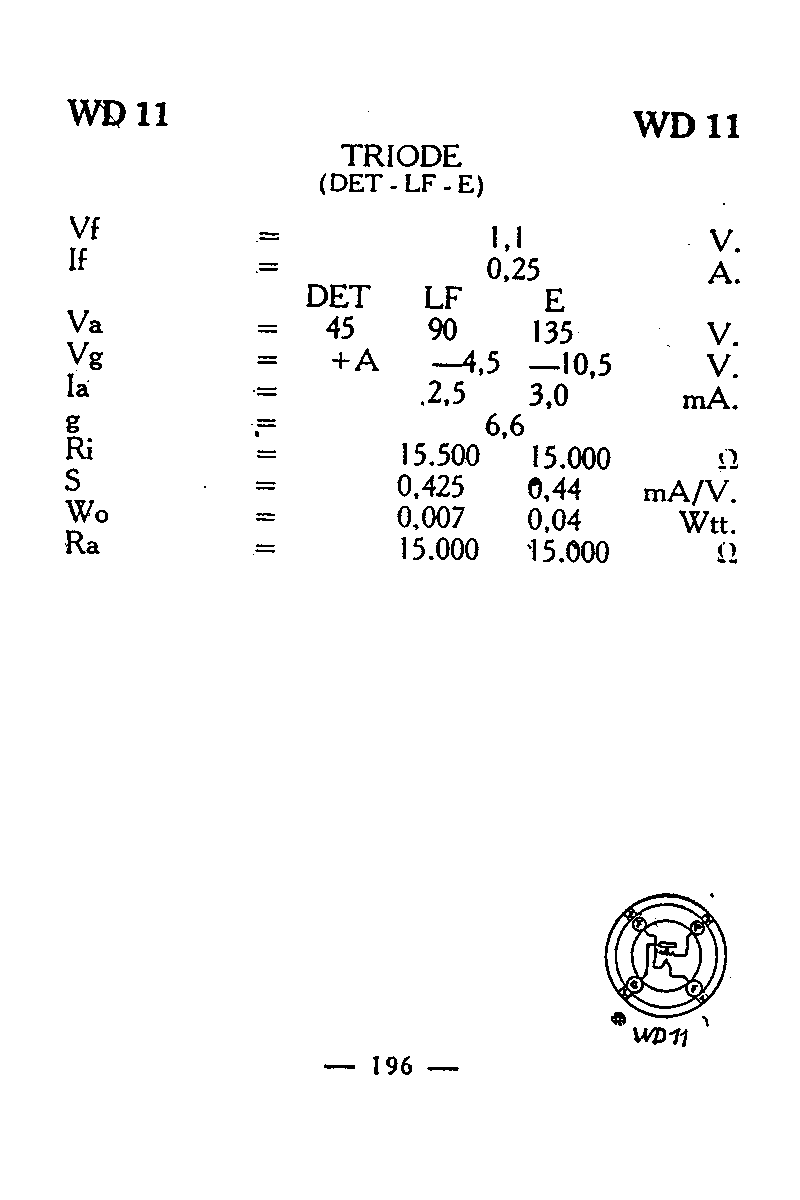
The WD11 and "RCA-11" (and later simply named "11" by RCA and Philips/Miniwatt) have the following characteristics:
| Socket: | EIA/RETMA base diagram: | Description: | Filament: | Plate (anode) voltage: | Grid voltage: | Plate current | Plate resistance: | Amplification Factor (mu): | Transconductance (gm or S): | Power output: (Po): | Grid-plate Capacitance (Cga): | |
|---|---|---|---|---|---|---|---|---|---|---|---|---|
| UV4 (also known as WD-4-Pin) | ||||||||||||
| 4F | ||||||||||||
| Detector Amplifier Triode | ||||||||||||
| Directly heated 1.1 V | 0.25 A | |||||||||||
| 90 V | 135 V maximum | |||||||||||
| −4.5 V | −10.5 V | |||||||||||
| 2.5 mA | 3.0 mA | |||||||||||
| 15.5 kΩ | 15 kΩ | |||||||||||
| 6.6 | 6.6 | |||||||||||
| 0.425 mA/V | 0.44 mA/V | |||||||||||
| 0.007 W | 0.04 W | |||||||||||
| 3.3 pF |
Drawbacks

The design of the WD-11 is somewhat flawed. When the filament burns out, it has a tendency to contact the plate. This feeds high voltages back through the heater circuitry, subsequently burning out the filaments on the remaining tubes.
The WD-11 has a unique 4-pin base layout that was unlike any subsequent UV and UX style tube bases. It had 3 "small" pins and one "large" pin. Later UV based tubes relied on an index pin on the side of the tube base and UX tubes had 2 large and 2 small pins to ensure proper indexing.
It was replaced a year after its introduction by higher performance tubes which were less likely to encounter the filament shorting problem, Westinghouse Electric's WD-12 and General Electric's UX-199. No radios using the WD-11 tube were designed after 1924. RCA ceased production and issued a service bulletin describing how to retrofit existing sets to use the newer UX-199 triodes.
Collectibility
Because of the rarity of the WD-11, it has become one of the most valuable vacuum tubes in the world. New-old-stock tubes have sold for as much as US$180 and used tubes have sold for over $100, more than the original price of the radios that use them. Collectors rarely use these tubes for fear of burning them out.
Substitution
Sets that use the costly WD-11 and UV-199 tubes can be modified to use the inexpensive 1A5/GT octal power pentode by wiring a 5.1 ohm resistor between the pins of the filament and fabricating an octal-to-four pin adaptor. The pin for the 1A5's suppressor is left unconnected and the screen connected to the plate.
The type 12 (also known as RCA-12) is electrically identical to the type 11, but with a more common UX4 base.
References
- (1937). "RCA Receiving Tube Manual RC-13".
- (1940). "RCA Receiving Tube Manual RC-14".
- (1958). ""Miniwatt" Technical Data". The "Miniwatt" Electronics Division of Philips Electrical Industries Pty. Limited, N.S.W..
- "WD 11".
This article was imported from Wikipedia and is available under the Creative Commons Attribution-ShareAlike 4.0 License. Content has been adapted to SurfDoc format. Original contributors can be found on the article history page.
Ask Mako anything about WD-11 — get instant answers, deeper analysis, and related topics.
Research with MakoFree with your Surf account
Create a free account to save articles, ask Mako questions, and organize your research.
Sign up freeThis content may have been generated or modified by AI. CloudSurf Software LLC is not responsible for the accuracy, completeness, or reliability of AI-generated content. Always verify important information from primary sources.
Report